no such thing, it would be delusional to expect anyone to be able to keep up with my constant, poorly organized torrent of words about Homestuck.
Force & Flow is an essay series I released a couple months ago focused heavily on a new understanding of the Classes that I think reflects how they work in Canon much better.
Obviously, I need to update the Destroy and Steal sections with their corresponding myths sometime. Dunno when I’ll get to that.
There’s a couple of offshoot essays focused on particular characters–Jade and Jane in particular, and I’ve done a toooon of writing on Jake and Dirk besides, but that about covers it.
God I need a better way to organize all this stuff and make it accessible >_>;; Sorry for the hassle, anon!
She could be significantly younger–tbh I’m not even clear on A. Claire’s timeline at all–or it could be Hiveswap being a fantasy story and not caring about stuff like menopause, or it could be hiveswap being a fantasy story and having perfectly functional forms of procreation that work regardless of age, like ectobiology.
I’m not sure why anyone is assuming these kids were born without ectobiology, honestly? Like…Pa is the dude who runs skaianet…ectobiology is kind of a big deal w/ this crowd. It’s not an area i’ve found myself wanting to speculate on much, but ectobiology is definitely the likeliest explanation for how they were born, just, statistically
useful context, thanks! pretty much however things shake out with A.Claire and Jake as far as Joey and Jude’s birth goes, i don’t think i’ll be bothered by the execution.
I’m more than a little upset I’m going to have to work these into my Force and Flow essays soon, but I figured I’d write these posts on the Unifying Myths for the Steal and Destroy classes because they’ll help me get my thoughts in order for the Classpect video I’m writing the script for.
(PS: That’ll exist soon! Ideally an easy way to introduce all sorts of newbies to the Classpect system. I’m excited!!)
So let’s talk about the unifying myth for Princes and Bards: That of Royalty. Related terms include aristocracy, nobility, and high blood by association.
I…don’t know why it took me so long to notice this? I guess I got tripped up by the royalty focus on the Fuschias, but I mean, class roleplay is an established thing and the Ancestors, as complex and multifaceted people living in the real world, muddy the water with the multiplicity of symbols they portray all the time.
Also, both Meenah and Feferi explicitly reject their royalty status and abdicate the crown. So. I really don’t know what was stopping me here. Anyhow, let’s get into it.
I think this mostly speaks for itself, honestly? Equius attributes Dave’s habit of destroying things to the training Bro–a Prince–gives him. He suggests it makes him nobler than others, and Dave himself likens himself to a King while carrying out the behavior.
This contextualizes Dave’s habit of destruction during Act 5 as him roleplaying as a Prince, in imitation of Bro. Fittingly given his confused state with regards to his abusive parentage, Dave doesn’t realize that’s what he’s doing or why, but his habit of breaking random stuff is one he mostly drops as he grows out of wanting to imitate Bro on any level (with one notable exception).
If the Royalty classes have a coherent theme, it’s a focus on historical legacy, lines of descent, and inherited destiny. Where other classes draw their interests from fiction, abstract concepts, or their own creative interests, the Royals typically find their biggest interests in the past–that of themselves and of their people. So Dirk and AR both view themselves as scions of Dave’s legacy.
The Makaras are beholden to their Subjugglator bloodline, and the allegiance to Lord English it represents. They don’t seem to believe in the cause of the Mirthful Messiahs so much as simply know the inevitable reality of their success well in advance. And why wouldn’t they, with evidence all around them like Doc Scratch, Lil Cal, and Lord English already wandering the Void?
And while we’re talking about Gamzee, I may as well cover Bard’s link to Royalty. I should note that this is part of a recurring trend with the Classes–one will generally relate to the unifying myth very directly, while the second will come with a host of references and plot beats linking it to the myth indirectly.
So a Witch is a magician by name, while an Heir is revealed as one through the myriad references John gets to wizardry. A Sylph is a kind of fairy by name, but it’s Maids who get described as being “Made of” their Aspect, and so their brand of magic. So on.
In this same respect, while Princes are Royalty manifest by their very name, Bards–though Gamzee–are lifted into the noble circle by implication and continuous reference.
Gamzee’s allegiance to LE results in the cultural dominance of Subjugglators, both on Alternia and on the Alpha Earth. The Mirthful Executives give us the clearest link to Gamzee, since their rise to horrible, aristocratic power is prophecized well in advance, George Washington describing them as “Salty Bards”.
The Amporas seem to have two distinct lines of inherited destiny–one related to their Blood, and one related to their Aspect. Their status as scions of the legacy of the Angels sees them as champions of fantasy, belief, and Hope. It also sets them up as natural rivals to the Makaras, and threats to Lord English.
It’s also likely deliberate to some extent, since it’s suggested that someone close to Lord English talked Cronus out of his relationship with Magic, and Alternia was all but designed to bring out the worst in Eridan’s entitlement complex and arrogance.
Since Caliborn had prior experience with the danger of a Hero of Hope, it makes sense he’d want to neutralize the others by prompting them to believe in something darker to believe in.
Which brings us to the arrogance and entitlement the Royalty classes often struggle with–the part of their natures that seems to constitute their greatest challenge before achieving fulfillment and balance.
The concept of High Birth seems to manifest in a sense of inherent superiority for Princes and Bards, and it’s this belief that tends to destroy their ability to make relationships. Both Makaras and both Amporas harbor these intense, megalomaniacal worldviews.
This, however, is where the best Prince begins to set himself apart. A successful, happy, healthy version of a prince who reaches balance is one who humbles himself, and gets over their sense of arrogant supremacy.
So we can see Dirk as a loose, loose glimpse into what it might look like for Eridan, for example, to chill out after a couple of years–had he gotten the chance. Of course, Dirk was never half as domineering or controlling as Eridan, so this is an unequal comparison, but I think it’s worth noting how their three age difference is meant to influence or readings of the two.
AR/Lil Hal is the version of Dirk that commits most of the abusive/manipulative behavior people usually pin on Alpha Dirk, and fittingly, he’s the one who actually distinguishes himself as Above his friends for most of his narrative.
In AR’s case, he does so on the basis that he is cybernetic and cyber-omniscient, a state he views as superior to being flesh-and-blood, even likening it to an aristocratic position once he’s mixed with Equius.
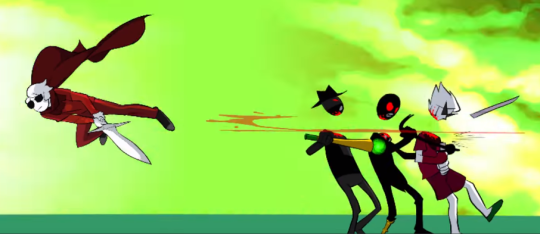
To swing things back around to Dave’s roleplay, there actually is one final act of destruction in his arc. After talking things out with Dirk and coming to see a version of his Bro as someone with the potential to do good, Dave and Dirk engage in what I can only describe as a 2x roleplay combo, with Dirk serving Dave through his Self and Dave killing Dirk to finish off the Jacks.
I like the sense of inverted symmetry here, and it puts into context why Dave’s attack is a positive thing for him–this moment is about Dave accepting that there can be some good in Dirk’s nature, and being willing to incorporate some of Dirk’s influence into his person at an appropriate time.
By embracing Dirk’s affinity for destruction and giving Dirk the chance to put his fate in someone else’s hands, Dirk can find absolution and Dave can find a coherent understanding of his identity, and Bro’s influence on it.
Anyway that’s about it. I’m glad to finally have coherent myths for Princes/Bard and Thief/Rogue, but we know how these classes work mechanically, so it’s not like they revolutionize my whole understanding of the canon. Feel free to send me asks with your thoughts, but for now…
okAY so i was just thinking about homestuck cause im always thinking about homestuck and I think i just figured out the ultimate riddle.
let’s talk about the Choice:
It’s been long accepted that the Choice is largely related to facing your own mortality. Alt!Calliope chose to die, Caliborn chose to be immortal, Roxy and John chose to live, all the trolls chose to fight. but we all forgot one.
davesprite chose to fix the sword instead of himself.
listen. LISTEN.
The Choice isn’t about facing your own mortality, it’s about choosing between being useful and being a good person.
bringing this back because with hiveswap, we now also know pretty much every single ancestor got to be big and important at the price of being a really really shitty parent. or they could lead a simple life and be dead.
Oh yes, I like this quite a bit. More fuel for the fire:
Gamzee choosing to be important over his friends.
This entire exchange from (Vriska) about LE and, by implication, Vriska.
AR being isolated from his friends and incredibly important/powerful, and later Arquis going on about this incredibly specific and important impact he later realizes through the Masterpiece.
There’s also Dirk struggling with his own innate self-worth and morality so much he ends up not really doing much of anything himself. I think that case is interesting because, if you think about it, Dirk is at his most impactful and successful in a healthy way only when his powers are working together with Jake’s.
Which I think suggests something about Homestuck’s logic with regard to how to break out of the two extremes–it’s in working together that we get the best of both worlds and all that. Makes me hope the content we start getting through Viz really starts exploring the implications of fraymotifs and what characters are capable of together, to be honest.
She could be significantly younger–tbh I’m not even clear on A. Claire’s timeline at all–or it could be Hiveswap being a fantasy story and not caring about stuff like menopause, or it could be hiveswap being a fantasy story and having perfectly functional forms of procreation that work regardless of age, like ectobiology.
I’m not sure why anyone is assuming these kids were born without ectobiology, honestly? Like…Pa is the dude who runs skaianet…ectobiology is kind of a big deal w/ this crowd. It’s not an area i’ve found myself wanting to speculate on much, but ectobiology is definitely the likeliest explanation for how they were born, just, statistically
[2]Then wouldnt it follow that princes/bards and sylphs/maids would switch places with the heirs/witches and mages/seers
Hrmmm, I see what you’re saying. I was going off this quote from Calliope:
Along with the distinction of Lords as “Most Active” and Muse as “Most Passive”.
My logic was that the more intensely Active/Passive classes had more dramatic impacts on their sessions, while the less Active/Passive classes were more versatile and able to switch back and forth from Active to Passive easier, making them more flexible.
The Master Classes, then, have the best of both worlds–they can have incredibly high impacts like the far-end classes, but they can also reap the benefits of both Exploiting and Allowing their aspect as necessary like the closer ones.
But that may be inaccurate. I think we’re getting closer, but I’m not sure we’ve “figured out” all the nuances of the Active/Passive scale. There’s a couple things that are still puzzling me, and questions like this one shaking or playing with the model are definitely helpful for helping us figure things out.
I don’t necessarily have any thoughts on this right now except that I’d like to hear how you account for Princes being positioned close to Lords in the scale. I don’t think you’re necessarily wrong, I feel like I’m missing stuff in my model. I’m just not 100% sure how to square this with the evidence we’ve got in canon.
Any thoughts?
If Lord being a very active class places them on the far side of the scale, then Witch (which Hussie says is “said to be a highly active class”) should also be towards the active end of the scale instead of the middle?
hrrrrm, yeah. My logic I wish I could find something in the text that helped us at least figure out how the structure works :[ I think we’re starting to understand what the spectrum means, but I’m not even sure that class pairs would be placed on it symmetrically.
All I can figure is that Witches are said to be highly active in context with all of the classes, including Passive ones? My mindset being that If they’re as active as, say, Princes, then I have to wonder why they don’t seem to struggle QUITE so dramatically when they’re in a Passive state, and why they seem to have an easier time switching back and forth.
It’s quite possible my train of thought wrt how to understand the classes in this regard is completely off, but I’d like to see alternate interpretations for how to understand the classes more holistically to counter the view, if that makes sense.
Hmm ok. Unfortunately holistic doesn’t come very naturally to me, as I’m more of a bottom-up (vs top-down) kinda thinker and I prefer to throw details at each other in the hopes that some conclusion will fall out eventually, maybe after a few years or so. Unifying myths or some other overarching key idea that Hussie included to clue us into the system is not an assumption I’m willing to throw into that mix so readily.
So here I am again, back to niggling at those details. Specifically, you mentioned classes at either ends of the active/passive scale have the worst and the most unhealthy difficulty if/when they attempt to swap to the other side, and you’ve defined the destroy/create classes as the very ends of the scale. But Dirk’s swap to a passive Knight doesn’t seem to be a bad thing for him, by your analysis? It demonstrates Dirk’s deep love for Jake and his friends, or something like that, and he even gets immortalized in Grandpa’s memories as a knight.
Additionally, I’d like to suggest that destroy/create are the classes who actually swap with each other as a matter of course, since destroying an aspect creates its opposite and vice versa. (This is again by your theory, according to that post a while ago where I argued that destroying Hope doesn’t automatically create Rage or vice versa? Although I don’t know if that’s a theory you still hold.)
Obviously there’s a lot of fine tuning required, but if you’re looking to shake up your class scale then this might be somewhere to start?
All kinds of thinking are useful to understanding Homestuck, imo! I hope I didn’t come off as talking down or anything, i was just trying to explain how I typically think about this stuff.
Yeah, I regard Dirk as a unique exception to the general trend of Roleplay Being Bad For You. The main thing that enables this is that Pages naturally invite Knight-like behavior in other classes, and Jake is a Hope player, which enables some good old powergamer cheating, of the sort that successful Sburb players often use.
AR would actually be a pretty good example of unhealthy roleplay. Like Dirk, he ends up roleplaying permanently, but his Knight imagery is decidedly darker: after his heroic sacrifice to save the alphas and stop Caliborn, he spends like, an eternity as LE’s personal Butler, serving for LE’s benefit for like, forever.
Which sucks and I hope AR is revived or something but, you know. It fits the mold.
As for that theory, I think you kind of swayed me back then? In that lately I think it’s more flexible. Like for example AR destroys Heart by getting Dirk to kill himself, but that doesn’t really result in the creation of Mind?
But I will admit I’m pretty tired and might be misunderstanding you. To be clear, you’re suggesting that a Prince of Heart will typically tend to act like a Sylph of Mind, and vice versa, simply due to the inverse meanings of their verbs?
[2]Then wouldnt it follow that princes/bards and sylphs/maids would switch places with the heirs/witches and mages/seers
Hrmmm, I see what you’re saying. I was going off this quote from Calliope:
Along with the distinction of Lords as “Most Active” and Muse as “Most Passive”.
My logic was that the more intensely Active/Passive classes had more dramatic impacts on their sessions, while the less Active/Passive classes were more versatile and able to switch back and forth from Active to Passive easier, making them more flexible.
The Master Classes, then, have the best of both worlds–they can have incredibly high impacts like the far-end classes, but they can also reap the benefits of both Exploiting and Allowing their aspect as necessary like the closer ones.
But that may be inaccurate. I think we’re getting closer, but I’m not sure we’ve “figured out” all the nuances of the Active/Passive scale. There’s a couple things that are still puzzling me, and questions like this one shaking or playing with the model are definitely helpful for helping us figure things out.
I don’t necessarily have any thoughts on this right now except that I’d like to hear how you account for Princes being positioned close to Lords in the scale. I don’t think you’re necessarily wrong, I feel like I’m missing stuff in my model. I’m just not 100% sure how to square this with the evidence we’ve got in canon.
Any thoughts?
So,this is my current version of the active passive scale.
My theory is that the further a class is positioned horizontally,the more direct control over their aspect they have,and the less likely they are to act in a more passive or active manner,and if they do it usually doesn’t go very well.The further vertically positioned a class is,the less direct control over their aspect they have,and the more likely they are to act in more active or passive manners successfully.So Princes and Bards are very active,just not the same way that lords are,and vice versa for Sylphs and Bards.
hmmm. I like this setup in theory, I think? I guess my main issue is that I don’t see how it’s provable or referenceable in Homestuck’s canon, and if we can’t pin down what Homestuck thinks it means for a class to be (-1) as opposed to (-2), then the whole setup becomes too abstract and theoretical to easily explain to a layperson.
Do you have any thoughts on how Homestuck would transmit these distinctions through its storytelling?
I mainly based this off of princes/bards and maids/sylphs having such extreme relations with their aspects as create and destroy,whereas muses and lords seem to have very little direct control over their aspects.For example,John an heir has basically no clue what to do with his wind powers until Vriska(i think?) tells him to get creative,and even then John’s use of his powers seem very basic,he can make wind,and that’s all he ever really does with it until he starts using his powers as makeshift teleportation,and even that’s after spending three years messing around on the ship. Eridan,a prince,on the other hand uses his hope powers to devastating effect without even going god tier,all he needed was a white stick and some convincing and he just went to town immediately.
I just had a realization that that this ties into the unifying myth theory pretty well actually.Princes/Bards (royalty) and Sylphs/Maids(fairies) are obviousy going to be in tune with their aspect much more readily,being made of it,and being raised by it.Whereas Witches/Heirs(wizards) and Seers/Mages (prophets),are very obviously going to have a bit of trial and error when it comes down to figuring out how to use their aspect,because theyre whole shtick is that they learn how to use it instead of being granted its power.I feel like the dichotomy between sorcerers and wizards applies well here,sorcerers just know magic intrinsically,while wizards have to learn about their magic through study.Im not sure what to say about Thiefs/Rogues(outlaws) and Knights/Pages(warriors/butlers) at the moment other than that they occupy a very nice and comfortable middle ground.
hmmmm, interesting! I will keep this in mind for now, for sure. I think there’s something to be said for Thief/Rogues and Knights/Pages common descriptions of “Weaponizing” their Aspects, but I’m not really sure how to tie these things together right now.
The hemospectrum as a biological thing is just part of how trolls are born, but Beforus doesn’t commit genocide and enforce slavery based on it. It has its problems as a society, but Alternia is a whole other ballpark of evil. And that has a lot to do with the hemospectrum as a violent, oppressive ideology, which is not really in Beforus to the same degree. That system is what I attribute to LE.
Also my view at this point is that Lord English is basically the God of all four worlds, with differing amounts of influence in each one of them–the least amount of influence in Beforus, the most amount of influence on Alternia. We don’t have a skull monster, but we do have systems of oppression, misinformation, and exploitative power, and Lord English is a villain that operates primarily through those abstract forces. That’s why I think Homestuck is such an important narrative–it presents the casting off of those toxic ideologies as inherently heroic, and necessary for both happiness and peace.
The hemospectrum as a biological thing is just part of how trolls are born, but Beforus doesn’t commit genocide and enforce slavery based on it. It has its problems as a society, but Alternia is a whole other ballpark of evil.
Yes, I addressed that. There’s a big difference between a mostly peaceful society working with a rigid social structure that can be shitty at enabling free expression, and an interstellar fascist empire that routinely commits genocide on its own species.
I don’t think it makes sense to regard Beforus’ problems as equivalent to Alternia’s, and Alternia being so much worse has Lord English and Doc Scratch’s influence as an established, canonical explanation. I’m just fleshing out the nuances here.
Ok but Beforus still had a system where people were privileged or oppressed based on the color of their blood, and I’m not sure if we can really be certain they never had slavery, either.
If the caste system were paradoxically originated from English’s components then it wouldn’t exist on Beforus, unless Lord English had a major influence there, and we know he didn’t because if he did then it would be just as bad as alternia
Ok, two things:
1) To the extent that Beforus HAD oppression, it was pinned on the purple cast that is strongly associated with LE. So I think it’s likely it had a degree of influence from him, just not a full-scale dominion like on Alternia–something more on par with the Condesce and Lil Cal’s influences on Beta Earth, more likely.
But 2) My point is that Beforus and Alternia, insofar as they exist in the modern states they are currently in, have different relationships to the hemospectrum.
Beforians had to deal with differing responsibilities and maybe some coddling and enforced roles based on their blood. Alternians had to deal with genocide, slavery, all manner of systemic and personal brutality, distrust, judgment, and cruelty. It’s like…a fundamentally different dynamic, and Alternia is demonstrably and explicitly far worse.
Lord English is the canonical cause of that difference. He’s why Alternia is explicitly worse. I don’t see how it’s a stretch to say that he’s responsible for the harsher penalties and views on the Hemospectrum when he’s already canonically responsible for…everything else wrong with Alternia?
At no point have I argued that the actual physical differences in trolls are a result of LE. Whether they are or not is besides the point–the decisions Beforus and Alternia make as societies regarding what to do about those differences is what matters, and one society makes demonstrably better choices than the other.
The hemospectrum as a biological thing is just part of how trolls are born, but Beforus doesn’t commit genocide and enforce slavery based on it. It has its problems as a society, but Alternia is a whole other ballpark of evil. And that has a lot to do with the hemospectrum as a violent, oppressive ideology, which is not really in Beforus to the same degree. That system is what I attribute to LE.
Also my view at this point is that Lord English is basically the God of all four worlds, with differing amounts of influence in each one of them–the least amount of influence in Beforus, the most amount of influence on Alternia. We don’t have a skull monster, but we do have systems of oppression, misinformation, and exploitative power, and Lord English is a villain that operates primarily through those abstract forces. That’s why I think Homestuck is such an important narrative–it presents the casting off of those toxic ideologies as inherently heroic, and necessary for both happiness and peace.
The hemospectrum as a biological thing is just part of how trolls are born, but Beforus doesn’t commit genocide and enforce slavery based on it. It has its problems as a society, but Alternia is a whole other ballpark of evil.
Yes, I addressed that. There’s a big difference between a mostly peaceful society working with a rigid social structure that can be shitty at enabling free expression, and an interstellar fascist empire that routinely commits genocide on its own species.
I don’t think it makes sense to regard Beforus’ problems as equivalent to Alternia’s, and Alternia being so much worse has Lord English and Doc Scratch’s influence as an established, canonical explanation. I’m just fleshing out the nuances here.




 Flying through Storytelling