I’m glad I could help. I always try to keep in mind that Cynicism isn’t just easy to pull off, but also pretty damn fashionable, especially of late. It doesn’t really guarantee anyone is right about anything. With Homestuck and What Pumpkin, our only consistent knowledge is that we don’t know anything about what comes next. All of this is unprecedented, and anyone presuming to do more than guess at what’s coming is frankly doing a lot of posturing, especially when they run counter to the words Hussie himself has said.
Yeah, I don’t have any doubt about it and I think it’s really, really weird and annoying that the regular fandom line has sort of turned into this self-assured, smug skepticism about it. It makes literally no sense to me.
There are like, three plot lines all set to converge on The Masterpiece and the clash between Vriska and LE in the Void–Terezi finding Vriska, the fates of the Alpha and Beta kids, and the ghosts in the Void. Hussie already literally said there’d be an epilogue, and delays aside, he’s never said something was going to happen in Homestuck and then not delivered at all.
There’s no real reason to doubt the epilogues existence, and from my vantage point it’s honestly the likeliest thing delaying Hiveswap at this point, since he said himself he’d withhold releasing the game until this “other project” was ready as well. And since Hiveswap itself looks excellent and is already fleshing out Homestuck’s lore, I just don’t have a reason to doubt the quality of either the game or whatever the hell the epilogue will be.
I’m glad you liked it! As for the Alphas’ cruxite item–the Caliborn piñata– I do think there’s some interesting subtext to it, but I also feel it’s pretty obvious, so I’m not sure I’ll be adding much that people don’t already know.
I feel like there’ll be more explicit stuff to say after the Epilogue, but basically, the cruxite artifacts seem to imply something of the impact on reality each character has. Jade gets Bec’s pinata, and choosing to kill Bec pretty much grants her absurd levels of power.
Dave’s impact comes by accepting the direction of others and playing ball with their suggestions as well as with the passage of Time. Rose’s destruction of the bottle symbolizes how she smashes her Sburb session in search of truth.
The Alphas don’t get distinct items, but only the one they all take on together–the Caliborn pinata. And so, they are relatively fruitless and unimpactful for most of the narrative.
Their biggest contribution to the story is unarguably killing Caliborn and turning him into Lord English, and so serving as the “Alpha” to his existence as a Yaldabaoth.
That’s foreshadowed as early as their entry. I think there’s more to say there, but I don’t like to speculate, so I’ll just say I won’t be surprised if we see that event again whenever the epilogue happens.
Part #1: Flight of the Movie & Anime References
This section is pretty much setup for the next three essays. There’s a couple sections here that I have a fair bit to say about, but probably just as many where I’ll close out with some minor observations, or reference to someone else’s Good Post™.
What I think is important is noting the consistency and similarity with which Homestuck engages in meaningful reference. I just want you to have this list in mind as I flesh out the three truly impactful references I want to talk about in this series.
So here’s a short list of cases where Homestuck outright leans on other stories to structure itself, with accompanying references:
1) The Game Over Arc – Plot Structure & Dragon Ball Z
We’re starting with Dragon Ball Z because the references here are relatively simple and straightforward, and they largely set up either pretty clear structural parallels, rather than thematic ones.
The clearest of these examples is the section of the story that begins with the joke Arquius makes above. In case you don’t know, the “over 9000″ meme has its roots in this iconic, hilarious sequence from DBZ:
What’s notable is what follows. From the moment this joke happens, the very structure of Homestuck changes to following the loose structure of some of the most memorable DBZ arcs.
I’m no buff on the series, but the memories it calls up for me most strongly resemble the Namek/Freeza or Buu arcs, and expert DBZ consultant @alotofmomos (who hates me for writing this) confirms these are the arcs that most perform the particular structure Homestuck will now be mimicking.
And what does that structure consist of? A particular mix of “pacing” choices, cinematography, and sheer scale of spectacle that I find hard to source to anything but DBZ. I can’t even think of other Shonen series that mix all these elements in quite the same way, though again, I’m no expert.
Some of these elements are:
A) Drawn out, massive power-up sequences:
B) Conflicts that carry out on planetary scales, and indeed often destroy the planets hosting them.
This pretty much speaks for itself, doesn’t it? Do I really have to say some stuff to make it look like I’m doing anything other than pointing out some obvious goddamn parallels that blew my mind because they took me years to notice?
Alright, fine. I’ll say this much: I think it’s quite fitting that Homestuck would borrow from the DBZ playbook for the section of the story that illustrates the sheer mind-boggling scale of power our protagonists have reached.
There’s very few stories out there that demonstrate this sense of mortals achieving such bonkers dominion over reality through sheer force of will, and the homage certainly hammers home the idea that these kids are Gods with levels of power we’ve barely scratched the surface of.
But I don’t think there’s a big Narrative Payoff to this particular reference. Instead, I think what Homestuck takes from this is functional in terms of narrative. Because the most interesting things this narrative model adopts are structural.
C) Convenient plot-structure.
Namely, what we end up with is a bunch of characters grouped into disparate conflicts across the same larger “playing field”, separated by considerable amounts of distance–and thus, isolating them into distinct narratives.
As a natural consequence of this, the pacing slows down to an excruciatingly slowness, as we cut from conflict to conflict, each one progressing in small snippets of minutes or even seconds at a time. All of this is par for the course for Dragon Ball Z, particularly in the Namek saga.
So what this provides us with isn’t a profound, revelatory moment of thematic meaning–but instead, an effective backdrop on which to flesh out that meaning elsewhere. In fact, this very arc does that like twice with two other stories!
So let’s move on from this and take a look at a couple of character arcs whose resolutions are telegraphed by way of reference.
The bottom line is: Terezi janks Jade’s shoes, and adopts the role of Dorothy in Homestuck’s symbol logic. This leads her home–to Vriska and their memories of growing up together, and ultimately to embracing her red feelings for her.
Terezi’s resolution is one of two relationships resolved in the wake of [S] Game Over. Let’s take a look at the other.
3) Jake as Buttercup
Don’t have much to say about this one either, cause I already wrote most of it. I will say I don’t think it’s an accident that the arcs to coincide here are Dirkjake’s and Vrisrezi’s, since the two relationships are in many ways direct parallels. But that’s another essay for another time.
I have received some rightful criticism on my writing on Jake in particular, and this is a good place to clarify my position, however. I do not think it’s particularly “Good” or “Healthy” for Jake to indulge his own desires at the expense of Dirk’s (or Jane’s) feelings.
My point has never been that Jake’s selfish behavior is inherently good–merely that Jake’s reasons for being in love with Dirk are his own, and not imposed to him from Dirk himself, or anyone around him.
As with all things in Homestuck, the key is for Jake to grapple with the negatives in himself and come to balance with the tension between his own wants and his relationships with others. This is true of literally everyone in Homestuck.
And there’s an easier way of saying what I am getting at. Because Homestuck literally gives us a guidebook to understanding Jake and Dirk’s relationships to each other, as parsed in Jake’s head–a guidebook that provides context to their entire relationship.
Just as you can read Terezi as Dorothy, so too can you read Jake as Buttercup. This is the crucial distinction I seek to make. In common readings of Dirk and Jake’s relationship, Jake acquiesces to Dirk’s pushy forcing of the relationship despite Dirk’s control issues.
In this one, Dirk is a flawed but committed provider and protector, and Jake picks up on and begins internalize a belief that Dirk will always be there for him, prompting him to fall for him. This reflects the fundamental core of their attraction to each other. It does not present a solution to their communication issues. They both have to work through that and be more aware of each other’s needs.
Now, The Princess Bride is a comedy action-adventure movie, but it’s also a philosophical fairy tale. Buttercup and Westley aren’t just in love, they’re in True Love, and the driving force of the movie is how Westley’s love empowers him to do anything it takes for his beloved.
A big part of her journey is learning to truly commit to not just Westley’s love for her, but her belief in that love as something both true and powerful. Something that can transcend all odds and obstacles.
Which is. You know. Exactly what Jake does when he’s fully immersed in the power of his own faith.
Now let’s move on, and note two more movie references that the comic makes outside of the context of this DBZ-mini arc.
4) Tavros as Peter Pan
There’s not a terrible amount of depth to be drawn here, either. I think most people accept that Tavros is deliberately invoking Peter Pan in his narrative victory here, with the ghosts as his Lost Boys. I will add, however, that if Peter Pan is the role Tavros is emulating in reaching his full potential, well…
Peter Pan isn’t exactly known for being Selfless, is he? He’s a hero, for sure, but self-centeredness is pretty much his calling card as a hero. To the point that Wikipedia claims that
“In the play and book, Peter symbolizes the selfishness of childhood, and is portrayed as being forgetful and self-centered.”
Understanding Caliborn as a Yaldabaoth is one way to contextualize his power over the reality all the characters preside over, and we’ll definitely touch on that further in the next three sections I’ll be covering.
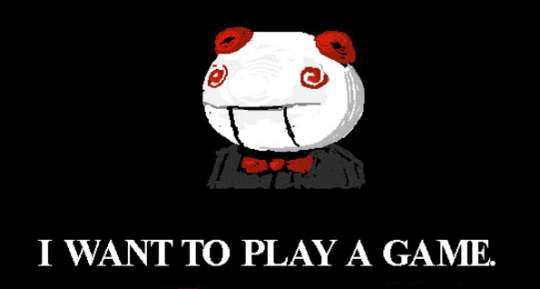
But one easy way to contextualize Lord English’s power is as…well…Jigsaw.
Like Jigsaw, Lord English builds a massive, highly controlled gauntlet that he exploits and terrorizes his victims through. The only difference is that Lord English’s dungeon is bigger than some creepy gray cellar.
It is in fact, Literally Everything that occurs within the context of the Alpha Timeline. Every homeworld that every character originates from–except for, arguably, Beforus, which is still under his sway enough to be doomed, but also presented as borderline Eden-like by comparison to Alternia.
While Yaldabaoth’s control seems very distant and abstract, Jigsaw’s is crystal clear and vicious. Everything the characters of SAW suffer is, ultimately, in the hands of the orchestrator of their misery. Their puppetmaster, so to speak.
In the same sense, pretty much every single way the characters in Homestuck suffer has Lord English at the root of it–even the thing they do to themselves and each other as a result of cultural memes.
Troll Violence, heteronormativity, quadrant normativity, and hypermasculinity–all are memetic structures that exist because Lord English himself disseminated them, in the context of Homestuck. They’re thought-traps rather than literal physical torture devices, but they’re torture tools all the same.
And you can even see Jigsaw as a symbol for Lord English’s influence, since it is, after all, one of the primary differences setting apart Bro and Dirk. Dirk has no interest in the SAW franchise at all, whereas Bro makes a point of mocking Dave with it. (thanks to @jadedresearcher for pointing this out, by the way!)
So yeah. Not only does SAW tell us a lot about the nature of Caliborn’s effect on our characters through the Alpha Timeline, it also acts as a mark for his influence. That’s…pretty much all there is to say on the matter.
For now.
That wraps up this little introductory round-up. Now I can get to talking about three of the biggest influences on Homestuck as a story: The Neverending Story (the book), Earthbound & Mother 3, and Gnostic Myth. Hope you’ll follow along with us over the next couple of weeks to find out more.
1) I think Lords and Muses are “real” classes insofar as any of the classes are “real”, which is to say: created by the players, as opposed to by the game.
That paper describes Abraxas as the ultimate, invisible God
that unites all opposites into one being, as well as the Lord of frogs and
amphibians (puts a whole new spin on consorts and BSlick, not even to mention
Jake’s consort kingdom, huh?). I also think the most obvious analog for Aeons
are actually the Aspects themselves–it’s important that the world of the
Pleroma is also the world of Ideas, and that Yaldabaoth is a “blind”
god because it cannot perceive the Ideas that created it.
The Ideas angle also
links into the Ur-Self stuff you talked about with Davepeta. I think Hussie
covered that pretty thoroughly, because the Ur-Self is just another branch of a
topic Hussie already covers from Act 1: Platonic Realism, and the expression of
the pure realm of Ideas in the world of Material reality. My next two videos
are covering the links between Gnosticism and Greek theory of Platonic Realism,
but in the meantime Tex Talks’ alchemy stuff breaks the latter down v well.
Oh, also notable is
that Yaldabaoth is described as having created “seven heavens” in the
sky–lending additional weights to the Seven Gates leading to Skaia, as the
characters must Ascend the gates much as humans must Ascend to the Heavens to
reach Pleroma 😉 And you are indeed correct that Skaia is the metaphysical
manifestation of Pleroma–hence why it acts as the Sessions’ Sun. It also gives
off Light, but Skaia’s Light is more focused on Ideas.
At last I finally have a chance to post your very helpful
correction! Sorry it took so dang long! XD
Yeah, I was totally wrong on Abraxas when I said he was Sophia’s
counterpart Aeon. I think I must have decided that because 1) it seems weird to
me that we wouldn’t know the name of that Aeon, but mythological systems are
weird and arbitrary like that I guess 2) I misread one of my sources, which referred
to Abraxas as “in Pleroma with Sophia,” which is still technically true, but as
it turns out, true in a more general way. I’ve corrected the original post. Won’t stop
old reblogs of it from going out, but ah, that’s the nature of the tumblr beast.
I’ll have to look into Jung’s take, but I’m intrigued. I
think Abraxas predates Jung, existing in earlier Gnostic systems (but not all
of them) and I think he does start as a separate god originally. But I LOVE
that he’s associated with amphibians! That’s fantastic. That really ties him closely
into the system of Sburb, even more than I originally thought, and suggests
that Hope is somehow tied to the unlimited creative potential of Skaia.
Also, I was looking into Abraxas, and as far as I can tell
he seems to have been a Hellenistic-Roman god of curses and power, of a type
that was pretty common in that period of history—gods whose long, bizarre names
were written on papyri and stones to summon the god’s magic power, frequently
as a curse to bring down your enemies. Variations on Abraxas’s name were
common, and in fact (I made sure I double-checked this this time, ha!) this
does appear to be where we get the word ABRACADABRA, from tablets and similar
riffing on ABRAXAS. Or Abraxas is a riff on ABRACADABRA and similar bizarre
power-god names. Which is fascinating in its own right, but on top of that, it
occurred to me…
Writing ABRAXAS like this might look something like:
And oh my god Jake is closely associated with Abraxas as his
denizen and Roxy even wonders on that page if he was writing ABRACADABRA and this just ties
Jake and the mysteries of the Hope aspect even more closely into Gnosticism,
and fuck, Homestuck really is the gift that keeps on giving, isn’t it? Fucking
love it.
You’re right, Homestuck has always engaged pretty closely
with the platonic/archetypal nature of its entities, all the way from Act 1
onward! Thanks for pointing that out. It’s interesting to see how it becomes
more explicit (and more focused on characters) later on, but it’s so satisfying
to notice how the seeds were already there. I like the Platonist Forms connection
lots of folks have made; I’ll admit Platonism isn’t my area of expertise,
though. I tend to approach this much more from a Lit Crit/ Structuralist theory
of ideas. But it kind of comes to the same result, doesn’t it? Structuralist concepts
and Platonism get along pretty well, the only difference is that one’s encoded in
language and one in the universe. Given that Homestuck’s a linguistic-narrative
structure that represents a cosmic structure, it’s a pretty fantastic marriage!
Seven Gates / Seven Heavens is another SWEET CATCH, thanks! Sevens
are a pretty classic magical number, but they don’t appear super often
Homestuck outside the acts and the gates, do they? Curious. Very curious.
Another echo of Narrative as Cosmos, Story as Gnosticism? From what I gather
the archetypal power of sevens historically comes from the seven visible
heavenly bodies, (the sun and moon plus the five visible planets), and that’s
probably pretty closely tied to the Gnostic idea of Seven Heavens. Which all
ties in very nicely with the planetary and cosmic structure of Sburb. Excellent
stuff.
Thanks so much for writing in! I always look forward to
hearing your ideas. 😀
I can’t believe I missed this until just now when I needed to dig up your post on the Gnostic stuff and LE as Yaldabaoth, but all of this is great and i need to save it now, thanks
ah yes, dirkbgjake, or as i like to call it, dirkBig Goodjake
[Note: This one’s a doozy! Still kind of off-the-cuff, in
that I tried not to stress out about getting everything perfect, but I did do
some revision to make my ideas more clear. That’ll probably be the norm from
here on out. Hope you’re in the mood for a long read and a wild ride!
…Seriously, this shit is like twenty pages in Word.]
In my previous posts, I’ve discussed a number of ideas
present in Act 6 and Act 7 Homestuck that I think contribute powerfully to the
ending of Homestuck, especially on a thematic level.
I’ve also discussed Homestuck, especially Act 6 Homestuck,
as a Gnostic work, the story of an escape from a cosmic tyrant, a Demiurge
whose ultimate weakness is that he cannot see the limitations of the domain
he’s been given. In the same post, I discussed how this realm of the Demiurge,
Lord English’s domain, is constantly paralleled with the space embodied by
Homestuck itself, and how the kid’s departure from the story evokes their
escape from this tyrant’s space-time domain as it reaches the end set for it by
Paradox Space. From the system of Lord English, Homestuck asks, how do we
escape? And at the same time, in the system of narrative called Homestuck, how
do we find meaning within its limitations, and how do we escape them?
These themes work together. As we’ve seen, they echo and reinforce each
other, provide parallels and points of contrast. In fact, I’d argue that each
of these different themes are diverse manifestations of one larger theme, in the
same way that individual selves in Homestuck can be thought of as
manifestations of one larger Self. This overarching theme is present throughout
Homestuck, but it reaches its culmination in Act 6 and 7, in a finale that
drives it home in a different ways. To understand Homestuck is to understand
this theme.
If someone were to ask me, “What is Homestuck about?” this
would be my answer:
Homestuck is an
exploration of the tension between abstract, impersonal systems and individual,
personal experiences of those systems.
Abstract, impersonal systems are everywhere in Homestuck,
systems that don’t always align with the desires, emotions, and goals of the
main characters. The central question of Homestuck is how these characters will
choose to understand the systems that govern their lives, and how they will carve
out meaningful lives in relation to those systems. Gnosticism, metafiction,
divided identities, and Sburb itself all play into this theme. As Homestuck’s
characters decide how to live their lives within these many interconnected systems,
they suggest possibilities for our own lives, for we readers also live in a
world that also contains many systems and forces outside of our control. In
their choices, we find opportunities and implications for how we should live.
You’ll notice I said there’s a tension, rather than an opposition,
between individual experience and abstract systems. I think that gets closer to
the truth of what Homestuck is trying to say. Characters in Homestuck sometimes
reject its systems altogether, but just as often they exploit them or find
identities for themselves within the constraints/opportunities of those
systems. While Caliborn’s Gnostic-style
domain of control is presented in a negative light, as something worth opposing
and escaping, other systems, like Sburb itself, are presented in a much more
ambiguous light, challenging us to decide how we feel about those systems and
the possibilities they present within their rules.
I’ve talked about several of these systems in my previous
posts, but today I want to talk about one I haven’t yet dug into in detail.
Narrative itself.
Narrative in Homestuck, the power a story holds over its
characters, is another system which the characters of Homestuck are constantly
fighting, exploiting, and embracing.
Because another word for those abstract systems in Homestuck
is…
This is honestly like the best writing on Homestuck’s themes I’ve read since, like, basically @sam-keeper ‘s stuff?
God I’m so glad this exists. God I hope we’re able to like, as a community uncovering these themes, like…make them accessible to people more. this stuff is so cool but also it’s so…important, to me? as a person? god
i’m emotional and crying and really pensive, just, just please read this ok? Read this and also everything on Homestuck sam ever wrote cause she was here like back in 2012 and we’re all more or less catching up.




 Flying through Storytelling