most people are pretty familiar with the basics so honestly if you struggle with the episodic nature and the 100+ episodes (perf reasonable) i’d say just watch season 3 because thats the best season
if you really like it season 5 is a great follow up, too. all the seasons are great imo but those two contextualize the sailor moon universe best imo so theyre the most impactful for me
“Resigned to the fact that there’s no hope and all thats left in his life is exploitative labor until death” is not the same as “genuinely interested”.
He’s trying to learn about being a butler because the alternative is being murdered even faster. There is no consent from Xefros in this situation, he’s merely complying with that Alternia demands of him on pain of death. It matters that Xefros doesn’t like it, and it matters that not wanting to do it but being forced to leaves him feeling drained and miserable.
That’s why I view the role of the Knight-a mechanical metaphor for his role as a Butler-as a corrupting influence that will likely be discarded as Xefros finds his true self. I 100% guarantee you there’s no scenario where Hiveswap will suggest that Xefros lying down and embracing the role of Alternian butler is a good thing.
The music link was initially Dammek’s idea, yes, but in contrast to the Butler motif it is actually possible for Xefros to choose to embrace it in a healthier way, now that he’s free. So it might turn out to be an interest he develops on his own terms together with Joey–the wish granting implications of the cherub portal suggest that performance is in Joey’s future, after all.
Not enough of the fandom is interested in how Classpects may play into Hiveswap, I think. We’ve gotten lots of hints at the player’s potential Classpects, but there’s a lot of skepticism as to whether Classpects will even show up at all, given that the game doesn’t center around Sburb.
I’m here to argue that they’ll definitely feature in some way. And luckily for all of us, whether or not I’m right here will be incredibly easy to prove!
Our case study will be Xefros Tritoh. But before I explain how we’ll scrutinize Xefros to determine whether or not I’m full of shit, I’ll need to talk about three things:
In Homestuck, when characters are particularly inspired by or moved to imitate rolemodels, that tends to show up in their mechanical behavior as Heroes. What’s more, such acts of imitation tend to come with references to the specific Mythological Archetypes that inform the Class of the Role-Model figure.
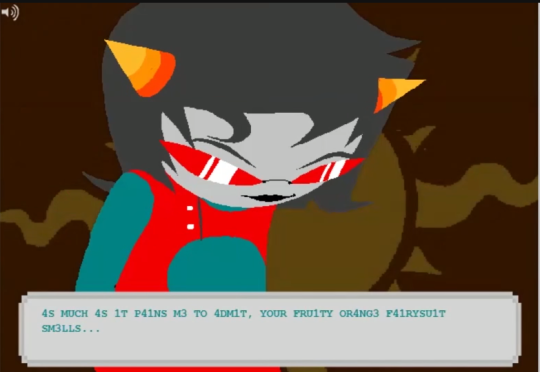
The Troll Ancestors are essentially our introduction to this concept, and there is no clearer example than Vriska. For all of Act 5, Vriska strives to emulate Mindfang in all things–and at the same time, Vriska is consistently depicted and referenced as a Fairy. You can see one such reference above.
@revolutionaryduelist But Xefros isn’t “interested” in being a butler. He repeatedly makes statements proving he’s being forced into it and hates it – he daydreams about smashing his practice silverware to bits, complains about how it’s left him without enough time to do the sports he really wants to do, and says that he sucks at cooking and the cleaning equipment depresses him. Does that imply he’s something other than a serving class and is roleplaying at being one because of societal pressure?
I expanded on this subject in my Xefros Tritoh video:
Tl;dr the role of a Butler seems to correspond with “One who serves for others”, specifically, meaning Butler roleplay parses as Knight roleplay.
Page is also a Serve class, but they seem to parse as “One who invites service for themselves”. As such, they tend to find themselves surrounded by Butlers/Knights/Helpers/Servants, rather than playing the role themselves.
Xefros echoes a desire similar to this when he mentions he only really feels like himself playing Arena stickball, where he mentions being “defended by his brawler.”
If Xefros had a different True Class, I’d expect to see its archetype and verb referenced somewhere in his text-he’s got some loose Destroy mentions, but he doesn’t generally commit to them, and there are no mentions of Royalty or aristocracy as far as I can tell.
Haven’t found any references to the outlaw, prophet, magician, or fairy archetypes in his text, either. That said there’s a handy compilation of all of Hiveswap’s descriptions here, thanks to @everythinghiveswap :
so feel free to look through the text yourselves. its entirely possible i’ve missed stuff, just as its possible new symbolism will be introduced in later acts.
See, maybe it’s the big sister in me, because I’ve never understood this particular complaint. The fact is, Dipper loves Mabel so much that her happiness is his own; his actions of sacrifice on her behalf are freely chosen. That’s why Bill’s behavior in “Sock Opera” is so insidious; he builds on Dipper’s momentary frustration with Mabel (why won’t she help me?!?!) by bringing up the various ways he’s helped her in the past, implying that she hasn’t done much to return the favor. He seeks to engender resentment where there was none, where Dipper was previously unwilling to give him so much as a stitch of Mabel’s puppet show; hey, she worked hard on those.
The key assertion I have to address here is that “Dipper sacrifices a lot for Mabel, while she only seems to sacrifice her sock-puppet show for him.” I imagine that viewers come to the conclusion that Dipper has the losing end because, when they compare Dipper’s problems to Mabel’s, they see Dipper’s as more serious. Dipper has a crush he can’t shake (relatable), Mabel is gaga over a pig she just saw at the fair (less relatable); Dipper is pursuing the latest lead in his search for the Author (important), Mabel is rigging up an elaborate puppet show to impress the Boy of the Week (unimportant). Yet the show is always keenly aware that Mabel’s problems, as trivial as they may seem to us, are as important to her as Dipper’s are to him. Bill highlights this when he says, “Who would sacrifice everything they’d worked for just for their dumb sibling?”, causing Mabel to respond, “Dipper would.” Dipper’s “everything” is his investigation of Gravity Falls and Mabel’s “everything” is her puppet show, but each of their projects is everything. Coming from Mabel, the sacrifice of the sock puppet show–and, by extension, of a shot at the “epic summer romance” she’s been seeking as ardently as Dipper has been seeking the answers to his questions–is a very real loss, one she’s willing to accept because Dipper would do and has done as much for her.
Nor is Mabel’s puppet show the only casualty of her greater love for her brother; the loss of her dream world is no mean thing. Mabeland might not be to everyone’s taste (I would personally have thinned out the crowd and lowered the 80s club music a notch), but it’s Mabel’s ideal universe; it’s a world where everything is as she wants it, where she’s never bored or lonely, where every boy loves her, where the high court judge is a kitten. With the threat of change weighing on her and the most important relationship of her life under siege, the prison bubble presents Mabel with an irresistible retreat. Bill, who has banked on human greed in the past to great success, believes that the trap is inescapable, that no one handed all their heart’s desires on a plate will be capable of leaving (just as Mabel is taken in by her desperation to stop time, Dipper wavers when presented with the possibility of growing up on the spot). But without Dipper, all of it is hollow; she prefers in the end to leave her safe place and to follow him into an uncertain world.
For much of the show, Dipper is the more responsible one within the context of their relationship. Regardless of actual birth order, Mabel is the baby; sometimes the baby gets in a habit of relying on charm to carry her through, taking it for granted that her older siblings will always step up to the plate on her behalf, because she’s just that cute (looking at you, youngest sibling in my own family). But if Mabel’s occasional thoughtlessness with regard to Dipper is a character flaw, it’s worth measuring against the depth of her concern for the world at large, a quality that Dipper himself, who tends to value his select group, could stand to learn from. Dipper’s only real issue with the destruction of Northwest Manor and all of its visitors is that Mabel happens to be among them; Mabel is the first to see the potential for redemption in Pacifica, even though Dipper is the one who becomes close to her.
But Mabel loves Dipper more than anyone, and she is grateful to him for everything he does for her and shows it. She apologizes to him at the end of “Sock Opera” for letting a transient enthusiasm skew her priorities: “I spent all week obsessing over a dumb guy. But the dumb guy I should have cared about was you.” After escaping the prison bubble, she makes it clear to him that he can stay with Ford if he wants to–her noblest moment in the series, because Dipper is her entire world, infinitely more to her than crushes and pet pigs and magical trees that grow stuffed animals. He stays with her, not out of guilty obligation, but because he wants to be with her–because she’s his best friend, because growing up without her would be unthinkable. He’s a fair-minded guy, not one to take the fall without good reason–when he operates against her in “The Time-Traveler’s Pig,” he does so on the assumption that her pig is an enthusiasm of the moment and that his love for Wendy is permanent. When he realizes that losing Waddles will truly hurt her, he doesn’t hesitate. “I could never break your heart, Mabel.”
But look at how she thanks him. She knows this wasn’t easy for him and she’s ready to show him how much it means to her. She tackles him in sheer strength of feeling. She lifts him right off his feet.
Treated unfairly? Dipper gets back everything he gives away with interest. Dipper’s happiness is his sister’s happiness and he always gets it because he is her happiness. Dipper is a lucky kid.
I think the most important part of this is “Mabel’s problems…are as important to her as Dipper’s are to him”. People arguing that Dipper somehow got the short end of the stick are saying, whether they intend to or not, that Mabel’s sacrifices don’t ‘count’; that unless she’s always giving up what she wants in order for Dipper to have what he wants, their relationship is out of balance. But that’s not how any relationship works, and the show seems to know that. Part of the reason that Dipper and Mabel’s sibling relationship feels so real is because the things that are important to each of them often clash, but the reason it’s so positive is that they manage to communicate with each other, to help make the other understand how important something is to them, and they’re both happy to give some things up if it means their twin can also be happy. It’s worth saying that this is the exact same dilemma Stan and Ford struggled with – they both had different priorities, different ideas of what was important – but they never learned to reconcile those (at least, not until the fate of both the entire universe and the kids rested on it).
Besides, the major things Dipper and Mabel give up for each other are actually exactly balanced. Dipper gives up a chance at a summer romance that he worked long and hard to make happen so Mabel could have her pig; Mabel gives up a chance at a summer romance that she worked long and hard to make happen so that Dipper could have his journal. Dipper gave up his chance at a dream future that seemed perfectly tailored for him so that he could be with Mabel; Mabel gave up her chance at a dream frozen-moment-in-time that was perfectly tailored for her so that she could be with Dipper. People who follow the show exclusively for the mystery arc might assume that this is out of balance because the things Dipper’s invested in are more important to them, but that’s exactly the point. Those things are important to them in the same way they are to Dipper, in the same way Mabel’s pig and her relationship with her family and her future and her perfect summer are to her. To her, those things are the things that are objectively, obviously important, that are real and that won’t vanish as soon as she moves on to something new.
Because the show values Mabel, because it treats what she wants and what she cares about as important, it treats the loss or sacrifice of those things as just as weighty as the loss or sacrifice of any of Dipper’s secrets and mysteries. And it’s right to do so, just as much as it’s right to balance Stan’s love for and protectiveness of his family against Ford’s desire to protect the universe. It’s a matter of priorities. And Dipper and Mabel have got theirs straight: their first priorities are each other.
Y’all I finished gravity falls the other day and it’s basically utena tier, do want to do videos on it, oh my gosh
I took a break from music streams to do a Friendsim stream with @revolutionaryduelist, so he can educate me a bit on how the hell classpects work. At the end of first stream, this went down.
Happy Hivebent!!
this is surreal to look at but it was genuinely pretty damn fun




 Flying through Storytelling