It’s a possibility, but at the moment I’m assuming Hiveswap is trying to avoid classpect redundancies and so give us as much exposition on the system as possible.
Between the two, I think it’s likelier Karako is the true page, because Bronze might plausibly induce it’s caste members to roleplay Page anyway.
For similar reasons, I think it’s likelier Tagora is a true thief and Remele is roleplaying a thief but actually a different class.
There’s a lot of layers to pull apart between these characters and society, so I’m trying to think about it from a lot of angles at once as we try and figure things out.
Friendsim volume 14 – as of the time of me starting this – dropped like 30 minutes ago and I’ve been losing my mind for just as long. While Karako’s route provides an insight into the Dark Carnival I’m sure nobody imagined we’d see, I’m going to postpone that discussion in favour of analyzing my new favourite boy and son, Karako Pierot – the Page of Mind (as discussed within the framework of @revolutionaryduelist ’s class system definitions). Spoilers for all 3 of Karako’s routes below. Long post ahead.
So the thing about my look at Karako’s lore is, Classpect wasn’t really the primary thing I wanted to explore.
Personally, after reading this, I’ve been swayed towards seeing him as a Page at the moment. Goes to show how quickly I change my mind about this stuff!
I’d recommend reading this for a thorough analysis on Karako that’s
more Classpect focused and less focused on the imagery surrounding the
Mirthful Messiah afterlife! This is real good shit. It also gets into some of the Pierot imagery I wanted to talk about, but which didn’t really fit into the framework I was presenting neatly.
If you want a full picture of Karako’s Classpect and how we understand his mythology, this piece is going to be as important as my own, I feel.
Here’s some thoughts that make my initial argument for Karako as a Lord seem more suspect, under the cut:
While the circle imagery I presented is somewhat linkable to Lords, the Carousel specifically isn’t so much related to Karako as it is to Lord English and his worship. Karako’s exposure to it is somewhat tangential.
And while thinking about it, I can draw some easy links between Pages and circles, too–a circle is prominently featured in Tavros’ sign as well as Karako’s, and Jake has the Hope orb, for example.
Both Tavros and Jake are uniquely paralleled with Caliborn, too–Jake’s imagery is thoroughly drowning with LE references, and Tavros is Gamzee’s only object of affection besides Caliborn. So does Karako happening to share LE’s gold tooth really tell us anything Class-ways? I kind of doubt it, honestly.
I think the symbolism surrounding the dream is fascinating and I stand by my writing on the carousel and Rage as a reflection of Maya–I just don’t think any of it tells us much about Karako specifically.
(RIP my thoughts on Vikare’s Classpect, since the main thing keeping me away from seeing Karako as a Page was that I already saw Vikare that way! So now I dunno what I think of him. Oh well, we’ll sort this stuff out eventually. Waddling through the confusion is a lot of fun :3)
Karako’s most emphasized attribute is his youth, Caliborn is identified by his eternal immaturity, and Porky Minch and Bastian (the two characters who most seem to infliuence Caliborn’s Lord status) are also either defined by an inability to grow up, or deal with a possible failure to do so, respectively.
And Karako does seem to operate pretty much off instinct, much like Caliborn.
That the Reader is left to carry on his will to punish the
Horror-Terrors is particularly compelling–the Reader has to make the CHOICE(Mind) to follow Karako into death, and getting onto the carousel is their reward for doing so.
As an ask pointed out back when we were talking about Boldir, we might expect circles to pop up in relation to Lords as well as spirals, and indeed circles pop up with Karako in several ways. His symbol contains a circle, and the dog tag his symbol is printed on is a gold circle itself. @wakraya also pointed out the cans can be seen as Tallcircles which seems like a stretch but still, worth noting.
But the most interesting circle in the Sim is definitely the Carousel. What we’ve got here is a circle, a wheel, that spins endlessly, always
pulling the horses that exist within it around and around. They’re bound
to the wheel, stuck in it.
Much like everyone who exists in the circle of LE’s causality.
I think this has its roots in LE’s nature as a Demiurge, and so a direct
offspring of “Abraxas”, the abstract God that we could see as Paradox
Space itself.
Abraxas is always depicted with twin snakes pulling in different directions, and in this notable depiction, the snakes themselves are pulling/guiding horses along.
To me, this evokes Caliborn and Calliope exerting their twin influences on the narrative, with the horses representing individuals living under their influence.
Whether it’s a psychic projection of Karako’s or some kind of afterlife (and we’ll come back to that question soon), the Carousel seems like a pretty succint presentation of the Mirthful Messiah’s entire Lord English-centric religion.
We’ve got the conflicting tragic/comic masks, Gamzee raising Caliborn
(red sun, green background) and Callie (green sun, red background), and
of course a wheel/circle that many horses are bound to.
Its interesting to note that this makes it pretty clear that the Mirthful Messiah was a seperate and distinct figure from Callie and Caliborn in the cult’s doctrine–it is specifically Gamzee, not the cherubs or LE’s later incarnations.
Of course, Callie isn’t really being worshipped here–the carousel is an altar to LE, not Abraxas.
Yaldabaoth was real big
on being known as the “one true god”, and being himself unaware of the
higher orders of God who created him. It’s unsurprising that his cult
would be lacking that higher-order imagery, and would place its highest
emphasis on the symbol of LE’s looping dominion.
The Dream version of the Dark Carnival that Meenah and (Vriska) visit in the dreambubbles is empty and lacks the historical frills describing Gamzee and Callie, but the religion’s most important symbol, the Circle/Carousel, remains. That’s the most prominent recurring memory.
(Aside: This might answer why horses are so ironic–horses bound/stuck to a wheel are a prominent symbol of LE’s dominance, and free horses running as they please are a suitable undermining of his symbolism.)
(Aside x2 combob: Akio Ohtori from Revolutionary Girl Utena is a Yaldabaoth figure quite similar to Caliborn, and his power/dominion too ends up being depicted through carousels. Chalk it up to shared gnostic symbolism I guess, but still, odd coincidence.)
Back to Karako.
Its worth noting that coming into conflict with highbloods/high
class members of troll society was one of the few things we were
expecting from Karako-it fits the motif of his Joker Card–oh yeah, a
bunch of the purplebloods in Hiveswap seem to match Joker Cards from the
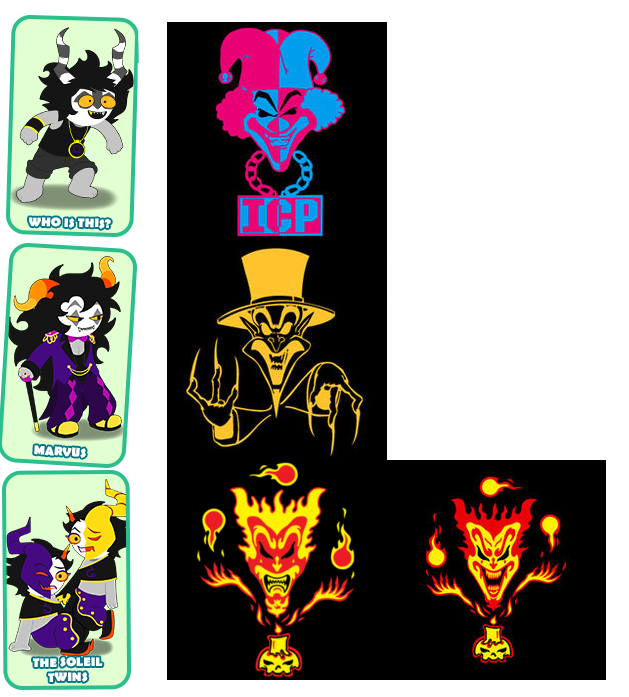
ICP’s albums in their designs:
“
The first Joker’s Card, Carnival of Carnage (1992), is a representation of the ghetto and the violence that occurs within.
It takes the form of a traveling carnival which doles out the same
brutality on those who have ignored the inner cities’ cries for help. The Card issues a warning against the upper-class and government’s negligence toward the lower classes.”
So yeah. That line of inquiry seems to be checking out so far. Really there’s a bunch of parallels between Juggalore and the Mirthful Messiah cult/LE in general, but I happen to know someone else is working on that, so I’ll leave it there for now.
Now to what is to me, the most interesting part: the vision of the carousel itself.
There are two possibilities here, I think:
1) This is a psychic projection Karako’s putting out in his dying moments. Its a quick vision meant to provide some small moments of comfort before they die.
2) I think more likely, we’re getting a glimpse into how death works in Paradox Space, absent dreambubbles. It seems likely to me that this is a dark carnival afterlife createdby the collective unconscious of Alternia and, specifically, it’s fervent cult of Mirthful Messiahs.
Karako was led to it because he’s part of the group that collective consciousness recognizes–ie: it’s likely a burgundy would be rejected as one who doesn’t belong, or led somewhere different in Alternia’s collective consciousness. The MSPA Reader was recognized because Karako recognized them, specifically, and was able to extend his afterlife’s promise to his friend.
Either way, we have no way to know and there’s more interesting questions. I’m struck by the fact that considering this is a promised afterlife of spiritual fulfillment, the vision we see is distinctly non-spiritual--in fact, it’s deliberately artificial.
There are angels, but they’re mannequin props strung up by string. There are happy inhabitants, but they are also mannequins made of wood. It’s like a theatrical parody of an afterlife, depicting the physical presence of holy attendants and subjects, but not the spiritual/magical influence that makes them true.
Basically, it’s a very Rage-y afterlife–it’s theatrical, it’s artificial, and above all it’s physical, not spiritual or magical. It all reminds me very much of the concept of “Maya” from various Indian philosophies–including Hinduism, from which we got the name “Makara” for Gamzee.
How Maya is treated by different cultures varies, but the basic gist is of
a magical power of illusions, of creating real, physical/material things that don’t actually reflect spiritual reality. To quote wikipeds:
The thing is that according to this framework, basically all of physical existence, or at least quite a lot of it, is ultimately Maya and thus illusionary. Physical existence is might or might not be “real”, but it is constantly changing, and so does not reflect spiritual, eternal truth.
I’ve suspected for a long time that at its core, the nature of Chucklevoodoo/Rage powers stem from an ability to manipulate the experience of Maya.
Chucklevoodos employ illusions that are physically real (the Jack Noir doll in John’s room, or Dave’s dream copy of Lil Cal), and inspire people to be afraid/paranoid/angry–binding them to their physical experiences of the world.
Enlightenment in these Maya-centric frameworks generally means becoming one with these eternal principles of spiritual truth, and thus moving away from Maya/physical reality and the fear/confusion it produces.
So here’s the thing: That’s pretty much exactly what the MSPA Reader begins to experience after Karako is killed.
They come into awareness of the fact that everything they’ve been experiencing on Alternia, everything about Paradox Space, is kind of profoundly unreal.
Which it is! Because its just a story being told to us, the players. They seem to become very aware of this unreal/illusionary nature to their own existence and that of the world of the Friendsim.
And instead of continuing to treat it as real/something to be afraid of, the Reader chooses to stand up for moral virtues, generate them into the world themselves.
And as they move on from the illusionary world of Alternia, they’re rewarded by becoming aware of an eternal, universal, spiritual truth:
Friendship.
Of course, the MSPA Reader is still on their path. If they’re going to keep up this metatextual evolution and eventually reach enlightenment, coming to understand the true nature of their own existence, then there’s a lot more to learn. (Here’s hoping Lanque will teach them (and us) something about Astrology, Alchemy, and Aspects.)
What I’m wondering is, how much longer before they start becoming aware of the part of their reality that is well and truly outside of the visible realm? How much longer before the MSPA Reader becomes aware of us?
yeah, I came into Homestuck analysis as a fan of BKEW and dahnithewitchoflight primarily, so I’m well-acquainted with the idea.
I don’t currently think of Class inversion as a thing (I view the system as both more complicated and more reliant on the individual player than their class via Roleplay). While I view Aspect changes as more flexible than inversion/overembracing as well, I do actually suspect Aspect inversion might be something of a default in the absence of other stressors/influences.
yeah, classpect stuff is for fun imo. I’m trying to draw connections between the classes for the purpose of analyzing canon, not to assign rules to fanon participation. do whatever feels fun and fitting to you 🙂
Alright folks! The release of Volume Fourteen: Of Cleanliness And Clownliness is just around the corner – expected to be sometime today, Friday the 12th, in fact! As such, it’s far past time you found out just who you can expect to befriend. (Not that the title made it a hard guess this time around.)
That’s right! You can look forward to meeting MARSTI HOUTEK and… Uh.
Oh for fuck’s sake. He’s always doing this. You cannot get this guy to sit down and say still for like ten seconds, I swear. I think he stole all my soda, too?? Great.
Look, I’m gonna have to go do some clown wrangling. Be back soon. If you see KARAKO wandering around anywhere, could you tell him to get his ass back over here?? He’s not in trouble. I just wanna talk. (Seriously! This guy’s too cute to stay mad at.)
sometimes do y’all think about how brave and courageous and powerful and kickass and heroic anthy himemiya is and just start to cry
anyone ever think about how calliope is a literal wellspring of strength and perseverance and hope for the dignity of sentient life
fellas is it gay to think about calliope and anthy wearing sunglasses, driving a convertible off a ramp that their shitty asshole brothers are tied to and high fiving whilst backed by the sun while their shitty brothers cry bout tire tracks and storms of swords or w.e




 Flying through Storytelling