yep! I pretty much agree. I’ve been trying to figure out exactly how to parse the motifs of the classes in a comprehensible way, and the Protect and Serve motto reads really well with Knights and Pages. I’ve never seen canon reference it–the closest would be Dave’s repeated references to Obama, I’d say. But it’s definitely been taking up my thoughts as I consider how the classes all fit together thematically. Sweet catch!
I agree. I have a few reasons to add “creating Light” as a reason for Joey, and I remember the Maid reference you’re talking about. It’s still SOMEWHAT possible she’s another class–I saw one reference to destruction, but she doesn’t feel like a Prince so I’m still leaning on Maid. But she’s definitely a Light player imo.
I need to get screenshots to make a whole post about it, but my classpect thoughts on the others are:
Xefros is absolutely a Page of Time. There were a fuckload of references to him as a Page already and at least one to Time, which are most of what I’ve got to compile.
Jude is PROBABLY a Seer of Doom. All of his knowledge ends up benefiting or acting through Joey, and she makes explicit reference to being impressed he actually *Knows* his stuff, with respect to all these threats and rogue conspirators he’s predicting. Of course, its still pretty early and there wasnt anything explicit there, so it’s still somewhat up in the air.
Dammek strikes me as a Thief of Breath. Not completely sure on the Thief part–all I have to go on is the fact that he’s so driven and the occasional references to him taking Xefros’ stuff. His passion for communism/non-ownership certainly sounds like “stealing” through “freedom/disattachment” to me for his own benefit, after all. So that’s my rationale there.
But SPECIFICALLY Dammek definitely seems like a Breath player, because he’s strongly referenced as having a talent for leadership and motivating/driving people–providing direction. The fact that Xefros’ classpect matches Aradia’s–Time doesn’t hurt, as Dammek’s analogue would Tavros, the Breath player.
On top of that, it sets up a somewhat interesting inverse dynamic to the relationship we saw between Vriska/Aradia/Tavros. Where Homestuck’s cycle of revenge began with a Maid of Time getting revenge on a Thief of Light for the abuse of a Page of Breath, Hiveswap’s plot seems to begin with a Maid of Light beginning to heal the withered sense of importance of a Page of Time at the hands of a Thief of Breath.
Not entirely sure if this reading will hold up, of course. But The Dancestors demonstrated an affinity for this kind of karmic role switching, and Scratch seems to be managing the events of this story, to an extent–just as he managed the cycle of revenge. So it wouldn’t surprise me if it pans out.
Not enough of the fandom is interested in how Classpects may play into Hiveswap, I think. We’ve gotten lots of hints at the player’s potential Classpects, but there’s a lot of skepticism as to whether Classpects will even show up at all, given that the game doesn’t center around Sburb.
I’m here to argue that they’ll definitely feature in some way. And luckily for all of us, whether or not I’m right here will be incredibly easy to prove!
Our case study will be Xefros Tritoh. But before I explain how we’ll scrutinize Xefros to determine whether or not I’m full of shit, I’ll need to talk about three things:
In Homestuck, when characters are particularly inspired by or moved to imitate rolemodels, that tends to show up in their mechanical behavior as Heroes. What’s more, such acts of imitation tend to come with references to the specific Mythological Archetypes that inform the Class of the Role-Model figure.
The Troll Ancestors are essentially our introduction to this concept, and there is no clearer example than Vriska. For all of Act 5, Vriska strives to emulate Mindfang in all things–and at the same time, Vriska is consistently depicted and referenced as a Fairy. You can see one such reference above.
So Maids and Sylphs are fairies, according to the Class system. But Vriska is a Thief, and attempting to live out the role of one. One important factor in the Roleplay system is that Roleplaying this way is often misguided and unhealthy, and that players are typically at their happiest and most powerful when playing to their innate strengths.
Compare Vriska’s attempts to make Tavros stronger to Aranea’s effort to do the same for Jake. Both end disastrously, but it’s hard to deny that Aranea had an easier time getting the job done.
We’ll talk about Knights (and Pages, by association) in a bit, but for those of you curious, here are the Archetypes for the other classes that have them:
The first thing Serve classes are prone to doing is Serving their enemies in brutal defeats.
The second–and nicely bringing us into a description of Neophyte Redglare, Terezi’s mythological idol–is the providing of Service.
Knights are prone towards helping others and serving others’ needs through the use of their Aspects. In Redglare’s case, that means that everything she does is at the behest of the Highbloods–even if she doesn’t agree with their ideology.
All the Knights we see in Homestuck adopt a code of honor of some sort, in that they hold themselves up to very high standards of behavior based on a persona they construct in their heads.
For Dave, this is the image of the cool dude. For Karkat, it’s the ruthless leader. For Latula, it’s the R4D G1RL act.
In all three of these cases, the Knights primarily use their personas to distance themselves from their emotions and force themselves into positions of responsibility, even if they’re uncomfortable with their own competence or don’t really want to carry out a particular duty.
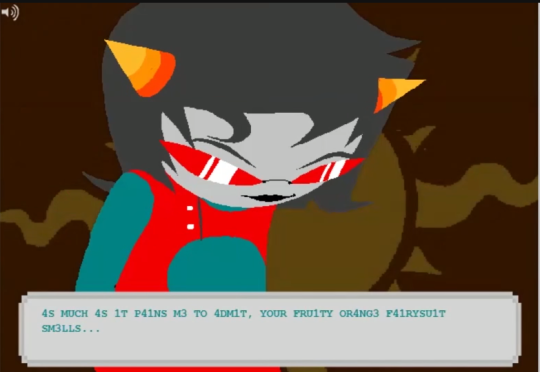
Which is exactly what Terezi does when confronted with the need to kill Vriska! Terezi buries her feelings about Vriska and decides that eliminating her is simply the professional way to resolve the problem–choosing to focus on performing her role as Redglare instead of thinking about her own feelings.
Terezi’s Redglare roleplay, however, might even go farther than the three true Knights–since it even includes a literal code for how to act as a Warrior, that she uses to determine when killing was acceptable. This code of honor is, of course, Terezi’s idea of JUST1C3.
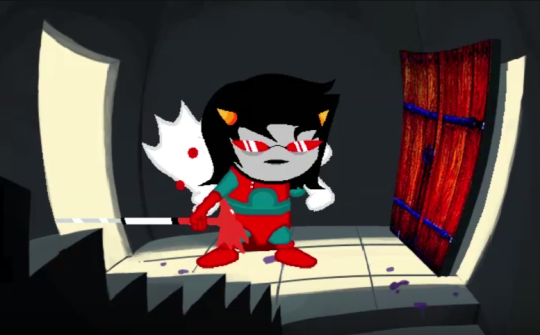
And once Gamzee manipulates Terezi into fully embracing her Redglare persona, Terezi is visually cast as an echo of another Knight– [S] Seer: Ascend acting as an extended visual callback to Dave’s [S] Dave: Ascend to the Highest Point of the Building. Seer: Ascend even starts off with Dave’s symbol!
And the end result of this roleplaying is, of course, as disastrous for Terezi’s being as Vriska’s Mindfang roleplay is for her.
Passing judgment on Vriska leaves Terezi doubt-riddled and self-loathing for years because her true inclinations as a Seer were not to try and go to war for the sake of Justice, but rather to pry, inquire, and discover the truth about Vriska’s nature and feelings. That roleplay misled Terezi from her desires and needs in this respect shows how much of an impact it has in the narrative.
Hopefully this overview gave you an idea of the logic behind it, and if not hopefully looking at other examples I’ve written in the links above–such as Rose as a Witch, Jane as an Heiress, or Dirk as a Knight– will illustrate further.
Now. Let’s get to Xefros.
Xefros is interesting here primarily because of his interest in Butlering. The Butler is the second Archetype that informs Knights and Pages, and it covers the Service connotation as well, but it also includes last definition of the Serve verb:
To give. As a counterpoint to Thieves and Rogues–who Take–Knights have a tendency to give others their Aspect, or give others things through their Aspect. Much as a Butler offering a plate of food. Davesprite giving John a hammer with Time powers is a prime example.
And on top of being interested in one of the biggest symbols of a given Class in the comic, Xefros also comes with one free FLARP manual, it seems. Flarp being the same book that marked the impact of Roleplay and Mythological Archetypes on Vriska and Terezi, this is relevant to me.
So my premise is simple. If the Classpect system has any weight in Hiveswap, odds are very good we’ll see Xefros display similarities with Knights in some way.
(I say Knights and not Pages because Pages seem to have a knack for inspiring those around them to do the serving, whereas Knights seem much more inclined to be serving others–and Xefros is definitely interested in doing the serving.)
But there is a catch here.
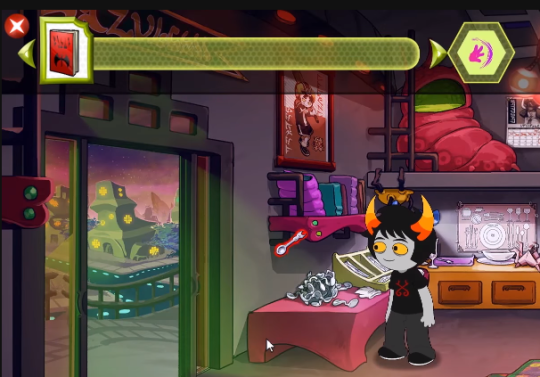
Apparently, becoming a Butler is Xefros’ ambition. But that seems a bit odd, considering he’s also a rebel fighter.
So the question is: Is Xefros a Knight, or is this interest in serving (presumably the elite of Alternia?) going to prove to be unhealthy for him? In other words: Is this an indication of Xefros’ true Classpect? Or is it a case of Roleplay?
I think it could go either way at this point. Of course, it’s also possible I’m reading into stuff too much and there’s nothing here but coincidences–in which case, Xefros will exhibit nothing particularly related to Knights or Pages or possibly any Classpect stuff at all.
But to be honest, I doubt that. I am, however, very interested in testing this guess, and I hope you’ll all at least be interested in holding me up to scrutiny, too.
That’s all for now. Feel free to drop by on r/Hiveswap’s reddit and Discord if you’d like to ask questions about this, or just jam about Classpects or other cool stuff in general.
(2/2) And if everyone is selfish, then what’s the point in making an argument about anyone? I see in this point a recurring trend in the arguments: the focus is on proving a theoretical concept at the expense of psychological nuance. Pages are active, active is selfish, therefore all actions of a Page are selfish. Yet I feel, from Dave’s final comment to Rose about character arcs, that all these characters are meant to be more complex and messy than the abstractions of their mythological roles.
Yeah, talking this stuff out with Viko has made me realize I’ve been overemphasizing the selfishness/selflessness angle a bit more than I think is accurate, or at least like, clearly posited in the comic. Not every single behavior an Active player engages in is necessarily selfish, and vice versa for Passive players. In particular, I think Viko raised a very good point about Jake’s dying for Jane. The Masterpiece/Dirk moment I feel is somewhat different, specifically because it’s so coded with romantic subtext.
I don’t think the distinctions are meaningless, but Alt!Calliope and Caliborn are the only characters I’d say really hold to the Selfless/Selfish mentality absolutely (well, besides Gamzee, who never seems motivated by anything but Caliborn when he has motivation to speak of). Everyone else is, by and large, more complicated. Which makes sense, since engaging with others and having that push and pull of wills is bound to bring out different facets of an individual.
So I think I’d say as with everything else, the Active/Passive describes a tendency or predisposition with Selfishness/Selflessness, too. It still seems like a pretty consistent established element, but I think it reads a lot stronger as one element that also takes others into account–such as how proactive vs. reactive a player is, how self-focused vs. group-focused they are, the “benefit oneself” vs. “benefit others” behavior in terms of mechanics, and so on.
Makes for less concise and easily transmitted analysis, but then Homestuck inherently resists reductive takes, so that makes sense.
So yeah, I’ll readily admit I’ve gotten carried away and made some pretty poor overwrought arguments–It’s a bad habit of mine. Honestly the strongest arguments for Jake being selfish are his treatment of Jane early on during the session (which directly parallels Horruss) and what he does when power-boosted by Aranea: Make Brain Ghost Dirk exclusively to make himself feel safe and protected when he had the power to pretty much win the whole session by himself, if he were so inclined.
Since those points together describe both Jake’s largest impact on the session over time, AND Jake’s impact at his most effective being to his own benefit, I’m pretty comfortable resting Pages’ active status on those particular points, as far as Jake’s concerned.
That said, with regards to your statement
I see your reasoning on that idea, but my issue is the idea of abstraction, which was brought up in the critique but which you did not, imo, address.
I’m not super sure what idea you’re referring to. As such, while I tried to address what I think you’re getting at, I’m not super sure that I did. Feel free to follow up if you have lingering questions or if you were getting to something else? Otherwise, thanks for giving me the chance to clarify my position on this front.
Yo, yall, I saw someone in the cherubplay tag asking about a guide for this and I like to think I’m pretty good at Dirk roleplaying, so let’s go.
I was going to try and keep this away from most “fanon vs. canon” stuff, but as a heads up, with both Striders it’s fairly impossible to avoid talking about that because they put up such fronts that get read as their actual character. (More on that in a sec.)
While on the one hand you have the misreadings of Dirk that result in desperate, clingy, whiny “looking for doms” bed starfish, on the other hand, you have the suave, domineering, puppeteer Dirks who control literally everything their friends do, are always in control, and definitely never panic in a bad situation. While both of those misreadings are bad, I’d actually argue the second is more OOC than the first, and this is a post about why.
Anyway, this is gonna be a really long post because I like talking about Dirk and his complexes way too much, so hit the readmore.
Dirk might not be a Knight, but he has all the same hallmarks as Dave of desperately armoring himself in “being cool” to avoid letting people see the raw underbelly underneath. If you come out of Homestuck reading that Dirk believes he’s the best thing since sliced bread, then … well, then he fooled you. You saw his front, accepted that for all he is, and moved on, and somewhere, the metafictional concept of Dirk probably let out a sigh of relief and wiped sweat off his forehead.
I’m reblogging this specifically because I think it’s relevant that Dirk acting as a Knight is objectively correct? Like, not just in terms of his characterization echoing Dave’s–in the sense that Dirk actively tries to roleplay a Knight throughout his narrative, in his emulating Alpha Dave.
So I think it’s pretty cool that someone picked up on this element of his characterization now that I think it’s like…a literal, explicit game mechanic, consistent not just in Dirk but throughout all of Homestuck (and Hiveswap, considering what we’ve seen up until now).
Classes are cool, y’all. Also Dirk Strider owns and I love and will protect him.
The way I see it, it makes a lot of sense: Pages are inherently Self-Serving, and that’s both an intense weakness and a great strength.
Why? Because in Homestuck, reality is made not just of what you want, but of what you’re willing to make happen. Willpower and thought are tangible, powerful things in Homestuck–things that shape the communal reality that all the characters share on their adventure.
So what if you had a natural talent to give yourself whatever you want? What if you had a natural talent to make other people WANT to give you whatever you want? Once Pages understand this potential in themselves and exploit it to it’s fullest potential, you get–well, you get Gods uniquely skilled at achieving exactly the outcome they want. So you get Jake summoning Brain Ghost Dirk, which should be impossible. You get Tavros managing to somehow organize an entire army out of extremely self-absorbed troll ghosts so he can finally show Vriska up, just by being nice and talking to them all one by one.
Ultimately, Homestuck posits that happiness/fulfillment/success, in reality, is made by knowing how to traverse the boundaries between what exists, what you want, and what the people around you want. Pages’ key verb, by design, gives them the shortest path to getting there. Other classes might use their ability to Make or Steal or Destroy to get what they want, but Pages have the luxury of simply Serving it to themselves–partly by making other people genuinely want to give it to them, or by using their Aspect to serve their own desires directly instead.
This makes them powerful vectors for organizing wills into a single goal, ie: Powerful leaders or warriors under the right circumstances.
The reason this is such a double-edged sword is twofold. For one thing, Pages being self-serving also makes them inclined to be cowardly and conflict avoidant, even when conflict is necessary. They’re also prone to put their own interest ahead of the group’s. For another, they can inspire people to want to help them, but those people are also their own people with their own predilections and ideas about what serving someone else means, which leads to unpredictable results. One need look no further than Vriska to see how that can go wrong.
And it’s worth noting that being self-serving is something society by and large strongly discourages, especially if you’re going to be asking people for help in accomplishing whatever you want to get done! It’s seen as a pretty Bad thing to be. So Pages perhaps more than most classes tend to be conditioned against embracing their innate skills.
This is a true mess of words. Hope it makes any damn sense but feel free to send me another ask if it doesn’t! And thanks a ton!
If you haven’t read them already, I’ll say read my essays on Knight/Page as Butlers as well as the Steal/Serve essay, because I advance my arguments for Karkat there.
To “Allow” basically means to give permission or entitle X to act through you, “As if through the Will of the Aspect”. I describe it as the counterpart to “Exploit” in Class theory, which means “to make use of or harness”.
Karkat’s Blood impact usually come without him being directly cognizant of it, as if Blood were acting through him. If you don’t have the time to read those essays and see what i mean send me another ask and I’ll answer you tomorrow, but I really think it’s kind of redundant effort all things considered. I’m happy to answer any questions or counterarguments you have for those essays, too.
Haha yeah I was being kind of flippant and facetious in the ask I think you’re referencing. I only want to start conversations, not impose a new understanding, so I’m happy to talk things out and debate views!
Tl;dr Jake wanted Dirk the whole time, he wants Dirk selfishly because he views Dirk has his protector and bodyguard and because Dirk helps him with whatever he wants help with, and he knowingly manipulated Jane into denying her feelings for him despite knowing otherwise for a fact because Roxy told him that she had feelings for him.
All of this is literally textual and in the comic.
Reading Jake as passive is the only reason anyone thinks DirkJake is ambiguous instead of one of the most mutual and passionate gay romances in all fiction, and it’s based on nothing but misinformation.
I’ve written so much about this it’s not funny, but feel free to read any of my various arguments on the subject and debate particular points if you want to follow up on something in particular.
Karkat: the reason there’s any people who think Karkat was turned into a joke and was never effective in the plot at all is because he almost always exerts his impact by “Allowing” his aspect, and thus ends up pretty effective all told despite not being aware of what he’s doing!
Tavros: reading Tavros as passive ignores the fact that Tavros fights and resists Vriska’s will every step of the way throughout his abuse, and is pretty capable about knowing who to get to help him in stopping her.
It ignores that the one time Tavros almost used his powers he was acting under his own agency, and that he quite expressly and dramatically is unwilling to do things the way Vriska wills them on him.
On Vriska’s end, ignoring that Pages inspire others to act for their own benefit paves over the element of her character that genuinely perceived herself as trying to help him, which is a textual element that complicates our view of her.
Obviously none of that is to say Tavros asked for it, or that any of what Vriska did is justified. But the way their wills play off each other is more complex than just “she bullies him and he’s a pushover”.
Tavros is NOT a pushover. He’s overpowered by force, but he tries fucking hard to resist his abuse. And Vriska doesn’t exactly just hate Tavros–there’s an element of her behavior genuinely rooted in a desire to help in the context of the fucked up world she grew up in.
But more than anything reading Pages as passive ignores Tavros’ motivation for raising the ghost army and turns it into “oh he ended up helping Vriska to her benefit in the end and that’s…his character arc?”
Which isn’t what that scene is at all. That scene is Tavros getting what he personally wanted to have closure for himself and move on from Vriska for good. Tavros healed. He moved on. He got a pretty gentle sort of revenge because Tavros is ultimately a kindhearted and gentle boy, but he used the ghosts specifically to aid his desire to own the fuck out of Vriska and then moved the hell on.
Reading Pages this way means that Tavros’ arc wasn’t written for the purpose of making a depthless joke of an abuse victim, which means you can understand Vriska’s character complexly without having to prioritize her over her victim.
I sure as hell wouldn’t call it, like, a perfectly handled narrative, but it does make it substantially better and make Tavros ’ ending a lot more satisfying. Also gives me more hope both Vriska and Tavros will be treated well with whatever on earth happens in the epilogue.
Homestuck was, if not good, at least only kind of shitty instead of dramatically in your face blatant abuse mockery shitty all along. Tavros is definitely treated as jokes, but he’s also given actual closure re:his abuse arc, that actually makes sense given who he is as a person. And understanding that means Vriska’s character was handled with more care, too.






 Flying through Storytelling