yeah! i mean i didnt really feel married to an aspect for ardata but i was closest to Blood, so this is interesting. Doom makes a good amount of sense in retrospect.
Obvs Marvus I had pegged for Blood too, which turned out to be wrong! That’s really interesting, since it changes a lot of the conceptions I had about him and Boldir. Still inclined to see him as a Lord, but obviously the overlap with Caliborn also makes me doubt it.
I’m entirely rethinking both counts, but that’s fine by me because it makes things more interesting :B Makes me glad i held off making videos on them before we found out for sure mostly.
She wants to improve you as dramatically as Kanaya and Aranea improved Eridan/Jake’s power levels. MAKE is right there. Nuff said, I think.
In the bad end she may echo Page or Heir, deploying these faculties to buff herself rather than you and manifesting either the Page’s limitless potential or the Heir’s powers of transformation and power over reality (through Void either way, since technology has some Void associations with Bluebloods particularly and factors so much into how she empowers herself)
Either way, both Page and Heir are less passive than sylph and so would explain her benefiting herself instead of others.
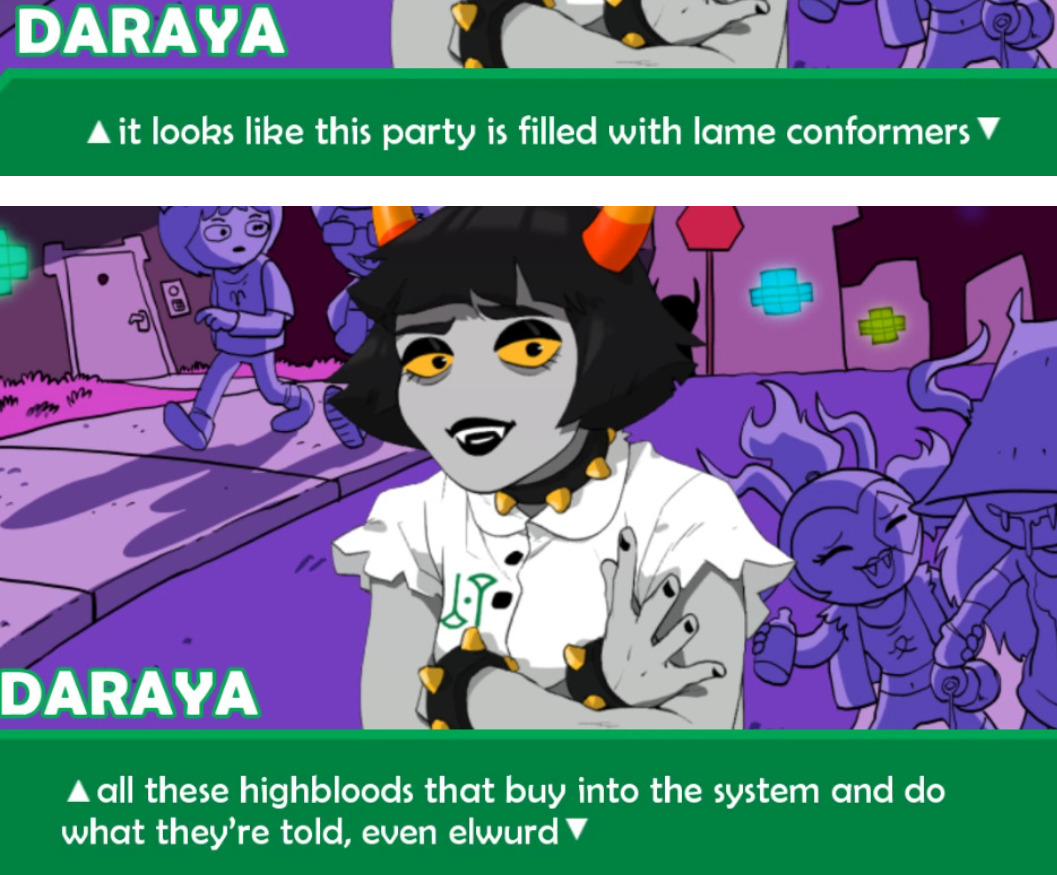
Daraya: Rogue of Hope
She’s heavily invested in rebelling/standing OUTSIDE alternia’s legal/social norms. She’s heavily drawn to other people who feel similarly, reflecting thieves/rogues general affinities for other outlaws(1)
–note that she’s specifically drawn to Elwurd and how she presents herself, and Elwurd is either a thief or a thief roleplayer herself.
as a Jade, Daraya would have the role of Sylph or maybe Maid forced on her, not Thief or Rogue. Hence, I think it’s likely her presentation of the Outlaw motif comes from a genuine place in her heart, rather than roleplay.
Things go very, very badly if you let her take direct charge and have her will take you to her favorite place. If you encourage her to just go out into the world and Let Stuff Happen (ie: take a more passive role in relation to reality), things go much better for both of you, and she finds an outlet that makes her feel better by making a friend and finding a cause she can help. by basically offering to steal books from the library, no less. so thats my Rogue logic.
(1)think the “Honor among thieves”
thing or Robin Hood’s band of merry men–Mindfang, a successful thief roleplayer, was drawn to Rufioh, an
innate Rogue. Vriska, an innate thief, was attracted to the IDEA of
tavros acting like a Rogue/the summoner rather than to tavros himself,
and later was drawn to Meenah.)
Vriska declares everyone on her ghost crew is ALSO a pirate, ie: an outlaw. Which is also a good example. Outlaws by definiton can only form communities/serious bonds with other people willing to shirk or redefine the norms of society, and outlaw communities run on their own self-defined rules and conventions of behavior. Contrast against Knights and Pages who generally feel quite beholden to societal convention.
I have longer posts on both of them sort of in the works but I’m doin a lot of stuff atm and the Classpects per se were not the most interesting thing about this volume imo, Daraya’s in particular. Not to say they were bad, I loved them both. Just that theres other stuff in these arcs I’m more inspired by.
I was getting bogged down writing ways all day today so I figured I’d try putting my thoughts out here in a shorter/snappier way, hope the format works. Lemme know if it does and maybe i’ll convince myself to write in shorter/snappier ways like this more in the future, could cover more trolls that way.
Idk, also Junko? Doom covers extreme binary shifts that can happen across active/passive lines after all
I don’t particularly think there need to be both classes in any given story, I just see them as playing the role of Dungeon Master/god and king.
Both are likely to show up in stories about gods manipulating mortals in a contest against each other, which ikuhara likes to do a lot so we tend to get pairs there. Not mandatory tho!
The childlike Empress (The neverending story), likely the direct prototype Callie is based on just as Bastian is the prototype for Caliborn’s Lord, forgot to mention him last time.
Also forgot to mention Pokey Minch (from earthbound/mother 3), who I see as a Lord of Life and also a direct influence on caliborn
Anthy Himemiya from Utena, Muse of Hope (or maybe Heart? I go back and forth) roleplaying a Witch of Rage (or maybe Mind)
The shadow girls from Utena collectively play the part of muse of void, too.
Madoka Kaname (Madoka magica), Muse of hope
Junko enoshima (dangan ronpa), Muse of rage and/or Doom
Momoka Oginome (mawaru penguindrum), muse of heart roleplaying Witch of Heart (she’s Very good at what she does, ok)
The holy ghost and the muses from Greek myth seem like the clearest mythological links, too.
Lil Cal and Doc Scratch arguably evoke LE’s roleplay of the Muse role in some ways, just as Callie’s direct destruction of the green sun evokes her roleplaying Lord
Lord of Rage: Akio (heart might also work I switch every so often)
Lord of Hope: Joshua (TWEWY)
Lord of Light: Gwyn (dark souls), main character girl who’s name I don’t remember (from Qualia the Purple or Purple Qualia or w.e that manga was called) Gwyn fits your argument better than that girl in this case tho
Drosselmeyer from princess tutu is probably a Lord but I’d have to rewatch to know of what.
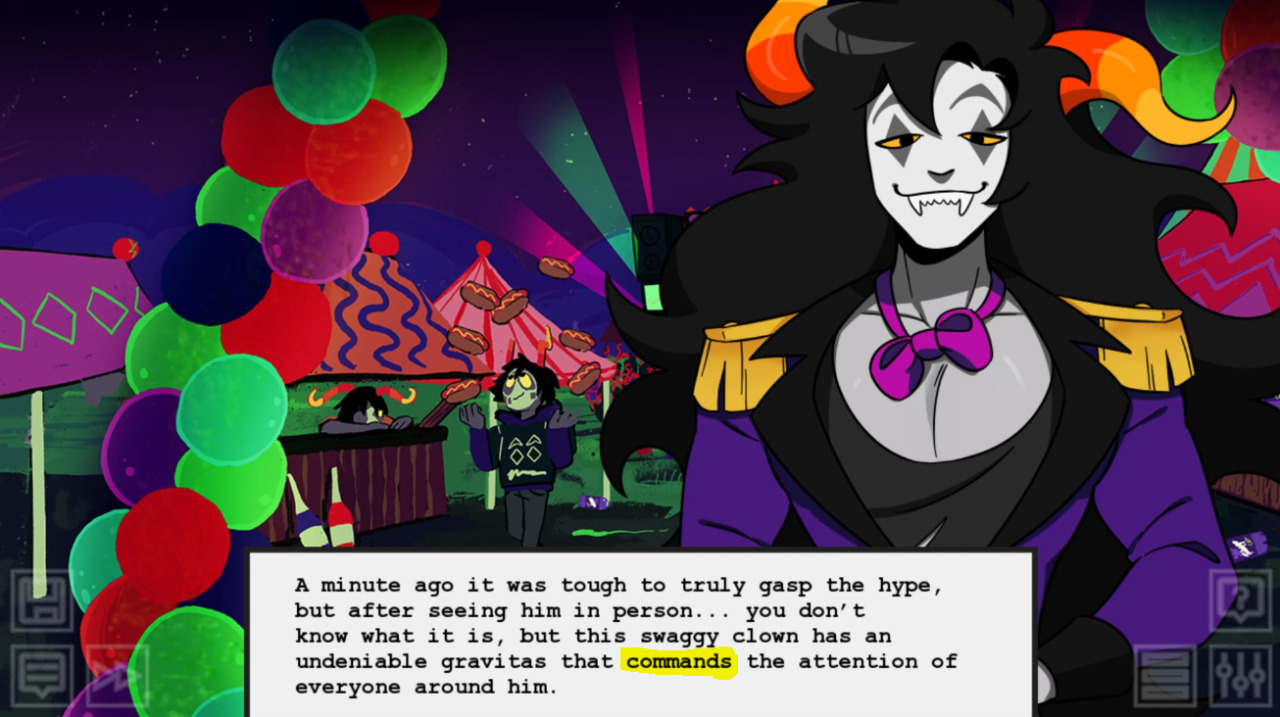
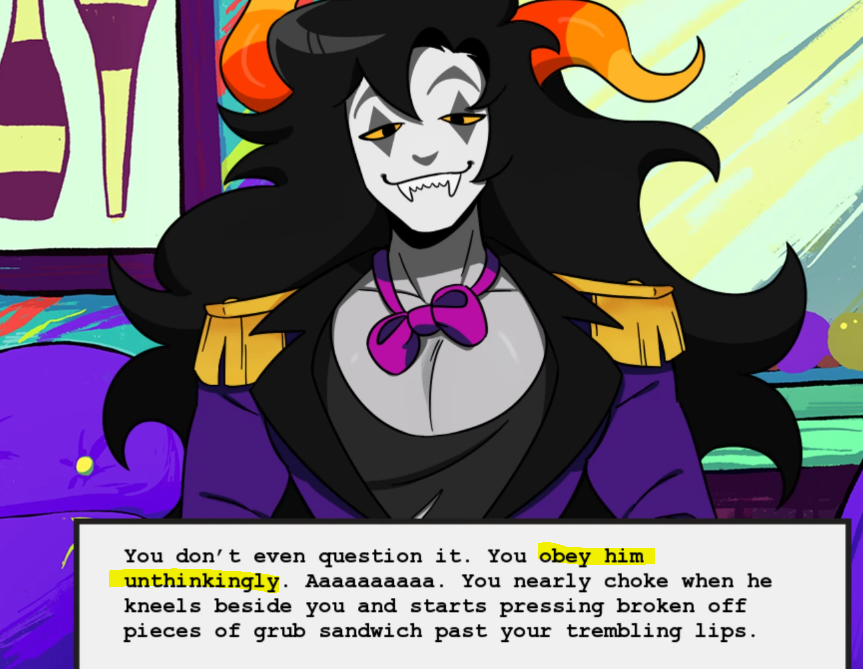
Command comes up with Caliborn like, a lot. Its also the name of the little arrows that connect every page of Homestuck. Every Command is a sort of direct attempt at mind control to the characters, as Hussie frames it–whether delivered by Exiles, the audience, or “The Author” himself.
The Muse seems inclined to wield that power through inspiration–once given a compelling enough idea, an actor can do nothing but work in relation to it, an artist can do nothing but work on it, as though they were possessed or enslaved.
The Lord seems to wield it through sheer dominance, or charisma–like a King who’s will cannot be denied.
I’m sure I don’t need to explain how that relates to Marvus. Y’all know.
So let’s cover why I think he’s a Lord of Blood specifically.
Imagine my surprise when I took another look at the Church. Now, to be fair, this spiral was always there, so its not exactly unique to Marvus. Chahut brought us here first, after all.
But it’s notable that Marvus brought us here because he was somehow aware it provided metaphysical safety. It’s “Hallowed ground, bizznatch.” That could be simple religious belief, but Marvus is a little too aware of the nature of reality for me to buy that. He’s aware of the rules of PSpace in a way Chahut isn’t, and the spiral is one of the rules. So it feels somewhat significant.
Now I can add this nugget: This is also one of a few purple signs that feature a crucifix or cross in the design. Given that a crucifix figures prominently in his path, that also feels notable.
Even so, this is all pretty circumstantial and quite likely bullshit. Like I said before, Marvus seems to showcase a mastery of many Aspects, and so its difficult to really be sure I’ve got him pinned down, especially based on some hazy symbolism stuff we aren’t sure is relevant.
Even so, lets get to his Blood imagery, which I feel is pretty strongly emphasized in this route–more than any other Aspect, barring Rage. And into why I think its through Blood that he carries his most definitive command over other people.
There’s a couple outright references to Blood early on, describing his effect on everyone around him. His very nature creates conflict, as the overzealous loving passion of his fans meets the violent restriction of his bodyguards.
These are classic Blood themes, all coming to the fore simultaneously.
Passion and commitment meet societal restriction, and the violence through which restriction is enforced. Blood flows in the wake of that conflict.
We see the conflict distilled during the concert. References to physical agony and mortal suffering are made, both of which are significant Blood ideas–the most recent example being Tyzias’ famous quote: “there’s so mmmmuch suffering.”
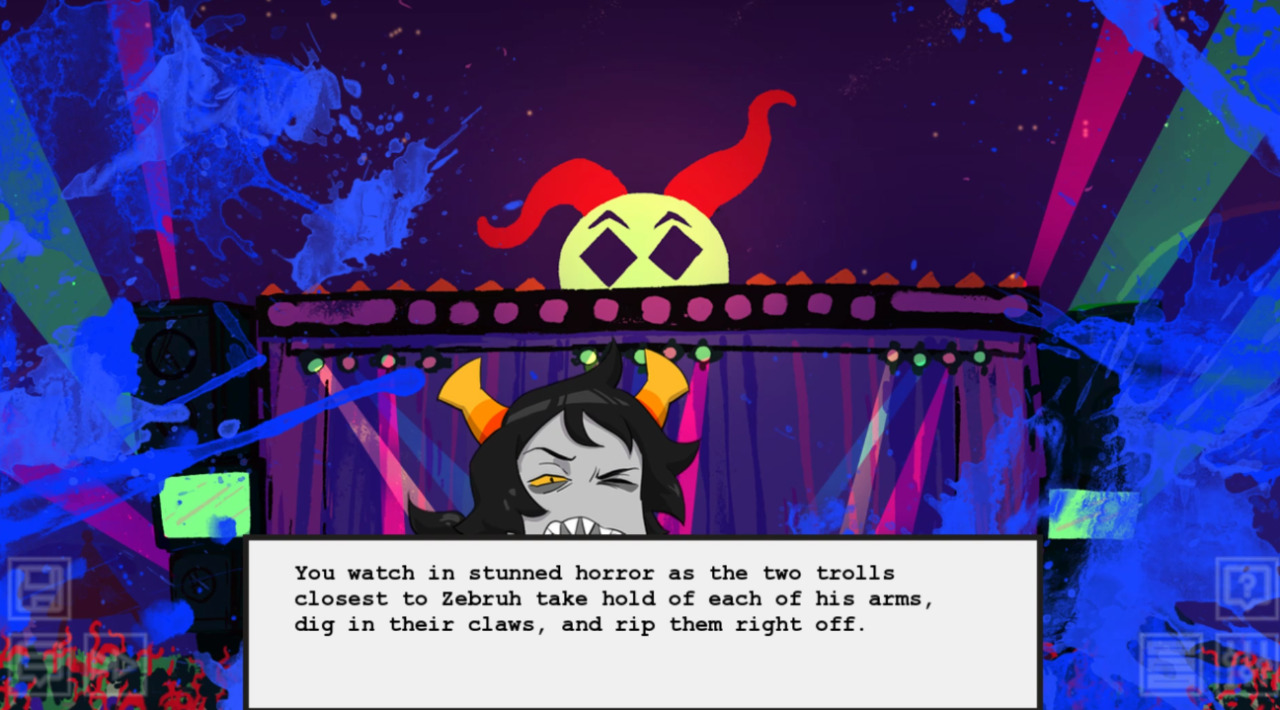
Though to be fair, that might have at least something to do with Zebruh. Blood may be associated with physical bondage and suffering, but Doom is quite literally the suffering Aspect, so its something of an area of overlap–Likely born at least partly from their close association on the Aspect wheel.
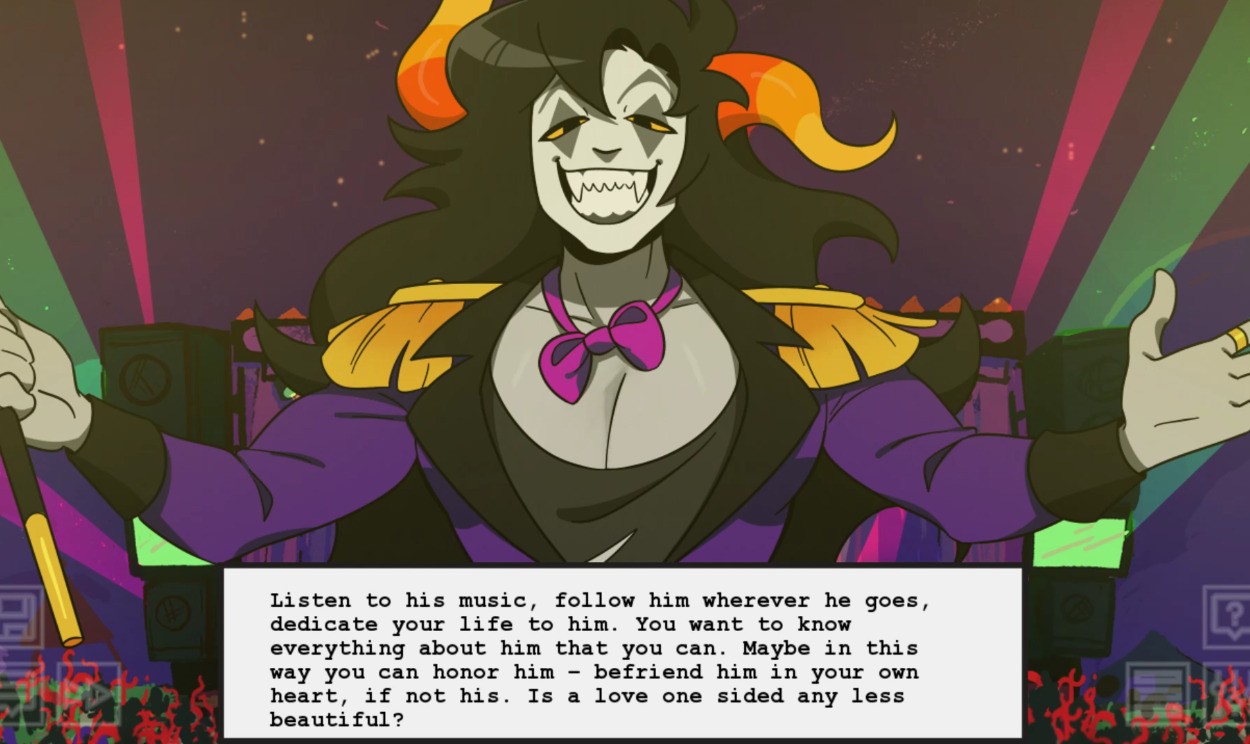
And the MSPA Reader of course falls into the romantic, committed, relationship-focused side of Blood–willing to do anything at all to share a connection with him.
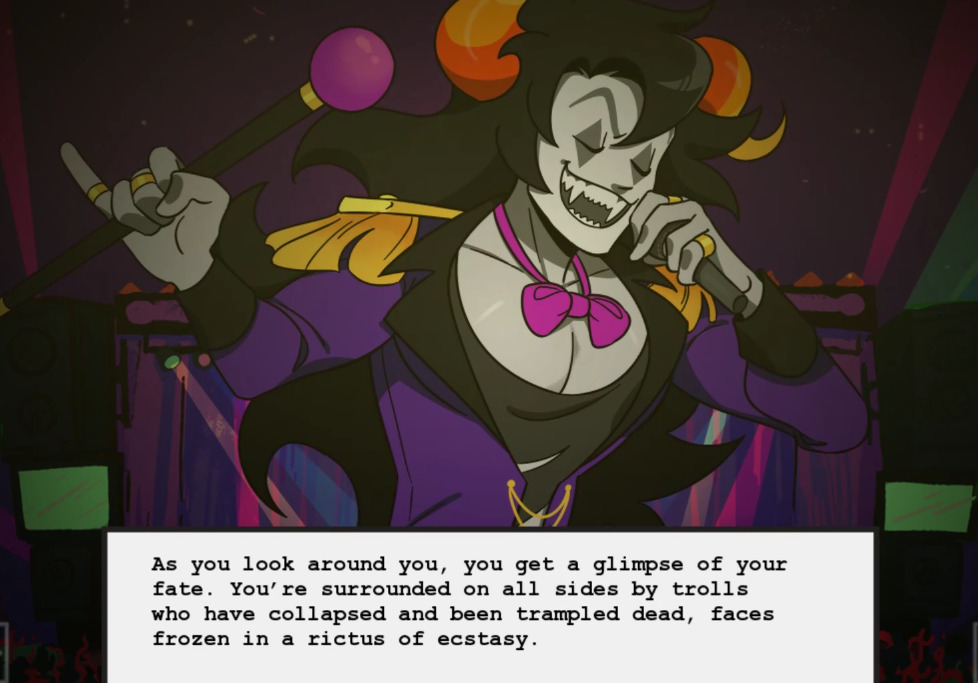
The two ideas fuse at the height of his performance, as it makes the MSPA Reader keenly aware of their physical suffering and subjects them to enormous violence and agony, whilst paradoxically keeping them spellbound to the mortal plane where they’re experiencing it. Violence, suffering, commitment, relationship.
Later, the MSPA Reader directly takes on Blood’s violent enforcer position, punching out teens desperate to establish a relationship with Marvus.
And Marvus doesn’t just absently invite these dynamics. He’s keenly aware of both the commitment to a relationship with him his fans experience, and the social obligation he would be subjected to as a result of it, unless the performance is violent enough.
He’s also deeply cognizant of the social restrictions imposed on Purplebloods as a caste, and the various forms of literal and institutional violence through which they’re enforced.
As well as the revolutionary implications of subverting or questioning those restrictions. In other words, Marvus has a deep understanding of the social glue that holds Alternia, a vertical structure held together by repression imposed from top to bottom, with blood spilled through brutality the whole way down.
But of course, understanding doesn’t make a Lord. Command does.
I’ve long said that Paradox Space is a place born of the wills of the individual, and it could be said that what the classes describe, more than anything, is the means by which a Hero most effectively applies their will to reality to achieve any given desired result.
This is what makes Lords and Muses so powerful–they shine at understanding the capabilities and inclinations of everyone around them, and more than anything, controlling and directing the other to achieve their own desired result. A Page might inspire others to serve them and rise to Kingship through their devoted teamwork, but to a Lord this innocence is unnecessary:
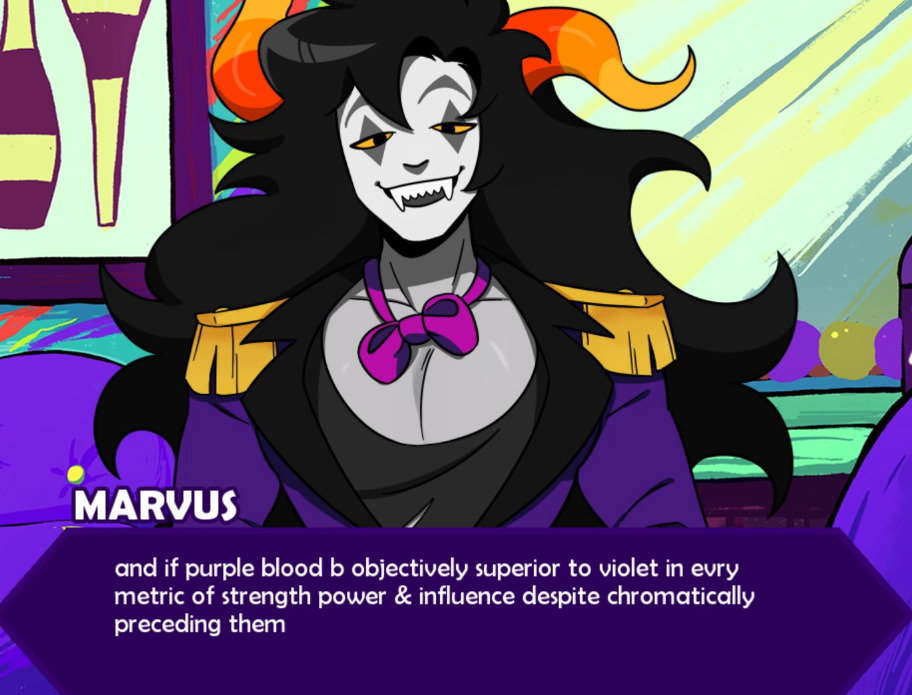
Be it freely given, manipulated or coerced, a Lord is supremely talented at dominating, and getting others to give them exactly what they want. When Marvus’ presence suggests silence, the silence is absolute among all blood castes. When Marvus wants his audience ready to turn up, they are so fucking ready. His every request is undeniable, and his will is others’ command.
What makes him scary is that he knows how to use that power. What he does with the Player’s execution is actually pretty clever–he pulls off a small magic trick, simply pretending to stab them. The illusion would fall apart under the most cursory scrutiny, but Marvus knows that doesn’t matter, because he’s working his real magic on the audience.
Marvus knows exactly how his stage will be segmented, and all he needs to do is kickstart a cascade of violent euphoria amongst the lowbloods, who by their structural disadvantage are too far away to tell the difference. (Interesting that the tealbloods are singled out as the rough origin point, considering their Mind association and how vulnerable Terezi was to Gamzee’s Rage-y predation.)
Even any highbloods who figured out what he’s up to are screwed, trapped by their own lucky blood closest to the stage and under his net, where they must fight if they want to get out alive. But nobody does. Once the climactic bloodbath is finished, nobody survives.
Which Marvus expected would happen. He told us so earlier. If Marvus isn’t literally massacring his fans with every performance he gives, he’s doing it during enough of them that it doesn’t feel much like hyperbole. And he does it effortlessly, through a simple understanding of how to move the crowd the way he wants to, like the ringmaster of a circus or the conductor of an orchestra.
This is one hells of powerful clown–frightfully intelligent and ruthless when he deems it necessary, even under the niceguy suave wokeness. Joey’s going to have a powerful ally on her side if they team up. Though I can’t help but worry that the old Purpleblood capriciousness might have him turn on us if the circumstances are right. Or, his ruthless pragmatism could make him end up feeling like a bit of a Vriska.
Probably both are gonna happen. Oh well. Anyway that’s why I see him as a Lord, and one of Blood specifically. Don’t hold me to it because frankly, if I’m really honest, there’s only one train of thought with Marvus that I’m really committed to:
He’s really hot and I’ve been the naughtiest, so frankly he can–
It’s an understatement to say that Marvus is a lot. He’s so much, in fact, that I had to split my thoughts about him into two posts from the get go. This got predictably long as hell so catch it under the read more.
This first part has to do with how he evokes various themes of Rage. I don’t think Marvus is Ragebound, but he seems to be the first direct evidence we’ve gotten that the Aspect influence of each Blood caste doesn’t necessarily have to manifest negatively.
Marvus seems to be so self-actualized and self-aware that he’s successfully reconciled and incorporated Rage into his identity, regardless of his true Aspect. Indeed, I’ve seen compelling arguments for Marvus as a Light, Hope, Mind, Heart and Life player so far–besides the personal impression I came away with of Blood.
He reminds me a lot of Doc Scratch, in terms of being someone who is so competent that they successfully blend and blur mastery of several different Aspects. Scratch wields virtually infinite influence through at least Space, Light, Rage, and even Time and Heart depending on how you look at it simultaneously, for example, which makes it hard to really assign him a true Aspect.
Marvus is obviously not that extreme, but given that he’s presumably a mere mortal in the end, he might be substantially more impressive. Anyway, lets get to noting the Rage references.
Obviously Its interesting that they start well before Marvus himself shows up. This has to do with the Reader becoming more aware of the nature of their reality as artificial/unreal/contrived, though, and that’s important to note for what comes next. For now lets keep it in mind and move on.
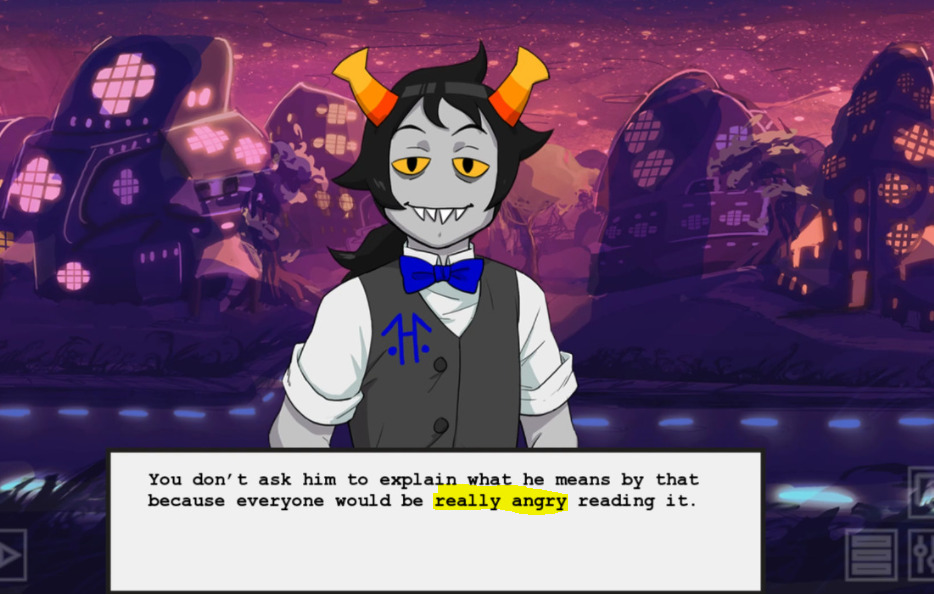
Zebruh, of course, inspires Rage through his “clowns are woke” comment, this time through simple anger. Of course, we’re inclined to think of Zebruh in terms of Doom and maybe Void, right? So maybe its a coincidence…
…but, huh, there it is again. Mentioned by name this time, no less.
This gets at an interpretation of Rage I’ve been meaning to talk about: Rage as a passionate spurt of fashion. The definition for this idiom, “all the rage”, says:
“The current or latest fashion, with the implication that it will be short-lived, The use of rage reflects the transfer of an angry passion to an enthusiastic one”
When something is highly fashionable, it generally involves a lot of passionate reproduction in the realm of physicality-whether its an object, like Zebruh’s scooter, or a particular kind of performance.
Things like sports seasons, for example, are a kind of performance that comes about every so often, generating intense passion and fervor when they do. This is why I see Xefros’ interest in Arena Stickball indicative of his Rage inclinations.
In the same way, both the traveling circus and the music festival are fundamentally events of the moment, and when they’re in town, they draw our eyes to artifice, meaningless (if fun!) spectacle, and when they’re good, hearty guffaws or empassioned bellows–all things associated with the Comitragic heart of Rage.
Zebruh’s designs on Marvus also evoke Rage. He asks us to engage in a theatrical performance (one centered on Black feelings, no less–Kissmesitude itself is inherently linked to Rage via Kurloz and Gamzee).
It’s pretty odd that Zebruh is so taken with Rage, but I think that’s simply the nature of Marvus’ performance–and perhaps tells us a bit about how Aspects shift and spread through individuals. Zebruh is thinking entirely about clowns, purplebloods, and Marvus specifically, and that seems to influence his actions–and so is really everyone in attendance at this dark carnival.
As a refresher, cults to Dionysus generally involved people–usually his female attendants, the Maenads, (who you might remember from Chahut’s last name) entering states of ritual madness and tearing animals or sometimes even humans apart with their bare hands.
Which uh, you know. Might have some parallels here. Just maybe.
I’m thinking its a possibility that Zebruh is inheriting Equius’ Orphic legacy here, just as Marvus is inheriting Gamzee’s Dionysian one.
Ok everyone should be about gone by now which means we can finally stop talking about Zebruh, just you and me. Finally.
Let’s cover some other things Dionysian worship tended to cover. Dionysus was also the god of religious ecstasy, which I think we see in the intense, deific love Marvus inspires. He’s also an entity of sexual transgression–much of his worship included orgies, and included in his male attendants were the Satyrs, goat men with perpetually erect penises described as “archetypal musicians and dancers”, associated with the breaking down of traditional values.
I think this is part (but not all) of the intense horniness that surrounds Marvus. Moreover, most of that horniness takes a pretty specific bent. It’s not just that people are horny for Marvus, but that he inspires some intense and very physical reactions, usually involving things we culturally see as debasement, degradation, and filth.
In other words, the specific kinks invoked through Marvus generally fall in the camp of things that are likely to outrage or disgust the audience, and so I’m ascribing that to his Rage influence as well.
I am well on record as describing Hope as the “horny” Aspect, but it’s worth noting that as its complement, we have precedent to see Rage as pretty horny, too, and in precisely this way: It brings to mind Gamzee’s bouts of necrophilia or profoundly upsetting approach to expressing his sexuality with women.
And of course, he’s putting on a performance of artifice and illusion for his fans–his show’s as much Theater as music. He even tricks them into thinking he killed you, sending them into a frenzy (ritual madness) that has them all tear each other to death. But more on that later.
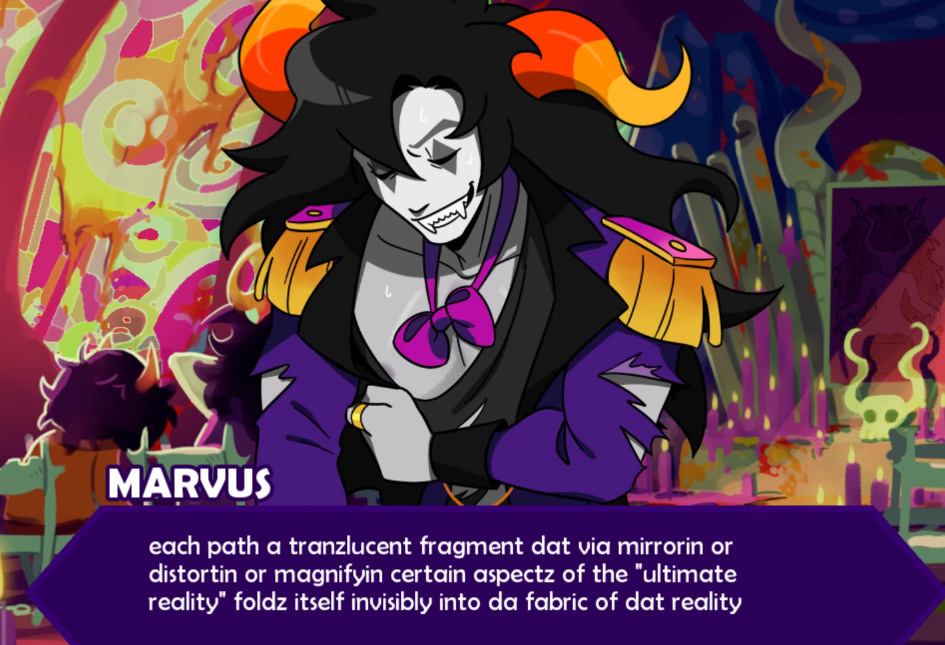
The most important way Rage manifests in Marvus is through his deep awareness of the theatrical, metatextual artifice that is The Friendsim itself. Like Gamzee before him, Marvus is aware of the nature of the story he’s in. He rivals Boldir or even Davepeta in his understanding of the implications of this, even.
But where the Heartbound tend toward an existential/spiritual focus on
the fates of the characters locked in the narrative, Marvus devotes his
awareness to dissecting the meaning and mechanisms that underpin this
entire narrative framework.
He transgresses against the rules of Paradox Space itself, and insists
that there is meaning even in the paths that seem most meaningless.
Interestingly, even the way he thinks about PSpace feels Ragey:
He says it doesn’t matter if a path is completely contrived and illegitimate–acknowledging a state of being as unreal can still inform how you interpret reality, and so choose to act upon it. The awareness of unreality can be a source of power in itself, as well as a source of confidence and motivation.
So for example, acknowledging Homestuck as unreal/artificial could have allowed Gamzee to interpret himself as immortal, or at least informed his choice to reject Homestuck and follow Lord English.
Or one could be Marvus, who is empowered by this awareness–I’m sure it’s easier to perform for crowds of adoring fans when you’re aware you’re in a video game in which you’re a pretty major character–and still choose to be the exact opposite of Gamzee. In the face of unreality, he chooses to be a friend and a comforting hero. Which is why hes bae.
Mirroring, Distorting, Magnifying–these are all tools of theater, of jokes, of circus acts and the deliberate construction of art and narrative.
Marvus is suggesting that any individual timeline expands the meaning of Paradox Space as a whole by exaggerating, paralleling, or subverting different elements of how we see it, and putting new elements of each character and the setting into focus as a result.
And he argues that wearing down or violating continuity can itself bring that continuity into sharper focus. By “defiling” the story, its the shape of its integrity is further defined.
This is terribly exciting, because its basically Marvus straight up saying that plot holes and contrivances are another element of Homestuck’s story, and that is absolutely crucial to understanding how Lord English attacks the characters, the audience, and Homestuck itself.
Every little thing Gamzee does or manipulates others into doing that pisses us off and makes us further question whether Homestuck is worthwhile or a pile of dreck is being directly acknowledged here as explicit and intentional.
Hell, his actions have the exact payoff he claimed they would–we’ve fundamentally learned something new about the nature of Paradox Space because of what he’s done. It actually CAN come undone around the characters, provided they’re resistant enough to dying or dissapearing as a doomed timeline demands.
I previously believed that was impossible, and that timelines in Homestuck simply faded out naturally when players went to sleep instead–meaning there couldn’t be any Gamzees who didn’t go to sleep and merge with the Alpha iteration of the guy. That presumption is now in question.
At the same time, we can now be pretty sure that those hypothesized Schrodingers Gamzees out there never turned into horrorterrors, since we know what happens when someone resists the pull of a doomed timeline and it’s…not that. So that old bit of fanon is that much more questionable.
Now we have new questions, like: Why did this doomed timeline collapse so quickly, as opposed to say, Dave and Rose’s, which lasted four months? And so, through this singular violation of the rules of Doomed timelines, the grander design that informs them has come into sharper focus.
By far the most interesting thing he says though, is this. This is. A lot. let’s try to unpack it. Basically, he’s saying even an incident outside of canon contributes to a wider fandom metaconciousness.
So for example the Game Over timeline isn’t canon, but we still know that when Jake reaches full Hope power he can summon Brain Ghost Dirk, and that even after Dirk breaks up with him, Jake thinks of Dirk as his boyfriend. So that is meta knowledge that we all hold, even though it didn’t happen in the “canon” timeline. Alright. Simple enough.
But then he suggests that that metaconciousness is built by, and might even be defined primarily by, the various interpretations held by those who observe the event, and the discussion where they exchange those ideas afterwards.
In other words, what defines the metaconcious reality of Paradox Space is…us. The audience. And the various interpretations of meaning we derive from what we’re witnessing, whether canonical or non-canonical. We’re the ones who tie it all together, in our heads and through our conversations and relationships with each other.
The album’s lyrics describe the leader of the Carnival, who serves as
one of the judges of one’s soul in the afterlife, as being created from
the listener’s own evils.
When I read that, it reminded me of “The Ringmaster”, the juggalo Joker Card we’ve been associating with Marvus in my patron server. The juggalo card suggests that the leader of the carnival is created by “The listener’s own evils”, and in this context I think we can trade “listener” for “audience” and “evils” for general thoughts. Paradox Space as it exists in Homestuck/hiveswap is created by our thoughts.
But of course there is a bigger ringmaster than Marvus out there. Is it worthwhile to consider that the true judge of souls in Homestuck’s afterlife–Lord English–is born from our evils himself, in some way?
Dunno. It’s all a lot to think about. For now, this wraps up my discussion of Marvus’ extensive links to Rage, so join me next for a discussion on what I’m certain is his Class–Lord–and my personal guess at his Aspect–Blood.
















 Flying through Storytelling