Unifying Myths: Prince/Bard — Royalty


So let’s talk about the unifying myth for Princes and Bards: That of Royalty.
Related terms include aristocracy, nobility, and high blood or high birth.

I…don’t know why it took me so long to notice this? I guess I got tripped up by the royalty focus on the Fuschias, but I mean, class roleplay is an established thing and the Ancestors, as complex and multifaceted people living in the real world, muddy the water with the multiplicity of symbols they portray all the time.


Also, both Meenah and Feferi explicitly reject their royalty status and abdicate the crown. So. I really don’t know what was stopping me here. Anyhow, let’s get into it.


I think this mostly speaks for itself, honestly? Equius attributes Dave’s habit of destroying things to the training Bro–a Prince–gives him. He suggests it makes him nobler than others, and Dave himself likens himself to a King while carrying out the behavior.

This contextualizes Dave’s habit of destruction during Act 5 as him roleplaying as a Prince, in imitation of Bro. Fitting, given his confused state with regards to his abusive parentage, Dave doesn’t realize that’s what he’s doing or why. But his habit of breaking random stuff is one he mostly drops as he grows out of wanting to imitate Bro on any level (with one notable exception).


If the Royalty classes have a coherent theme, it’s a focus on historical legacy, lines of descent, and inherited destiny. Where other classes draw their interests from fiction, abstract concepts, or their own creative interests, the Royals typically find their biggest interests in the past–that of themselves and of their people. So Dirk and AR both view themselves as scions of Dave’s legacy.


The Makaras are beholden to their Subjugglator bloodline, and the allegiance to Lord English it represents. They don’t seem to believe in the cause of the Mirthful Messiahs so much as simply know the inevitable reality of their success well in advance. And why wouldn’t they, with evidence all around them like Doc Scratch, Lil Cal, and Lord English already wandering the Void?


And while we’re talking about Gamzee, I may as well cover Bard’s link to Royalty. I should note that this is part of a recurring trend with the Classes–one will generally relate to the unifying myth very directly, while the second will come with a host of references and plot beats linking it to the myth indirectly.

So a Witch is a magician by name, while an Heir is revealed as one through the myriad references John gets to wizardry. A Sylph is a kind of fairy by name, but it’s Maids who get described as being “Made of” their Aspect, and so their brand of magic. So on.


In this same respect, while Princes are Royalty manifest by their very name, Bards–though Gamzee–are lifted into the noble circle by implication and continuous reference.

Gamzee’s allegiance to LE results in the cultural dominance of Subjugglators, both on Alternia and on the Alpha Earth. The Mirthful Executives give us the clearest link to Gamzee, since their rise to horrible, aristocratic power is prophecized well in advance, George Washington describing them as “Salty Bards”.


The relationship between Bards and royalty could actually go back to Hussie’s old adventure Bard Quest, where the Bard’s acquisition of a cod piece much like Gamzee’s earns him the worship and devotion of some random dudes in an alley. So…yeah. Thanks, Hussie.


The Amporas seem to have two distinct lines of inherited destiny–one related to their Blood, and one related to their Aspect. Their status as scions of the legacy of the Angels sees them as champions of fantasy, belief, and Hope. 
It also sets them up as natural rivals to the Makaras, and threats to Lord English.


But both Amporas fail to live up this legacy, and instead of believing in anything fantastical or magical, both stake their self-worth on an unhealthy fixation with their blood color and the presumption that it makes them “Better” than their friends. This, of course, is false and unimportant information, so it’s fitting that it renders them irrelevant and marginal.


It’s also likely deliberate to some extent, since it’s suggested that someone close to Lord English talked Cronus out of his relationship with Magic, and Alternia was all but designed to bring out the worst in Eridan’s entitlement complex and arrogance.

Since Caliborn had prior experience with the danger of a Hero of Hope, it makes sense he’d want to neutralize the others by prompting them to believe in something darker to believe in.


Which brings us to the arrogance and entitlement the Royalty classes often struggle with–the part of their natures that seems to constitute their greatest challenge before achieving fulfillment and balance.

The concept of High Birth seems to manifest in a sense of inherent superiority for Princes and Bards, and it’s this belief that tends to destroy their ability to make relationships. Both Makaras and both Amporas harbor these intense, megalomaniacal worldviews.


This, however, is where the best Prince begins to set himself apart. 
A successful, happy, healthy version of a prince who reaches balance is one who humbles himself, and gets over their sense of arrogant supremacy.

Dirk is actually…pretty close to that already by the point he’s introduced in the comic. Alpha Dirk references this egocentrism as something he definitely struggled with at 13, but 16-year-old Dirk has mostly switched to an intense self-loathing reminiscent of Karkat, with a toxic relationship with a version of himself to boot.

So we can see Dirk as a loose, loose glimpse into what it might look like for Eridan, for example, to chill out after a couple of years–had he gotten the chance. Of course, Dirk was never half as domineering or controlling as Eridan, so this is an unequal comparison, but I think it’s worth noting how their three age difference is meant to influence or readings of the two.


AR/Lil Hal is the version of Dirk that commits most of the abusive/manipulative behavior people usually pin on Alpha Dirk, and fittingly, he’s the one who actually distinguishes himself as Above his friends for most of his narrative.

In AR’s case, he does so on the basis that he is cybernetic and cyber-omniscient, a state he views as superior to being flesh-and-blood, even likening it to an aristocratic position once he’s mixed with Equius.


To swing things back around to Dave’s roleplay, there actually is one final act of destruction in his arc. After talking things out with Dirk and coming to see a version of his Bro as someone with the potential to do good, Dave and Dirk engage in what I can only describe as a 2x roleplay combo, with Dirk serving Dave through his Self and Dave killing Dirk to finish off the Jacks.

I like the sense of inverted symmetry here, and it puts into context why Dave’s attack is a positive thing for him–this moment is about Dave accepting that there can be some good in Dirk’s nature, and being willing to incorporate some of Dirk’s influence into his person at an appropriate time.

By embracing Dirk’s affinity for destruction and giving Dirk the chance to put his fate in someone else’s hands, Dirk can find absolution and Dave can find a coherent understanding of his identity, and Bro’s influence on it.

Anyway that’s about it. I’m glad to finally have coherent myths for Princes/Bard and Thief/Rogue, but we know how these classes work mechanically, so it’s not like they revolutionize my whole understanding of the canon. Feel free to send me asks with your thoughts, but for now…

Keep Rising!

[Patreon] [Hiveswap Discord]


Originally published at revolutionaryduelist.tumblr.com.

Musings on Hope and Rage (Part 2)

crisesofsanity:

So. We left off affirming Hope’s connection to rationalizations, and how Hope players are able to use this to give themselves great power. My working theory right now is that Hope players find “evidence” to use as fuel for attacks and skills that I’ll call “claims” and “theories”– but they can also be confronted with “evidence” against their “claims”. This “debunks” their “claims”, perhaps permanently, and is also kind of demoralizing.

Like Kanaya being alive even after getting blasted through the stomach. That’s the kind of thing that makes you doubt your ability to Hope people to death, y’know?

I’m using this analogy of evidence and theories because there’s something about Eridan that a lot of people tend to gloss over when discussing Hope.

That thing is his obsession with SCIENCE.

At some point during his time in SGRUB, he decided that to really get ahead in life he needed to employ the most stringent magics of wwizardly science.

The fact that all of his scientific principles were objectively more shaky than a half-paralysed mountain goat about to get simultaneously devoured by a puma and crushed by an avalanche doesn’t matter. He decided that testable science was vastly preferable to arcane magic, and this has an interesting relationship to what I’ve already noticed– rationalizations and the quest for explanations.

Now we’ll take a brief interlude in order to discuss what I consider to be Hope’s antithesis.

I’m talking about Rage.

Zenosanalytic recently made an eloquent and highly sexy post that detailed his(her?) observations on Rage. In the interest of economy, I’ve decided that their points and views line up well enough with mine that you can read his post and come away with 70-75% of my understanding of Rage*.

One of the core points that zenosanalytic raised is that Rage deals with emotions and the animal part of people. I think it’s called the hindbrain or something, but my knowledge of neural anatomy might be a little dated/wildly incorrect. Point is, Rage is the opposite of logic and science. It is run by emotions and precious little else.

It also deals with fear and suffocation, so we can further say that it might act as anathema to the SPIRIT OF ADVENTURE!

You would love to travel around the world, toppling any SACRED URNS you encountered. You’d be tickled by the opportunity to defile HALLOWED TOMBS everywhere, raiding them of their treasures. And how you’d give your RIGHT LEG for a shot at desecrating THE SHIT out of some real life MYSTIC RUINS for their byzantine wares. Luckily for your limb, there is a dandy set of such ruins nearby, and you desecrate them quite frequently!

Anyway, that’s largely tangential. Hope as adventure is only ever really explored by Jake, although Eridan (as a Prince) did have adventures in destruction, and Cronus had his stupid “fantasy” about the evil wizard.

Back to Rage vs. Hope as Emotional Thinking vs. Rational Thinking: when you look at it, a lot of things that humans have done must look really dumb to animals. It’s like, “Let’s poke this mystery substance to see what happens!” Or, “Guys let’s go fight a vicious dragon so that we can have FUN ADVENTURES!”

Would an animal do that? Hell fucking no. Not for those reasons, anyway. I guess they could just be that stupid. But that’s a whole other aspect.

So we could further colour Rage vs. Hope as Animal vs. Human. Interestingly, here we can see their issues of belief reflected in real life, with animals believing in what happens on the surface but not trying to find explanations– much like Gamzee does!– while humans have managed to explain reality to the point that they can be very skeptical about things that do happen in front of their faces.

Rage sees objects as self-explanatory, but Hope sees explanations as the object. It’s not a cat, it’s a bunch of carbon, hydrogen, oxygen, nitrogen and a few other elements mixed in such a way that it meows and is adorable! It’s not a bright glowy thing in the sky, it’s a ball of hydrogen and helium that causes nuclear fusion to keep itself burning!

(Also: Cronus sees himself as “humankin”. This is pretty interesting against this interpretation of Hope, especially when we see that the Alternian trolls were largely ruled by Rage.)

But there’s something that divorces Hope from Science, or at least the Science that is practiced today. Put simply, Hope players are complacent. They make something up, and since it matches every single data point they believe it. They’re accommodating when the evidence shifts, disregarding previous theories and adopting new ones– much like scientists– but when evidence doesn’t seem to change, they stick to their guns. They might be driven to seek explanations, but they aren’t driven to seek evidence.

One could make a connection between this outlook and many religions, despite how triggering it could be. I think that, while the connection exists, it’s more because religion is a kind of science– in terms of “I seek a reason”. There are probably a couple of religions that don’t seek reasons for humanity’s existence, but the vast majority of them give explicit reasons for why humanity exists. To worship gods, to seek enlightenment, to protect Earth… the list goes on. But, unlike Science, most religions don’t actively look for ways to debunk their own theories– just like Hope players. I don’t mean to offend or insult, but religions are a very human thing. It makes sense that Hope deals with it, and that Rage finds it stupid.

“But wait!” I hear you cry. “Gamzee is one of the only explicitly religious characters in the story! And the other Heroes of Rage are both religious as well!”

Well. Yeah.

But have you actually looked at their religion?

You can sum up their views in two two-word phrases: “MoThErFuCkInG mIrAcLeS” and “mirthful MESSIAHS”.

They don’t try to explain anything beyond saying “miracles” and “jujus”, they worship the two most terrible gods ever, they are goddamn juggalos and the entire thing is just a parody of a stupid Internet cult that revolves around drinking Faygo and watching ICP videos.

When you look at it, this religion is actually viciously pragmatic in its own right. Its worshippers recognize that you don’t necessarily need any explanation beyond “it’s fucking magic”, and so they’ve based it on absolutely concrete tenets like “thou shalt not piss off Caliborn to the point that he obliterates you from the timeline”.

So while the veracity of calling Gamzee’s beliefs a “religion” may be a matter of contention between philososcholars, it’s sufficiently divorced from Hope’s concept of a religion that we can consider it another opposite between them.

(In fact, it could be said that the bullshit about miracles is basically how cats and dogs see our technology, with all our water taps and refrigerators and computers and buses and planes. They don’t exactly think to themselves “Oh I get it there must be some piping system that gets water from a remote reservoir”. They don’t even think to themselves “Humans must put their tears into bottles which they then hide inside the sink”. They just think “Miracles”. Compare that to a scientist or the Pope getting abducted by aliens for a while. The scientist would be all like “so this must be some kind of relativistic anti-speed drive with the ability to blah blah blah blah science words”, and the bishop would be like “ah this must be a challenge from God blah blah blah blah Biblical verses”. They could be exactly correct, or seven thousand miles from the truth, but the point is that people come up with explanations, while animals literally cannot give two shits.)

Anyway. Hope as logic and humanity’s quest for meaning, versus Rage as emotions and the animalistic urges to survive. Does that look absolutely awesome? Mildly cool? Structurally sound?

And thus concludes my musing. Heed these words well. Heed… them… well.

Or I guess you can just forget about my overthinking and laugh at the fact that I might have jumped to what might be an absurd conclusion in an ironically Hope-like manner. OH WELL.

* The other 25-30% of my understanding of Rage comes from this dude. He’s an outstanding candidate for Rage’s philosopher right now, so take from that what you will.

1) why have i never seen this in, what, four goddamn years?

2) thank u @arrghus for making me see this, you’re a hero

im trying to find my classpect and im. a little confused as to what that actually Is? does it define who you are as a person, who you are at your core? is it what you Strife to be/aspire to be, however far away from it you are? how does one go about finding their Aspect even? like drawing something is essentially creating space, ending a relationship is destroying blood, but everyone does that so how exactly do you find like, Your Thing?

a little confused as to what that actually Is? does it define who you are as a person, who you are at your core?

how does one go about finding their Aspect even?

For the former, I’d say it’s a little of column A, a little of column B. The best way to pick a classpect, in my personal opinion, is to look for that reflects your strengths AND ALSO inspires you to do better. Everybody does a little of everything, but everyone also shines at particular things–and those are usually things they happen to like doing! But that’s going to be different for everyone, and taking that approach only FOR SURE worked for me.

For the latter, I’d say how does anyone find their bender type in Avatar fandom? Just play around with whatever Aspects resonate with you and whatever concepts sound cool. If all of them do, then great! You have a multitude of lenses through which to view yourself and understand your own strengths and potential.

Also, not trying to be pedantic, but on the chance that you genuinely mixed them up I may as well say you meant ‘Strive’ in that one sentence, not ‘Strife’. Just tryin’ to be helpful.

I guess my real advice is: keep in mind that whatever you identify with can change, and ultimately the whole endeavor is just for fun. Don’t stress yourself out about it!

I’ve never been very knowledgeable of classpects, and I’d like to start getting into it and the different theories. Is there anything you could recommend reading (aside from what’s been said in-comic) for a beginner to get started?

@bladekindeyewear , @theworstpersonintheworld (misleadingly named) @dahniwitchoflight have both done really good writing on it. In particular, I’m still heavily influenced by their views on Aspects.

Tex Talks does an amazing job breaking down the Aspects he’s covered, too: https://www.youtube.com/watch?v=x2TzBgFx3mo&t=1254s&ab_channel=TexTalks

As for classes, all of the people above but Tex have also written on those. I basically don’t agree with anyone’s model of Classes but my own, which is p similar to others listed here other than the fact that I don’t buy Class “inversion”, feel pretty strongly that Pages are Active and Knights are Passive (and group them under the verb “Serve” where many would use exploit or whatnot), and of course the whole addition of the class roleplay system. You can find my own writing on classes here: https://medium.com/@RoseOfNobility/force-and-flow-the-aspects-arent-the-only-existential-duality-at-play-in-classpects-fd1c3958314c

i always forget people during this stuff but thats not a bad start

do you have any advice for trying to assign yourself a classpect?

Keep in mind that it’s ultimately only worth doing if it makes you happy and helps you visualize your strengths/like yourself more. They’re a useful tool for assessing yourself if you understand them and yourself well, but not everyone is there or even interested in it and that’s ok! At the same time, I think classpects are at their best when they give you something to aspire to and strive for.

Basically just make sure you’re engaging healthily and that you’re having fun. As far as, like, picking one? I’d just say the more you read about the system the easier it is to figure it out. That’s what worked for me, anyhow! 

Unifying Myths: Thief/Rogue – Pirates & Outlaws

image

For the time being, I think Thieves and Rogues are better fleshed out than Princes and Bards, and the imagery surrounding them is quite a bit clearer.
So this is going to be a shorter post, but I still think we’ll cover some interesting consistent elements to Thief and Rogue players. And maybe a bit more?

And as with our post on Royalty, we’ll start with a case of Roleplay rather than focusing on the classes themselves. Specifically, I want to look at Aranea’s mad power grab, because it tells us some interesting stuff about how ancestral figures work. 

image
image


Namely, that it seems to have as much to do with the consumers’ interpretation as anything inherent to the mythic figure. To Vriska–a Thief–, emulating Mindfang seems to mean emulating a Fairy–in other words, being more like Aranea.

But to Aranea–who is already a Sylph– emulating Mindfang means emulating a Pirate, while striving to take control from the session by making herself the most relevant and powerful party in it. In other words, she’s trying to be more like Vriska.

image

This doesn’t go any better for Aranea than it went for Vriska, of course.
The consistent underlying theme with roleplay seems to be that, while taking inspiration and influence from role models can be a source of strength, taking it too far and trying to be someone you’re not usually won’t end well.

image
image

Roxy is also linked to Piracy. Roxy’s relationship with internet piracy and hacking is a modernized take on piracy–casting her as an internet pirate of sorts. 

Several of Grandpa’s mummies in both Homestuck and Hiveswap are dressed up as pirates, linking Roxy to the archetype in his memory. Alpha Dirk, the specific Dirk dating Jake, is similarly remembered for his class roleplay–Grandpa remembers him as a knight rather than as a Prince.

image

But Roxy is also linked to Robin Hood, who was not a Pirate but rather part of a wider band of individuals that certainly includes them: The myth of the Outlaw.

image

Historically, the title of Outlaw was a legal punishment that declared the individual outside the protection of the law. In general, it means that the individual was pushed out of society and could be killed with no legal consequences.

And it’s this myth that unifies the rest of the Thief/Rogue players, because all of these players share common themes of fleeing their respective societies, and existing beyond the boundaries of the law.

image
image

Nepeta and Roxy qualify almost by default. Nepeta lives in a cave and hunts wild animals for food, and is alienated by what blood colors mean in her society’s brutally repressive hemospectrum.

Roxy, of course, doesn’t really HAVE a society anymore. But even so, she’s paranoid and suspicious of the Condesce’s plans, viewing herself as a whistleblower speaking the truth about a massive corrupt scheme.

image
image

But both Meenah and Rufioh fit the bill as well. Meenah runs from her society entirely, retreating to seclusion on the moon. And Rufioh escapes to a forest, living in the wilderness away from Beforus’ standard social system.

image
image

All this focus on sitting outside the boundaries of society sets up a fascinating parallel for the Steal classes and their dichotomous pair: The Warrior classes, Knight and Page, who operate off the verb Serve.

(Credit for this wrinkle goes to @grippingtraverse and @the-null-hypothesis77, who came up with a model for understanding all twelve classes that we’re still exploring as a whole. The Serve and Steal classes present the clearest and most inarguable part of this argument, enough so that I thought it worth presenting it here.)

Serve can mean to ‘Give’, an easy counterpoint to the Outlaw’s ‘Take’. But Serve can also entail providing service–to one’s friends or to one’s society.

As such, the Servers have a consistent law enforcement motif that often brings them into conflict with other players– particularly with Thieves, who tend to steal for selfish reasons and so often transgress the social contracts of their groups.

image
image

Both Dave and Karkat respond to their friends being hurt with a desire to hunt down and punish wrongdoers–at various points, Terezi and Jack Noir are such targets for Dave, and Eridan and Gamzee are for Karkat.

image

And discovering Vriska’s elaborate gambit to create Bec Noir is what incites Tavros into finally confronting her–reasoning that she is now a Bad Guy by association, and thus deserves to be stopped.

image
image

It’s worth noting that this pursuit of wrongdoers is often based on a nebulous and personal understanding of “Justice” that has as much to do with the Server’s feelings and opinions as anything objective. 

This is particularly obvious with Jake–a Page–in his conflict with a Thief in Meenah. Here Jake uses justice as a pretense for indulging his personal hero fantasy at the expense of facts or context. This trend doesn’t particularly flesh out Thieves and Rogues more, except that it puts them into a thematic context with their “rival” classes. 

It also suggests that the other quartets of classes with contrasting verbs could well have their own recurring motifs. Fairies and Royalty both being linked to Courts and Prophets and Magicians both being linked to the scientific process does seem to point to the idea. 

But I don’t think I’ve found canonical links as clear-cut and coherent as those for the Serve and Steal classes, so I just wanted to throw this out there for now!

Now that the Outlaw myth has been established, that completes the set! I hope this helps us all take Classpect thought and analysis to a new level.
For my part, I have been hard at work on the scripts for the next round of videos on both Homestuck and Hiveswap, including a post outlining Classpects to a broader audience.

I hope you all look forward to it. For now,

Keep Rising!

[Patreon] [Hiveswap Discord]

Unifying Myths: Thief/Rogue — Pirates & Outlaws


For the time being, I think Thieves and Rogues are better fleshed out than Princes and Bards, and the imagery surrounding them is quite a bit clearer. 
So this is going to be a shorter post, but I still think we’ll cover some interesting consistent elements to Thief and Rogue players. And maybe a bit more?

And as with our post on Royalty, we’ll start with a case of Roleplay rather than focusing on the classes themselves. Specifically, I want to look at Aranea’s mad power grab, because it tells us some interesting stuff about how ancestral figures work.


Namely, that it seems to have as much to do with the consumers’ interpretation as anything inherent to the mythic figure. To Vriska–a Thief–, emulating Mindfang seems to mean emulating a Fairy–in other words, being more like Aranea.

But to Aranea–who is already a Sylph– emulating Mindfang means emulating a Pirate, while striving to take control from the session by making herself the most relevant and powerful party in it. In other words, she’s trying to be more like Vriska.


This doesn’t go any better for Aranea than it went for Vriska, of course.
The consistent underlying theme with roleplay seems to be that, while taking inspiration and influence from role models can be a source of strength, taking it too far and trying to be someone you’re not usually won’t end well.


Roxy is also linked to Piracy. Roxy’s relationship with internet piracy and hacking is a modernized take on piracy–casting her as an internet pirate of sorts.

Several of Grandpa’s mummies in both Homestuck and Hiveswap are dressed up as pirates, linking Roxy to the archetype in his memory. Alpha Dirk, the specific Dirk dating Jake, is similarly remembered for his class roleplay–Grandpa remembers him as a knight rather than as a Prince.


But Roxy is also linked to Robin Hood, who was not a Pirate but rather part of a wider band of individuals that certainly includes them: The myth of the Outlaw.


Historically, the title of Outlaw was a legal punishment that declared the individual outside the protection of the law. In general, it means that the individual was pushed out of society and could be killed with no legal consequences.

And it’s this myth that unifies the rest of the Thief/Rogue players, because all of these players share common themes of fleeing their respective societies, and existing beyond the boundaries of the law.


Nepeta and Roxy qualify almost by default. Nepeta lives in a cave and hunts wild animals for food, and is alienated by what blood colors mean in her society’s brutally repressive hemospectrum.

Roxy, of course, doesn’t really HAVE a society anymore. But even so, she’s paranoid and suspicious of the Condesce’s plans, viewing herself as a whistleblower speaking the truth about a massive corrupt scheme.


But both Meenah and Rufioh fit the bill as well. Meenah runs from her society entirely, retreating to seclusion on the moon. And Rufioh escapes to a forest, living in the wilderness away from Beforus’ standard social system.


All this focus on sitting outside the boundaries of society sets up a fascinating parallel for the Steal classes and their dichotomous pair: The Warrior classes, Knight and Page, who operate off the verb Serve.

(Credit for this wrinkle goes to @grippingtraverse and @the-null-hypothesis77, who came up with a model for understanding all twelve classes that we’re still exploring as a whole. The Serve and Steal classes present the clearest and most inarguable part of this argument, enough so that I thought it worth presenting it here.)

Serve can mean to ‘Give’, an easy counterpoint to the Outlaw’s ‘Take’. But Serve can also entail providing service–to one’s friends or to one’s society.

As such, the Servers have a consistent law enforcement motif that often brings them into conflict with other players– particularly with Thieves, who tend to steal for selfish reasons and so often transgress the social contracts of their groups.


Both Dave and Karkat respond to their friends being hurt with a desire to hunt down and punish wrongdoers–at various points, Terezi and Jack Noir are such targets for Dave, and Eridan and Gamzee are for Karkat.


And discovering Vriska’s elaborate gambit to create Bec Noir is what incites Tavros into finally confronting her–reasoning that she is now a Bad Guy by association, and thus deserves to be stopped.


It’s worth noting that this pursuit of wrongdoers is often based on a nebulous and personal understanding of “Justice” that has as much to do with the Server’s feelings and opinions as anything objective.

This is particularly obvious with Jake–a Page–in his conflict with a Thief in Meenah. Here Jake uses justice as a pretense for indulging his personal hero fantasy at the expense of facts or context. This trend doesn’t particularly flesh out Thieves and Rogues more, except that it puts them into a thematic context with their “rival” classes.

It also suggests that the other quartets of classes with contrasting verbs could well have their own recurring motifs. Fairies and Royalty both being linked to Courts and Prophets and Magicians both being linked to the scientific process does seem to point to the idea.

But I don’t think I’ve found canonical links as clear-cut and coherent as those for the Serve and Steal classes, so I just wanted to throw this out there for now!

Now that the Outlaw myth has been established, that completes the set! I hope this helps us all take Classpect thought and analysis to a new level. 
For my part, I have been hard at work on the scripts for the next round of videos on both Homestuck and Hiveswap, including a post outlining Classpects to a broader audience.

I hope you all look forward to it. For now,

Keep Rising!

[Patreon] [Hiveswap Discord]


Originally published at revolutionaryduelist.tumblr.com.

Hey, sorry if this is ignorant or whatever, but I’m still relatively New to your blog (which is pretty fucking amazing btw) but what’s your Force and Flow series? From what I’ve been able to gather it has a lot to do with classpects

no such thing, it would be delusional to expect anyone to be able to keep up with my constant, poorly organized torrent of words about Homestuck.

Force & Flow is an essay series I released a couple months ago focused heavily on a new understanding of the Classes that I think reflects how they work in Canon much better.

https://medium.com/@RoseOfNobility/force-and-flow-the-aspects-arent-the-only-existential-duality-at-play-in-classpects-fd1c3958314c

This is the Master post, where I outline the foundational logic of the system and talk about Lord/Muse

Then it links into three essays for four sets of classes for the other 12:

https://medium.com/@RoseOfNobility/force-and-flow-destroy-and-create-f5294ac04ee5

https://medium.com/@RoseOfNobility/force-and-flow-steal-and-serve-83c1e077c50f

https://medium.com/@RoseOfNobility/force-and-flow-know-and-change-6ea05e3e00e8

Obviously, I need to update the Destroy and Steal sections with their corresponding myths sometime. Dunno when I’ll get to that. 

There’s a couple of offshoot essays focused on particular characters–Jade and Jane in particular, and I’ve done a toooon of writing on Jake and Dirk besides, but that about covers it.

God I need a better way to organize all this stuff and make it accessible >_>;; Sorry for the hassle, anon!

Unifying Myths: Prince/Bard – Royalty

image
image

I’m more than a little upset I’m going to have to work these into my Force and Flow essays soon, but I figured I’d write these posts on the Unifying Myths for the Steal and Destroy classes because they’ll help me get my thoughts in order for the Classpect video I’m writing the script for.

(PS: That’ll exist soon! Ideally an easy way to introduce all sorts of newbies to the Classpect system. I’m excited!!)

So let’s talk about the unifying myth for Princes and Bards: That of Royalty.
Related terms include aristocracy, nobility, and high blood by association.

I…don’t know why it took me so long to notice this? I guess I got tripped up by the royalty focus on the Fuschias, but I mean, class roleplay is an established thing and the Ancestors, as complex and multifaceted people living in the real world, muddy the water with the multiplicity of symbols they portray all the time. 

image
image

Also, both Meenah and Feferi explicitly reject their royalty status and abdicate the crown. So. I really don’t know what was stopping me here. Anyhow, let’s get into it. 

image

I think this mostly speaks for itself, honestly? Equius attributes Dave’s habit of destroying things to the training Bro–a Prince–gives him. He suggests it makes him nobler than others, and Dave himself likens himself to a King while carrying out the behavior. 

This contextualizes Dave’s habit of destruction during Act 5 as him roleplaying as a Prince, in imitation of Bro. Fittingly given his confused state with regards to his abusive parentage, Dave doesn’t realize that’s what he’s doing or why, but his habit of breaking random stuff is one he mostly drops as he grows out of wanting to imitate Bro on any level (with one notable exception).

image
image

If the Royalty classes have a coherent theme, it’s a focus on historical legacy, lines of descent, and inherited destiny. Where other classes draw their interests from fiction, abstract concepts, or their own creative interests, the Royals typically find their biggest interests in the past–that of themselves and of their people.  So Dirk and AR both view themselves as scions of Dave’s legacy.

image
image

The Makaras are beholden to their Subjugglator bloodline, and the allegiance to Lord English it represents.  They don’t seem to believe in the cause of the Mirthful Messiahs so much as simply know the inevitable reality of their success well in advance. And why wouldn’t they, with evidence all around them like Doc Scratch, Lil Cal, and Lord English already wandering the Void? 

image

And while we’re talking about Gamzee, I may as well cover Bard’s link to Royalty. I should note that this is part of a recurring trend with the Classes–one will generally relate to the unifying myth very directly, while the second will come with a host of references and plot beats linking it to the myth indirectly.

So a Witch is a magician by name, while an Heir is revealed as one through the myriad references John gets to wizardry. A Sylph is a kind of fairy by name, but it’s Maids who get described as being “Made of” their Aspect, and so their brand of magic. So on.

image

In this same respect, while Princes are Royalty manifest by their very name, Bards–though Gamzee–are lifted into the noble circle by implication and continuous reference. 

Gamzee’s allegiance to LE results in the cultural dominance of Subjugglators, both on Alternia and on the Alpha Earth. The Mirthful Executives give us the clearest link to Gamzee, since their rise to horrible, aristocratic power is prophecized well in advance, George Washington describing them as “Salty Bards”.

image
image

The relationship between Bards and royalty could actually go back to Hussie’s old adventure Bard Quest, where the Bard’s acquisition of a cod piece much like Gamzee’s earns him the worship and devotion of some random dudes in an alley. So…yeah. Thanks, Hussie. 

image

The Amporas seem to have two distinct lines of inherited destiny–one related to their Blood, and one related to their Aspect. Their status as scions of the legacy of the Angels sees them as champions of fantasy, belief, and Hope. 
It also sets them up as natural rivals to the Makaras, and threats to Lord English.

image

But both Amporas fail to live up this legacy, and instead of believing in anything fantastical or magical, both stake their self-worth on an unhealthy fixation with their blood color and the presumption that it makes them “Better” than their friends. This, of course, is false and unimportant information, so it’s fitting that it renders them irrelevant and marginal.

image

It’s also likely deliberate to some extent, since it’s suggested that someone close to Lord English talked Cronus out of his relationship with Magic, and Alternia was all but designed to bring out the worst in Eridan’s entitlement complex and arrogance. 

Since Caliborn had prior experience with the danger of a Hero of Hope, it makes sense he’d want to neutralize the others by prompting them to believe in something darker to believe in.

image
image

Which brings us to the arrogance and entitlement the Royalty classes often struggle with–the part of their natures that seems to constitute their greatest challenge before achieving fulfillment and balance.

The concept of High Birth seems to manifest in a sense of inherent superiority for Princes and Bards, and it’s this belief that tends to destroy their ability to make relationships. Both Makaras and both Amporas harbor these intense, megalomaniacal worldviews. 

image

This, however, is where the best Prince begins to set himself apart.
A successful, happy, healthy version of a prince who reaches balance is one who humbles himself, and gets over their sense of arrogant supremacy.

Dirk is actually…pretty close to that already by the point he’s introduced in the comic. Alpha Dirk references this egocentrism as something he definitely struggled with at 13, but 16-year-old Dirk has mostly switched to an intense self-loathing reminiscent of Karkat, with a toxic relationship with a version of himself to boot.

So we can see Dirk as a loose, loose glimpse into what it might look like for Eridan, for example, to chill out after a couple of years–had he gotten the chance. Of course, Dirk was never half as domineering or controlling as Eridan, so this is an unequal comparison, but I think it’s worth noting how their three age difference is meant to influence or readings of the two.

image

AR/Lil Hal is the version of Dirk that commits most of the abusive/manipulative behavior people usually pin on Alpha Dirk, and fittingly, he’s the one who actually distinguishes himself as Above his friends for most of his narrative.

In AR’s case, he does so on the basis that he is cybernetic and cyber-omniscient, a state he views as superior to being flesh-and-blood, even likening it to an aristocratic position once he’s mixed with Equius.

image

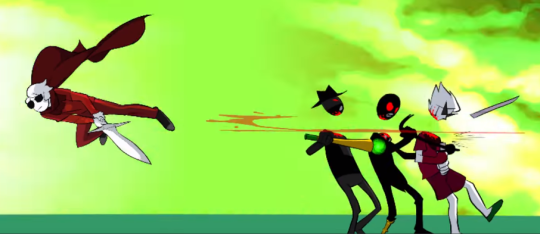
To swing things back around to Dave’s roleplay, there actually is one final act of destruction in his arc. After talking things out with Dirk and coming to see a version of his Bro as someone with the potential to do good, Dave and Dirk engage in what I can only describe as a 2x roleplay combo, with Dirk serving Dave through his Self and Dave killing Dirk to finish off the Jacks.

I like the sense of inverted symmetry here, and it puts into context why Dave’s attack is a positive thing for him–this moment is about Dave accepting that there can be some good in Dirk’s nature, and being willing to incorporate some of Dirk’s influence into his person at an appropriate time.

By embracing Dirk’s affinity for destruction and giving Dirk the chance to put his fate in someone else’s hands, Dirk can find absolution and Dave can find a coherent understanding of his identity, and Bro’s influence on it.

Anyway that’s about it. I’m glad to finally have coherent myths for Princes/Bard and Thief/Rogue, but we know how these classes work mechanically, so it’s not like they revolutionize my whole understanding of the canon. Feel free to send me asks with your thoughts, but for now…

Keep Rising!

[Patreon] [Hiveswap Discord]

[1]OK so in your force and flow series,you said that Lords and Muses,which are both extreme examples of active and passive classes,are successful because they utilize their abilities in active and passive ways simultaneously,you also said that heirs/witches and mages/seers are successful for extremely similar reasons,and that they were the least extreme cases of active/passive classes,but if we consider similarity to either of the master classes to indicate activity/passivity

catchaloststar:

revolutionaryduelist:

catchaloststar:

revolutionaryduelist:

[2]Then wouldnt it follow that princes/bards and sylphs/maids would switch places with the heirs/witches and mages/seers

image

Hrmmm, I see what you’re saying. I was going off this quote from Calliope:

Along with the distinction of Lords as “Most Active” and Muse as “Most Passive”.

My logic was that the more intensely Active/Passive classes had more dramatic impacts on their sessions, while the less Active/Passive classes were more versatile and able to switch back and forth from Active to Passive easier, making them more flexible.

The Master Classes, then, have the best of both worlds–they can have incredibly high impacts like the far-end classes, but they can also reap the benefits of both Exploiting and Allowing their aspect as necessary like the closer ones.

But that may be inaccurate. I think we’re getting closer, but I’m not sure we’ve “figured out” all the nuances of the Active/Passive scale. 
There’s a couple things that are still puzzling me, and questions like this one shaking or playing with the model are definitely helpful for helping us figure things out.

I don’t necessarily have any thoughts on this right now except that I’d like to hear how you account for Princes being positioned close to Lords in the scale. I don’t think you’re necessarily wrong, I feel like I’m missing stuff in my model. I’m just not 100% sure how to square this with the evidence we’ve got in canon. 

Any thoughts?

If Lord being a very active class places them on the far side of the scale, then Witch (which Hussie says is “said to be a highly active class”) should also be towards the active end of the scale instead of the middle?

hrrrrm, yeah. My logic I wish I could find something in the text that helped us at least figure out how the structure works :[ I think we’re starting to understand what the spectrum means, but I’m not even sure that class pairs would be placed on it symmetrically.

All I can figure is that Witches are said to be highly active in context with all of the classes, including Passive ones? My mindset being that If they’re as active as, say, Princes, then I have to wonder why they don’t seem to struggle QUITE so dramatically when they’re in a Passive state, and why they seem to have an easier time switching back and forth. 

It’s quite possible my train of thought wrt how to understand the classes in this regard is completely off, but I’d like to see alternate interpretations for how to understand the classes more holistically to counter the view, if that makes sense. 

Hmm ok. Unfortunately holistic doesn’t come very naturally to me, as I’m more of a bottom-up (vs top-down) kinda thinker and I prefer to throw details at each other in the hopes that some conclusion will fall out eventually, maybe after a few years or so. Unifying myths or some other overarching key idea that Hussie included to clue us into the system is not an assumption I’m willing to throw into that mix so readily.

So here I am again, back to niggling at those details. Specifically, you mentioned classes at either ends of the active/passive scale have the worst and the most unhealthy difficulty if/when they attempt to swap to the other side, and you’ve defined the destroy/create classes as the very ends of the scale. But Dirk’s swap to a passive Knight doesn’t seem to be a bad thing for him, by your analysis? It demonstrates Dirk’s deep love for Jake and his friends, or something like that, and he even gets immortalized in Grandpa’s memories as a knight.

Additionally, I’d like to suggest that destroy/create are the classes who actually swap with each other as a matter of course, since destroying an aspect creates its opposite and vice versa. (This is again by your theory, according to that post a while ago where I argued that destroying Hope doesn’t automatically create Rage or vice versa? Although I don’t know if that’s a theory you still hold.)

Obviously there’s a lot of fine tuning required, but if you’re looking to shake up your class scale then this might be somewhere to start?

All kinds of thinking are useful to understanding Homestuck, imo! I hope I didn’t come off as talking down or anything, i was just trying to explain how I typically think about this stuff. 

Yeah, I regard Dirk as a unique exception to the general trend of Roleplay Being Bad For You. The main thing that enables this is that Pages naturally invite Knight-like behavior in other classes, and Jake is a Hope player, which enables some good old powergamer cheating, of the sort that successful Sburb players often use. 

AR would actually be a pretty good example of unhealthy roleplay. Like Dirk, he ends up roleplaying permanently, but his Knight imagery is decidedly darker: after his heroic sacrifice to save the alphas and stop Caliborn, he spends like, an eternity as LE’s personal Butler, serving for LE’s benefit for like, forever.

Which sucks and I hope AR is revived or something but, you know. It fits the mold.

As for that theory, I think you kind of swayed me back then? In that lately I think it’s more flexible. Like for example AR destroys Heart by getting Dirk to kill himself, but that doesn’t really result in the creation of Mind? 

But I will admit I’m pretty tired and might be misunderstanding you.
To be clear, you’re suggesting that a Prince of Heart will typically tend to act like a Sylph of Mind, and vice versa, simply due to the inverse meanings of their verbs?