I agree. I have a few reasons to add “creating Light” as a reason for Joey, and I remember the Maid reference you’re talking about. It’s still SOMEWHAT possible she’s another class–I saw one reference to destruction, but she doesn’t feel like a Prince so I’m still leaning on Maid. But she’s definitely a Light player imo.
I need to get screenshots to make a whole post about it, but my classpect thoughts on the others are:
Xefros is absolutely a Page of Time. There were a fuckload of references to him as a Page already and at least one to Time, which are most of what I’ve got to compile.
Jude is PROBABLY a Seer of Doom. All of his knowledge ends up benefiting or acting through Joey, and she makes explicit reference to being impressed he actually *Knows* his stuff, with respect to all these threats and rogue conspirators he’s predicting. Of course, its still pretty early and there wasnt anything explicit there, so it’s still somewhat up in the air.
Dammek strikes me as a Thief of Breath. Not completely sure on the Thief part–all I have to go on is the fact that he’s so driven and the occasional references to him taking Xefros’ stuff. His passion for communism/non-ownership certainly sounds like “stealing” through “freedom/disattachment” to me for his own benefit, after all. So that’s my rationale there.
But SPECIFICALLY Dammek definitely seems like a Breath player, because he’s strongly referenced as having a talent for leadership and motivating/driving people–providing direction. The fact that Xefros’ classpect matches Aradia’s–Time doesn’t hurt, as Dammek’s analogue would Tavros, the Breath player.
On top of that, it sets up a somewhat interesting inverse dynamic to the relationship we saw between Vriska/Aradia/Tavros. Where Homestuck’s cycle of revenge began with a Maid of Time getting revenge on a Thief of Light for the abuse of a Page of Breath, Hiveswap’s plot seems to begin with a Maid of Light beginning to heal the withered sense of importance of a Page of Time at the hands of a Thief of Breath.
Not entirely sure if this reading will hold up, of course. But The Dancestors demonstrated an affinity for this kind of karmic role switching, and Scratch seems to be managing the events of this story, to an extent–just as he managed the cycle of revenge. So it wouldn’t surprise me if it pans out.
As for these two, I agree pretty much entirely! I think absolute power over a particular domain is well within the description of both Muses and Lords–though I will admit, the thing about Lord English and the sand kind of lost me a little? i didn’t quite follow. I’d say that their domains in Homestuck are, well. Homestuck itself. IE-The narrative.
I also agree that Lords and Muses find themselves dealing in their complementary (saying “inverse” brings us too close to inversion theory for me, I think, but it’s as good a descriptor as any) Aspect as well, I think that’s a sweet catch on your part. Lord English is demonstrably interested in Space, after all–going so far as to give himself first guardian powers.
As for this compilation of the Classes, It was quite the interesting read! For the most part we agree, and I think the Aspect “gauges” are an interesting way to visualize classpect dynamics. I like it a lot! There’s a couple of things I’m not sure I remember too well–I don’t remember Kanaya making clothes for anyone but Vriska, who did most definitely wear the fairy dress she made her, for example.
But the only thing I really disagree with is the conception of Knights and Pages. I’m pretty well on record as thinking Knights and Pages are best described by the verb Serve, and that Knights are Passive, with Pages as Active.
I also think that “buffs”/”debuffs” as a concept are probably best applied to the spectrum of Passive classes, though I definitely agree the concept applies pretty strongly to the Steal/Serve (in your reading Move/Use) quartet of classes.
All in all these were a fun read and really interesting! Thanks for sharing :))
Hey guys! With Hiveswap coming out LITERALLY TOMORROW (AAAAAAAAAA!!!!!!!!) I wanted to put together a quick video kicking off what I’ll be calling the Hiveswap Lore series–where I’ll break down connections between Hiveswap and Homestuck to Hiveswap fans who may not have the time to dig deep into Homestuck themselves, and even us Homestuck fans who might miss connections here and there!
Hopefully this video will get you more excited about Hiveswap than you are already! And since I used RJ! Lake’s Stuckhome Syndrome album for the background tracks here, I wanted to take the opportunity to remind you guys about Songs for Rune, as well!
If you’re not already aware, Rune is very sick, and could really use the support! If you enjoy this video at all and have the cash to spare, it would mean a lot to me if you nabbed some sweet music at whatever price you decide you can manage.
That’s all for now! I’m super excited to finally see Hiveswap, and I hope you are too! Hard to believe it’s less than 24 hours away, but until then–
Hey I totally forget if I already asked you this, but I was reminded by your recent post that I had a question for you about Sylphs and fairies and Vriska’s roleplaying.
Hussie said on his formspring once while talking about god tiers that “Vriska’s true form is that of a pesky, murderous luck fairy,” which seems to go against your theory that Vriska is unhealthily roleplaying her ancestor’s god tier and is not, herself, a fairy at all. https://classesandaspects.tumblr.com/post/130602203382/hussie-god-tier
How do you reconcile Hussie’s statement with your theory? (Death of the Author is an acceptable answer.)
If you did ask, I never saw it! I think I’ve seen this quote before, come to think of it.
I wouldn’t really use DotA to discard theories because I’m primarily interested in trying to understand the comic as cohesively as possible, and Hussie’s quotes re: mindset with developing it has helped me consider how best to read it many times.
I’d really only say that this particular quote kinda has to be taken in context. The thing is, Vriska IS definitely a fairy for the entirety of Act 5. It’s coded into the language she’s presented with both textually and visually across the whole deal.
When I say Vriska is a “false fairy”, I don’t mean that she’s incapable of creating a version of herself that plays the role. What I mean is that the roleplaying itself is toxic and unhealthy for her (holding to her Mindfang persona literally kills her, after all), and so it’s ultimately discarded as her character grows.
The question for me is: why was that element so completely dropped later? And why is the myth of the Fairy so consistently tied to the Maid and Sylph classes–with the exception of cases like Vriska and Tavros, for whom behaving as fairies ends atrociously?
Hussie has always been cagey about telling us exactly what’s going on. So weighed against the evidence in the comic, I’m inclined to think he’s just leaving stuff out here, given that this quote is from Act 5–before we even knew the Dancestors and could put this stuff together.
i’m usually pretty averse to posting quotes from wp staff, but i figure they’ve said inversion theory is fake often enough that it’s more helpful to spread the word than to bite my tongue on it.
It’s a really cool idea, and for years I thought it was the best way to understand Classpects. Nowadays I think of Aspect Duality is its own separate concept, and what BKEW explains through Class inversion, I think is more clearly and accurately described as Class Roleplay. That is, of course, just me. I’m not 100% sure I’m right about the Class roleplay stuff even now, though I expect Hiveswap will make me feel more certain one way or the other. All I do know is that inversion, as posited here, is extra-canonically debunked. But it’s a good concept to understand to contextualize fandom history. And it’s cool.
1. the “employee” who said that was hussie’s actual girlfriend, but other things she has said over the years prove that she doesn’t have any special insight on what andrew was planning at any given time
2. even if i did accept it as “word of god”, the author is dead.
3. also yeah its fun. i just hate people who completely dismiss it as a theory
just a note re 1): Her being debunked about other things may be true, I honestly don’t look at WP statements much so i wouldn’t know. but in that specific situation she said she’d talked to Hussie about this and was speaking from “a position of privilege”. I can dig up the particular comment if you’re interested but its just something that stuck out in my memory.
You’re right though, Word of God is no reason to simply discard a thing peeps have fun with. I don’t really like using inversion theory to try to understand the comic, but I like the concept of it a lot.
Not enough of the fandom is interested in how Classpects may play into Hiveswap, I think. We’ve gotten lots of hints at the player’s potential Classpects, but there’s a lot of skepticism as to whether Classpects will even show up at all, given that the game doesn’t center around Sburb.
I’m here to argue that they’ll definitely feature in some way. And luckily for all of us, whether or not I’m right here will be incredibly easy to prove!
Our case study will be Xefros Tritoh. But before I explain how we’ll scrutinize Xefros to determine whether or not I’m full of shit, I’ll need to talk about three things:
In Homestuck, when characters are particularly inspired by or moved to imitate rolemodels, that tends to show up in their mechanical behavior as Heroes. What’s more, such acts of imitation tend to come with references to the specific Mythological Archetypes that inform the Class of the Role-Model figure.
The Troll Ancestors are essentially our introduction to this concept, and there is no clearer example than Vriska. For all of Act 5, Vriska strives to emulate Mindfang in all things–and at the same time, Vriska is consistently depicted and referenced as a Fairy. You can see one such reference above.
So Maids and Sylphs are fairies, according to the Class system. But Vriska is a Thief, and attempting to live out the role of one. One important factor in the Roleplay system is that Roleplaying this way is often misguided and unhealthy, and that players are typically at their happiest and most powerful when playing to their innate strengths.
Compare Vriska’s attempts to make Tavros stronger to Aranea’s effort to do the same for Jake. Both end disastrously, but it’s hard to deny that Aranea had an easier time getting the job done.
We’ll talk about Knights (and Pages, by association) in a bit, but for those of you curious, here are the Archetypes for the other classes that have them:
The first thing Serve classes are prone to doing is Serving their enemies in brutal defeats.
The second–and nicely bringing us into a description of Neophyte Redglare, Terezi’s mythological idol–is the providing of Service.
Knights are prone towards helping others and serving others’ needs through the use of their Aspects. In Redglare’s case, that means that everything she does is at the behest of the Highbloods–even if she doesn’t agree with their ideology.
All the Knights we see in Homestuck adopt a code of honor of some sort, in that they hold themselves up to very high standards of behavior based on a persona they construct in their heads.
For Dave, this is the image of the cool dude. For Karkat, it’s the ruthless leader. For Latula, it’s the R4D G1RL act.
In all three of these cases, the Knights primarily use their personas to distance themselves from their emotions and force themselves into positions of responsibility, even if they’re uncomfortable with their own competence or don’t really want to carry out a particular duty.
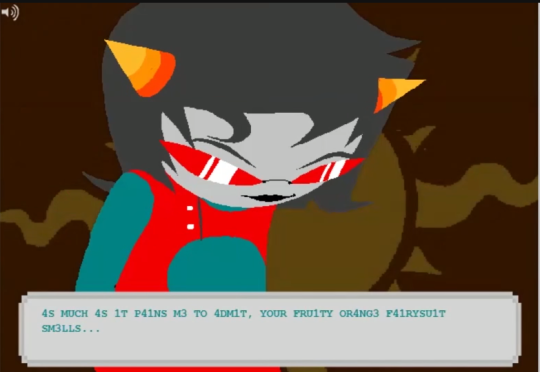
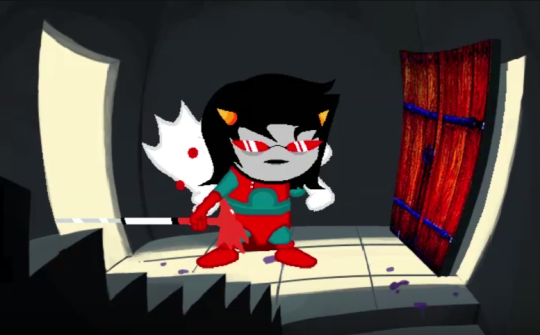
Which is exactly what Terezi does when confronted with the need to kill Vriska! Terezi buries her feelings about Vriska and decides that eliminating her is simply the professional way to resolve the problem–choosing to focus on performing her role as Redglare instead of thinking about her own feelings.
Terezi’s Redglare roleplay, however, might even go farther than the three true Knights–since it even includes a literal code for how to act as a Warrior, that she uses to determine when killing was acceptable. This code of honor is, of course, Terezi’s idea of JUST1C3.
And once Gamzee manipulates Terezi into fully embracing her Redglare persona, Terezi is visually cast as an echo of another Knight– [S] Seer: Ascend acting as an extended visual callback to Dave’s [S] Dave: Ascend to the Highest Point of the Building. Seer: Ascend even starts off with Dave’s symbol!
And the end result of this roleplaying is, of course, as disastrous for Terezi’s being as Vriska’s Mindfang roleplay is for her.
Passing judgment on Vriska leaves Terezi doubt-riddled and self-loathing for years because her true inclinations as a Seer were not to try and go to war for the sake of Justice, but rather to pry, inquire, and discover the truth about Vriska’s nature and feelings. That roleplay misled Terezi from her desires and needs in this respect shows how much of an impact it has in the narrative.
Hopefully this overview gave you an idea of the logic behind it, and if not hopefully looking at other examples I’ve written in the links above–such as Rose as a Witch, Jane as an Heiress, or Dirk as a Knight– will illustrate further.
Now. Let’s get to Xefros.
Xefros is interesting here primarily because of his interest in Butlering. The Butler is the second Archetype that informs Knights and Pages, and it covers the Service connotation as well, but it also includes last definition of the Serve verb:
To give. As a counterpoint to Thieves and Rogues–who Take–Knights have a tendency to give others their Aspect, or give others things through their Aspect. Much as a Butler offering a plate of food. Davesprite giving John a hammer with Time powers is a prime example.
And on top of being interested in one of the biggest symbols of a given Class in the comic, Xefros also comes with one free FLARP manual, it seems. Flarp being the same book that marked the impact of Roleplay and Mythological Archetypes on Vriska and Terezi, this is relevant to me.
So my premise is simple. If the Classpect system has any weight in Hiveswap, odds are very good we’ll see Xefros display similarities with Knights in some way.
(I say Knights and not Pages because Pages seem to have a knack for inspiring those around them to do the serving, whereas Knights seem much more inclined to be serving others–and Xefros is definitely interested in doing the serving.)
But there is a catch here.
Apparently, becoming a Butler is Xefros’ ambition. But that seems a bit odd, considering he’s also a rebel fighter.
So the question is: Is Xefros a Knight, or is this interest in serving (presumably the elite of Alternia?) going to prove to be unhealthy for him? In other words: Is this an indication of Xefros’ true Classpect? Or is it a case of Roleplay?
I think it could go either way at this point. Of course, it’s also possible I’m reading into stuff too much and there’s nothing here but coincidences–in which case, Xefros will exhibit nothing particularly related to Knights or Pages or possibly any Classpect stuff at all.
But to be honest, I doubt that. I am, however, very interested in testing this guess, and I hope you’ll all at least be interested in holding me up to scrutiny, too.
That’s all for now. Feel free to drop by on r/Hiveswap’s reddit and Discord if you’d like to ask questions about this, or just jam about Classpects or other cool stuff in general.
Yes. In fact I think them sharing them is canon, easy to prove in the story, and central to understanding the impact that Ancestors have on players. EXTREME ROLEPLAY of the kind we’re introduced to with FLARP actually has a lot more weight in the story than the fandom has thought up until now, I feel.
I’m actually writing a post sort of about that right now, since it suggests some things about Xefros’ potential Class. I’ve been writing about this for a while but it’s been sort of hard to get people interested? But it’s really important and adds a lot of richness to the characters imo.
i agree with it and like it a lot, but with a caveat. It seems to me that all the lands sort of reflect the state of mind of the Hero in question, and I don’t think Skaia populates planets with any particular intent–much less anything ambiguously malicious like trying to torment players with things they don’t like.
The planets are generated from the input of the player’s life, context, and imo most importantly mind and thought patterns. Homestuck’s most pervasive theme is that -individual thought- creates the reality you experience, and the individual thoughts of everyone living create the reality they experience together. I don’t see a reason to shortchange that by ascribing Skaia agency I don’t think it has.






 Flying through Storytelling