Ok, this is a pretty good reasoning of the motif, however there are still a couple of things I think you’ve missed:
1: Vriska’s motivation for dressing up as fairy is to fulfill the whole pupa pan story, and this is then connected to her GT outfit. She doesn’t do it in conscious reference to her ancestor at all, and I don’t think her admiration for Mindfang is ever verbally or image-ly linked to her fairy motifs? Also Vriska’s tinkerbell reference is also sort of present in WV’s dream, something that isn’t really connected to Tavros?
2: The references to people being fairies are connected to the troll god tier outfit, as is the fairy imagery (butterfly wings, fairy dust – which is connected to tinkerbell in [S]wake but continues to be present in the comic afterwards). The reason I think this is important is that the Maids and Sylphs who aren’t troll god tiers (Jane, Kanaya, Porrim?) are never called fairies, which sort of implies that the motif has more to do with the god tier accesories than it has to do Maids and Sylphs?
Ok, so:
1. You’re right! A lot of Vriska’s playing up the Fairy thing has to do with Tavros…but Vriska wants to win over Tavros because of Mindfang in the first place. And as far as I can tell, these dynamics are just as often presented through…for lack of a better term, narrative game mechanics, as they are through explicit text.
As far as Mindfang is relevant to the narrative, she exists as a being Made of Light in Vriska’s eyes–her importance, agency and storytelling define her, and this a Light Vriska steals for herself, to make herself feel more important and capable.
For as long as Vriska is trying to live out Mindfang’s image specifically, and trying to recreate her relationship with the Summoner through herself and Tavros, she spends her time trying to act like a Sylph.
Think about what she’s doing with Tavros: She’s trying to get him to get stronger and more assertive, trying to increase his willpower, trying to get him to become more important.
If that sounds familiar, it’s because it’s what Aranea successfully does effortlessly with Jake. Vriska tries (and is equally harmful in the process) but she isn’t playing to her strengths like Aranea is. This isn’t her forte or where she excels–it’s a role she’s playing out because it’s Important to her.
And that’s reflected in the mechanics of how she tries to handle the people around her, just as it does with Dirk and Hal.
This is also why I don’t think WV’s dream presents a conflict–being a Fairy is something important to Vriska because of Mindfang as much as because of Tavros, though the two are deeply interrelated.
There’s lots of other examples of this in the story, too–I’m fairly certain I’ve missed many even now, since Vriska as a fairy wasn’t on my radar until you sent this. Again, I’ll go over some in more detail as this series goes up.
2. The troll god tier thing is complicated somewhat by the fact that the only two trolls who god tier are…Aradia, a fairy class, and Vriska, who’s trying to fit into the fairy figure. I agree there’s some muddling of themes, but not as much as it seems like. This is because no God Tier trolls are described as fairies besides Aradia or Vriska, and Vriska drops the aesthetic completely after dying/getting punched by John.
It’s also worth noting that the forms of exposition for the classes aren’t always symmetrical–like I pointed out in my Jade essay, Witches’ powerful guardians aren’t literally called Familiars, but by all definitions that’s exactly what they are. The implication is built into the nature of the title Witch, while their complement classes have parallels built up through other means.
This, again, will hopefully become clearer soon.
So too it is with a Sylph. Maybe they aren’t literally called fairies as often, but I’d argue they don’t need to be, because a Sylph by definition is a species of Fairy. It’s also untrue that Kanaya is never referred to as a Fairy! She receives the title “Fairy God Troll” in reference to her being Rose’s Patron troll, although Doc Scratch later says this about it:
As she prepares to alchemize new items, she is contacted by her “fairy god troll”, a distinction which does not necessarily have anything to do with being a kid’s patron troll.
She’s the only troll to be described this way, with one exception: Tavros in this pesterlog with Jade, where he’s described as a Fairy God Troll…and where he attempts to do the same thing Vriska is doing by inserting himself into Jade’s story, and even considers following Vriska’s ideology briefly and controlling Bec over Jade’s protests.
Tavros ultimately doesn’t end up being Jade’s patron troll–Karkat fills that role, and is not described as a Fairy. Kanaya is described as a Fairy God Troll and successfully lives out the role that implies, setting her apart in this regard.
Finally, Jane is complicated. Like Kanaya and Karkat, Jane’s entire arc is about struggling to find herself, and she spends a lot of time slotting herself into the role of an Heiress instead–something I think I’m likely to talk about in my essay about her now that I noticed it, ALSO thanks to you so thanks.
Hey! So, this is a really good point (and is leading me to thinking about Vriska in some interesting new Lights…)
What I will point out is this: I looked it over, and pretty much every time Vriska is referenced as a fairy, it either directly concerns or surrounds a pivotal moment in her arc with Tavros specifically. After [S] Wake, Vriska is never referenced as a Fairy again.
Vriska also at least somewhat admired two Fairy figures–she thought Kanaya’s lusus was the coolest of all of them, and she literally crafted herself in the image of Mindfang–a Sylph of Light herself. This is not the only instance of a character from one mythological role actively trying to fit into the context of another. I’ll be going into at least some others–but not all–in the next two posts. One thing I’m noticing more and more now that I have the understanding I do is that the way these mythological motifs affect different classes is complicated, and that this system has kind of essentially infinite depth. There’s a lot in this story for us to reconsider and rediscover, and I’m very excited about sharing it with you guys.
Stay tuned 😉
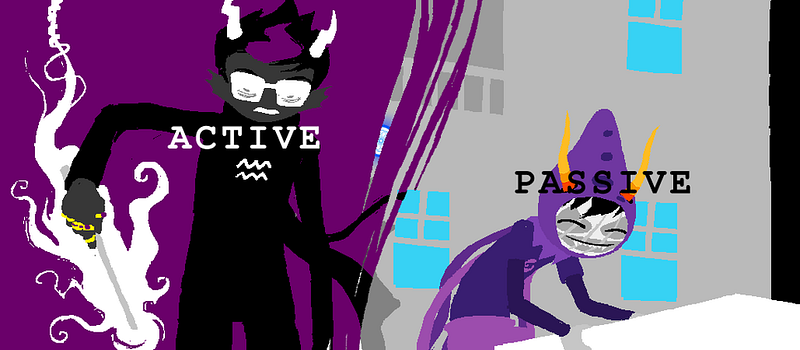
PS: As I release these essays, I’ll begin tagging posts concerning these mythological figures with their tags instead of going for the more awkward Active/Passive setup. I just think it’ll be more elegant that way, though I might have to think up terms for Prince/Bard and Thief/Rogue, who don’t seem to get them (as far as I can tell right now) because they’re freebies from Calliope.
Ok, you’ll try it out with one of your less prized possessions just to prove how dumb it is. You never liked this hat much. It makes you look like a gnome and basically isn’t funny at all.
I’ve heard this a couple of times and I think it’s currently the likeliest explanation, to be honest! Ancient philosophy didn’t account for our magnetic sciences, I guess
doesn’t aradia actually have a line implying knights are passive?
She has a line implying both she and Dave–as Time players–serve a Master they must be prepared to die a thousand deaths for. I THINK That’s a reference to Lord English, though–so I’m not entirely sure I’d count it for classpect purposes.
I’m pretty sure Caliborn’s information came from going back and reading through Calliope’s archives, if I remember right? He told Jake he did so in that conversation I believe, but I’ll have to check later.
I am completely certain Calliope is mostly reliable. She’s wrong about one thing–the Gender distributions–and those she draws from the pools of the session she has available. But Ying/Yang principles are posited to be a universal tenet of Homestuck’s reality (and many people believe our own reality too), so if Calliope is inclined to see the Class system that way, I think it’s very likely she’s right about it.
The other thing is that without being able to trust Calliope, Homestuck’s Class system really IS broken and incomprehensible. If you believe her, then suddenly it makes total sense and is absolutely fascinating and has practically limitless depth. From a writing perspective, why would Hussie go to the trouble to including all of that in logs if we were meant to completely dismiss her?
Basically I think Homestuck is a well-told story, so here where the information is delivered with care, time and attention and lines up perfectly with Homestuck’s wider themes and mechanics, I think it’s worth just taking the alien girl at her word.
Well, that would be Spoilers™ so for the most part I’m gonna abstain from answering and say that you’ll know why I placed them where I did within the next couple weeks–looking like next week if the current votes are anything to go by.
But I will say I don’t think you’re too far off! The nature of the Active/Passive spectrum factors in here, and hopefully once you see the post you’ll know what I mean 😉
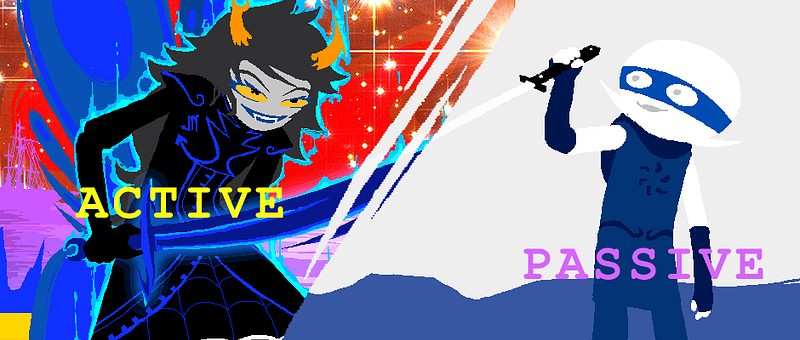
Here’s the first of the Class essays, where we go over the most intense Active/Passive dichotomy, putting these Classes on the furthest ends of the spectrum.
The Key Verbs for these classes are Destroy and Create, covering Princes and Bards & Maids and Sylphs, respectively.
Quick disclaimer so I don’t get anyone’s hope’s up: This essay doesn’t include much discussion of Jane Crocker! Not because she isn’t relevant, but because I actually ended up writing this entire series because I needed to lay out my thoughts on Maids so I could get around to writing my essay about her.
I’ll be linking to my Jane post at the end of this essay once it’s up, and this essay is pretty much required reading for it! So I think it’s worth checking out if you’re interested in her anyway.
As for the rest, I just hope you enjoy. The other two essays are already written, and I’ll be posting them over the next two weeks!
They are available in their entireties for my Patrons, so if you can spare me a buck a month you can get these early if you decide you like them enough. Higher reward tiers will let you invite friends to the Discord so they can read them too!
Feel free to @ me, reblog or send me an ask with your thoughts on these first two essays. There may be some things I can’t answer as they will be answered in later posts, but I might use those as inspiration for what teasers to release from sections of the next two essays over the course of the week.
You can also feel free to talk to me in the Hiveswap Discord where I moderate and cry about Homestuck. I’m very interested in seeing how my thoughts stand up to scrutiny, so don’t be shy!
How does this work in regards to the alpha trolls? From what we see, Kurloz is serving both Gamzee and Lord English, and Cronus is a Self-Serving prick?
Both Kurloz and Cronus are potrayed as ineffective fuck-ups. Most of the Alpha trolls are failed states for their Classes, and as I pointed out with Dirk for example who spends most of his session acting extremely Yin to both Hal’s will and Jake’s, an active class CAN end up acting Yin/Passive–it just isn’t super healthy for them, nor is it the most effective way they impact reality.
To talk about specifics I’d have to actually look at Cronus and Kurloz’s arcs, which…urgh. Maybe later. I’ve heard they’re interesting but I really need to work up the will to REALLY pore through all of Openbound again–I reference some Alpha trolls in this series but not all of them.
Here’s the first of the Class essays, where we go over the most intense Active/Passive dichotomy, putting these Classes on the furthest ends of the spectrum.
The Key Verbs for these classes are Destroy and Create, covering Princes and Bards & Maids and Sylphs, respectively.
Quick disclaimer so I don’t get anyone’s hope’s up: This essay doesn’t include much discussion of Jane Crocker! Not because she isn’t relevant, but because I actually ended up writing this entire series because I needed to lay out my thoughts on Maids so I could get around to writing my essay about her.
I’ll be linking to my Jane post at the end of this essay once it’s up, and this essay is pretty much required reading for it! So I think it’s worth checking out if you’re interested in her anyway.
As for the rest, I just hope you enjoy. The other two essays are already written, and I’ll be posting them over the next two weeks!
They are available in their entireties for my Patrons, so if you can spare me a buck a month you can get these early if you decide you like them enough. Higher reward tiers will let you invite friends to the Discord so they can read them too!
Feel free to @ me, reblog or send me an ask with your thoughts on these first two essays. There may be some things I can’t answer as they will be answered in later posts, but I might use those as inspiration for what teasers to release from sections of the next two essays over the course of the week.
You can also feel free to talk to me in the Hiveswap Discord where I moderate and cry about Homestuck. I’m very interested in seeing how my thoughts stand up to scrutiny, so don’t be shy!
I’m pretty sure I solved Homestuck’s Class System.
This is a masterpost for a series of essays that lay a case, strongly informed by the canon with screenshots and references, for the following things:
1) What every Passive/Active pair is.
2) What every Key Verb (IE: Destroy and Steal, the canon ones) is, and how those Key Verbs are paired together.
3) What Passive/Active designations mean.
4) How the Passive/Active spectrum works.
In this masterpost, I make the case for the core philosophy that informs the entire Class system. I’m also posting and linking to the first essay, on the Destroy and Create verb pair. The other two essays are already written, and I’ll be posting them over the next two weeks!
They are available in their entireties for my Patrons, so if you can spare me a buck a month you can get these early if you decide you like them enough. Higher reward tiers will let you invite friends to the Discord so they can read them too!.
Feel free to @ me, reblog or send me an ask with your thoughts on these first two essays. There may be some things I can’t answer as they will be answered in later posts, but I might use those as inspiration for what teasers to release from sections of the next two essays over the course of the week.
You can also feel free to talk to me in the Hiveswap Discord where I moderate and cry about Homestuck. I’m very interested in seeing how my thoughts stand up to scrutiny, so don’t be shy!
Thieves and Rogues, described by Callie as the Steal classes, are another freebie we understand pretty well already. Which means I get to once again explore the broader mechanics at play in this section.
The classes are a spectrum, and now that we’ve moved away from the furthest existential extremes of Destroy and Create, we can expect a bit more overlap and gentler switching between Yin and Yang states. This means two things:
These classes have an easier time switching from Passive to Active states than the more extreme Destroy/Create classes do. Doing so is typically less dramatic onto the plot, and less visceral and exhausting for the character in question, too.
These classes may switch back and forth between Allowing and Exploiting their Aspect with greater frequency, too. This makes them somewhat more versatile than Destroyers/Creators, who seem to stick harder towards one use or the other.
I will note Dirk once again describing Roxy as more group-oriented and selfless than the other three Alphas, which is true — even where Roxy begrudges Dirk his romantic disinterest in her, she doesn’t try to force things actively. Instead, Roxy pulls back from the Jakestakes and tries to manage the scenario from the sidelines for both Jane and Dirk’s benefit.
That she maintains an interest in Dirk throughout this feeds her passive aggressiveness towards him, but she still finds herself drawn to trying to help him through a breakup and worrying about his state of mind.
Consider her mirror in Vriska, who decides not to tell John about his Dad dying out of concern for his feelings — an act that could be construed as selfless…but does so because she doesn’t want to be the one who makes him sad, and wonders if that makes her selfish.
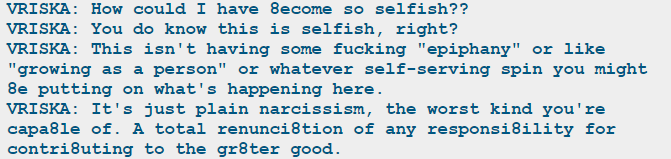
In her rant with (Vriska), Vriska also notes that she thinks giving up responsibility for the greater good is in and of itself selfish, meaning that to some degree she thinks of herself as acting selflessly by adopting her take-charge, get-shit-done persona, even when it leads her to usurping or trampling on the wills of others.
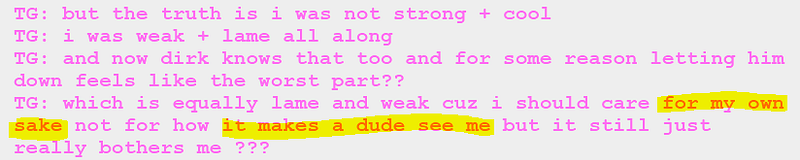
Roxy also gives us valuable insight on the nature of selflessness — namely, that it’s not always a good thing! That Roxy is more moved by thinking she failed Dirk than by thinking she failed herself BOTHERS her about herself, just as countless characters express frustrations with their own selfishness.
And Roxy is one of the clearest examples of a Passive Class acting Active in one sense while being Passive in another, as well. After all, creating the Matriorb is an incredibly conscious, laborious process for Roxy — it’s quite definitely an exploitation of her Aspect. But it’s done for the benefit of another — both of Kanaya specifically, and of an entire civilization.
The Condesce is another odd case in this respect, as she extends the Psiionic’s lifespan, which technically qualifies as benefiting him in that it allows him to continue living and impacting reality…but really only does it so he can serve as the fuel for her ship, thus benefiting herself. I mostly only include it because it’s a rare, clear instance of a Non-Seer, Non-Player character developing Classpect powers without having played the game.
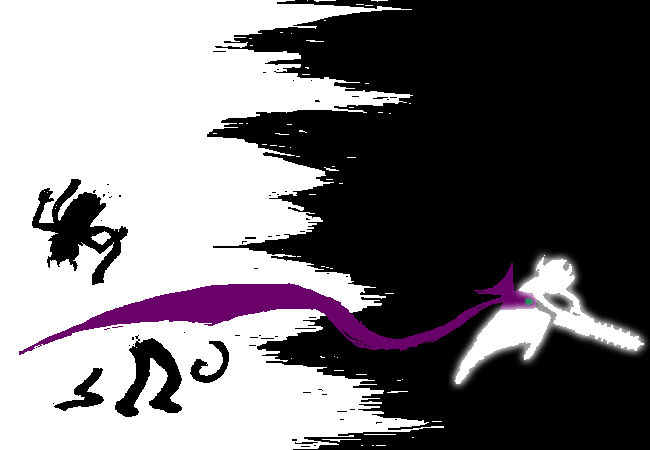
Finally, Vriska provides us with an interesting example in her childhood. When she was at her most insecure and worried she wouldn’t be able to rise up to the challenges before her, she sees a shooting star — a Light source — and reacts to it, following it and discovering the Light of Mindfang’s story within.
She steals Mindfang’s identity for herself, but she doesn’t actually describe herself as Stealing it. She only describes herself as being inspired by the story she read, and she believes the things she took were left for her.
She’s not really exploiting the story consciously, because she’s fundamentally reactive to it! In this sense Vriska functions as the opposite of Roxy stealing the Matriorb — she Allows Light to benefit herself.
Of course, it turns out to be a poor fit down the line, and arguably hurts her as much as it helps. But you could say the same about Roxy’s drinking allowing Void to benefit herself by helping her forget about her problems. Short-term Benefit doesn’t necessarily translate to long-term health.
She does this again as (Vriska). When watching Lord English destroy Paradox Space, she describes the show as Fireworks (another Light source) and Allows Light to benefit her, coming into posession of one of the most important pieces of knowledge in the entire comic as far as achieving Enlightenment goes — information that neither Lord English nor Alpha Vriska can see. Information that eventually leads her to Terezi.
This higher degree of flexibility when compared to the Destroy/Create classes is a consistent trend for all the classes going forward — which means it’s time to switch to talking about the other side of this coin: The Serve Pair.
I’ve written literally way too goddamn much on Knights/Pages and Dirk and Jake’s relationship, so for the most part I’m just going to link to this post:
Suffice it to say, a Butler is one who Serves — both through the providing of literal service as well as by serving/providing goods like food. In this sense, Knights and Pages can be considered a class focused on both service and on Giving their aspect to themselves or others.
Knights actively try to serve others — but they often end up doing so ineffectively. They’re much more effective when they embrace their group support roles honestly, and happier when they stop trying to take charge.
Karkat, for example, is routinely at his best when he allows Blood to benefit those around him without being aware of his own power to do so, even as he actively tries to lead others through ruthless leadership.
Pages, meanwhile, inspire others to serve them — but once they develop the strength of will to directly exploit their Aspects, as Jake does in the Masterpiece, they become much more powerful.
Which does point to a few new bits of information I think are worth adding to the analysis pile. Which does not stop from getting taller. I keep getting served these additional morsels left and right, like I am a dude trapped on Butler Island, and the only meal is Homestuck analysis. I am so full. Please help me.
Just for the record, here’s one more reference to Jake’s self-absorption and selfishness. While I’m here, I thought I would touch on how this reading of Pages reflects on Horuss. And also Jake again.
Back in the day, Horuss’ manipulative behavior was likened to Dirk’s behavior in his relationship with Jake. Which is hilarious to me because Horruss DOES establish a parallel to the Alphas here… with Jake’s behavior, not Dirk’s.
This is Jake using his higher flexibility as a Page to his advantage. He takes the initiative in approaching Jane, and then actively forces her into adopting a stance up-front, casting himself in the Yin position so he can merely react to what she says all the while.
He then promptly stops her from taking it back, adopting the Yang position now that Jane is reacting to their newly-established dynamic, lets her know it was a relief to find out, and conscripts her totally 100% non-fake platonic Friendliness to help him in figuring things out with Dirk.
Which keeps Jane — an Active Creation player who more healthily occupies a Yang mindset and who has a much harder time switching between Passive and Active states reactive and receptive to Jake’s will and ready to help him through his problems. For six months.
He even does the cutting Jane off thing when what she says isn’t what he wants to hear, Serving himself Hope and choosing to believe whatever statement is most convenient to him before she can counter it too directly.
But shit this is getting a little too close to making Jake look unlikable so here’s a quick reminder that, while an ass in this context, Jake is also willing to die protecting Janeafter she threatened him with sexual slavery. This is a good boy who loves his friends and is worthy of admiration and love at the end of the day, ok? People can be flawed and still good I promise.
Now let’s go back to looking at the horse asshole.
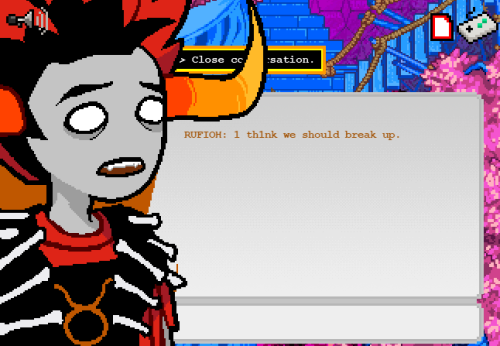
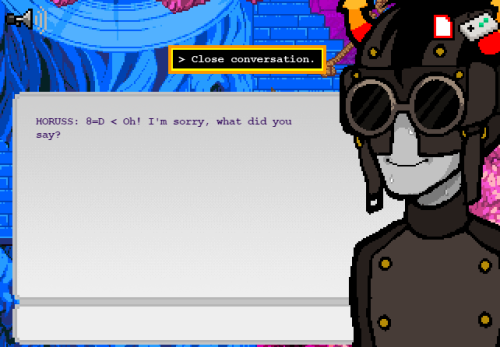
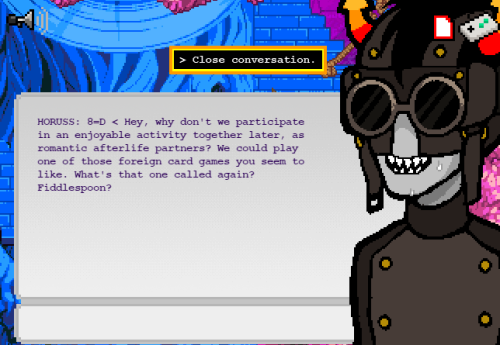
Horuss does exactly the same thing Jake does when confronted with a break-up. He simply serves himself Void in response— pretending he straight up didn’t hear what Rufioh said — and changes the subject to a romantic meeting just like Jake constantly talks up what a good friend Jane is while getting her help in managing his Dirk issues.
In both cases, the Pages make it as difficult as possible for the other party to approach them honestly, and personally benefit from continuing the status quo.
And while it’s possible to think that Jake is simply allowing his Hope to benefit him, it’s clear that Horuss is actively exploiting Void — he is directly conscious of what’s happening and what he’s doing, given the sweat drops on his talk sprite. In this, we get a suggestion of how even two different members of the same Class can execute their class differently.
Historically speaking, Warriors are a class of society specializing in combat and warfare. That is to say, the imposition of the will of an individual or collective through force and violence. Because negotiating the imposition of will is also a major factor in Leadership, both Warrior classes have a connection to that concept as well. As a result, all four classes have a particular relationship with the concept of Fighting and Battle.
Warriors also typically operate based on Codes of Honor, which squares perfectly well with both Knights and Pages’ constructed Personas. The Knight’s personas are tailored to get people to rely on them, while the Page’s personas are tailored to get people to aid them.
Left: The Warrior’s Front. Right: The Warrior’s true feelings.
That these codes are established to avoid corruption or the Warrior becoming dangerous to their societies also reflects how Dave, Karkat and Jake all struggle with their respective relationships to queerness. Dave and Jake avoid their bisexuality by using their Cool Guy and Adventurer Hothead personas respectively, and Karkat avoids his panquadrant feelings by overdramatically playing up how great the Quadrants are.
This leads to a bizarre dynamic. Knights actively tend to treat the friends surrounding them as Pages, being incredibly forward and willing to offer not just goods and services, but advice — positioning themselves as authorities who should be trusted and listened to, and doing it all for the benefit of others.
Pages, on the other hand, inspireothers to act as their Knights for their OWN benefit.
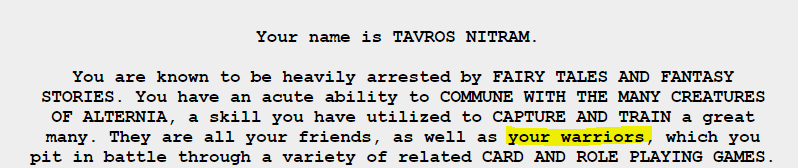
While Karkat finds the Warrior Spirit something to personally aspire to, Tavros inspires both beasts and friends to act as his personal warriors, having them aid him in accomplishing whatever he wants to do (though this can sometimes backfire). Tavros’ talent, then, is in convincing others to follow his Will — something he does Passively at some times and Actively at others, but almostalways to his own benefit. Unless, you know. Vriska’s involved.
The theme of Pages getting others to act as their Knights is redoubled with Jake, who allows Hope to summon an idealized, imaginary version of his best friend, calling himself his boyfriend post-breakup, to act as his personal warrior — Benefiting Him. Sorry, got a bit carried away there. Can’t ever get over how gay that is.
But seriously, real quick before we continue? I’ve seen people responding to this scene by saying it isn’t relevant to Jake’s desires because Jake has been manipulated by Aranea, and uh…I really have to point out that makes literally no sense. Forreal. I’ll fight about it.
Because Brain Ghost Dirk is summoned specifically to oppose Aranea here. That’s his entire purpose of being, and Aranea didn’t even know HOW he existed, so even if she somehow had a reason to summon him, her reaction does not at all imply that she did. This isn’t Aranea’s will at play, which means Jake isexploiting the power she forced out of him to exert his.
So Dirk is like Vriska — trying to live up to a mythological role that isn’t natively his. But through his relationship with Jake, Dirk becomes something that, near as I can tell so far, is wholly unique — a successful case of someone roleplaying a Class that isn’t theirs in a healthy way.
Jake’s behavior in summoning Dirk this way, by the way, is a direct contrast to Roxy’s creation of the matriorb, by the way — where the Passive Stealer of the Alpha session exploits her Aspect to benefit others, the Active Serverallows his Aspect to benefit himself. In both cases, the Player makes something out of nothing — they just go about it in different ways.
But it’s when Jake exploits Hope that his power truly shines, as he willfully rises up to deal Caliborn his first defeat — this time coming to Dirk’s defense instead of having Dirk save him. Though given all the vaguely blackrom-coded language surrounding Caliborn and Dirk and the gay romance language linked to the Hope Bubble, it’s possible there may be an element of selfish jealousy to Jake’s actions here, indicating he’s acting for his own benefit after all.
Either way, it’s thoroughly in keeping with a Page’s potential behavior.
Tavros’ gathering of the Ghost Army is also an active process where he exploits Breath to inspire others to follow him, but many seem to consider it Passive in the sense that they think he’s doing it for Vriska’s benefit. He is not. Tavros is acting for his own benefit, and he gathers the Ghost Army specifically so he can take the credit and use it for a specific purpose:
Owning the fuck out of Vriska. To put it another way, what we’re watching here is Vriska getting Served. But not in the butlering sense — strictly in the sense of dealing someone a devastating rhetorical loss. And immediately once he deals wrecks her shit, he pretty much goes on to ignore her completely, focusing all his attention on Meenah.
He gives Meenah the army OVER Vriska, despite barely even knowing her. Which makes total sense — Tavros is a Self-centered Breath player, the Aspect of freedom and detachment. He was happy enough to get all these ghosts to help him with wrecking Vriska’s shit, but there’s nothing in Tavros’ character that suggests he WANTS responsibility or control over anyone, let alone a vast group of people with literally the highest stakes imaginable in question.
Though the way he goes about handing it over is…well. What the fuck is he doing, exactly? This is really out of nowhere and random, right? Doesn’t it feel contrived and ridiculous? I know it did for me.
Until I realized. I’ve seen this before.
This is Tavros buttering someone up. When they want something specific from someone, Pages are very good at resorting to flattery. And if you’re doubting Tavros is as capable of doing so as Jake and Horruss, well…Tavros has self-evidently farimproved his persuasion skills, hasn’t he? I mean, he got what he wanted out of nearly every self-absorbed ghost in Paradox Space.
And Meenah has something Tavros wants, because Tavros died at 13 and never really grew up like the other characters — in keeping with his Peter Pan fantasy. But never growing up means Tavros still has another fantasy he wanted to live up to — one that originates all the way back in the early days of Hivebent.
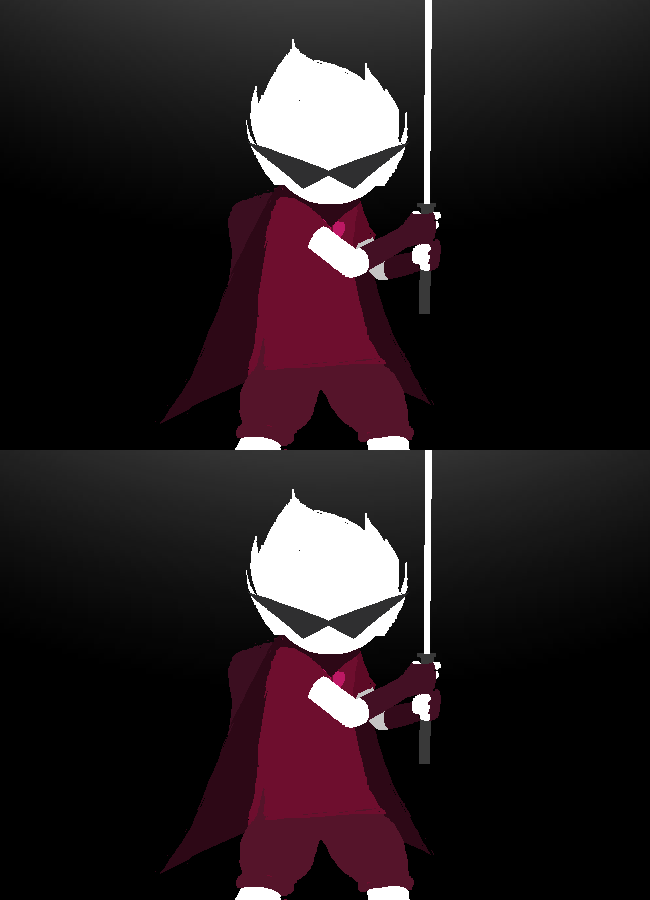
Becoming a Cavalreaper. Which is exactly what he does, if this jousting practice figure is anything to go by! Tavros ends up missing a shield, but he’s got the jousting lance down, and Meenah literally uses him as Cavalry — fulfilling the first half of the name.
It’s also worth noting that despite being much younger than Meenah and Aranea age-wise (he died younger and his entire thing is not growing up), Tavros holds his own in the fight against Lord English about as well as they do. Considering Meenah’s power-level was once implied to be equivalent to the original Vriska’s, that puts him about on par with her, too.
Tavros living out two fantasies and free of all burdens and responsibilities makes a formidable Warrior in his own right, even as a Ghost denied the opportunity to really grow or mature like the other characters. He’s certainly come far from his old showdown with Vriska in [S] Wake.
And Vriska had exactly fuckall to do with it. Good job, kid. I’m proud.
Now I think we’re ready to move on to Knights. Again, I laid out most of my argument for Knights in the post linked above, so here’s the link again. I did find a couple more things worth noting to add to my case, however.
First off, Karkat dropping Sollux down the stairs counts as Karkat acting passively under both definitions, as the event knocks his front teeth out, allowing Blood to flow from Sollux’s mouth. It turns out this is Karkat allowing Blood to benefit Sollux, too, as Sollux ends up being pretty happy to be able to speak without his lisp!
Finally, I don’t think I need to prove how group-oriented and selfless Dave and Karkat are, but I did find this exchange notable. Seers are also a Passive class, and here we have Rose and Dave each trying to argue each other down from taking ownership of their suicide mission. Each trying to get the other to prioritize themselves while personally prioritizing the other.
Rose isn’t able to talk Dave down until she admits to another way he can help her, giving him a way to be of service to her by just spending some time with her before she dies. Obviously soon after this Rose ends up in danger and Dave flies off to save her, putting them both on the moon anyway — but the exchange itself is notable for how it tells us Dave thinks about things.
Dave’s instinctual focus — like Kanaya, Gamzee, Roxy, and others — is on how he can help others, and he’ll take pretty much any opportunity to do for those he cares about, even at the cost of his own desires.
Lastly for now, we’ve got this moment, which I found notable because it showcases Dave acting reactively both to the will of another — in this case, Terezi — and to the will of his Aspect — in this case, Future Dave.
Dave continually talks about how he’s simply presented with time loops over the course of the Beta session that he’s then obliged to complete. Which sounds very much like behaving as if through the will of the Aspect.
That’s all on this pair, though I’m sure I’ll have more to say about it in the future. For now, feel free to check out the other pairs:
Special credit goes to meteorMatador for informing me about the Serve verb in the first place. This piece wouldn’t have been written without him.
This series of meta posts is a passion project, but also just a side project to my youtube series aimed at making Homestuck to both new fans and old ones. That means these very posts will be showing up with updates and more polish in Youtube Video form, and if I have my say they’ll do so as soon as possible.
If you like my writing and have a buck to spare, you could really help me make that reality possible sooner rather than later by throwing me a buck on Patreon. Doing so will also give you access to the main community that has helped me craft this analysis series, although I also got plenty of insight through conversations on the public Hiveswap server I help moderate.
Since Calliope just gives us the definitions for Prince and Bard, I get to use this as a freebie space — no Unifying Myth prove here. I did EVENTUALLY find the Unifying Myth for Prince/Bard, and I think it’s interesting, but you can click through to the hyperlink if you want to read about that.
Since we can take this pair as a given, I’ll mostly use this section to lay out some of the foundation for how this system actually works in practice.
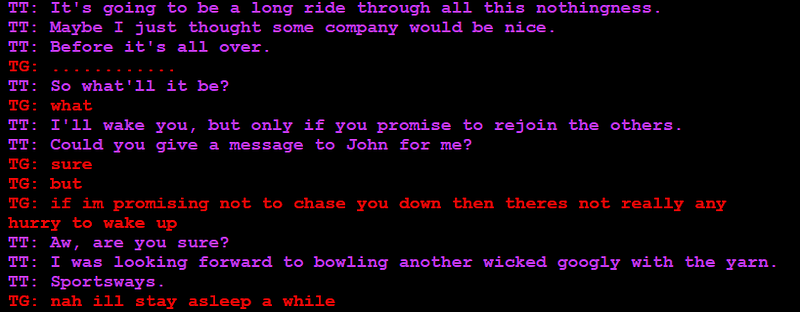
For now, let’s get to establishing that Selfless/Selfish thing. Notice Dirk describing Roxy as selfless here, and distinguishing himself as someone to whom that doesn’t come naturally.
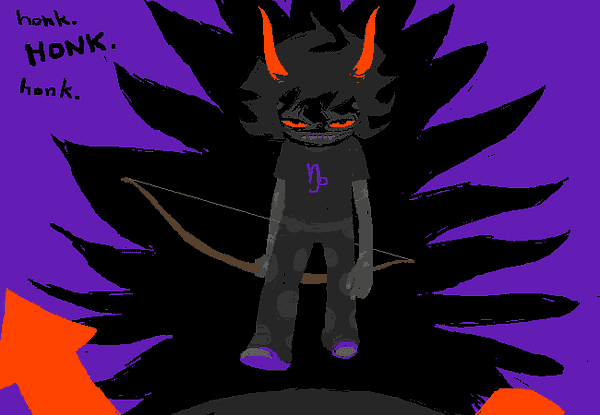
In this sense we can immediately distinguish Dirk not just from Roxy, but from Gamzee. Gamzee is a horrible, evil, vicious person — but he’s also extremely selfless, given that literally everything he does is in service to Caliborn’s goal of becoming Lord English.
Gamzee will become Lord English, too — but note who the Dominant/Yang personality is once they’ve combined. Caliborn is the Active force. Gamzee is the Passive one.
Ok I guess I should stop making that sound so homoerotic for now. Let’s change the subject before your desire to read this is destroyed completely. Sorry about that. Just…Gamzee, you know? What can I do. Fuck that guy.
I know what I can do actually. Present a new concept!
The easiest way to imagine the Active/Passive spectrum as I see it — at least, that I’ve found so far — is as a sort of See-Saw. The more existentially intensely opposed a pair of verbs is, the further down the See-Saw they are.
This is because the verbs themselves are more intense — the effect on the whole of reality exerted by someone Stealing something is less intense than the effect exerted by Destroying it. Knowing a lot about a thing is even less impactful onto reality than stealing it is in turn.
This is what determines the Spectrum, in my view. A Prince is not more “Selfish” than a Witch or a Page, or even necessarily more effective — but their natural role is both more specific and dramatic in it’s effect, Removing something from the world, where it can’t be easily reclaimed or fixed. This means that all else being equal, with two players both playing to their strengths and in tip-top condition…
A Destroy class could be expected to win an outright firefight with most other classes, riding on the intensity implied by their Verb.
But this focus on specialized power comes at significant cost. The classes at these extremes are less versatile as a result of their extremity. The full implications of the loss of that versatility will become clearer as we compare this quartet to those that will come later, but here’s a good place to start:
The more intense the existential dichotomy between the two pairs, the less likely it’ll be for an Active class to act Passive, and vice versa. And with verbs as extreme as Destroy and Create, we can expect the shifts between Yin and Yang to be extremely intense the rare times they happen, and often greatly unpleasant for the Player when they do.
This means that Create and Destroy classes tend to be fairly all or nothing. They tend to struggle between extremes, either rendering themselves almost totally irrelevant or practically dominating the plot with their wills.
Finding a balance between the poles tends to be a hallmark of successful versions of these classes, and in some cases is the main challenge they face.
This is certainly true in Gamzee’s case. As a Bard, he starts off incredibly Passive — allowing the Destruction of his own Rage, benefiting the entirety of the troll party. Going Sober temporarily puts him in an intensely Yang position, resulting in his damn near taking over the story — which also marks the moment Gamzee ceases thinking about benefiting his game partners and begins thinking about benefiting Caliborn instead.
His dominance over the story doesn’t last, though, and the rest of the time Gamzee manipulates the story from the margins — typically by inviting Rage in other people.
For most of his narrative, however, Dirk actually remains static, inactive, and thoroughly Yin-positioned in a way deeply unhealthy to him — just like Jane and Jake. Almost all of the Yang behavior of Active Destruction carried out in his narrative isactually committed by Hal, who plays an integral part in Dirk’s evaluation of himself and his mythological role.
When Dirk finally takes action on his own, turning Yang/Active himself, he threatens to destroy Hal (and, implicitly, himself). Dirk’s narrative role is complicated somewhat by Jake, so I’ll pick up a bit of this thread in the Page/Knight section.
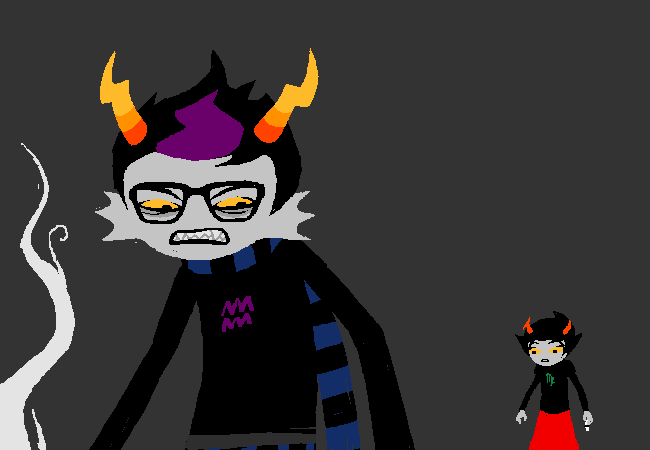
Eridan is a clearer example, as he’s constantly simultaneously destroying his own Hope — rendering himself angry, miserable, and skeptical — AND Actively destroying his relationships through his Hope for romantic reciprocation with practically anyone. And when his misery and self-centeredness come to a head, nobody is able to dissuade him except by force.
And nobody manages to do that until he pisses off the reactive, stable, Passive Sylph enough to make her take action. Who is much more pleasant to talk about and who I actually have to prove points about anyway, so like, let’s cut to the chase and get to the Creators.
Maid/Sylph Key Verb: Create (Make?) Copacetic Sub-Verbs: Make (Create?) , Improve, Heal, Repair, Increase, Grow Unifying Myth: Fairies (Note: The Create/Make nuance is a pedantic one on my part. Nothing much changes, but I may expand on it in the Jane essay.)
Fairies are beings mythologically described in tons of different ways, and are an extremely old and varied cultural figure. But some consistent themes surrounding them include an unearthly Fairy realm of their own to inhabit (which certainly describes Aradia’s relationship to the Bubbles) and an interest in meddling in the affairs of mortals. (Kanaya and Aranea. Nuff said).
Crucially, every Fairy-type player is at some point described as a kind of Fairy, and pretty much exclusively…with one exception. We’ll revisit Kanaya and her role as a “Fairy God Troll” in a little while, but first I wanted to use this moment to segue a little.
Because this “Fairy God Troll” reference leads us to the only real muddying of the waters as far as Maids and Sylphs exclusively being related to fairies, and it points out some interesting stuff about how Classes work in Homestuck.
So Kanaya’s one reference to being a fairy is here, where she’s described as being a Fairy God Troll. This is a designation that Doc Scratch explicitly notes doesn’t necessarily have anything to do with being a kid’s patron troll, although it’s used in the context of Kanaya attempting to be Rose’s patron troll.
So there we go — Kanaya gets a fairy reference, mythology secured, I’m right about everything and Homestuck is great. Good job team. Except wait — Doc Scratch isn’t talking about Kanaya in that line. He’s talking about Tavros.
Tavros ALSO gets the Fairy God Troll designation once, when he talks to Jade. In this conversation, Tavros attempts to act as Jade’s Patron troll…but unlike Kanaya, he fails at this! It doesn’t work out, and Karkat assumes the role instead. In this sense, Kanaya succeeds — thereby securing coherence between the mythology she was trying to live up to and the role she was trying to play. Fairy God Troll reference achieved.
But that’s not all Tavros does here. This is also the one conversation where Tavros flirts with embracing Vriska’s ideology of doing what’s best for others even at the cost of their own wills. But hang on — what does Vriska have to do with fairies? This Unifying Myth thing is starting to sound an awful lot like bullshit!
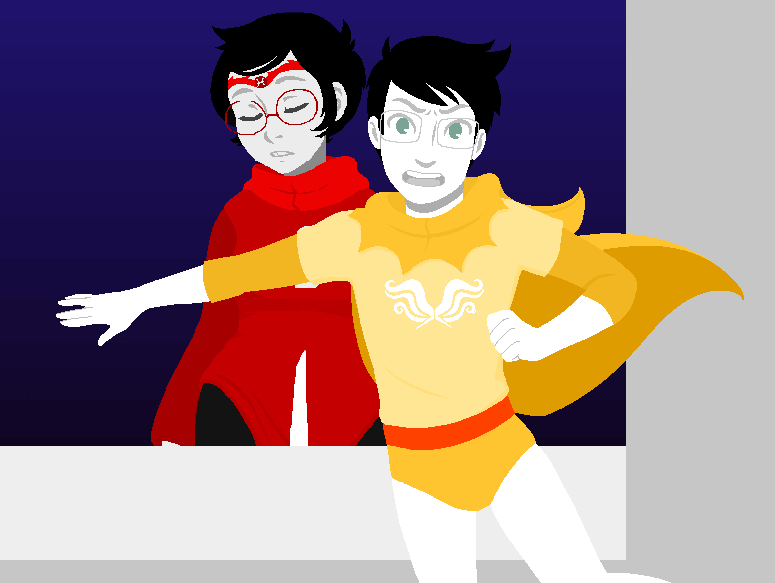
Well, quite a lot, actually. Vriska actually has by far the most references to being a Fairy out of any individual character, and gets several visual motifs referencing her playing out the role of a Fairy as well. So what gives? Doesn’t this kill my whole argument?
Not exactly. 100% of Vriska’s references to Fairies come about while she’s trying to live up to a Sylph’s legacy–Mindfang’s. She references the dress she used trying to get Tavros to like her (a sequence which has a bunch of fairy references, not including it here cause it’s pretty uncomfortable) as being a Fairy dress, and her entire rationale for being interested in Tavros’ is Mindfang’s past tryst with the Summoner.
Like Dirk trying to play the role of the Knight, or Eridan that of a Wizard, this is another instance of that I’m taking to calling Mythological Roleplay.
This is Vriska trying to force an identity onto herself that doesn’t quite fit. As a result, she comes off kind of try-hard about a thematic motif she later drops completely after her death/The Retcon, at least in terms of trying to do things exactly as Mindfang would do them. And this is reflected not just thematically, but mechanically as well.
After all, one of Vriska’s main goals as a Fairy is to make Tavros stronger, more assertive, more…Important. Vriska is trying to act like a Sylph, increasing the Light in another. This does not play to Vriska’s strengths, and is a terrible idea! She is not successful at all. Which is worth noting here, simply because this exact thing is something Aranea can do basically effortlessly.
Aranea engages in the same role play as Vriska, but to her this role comes naturally, and she’s far more successful at achieving the particular goal of making a Page more relevant…even if it’s also to the Pages’ detriment.
S0 having cleared up the references surrounding Fairies, it’s time to ask…what does being a Fairy even mean?
And just as Kanaya is by implication, Aradia personally claims to be Made of Time. This absolute connection to their Aspect also explains why Sylphs are more magical than Witches. A Magician can use magic, but a Fairy is literally made of it.
Kanaya and Jade also give us another clear indication that Passive classes are group oriented or selfless, as Kanaya — like her fellow Sylph, Aranea — finds herself eager to help and meddle in the affairs of others.
They are typically shut out from doing so, however, and considered “nannying” or “meddling” for their trouble, which tends to frustrate them and make them unhappy. Finding a balance between focusing on themselves and their desire to get involved with and help others is part of a Sylph’s struggle, at least in the context of the Sylphs we see in Homestuck.
This is one aspect of the Maid/Sylph dichotomy, so keep it in mind for when we get to Aradia.
For now, let’s revisit this Fairy God Troll thing with Kanaya, because at turns out, just like with Tavros emulating Vriska, there’s a double-meaning to her actions in this pesterlog, too.
Think about it. Eridan had access to Alchemy, just like Kanaya did. And he could presumably watch Rose alchemize her own wands, too. Why should he need Kanaya to alchemize a Wand at all?
Well, come to think of it… do we ever see ANY Princes alchemize new weapons for themselves? No. And Princes are a Destroyer class, while Alchemy is a process of Creation or Recombination. Is it possible that different Classes have unique relationships to the Alchemy system?
And if Princes are less inclined or able to make magical items…is it possible that a Sylph, being a Creator class noted as being “More Magical” than even a Witch, might have an easier time using Alchemy — a Sburb construct, ie: an element of the setting, and thus an element of Space — to create objects Imbued with magic?
Couldn’t that action be parsed as Creating through Space, for the benefit of another?
I’m going to say the answer is yes, and I’m also going to say Rose, as a Seer, has a relationship to magic that makes it easier for her to more accurately roleplay the idea of a Witch, relative to Eridan — one that has to do with her positioning on the Class spectrum. Take me at my word on this until you can read the essay on the Change/Know classes, for now.
Obviously, helping out Eridan doesn’t work out for Kanaya. But once Kanaya is reborn through Space as a Rainbow Drinker, she also gains unnatural “rainbow drinker fastness” that she hardly seems aware of — Almost as if she had an increased ability to navigate space.
And when she goes on her rampage of revenge — temporarily becoming a Yang force that, again, dominates the narrative for as long as it lasts — she kicks Gamzee off a cliff, sending him deeper into the Meteor and increasing the Space between him and the rest of the cast, to all their benefits. She proceeds to Punch Vriska further away, too — putting her at a distance from her showdown with Eridan, before finally….
Increasing the Space between Eridan’s two body halves. Note that Kanaya’s weapon is the only one that consistently does this — the only other weapons used for severing in the story are Dave and Dirk’s swords, but even those are much more often used for puncturing or stabbing. Kanaya’s weapon, uniquely, only severs.
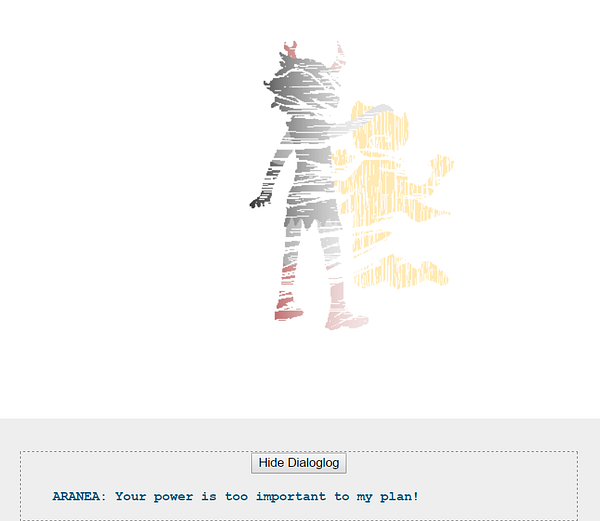
Aranea is another obvious example of Creating being a powerful offensive force. Aranea describes herself as a Healer, and her skillset certainly includes the ability, but all Aranea really does to Jake is make him more important.
She increases his relevance both literally and figuratively, making him Light Up so much he becomes the brightest object in the Session and draws all eyes to him. In other words, she Creates Light in him.
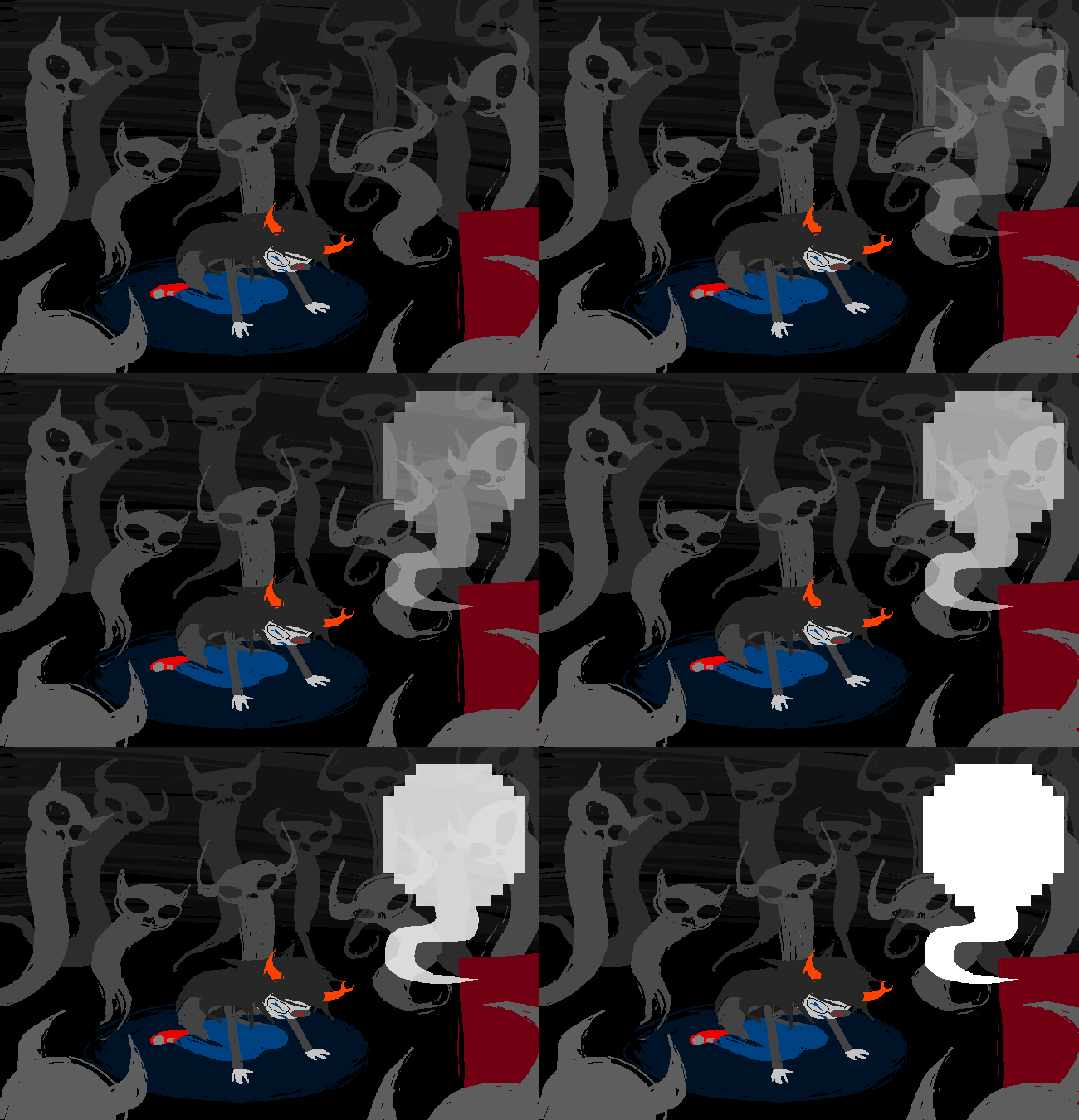
Aradia operates similarly, bringing us to Maids. Aradia’s main psychic power is to summon the souls of the deceased. In effect, that can easily be interpreted as giving more Time to the departed, allowing them periods during which to continue existing in the mortal coil.
However, Aradia summons these ghosts specifically to exert her own will by making Vriska Pay. Note that Terezi dissuaded her from doing so, and Aradia expressly didn’t listen. Aradia’s patterns of thought are ultimately self-directed, Yang focused rather than Yin.
And once Vriska kills her, Aradia Re-Creates herself the same way Kanaya did. However, for Aradia this is implied to be an Active process. The most likely case for why she was ever a Ghost in the first place is that her dream self was sleeping on Derse and summoning herself into the mortal plane, effectively Buying herself Time.
But just like Kanaya’s transformation into a Rainbow Drinker was a byproduct of the environment Kanaya grew up in, Aradia’s transformations fit into Time’s visual motifs.
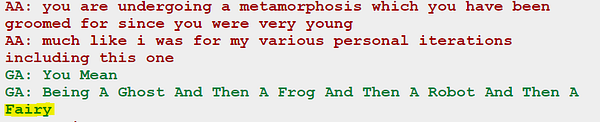
First she dies, experiencing the one change Time will force on everyone. Then she combines with a frog as her Sprite self, resembling a tadpole. That links her to one species known for undergoing metamorphosis over time, but the trend continues as she encases herself in a metal shell — as if a kind of Pupa — before finally bursting forth as a full-grown Butterfly/Fairy.
Tadpole to Frog, and Caterpillar to Butterfly. Aradia’s character arc includes Double Metamorphmetaphors.
Aradia’s greatest act in the session proper is to Create thousands of time duplicates of herself — something she does willfully and knowingly, not “through the will of the Aspect” at all. These clones then create more Time for the trolls to survive — first by subduing the psychic pressure of the Vast Glub, and then by serving as a distraction against Bec Noir.
But now we come into a point of conflict for many. Being a Maid, like being a Knight, comes with an implication of Servitude — and that leads to many seeing Maid as Passive class. In my view, however, this focus on servitude is something to overcome for Maids, or at least to find a sort of balance with.
Servitude does not leave Maids feeling fulfilled the way it does for Knights and Sylphs — they have more in common with Pages in this respect. It is something to overcome to a large extent, and when embraced, it is only because it is tangential to the goals they have decided on.
All this imposed servitude to Time leaves Aradia miserable, fatalistic and empty. It’s only once she God Tiers that she becomes happy, and at that point her priorities become notably different. Aradia takes to a different kind of service — one she chooses herself, by acting as a psychopomp for the dead ghosts in the bubbles. But Aradia starts doing something else at the same time — something decidedly Homestuck.
She begins creating Time in vast, incomprehensible amounts for herself. As the story of Homestuck progresses, the sheer amount of Time Aradia spends in the bubbles informs more and more of our reading of her, making her alien and incomprehensible.
And while she uses her Time to help ghosts out, she’s notably unconcerned when they start getting murdered and stuff! Aradia’s reasons for staying in the Bubbles aren’t quite just to help her friends out, though they can include the activity. They’re far more specific, as we come to find out through John.
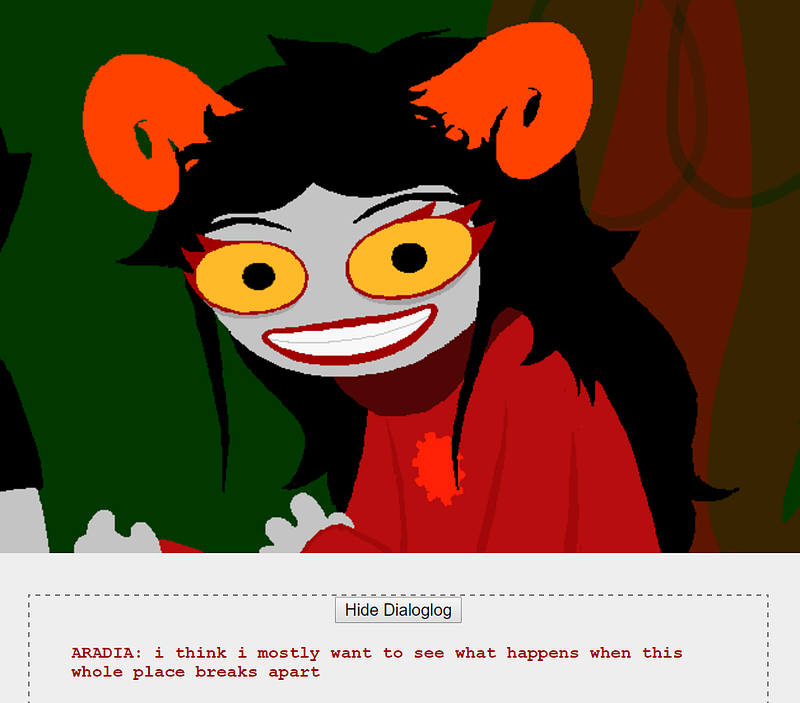
Aradia wants to know what happens next. She wants to be there to witness the end of the story, and the beginning of whatever comes after. And in the meantime she lingers in the bubbles, uncovering the entire history of the massive time loop that informs the story in it’s entirety.
By the end of her arc, Aradia’s not operating as a Passive class according to either definition. She’s not fundamentally reactive to her Aspect, since she actively uses it to get what she wants. And she’s not particularly motivated by helping other people either, although she’ll be happy to if it lines up with her goals and desires.
This particular post will receive one big follow-up when I talk about Jane, because I really think Jane merits the space for an entire essay by herself, and this monstrosity of a project is already too long.
But I wanted to note that she is in fact referenced as a Fairy once–in an interesting context. Gnomes are also sometimes described as Fairies, and like Sylphs, are a species of Elemental–in this case, of the Earth.
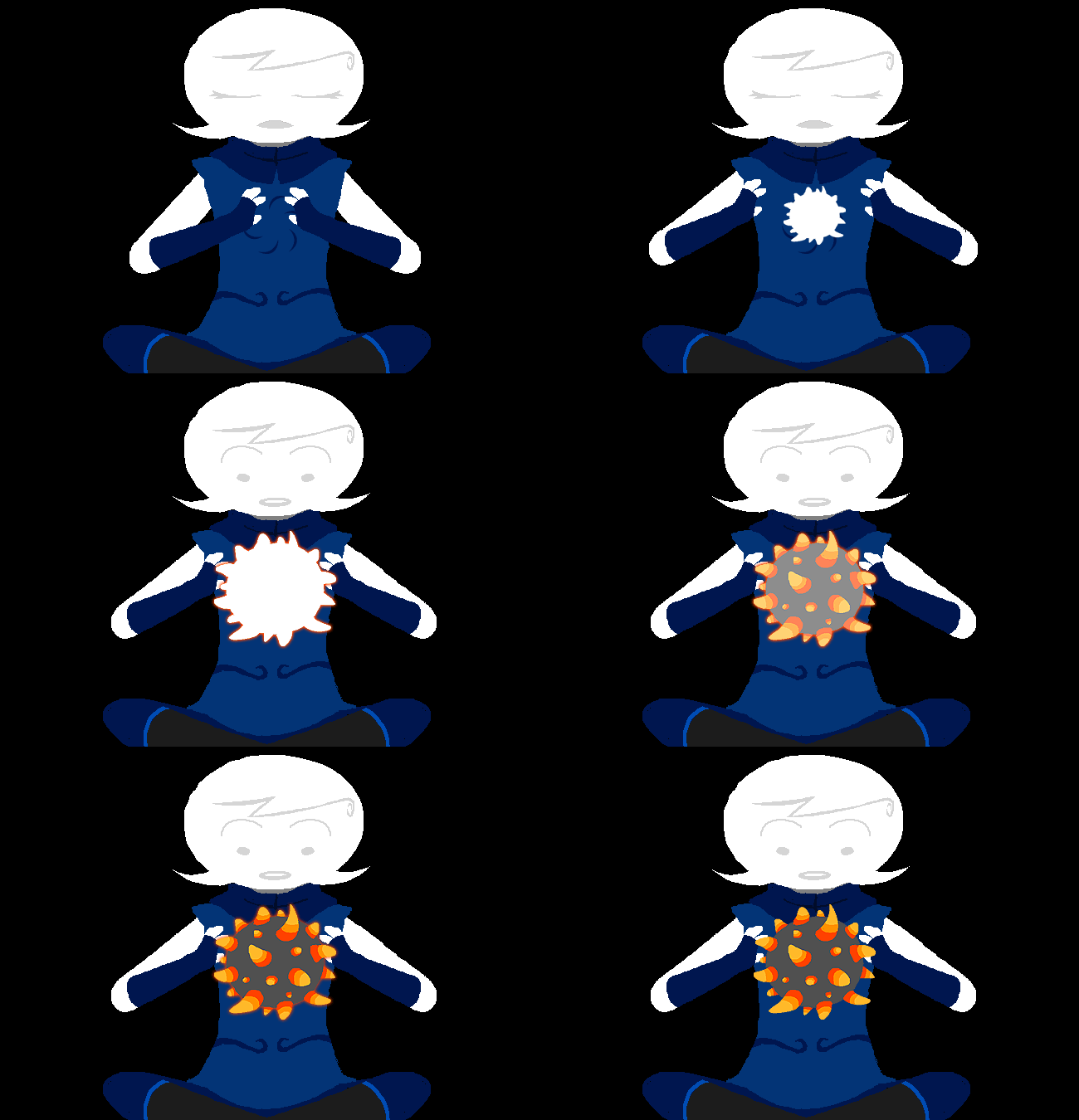
But Jane discards this role, claiming it makes her look stupid, and that it’s unfunny. Jane embraces a different role instead…that of the Heiress.
Suffice it so say, I think it helps to read her arc as one where she finds herself serving Life, much as Aradia does Time. For Jane, that servitude is enforced through a role she’s encouraged to play, one that doesn’t play into her strengths and causes her to struggle with her true nature.
that her struggle is one of finding the balance between imposing her Life onto others and repressing her Life entirely. I also think it maps onto this reading of Maids and Sylphs perfectly.
Once it’s available, I will hyperlink that expansion here:
This series of meta posts is a passion project, but also just a side project to my youtube series aimed at making Homestuck to both new fans and old ones. That means these very posts will be showing up with updates and more polish in Youtube Video form, and if I have my say they’ll do so as soon as possible.
If you like my writing and have a buck to spare, you could really help me make that reality possible sooner rather than later by throwing me a buck on Patreon. Doing so will also give you access to the main community that has helped me craft this analysis series, although I also got plenty of insight through conversations on the public Hiveswap server I help moderate.
































 Flying through Storytelling