Seeking truth through conversations on Love and Fandom
Tag: classpects
Idk if you’ve already mentioned this but wrt Jake being smarter than he presents himself as, there’s also this dialogue about Tavros (and Vriska) early in Act 5:
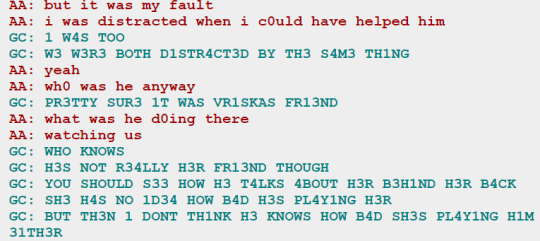
GC: H3S NOT R34LLY H3R FR13ND THOUGH GC: YOU SHOULD S33 HOW H3 T4LKS 4BOUT H3R B3H1ND H3R B4CK GC: SH3 H4S NO 1D34 HOW B4D H3S PL4Y1NG H3R GC: BUT TH3N 1 DONT TH1NK H3 KNOWS HOW B4D SH3S PL4Y1NG H1M 31TH3R GC: S33 1TS COMPL1C4T3D
But I haven’t been able to find anything in the rest of the comic that builds on this quote. What do you think?
The thing is, this quote doesn’t refer to Vriska and Tavros. It refers to Doc Scratch. Here’s the full quote:
Terezi and Aradia are talking about how Scratch distracted them, giving Vriska the opening she needed to hurt Tavros in the first place.
I haven’t deleted it because I think it’s a lot better than people thinking Jake is a clueless moron, and deleting it wouldn’t stop the reblogs anyway. But I think I overstated my point pretty hard.
Jake is really perceptive and aware–much more than people give him credit for–but he’s not like, moreso than any other one of the kids. He’s just about on par with them. What people mistake for cluelessness is actually willful ignorance that Jake uses to avoid confrontation because it scares him, basically.
I think reading Pages as a class that is out to serve themselves and inspires others to serve them is a much more comprehensive and accurate description of how Pages act in general.
I don’t think that behavior is always particularly intentional and highly ceberal/manipulative though, and I certainly wouldn’t say what happened with Tavros and Vriska was at all equal.
Tavros found himself outmaneuvered, manipulated and coerced at almost every point with Vriska– that she did it all out of a desire he inspired in her to help him become stronger doesn’t really change that.
You can abuse someone while wanting to help them every step of the way, and Vriska’s intentions weren’t even quite that clear-cut and noble. Things with Dirk and Jake are substantially more complicated, and I don’t consider Dirk’s behavior abusive or coercive at all (Hal is another story).
But that I’m trying to reframe how Pages are perceived to act in general shouldn’t be an indication that I’m trying to establish a new parallel between Dirk and Jake’s relationship and Tavros and Vriska’s.
They are two completely different arcs with totally different contexts, and how I read Jake and Tavros as characters doesn’t mean that either was less abused–Jake by Hal, Crockertier!Jane and Aranea, Tavros by Vriska.
But uh yeah basically check out that other post, I wrote better in that one and I had new info to add there anyway. Thanks a ton for sending me an ask I could use as a loose excuse to get this off my chest.
So the first thing to note is that any gender can be any class. Hussie confirmed that girls can be Princes on twitter at some point, I don’t really have a link or anythin but I thought I’d point that out.
And in my view the gender restrictions were always canonically shaky in the first place. They were delivered by Calliope early in Act 6, and Calliope understands a lot about the game (I think she’s right about her descriptions of Active/Passive classes and I use her definitions as my own), but I don’t think Calliope understands very much about gender or identity by that point.
I mean, that’s a plot point! Calliope thinks she’s incapable of feeling red romance because of her species…even as she expresses profound fascination and interest in it. Calliope, like all the characters, is influenced by a status quo of heteronormativity and gender essentialism. What she says about how often any class is any gender reflects 2 things:
1) Her own views on gender and identity, which at this point are still limiting and self-restrictive in a way she explicitly grows out of just like every other character in the comic, given that she starts dating Roxy.
2) The patterns of the four sessions she has access to and draws sources from. Calliope doesn’t analyze all of Sburb–she analyzes Sburb in the context of Homestuck, just like we the audience do, and where the conclusion she draws is incorrect, it’s informed by a bias towards preestablished gender norms.
As for the specifics, there’s tons of ways trans/nonbinary people could interact with Sburb. Dream Selves are idealized selves so I guess trans people who find that powerful and gratifying there could be an element of transition to the transformation. God tier powers are reality warping enough to enable that kind of thing in dozens of ways, too.
Not that that’s necessary, obviously. Lots of trans people don’t want to transition and I suspect some people would consider it being presented that way kind of cheap. There’s also tons of ways to enable more honest gender expression through the Alchemy system. For instance, I read Jake as non-binary or genderfluid and I think he expresses that potential fairly well. So there’s that. There’s also people who read, say, Roxy and Dirk as trans–and since Calliope is at the mercy of her sources which are historical documents that track the mythologies of the players as they present them, there’s not really any way she’d know better.
I think Sburb is always best interpreted as expansively as possible while still holding to the existential philosophy that informs its game design. So the answer is anyone can be anything they feel called to, wherever they fall on the spectrum. Sburb is interested in having its players self-actualize, and that can happen in as many different ways as there are stories to tell–whether we’re talking about rises to heroism narratives, or coming of age and coming out narratives. (Coming out narratives are intrinsically heroic narratives anyway, in my view.)
All witches are selfish, the Queen had said. But Tiffany’s Third Thoughts said: Then turn selfishness into a weapon! Make all things yours! Make other lives and dreams and hopes yours! Protect them! Save them! Bring them into the sheepfold! Walk the gale for them! Keep away the wolf! My dreams! My brother! My family! My land! My world! How dare you try to take these things, because they are mine!
I have a duty!
Terry Pratchett, The Wee Free Men (Discworld, #30; Tiffany Aching, #1)
So this is vibing really really hard for me in terms of Active classes in general, and Jade and Jake in particular. I think the active/passive system is unfurling into something that is as profound and fascinating as the Aspects themselves in my head and I am really really excited about it.
i agree that figuring out your classpect is something pretty personal – a close friend might be able to guess at it, but it’s ultimately something you should figure out yourself, and a stranger will never have enough information to be all the much help imo. my advice to anon is to think about the way you interact with and impact the world, and ask if any of the ideas embodied in the aspects feel foundational and especially important to you.
and you can also look to hs characters, it’s likely that’ll you’ll find similarities between yourself and characters that share your class or aspect. not always though, since there are lots of ways to interpret and embody every class and every aspect.
I’m kinda really busy so I can’t really like, help all peeps out with god tier titles especially since I consider it something pretty personal to me and I’d feel weird about just suggesting them to people I don’t know well!
jumping off of that last post – this is why i dont put much stock in classpect analysis, because there is so little supporting it in canon and what there is can be interpreted so many different ways
like i said, the canon complementary aspects are time/space, but theres enough similarities between space (being) and void (non-being) to consider them opposites. and when you look at the classes that are usually considered complementary pairs (with NO support from the narrative), a lot of them just seem to be tacked together because all the others were already taken. for example, what is the overlap between breath (wind, freedom, forward momentum) and blood (unity, brotherhood, interpersonal bonds)?
wouldnt the more sensible pairing be breath and doom, and blood with heart? breath represents freedom and autonomy, while doom is implied (we never meet enough doom players to know for sure) to represent submission to a predetermined outcome – whereas blood represents bonds and community, and heart represents ones own self or identity. OR you could draw a line between doom (predestination) and mind (choice). hell, forget doom, its the duty of a time player to submit to the will of the alpha timeline – wouldnt a knight of doom and a knight of time use different methods/tools to the same ends? wouldnt a seer of time and a seer of doom both be granted with Knowledge of the ultimate will of the alpha timeline?
what about breath and mind? “my path is the only path” vs “two roads diverged”. or light and rage? enlightenment and good fortune vs. despair and senseless destruction. or hope and breath? what i believe vs. what i do.
which is why i tend to value classpect analysis by textalks over, say, bkew – bkew makes assumptions about which classes and aspects are complementary, and then uses those assumptions to prop up more assumptions about where characters arcs are leading, or what theyre not telling us. assumptions built on assumptions, putting weight on a house of cards. whereas textalks works the other way around – figure out what characters do and think, looking at their complete journeys through the narrative, things we know, and then drawing conclusions about what classpect means from there. most of the classpects are very nebulously defined, and theres enough in the canon to extrapolate an approximate meaning, but if you build a house on unsteady ground it cant hold itself up for long
I basically think Classpect analysis needs to be rebuilt from the ground up. I think we know basically what all the Classes and Aspects do and are (or at least, can be), but you’re right–a lot of the fanon around it has essentially turned into a complicated house of cards, and it’s limited the way we think about them up til now.
For instance I actually agree with BKEW’s Aspect pairings (and iirc Tex does too), but I think “inversion” as BKEW posits it does a lot of harm to our abilities to read a coherent narrative into Jade, Aradia, especially Jane (which is a particular point of aggravation for me).
I also think in nailing down particular pairings we’ve sorta forgotten that there can be parallels and synergies beyond just the complementary pairs. The aspects are meant to make up all of reality, after all–it’s totally possible to think of constructs that are primarily made up of one or two aspects primarily even when they aren’t pairs.
For example, the Green Sun incorporates Light as much as it does Space. The Horrorterrors are as Lifey as they are Voidy, and water itself has both Life and Void connotations depending on how you look at it.
The aspects are colors used to paint all of Paradox Space, and there’s ways they can resonate with each other beyond just their complements. That’s what makes the system compelling, imo.
Haha I actually kind of hate the one about Jake’s intelligence because I feel like I overblew my point, but if it’s doing it’s job by countering the “Jake is a moron” mentality I’ll only grumble a LITTLE. But I will say pretty much everything I’ve written about Homestuck is better, and you might wanna read that instead.
As far as Classpect help you can feel free to drop me an ask with your thoughts or drop by the Hiveswap discord and I and a bunch of other classpect peeps are there. My general view is that classpects are a pretty personal thing (or at least, mine is for me), so I don’t tend to try to classpect people or tell them how “correct” their classpects are but sometimes havin someone to spitball off and insight on what the classpects are and do is all you need to decide for yourself, and I’m happy to try and help out there.
Alright here we go I finally get to write about Jade. My biggest Homestuck secret is that for how relatively little I talk about her, Jade is actually probably my favorite Beta kid.
I love the others and Rose and Dave in particular are intensely personal to me but Jade vibed with me in a way pretty much no character in fiction ever did because she’s an unabashed furry and that’s basically the subculture that raised my preteen catholic ass.
So Jade means a lot to me, and the way her narrative grows has always spoken to me as much as Dave’s narrative about overcoming toxic masculinity, or Rose’s struggle to find existential meaning. In a way, Jade’s struggle IS Rose’s struggle! Jade and Rose have narratives that lead us to twin conclusions about the nature of Homestuck’s reality.
That’s getting ahead of myself though, and I’m going to do this wild thing where I try to impose some structure on my approach so hopefully you can come away with a clear idea of what I think Homestuck is doing. (I want to give special thanks to @landofsomethingsomething for helping me out with the feedback that led me to striving to improve in this respect.)
So. This post has three thesis statements that I hope you come away with at least seriously considering, if not outright buying into.
1. Jade’s character arc was as thought out and deliberate as any of the kids’. She was not “shafted” by the story. The two reasons fans most likely seem to think she was were the Three Years trip she spent alone, and that she “didn’t do anything in Collide”. I believe both are misreadings of the canon.
2. Jade’s arc is meaningful both for herself and for the broader narrative, and builds to one of the most important revelations about Homestuck’s universe.
3. Jade and Davepeta are not only canon but deeply romantic, and Davepeta stands to improve one of the biggest reasons fans feel Jade got “shafted”–not to mention that some fans might take issue with Jade’s lack of a romantic arc, and Davepeta…well…is her romantic arc.
But before we can talk about where Jade’s arc succeeds, we need to talk about what it is, which means we need to talk about her title–Witch of Space. For the record, here’s my view on the mythological roles:
They aren’t a pasted on set of superpowers, and they aren’t given to the kids by Skaia. The titles describe the nature the kids had all along, and the way their patterns of thought reflect onto the world around them. They also foreshadow their narrative arcs and trajectories in their entireties–Just like the titles Hussie was inspired by in creating the system, the Hero of Time and Hero of the Winds structure from the Legend of Zelda.
I’ll begin by tracking Jade’s similarities to her fellow Witches and Space players. By pointing these out I believe I should be able to give you an idea of what I think Jade’s arc is about, exactly.
After that, I’ll expand my reading of Jade as a Witch of Space to include her later narrative turns, as well as explaining how I feel Davesprite–and later Davepeta–is inherently tangled up in her arc, as well as being a better romantic partner for Jade than basically anyone else in the story.
Let’s go. I’m hoping this is the beginning of something really excellent.
Where lies the Witch’s magic?
The first striking similarity between Witches is their bond with an outside force much more powerful than they arerepresenting their Aspect. For Jade, this is Becquerel.
For Feferi, it’s Gl’bolyb-who is about as Lifey an entity as it gets. It is, after all, defined by being unknowably massive, incomprehensible Living things, with conscious awareness of its own.
It is simply a completely alien kind of Life to our own, and thus the Cosmic Horror. Gl’bolyb also requires the consumption of vast quantities of Life that Feferi has to provide it, tying it to Life’s themes of edible consumption. More on Life stuff when I write about Jane soon, though.
Like Jade, Feferi has little direct power early in her life. But she’s able to accomplish stunning feats through her connection to her guardian–which functions effectively as a Witch’s familiar. Before ascension, a Witch’s power is linked to the symbol that identifies her as a Witch in the first place.
Feferi is also ambitious. Not only did Feferi originally aim to change the rules of Life in troll society imposed by the Condesce’s will, but through her connection to the Horrorterrors, she’s able to fundamentally change the rules of Life on a metaphysical level, allowing Ghosts to exist inside dream bubbles in an unnatural limbo.
Damara has an outside power figure linked to Time, too–Lord English, who she associates with and wishes to work for. She also changes her relationship with Time–turning it into a weapon to use against her friends as revenge as opposed to a tool and series of systems she needs to serve like Aradia and Dave do during their sessions. She’s quite willful and ambitious about both her relationship to her “Familiar” and her use of her Aspect.
Both witches are driven primarily by their own ambitions and desires, and both witches are also fundamentally Changed by their Aspects. Feferi loses her life and becomes a ghost, her will becoming almost indistinguishable from the Horrorterrors’. And Damara’s primary use of her Aspect coincides with a drastic change in outlook and personality, making her cynical, bitter, and willing to serve her Familiar over connecting with others.
Now–if Witches are ambitious about and defined by both changing and being changed by the domain of their Aspect, then what is Jade’s field of ambition in this regard? To answer this question, it’ll help to look at her fellow Space players.
The weight of Space
We don’t see Porrim pre-session, but from their introductions, Jade, Kanaya and Calliope are all defined by a unique passion for Sburb. This makes sense–Sburb, after all, is the construct that defines the Space they will exist in their entire lives.
Waking early on Prospit also essentially makes them grow up in two environments–places–at once, meaning that they grow up influenced by the culture inherent to two different environments.
This is particularly notable with Kanaya, who is uniquely untouched by Troll culture compared to her friends. Her morals are much more aligned with Sburbs’ spirit of growth and cooperation, and she takes a passionate interest in fashion–which is to say, the expression of ideas about oneself through clothes.
This kind of self-expression is something Sburb encourages constantly, and is in fact it’s core philosophy. Kanaya internalizes it completely to such an extent her identity is created by her relationship to Sburb–and Space–much more than by her relationship to Troll culture. Calliope, too, is so inspired by Sburb’s philosophy of cooperation and possibility that it works against her Cherub sociology.
This connection also allows them to use the insight gained from one environment to influence the other. Space players tend to set the stage for their own sessions, laying the Setting for their games in their own unique ways.
Finally, all Space players seem to end up somehow becoming entities they surround themselves with and are influenced by in life, in this sense being drastically affected by their own environments. Kanaya grew up influenced by troll rainbow drinker novels, and just so happened to develop an affinity for the Alternian sun.
Once she transforms, she gains super speed–ie: an increased ability to navigate space– and the ability to fill her environment with Light, which she always found highly desirable. This pattern is repeated across Space players–Calliope is able to inspire others to see her as a Troll, while Jade is able to deliberately Change herself into a Furry. More on that later in this essay.
Now a picture begins to emerge.
The Witch is the Active Change class. One could parse the title as:
One who Changes X, or Changes through X.
With the corollary attribute of One who is Changed By X.
And as Sburb defines everything about the setting of Homestuck, and the enviroments of Space players growing up. And given Witch’s ambition and zeal, it makes perfect sense to think Jade’s ambition and execution would concern Changing not just Space, but Sburb itself.
And she is uniquely changed by the environments the game exposes her to–the divide between Jade’s Dream Self and her Waking Self is by far the widest of any Player.
Dream Jade is relatively pampered and aloof, and while having access to a whole other world makes Waking Jade’s life far less distressing and lonely than it might otherwise have been, she still ends up more practical.
And once the game really gets going, also more demanding. In her desire to protect people and be an asset, Jade holds herself to a very high standard. As such, she actively tries to be strong and keep an upbeat attitude, and in execution Jade’s approach to this is quite similar to John’s–she ends up coming off as weirdly emotionally detached from the consequences of what she’s doing.
The difference is that Jade willfully uses that detachment for her own benefit, like Jake does. After all, reviving Dream Jade this way directly leads Jade to becoming a God Tier, and embodying Space as a First Guardian.
Dream Jade, meanwhile, dies, and is greatly changed by the stagnancy and fatalism inherent to the Dream Bubbles. Jade tries to comfort Jadesprite, but this also brings us to another core facet of Jade’s. Jade has a habit of bottling up her emotions in a big way, like Jane. Jade wants to be reliable and useful, and to her that parses as a focus on practicality and solution-oriented thinking.
So when Jadesprite–who’s another version of her–fails to live up to her standards, Jade tries to be caring… but tries to find practical solutions which go ignored as Jadesprite copes with the trauma of her circumstances. Jade’s frustration with the game, with Jadesprite’s defeatism, and with Jadesprite as a reflection of herself build until finally she gets fed up and…
Blows a gasket. Jade’s got self-loathing issues just like anyone in Homestuck, and for her they manifest as being angry at what she could’ve become under different circumstances. She hates Jadesprite for being so malleable to her environment, and for being something she sees in herself–Selfish. Jade didn’t think too much about Becquerel before creating Jadesprite, after all, did she? Active classes are intrinsically self-motivated, and Jade is no exception.
She extends much more time and patience to her friends, consoling Rose when her Mom dies…but even then is immediately concerned about what she will do with her feelings. In this pesterlog she also begins to question the nature of the game they’re playing, beginning to note Sburb seems outright cruel at times–foreshadowing her more intense struggles with the nature of the Space she inhabits.
Which brings us to Davesprite. Dave and Jade had a special relationship growing up, and Davesprite is a Dave brought into being by the game Jade is so invested in. And Davesprite is the one who finds Jadesprite at her lowest, and comforts her. He then makes her aware of her own power…
And encourages either Jade’s first great feat of magic as a Witch of Space. Immediately after this, Jade ascends, becoming one with Jadesprite and bringing the entire session under control–an action Davesprite bears witness to in it’s entirety. Soon after, Jade and Davesprite start dating during the three year’s boat trip. But…
It doesn’t work out. Why?
Well, there’s two reasons. The first is that Dave is an abuse victim, and that isn’t really the kind of trauma Jade could easily relate to–she’s been exposed to neglect and isolation, but the experience of being subjugated under an overbearing guardian would be alien to her– and she never takes it particularly seriously growing up.
This is something Jade can relate to to some extent–she was solely a Sprite for a time, and distanced and set apart from all society besides that. But the game fixed both of those for Jade, through bringing her closer to her friends and God Tiering. Not so for Davesprite.
Note what these issues have in common, though: Neither abuse trauma nor existential marginalization are problems that come with practical, tidy solutions–which are Jade’s instinctive method of dealing with things.
Jade wants to look for something to Do about everything, but there’s nothing to really Do for Davesprite. So Jade bottles her feelings of frustration up, only to have them come out when she goes Grimbark. But even while evil, brainwashed, and pissed off about Davesprite breaking up with her…
She still sticks up for Davesprite’s validity and personhood. Now, let’s move on to the retcon.
Davepeta happens, obviously–Nepeta acting as a Rogue to “Steal” Dave’s Heart for his own benefit. Davesprite transcends both his issues with his Bro and his tortured sense of auxiliary identity. Nepeta benefits from this arrangement, too–but we’re talking about Jade, so let’s see how the retcon treats her.
In the Post-Retcon version of the three years trip, Jade ends up completely alone and isolated. Fans usually hate this about her arc, but hear me out, because this is where I make my case for the first point I laid out at the beginning of this:
This isn’t just about tormenting or “shafting” Jade. It isn’t Hussie being lazy or not caring about her. Jade is struggling with her Aspect, the same way Dirk is tormented by his Splinters, Terezi by her Choices, and so on. And as she struggles with Space, she also struggles with the Game–and the label it seemingly “assigns” her. Space.
She dreams about and meets Alt!Calliope, who tells her the Game has ordained this tragic reality for her, and as a result Jade feels distanced and set apart from her friends–just as Davesprite once did. When she meets Alt!Calliope again, she reinforces this notion, seemingly telling Jade that it is in a Space player’s nature to be alone.
But that’s not all she tells her. As she’s exposed to the fully-fledged Muse of Space the longest, Jade is also uniquely privy to the deepest secret of the nature of all of the entire Homestuck multiverse. A secret implied and built up to literally from the moment John first bites Sburb’s apple and enters the game(citation pending–I’ve got that video recorded already):
That Paradox Space is composed out of the abstractions of thought called the Aspects. This is the root of my second point, that Jade’s narrative is important both for herself and the wider Homestuck story–not to mention our understanding of it’s Multiverse.
The implications of this stunning revelation are enormous. Calliope literally states that ideas are made up of the Aspects, and what the Alchemy system does is make physical objects out of ideas. All of Paradox Space grows outwards from these twelve tiny elements of thought, and so reality is literally something created by those perceiving it. In Homestuck, existence is created by thought–and so too is all physical matter.
Imagine being granted the key to understanding the entire universe. That’s what is happening here. Jade doesn’t understand all of it right away, but the core idea gets across. And understanding the true nature of reality this way could take Jade’s interest in science to an entire other level. There’s practically no limit to what she could do with this information, I mean–if all of reality is created by thought, then what are the real limits of what’s possible for anyone?
Having delivered this information, Calliope leaves–leaving Jade as close to the biggest symbol of Space in the comic–the Green Sun–as she could get. Jade lingers, waiting, under the impression she is inherently meant to simply comply with the will of her Aspect and Paradox Space, when along comes…
Davesprite, freed of all the issues that made their relationship originally unworkable. Only now it’s Davepeta, and Davepeta is a wholly new entity, completely and utterly defined by their relationship to the Game that functions as one of Jade’s primary domains of power and influence. It would be literally impossible for Jade to have met any version of any person even remotely like Davepeta elsewhere. It had to be here. It had to be through Sburb.
Davepeta also has unique insight into the nature of the Player’s ultimate reality, and is one of the few characters with more insight into that reality than Jade herself.
In keeping with the Light motif with Homestuck’s romantic relationships, Jade lingers in the dark Void of her loneliness, not knowing whether she should Do anything, by a hyper-incandescent 2xSprite, an entity literally created to provide aid and information as well as giving off Light physically.
As if that weren’t enough, Davepeta is also a twice over Passive player–a Knight who serves their friends Time, or serves them through Time, and a Rogue who can Steal Hearts for the benefit of others.
And Davepeta is also coded as a cat and a bird, simultaneously–the two animals most commonly associated with Witches.
Do you see where I’m going with this? Now that Jade is a fully ascended Witch who has mastered Space, along comes Davepeta, framed perfectly to act as the Witch’s Familiar. A Familiar whose existence reflects not just dominion over Physical Space, but mastery over both Sburb and the nature of Paradox Space.
And what does Davepeta do when it’s, for once, Jade at a loss for what to do next, trapped in a circular spiral of logic on whether to even move forward? Davepeta says that’s dumb, and that Jade should do whatever she wants to, and offers her a practical solution to help her do it. Making it clear that Davepeta is capable of being a partner and aid to Jade’s desires and ambitions.
Jade then wakes up, and decides to follow Davepeta’s (and Calliope’s) advice: She has fun.
In Collide, Jade chooses not to fight, but rather to use her space powers to play with Bec Noir and PM, distracting them and keeping them busy. Doing this leads her to Changing the game in the most powerful way possible.
The two First Guardians are completely equalized by Bec’s influence on them, making them equal in power…but also giving them equally powerful feelings of love for Jade.
By setting up this situation, Jade turns the core fatalism of Sburb on it’s head–-setting up a scenario where White can do the impossible and defeat Black itself. That’s about as “Changing” the nature of “Space” as it gets–a Witch of Space, fully realized.
And now Jade is hanging out, happy with her friends and not lonely or isolated at all. Jade is having fun and enjoying herself on Earth C. That’s a pretty satisfying narrative, as far as I’m concerned.
Jade struggled, but she also gained unique insight and knowledge entirely in keeping with her Aspect. At the very least, considering the importance of the information Jade got from her journey and all the thematic imagery surrounding it, I think it’s likely that approach was intentional and not a byproduct of Hussie “not caring about Jade” or “shafting” her.
Whether you guys do or don’t like where he took Jade’s arc is another conversation, albeit one I’m willing to have–I’m just arguing there was intent behind the chaos.
That said, now I’m going to do something I don’t usually like to do, and speculate about Jade’s future a little.
I personally think Jade’s “arc” is complete enough as it stands now–Davepeta’s a compelling romantic partner, but it’s not like Jade necessarily needs a romance in the first place. I won’t be upset if I end up wrong about this stuff– I just think the nature of all this build up between Jade and Davepeta makes it more likely than any alternatives I can think of.
So here’s some thoughts about the Epilogue you may want to consider:
Whether Davepeta will survive to meet up with her again is, admittedly, an open question…but considering all this narrative buildup, the fact that we already know Sprites exist past the end of the Game, and that Davepeta already fought Lord English and survived, I have a hard time believing they’re going to be killed off at this point.
We already saw Roxy steal something from nothing, so it’s not impossible to think Davepeta could reach across the Timelines they already see, and steal the Heart or Time Game Over Jade spent with John and Davesprite in the original timeline back from the Game that took those experiences from her–fitting into Jade’s motif of Cheating the game to suit her desires.
This is the nature of my third and final point–that on top of everything else Davepeta adds to Jade’s narrative, they could subvert the lasting pain and suffering the Game inflicted on Jade across those three years, enabling her to remember her relationship with Davesprite, and also potentially giving John and Roxy another person who remembers the old timeline.
No idea if that’s gonna happen, or be shown in detail if it is. I just think that given the sheer depth in which Davepeta’s and Jade’s arcs are interwoven, it’s not impossible. If it doesn’t, I’m personally pretty happy with Davepeta giving Jade some good advice and helping her out at the end. Feel free to let me know what you think! 🙂
Alright, that’s all I got on Jade for now, guys. Hoping to write one post about Jane soon, but I’m going to be refocusing back towards video editing and job hunting, so these written posts may slow while I devote more energy to making videos. This has essentially been a side project to my Homestuck, Explained series as I gathered my thoughts on the endgame enough that I thought it warranted posting some more of them.
If you’re interested in enabling me to write more of these posts and making more videos, it’d be cool of you to check out my Patreon. We’ve got a neat little Discord community of Homestuck aficionados thinking and talking about a bunch of different Homestuck analysis topics, and doing so can also get you perks like previews of my video scripts and previews of the videos themselves.
That’s all for now, peeps. As always, thanks a ton for reading.
[Author’s Note: This is a repost of Love, Faith and Fantasy–my piece on Jake and Dirk’s character arcs and the relevance of Knights and Pages in understanding them. I thought breaking it up into chunks would make the content more accessible, and give me room to flesh out each argument. Thus there will be some updates to the content. Hopefully this will mean more people can easily approach it!] [Pt. 2 – Faith and Fear] [Pt. 3 – Fearful Heart] [Pt. 4 – Noble] [Pt. 5 – As You Wish]
This is super interesting! I really like the serve/own verb, but I’m still kinda trying to square away the active/passive reversal with what we’re told in canon. Obviously Homestuck is full of unreliable narrators, so we might be able to just throw out some of that, but I wonder if it might be possible to slightly adjust our understanding of active and passive classes to make this all work? Kind of what I’m thinking about here is a grammatical approach, with active classes more frequently taking on the subject of the sentence. For example: A thief steals, a prince destroys, a knight serves. A rogue allows things to be stolen, a bard invites destruction, a page inspires service. I do agree with you that players generally both act and are acted upon by their aspects though, so this is more about general inclination than saying that a rogue can’t directly steal or a prince can’t be destroyed by their own aspect.
Hmm. So here’s the thing: I think this understanding of Knights and Pages is much more in line with canon, actually.
As far as I can tell, the understanding that Pages are passive and Knights active seems much more in line with cultural connotations of those phrases than with how the classes’ actual execution lines up with what we’re told.
Calliope gives us two different potential signposts for the Active/Passive divide:
There’s what she says about Rogues/Thieves:
Active Benefits Themselves, Passive Benefits Others
And what she says about Princes/Bards:
Prince destroys the Aspect, or through the Aspect.
Bard invites the destruction of the Aspect, or invites destruction through the Aspect.
I think both of these definitions of Active are much more clearly filled by Pages than by Knights. Knights are thrown off by Dave seeming so in control of his Aspect, but Dave is in fact forced to comply with loops Time has already presented him with.
Pages seem passive perhaps because they inspire their Aspect in others–but then, they only do it so those others will then serve them. And what do we make of Dave giving John a hammer made of Time and Karkat seeming to invite Blood without even knowing it?
I do think it’s intentional that Knights come off active and Pages come off passive, though. Calliope also tells us this:
The Dichotomy is complex. Understanding the Active/Passive dichotomy as being “for oneself” or “for others” is, apparently, only a handy starting point. And this is demonstrably true–after all, Roxy is a “passive” player, but she develops pretty willful and deliberate control over her Aspect.
It’s hard to say she’s acting “as if through the will of Void” when she revives Calliope or makes the Matriorb–that really seems like the will of Roxy to me.
So while we’re considering potential complications for the pairs, I think the question is worth asking: Is it possible for a pair to exist operating one way while cultivating an affect that suggests the opposite? I think so. It’d be in line with Hussie’s MO to mislead our perceptions that way, I think.
That said, I am genuinely curious to hear people contest this, if they ever do. It’s entirely likely I’m wrong here and I’ve missed something obvious that makes Pages passive after all, but no real definition I’ve seen for them in the comic seems to fit that.
What we seem to be going off, as a culture, is that regularly lacking agency or not necessarily contributing much to events makes the class Passive…but we never get that as a definition for Passive in the comic, and several Passive players fly in the face of it. It seems like something we’re bringing to Homestuck from the broader cultural understandings of those words to me right now.
[Author’s Note: This is a repost of Love, Faith and Fantasy–my piece on Jake and Dirk’s character arcs and the relevance of Knights and Pages in understanding them. I thought breaking it up into chunks would make the content more accessible, and give me room to flesh out each argument. Thus there will be some updates to the content. Hopefully this will mean more people can easily approach it!] [Pt. 2 – Faith and Fear] [Pt. 3 – Fearful Heart] [Pt. 4 – Noble] [Pt. 5 – As You Wish]
What I didn’t do is discuss the potential key verbs Knights and Pages might operate under–because I honestly didn’t have one I felt confident in. In the wake of discussing the piece with @theworstpersonintheworld (misleadingly named), he made a suggestion that struck me deeply, and once I started thinking about the story in those terms everything truly fell into place.
I think it will be useful in explaining the dynamic between Jake and Dirk as I see it, so I’d like to make the case for it here before we move forward.
The key verb for both Knights and Pages is ‘Serve’. This puts them in direct thematic opposition to Rogues and Thieves, who ‘Steal’, which lines up with those dual systems Sburb loves so much–after all, if Princes and Bards are ‘Destroy’ classes, it’s reasonable to assume there is also a ‘Create’ set, right?
Knights Serve their Aspect to others. Pages use their Aspect to Serve themselves. To establish this and contrast against Jake’s actions later, let’s see how this model applies to Dave, Karkat and Tavros. First, the Knights, and an outline of the different executions the Serve verb can take.
Serve can mean:
1. To provide, or give (a counterpoint to Take)
2. To provide service for
3. To own or defeat, in literal or rhetorical battle (in the colloquial ‘You Got Served’ sense).
Karkat does the same thing–often offering Pacts and Bonds to friends that he likes while simultaneously offering his services in helping them figure out relationship problems.
Davesprite comes back from the future and literally empowers not just Dave, but John by providing him Time in the form of a Hammer with Time powers.
Dave’s primary contribution to the Beta session is to run loops around the session, constantly gathering all relevant resources possible so that his friends don’t need to worry at all about limitations like money or access to weapons and can do whatever they feel like.
Essentially, Dave takes care of the minutiae. He provides a service to his friends–putting them in the best position possible to act out their own wills.
Karkat’s ultimate contribution to his session is similar–ultimately, Karkat’s main role was to maintain the bonds between all his friends. LIke Dave’s, Karkat’s nature affects every single other player, keeping them bound towards a common goal and thus bettering their odds of winning the game. (it’s worth noting I think Vriska’s view of Sburb is wrong here.)
This predisposition to giving service to others is also likely why Knights seem to end up helping out with Frog Breeding duties so often. This is essentially the most important game objective, and so helping the Space player in completing it is also helping every other player in step.
And then there’s this. There’s a colloquial definition of Serve that derives it’s use from the term “Get Served”, which Urban Dictionary defines as: To be completely owned or shown up by someone. Kinda like Dave does to us here–which Karkat also does, by the way, before going on a rant outlined by his ambitions and silhouetted with Blood colors.
To serve someone in this sense essentially means to defeat them in rhetorical or literal battle, explaining why Aradia describes Knights as a powerful Warrior class–one of the definitions this wordplay allows for is a class that uses its Aspect to deal devastating, embarrassing defeats.
Every time Karkat wins a confrontation in Homestuck, he does so by establishing a connection. You can argue Karkat’s aware he does this with Gamzee, but he doesn’t really parse it as doing a Knight of Blood thing. But with Clover he doesn’t realize what he’s doing at all! He thinks he just beat this green elf dude, but what actually happens is Clover wanted to enter a relationship with him.
What goes ignored is how unlikely a win this is–because Clover is so lucky, he straight up could not be defeated normally. Clover loses this fight not because he’s overpowered, but because he benefits even more than Karkat does. Clover is a horndog, and in his view there’s no better outcome to this fight than Getting Lucky. Karkat wins unawares, as if through the Will of Blood.
Contrast this with Jake’s win. Jake beats the felt, shocking Crowbar–but Crowbar doesn’t benefit from this at all. Jake does. Jake is the one who wants to be seen as an impressive adventuring hero, and by exposing Crowbar to an unforeseen possibility, he achieves that.
I’d like to posit a corollary attribute that I believe holds true for all Classes, as well. This one is not explicitly advanced textually, but I believe I can back it up. It takes place along a different axis. I posit that just as the classes affect their Aspect, so too they are affected BY their Aspect.
So in addition to the Active/Passive distinction, we could read both Knights and Pages as ones who are Served by their Aspect.
This is true of Dave, as he gets owned by his Bro in an explicitly time-consuming fight. And the trend continues as he then gets saved by his future selves over and over again throughout the session–being served in both senses:
In this sense, Dave also operates “As if through the Will of the Aspect”, even as he’s in control of his actual powers. He’s presented with stable time loops that he has to obey, and it’s kind of a loaded question whether any given Present Dave would have taken the same path had he not already been given the path to follow from his future selves.
Now, to contrast before we move on to the rest of this series, a few notes on Tavros:
Tavros’ main psychic abilities correspond to his Classpect–he’s able to move animals to serve his will, providing them direction. The reading that Pages inspire their Aspect in others isn’t totally off, in my view. What it misses is that Pages seem to inspire in others a desire to serve or help them. To benefit themselves somehow.
This doesn’t extend to just Vriska, though. Tavros inspires Kanaya and even Equius–who ordinarily wouldn’t help on account of the Hemospectrum–to provide him with robot legs, extending his freedom of motion, again a concept linked to Breath. This again benefits no one except Tavros.
And of course, this reading puts a whole new spin on Tavros’ final act in the story. If we’re reading Pages as intrinsically kind of selfish and self-motivated, then Tavros’ motivation here isn’t to provide a useful service to Vriska. It’s to do something so useful she can’t possibly deny it, so he can have the pleasure of owning her.
This is Vriska getting Served. This is an immutable fact that is being stated for the record. That it is genuinely helpful does not mean that Vriska getting fucking wrecked isn’t what is taking place here. Notably, Tavros immediately gives power over the army to Meenah, because he doesn’t give a shit about responsibility. Tavros had a goal, and the ghosts helped him achieve it.
A final note:
If this reading of Knights and Pages happens to bother you because it means that the Beta session has an uneven distribution of Active/Passive classes, consider the dynamics of both sessions:
In the beta session, Rose essentially takes and follows orders from the Horrorterrors and Doc Scratch, whilst also distributing orders to Dave and John (who each take further orders from troll girls and Jade).
All of this is ultimately in support of the plan Jade commits to herself, plans herself, and executes herself–taking Active control of the entire session in one fell swoop at the last instant.
In the Alpha session, all three Active players flounder and stifle themselves and each other with nothing meaningful to do and no way to receive substantial benefit.
Ultimately, it is the Passive player–Roxy–who rises above the constraints of her session and achieves more or less competence at understanding her role and powerset by the end of the session.
In the session that requires constant action and change, there’s Three passives to one Active. In the session that requires patience, introspection, and connecting with each other, the inverse is true. The incentives and natural skills of the players are set at odds in both cases, stacking the cards against them.
In fact, @arrghus makes an insightful point about these unbalanced sessions:
Namely, that this puts the kids in the exact same position as the Trolls’ Red and Blue teams–which ALSO have an uneven distribution of Passive/Active classes under this reading, only reaching equilibrium when added together.
This segment covered, we can move on to Jake, and how this reading of Pages reflects on him.
If you like my writing and have a buck to spare, you could also really help me out by enabling me to focus on putting more of this content out there through pledging on Patreon. Doing so will also give you access to my private community of enthusiasts trying to advance new and interesting readings of this wonderful property.












 Flying through Storytelling