I’m more than a little upset I’m going to have to work these into my Force and Flow essays soon, but I figured I’d write these posts on the Unifying Myths for the Steal and Destroy classes because they’ll help me get my thoughts in order for the Classpect video I’m writing the script for.
(PS: That’ll exist soon! Ideally an easy way to introduce all sorts of newbies to the Classpect system. I’m excited!!)
So let’s talk about the unifying myth for Princes and Bards: That of Royalty. Related terms include aristocracy, nobility, and high blood by association.
I…don’t know why it took me so long to notice this? I guess I got tripped up by the royalty focus on the Fuschias, but I mean, class roleplay is an established thing and the Ancestors, as complex and multifaceted people living in the real world, muddy the water with the multiplicity of symbols they portray all the time.
Also, both Meenah and Feferi explicitly reject their royalty status and abdicate the crown. So. I really don’t know what was stopping me here. Anyhow, let’s get into it.
I think this mostly speaks for itself, honestly? Equius attributes Dave’s habit of destroying things to the training Bro–a Prince–gives him. He suggests it makes him nobler than others, and Dave himself likens himself to a King while carrying out the behavior.
This contextualizes Dave’s habit of destruction during Act 5 as him roleplaying as a Prince, in imitation of Bro. Fittingly given his confused state with regards to his abusive parentage, Dave doesn’t realize that’s what he’s doing or why, but his habit of breaking random stuff is one he mostly drops as he grows out of wanting to imitate Bro on any level (with one notable exception).
If the Royalty classes have a coherent theme, it’s a focus on historical legacy, lines of descent, and inherited destiny. Where other classes draw their interests from fiction, abstract concepts, or their own creative interests, the Royals typically find their biggest interests in the past–that of themselves and of their people. So Dirk and AR both view themselves as scions of Dave’s legacy.
The Makaras are beholden to their Subjugglator bloodline, and the allegiance to Lord English it represents. They don’t seem to believe in the cause of the Mirthful Messiahs so much as simply know the inevitable reality of their success well in advance. And why wouldn’t they, with evidence all around them like Doc Scratch, Lil Cal, and Lord English already wandering the Void?
And while we’re talking about Gamzee, I may as well cover Bard’s link to Royalty. I should note that this is part of a recurring trend with the Classes–one will generally relate to the unifying myth very directly, while the second will come with a host of references and plot beats linking it to the myth indirectly.
So a Witch is a magician by name, while an Heir is revealed as one through the myriad references John gets to wizardry. A Sylph is a kind of fairy by name, but it’s Maids who get described as being “Made of” their Aspect, and so their brand of magic. So on.
In this same respect, while Princes are Royalty manifest by their very name, Bards–though Gamzee–are lifted into the noble circle by implication and continuous reference.
Gamzee’s allegiance to LE results in the cultural dominance of Subjugglators, both on Alternia and on the Alpha Earth. The Mirthful Executives give us the clearest link to Gamzee, since their rise to horrible, aristocratic power is prophecized well in advance, George Washington describing them as “Salty Bards”.
The Amporas seem to have two distinct lines of inherited destiny–one related to their Blood, and one related to their Aspect. Their status as scions of the legacy of the Angels sees them as champions of fantasy, belief, and Hope. It also sets them up as natural rivals to the Makaras, and threats to Lord English.
It’s also likely deliberate to some extent, since it’s suggested that someone close to Lord English talked Cronus out of his relationship with Magic, and Alternia was all but designed to bring out the worst in Eridan’s entitlement complex and arrogance.
Since Caliborn had prior experience with the danger of a Hero of Hope, it makes sense he’d want to neutralize the others by prompting them to believe in something darker to believe in.
Which brings us to the arrogance and entitlement the Royalty classes often struggle with–the part of their natures that seems to constitute their greatest challenge before achieving fulfillment and balance.
The concept of High Birth seems to manifest in a sense of inherent superiority for Princes and Bards, and it’s this belief that tends to destroy their ability to make relationships. Both Makaras and both Amporas harbor these intense, megalomaniacal worldviews.
This, however, is where the best Prince begins to set himself apart. A successful, happy, healthy version of a prince who reaches balance is one who humbles himself, and gets over their sense of arrogant supremacy.
So we can see Dirk as a loose, loose glimpse into what it might look like for Eridan, for example, to chill out after a couple of years–had he gotten the chance. Of course, Dirk was never half as domineering or controlling as Eridan, so this is an unequal comparison, but I think it’s worth noting how their three age difference is meant to influence or readings of the two.
AR/Lil Hal is the version of Dirk that commits most of the abusive/manipulative behavior people usually pin on Alpha Dirk, and fittingly, he’s the one who actually distinguishes himself as Above his friends for most of his narrative.
In AR’s case, he does so on the basis that he is cybernetic and cyber-omniscient, a state he views as superior to being flesh-and-blood, even likening it to an aristocratic position once he’s mixed with Equius.
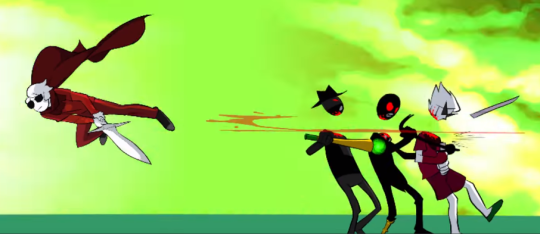
To swing things back around to Dave’s roleplay, there actually is one final act of destruction in his arc. After talking things out with Dirk and coming to see a version of his Bro as someone with the potential to do good, Dave and Dirk engage in what I can only describe as a 2x roleplay combo, with Dirk serving Dave through his Self and Dave killing Dirk to finish off the Jacks.
I like the sense of inverted symmetry here, and it puts into context why Dave’s attack is a positive thing for him–this moment is about Dave accepting that there can be some good in Dirk’s nature, and being willing to incorporate some of Dirk’s influence into his person at an appropriate time.
By embracing Dirk’s affinity for destruction and giving Dirk the chance to put his fate in someone else’s hands, Dirk can find absolution and Dave can find a coherent understanding of his identity, and Bro’s influence on it.
Anyway that’s about it. I’m glad to finally have coherent myths for Princes/Bard and Thief/Rogue, but we know how these classes work mechanically, so it’s not like they revolutionize my whole understanding of the canon. Feel free to send me asks with your thoughts, but for now…


 Flying through Storytelling