Seeking truth through conversations on Love and Fandom
Tag: Dave Strider
you: I hope dammek is confirmed to be davekat’s kid somehow!!!!
Me, an intellectual: IF the Hiveswap kids get to Earth C in the end then they’ll be minors left adrift without parents and upon learning xefros and dammek are from Alternia Karkat will absolutely, without question, adopt them
i agree with it and like it a lot, but with a caveat. It seems to me that all the lands sort of reflect the state of mind of the Hero in question, and I don’t think Skaia populates planets with any particular intent–much less anything ambiguously malicious like trying to torment players with things they don’t like.
The planets are generated from the input of the player’s life, context, and imo most importantly mind and thought patterns. Homestuck’s most pervasive theme is that -individual thought- creates the reality you experience, and the individual thoughts of everyone living create the reality they experience together. I don’t see a reason to shortchange that by ascribing Skaia agency I don’t think it has.
This section is pretty much setup for the next three essays. There’s a couple sections here that I have a fair bit to say about, but probably just as many where I’ll close out with some minor observations, or reference to someone else’s Good Post™.
What I think is important is noting the consistency and similarity with which Homestuck engages in meaningful reference. I just want you to have this list in mind as I flesh out the three truly impactful references I want to talk about in this series.
So here’s a short list of cases where Homestuck outright leans on other stories to structure itself, with accompanying references:
1) The Game Over Arc – Plot Structure & Dragon Ball Z
We’re starting with Dragon Ball Z because the references here are relatively simple and straightforward, and they largely set up either pretty clear structural parallels, rather than thematic ones.
The clearest of these examples is the section of the story that begins with the joke Arquius makes above. In case you don’t know, the “over 9000″ meme has its roots in this iconic, hilarious sequence from DBZ:
What’s notable is what follows. From the moment this joke happens, the very structure of Homestuck changes to following the loose structure of some of the most memorable DBZ arcs.
I’m no buff on the series, but the memories it calls up for me most strongly resemble the Namek/Freeza or Buu arcs, and expert DBZ consultant @alotofmomos (who hates me for writing this) confirms these are the arcs that most perform the particular structure Homestuck will now be mimicking.
And what does that structure consist of? A particular mix of “pacing” choices, cinematography, and sheer scale of spectacle that I find hard to source to anything but DBZ. I can’t even think of other Shonen series that mix all these elements in quite the same way, though again, I’m no expert.
Some of these elements are:
A) Drawn out, massive power-up sequences:
B) Conflicts that carry out on planetary scales, and indeed often destroy the planets hosting them.
This pretty much speaks for itself, doesn’t it? Do I really have to say some stuff to make it look like I’m doing anything other than pointing out some obvious goddamn parallels that blew my mind because they took me years to notice?
Alright, fine. I’ll say this much: I think it’s quite fitting that Homestuck would borrow from the DBZ playbook for the section of the story that illustrates the sheer mind-boggling scale of power our protagonists have reached.
There’s very few stories out there that demonstrate this sense of mortals achieving such bonkers dominion over reality through sheer force of will, and the homage certainly hammers home the idea that these kids are Gods with levels of power we’ve barely scratched the surface of.
But I don’t think there’s a big Narrative Payoff to this particular reference. Instead, I think what Homestuck takes from this is functional in terms of narrative. Because the most interesting things this narrative model adopts are structural.
C) Convenient plot-structure.
Namely, what we end up with is a bunch of characters grouped into disparate conflicts across the same larger “playing field”, separated by considerable amounts of distance–and thus, isolating them into distinct narratives.
As a natural consequence of this, the pacing slows down to an excruciatingly slowness, as we cut from conflict to conflict, each one progressing in small snippets of minutes or even seconds at a time. All of this is par for the course for Dragon Ball Z, particularly in the Namek saga.
So what this provides us with isn’t a profound, revelatory moment of thematic meaning–but instead, an effective backdrop on which to flesh out that meaning elsewhere. In fact, this very arc does that like twice with two other stories!
So let’s move on from this and take a look at a couple of character arcs whose resolutions are telegraphed by way of reference.
The bottom line is: Terezi janks Jade’s shoes, and adopts the role of Dorothy in Homestuck’s symbol logic. This leads her home–to Vriska and their memories of growing up together, and ultimately to embracing her red feelings for her.
Terezi’s resolution is one of two relationships resolved in the wake of [S] Game Over. Let’s take a look at the other.
3) Jake as Buttercup
Don’t have much to say about this one either, cause I already wrote most of it. I will say I don’t think it’s an accident that the arcs to coincide here are Dirkjake’s and Vrisrezi’s, since the two relationships are in many ways direct parallels. But that’s another essay for another time.
I have received some rightful criticism on my writing on Jake in particular, and this is a good place to clarify my position, however. I do not think it’s particularly “Good” or “Healthy” for Jake to indulge his own desires at the expense of Dirk’s (or Jane’s) feelings.
My point has never been that Jake’s selfish behavior is inherently good–merely that Jake’s reasons for being in love with Dirk are his own, and not imposed to him from Dirk himself, or anyone around him.
As with all things in Homestuck, the key is for Jake to grapple with the negatives in himself and come to balance with the tension between his own wants and his relationships with others. This is true of literally everyone in Homestuck.
And there’s an easier way of saying what I am getting at. Because Homestuck literally gives us a guidebook to understanding Jake and Dirk’s relationships to each other, as parsed in Jake’s head–a guidebook that provides context to their entire relationship.
Just as you can read Terezi as Dorothy, so too can you read Jake as Buttercup. This is the crucial distinction I seek to make. In common readings of Dirk and Jake’s relationship, Jake acquiesces to Dirk’s pushy forcing of the relationship despite Dirk’s control issues.
In this one, Dirk is a flawed but committed provider and protector, and Jake picks up on and begins internalize a belief that Dirk will always be there for him, prompting him to fall for him. This reflects the fundamental core of their attraction to each other. It does not present a solution to their communication issues. They both have to work through that and be more aware of each other’s needs.
Now, The Princess Bride is a comedy action-adventure movie, but it’s also a philosophical fairy tale. Buttercup and Westley aren’t just in love, they’re in True Love, and the driving force of the movie is how Westley’s love empowers him to do anything it takes for his beloved.
A big part of her journey is learning to truly commit to not just Westley’s love for her, but her belief in that love as something both true and powerful. Something that can transcend all odds and obstacles.
Which is. You know. Exactly what Jake does when he’s fully immersed in the power of his own faith.
Now let’s move on, and note two more movie references that the comic makes outside of the context of this DBZ-mini arc.
4) Tavros as Peter Pan
There’s not a terrible amount of depth to be drawn here, either. I think most people accept that Tavros is deliberately invoking Peter Pan in his narrative victory here, with the ghosts as his Lost Boys. I will add, however, that if Peter Pan is the role Tavros is emulating in reaching his full potential, well…
Peter Pan isn’t exactly known for being Selfless, is he? He’s a hero, for sure, but self-centeredness is pretty much his calling card as a hero. To the point that Wikipedia claims that
“In the play and book, Peter symbolizes the selfishness of childhood, and is portrayed as being forgetful and self-centered.”
Understanding Caliborn as a Yaldabaoth is one way to contextualize his power over the reality all the characters preside over, and we’ll definitely touch on that further in the next three sections I’ll be covering.
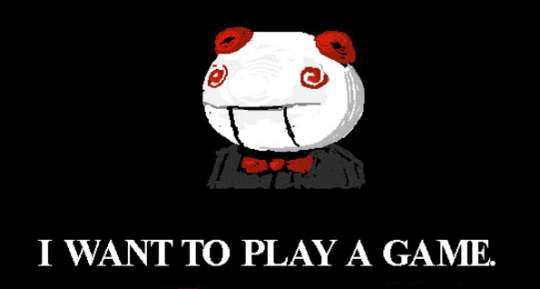
But one easy way to contextualize Lord English’s power is as…well…Jigsaw.
Like Jigsaw, Lord English builds a massive, highly controlled gauntlet that he exploits and terrorizes his victims through. The only difference is that Lord English’s dungeon is bigger than some creepy gray cellar.
It is in fact, Literally Everything that occurs within the context of the Alpha Timeline. Every homeworld that every character originates from–except for, arguably, Beforus, which is still under his sway enough to be doomed, but also presented as borderline Eden-like by comparison to Alternia.
While Yaldabaoth’s control seems very distant and abstract, Jigsaw’s is crystal clear and vicious. Everything the characters of SAW suffer is, ultimately, in the hands of the orchestrator of their misery. Their puppetmaster, so to speak.
In the same sense, pretty much every single way the characters in Homestuck suffer has Lord English at the root of it–even the thing they do to themselves and each other as a result of cultural memes.
Troll Violence, heteronormativity, quadrant normativity, and hypermasculinity–all are memetic structures that exist because Lord English himself disseminated them, in the context of Homestuck. They’re thought-traps rather than literal physical torture devices, but they’re torture tools all the same.
And you can even see Jigsaw as a symbol for Lord English’s influence, since it is, after all, one of the primary differences setting apart Bro and Dirk. Dirk has no interest in the SAW franchise at all, whereas Bro makes a point of mocking Dave with it. (thanks to @jadedresearcher for pointing this out, by the way!)
So yeah. Not only does SAW tell us a lot about the nature of Caliborn’s effect on our characters through the Alpha Timeline, it also acts as a mark for his influence. That’s…pretty much all there is to say on the matter.
For now.
That wraps up this little introductory round-up. Now I can get to talking about three of the biggest influences on Homestuck as a story: The Neverending Story (the book), Earthbound & Mother 3, and Gnostic Myth. Hope you’ll follow along with us over the next couple of weeks to find out more.
(please dont tag as st/ri/derc//est or anything of the like you absolute Barbarians. these bros are just letting shit thats been internalized for years go and just got finished spilling pent up frustrations. if you do i will hunt you down amigo.
cause i know. i Know if i dont put this here im gonna get some weirdos tagging this with shit this isnt supposed to be. let these two comfort each other without it having to turn into a Whole Thing.
the gravity falls fandom has left me paranoid.
i cant believe i actually have to put this notice here ffs. fuck im rambling again. sorry. anyway)
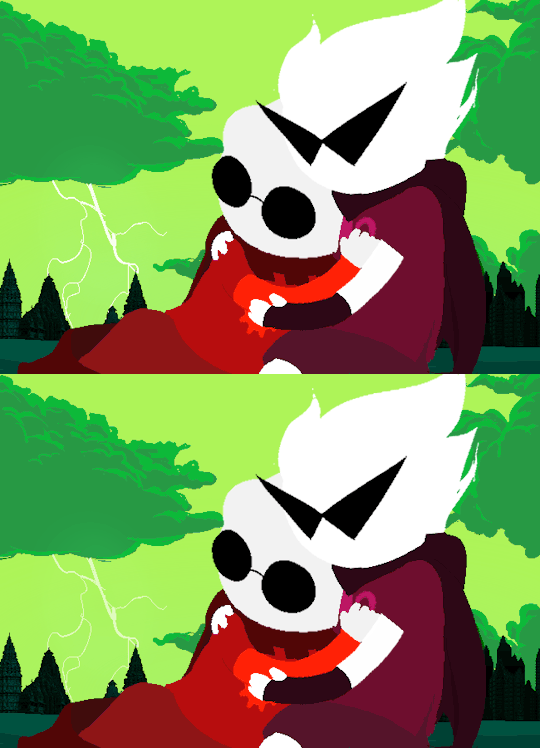
listen just two pages of an awkward hug werent enough. dave goddamn needed this shit so badly (after this string of pages from that upd8)
A lot of stuff they cite is either misunderstanding my points, missing context, or based on my own writing’s execution being flawed, so I think it’s worth clarifying a lot of it. The following is my response to their post, and as such I’ll be referring to them directly from here on in.
First off, thanks for writing this. I appreciate people being willing to talk to me about this stuff, and even if you were kind of ornery, if most of your anger really is sourced in thinking I think Jake was actually the hypermanipulative abuser and that makes it ok, well–I get that. No hard feelings.
As such, just know the response is v much appreciated!
I’m gonna break this down into sections per character in hopes that’ll help me keep down the length.
But first, on the Active/Passive distinction:
I’m against the lines “Yang to the wills of others” and “Yin to the wills of others”. I’d argue they should be dropped entirely.
I’d be curious to hear why you oppose that bit specifically–I think it’s probably kind of stilted and ineffective since most people probably don’t have a strong grasp of those concepts anyway. I’m not exactly married to any particular bit of terminology, so yeah I’m willing to consider that aspect should be dropped.
I also argue that Page and Knight specifically are very close and malleable passive/active-wise, which is the main reason it’s easy to find evidence for either way.
I don’t think we disagree here as much as you think. I don’t think Page and Knight are particularly close or malleable exactly, but I do think the system as a whole incorporates malleability. Which brings me to…
Which of those do you think is closer to what you meant by saying that? Personally, I think the version with “selfless” is nonsense, but the version with “receptive” is very reasonable — and I completely agree with it. But you’ve defined passive, in the classpect sense, as much closer to “selfless” than “receptive”.
[…]
Which of those do you think is closer to what you meant by saying that? Personally, I think the version with “selfless” is nonsense, but the version with “receptive” is very reasonable — and I completely agree with it. But you’ve defined passive, in the classpect sense, as much closer to “selfless” than “receptive”.
I’m curious–did you see the part of the Class Masterpost that goes into the Lord and Muse classes? It’s totally on me if you didn’t–I added that section way after the fact, specifically because I thought it helped clarify this.
Suffice it to say, you’re right–Passive constitutes two different definitions. It’s not that I downplay one over the other exactly, but that I think the Receptive/Proactive distinction is one that can shift over time, while the Selfless/Selfish distinction is much more consistent.
Alt!Calliope is certainly receptive to Space for untold years, but when she takes action, she exploits it knowingly–she simply does so for the benefit of others. Caliborn, meanwhile, describes himself as having to become “At ease with the forces of inevitability”, which definitely sounds like being Receptive to letting Time benefit him to me.
Hence why I stick to the primary definition of Active/Passive as being “For oneself” vs. “For others”–which can easily be parsed into Selfish/Selfless when framed as general mindsets.
However, in this particular context, with Jake, I believe both apply. Reading Jake as receptive to whatever Dirk “Forces” him to do is part of why people read Dirkjake as abusive. Reading him as primarily motivated by making Dirk and the others happy is also part of it.
The best way I’ve seen this put, hilariously, comes from the man himself. I don’t usually quote Hussie on stuff–I prefer to steer clear from Word of God, because by and large, I don’t think it’s necessary. But this is a pretty complicated subject, and this quote puts some ambiguity on Knights as active along with clarifying my point, so I may as well put it here.
You could also look to the passive/active nature of the classes in making some retroactive sense of the Derse/Prospit dreamer duality. Passive/active classes are also a pretty vague thing, and don’t resolve so easily into simple dualities like defensive/offensive and such. Those are the guidelines for understanding them, but there is clearly a lot of flexibility within that system. They seem to suggest tendencies rather than absolute capabilities.
Like there isn’t a rule that says a passive class could never use an offensive technique. The system is meant to be very flexible, and in the story, classes suggest a little more about a hero’s path and role in the greater quest than what their battle capabilities are.
But if we’re saying active/passive literally translates to offensive/defensive for the sake of this topic, then Derse would be very active and Prospit would be very passive. Derse’s job is to attack. Prospit’s is to defend.
This seems to carry over to the roles of the dreamers too. Dave and Rose turned out to be very active players. Dave time traveling all over the place, making a fortune on stocks and such. Rose went on her crazy solo mission to break the game and fight Jack.
Jade and John had more passive roles through most of that, players who were “acted upon” by other players and circumstances. John was always being led around by trolls this way and that, drifting around wherever the wind took him. Jade was especially passive for a lot of the story, spending a lot of time falling asleep (or being put to sleep) at key moments.
It wasn’t until she reached god tier as a Witch (said to be a highly active class) that she became extremely active, making lots of stuff happen, rounding up planets and all that. Rose may have been a similar case, being excessively active as a Derse dreamer, but then flipping over to a passive role upon reaching god tier as a passive class.
Being from Derse means you are from a culture of offense and aggression. Being from Prospit means the opposite. You could argue that these are qualities that either rub off on the dreamers, or they are designated as those dreamers in the first place because of those qualities.
You could take the view that these are innate tendencies to overcome, as seemed to be the case for Jade and Rose. Or maybe sometimes they are tendencies that are resisted, and need to be understood and embraced.
As a Prospit dreamer, did Karkat struggle because he was actually passive in nature, but had a very active self image as a leader and conqueror? Was Vriska an even more extreme case of misplaced active behavior from a Prospit dreamer?
These are yet more things to consider when looking at everything contributing to the hero story of an individual in this game.
Maybe that helps frame what I mean. Any player can behave Actively or Passively in terms of being self-directed or directed by others, or in terms of being proactive or being reactive–of course. People are flexible and multifaceted. But where do they shine? Where are they comfortable? What leaves them feeling fulfilled and happy?
These are the questions I consider in proposing this system, and they don’t really dissolve into simple answers per Class–instead, the execution depends on the individual.
Dirk is a very Active player, for example–but his happiest state of being is in being wanted and helpful to Jake specifically, and he spends most of his narrative being incredibly reactive to Hal’s behavior–a period of time in which he’s thoroughly miserable.
Similarly, Jane is Active, but spends months tending to Jake’s emotional needs…even though she hates it and it leaves her feeling drained and unhappy. And like Rose, Karkat and Dave both grow more Passive as they get older on the meteor–Dave to the point of swearing off Time, Karkat to the point of giving up on Leadership.
Which brings us to the characters, finally.
Tavros:
So he wants the best for his friends, but he’s not willing to just follow their instructions, preferring to figure out how best to help them himself?
When does Tavros think about his friends all that much, though? Tavros does not demonstrate the fixation on others that Knights, Sylphs, Bards, or Rogues have. He spends most of his session indulging his own personal desire, sleeping the adventure away because it’s what’s best for *him* specifically, and what *he* wants to be doing.
When Tavros reaches out to others, it’s pretty much always to get help from them in some way.
I would argue that that’s more a matter of Vriska’s personality than it is of Tavros’s, personally — Vriska consistently giving away that she’s not all that comfortable with how hellish their world is, as much as she’d like to pretend otherwise — but analyzing Vriska is well past what I’m trying to do with this.
In your own words: Why not both? When a character showcases the ability to get pretty much every other character to help him in some way or another, and is part of a Class that *also* demonstrates that pattern, it seems kind of weird to remove their influence entirely from one particular case of…a character wanting to help them. Events in Homestuck are regularly caused by more than one thing.
Taking it doesn’t make him a selfish person, it makes him normal. Incidentally, it makes perfect sense for him to be more selfish when dealing with Vriska than he usually is. He’s rebounding from abuse, of course he runs the risk of going unusually far in the other direction.
It feels like you’re putting a moral prerogative on Selfishness that I actively argue against, and that does not innately exist. Tavros being selfish about this doesn’t mean his contribution is worthless or compromised–it just means he was largely thinking about his own satisfaction and methods while making it.
Vriska does the same thing, and nobody denies that she’s effective and adds value to the team at various points. Ditto Jade.
Also, you ignored the part where Tavros immediately followed up the Ghost Army by getting something he wanted in his introduction out of Meenah. By talking her up, much the same way the other Pages do. It’s important to keep track of those consistent behavior patterns.
Much later, it also allows him to build the army which is crucial to English’s defeat — after all, I doubt he would be particularly inspiring if he were still in a wheelchair. Any Prospit dreamer could easily have seen this in a cloud. Like, say, Kanaya, who conveniently enough also happens to be directly involved in the amputation.
Holy shit, I am not touching that. Homestucks’ kind of bad treatment of disability aside (and you’re wrong by the way), are you arguing that Kanaya’s clouds could have shown her visions of *the very end of the story, in the Dream Bubbles*?
Because…no. We have no evidence of that.
The clouds have never shown events in the Horrorterror’s domain before as far as I can recall, and such reasoning would need to be justified in the story to make any sense anyway.
As long as we’re indulging each other on being harsh, I can’t believe how bad this argument is. Tavros robolegs don’t even factor into building the army!
Tavros can walk in the dream bubbles because he DIED AND IS A GHOST, it has nothing to do with his robolegs, he could’ve been evaporated into molecules and he’d still be able to walk and stuff as a ghost because he’s…dead!! Tavros exists as he imagines himself in the bubbles, this was an established thing!
The end impact of Tavros’ robolegs are that Tavros benefits because he enjoys being able to walk. That’s literally it. Moving on.
Dave:
This is using “passive” as “receptive” again, but even besides that, it’s just a matter of being a Time player — or anyone in Sburb, really, but Time players have it hardest by far since they’re the ones with actual time powers. I can’t see this as a sign that Knights are passive without extending it to mean that all Time players are passive, which goes against the fundamentals of the class system as Calliope described them.
This is demonstrably untrue. It’s true all Time players will largely have to comply with loops or die, but Dave by and large managed to keep to his loops incredibly well.
Contrast with Aradia–who exploited her own tendency to break loops to end up with thousands of copies of herself, and went on to use Time entirely for her own benefit besides after God Tiering, and who has additional Time-based psychic powers even beyond that.
Also contrast with Damara, who actively broke timelines just to hurt the other players–an extremely willful and selfish use of her Aspect, to be sure. All of the Time players must comply with loops on pain of death. That doesn’t mean they all will, or that they’ll do so the same way.
The scene you linked reads fairly clearly to me exactly opposite of how you’ve read it. Dave simply ignores John telling him that he doesn’t care to hear rap at that moment, and raps anyway. Actually, you later describe a very similar eventas “overwhelm[ing] Tavros with a time-consuming and epically sassy document”. I don’t doubt that doing this to Tavros was far more intentional and malicious than it was to John, but it’s basically the same thing happening.
Uh… you’re giving examples of Dave forcing his aspect on others, and overwhelming them with it. This is exactly the opposite of Karkat refusing to offer his aspect to others. They’re not at all comparable.
I mean, you could read them both more generally as Knights picking and choosing where to send their aspect, but that could be done selfishly or selflessly, and both of these uses are selfish.
Basically. Here, I’m arguing for the use of the verb “Serve” as the delivery of rhetorical defeat. Karkat is “serving” Eridan by cutting off their former bond, Dave is “serving” Tavros by overwhelming him. Don’t know that I’d call Karkat’s behavior selfish, since he’s motivated by thinking about Feferi and Kanaya.
I’m not sure I’d stand by the John case, in retrospect–all I’m trying to say is Dave is prone to giving his friends his Time, whether they want it or not. That’s not Passive behavior in the sense of receptiveness, but it is indicative of his focus on others.
I personally read this as him being pushed into a passive persona (note, once again, the persona contrasts its owner in the passive-active dimension) by necessity — after all, someone needed to take care of the minutiae, Dave happened to be well-equipped for it powers-wise, and it already jibes with his persona being cool, collected, and capable of solving problems. And again, I want to stress that Dave certainly isn’t doing this illegitimately or deceptively — only that it’s not necessarily his default position.
This would make sense, if Dave getting healthier and more at ease with himself coincided with him getting more Active. But it doesn’t. Dave coming into his own coincides with him getting more Passive in an activity sense–much like Karkat and Rose.
It certainly doesn’t diminish the fact that Dave’s focus is consistently on others–the group–rather than himself. This is also true of both Karkat and Latula.
Karkat:
Actually, here’s a thought. What if the persona is the relationship-aid role? He does quite a bit less of that later in the story, and it would fit the idea that personas oppose their players on the passive-active spectrum as well — leadership can be selfish or selfless, but helping others with their relationships inherently can’t be selfish… Food for thought.
He doesn’t do that less at all. He focuses his behavior in that regard pretty much exclusively on Dave, is all–who sorely needs it. Dave specifically comments on and singles out Karkat above his friends in talking to Dirk and talks about how instrumental having people who cared about him was in helping him understand his own abuse and how to have relationships.
He also pretty much defaults to engaging in the same behavior with John and Terezi, which notably calms him down.
As for the leadership thing…did we read the same comic?
DAVE: just wondering how you felt about vriska usurping your leadership role DAVE: and if maybe you wanted to throw a vintage shitfit about that or… KARKAT: OH! KARKAT: OH!!!!! KARKAT: HAHA! KARKAT: HAHAHAHAHAHAHA!!! KARKAT: THAT’S A GOOD ONE DAVE! KARKAT: WOW! HAHA, HA, HAHAHAHA! ME LEADER?? TOO FUNNY! KARKAT: I AM ENTIRELY AND SINGULARLY BAFFLED THAT IT COULD STILL EVEN *OCCUR* TO ANYONE TO ENTERTAIN THE NOTION THAT I MIGHT STILL BE PLAYING *ANY* ROLE EVEN WITHIN SNIFFING ORBIT OF A LEADERSHIP POSITION OF THIS RIDICULOUS PARTY. KARKAT: WHEN WAS THE LAST TIME I DID *ANYTHING* OF A LEADER-LIKE NATURE, WITHOUT BEING TRUMPED BY VRISKA’S MACHIAVELLIAN LIMELIGHT GLUTTONY? KARKAT: OR FOR THAT MATTER, WHEN WAS THE LAST TIME THERE WAS ACTUALLY ANYTHING LEADERY *TO* DO, THAT DIDN’T INVOLVE SNUGGLING UP ON THE COUCH TO WATCH “GOOD LUCK CHUCK” FOR THE FIVE HUNDREDTH TIME?!
Karkat is not acting like a leader for most of the retcon timeline. This is in fact a huge point of grievance for many Karkat fans.
I’ll say this much: I think it’s pretty much canon Karkat takes up a leadership role again, and I don’t think being a Passive player implies an inability to take on that mantle–Roxy and John are both described as leaders, and both are passive players too.
But it seems implied to be one focused on relationships and society building rather than ruthless combat and victory over enemies, which seems fitting, because that’s always where Karkat struggled. It’s also easy to think he’d be a terrifically effective leader if he responded to people’s wills more and took them into account rather than imposing his own will.
Both of which are fitting, because those were p much Karkat’s weaknesses in the first place.
Actually, I honestly don’t get how you could think that at all. Karkat, throughout the story, spends a lot of time openly leading people, not just “Allowing” things. I honestly don’t understand why you could read him as “Allowing” anywhere near as much as he actively exerts his will.
I’m talking about instances Karkat seems to use his actual Blood *powers*. Dropping Sollux down the stairs is one example, establishing a Bond with Jack Noir is another. He resolves the conflict with Gamzee by entering a relationship with him, and resolves the conflict with Clover by making him *want* Karkat in a relationship.
Pretty sure I’ve written about this. First off, Clover isn’t particularly noted as giving a shit about the job, and he’s described as being motivated to flirt with pretty much anything that moves–so I disagree.
Kanaya questions the virus’ effectiveness in a pesterlog with Vriska, for one thing. And the bad luck virus is literally never mentioned or drawn attention to again, which…if it was relevant this far in, would be pretty poor storytelling.
In any case, Karkat’s behavior already fits into a pattern of resolving conflict through forming or inspiring relationships, so I don’t really see a reason to overcomplicate Clover’s plot beat with an unmentioned virus when Classpects and Occam’s razor already explain it neatly.
My view of Jake is not that he’s callously manipulating Jane OR Dirk. I’m not gonna comment on your rough timeline much, mostly because it’s pretty plausible, although there’s nothing in the text to really suggest he’s exactly panicking much.
It doesn’t really change anything though. Whatever Jake’s exact mental processes, he prioritizes his own desire to avoid confrontation even when he *knows*, for a *fact*, it requires sacrificing Jane’s emotional well-being, and does so for months.
As you said yourself, Brain Ghost Dirk *is* Jake, and knows the truth, so Jake recognizes what he’s doing is wrong on some level. Still, his fear of confrontation leads him to ignore it. And he uses his ability to convince himself to believe anything to do so.
Do I think he’s hyperaware of this and using it maliciously because No One’s Feelings Matter? No. I think Jake loves the hell out of Jane. All I’m arguing is that because Jake loves Jane a lot, his immediate response is to want to find a solution where he doesn’t have to hurt her feelings or let her down–and that ends up looking like Jake choosing to believe Jane never had feelings for him all along.
It’s not some hypercompetent display of malicious insight, and it’s not Jake being totally brainless either. It’s a teenage kid being shortsighted and scared of confrontation and handling his friendships badly as a result.
Still, Jake is neither taking Jane’s feelings/needs primarily into account, nor is he being reactive and go with the flow here. By either definition, Jake is behaving Actively. That’s the important takeaway.
I would personally say that Jake’s Adventurer Persona would be a pretty textbook active player if it were real.
Cool, except that part of Jake’s persona is a constant awareness of others that does actually come to Passive players but which he explicitly lacks:
Like Tavros’ general personal of hapless affability, Jake’s persona also allows him to get away with things he’d normally be held accountable for. Hence the point. By seeming passive and reactive in the extreme, Jake is able to indulge his own will to the maximum.
Not saying he does it on purpose–the same way I don’t think Dave or Karkat are misleading anyone in setting up personas that are very active and in control in order to get others to rely on them. But it is the end result.
This reading of Dirk and Jake’s relationship is utterly appalling. It’s no better than the one you spent four essays arguing against, and shipping it is just as reprehensible.Let’s recap. In a four–partessayseries (with which I wholeheartedly agree), you describe a reading of Homestuck where Dirk manipulates Jake throughout their relationship, with no regard to what Jake wants or needs, and lay out all the ways in which this reading is flat-out wrong.
And now, you’ve just declared that you think their relationship is exactly the same thing in reverse.
No, don’t deny it. You’ve just explicitly stated that, as you see it, Jake’s only motivation for anything he does with Dirk is to get what he (Jake) wants out of it, ignoring everything Dirk needs. Actually, you’ve gone further — by reading Dirk as trying to live up to the image of Dave (who you still read as selfless, of course), you’ve implicitly established a dynamic where Dirk is far more vulnerable to this manipulation from Jake than Jake ever could have been to it from Dirk.
There is no reason that reading Jake as the abuser here makes a relationship with this dynamic any healthier. At all. Fortunately, Jake isn’t an abuser.
I will say, if this is the source of your heated approach to this, I understand. I will readily admit I kind of overstated things with Jake, at least partly because I’m–as I’ve readily admitted–so motivated by countering the popular perception of Dirk as an abuser.
That said, all I attempted to describe in the section you quoted is why Jake fell in love with Dirk in the first place. Obviously, all the Alphas have made mistakes that they need to overcome in order to understand each other properly and treat each other well.
I’m not arguing that Jake can’t and shouldn’t ever think about other people’s feelings–including Dirk’s–and take them into account in living his life. What I am arguing is simply that Jake’s canonically established love for Dirk is rooted in Jake feeling that he personally benefits from Dirk’s company, which runs a pretty strong counter to Dirk as abuser discourse.
The fact that Jake and Dirk both fell into self-loathing and took the OTHER extreme–choosing to stay away from others–by the end of the story should tell you that Jake’s made some of that growth, though.
As does the Masterpiece, where–as you stated–Jake acts to save Dirk’s life. That said, is every act done for another innately linked to selflessness? What do we make of Jade saving the entire session, in that case? Or Vriska wanting to fight Bec Noir to protect the others?
So if your view is rooted in me thinking that Jake does not and need not ever take Dirk into account, well–rest assured, that’s not what I think. I’ve written novel-length fanworks expressing otherwise, lmao.
Still, That’s down to poor execution on my end to some extent, to be sure. But if you’re writing thoroughly researched responses to people’s work I do suggest you try to take into account elements of it which they might have discredited.
If your premise is that Jake valuing Dirk being helpful to him is inherently predatory, though…no. It isn’t. Relationships are posited on give and take, and both Jake and Dirk get valuable things out of their relationship.
For Dirk, that’s a sense of worth and goodness that he struggles with holding on to–he values that Jake believes in him, explicitly. For Jake, it’s that Dirk makes him feel safe and cared for. That’s all I was getting at.
Sorry I didn’t make that clearer, for what it’s worth, because it’s a completely valid issue to take. My language falling onto the other extreme in counteracting Dirk as abuser discourse has been an issue before, but of course the ideal–and in my view, canonical–scenario is for them to reach a healthy balance with open communication. This is true of all relationships.
I’ve already explained why I think that Jake is fundamentally a selfless person. But I’ll call up one more example specifically relevant to this point.
Tricksters are essentially the very core of a personality placed in an environment where it can never be unhappy again. When Jane becomes a Trickster, she immediately runs to Jake. Selfishly. She turns Jake Trickster as well, and guess what his basest personality turns out to work to do above all else?
Pleasing literally everyone who ever wanted him.
Yes, because Jake doesn’t want confrontation and already stated he’d been open to considering relationships with all his friends. Jane initially raises an objection to Roxy marrying Jake in that sequence, and Jake presses the issue to convince her.
Jake is A) Attracted to all his friends and B) invested in the approach that solves all problems without causing conflict or unhappiness, because he’s personally frightened by the prospect. I don’t think it’s as simple as Jake just looking to make everyone else happy, is what I’m saying.
While we’re at it, Roxy selfishly tries to steal Dirk, too, but she’s explicitly Passive. The tricksters are more complicated than just being the Alpha’s “True Selves”–Jane is the exception, not the rule.
Finally, re: Jake saving Jane and Dirk
There’s not even any room for interpretation — not wanting to disappoint others is obviously selfless.
No…it isn’t? Do you not want to disappoint others out of a desire to live up to their expectations, or because you want to avoid judgment and confrontation? Those are pretty different motivations. One can obviously also be motivated by a mix of both.
I’ll agree the rest of my execution is muddled and comes off pretty weak, though. It’s largely an attempt to contextualize Jake’s behavior in the context of his past–explicitly selfish–behavior, but I’m not even sure that that’s necessary.
Someone can act selfishly at some times and selflessly at others, and Jake’s behavior for the majority of the narrative is self-centered.
Dirk’s in particular is still questionable, given that the Masterpiece is immensely coded as being indicative of Caliborn demonstrating some blackrom attraction to Dirk, in which case even a degree of jealousy makes sense.
But whichever way you read Jake’s motivation, his behavior is pretty simply Active–he doesn’t really give anyone Hope, he doesn’t buff or empower anyone else. He gets really pissed off that Caliborn is beating up his boyfriend–the possessive language in explicit in the comic–and beats Caliborn in turn, using Hope as a weapon to do so.
Once you establish that Pages can exploit that aspect as well as Knights can, it becomes a matter of taking stock of trends. Knights spend most of their time throughout the narrative thinking about others or advancing other’s wills. Pages spend most of their time thinking about themselves or advancing their own wills. That’s all I’m getting at.








 Flying through Storytelling