every maid and sylph in homestuck resurrected from a death that they should not have been able to revive from
aradia: dream self/god tier kanaya: rainbow drinker jane: dream self lifey thing aranea: ring of life porrim: rainbow drinker [i’m making an assumption about how she originally awakened her vampire powers, but i think it’s probable that she matches the pattern]
Just as interesting, all of them transform-usually as a result of that ressurection–into more ethereal or imaginary-coded sorts of beings. Porrim and Kanaya become vampires, Aradia becomes a spooky ghost, Aranea becomes a true immortal.
Jane doesn’t transform as a result of her death (being a Life player gives her some more grounded but still very intense connotations, I feel), but she eventually becomes more ethereal and otherworldy when becoming a Trickster. This association with becoming imaginary/fantastical beings is p interesting, given that both classes are linked to fairies.
Seers and Mages also have links to impossible resurrections. Terezi, a Passive player, orchestrates the revival of Vriska. Sollux somehow skirts the edge of death by ending up a Half-Ghost.
The focus here seems to be on miracles rather than solely ressurection–Rose performs a similarly impossible feat by guiding everyone through the Void–but the association with historical Prophets’ habit of reviving others/themselves is interesting, especially since it lacks the imaginary being/fairy connotation.
I agree. I have a few reasons to add “creating Light” as a reason for Joey, and I remember the Maid reference you’re talking about. It’s still SOMEWHAT possible she’s another class–I saw one reference to destruction, but she doesn’t feel like a Prince so I’m still leaning on Maid. But she’s definitely a Light player imo.
I need to get screenshots to make a whole post about it, but my classpect thoughts on the others are:
Xefros is absolutely a Page of Time. There were a fuckload of references to him as a Page already and at least one to Time, which are most of what I’ve got to compile.
Jude is PROBABLY a Seer of Doom. All of his knowledge ends up benefiting or acting through Joey, and she makes explicit reference to being impressed he actually *Knows* his stuff, with respect to all these threats and rogue conspirators he’s predicting. Of course, its still pretty early and there wasnt anything explicit there, so it’s still somewhat up in the air.
Dammek strikes me as a Thief of Breath. Not completely sure on the Thief part–all I have to go on is the fact that he’s so driven and the occasional references to him taking Xefros’ stuff. His passion for communism/non-ownership certainly sounds like “stealing” through “freedom/disattachment” to me for his own benefit, after all. So that’s my rationale there.
But SPECIFICALLY Dammek definitely seems like a Breath player, because he’s strongly referenced as having a talent for leadership and motivating/driving people–providing direction. The fact that Xefros’ classpect matches Aradia’s–Time doesn’t hurt, as Dammek’s analogue would Tavros, the Breath player.
On top of that, it sets up a somewhat interesting inverse dynamic to the relationship we saw between Vriska/Aradia/Tavros. Where Homestuck’s cycle of revenge began with a Maid of Time getting revenge on a Thief of Light for the abuse of a Page of Breath, Hiveswap’s plot seems to begin with a Maid of Light beginning to heal the withered sense of importance of a Page of Time at the hands of a Thief of Breath.
Not entirely sure if this reading will hold up, of course. But The Dancestors demonstrated an affinity for this kind of karmic role switching, and Scratch seems to be managing the events of this story, to an extent–just as he managed the cycle of revenge. So it wouldn’t surprise me if it pans out.
Hey I totally forget if I already asked you this, but I was reminded by your recent post that I had a question for you about Sylphs and fairies and Vriska’s roleplaying.
Hussie said on his formspring once while talking about god tiers that “Vriska’s true form is that of a pesky, murderous luck fairy,” which seems to go against your theory that Vriska is unhealthily roleplaying her ancestor’s god tier and is not, herself, a fairy at all. https://classesandaspects.tumblr.com/post/130602203382/hussie-god-tier
How do you reconcile Hussie’s statement with your theory? (Death of the Author is an acceptable answer.)
If you did ask, I never saw it! I think I’ve seen this quote before, come to think of it.
I wouldn’t really use DotA to discard theories because I’m primarily interested in trying to understand the comic as cohesively as possible, and Hussie’s quotes re: mindset with developing it has helped me consider how best to read it many times.
I’d really only say that this particular quote kinda has to be taken in context. The thing is, Vriska IS definitely a fairy for the entirety of Act 5. It’s coded into the language she’s presented with both textually and visually across the whole deal.
When I say Vriska is a “false fairy”, I don’t mean that she’s incapable of creating a version of herself that plays the role. What I mean is that the roleplaying itself is toxic and unhealthy for her (holding to her Mindfang persona literally kills her, after all), and so it’s ultimately discarded as her character grows.
The question for me is: why was that element so completely dropped later? And why is the myth of the Fairy so consistently tied to the Maid and Sylph classes–with the exception of cases like Vriska and Tavros, for whom behaving as fairies ends atrociously?
Hussie has always been cagey about telling us exactly what’s going on. So weighed against the evidence in the comic, I’m inclined to think he’s just leaving stuff out here, given that this quote is from Act 5–before we even knew the Dancestors and could put this stuff together.
Not enough of the fandom is interested in how Classpects may play into Hiveswap, I think. We’ve gotten lots of hints at the player’s potential Classpects, but there’s a lot of skepticism as to whether Classpects will even show up at all, given that the game doesn’t center around Sburb.
I’m here to argue that they’ll definitely feature in some way. And luckily for all of us, whether or not I’m right here will be incredibly easy to prove!
Our case study will be Xefros Tritoh. But before I explain how we’ll scrutinize Xefros to determine whether or not I’m full of shit, I’ll need to talk about three things:
In Homestuck, when characters are particularly inspired by or moved to imitate rolemodels, that tends to show up in their mechanical behavior as Heroes. What’s more, such acts of imitation tend to come with references to the specific Mythological Archetypes that inform the Class of the Role-Model figure.
The Troll Ancestors are essentially our introduction to this concept, and there is no clearer example than Vriska. For all of Act 5, Vriska strives to emulate Mindfang in all things–and at the same time, Vriska is consistently depicted and referenced as a Fairy. You can see one such reference above.
So Maids and Sylphs are fairies, according to the Class system. But Vriska is a Thief, and attempting to live out the role of one. One important factor in the Roleplay system is that Roleplaying this way is often misguided and unhealthy, and that players are typically at their happiest and most powerful when playing to their innate strengths.
Compare Vriska’s attempts to make Tavros stronger to Aranea’s effort to do the same for Jake. Both end disastrously, but it’s hard to deny that Aranea had an easier time getting the job done.
We’ll talk about Knights (and Pages, by association) in a bit, but for those of you curious, here are the Archetypes for the other classes that have them:
The first thing Serve classes are prone to doing is Serving their enemies in brutal defeats.
The second–and nicely bringing us into a description of Neophyte Redglare, Terezi’s mythological idol–is the providing of Service.
Knights are prone towards helping others and serving others’ needs through the use of their Aspects. In Redglare’s case, that means that everything she does is at the behest of the Highbloods–even if she doesn’t agree with their ideology.
All the Knights we see in Homestuck adopt a code of honor of some sort, in that they hold themselves up to very high standards of behavior based on a persona they construct in their heads.
For Dave, this is the image of the cool dude. For Karkat, it’s the ruthless leader. For Latula, it’s the R4D G1RL act.
In all three of these cases, the Knights primarily use their personas to distance themselves from their emotions and force themselves into positions of responsibility, even if they’re uncomfortable with their own competence or don’t really want to carry out a particular duty.
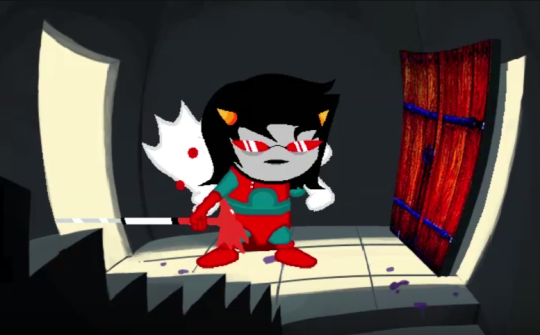
Which is exactly what Terezi does when confronted with the need to kill Vriska! Terezi buries her feelings about Vriska and decides that eliminating her is simply the professional way to resolve the problem–choosing to focus on performing her role as Redglare instead of thinking about her own feelings.
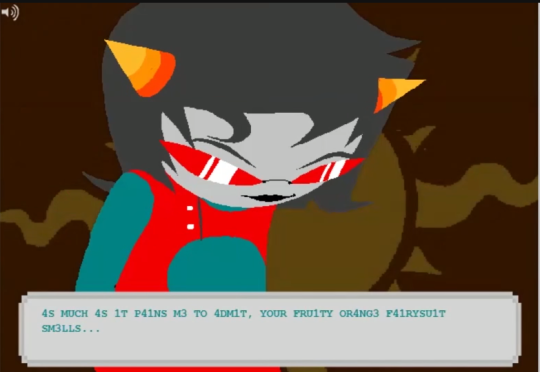
Terezi’s Redglare roleplay, however, might even go farther than the three true Knights–since it even includes a literal code for how to act as a Warrior, that she uses to determine when killing was acceptable. This code of honor is, of course, Terezi’s idea of JUST1C3.
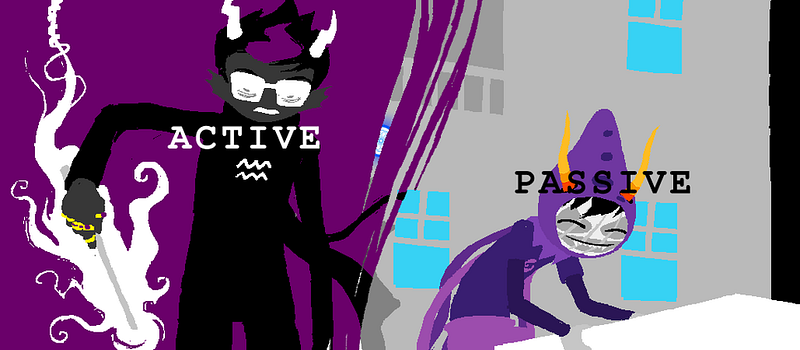
And once Gamzee manipulates Terezi into fully embracing her Redglare persona, Terezi is visually cast as an echo of another Knight– [S] Seer: Ascend acting as an extended visual callback to Dave’s [S] Dave: Ascend to the Highest Point of the Building. Seer: Ascend even starts off with Dave’s symbol!
And the end result of this roleplaying is, of course, as disastrous for Terezi’s being as Vriska’s Mindfang roleplay is for her.
Passing judgment on Vriska leaves Terezi doubt-riddled and self-loathing for years because her true inclinations as a Seer were not to try and go to war for the sake of Justice, but rather to pry, inquire, and discover the truth about Vriska’s nature and feelings. That roleplay misled Terezi from her desires and needs in this respect shows how much of an impact it has in the narrative.
Hopefully this overview gave you an idea of the logic behind it, and if not hopefully looking at other examples I’ve written in the links above–such as Rose as a Witch, Jane as an Heiress, or Dirk as a Knight– will illustrate further.
Now. Let’s get to Xefros.
Xefros is interesting here primarily because of his interest in Butlering. The Butler is the second Archetype that informs Knights and Pages, and it covers the Service connotation as well, but it also includes last definition of the Serve verb:
To give. As a counterpoint to Thieves and Rogues–who Take–Knights have a tendency to give others their Aspect, or give others things through their Aspect. Much as a Butler offering a plate of food. Davesprite giving John a hammer with Time powers is a prime example.
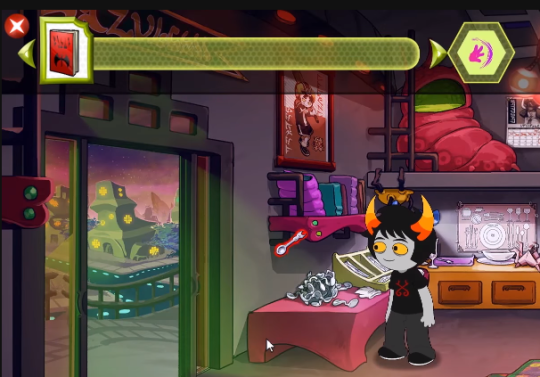
And on top of being interested in one of the biggest symbols of a given Class in the comic, Xefros also comes with one free FLARP manual, it seems. Flarp being the same book that marked the impact of Roleplay and Mythological Archetypes on Vriska and Terezi, this is relevant to me.
So my premise is simple. If the Classpect system has any weight in Hiveswap, odds are very good we’ll see Xefros display similarities with Knights in some way.
(I say Knights and not Pages because Pages seem to have a knack for inspiring those around them to do the serving, whereas Knights seem much more inclined to be serving others–and Xefros is definitely interested in doing the serving.)
But there is a catch here.
Apparently, becoming a Butler is Xefros’ ambition. But that seems a bit odd, considering he’s also a rebel fighter.
So the question is: Is Xefros a Knight, or is this interest in serving (presumably the elite of Alternia?) going to prove to be unhealthy for him? In other words: Is this an indication of Xefros’ true Classpect? Or is it a case of Roleplay?
I think it could go either way at this point. Of course, it’s also possible I’m reading into stuff too much and there’s nothing here but coincidences–in which case, Xefros will exhibit nothing particularly related to Knights or Pages or possibly any Classpect stuff at all.
But to be honest, I doubt that. I am, however, very interested in testing this guess, and I hope you’ll all at least be interested in holding me up to scrutiny, too.
That’s all for now. Feel free to drop by on r/Hiveswap’s reddit and Discord if you’d like to ask questions about this, or just jam about Classpects or other cool stuff in general.
I’ve used Create for the longest time, but am finding myself leaning towards Make lately simply because it’s referenced much more in the comic and I think has some interesting wordplay with Maids specifically.
My tldr response is I don’t think Heal/repair accurately describes enough of what fairies do. I think both are ways their abilities might be described, but using make or create accounts for much more of all of the fairies’ behavior.
My immediate counterpoint is Aranea, who doesn’t really heal Jake at all. That seems very much like her flattering herself. She just makes him more important and relevant, and doing so enables Jake’s will more than her own in ways she didn’t expect.
I also don’t agree Sylphs are selfish and Maids are selfless. I laid out my argument for most of this with my Destroy/Create essay, so I’d be curious to how you’d respond to my points there.
Ok, this is a pretty good reasoning of the motif, however there are still a couple of things I think you’ve missed:
1: Vriska’s motivation for dressing up as fairy is to fulfill the whole pupa pan story, and this is then connected to her GT outfit. She doesn’t do it in conscious reference to her ancestor at all, and I don’t think her admiration for Mindfang is ever verbally or image-ly linked to her fairy motifs? Also Vriska’s tinkerbell reference is also sort of present in WV’s dream, something that isn’t really connected to Tavros?
2: The references to people being fairies are connected to the troll god tier outfit, as is the fairy imagery (butterfly wings, fairy dust – which is connected to tinkerbell in [S]wake but continues to be present in the comic afterwards). The reason I think this is important is that the Maids and Sylphs who aren’t troll god tiers (Jane, Kanaya, Porrim?) are never called fairies, which sort of implies that the motif has more to do with the god tier accesories than it has to do Maids and Sylphs?
Ok, so:
1. You’re right! A lot of Vriska’s playing up the Fairy thing has to do with Tavros…but Vriska wants to win over Tavros because of Mindfang in the first place. And as far as I can tell, these dynamics are just as often presented through…for lack of a better term, narrative game mechanics, as they are through explicit text.
As far as Mindfang is relevant to the narrative, she exists as a being Made of Light in Vriska’s eyes–her importance, agency and storytelling define her, and this a Light Vriska steals for herself, to make herself feel more important and capable.
For as long as Vriska is trying to live out Mindfang’s image specifically, and trying to recreate her relationship with the Summoner through herself and Tavros, she spends her time trying to act like a Sylph.
Think about what she’s doing with Tavros: She’s trying to get him to get stronger and more assertive, trying to increase his willpower, trying to get him to become more important.
If that sounds familiar, it’s because it’s what Aranea successfully does effortlessly with Jake. Vriska tries (and is equally harmful in the process) but she isn’t playing to her strengths like Aranea is. This isn’t her forte or where she excels–it’s a role she’s playing out because it’s Important to her.
And that’s reflected in the mechanics of how she tries to handle the people around her, just as it does with Dirk and Hal.
This is also why I don’t think WV’s dream presents a conflict–being a Fairy is something important to Vriska because of Mindfang as much as because of Tavros, though the two are deeply interrelated.
There’s lots of other examples of this in the story, too–I’m fairly certain I’ve missed many even now, since Vriska as a fairy wasn’t on my radar until you sent this. Again, I’ll go over some in more detail as this series goes up.
2. The troll god tier thing is complicated somewhat by the fact that the only two trolls who god tier are…Aradia, a fairy class, and Vriska, who’s trying to fit into the fairy figure. I agree there’s some muddling of themes, but not as much as it seems like. This is because no God Tier trolls are described as fairies besides Aradia or Vriska, and Vriska drops the aesthetic completely after dying/getting punched by John.
It’s also worth noting that the forms of exposition for the classes aren’t always symmetrical–like I pointed out in my Jade essay, Witches’ powerful guardians aren’t literally called Familiars, but by all definitions that’s exactly what they are. The implication is built into the nature of the title Witch, while their complement classes have parallels built up through other means.
This, again, will hopefully become clearer soon.
So too it is with a Sylph. Maybe they aren’t literally called fairies as often, but I’d argue they don’t need to be, because a Sylph by definition is a species of Fairy. It’s also untrue that Kanaya is never referred to as a Fairy! She receives the title “Fairy God Troll” in reference to her being Rose’s Patron troll, although Doc Scratch later says this about it:
As she prepares to alchemize new items, she is contacted by her “fairy god troll”, a distinction which does not necessarily have anything to do with being a kid’s patron troll.
She’s the only troll to be described this way, with one exception: Tavros in this pesterlog with Jade, where he’s described as a Fairy God Troll…and where he attempts to do the same thing Vriska is doing by inserting himself into Jade’s story, and even considers following Vriska’s ideology briefly and controlling Bec over Jade’s protests.
Tavros ultimately doesn’t end up being Jade’s patron troll–Karkat fills that role, and is not described as a Fairy. Kanaya is described as a Fairy God Troll and successfully lives out the role that implies, setting her apart in this regard.
Finally, Jane is complicated. Like Kanaya and Karkat, Jane’s entire arc is about struggling to find herself, and she spends a lot of time slotting herself into the role of an Heiress instead–something I think I’m likely to talk about in my essay about her now that I noticed it, ALSO thanks to you so thanks.
Hey! So, this is a really good point (and is leading me to thinking about Vriska in some interesting new Lights…)
What I will point out is this: I looked it over, and pretty much every time Vriska is referenced as a fairy, it either directly concerns or surrounds a pivotal moment in her arc with Tavros specifically. After [S] Wake, Vriska is never referenced as a Fairy again.
Vriska also at least somewhat admired two Fairy figures–she thought Kanaya’s lusus was the coolest of all of them, and she literally crafted herself in the image of Mindfang–a Sylph of Light herself. This is not the only instance of a character from one mythological role actively trying to fit into the context of another. I’ll be going into at least some others–but not all–in the next two posts. One thing I’m noticing more and more now that I have the understanding I do is that the way these mythological motifs affect different classes is complicated, and that this system has kind of essentially infinite depth. There’s a lot in this story for us to reconsider and rediscover, and I’m very excited about sharing it with you guys.
Stay tuned 😉
PS: As I release these essays, I’ll begin tagging posts concerning these mythological figures with their tags instead of going for the more awkward Active/Passive setup. I just think it’ll be more elegant that way, though I might have to think up terms for Prince/Bard and Thief/Rogue, who don’t seem to get them (as far as I can tell right now) because they’re freebies from Calliope.
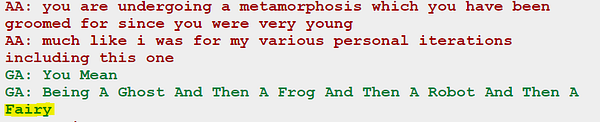
Ok, you’ll try it out with one of your less prized possessions just to prove how dumb it is. You never liked this hat much. It makes you look like a gnome and basically isn’t funny at all.
Hey! So, this is a really good point (and is leading me to thinking about Vriska in some interesting new Lights…)
What I will point out is this: I looked it over, and pretty much every time Vriska is referenced as a fairy, it either directly concerns or surrounds a pivotal moment in her arc with Tavros specifically. After [S] Wake, Vriska is never referenced as a Fairy again.
Vriska also at least somewhat admired two Fairy figures–she thought Kanaya’s lusus was the coolest of all of them, and she literally crafted herself in the image of Mindfang–a Sylph of Light herself. This is not the only instance of a character from one mythological role actively trying to fit into the context of another. I’ll be going into at least some others–but not all–in the next two posts. One thing I’m noticing more and more now that I have the understanding I do is that the way these mythological motifs affect different classes is complicated, and that this system has kind of essentially infinite depth. There’s a lot in this story for us to reconsider and rediscover, and I’m very excited about sharing it with you guys.
Stay tuned 😉
PS: As I release these essays, I’ll begin tagging posts concerning these mythological figures with their tags instead of going for the more awkward Active/Passive setup. I just think it’ll be more elegant that way, though I might have to think up terms for Prince/Bard and Thief/Rogue, who don’t seem to get them (as far as I can tell right now) because they’re freebies from Calliope.
Since Calliope just gives us the definitions for Prince and Bard, I get to use this as a freebie space — no Unifying Myth prove here. I did EVENTUALLY find the Unifying Myth for Prince/Bard, and I think it’s interesting, but you can click through to the hyperlink if you want to read about that.
Since we can take this pair as a given, I’ll mostly use this section to lay out some of the foundation for how this system actually works in practice.
For now, let’s get to establishing that Selfless/Selfish thing. Notice Dirk describing Roxy as selfless here, and distinguishing himself as someone to whom that doesn’t come naturally.
In this sense we can immediately distinguish Dirk not just from Roxy, but from Gamzee. Gamzee is a horrible, evil, vicious person — but he’s also extremely selfless, given that literally everything he does is in service to Caliborn’s goal of becoming Lord English.
Gamzee will become Lord English, too — but note who the Dominant/Yang personality is once they’ve combined. Caliborn is the Active force. Gamzee is the Passive one.
Ok I guess I should stop making that sound so homoerotic for now. Let’s change the subject before your desire to read this is destroyed completely. Sorry about that. Just…Gamzee, you know? What can I do. Fuck that guy.
I know what I can do actually. Present a new concept!
The easiest way to imagine the Active/Passive spectrum as I see it — at least, that I’ve found so far — is as a sort of See-Saw. The more existentially intensely opposed a pair of verbs is, the further down the See-Saw they are.
This is because the verbs themselves are more intense — the effect on the whole of reality exerted by someone Stealing something is less intense than the effect exerted by Destroying it. Knowing a lot about a thing is even less impactful onto reality than stealing it is in turn.
This is what determines the Spectrum, in my view. A Prince is not more “Selfish” than a Witch or a Page, or even necessarily more effective — but their natural role is both more specific and dramatic in it’s effect, Removing something from the world, where it can’t be easily reclaimed or fixed. This means that all else being equal, with two players both playing to their strengths and in tip-top condition…
A Destroy class could be expected to win an outright firefight with most other classes, riding on the intensity implied by their Verb.
But this focus on specialized power comes at significant cost. The classes at these extremes are less versatile as a result of their extremity. The full implications of the loss of that versatility will become clearer as we compare this quartet to those that will come later, but here’s a good place to start:
The more intense the existential dichotomy between the two pairs, the less likely it’ll be for an Active class to act Passive, and vice versa. And with verbs as extreme as Destroy and Create, we can expect the shifts between Yin and Yang to be extremely intense the rare times they happen, and often greatly unpleasant for the Player when they do.
This means that Create and Destroy classes tend to be fairly all or nothing. They tend to struggle between extremes, either rendering themselves almost totally irrelevant or practically dominating the plot with their wills.
Finding a balance between the poles tends to be a hallmark of successful versions of these classes, and in some cases is the main challenge they face.
This is certainly true in Gamzee’s case. As a Bard, he starts off incredibly Passive — allowing the Destruction of his own Rage, benefiting the entirety of the troll party. Going Sober temporarily puts him in an intensely Yang position, resulting in his damn near taking over the story — which also marks the moment Gamzee ceases thinking about benefiting his game partners and begins thinking about benefiting Caliborn instead.
His dominance over the story doesn’t last, though, and the rest of the time Gamzee manipulates the story from the margins — typically by inviting Rage in other people.
For most of his narrative, however, Dirk actually remains static, inactive, and thoroughly Yin-positioned in a way deeply unhealthy to him — just like Jane and Jake. Almost all of the Yang behavior of Active Destruction carried out in his narrative isactually committed by Hal, who plays an integral part in Dirk’s evaluation of himself and his mythological role.
When Dirk finally takes action on his own, turning Yang/Active himself, he threatens to destroy Hal (and, implicitly, himself). Dirk’s narrative role is complicated somewhat by Jake, so I’ll pick up a bit of this thread in the Page/Knight section.
Eridan is a clearer example, as he’s constantly simultaneously destroying his own Hope — rendering himself angry, miserable, and skeptical — AND Actively destroying his relationships through his Hope for romantic reciprocation with practically anyone. And when his misery and self-centeredness come to a head, nobody is able to dissuade him except by force.
And nobody manages to do that until he pisses off the reactive, stable, Passive Sylph enough to make her take action. Who is much more pleasant to talk about and who I actually have to prove points about anyway, so like, let’s cut to the chase and get to the Creators.
Maid/Sylph Key Verb: Create (Make?) Copacetic Sub-Verbs: Make (Create?) , Improve, Heal, Repair, Increase, Grow Unifying Myth: Fairies (Note: The Create/Make nuance is a pedantic one on my part. Nothing much changes, but I may expand on it in the Jane essay.)
Fairies are beings mythologically described in tons of different ways, and are an extremely old and varied cultural figure. But some consistent themes surrounding them include an unearthly Fairy realm of their own to inhabit (which certainly describes Aradia’s relationship to the Bubbles) and an interest in meddling in the affairs of mortals. (Kanaya and Aranea. Nuff said).
Crucially, every Fairy-type player is at some point described as a kind of Fairy, and pretty much exclusively…with one exception. We’ll revisit Kanaya and her role as a “Fairy God Troll” in a little while, but first I wanted to use this moment to segue a little.
Because this “Fairy God Troll” reference leads us to the only real muddying of the waters as far as Maids and Sylphs exclusively being related to fairies, and it points out some interesting stuff about how Classes work in Homestuck.
So Kanaya’s one reference to being a fairy is here, where she’s described as being a Fairy God Troll. This is a designation that Doc Scratch explicitly notes doesn’t necessarily have anything to do with being a kid’s patron troll, although it’s used in the context of Kanaya attempting to be Rose’s patron troll.
So there we go — Kanaya gets a fairy reference, mythology secured, I’m right about everything and Homestuck is great. Good job team. Except wait — Doc Scratch isn’t talking about Kanaya in that line. He’s talking about Tavros.
Tavros ALSO gets the Fairy God Troll designation once, when he talks to Jade. In this conversation, Tavros attempts to act as Jade’s Patron troll…but unlike Kanaya, he fails at this! It doesn’t work out, and Karkat assumes the role instead. In this sense, Kanaya succeeds — thereby securing coherence between the mythology she was trying to live up to and the role she was trying to play. Fairy God Troll reference achieved.
But that’s not all Tavros does here. This is also the one conversation where Tavros flirts with embracing Vriska’s ideology of doing what’s best for others even at the cost of their own wills. But hang on — what does Vriska have to do with fairies? This Unifying Myth thing is starting to sound an awful lot like bullshit!
Well, quite a lot, actually. Vriska actually has by far the most references to being a Fairy out of any individual character, and gets several visual motifs referencing her playing out the role of a Fairy as well. So what gives? Doesn’t this kill my whole argument?
Not exactly. 100% of Vriska’s references to Fairies come about while she’s trying to live up to a Sylph’s legacy–Mindfang’s. She references the dress she used trying to get Tavros to like her (a sequence which has a bunch of fairy references, not including it here cause it’s pretty uncomfortable) as being a Fairy dress, and her entire rationale for being interested in Tavros’ is Mindfang’s past tryst with the Summoner.
Like Dirk trying to play the role of the Knight, or Eridan that of a Wizard, this is another instance of that I’m taking to calling Mythological Roleplay.
This is Vriska trying to force an identity onto herself that doesn’t quite fit. As a result, she comes off kind of try-hard about a thematic motif she later drops completely after her death/The Retcon, at least in terms of trying to do things exactly as Mindfang would do them. And this is reflected not just thematically, but mechanically as well.
After all, one of Vriska’s main goals as a Fairy is to make Tavros stronger, more assertive, more…Important. Vriska is trying to act like a Sylph, increasing the Light in another. This does not play to Vriska’s strengths, and is a terrible idea! She is not successful at all. Which is worth noting here, simply because this exact thing is something Aranea can do basically effortlessly.
Aranea engages in the same role play as Vriska, but to her this role comes naturally, and she’s far more successful at achieving the particular goal of making a Page more relevant…even if it’s also to the Pages’ detriment.
S0 having cleared up the references surrounding Fairies, it’s time to ask…what does being a Fairy even mean?
And just as Kanaya is by implication, Aradia personally claims to be Made of Time. This absolute connection to their Aspect also explains why Sylphs are more magical than Witches. A Magician can use magic, but a Fairy is literally made of it.
Kanaya and Jade also give us another clear indication that Passive classes are group oriented or selfless, as Kanaya — like her fellow Sylph, Aranea — finds herself eager to help and meddle in the affairs of others.
They are typically shut out from doing so, however, and considered “nannying” or “meddling” for their trouble, which tends to frustrate them and make them unhappy. Finding a balance between focusing on themselves and their desire to get involved with and help others is part of a Sylph’s struggle, at least in the context of the Sylphs we see in Homestuck.
This is one aspect of the Maid/Sylph dichotomy, so keep it in mind for when we get to Aradia.
For now, let’s revisit this Fairy God Troll thing with Kanaya, because at turns out, just like with Tavros emulating Vriska, there’s a double-meaning to her actions in this pesterlog, too.
Think about it. Eridan had access to Alchemy, just like Kanaya did. And he could presumably watch Rose alchemize her own wands, too. Why should he need Kanaya to alchemize a Wand at all?
Well, come to think of it… do we ever see ANY Princes alchemize new weapons for themselves? No. And Princes are a Destroyer class, while Alchemy is a process of Creation or Recombination. Is it possible that different Classes have unique relationships to the Alchemy system?
And if Princes are less inclined or able to make magical items…is it possible that a Sylph, being a Creator class noted as being “More Magical” than even a Witch, might have an easier time using Alchemy — a Sburb construct, ie: an element of the setting, and thus an element of Space — to create objects Imbued with magic?
Couldn’t that action be parsed as Creating through Space, for the benefit of another?
I’m going to say the answer is yes, and I’m also going to say Rose, as a Seer, has a relationship to magic that makes it easier for her to more accurately roleplay the idea of a Witch, relative to Eridan — one that has to do with her positioning on the Class spectrum. Take me at my word on this until you can read the essay on the Change/Know classes, for now.
Obviously, helping out Eridan doesn’t work out for Kanaya. But once Kanaya is reborn through Space as a Rainbow Drinker, she also gains unnatural “rainbow drinker fastness” that she hardly seems aware of — Almost as if she had an increased ability to navigate space.
And when she goes on her rampage of revenge — temporarily becoming a Yang force that, again, dominates the narrative for as long as it lasts — she kicks Gamzee off a cliff, sending him deeper into the Meteor and increasing the Space between him and the rest of the cast, to all their benefits. She proceeds to Punch Vriska further away, too — putting her at a distance from her showdown with Eridan, before finally….
Increasing the Space between Eridan’s two body halves. Note that Kanaya’s weapon is the only one that consistently does this — the only other weapons used for severing in the story are Dave and Dirk’s swords, but even those are much more often used for puncturing or stabbing. Kanaya’s weapon, uniquely, only severs.
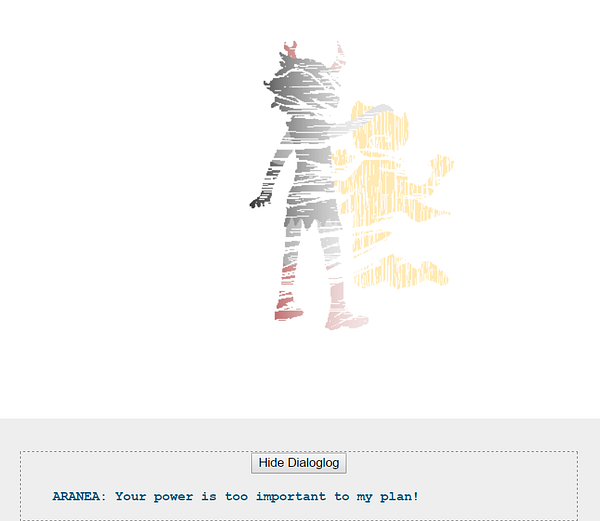
Aranea is another obvious example of Creating being a powerful offensive force. Aranea describes herself as a Healer, and her skillset certainly includes the ability, but all Aranea really does to Jake is make him more important.
She increases his relevance both literally and figuratively, making him Light Up so much he becomes the brightest object in the Session and draws all eyes to him. In other words, she Creates Light in him.
Aradia operates similarly, bringing us to Maids. Aradia’s main psychic power is to summon the souls of the deceased. In effect, that can easily be interpreted as giving more Time to the departed, allowing them periods during which to continue existing in the mortal coil.
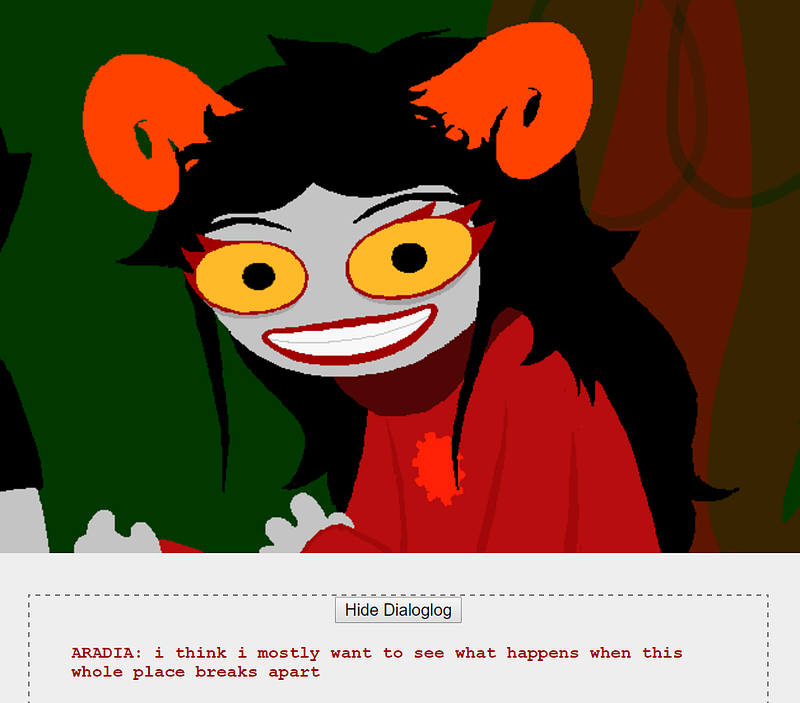
However, Aradia summons these ghosts specifically to exert her own will by making Vriska Pay. Note that Terezi dissuaded her from doing so, and Aradia expressly didn’t listen. Aradia’s patterns of thought are ultimately self-directed, Yang focused rather than Yin.
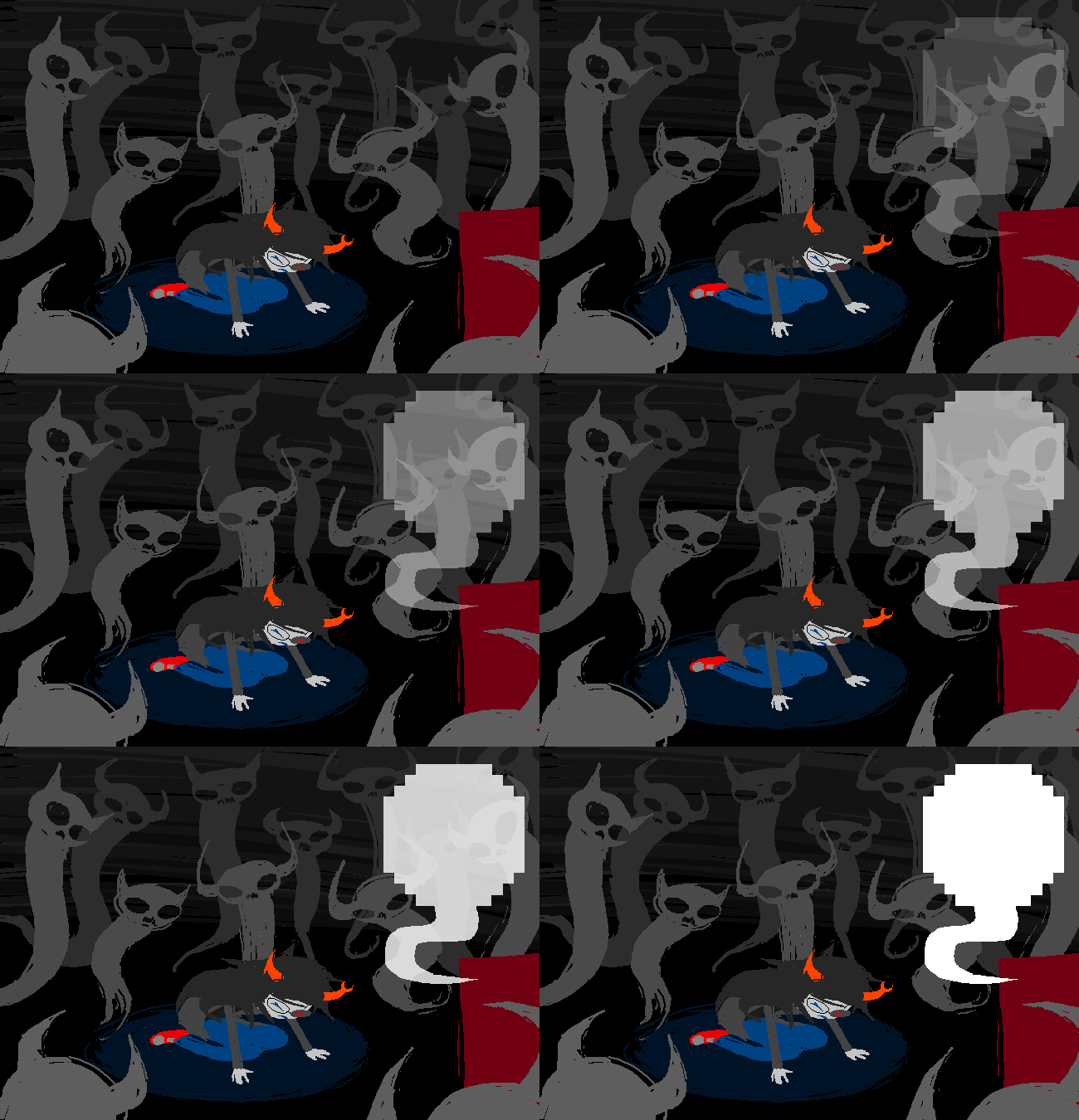
And once Vriska kills her, Aradia Re-Creates herself the same way Kanaya did. However, for Aradia this is implied to be an Active process. The most likely case for why she was ever a Ghost in the first place is that her dream self was sleeping on Derse and summoning herself into the mortal plane, effectively Buying herself Time.
But just like Kanaya’s transformation into a Rainbow Drinker was a byproduct of the environment Kanaya grew up in, Aradia’s transformations fit into Time’s visual motifs.
First she dies, experiencing the one change Time will force on everyone. Then she combines with a frog as her Sprite self, resembling a tadpole. That links her to one species known for undergoing metamorphosis over time, but the trend continues as she encases herself in a metal shell — as if a kind of Pupa — before finally bursting forth as a full-grown Butterfly/Fairy.
Tadpole to Frog, and Caterpillar to Butterfly. Aradia’s character arc includes Double Metamorphmetaphors.
Aradia’s greatest act in the session proper is to Create thousands of time duplicates of herself — something she does willfully and knowingly, not “through the will of the Aspect” at all. These clones then create more Time for the trolls to survive — first by subduing the psychic pressure of the Vast Glub, and then by serving as a distraction against Bec Noir.
But now we come into a point of conflict for many. Being a Maid, like being a Knight, comes with an implication of Servitude — and that leads to many seeing Maid as Passive class. In my view, however, this focus on servitude is something to overcome for Maids, or at least to find a sort of balance with.
Servitude does not leave Maids feeling fulfilled the way it does for Knights and Sylphs — they have more in common with Pages in this respect. It is something to overcome to a large extent, and when embraced, it is only because it is tangential to the goals they have decided on.
All this imposed servitude to Time leaves Aradia miserable, fatalistic and empty. It’s only once she God Tiers that she becomes happy, and at that point her priorities become notably different. Aradia takes to a different kind of service — one she chooses herself, by acting as a psychopomp for the dead ghosts in the bubbles. But Aradia starts doing something else at the same time — something decidedly Homestuck.
She begins creating Time in vast, incomprehensible amounts for herself. As the story of Homestuck progresses, the sheer amount of Time Aradia spends in the bubbles informs more and more of our reading of her, making her alien and incomprehensible.
And while she uses her Time to help ghosts out, she’s notably unconcerned when they start getting murdered and stuff! Aradia’s reasons for staying in the Bubbles aren’t quite just to help her friends out, though they can include the activity. They’re far more specific, as we come to find out through John.
Aradia wants to know what happens next. She wants to be there to witness the end of the story, and the beginning of whatever comes after. And in the meantime she lingers in the bubbles, uncovering the entire history of the massive time loop that informs the story in it’s entirety.
By the end of her arc, Aradia’s not operating as a Passive class according to either definition. She’s not fundamentally reactive to her Aspect, since she actively uses it to get what she wants. And she’s not particularly motivated by helping other people either, although she’ll be happy to if it lines up with her goals and desires.
This particular post will receive one big follow-up when I talk about Jane, because I really think Jane merits the space for an entire essay by herself, and this monstrosity of a project is already too long.
But I wanted to note that she is in fact referenced as a Fairy once–in an interesting context. Gnomes are also sometimes described as Fairies, and like Sylphs, are a species of Elemental–in this case, of the Earth.
But Jane discards this role, claiming it makes her look stupid, and that it’s unfunny. Jane embraces a different role instead…that of the Heiress.
Suffice it so say, I think it helps to read her arc as one where she finds herself serving Life, much as Aradia does Time. For Jane, that servitude is enforced through a role she’s encouraged to play, one that doesn’t play into her strengths and causes her to struggle with her true nature.
that her struggle is one of finding the balance between imposing her Life onto others and repressing her Life entirely. I also think it maps onto this reading of Maids and Sylphs perfectly.
Once it’s available, I will hyperlink that expansion here:
This series of meta posts is a passion project, but also just a side project to my youtube series aimed at making Homestuck to both new fans and old ones. That means these very posts will be showing up with updates and more polish in Youtube Video form, and if I have my say they’ll do so as soon as possible.
If you like my writing and have a buck to spare, you could really help me make that reality possible sooner rather than later by throwing me a buck on Patreon. Doing so will also give you access to the main community that has helped me craft this analysis series, although I also got plenty of insight through conversations on the public Hiveswap server I help moderate.





















 Flying through Storytelling