
Dunno! This is one of the few things in Homestuck I regard as a legit plot hole right now, in absence of a better explanation. it doesn’t bother me though, given that i basically see Rage as the plot hole aspect so if this kinda thing was gonna happen anywhere i’d expect it with gamzee.
Tag: gamzee makara
Gamzee Pt. 4 — Rage as Roleplay
This is a script draft that was used for the following video, and is missing picture assets as well as general polish:
This train of thought is a bit more speculatory, so I decided to keep it seperate from focusing on Gamzee’s character. But linking Rage to Homestuck’s Theatrical elements might also tell us about the abilities and powersets Rage players might exhibit, and that seems worth discussing on its own, so…here we are.
Obviously, reading Rage as the Aspect that rules over Homestuck’s reality as a play lends itself to Tex Talk’s theory of Rage as the Aspect that describes Plot Contrivance, and I could argue there’s even a link between the two in the text itself.
The MSPA Command Terminal that Caliborn and Gamzee unlock using the tragicomic mask keys allow Caliborn to talk directly with the author, Andrew Hussie — Specifically, the ghost of Andrew Hussie, who somehow communicates through the machine after being murdered by Lord English.
As the original author, he’s now the God in the machine operating the story of Homestuck, and his awareness of Homestuck’s larger context lets him give Caliborn the scoop, enabling his rise to power as Lord English in the first place.
This could be seen as an echo of Homestuck’s roots in Theatre as well:
The term “Deus Ex Machina”, or God in the Machine, originally refers to the practice whereby actors playing Gods would be entered into the play by an elaborate mechanism built into the theatre stage, usually by crane or a trapdoor.
The God character was often used at the end of a Tragedy, using their divine powers to wrap up remaining plot threads and bring the story to a close.
Now, of course, the term is used as shorthand for whenever a story resolves problems in highly unlikely and often surprising ways — and is often considered a hallmark of bad, contrived writing as a result.
Actually, this might solve a mystery nobody knew needed solving. A lot of fans assume the story’s logic breaks down with the dream bubbles, based on the perceived nonsensical absence of dream ghosts — mainly concerning four characters:
Meenah and Aranea, Vriska, and Gamzee. But Meenah and Aranea actually do have ghosts in the bubbles — both are present in the final army that faces Lord English.
Vriska only has (Vriska), which is kinda weird, but John’s retcon is bizarre enough that I can kinda believe it would collapse all potential versions of Vriska into the weird…schrodinger’s vriska setup the comic gives us.
Which leaves only Gamzee. If he’s aware of the mechanisms that run the theatre of Homestuck, then he may know about an obscure game mechanic. If a player goes to sleep at the end of a doomed timeline, like Rose does in the timeline that Davesprite came from, they don’t actually produce a ghost.
Instead, the player’s dreamself simply merges with the Alpha dreamself, and the player inherits all the memories of the doomed version. This might require that the player in question be the last one standing, which might be why Gamzee kills all the other trolls in at least one doomed timeline.
Whether he kills the others for this reason or not, if Gamzee outlives all the other trolls in every timeline in this manner, then we have canonical basis for Hussie’s statement that Gamzee hasn’t died in any timeline he’s aware of.
This would also mean Gamzee houses the conciousness of all his doomed selves, and that every single version of Gamzee would get to live out the truth that he is his own mirthful messiahs. No clown left behind…I guess?

But there’s something else I want to talk about.
If Gamzee views Homestuck as a play, then another facet of his power may be the ability to understand the various Masks that characters wear during their adventure — and the corresponding Roles they take on, as they perform their identities in relationship with the world.
Only in Homestuck, roles that define how characters Act are a codified game mechanic: Classes.
And I’ve recently found myself arguing that characters perform the behaviors of the Classes they’re assigned, but also often emulate — or try and fail to emulate — other Classes’ behaviors, through a mechanic I’ve taken to calling Roleplay.
Most characters only Roleplay classes they absorb through culture, whether it’s their interests or — more commonly — role model adult figures called Ancestors.
Having power over roleplay would make Gamzee uniquely dangerous, because it would give him the power to warp how other players see themselves and each other — confusing them by alienating them from their own true roles.


By inviting Terezi to adopt the persona of Redglare, he encourages her to take on the role of a Knight. As a result, Terezi gives a Knight’s performance in one of Homestuck’s theatrical Flashes — [S] Seer: Ascend. She’s even cast in another Knight’s shadow— imitating Dave’s own ascension flash.


It would also make him uniquely flexible. Understanding all the roles played in the story, Gamzee would be able to wear any of those masks to complete whatever objective is at hand. This is likely why Gamzee’s Jokerkind Specibus allows him to use every weapon.
He introduces himself to Jane with music boxes originally owned by Aradia Megido — A Maid, a class linked to the Fae archetype.
Maids and Sylphs are often referenced as imaginary beings, and this tends to include players committed enough to roleplaying one of the two — vampires, ghosts, gnomes, fairies, and in Gamzee’s case, he’s referenced as an elf during this stint.


The Fairy classes are associated with healing and creating new things. And Gamzee happens to perform this role— healing his troll friends by reviving them as Sprites, merging their personalities together in the process.


Later, Caliborn learns he’s immortal for arbitrary reasons that make no sense. Of course, it’s because he’s still relevant to later events in the story, and knowing this, Gamzee is aware he cannot die.
Wearing Fairy wings labeled with the masks of comedy and tragedy,
Gamzee evokes Maids as ones who are “Made of” their Aspect — in his case, Made of Rage: In this case, in the form of theatrical contrivance.
In the comic, Maids are repeatedly shown to have some passive self-ressurection or survivability perks, and Gamzee seems able to make use of that benefit by acting out the Maid’s role.


But all of Gamzee’s creations are abominations, and his form of “immortality” is brutal and painful for him, especially since his natural inclinations invite destruction — no matter what part he consciously tries to act out.
This is a common result of roleplay. Homestuck seems to lean on a “Know yourself first” approach to identity, as characters often confuse their own personalities with what they wish they were, commonly while trying to emulate an ideal or person they view with admiration.
This commonly leans to failure and confusion for Roleplayers, as their own instinctive tendencies come out even when they’re going for something entirely different.
Gamzee is subject to these negative effects, but to him, it doesn’t seem to matter. He’s just barely good enough at acting like these classes to accomplish the goals he sets out to achieve, and the rest of us just have to deal with it.

Of course, many would argue that Theater has nothing to do with Rage and everything to do with Gamzee belonging to the Purpleblood Caste, since several Purplebloods in Hiveswap share Gamzee’s clown motif and one pair even evokes the Comedy and Tragedy imagery.
Just as Xefros’ Rust-Blood status encourages him to think in terms of Time, I believe it’s possible these cultists are being societally pushed into thinking in terms of Rage, the Aspect of their Caste’s True-Sign — Capricorn.


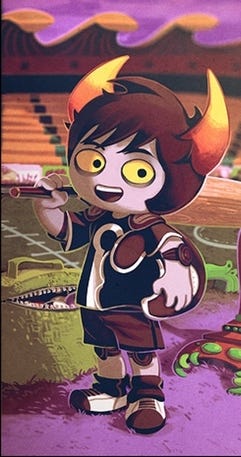

So I’ll be interested in observing just how they relate to their own Aspects, and in seeing to what extent any of them are linked to Rage — not to mention comparing them to characters that we know are Rage-bound, such as our hero, Xefros Tritoh.
Off the top of my head, Sports and Wrestling share some similarities with theatre — the inherent artifice of the experience and the distinct roles for every participant to follow. One of my biggest inspirations, Supereyepatchwolf, has actually done a great video on the theatrical elements of wrestling you can check out here, if you’re interested.
I’m not necessarily claiming this interpretation of Rage is canon or anything — I just thought it’d be an interesting thing for you guys to talk about, and consider, as we get to know the trolls through the Hiveswap: Friendsim and Hiveswap: Act 2.
GAMZEE MIGHT MAKE SENSE ACTUALLY —

It never stops from keep happening.
[ACT 1==> THE MIRTHFUL MESSIAHS]

Most of the Homestuck fandom will tell you that Gamzee Makara is a broken character, and with good reason. It’s not just that his actions are morally repugnant, but that he seems like a hollowed out caricature of a character, almost deliberately crafted by the author to be as flat and nonsensical as possible.


The author of the story literally tells us that his actions probably don’t make any sense, and a lot of the fandom has decided to take that literally, believing that Andrew Hussie didn’t know what he was doing when writing this character — or, more likely, was just “trolling” us.
The end result is a character that is, for most, deeply unpleasant to think about for all sorts of reasons — he commits all kinds of acts of depraved and distasteful immorality, but we’re also barely told anything about who he is, how he does what he does, or why he even does it.
But I think there’s a coherent strain of thought behind Gamzee’s character, and while I consider Gamzee responsible for everything he did, I think there’s a case to be made that his worldview made him uniquely malleable and exploitable by Lord English.
You probably won’t believe me about this, but then, that’ll be kind of the point. Introductions complete, let’s begin our Descent.


The Rage-bound care about truth more than anything. They aren’t so much religious or spiritual as they are deeply dogmatic and intense about their worldviews — in essence, they’re conspiracy theorists.

Understanding this is vital, because at the core of Gamzee’s narrative is a schism between two major versions of his character, separated by an intense crisis of faith.

Gamzee is a Bard: The Passive Destroyer Class. This means we can understand him as one who allows Rage to be Destroyed, or invites destruction through Rage. Rage rules over concepts like anger, fear, hate, doubt, and confusion, and Gamzee will often be found exerting his influence over the story through both definitions of his title, sometimes at the same time.


Early Gamzee is little more than a 420 joke — he’s depicted as a harmless stoner juggalo who simply wants to make his friends happy.


He worships his personal vision of the Mirthful Messiahs, an obscure religious cult largely made up of Purple-Blooded trolls like Gamzee, the Highest blood color of Alternia’s Hemospectrum that belongs to Land-dwelling trolls.


Highblood privilege allows him a sheltered upbringing and the freedom to indulge his soporific drug habit, and as a result he seems completely out of touch with the true nature of his religious order.
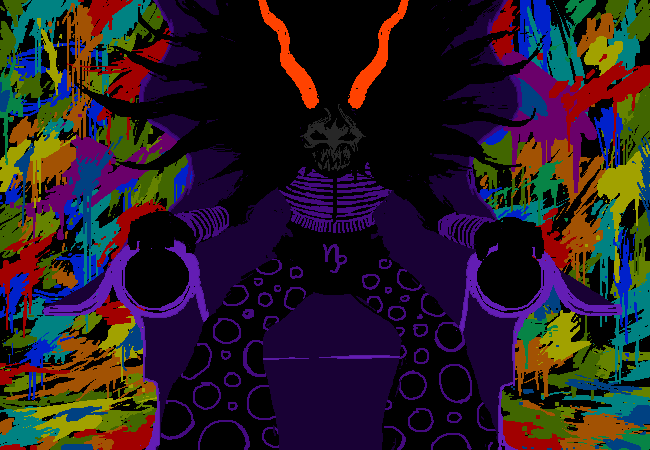


In reality, Alternia’s Grand High Bloods are an obscure but powerful cult devoted to the worship of Lord English, a physical God who exists on Alternia and tortures trollkind throughout its history through a number of Agents.
The Highbloods are one of these agents: religious enforcers who control the population through a combination of brutal executions and psychic Chucklevoodos that poison lowblood’s minds with nightmares of gore and violence, fear, anger, and paranoia.


Gamzee’s crisis of faith comes about when Dave Strider exposes Gamzee to the real-world inspiration for his religion: The Juggalo subculture formed around the Insane Clown Posse. When Gamzee learns about this, he regards it as heretical, and a desecration of everything he believes in.
He soon comes into contact with two messengers of his God, Lord English.
First is Lil Cal — a doll containing the Lord English’s composite, twisted soul. Gamzee looks into Lil Cal’s eyes, and in the depth of those peepers he discovers a horrifying, unavoidable truth:


Just as Caliborn does later, Gamzee recognizes one of the souls that makes up Lord English as his own — meaning Gamzee’s soul is, in effect, partly responsible for starting his own religion.

Gamzee is initially distraught and confused by this knowledge, but he soon begins to trust Lil Cal and the souls within, and decides to reframe his worldview according to what it tells him.


Lil Cal can be highly influential to those who hold it, as Gamzee and Bro both begin to pick up phrases and habits originally native to Caliborn while in contact with the doll. Because Bro is a highly Active class and Gamzee a highly Passive one, we also have grounds to believe Gamzee more susceptible to suggestion.


But the relationship doesn’t seem to be mind control, since this form of psychic influence is distinct from the full mind control Lil Cal proves capable of later. Rather, Gamzee implies he welcomes Lil Cal like a best friend.


Specifically a replacement for Tavros, who Gamzee had romantic feelings for.
The Purple Sign Caste description tells us Gamzee is a strictly monogamous and devoted lover, and he goes on to prove it.
We can see Tavros’ death as the moment Gamzee’s relationship to the rest of his friends is severed, and he devotes himself fully to the new object of his affections: Caliborn — the Cherub boy who will eventually become
Lord English.
And why?


Because Lil Cal gives him the truth.
[ACT 2 — THE VAST JOKE]
At this moment, Gamzee simultaneously receives three divine revelations:
He discovers that his cult’s God exists in physical form, the cruel and brutal nature of this God, and that he himself is this God.

The important thing is that Gamzee does not choose to believe these things — he’s confronted with unavoidable proof for all of them. He’s confronted with a raw, physical, tangible truth.

Now forced to accept this truth, Gamzee embraces the violent and vicious roots of the cult, becoming a Dark Messiah ruthlessly devoted to bringing about the advent of his God.


He taps into his ancestral memory of the Grand High Blood, a notable head of the cult and Gamzee’s Ancestral Figure. He begins imitating the Highbloods and murdering his lower-blooded friends.


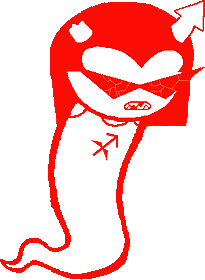
Starting with Equius, one of the other characters whos soul becomes part of LE’s. Equius must become Arquis for Lord English to be born, which Gamzee would also have found out from Lil Cal. He kills Equius and hoards his corpse.


After securing the other component of Lord English in his session, he targets female characters that Caliborn later goes on to single out for death in his retelling of Homestuck. He kills dear, sweet, precious, DEAR Nepeta before our eyes, while Caliborn describes her as useless and irrelevant. The monster.


Vriska is targeted for her ambition and attempts at relevance. Rather than confront her directly, Gamzee drags Terezi Pyrope into the conflict.


He does so by manipulating Terezi to play up her anger and frustration with Vriska. He also encourages her to take on the Neophyte Redglare persona she used to roleplay during FLARP campaigns she and Vriska waged together, partnered as the Scourge Sisters.


Caliborn singles Terezi out for getting between his One True Pairing of Dave and Karkat, and though she doesn’t die, Gamzee makes sure she suffers for this.
After Terezi kills Vriska, Gamzee and Terezi enter a Kissmesitude, and he starts harassing and emotionally abusing her, wearing down her self-respect and ability to focus and help her friends for the rest of the adventure.


He also uses his Caste-given Chucklevoodos to mess with the Beta Kid’s minds, rendering them all somewhat mentally unstable. He pays special attention to John, seeding in his mind the clown doll that acts as the source of John’s self-loathing messages and clown scrawlings.


Which indirectly contributes to Jack Noir’s Rage fueled rise to power, and destruction of the Beta’s session.

However, perhaps because Bard is one of the most Passive classes, pushing himself into behaving so actively is exhausting and stressful for him.
While Gamzee’s behavior during Horrorstuck is impactful, it’s also unsustainable, and he soons settles down with some help from Karkat.


He’s then contacted by Doc Scratch, Lord English’s second emissary.
Scratch is LE’s best bureaucrat, smooth salesperson, and master manipulator. He’s also a part of Lord English himself, a puppet that LE uses to carry out tasks he doesn’t want to perform himself.
It’s Doc Scratch who manipulates Trolls into being as violent and cruel as they are, across their entire planet’s history. And since Scratch’s soul includes Dirk’s cyber-omniscient AI Auto-Responder, Equius, and Gamzee himself, Scratch is also aware of all the events to come in the second half of Homestuck.

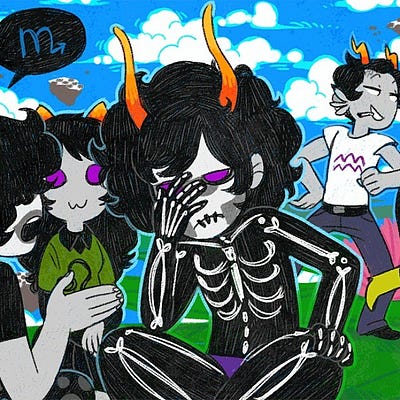
In [S] Cascade, Gamzee talks to Scratch, and by reporting the completion of Horrostuck’s events, implies he was doing everything he did on the orders of Scratch, Lil Cal, or both. Then he asks what’s next.
So Scratch is in a position to offer Gamzee something unique: A script.
Through Scratch, Gamzee could have learned everything he needed to do over the course of the Alpha Kid’s session in order to bring about the birth of LE.
This is why Gamzee complains about Vriska in the Post-Retcon timeline.
There’s a plan in place that the Cult of the Mirthful Messiahs is following, and Vriska cheating her way into being alive throws that plan off the rails.
But in learning his role, Gamzee would also learn something else.
A deep truth of Homestuck’s universe, that would reshape the way he sees the world, and the way we see Rage. He would learn that Homestuck…isn’t real.
Homestuck is a story. A story told online, by an author: Andrew Hussie, who wrote Gamzee’s life into existence as a silly parody of the Insane Clown Posse.
An author who created Gamzee’s life to be a joke.


But Homestuck is also the story of how Lord English murdered its author, and took over the story for his own, ensuring that his dominance is forever absolute. LE cannot be defeated. LE cannot be stopped.
And Gamzee cannot die, because he has to become part of LE for the story of Homestuck to exist. Knowing this means Gamzee sees the story for what it is — as a jokey webcomic structured like a theatre play, with himself as the comic relief.
Where the rest of the characters see The World, Gamzee sees a Stage.
[ACT 3— THEATRE OF DIONYSUS]


Perhaps Gamzee’s biggest recurring symbol is the masks of comedy and tragedy-the archetypal symbol for Theatre and Tragicomedy. The harlequin mask keys he and Caliborn use to power on the MSPA terminal grant Caliborn the ability to view and influence every event in the entire story — letting him take ownership of the play of Homestuck itself.


We can more about theatre through the Troll Call purpleblood Chahut’s
last name: Maenad.
In Greek Myth, the Maenads were the female companions to Dionysus — the Greek God associated with wine, epiphanies, religious ecstasy, and ritual madness. Also associated with Dionysus are half-goat men called Satyrs, who are described as “ archetypal musicians and dancers”, associated with the breaking down of traditional values.


Like Gamzee, Dionysus is also intimately connected to his Godly All-Father, the Demiurge: Zeus for Dionysus, Lord English for Gamzee. Zeus saved his son by sewing him up in his thigh and keeping him there until he reached maturity, so that he was twice born. Similarly, Gamzee is Born Again when he discovers his ultimate fate is to become part of Lord English.


Worship of Dionysus is also credited with the eventual founding of Theatre, particularly the Tragedy genre. An early predecessor of Theater is the Satyr Play, a largely comedic and slapstick performance reminiscent of the Trickster Mode sequence.


Early theatre often employed the use of masks, allowing actors to easily switch between portraying different characters. This colors almost every action Gamzee takes as performative in nature — recognizing Homestuck for the story it is, he plays whatever character is convenient to achieve his objectives.
Gamzee also uses theatre’s history of audience participation to punish the viewer directly. We can view pretty much every nonsensical impact on the plot he has this way — like how his immortality is literally derived from “Plot Armor”, practically begging the audience to call the story on its bull.
But in particular, every sprite he creates in the Alpha session seems deliberately designed to cause as much frustration and anger as possible, not just for the characters, but for Us — the fans.
Seriously. Hear me out.


Eridan and Sollux’s mutual hatred made them two of the most popular characters over the course of act 5, with plenty of detractors and supporters on both sides passionately clashing to defend their favorite characters — and just as many shipping the two in hate-fueled Kismessitude relationships.
Gamzee revives the character conflict between these two — but without any of the fandom-fuel romantic tension. Just misery and self-loathing with no catharsis, a disappointing outcome for any fan invested in seeing their conflict reach any kind of resolution.


Nepeta and Feferi — — two characters the fandom often criticizes the comic for abandoning — are brought back, but their union leaves them a running gag where the fandom gets to hear all about the cool and helpful stuff they’re up to, but without ever actually seeing either girl talk again. Fueling the fandom’s bitterness over their irrelevance.


And Tavrisprite’s creation eventually causes Vriska and Tavros to get into a relationship together, extending the fandom’s furious debate about their unhealthy, abusive dynamic long past the deaths of both characters, when we thought we’d seen the end of both arcs.


And the creation of Arquisprite, of course, is a necessary part of the script that eventually leads to Caliborn, Arquis, and half of Gamzee’s corpse being destroyed and merged inside the Lil Cal doll, bringing about the birth of Lord English.

Don’t believe me? Does this sound too thought out for Hussie, just a bit too far-fetched? That’s fine, I feel you. I understand. Just keep in mind that Doubt itself is also linked to the Rage Aspect. Our skepticism is already written into the story.
To me, it now seems that Gamzee’s story is not that he was lying or pretending during his kind phase, or that he’s a helpless victim of mind control, but rather that he’s coerced through his own intense convictions into accepting a deep sense of tragicomic fatalism.
This distances him from his friends, as he can no longer see them as anything more than falsehoods to be obliterated and punished by the self-evident power of his One True God. We don’t know exactly how Gamzee feels about this, beyond the fact that he’s accepted it.
But it brings up an interesting question that puts a new light on the half of a Gamzee corpse that remains after the end of the Masterpiece, and the creation of Lord English.

It’s true that LE is the overbearing truth of Homestuck, the comic. But there are deeper truths than those that are immediately apparent from observing physical reality — such as the inevitability that all tyrants eventually fall, just as Lord English has at the end of Act 7.


And the paradise planet that Gamzee so passionately believed in early in life, the one he wanted to share with his friends and at least one boy he had romantic feelings for — it actually exists. Earth C is just that sort of paradise planet.


Only half of Gamzee went into Lord English, so he still technically has a corpse available. Jane could, hypothetically, use her life-restoring powers to bring Gamzee back from death’s doorstep — only he would now be custody of our Heroes, with his God either dead or sealed in a black hole for eternity.
If that were to happen, and if there’s any truth to this reading of Gamzee, then what would the Bard of Rage make of this truth beyond truth, this promised land he would find himself in on the other side of an endlessly dark reality?
It’s enough to make me curious, personally. Although my personal suspicion is that if he gets the opportunity, whatever he does, it’s going to manage to piss us off. It’s inevitable, because seriously…Fuck that guy.
HSE: God Tiers
In this episode, we take a closer look at the God Tier power-up system, and its various perks. I also make a case for understanding God Tier powers as being an innate inner power of the players, manifested through their wills and thoughts, rather than a power-up granted to them by the game.
This means I argue that every character uses their Classpect powers throughout their lifetimes, whether or not they actually make God Tier. It also means a player can develop God Tier-level powers without actually being God Tier.
God Tier tends to grant players power because experiencing the messianic death and rebirth of the heroes’ journey tends to make people feel more like heroes, and so more able to self-actualize–NOT because doing so arbitrarily unlocks their superpowers. In other words, I argue God Tier is a shortcut to Heroes’ inner potential–not a requirement for it.
This warrants a closer look at examples of characters in Homestuck typically considered not to be good “examples” of their Hero Titles. I provide some examples of how I understand such characters, as well–including Karkat, Nepeta, and Gamzee.
Lastly, this understanding ties Homestuck’s take on psychic powers to that of it’s namesake, Earthbound–and suggests the possibility that Hiveswap’s characters could well develop God Tier-like powers, too.
Please feel free to discuss and question these ideas in the comments. I’m sure we’ll be revisiting your responses sooner or later, and I’m very curious as to how this video will be received. Thanks for reading, and keep rising!
You can support this project at:
https://www.patreon.com/optimisticDue…
Or follow us on social media!:
https://revolutionaryduelist.tumblr.com
https://twitter.com/RoseOfNobility
Find the music on Bandcamp!
Pyrocumulus (Sicknasty):
https://homestuck.bandcamp.com/track/…
Revered Return:
https://homestuck.bandcamp.com/track/…
Awakening:
https://homestuck.bandcamp.com/track/…
Heirfare:
https://homestuck.bandcamp.com/track/…
man I don’t think you can really say bro is…
I want so hard to think and believe gamzee is just a manipulated pawn and unfortunate casualty because he’s my favorite character beside dave, and I want to believe there is some good in him
hey fwiw this post is somewhat outdated. haven’t had time to revisit it but i have been swayed somewhat by friends and am a little more inclined to think there’s a redemption narrative for gamzee yet.
i still stand by pretty much everything in that essay, i just became aware of some more details that tip the scales for me a bit. mainly to do with caliborn. i’m not sure, but i’m biding my time until the epilogue to really make up my mind about the gamzee deal for good.
if there is anything to a more sympathetic view for him, i’m inclined to think the epilogue will surprise us about him. we’ll find out together, i guess!
Unifying Myths: Prince/Bard – Royalty


I’m more than a little upset I’m going to have to work these into my Force and Flow essays soon, but I figured I’d write these posts on the Unifying Myths for the Steal and Destroy classes because they’ll help me get my thoughts in order for the Classpect video I’m writing the script for.
(PS: That’ll exist soon! Ideally an easy way to introduce all sorts of newbies to the Classpect system. I’m excited!!)
So let’s talk about the unifying myth for Princes and Bards: That of Royalty.
Related terms include aristocracy, nobility, and high blood by association.
I…don’t know why it took me so long to notice this? I guess I got tripped up by the royalty focus on the Fuschias, but I mean, class roleplay is an established thing and the Ancestors, as complex and multifaceted people living in the real world, muddy the water with the multiplicity of symbols they portray all the time.


Also, both Meenah and Feferi explicitly reject their royalty status and abdicate the crown. So. I really don’t know what was stopping me here. Anyhow, let’s get into it.

I think this mostly speaks for itself, honestly? Equius attributes Dave’s habit of destroying things to the training Bro–a Prince–gives him. He suggests it makes him nobler than others, and Dave himself likens himself to a King while carrying out the behavior.
This contextualizes Dave’s habit of destruction during Act 5 as him roleplaying as a Prince, in imitation of Bro. Fittingly given his confused state with regards to his abusive parentage, Dave doesn’t realize that’s what he’s doing or why, but his habit of breaking random stuff is one he mostly drops as he grows out of wanting to imitate Bro on any level (with one notable exception).


If the Royalty classes have a coherent theme, it’s a focus on historical legacy, lines of descent, and inherited destiny. Where other classes draw their interests from fiction, abstract concepts, or their own creative interests, the Royals typically find their biggest interests in the past–that of themselves and of their people. So Dirk and AR both view themselves as scions of Dave’s legacy.


The Makaras are beholden to their Subjugglator bloodline, and the allegiance to Lord English it represents. They don’t seem to believe in the cause of the Mirthful Messiahs so much as simply know the inevitable reality of their success well in advance. And why wouldn’t they, with evidence all around them like Doc Scratch, Lil Cal, and Lord English already wandering the Void?

And while we’re talking about Gamzee, I may as well cover Bard’s link to Royalty. I should note that this is part of a recurring trend with the Classes–one will generally relate to the unifying myth very directly, while the second will come with a host of references and plot beats linking it to the myth indirectly.
So a Witch is a magician by name, while an Heir is revealed as one through the myriad references John gets to wizardry. A Sylph is a kind of fairy by name, but it’s Maids who get described as being “Made of” their Aspect, and so their brand of magic. So on.

In this same respect, while Princes are Royalty manifest by their very name, Bards–though Gamzee–are lifted into the noble circle by implication and continuous reference.
Gamzee’s allegiance to LE results in the cultural dominance of Subjugglators, both on Alternia and on the Alpha Earth. The Mirthful Executives give us the clearest link to Gamzee, since their rise to horrible, aristocratic power is prophecized well in advance, George Washington describing them as “Salty Bards”.


The relationship between Bards and royalty could actually go back to Hussie’s old adventure Bard Quest, where the Bard’s acquisition of a cod piece much like Gamzee’s earns him the worship and devotion of some random dudes in an alley. So…yeah. Thanks, Hussie.

The Amporas seem to have two distinct lines of inherited destiny–one related to their Blood, and one related to their Aspect. Their status as scions of the legacy of the Angels sees them as champions of fantasy, belief, and Hope.
It also sets them up as natural rivals to the Makaras, and threats to Lord English.

But both Amporas fail to live up this legacy, and instead of believing in anything fantastical or magical, both stake their self-worth on an unhealthy fixation with their blood color and the presumption that it makes them “Better” than their friends. This, of course, is false and unimportant information, so it’s fitting that it renders them irrelevant and marginal.

It’s also likely deliberate to some extent, since it’s suggested that someone close to Lord English talked Cronus out of his relationship with Magic, and Alternia was all but designed to bring out the worst in Eridan’s entitlement complex and arrogance.
Since Caliborn had prior experience with the danger of a Hero of Hope, it makes sense he’d want to neutralize the others by prompting them to believe in something darker to believe in.


Which brings us to the arrogance and entitlement the Royalty classes often struggle with–the part of their natures that seems to constitute their greatest challenge before achieving fulfillment and balance.
The concept of High Birth seems to manifest in a sense of inherent superiority for Princes and Bards, and it’s this belief that tends to destroy their ability to make relationships. Both Makaras and both Amporas harbor these intense, megalomaniacal worldviews.

This, however, is where the best Prince begins to set himself apart.
A successful, happy, healthy version of a prince who reaches balance is one who humbles himself, and gets over their sense of arrogant supremacy.
Dirk is actually…pretty close to that already by the point he’s introduced in the comic. Alpha Dirk references this egocentrism as something he definitely struggled with at 13, but 16-year-old Dirk has mostly switched to an intense self-loathing reminiscent of Karkat, with a toxic relationship with a version of himself to boot.
So we can see Dirk as a loose, loose glimpse into what it might look like for Eridan, for example, to chill out after a couple of years–had he gotten the chance. Of course, Dirk was never half as domineering or controlling as Eridan, so this is an unequal comparison, but I think it’s worth noting how their three age difference is meant to influence or readings of the two.

AR/Lil Hal is the version of Dirk that commits most of the abusive/manipulative behavior people usually pin on Alpha Dirk, and fittingly, he’s the one who actually distinguishes himself as Above his friends for most of his narrative.
In AR’s case, he does so on the basis that he is cybernetic and cyber-omniscient, a state he views as superior to being flesh-and-blood, even likening it to an aristocratic position once he’s mixed with Equius.
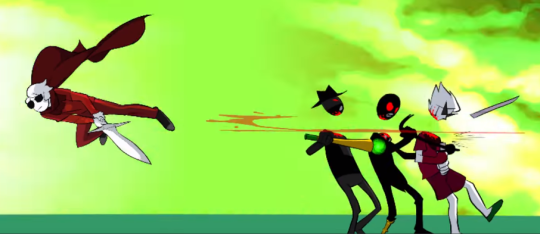
To swing things back around to Dave’s roleplay, there actually is one final act of destruction in his arc. After talking things out with Dirk and coming to see a version of his Bro as someone with the potential to do good, Dave and Dirk engage in what I can only describe as a 2x roleplay combo, with Dirk serving Dave through his Self and Dave killing Dirk to finish off the Jacks.
I like the sense of inverted symmetry here, and it puts into context why Dave’s attack is a positive thing for him–this moment is about Dave accepting that there can be some good in Dirk’s nature, and being willing to incorporate some of Dirk’s influence into his person at an appropriate time.
By embracing Dirk’s affinity for destruction and giving Dirk the chance to put his fate in someone else’s hands, Dirk can find absolution and Dave can find a coherent understanding of his identity, and Bro’s influence on it.
Anyway that’s about it. I’m glad to finally have coherent myths for Princes/Bard and Thief/Rogue, but we know how these classes work mechanically, so it’s not like they revolutionize my whole understanding of the canon. Feel free to send me asks with your thoughts, but for now…
Keep Rising!
hi! me and my friend have long considered Gamzee more as a plot device/deus ex machina than a character with an actual personality that makes logical sense. we were looking up Whistles (see MSPA wiki) and think that Gamzee is… apparently just a giant callback? A private joke? A character moved to the wrong universe, warped to fit the narrative? we’re going to get our hands on the actual book ASAP, but I figured if any blog could start meta discussion over it w/ owners, it was yours.
I will say that my friend @hussianphilosopher made some points about Gamzee I thought were compelling, and on my agenda is moving that little Tumblr post over to Medium with a few expanded sections on Gamzee and Damara.
I’ve known about Whistles, and yeah I agree that Gamzee is definitely a giant callback to that in many ways. But honestly I really don’t like the idea that any character in homestuck is just a plot device/makes no sense–Equius is an extended humanimals reference in a bunch of ways, but he’s still also a character who has depth and intrigue and a coherent personality, as Tex Talks breaks down excellently here:
https://www.youtube.com/watch?v=qjZtB2i8vR0&t=50s&ab_channel=TexTalks
HOWEVER, If I were to accept that any character in Homestuck is contrived and nonsensical and exists only to be a joke, it would be Gamzee. It’s just that I believe that perception is intentional, and in itself part of his character arc. Tex Talks may help get across why I think so here, as well:
https://www.youtube.com/watch?v=4H7m23gkAe4&ab_channel=TexTalks
I honestly think it’s pretty fascinating how much Gamzee deliberately flattens himself, how much he *chooses* to be uncomplicated as a character, because he devotes himself to a single principle: serving/becoming Lord English. As revolutionaryduelist pointed out in their last post, he destroys all the offshoot timeline’s he’s in and chooses, over and over, to seek out LE instead of helping his ostensible friends.
I’ve never really bought the argument that Gamzee lacks motivation, even in Act 6. From, like, day ONE, we’re told that the most important thing in his life is his religion. His switch from interpreting it as a distant prophecy of future clown messiahs to meaning LE (and, by later implication, himself) is admittedly subtle at first, relying on recognizing that he was speaking to Doc Scratch in Cascade and that the Vast Honk is actually LE’s, but by mid Act 6, it’s not even subtle anymore. Like,while Gamzee is doing his antics, the Author himself literally tells us that Gamzee sees Caliborn as his god, and that he gave up all his other connections to serve him. The only missing piece of the puzzle, then, is why Gamzee called *himself* the mirthful messiah back in Horrorstuck–which is answered in Caliborn’s masterpiece: he experiences apotheosis with his own god by becoming part of LE. Which explains the Vast Honk in the first place. It’s great.
Note also that after Horrorstuck, Gamzee basically ends up having zero connections to anyone else–which were the bonds and desires that made him a more complex character originally. Tavros, the one person he arguably kind of cared about, is dead and mourned, and while Karkat’s morallegiance manages to snap him out of cruel Joker prankster rage mode, he ultimately chooses (as Hussie says) to abandon it for his LE-centric goals. He discards the bonds and thus his complexity, in other words, to serve an idea, a principle.
This is why the Whistles parallels make so much sense: like Whistles, Gamzee chose to devote his entire being to one entity, in this case Lord English. And his arbitrary, plot-device-like appearances in Act 6, while closely connected to the caprice inherent in Rage, as Tex points out, also make perfect sense in the context of him wanting to fulfill all the time loops that lead to Lord English. He becomes less of a character, less of a person, because *he wants to be.*
Honestly, the parallels between Caliborn and Gamzee are fascinating. They have the same hubristic sin: they’re willing to give everything else up to be exalted as a supcreme god, and don’t recognize the value of what they’re sacrificing. Only Caliborn does it as himself, and Gamzee, as a passive class, other-oriented character, does it entirely through submitting his agency to that of another. God, I love this comic sometimes.
In short, everything Gamzee does makes perfect sense when you consider what he wants and what he’s willing to give up for it. And that, while it makes him an increasingly simplistic character, also makes him a fascinating one.
catchaloststar replied to your post “@catchaloststar submitted: That Gamzee explanation is pretty…”
Yeah I don’t really think Horrorterrors are transformed players either, that point got a little away from me a bit. My main objection was the line of assumptions described in the first paragraph. From my POV, Occam’s Razor better suits the “explanation” that “Gamzee has no ghosts because he’s an unkillable clown” rather than coming up with any deeper explanations like infinite loyalty to LE. I’d be interested in reading that future post!
Sure, but my point about his allegiance to LE came about from attempting to resolve the tension between “Gamzee never dies because he’s an unkillable clown” and “Everyone dies in a doomed timeline”. Those are apparently contradictory facts that warrant some way of being bridged if you want to assume Homestuck is coherent, like I do.
As far as I can tell, the dreamself mechanic is the only explanation the comic gives able to resolve said tension, and it works out pretty neatly if you go with it. What followed was my interpretation of his actions taking into account the sheer scale at which they operate.
Like I said though, I think there’s at the very least additional context that casts that interpretation in a murkier light, without changing the fact of what Gamzee’s done. Here’s hoping i get to present that view soon.
i wanted to bring htis up bc you’ve been talking about Gamzee more lately and what Homestuck gets right, but i do not think you can approarch this subject without talking about what Homestuck did wrong: and that is writing nearly all its main antagonists with Black coding. Gamzee’s portayal did NOT get any better at this throughout the comic, and regardless of whether o rnot his motives ACTUALLY stem from mental illness that is the perception the comic freely states, which is peak antiBlackness
then theres the whole mess with Meenah? like, seriously, is there any way to get around that like, at all. the antiBlackness of Meenah’s portrayals. then the cherubim are associated with Voudoun and other Afrikan spiritualities, and no Calliope being a single exception to the trope does not excuse this one BIT it is seriously not okay and people like Shelby Cragg were helping with the writing of the Gamzee arc too and you can’t just ignore it
esp while praising SU which is guilty of similar
I am speaking from the bottom of my heart when I say I have no idea what you’re talking about.
I’d heard criticism of Gamzee for being shitty mental illness representation, which I think is pretty valid. I know for a fact that Sollux is atrocious bipolar rep, as I’ve heard from friends with bipolar conditions. I don’t particularly think Homestuck is perfect art (a concept that is FAKE AS SHIT and doesn’t interest me), and I don’t mind pointing out the places it slips into unfortunate territory.
But I’d never heard anything about Gamzee representing anti-blackness, and juggalos are plenty white from the admittedly little I’ve seen of them, so…you’d have to convince me there? Like, I guess maybe you mean the chucklevoodoos? Which MIGHT be fair but I think they’re pretty clearly a Rage thing, and generic Rage power is basically how I default to thinking of them.
Meenah and the Condesce I can see, but uh. Meenah’s not a bad guy or treated like one by the narrative, as far as I’m concerned? She is, if anything, a way more sympathetic take on a black-coded character. It’s kind of like arguing Bro/AR is a problematic gay predator trope– and by association so is Dirk, as far as I can tell? In which case, my answer would be
“No, Dirk is a noble figure and the counterweight to that image.”
So since I don’t really understand how Gamzee factors in here and it seems to me the Condesce and Meenah exist as balances to each other, I can only really regard Caliborn’s Voudoun stuff as it exists in relation to Calliope’s, in which case I do think it’s fair to weigh the two against each other.
I’m not black so it’s pretty much not my place to say? Feel free to send me links to a more structured argument re: Gamzee if you’d like to sway me, anon. He’s an evolving subject for me anyway.
@catchaloststar submitted:
That Gamzee explanation is pretty convincing, but it relies on the assumption that Gamzee has no ghosts + dream merger mechanics -> Gamzee never successfully saved his friends -> Gamzee is a murderous asshole who never chooses his friends over his murderous tendencies and LE loyalty. Note, of course, that I inserted the word “successfully.” Perhaps Gamzee’s immortality is a separate mechanic due to being a “rascally clown” as Hussie says, rather than simply out-surviving (or killing) the others? Aradia notes that the beta trolls fucked up their session multiple times, making victory unobtainable, without actually implying that Gamzee was responsible for each fuck-up. It seems plausible that the other beta trolls are perfectly capable of ruining their own session without Gamzee’s interference or even with his cooperation, considering how many Aradiabots had to step in and help Karkat here and there just due to his own stupid actions. Or something just didn’t loop correctly despite perfectly good yet still incorrect behavior, triggering a doomed offshoot that resulted in the surviving trolls all eventually dying of old age and leaving Gamzee. Several possible explanations, you know?
Anyway, what I’m suggesting is a scenario kind of like that old tumblr post with a picture of a Seer of Time standing alone on the Battlefield surrounded by their dead friends’ corpses, followed by a lot of speculation about immortal god tiered players in doomed timelines. Or a different post that suggests all doomed Gamzees become purple-blooded Horrorterrors rather than ghosts. Both fan-created theories, of course, but not theories that are contradicted by the source material (yet). (I can probably dig those posts up if you need them, just let me know.)
My theory in turn relies on Gamzee’s immortality being solely and independenrly due to his clownishness, rather than as a result of various other actions. Hussie “confirmed” on his formspring that Gamzee doesn’t die because he’s a “rascally clown,” but who knows how serious his formspring responses are. Maybe his being a juggalo actually refers to being a disciple of the juggalo religion, which brings us back to LE loyalty. In-comic Hussie tells Caliborn that “you can’t keep down the clown,” which Gamzee seems to support by taking an entire automatic rifle’s magazine and still being alive – but I guess you could argue that he was expressing his loyalty to LE in that scene, hence unable to die while in pursuit of that task? It’s theories all the way down. Anyway what do you think.
My main issue isn’t so much that such scenarios are impossible as it is that I think they’re begging the question a little. Occam’s razor, you know? While stuff like players turning into horrorterrors and stuff is fun, yeah, and they’re potential explanations…they’re also explanations the canon never brings up.
I tend to part from the starting premise that Homestuck is in most things a coherent and well-structured story, that tells the audience what it thinks is important for the audience to know. So coming up with fanon explanations for something we HAVE a canonical explanation for, just one that leads us to some conclusions that are pretty unpleasant, just doesn’t really mesh with my particular methodology too well.
I do think Gamzee’s immortality is due to his clownishness, but I view the link between those two things as Gamzee’s Rage aspect. Immortality=Clowns works because, well, it’s contrived and infuriating, and infuriating plot contrivances are part of the language Rage exists to describe.
All of this said, @hussianphilosopher raised some good critical counterpoints to that Gamzee post that I’m looking to incorporate into an expanded piece on Gamzee when I port that little post to Medium. I don’t really think that post is the most accurate take on Gamzee anymore.
I’m just not sure when I’ll get the chance to present this slightly different context
😦 As soon as I can, I guess.
 Flying through Storytelling