OK this is gonna be shorter than Marvus obvs but Fozzer DID give me a good amount to think about, so here goes
Fozzer outright identifying as a dialectical materialist is exciting for a couple reasons. There’s a lot one could say about dialectics and Paradox Space in general (I’ve been trying to write that script for about a year) but here I want to focus on the Materialist half of that, because it immediately reminded me a lot of @arrghus’ idea of the notional/material divide between aspects.
Ever since the Extended Zodiac, we’ve been wondering if the way the Aspect wheel is laid out might suggest some relationships between Aspects, either original to Homestuck, mirroring the relationships the Signs share in the traditional Zodiac wheel, or some combination of both.
Arrghus’ essay series proposes a model for how those relationships might work, at least in part. I’d suggest checking it out for the full picture, but here I want to focus on the divide I find clearest and most compelling: That between the Ideal/Notional Aspects and the Material/Physical ones.
The gist is this: The top five Aspects (Mind, Hope, Breath, Life, and Light) are more closely aligned with the World of Ideas, and so those bound to them tend to be more concerned with the ideal, abstract, and imaginary. The bottom five (Void, Doom, Blood, Rage, and Heart) are more closely tied to the material, physical, and real.
If you’ve seen my prior writing on Homestuck, you might note that this dovetails easily with Gnosticism’s old cosmology of reality as divided between an imaginary world of Light and a physical world of Darkness. That said, this isn’t a hard binary–Blood obviously refers to some concepts as well as physical experience, and Breath obviously links to some things that happen in physicality, even if those elements are by definition elusive and insubstantial.
Space and Time are an even split, as much conceptual law to be deciphered as they are physical element of reality to be experienced. It could well be that this reflects most strongly in the perspectives those Bound to each Aspect are given to, as opposed to an underlying reality of the Aspects themselves, and in any case all twelve Aspects are necessary to describe a full picture of reality.
One of the most exciting possibilities this model raises for me is the idea of Aspect “Mirroring”, which is essentially a different kind of relationship Aspects can have. Aspects that are Mirror each other vertically, for example, might express the same ideas through the filter of the Ideal vs. the Material–reflecting the hermetic/magical principle of “As above, so below”.
Heart and Light are a pretty good way to express the relationship between vertically mirrored Aspects, as it turns out. Consider:
Humanity gains the ability to access this world, the self-aware conciousness necessary to think, when the Goddess of Wisdom Sophia descends from that realm and imbues us with her Light–the light of curiosity, of wisdom, of the power to know. The light of the soul.
There are a lot of ideas and concepts that Dirk’s soul seems consistently inclined to express onto reality. The shades, the concept of “being a Bro”, the idea of the Hard Anime Dude, Stoicism, the pervasive homoeroticism innate to the Greek ideals he’s generally shaped by, etc.
The clearest example of this might be his sword, which is itself a physical object seemingly ripped directly out of the “fake” (read: imaginary) world of anime. An idea, made physical, through the sheer expression of will manifested by Dirk’s soul.
This is what makes his katana so powerful:
It’s quite near to being a physical expression of our collective idea of the “Perfect Sword”, much like Bro sets an impossible ideal of “Perfect Manhood” that Dave wrestles with living up to. This might give you an idea of some of the more direct ways Heart’s conceptual toolbox could be exploited or weaponized.
The point here is that just expressing the idea of a “Bro” is
extremely important to Dirk, and expressing the idea of “Cats” is
similarly important to Nepeta and Meulin.
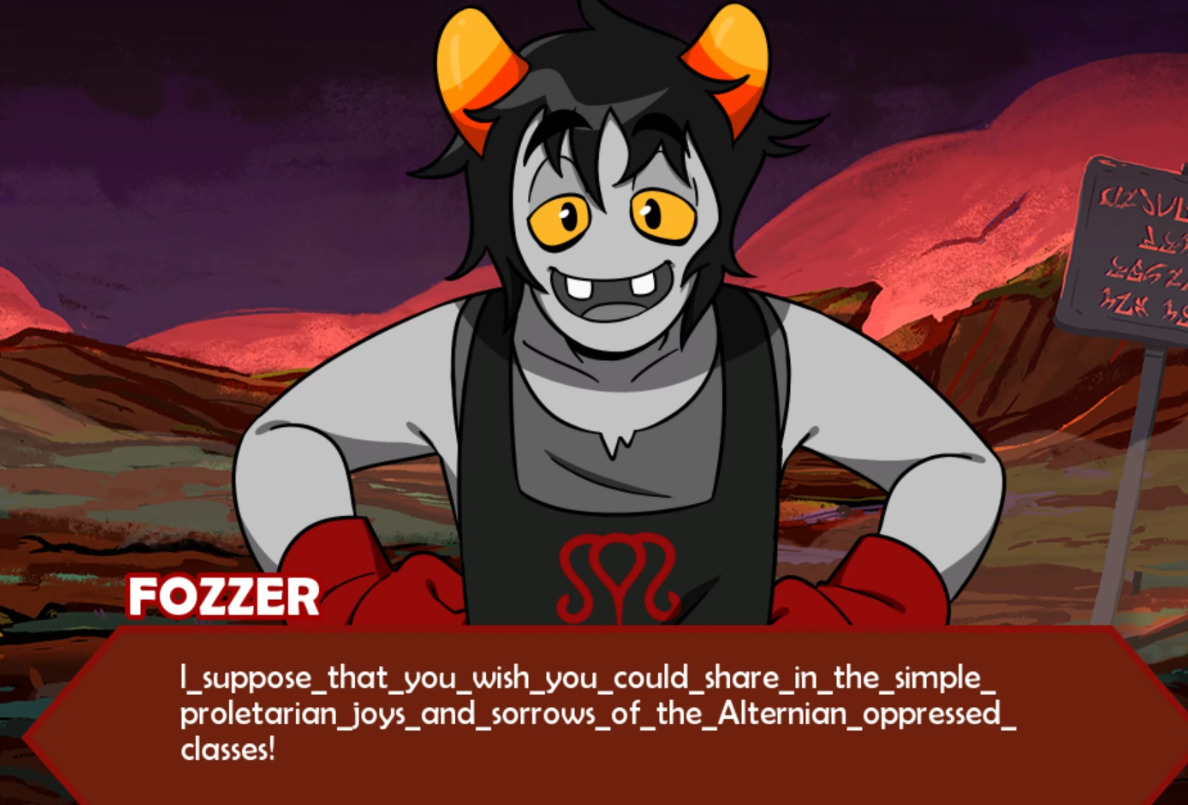
In the same way, Fozzer seems like an acutely intense expression of a political Persona. A philosophical idea, expressed in the physical world as an intense commitment to an associated identity. His shovel is an expression of that identity, much the same way Dirk’s katana or Nepeta’s claws are expressions of theirs.
But then again, Fozzer’s identity ain’t exactly stable, is it?
Before we talk about The Thing That Happens, we should note that as much as Fozzer seems to genuinely believe in his communist philosophy, he mostly seems interested in it as a means for self-expression, rather than an actual political movement with direct goals and results he’s looking to achieve.
And even though he’s very intense and earnest about it, Fozzer seems inclined
to exploit his own identity in somewhat self-serving ways.
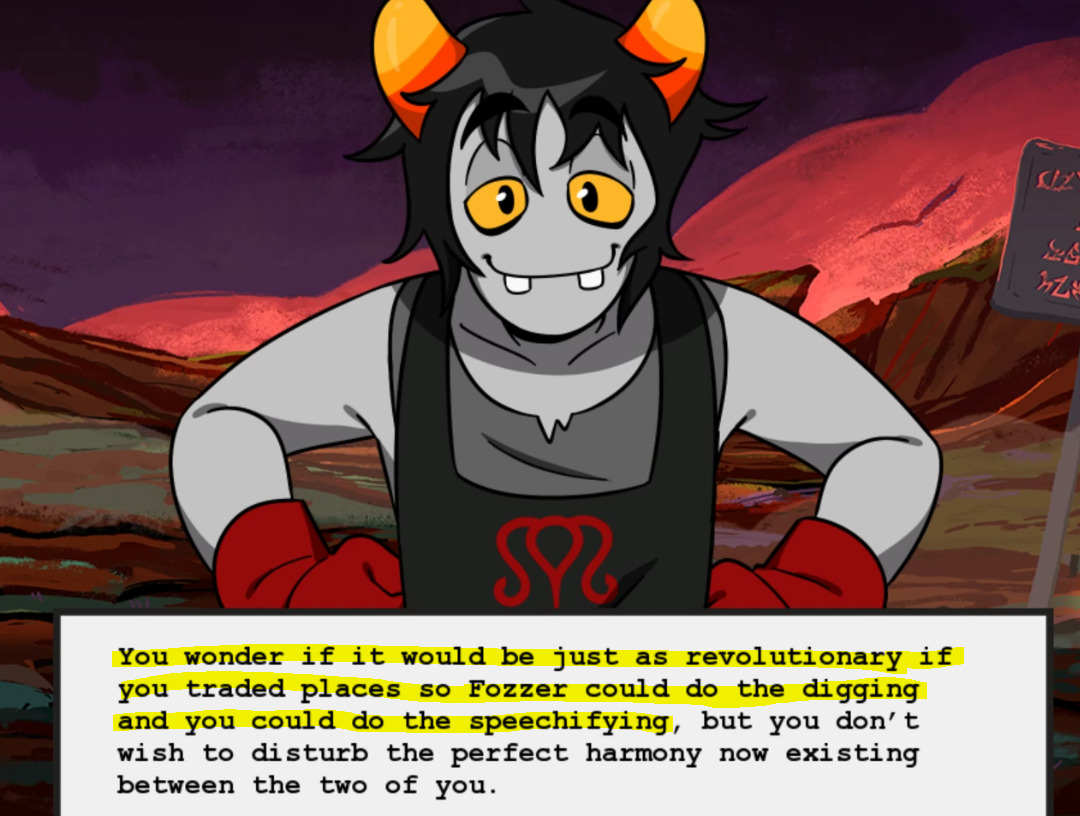
Unintentionally or no, he more or less uses his ideological speechifying
to conscript the Reader into doing work for him, therefore inviting the reader to Serve him through Heart, for Fozzer’s own benefit.
This, coupled with his strongly noted cowardice, leads me to consider him a Page. But my real point here is that even if a lot of us here on Tumblr find Fozzer’s ideology appealing, Fozzer seems less invested in ideology proper than with the identity it comes with–and even here, Fozzer isn’t exactly being portrayed as unambiguously Good and Correct.
Even if he’s preferable to the alternative. Sigh.
Let’s talk about the thing.
[WORLDBUILDING INTERMISSION]
So the biggest surprise of this friendsim was that we stumbled onto what’s basically a swell of Scratch energy just…hanging out under Absence Park, apparently?
Which is. A lot. This energy resets our conversation with Fozzer and changes his personality, which we’ll get into in a minute, but first I want to speculate: How the hell does this thing exist at all, and what does it even mean? There’s a couple of possibilities.
Since this is essentially Time-coded Scratch energy we’re dealing with, @blindrapture pointed out that it could have something to do with the Handmaid, which I’d expand to include Lord English–and though I doubt it’s directly linked to Scratch himself, since he’s not too associated with Time the way the former two are, he may be aware of or able to use this…”glitch” in reality.
It’s also possible this is a natural consequence of a Scratch, and pockets of leftover Scratch energy like these are present in some locations of Post-Scratch worlds. For that matter, it could be a consequence of John’s retcon powers, which act like the scratch in some ways and might have had consequences we don’t yet fully understand.
Finally, given the language, I suspect that the hole in Absence Park is actually just a hole into the Void, leading to the Furthest Ring, much like Roxy’s windows. This Scratch energy seems to have entered the Furthest Ring, and is presumably writhing there until circumstances allow it to vent out through this particular entrance to reality.
What are the implications? Who knows. If this is a hole into the Void, then this is another avenue through which Hiveswap’s cast might be able to exit Alternia and find a new world.
If the Scratch outbursts are recurring enough, then we have at least one way for our heroes to “Time Travel” and basically save scum to try and achieve optimal desires results, like saving a troll friend who gets killed by going back in time for example.
That’s probably the biggest takeaway to me, because having a way to time travel built into Hiveswap’s text already makes me that much more sure that no matter what kind of carnage and brutality our beloved troll friends get subjected to, we’re ultimately headed towards a happy ending where probably nobody dies– I can reasonably see the possibility that even antagonistic figures like Ardata and even Trizza could be saved, under these circumstances.
Ok back to Fozzer.
So the thing about “Post-Scratch” Fozzer is that I feel he’s being dismissed somewhat due to his admittedly unsavory politics. This still strikes me as a very genuine and direct expression of Fozzer’s Classpect inclinations.
Fozzer is still taking a very materialist view of reality here, for example–he’s interested in the actual physical history of how this system evolved, and considers understanding that history necessary to understanding society.
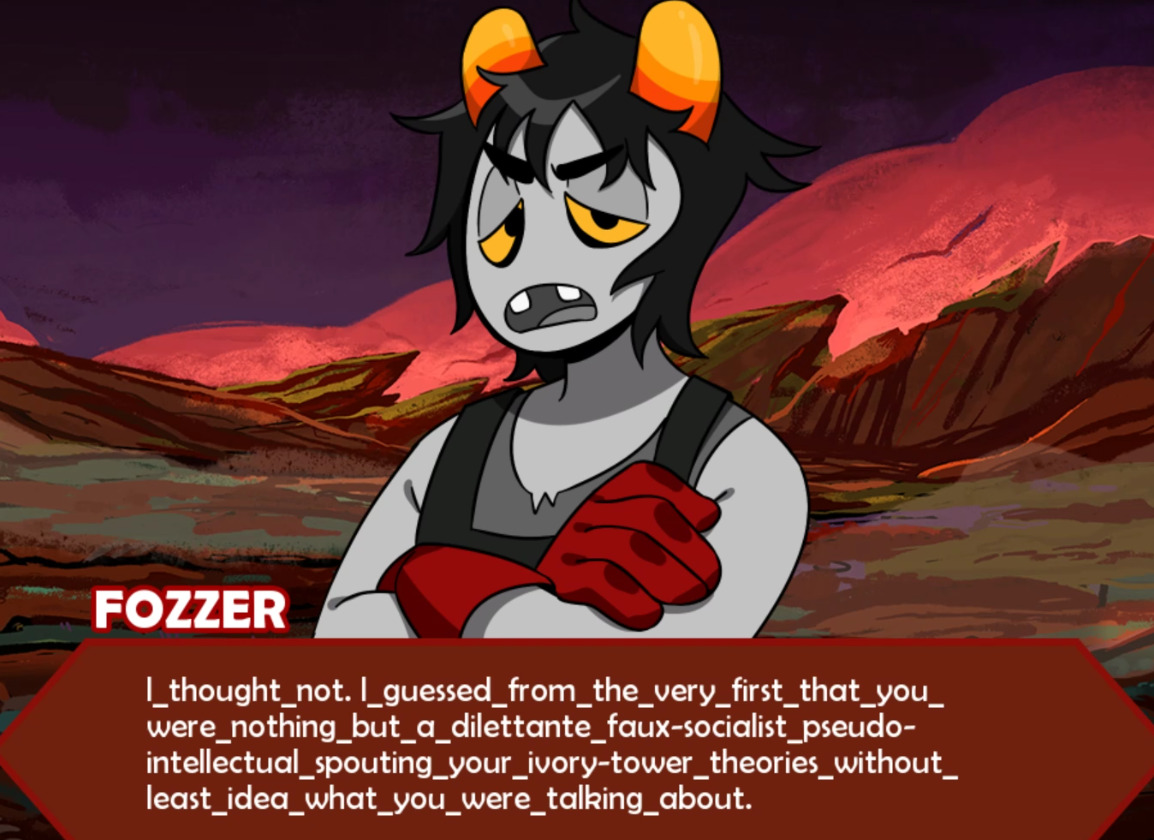
And however he disagrees with you, his instinctual response is the same. He storms off after verbally thrashing the Reader, but its interesting that he does it the same way both times: By imposing identities onto the Reader. Hilariously, Fozzer is unwittingly owning alternate versions of himself, too, and unwittingly inviting self-owns is basically the core of the Knight/Page aesthetic.
So really, Fozzer’s core personality is much the same–what’s taken place is a binary flip in the persona he relates to the world with. In one reality, he conveys the ideas of the hopeful revolutionary underclass.
In the other, he projects the identity of a happy and willing member for the Empire’s war-machine–the joyful slave, the pain of his own exploitation cushioned by a strong sense of societal purpose and identity. Note how the shovel easily parses as a strong symbol of this identity, too–a triumphant tool with which to serve the empire, rather than an ironic symbol of oppression.
I don’t think we should be hasty in assuming one Fozzer is more real than the other, even if we’re inclined to like one of them more. Especially since Fozzer works in Absence Park and seems familiar with these lights, meaning these scratch shifts might have been happening to him for a while.
The two Fozzers give us a fascinating window into the nuances of Heart, and indeed we’ve been told this sort of splintering of self can be common to the Heartbound by Calliope. Their opposing ideologies present us with a self-contained dialectic, in fact.
In Hegel’s understanding of the term, we can only truly understand an individual idea (say: Fozzer) by examining the tensions and similarities between these two opposed perspectives.
And these tensions are usually resolved not by one winning out over the other, but by achieving a Synthesis that combines he best traits of both.
Maybe because of that, I find the fact that we can only “win” by embracing the “Happy Slave” Fozzer unnerving. It’s hard to say how Fozzer’s path will evolve going forward, but given how central the idea of conflicting opposites is to his expression of his Classpect, I highly doubt we’ve seen the last of “Comrade” Fozzer.
So, I guess we’ll just have to see how it goes?
[Closing disclaimer: I’m not entirely sure how different Marxism’s Dialectic Materialist approach is from Hegel’s Dialectics. For instance, I’m unsure if it also uses the “Thesis”, “Anti-Thesis”, “Synthesis” model Hegel describes, or if I’m accidentally mixing the two.
Cursory Wikipedia research seems to bear this out, with Marx even describing Dialectic Materialism as simply the opposite of Hegel’s more philosophical and idealistic take on the idea, which Marx regarded as full of “Mysticism”. As a Hopebound more comfortable with the ideal than the material myself, I suppose its no surprise I find Hegel’s dialectics more immediately approachable and comfortable, for now.
What I’m saying here is, take everything I’ve written about dialectic materialism here with a grain of salt: I’m trying to do my homework and make sure I have the facts straight, but it turns out philosophy can get hard to sum up, especially when you’re trying to reconcile it with a fantasy metaphysics system. Feel free to clarify if I’ve messed details up. ]
not just sometimes, that’s literally what he is and because he stands for all opposites, he isn’t stuck between effectiveness and ineffectivess, since ineffectiveness in it’s nature never manifests, it is literally *ineffective*,
It is things not happening, versus things happening, so something that doesnt happen has no power against the things that do happen, letting unbridled effectiveness unfold wherever it pleases. They are unique opposites that by nature do not cancel each other out.
This is what Abraxas is all about and why he is a god, the ultimate god guy person thing. he need only imagine something for it to become reality because as the culmination of all opposites, usually all opposites cancel each other out, so his power is nothing except effectiveness, since that’s the only thing that manifests in the face of its opposite
but yes since he is literally everything in one being, he is the most truly powerful (yalda only believes he is the biggest bad aruund because he is either ignorant of Abraxas’s existence, or is directly malevolent against him, depending on the tale, but homestucks yalda seems to be the ignorant one)
but this means that as a denizen in nature he is whatever the player can need him to be, representing them perfectly like how Karkat described for himself, but the thing that makes me think that its Abraxas the most is Karkat saying how he’s the opposite of Yalda, and Yaldabaoth and Abraxas are opposed as the fake ultimate and the true ultimate creator, everything Yaldabaoth does is just a sham imitation of what Abraxas is
Abraxas creates all things from himself and permeates all of a reality of like while the facets of himself manifest as varying aeons of a perfect reality
Yalda tries to imitate this by creating our material realm in which he permeates throughout and this is gnosticism’s explanation for why our realm is dark and imperfect in nature, a cheap shitty imitation, think how like Homosuck is to Homestuck
So Karkat saying the denizen opposite of Yaldabaoth, when usually you would assume that was Echidna, but he’s clearly meaning someone else, makes me think he means Abraxas. Those three Echidna, Yaldabaoth and Abraxas are closely tied together symbolically in homestuck, especially when you see the Echidna/Sophia parallels, they are the 3 denizens directly relating to gnosticism and to eachother, so when soeone mentions one while describing another, i tend to them of them 3, so it’s perfect as well that as Yaldabaoth is represented as all powerful and for the strongest players, Abraxas would be represented seemingly first as the opposite, for the ‘weakest’ players, but in reality he is truly the Denizen of the actual strongest players, even if they themselves do not see it yet
Perfect for someone like Karkat and Jake
just think of it like them being “Strong in the real way” yknow?
You know, the reason I started writing Homestuck analysis in the first place was my frustration with the fandom’s conversation on all things surrounding the comic’s canon lore — because from my perspective, there was very little regard to the overarching themes that informed the “ending” of the story.
But I can hardly blame them. A lot of the fandom came into the comic drawn in by the spectacle of dramatic showpieces like [S] Cascade, and so expecting, essentially, a straightfoward if overly complicated action romp anime. Like a One Piece, or a Naruto.
But while Homestuck isn’t necessarily deeper than those stories, it is constructed differently. A lot of the comic’s storytelling is left in the background, through visual symbolism or mythological and literary references.
AURYN, the twin amulet from The Neverending Story, is the symbolic core of Homestuck’s multiverse.
Keeping track of the story required drawing connections between otherwise throwaway words and phrases, descriptions, images and all sorts of other stuff. It’s a story constructed like a puzzle box.
So my frustration with the fandom was heightened, perhaps, because I happened to be coming from a slightly different position. I already knew a story who’s fandom had developed entirely around the idea of putting together just such an ambiguous and interwoven narrative.
I came in a fan of Dark Souls.
So imagine my delight when Mr. BestGuyEver (One of my favorite youtubers) drew a direct link between the endings of Dark Souls 3 and Homestuck in his look at the game’s final ending.
He contrasted the nature of Sburb (A game that consumes a planet to produce a new universe) to the Painted World of Dark Souls 3’s ending, which uses the blood of Humanity — the Dark Soul — as a creative pigment with which to draw a new world into existence, at the expense of the old.
And that’s a solid parallel…but I’m here to argue BestGuy was more right than he knows. But first, a detour.
In the discussion that followed the final entry in the story of the Dark Souls Trilogy — the Ringed City DLC — discussion began to surface on the parallels between the white egg held by Filianore and a previously little-known anime film known as Angel’s Egg.
Which is a shame, because Dark Souls isn’t just pulling inspiration from any general depiction of the mythological world egg. Angels’ Egg is an explicitly Christian work, a product of a man’s deep personal conversation with a particular religion’s themes and symbols.
I believe that Filianore’s Egg, introduced at the end of Dark Souls, is a signpost marking the beginning of a path to a set of symbols and archetypes that can help us cast new lights on what Dark Souls’ trilogy might be getting at.
Now to be clear, I’m no religious historian or scholar, and I know precious little Christian history. So for the most part, I won’t be getting into that. Lucky for us, we don’t have to, because there are many relatively modern works tapping into the same well of symbolism these two draw from.
And the usage of these symbols is so consistent that I can draw direct parallels between these otherwise totally disconnected works— including Berserk, Homestuck, Revolutionary Girl Utena, the MOTHER franchise, Persona, and fucking Digimon.
Not every story uses all the same symbols, since modern fiction — especially in Japan — often takes from and plays with spiritual symbols and concepts quite liberally. But when the same symbols do surface, they tend to get used the same way.
Take the egg, for example.
Both Homestuck and Revolutionary Girl Utena feature white eggs, whose destructions herald the end of the story and the world. Utena is the most explicit about the eggs’ apocalyptic imagery, and so the most informative on the symbol’s meaning:
The entire motivation of the antagonists — members of Ohtori Academy’s powerful Student Council, which serves the agenda of a mysterious agent known as End of The World — centers on this key phrase, ritually chanted at the beginning of every Council meeting.
The phrase equates the egg’s shell with the world, and the chick with the plight of the council — humans, each seeking to somehow escape the restraints put on them by themselves and society. Every council member is seeking to “be born”, an act that necessitates the destruction of the world that constrains them, to allow for the birth of a new one fit to their desires. A revolution. An apocalypse.
In Dark Souls, the birth of humanity similarly requires the destruction of the egg that maintains the rule of the Gods, the end of everything, and a rebirth into a new kind of world. A revolution. An apocalypse.
“The bird fights its way out of the egg. The egg is the world. Who would be born must first destroy a world. The bird flies to God. That God’s name is Abraxas.” ― Hermann Hesse, Demian.
But Utena’s ritual chant is actually paraphrased from an older story: Herman Hesse’s 1919 novel, Demian. Demian concerns itself with the coming of age of Emil Sinclair, a boy who finds himself torn between two worlds:
The bright, safe world of light and illusion, ruled by benevolent gods such as Mother and Father. And the dark and dangerous world of thought and spiritual truth.
As he delves deeper into the latter, Demian finds himself discovering two mysterious entites: His own human self, and a cryptic deity named Abraxas — the God that the bird of humanity flies to once it’s broken free of its shell. So what is Abraxas?
Well, that’s complicated. Across history, the name Abraxas has been described as an Egyptian deity, a demon, a magical incantation, and more.
Drawing from the word’s usage in Utena, Demian, and Homestuck, however, here we’ll talk about Abraxas as the Gnostic deity described by writers like Herman Hesse and psychologist/spiritualist Carl Jung.
So what’s Gnosticism?
Well, again, it’s complicated. Gnosticism is basically an umbrella term used by modern religious scholars to describe a variety of spiritual traditions and philosophical beliefs spawned from early Christianity.
No defined group called “Gnostics” ever existed, and groups now joined under its banner didn’t all necessarily agree — the term is just a loose grouping of many traditions outside the Christian “Canon” based on the Old and New Testament most of us are familiar with, containing all sorts of beliefs.
But at least in terms of what more modern works seem to have taken away from Gnosticism’s influence, there seems to be some fairly consistent imagery.
For starters, Gnosticism tends to expand the mythology of Christianity. Rather than a monotheistic model with One True God, Gnosticism could be interpreted as having at least two major deities, or an outright Pantheon, like the Olympians in Greek Myth.
This is unsurpising, since a lot of what made Gnosticism movements “different” from traditional Christianity was influence from other cultures — such as Greek Philosopher Plato’s Theory of Forms, and the concept of the Demiurge. Ideas who’s relevance to Dark Souls we’ll explore in Part 2.
Pt. 2 —Sophia and the Demiurge.
It could be said for the most part, Gnostic myth is a synthesis between Christian symbolism and Plato’s philosophy. This makes it quite interesting, because Plato’s philosophy gets at the fundamental tension of, well, existence. Which makes it pretty useful to questions of spirituality and religion, where providing answers to existential questions is pretty much the point!
See, Plato really loved knowledge. But in having knowledge, he came to a conclusion: The world kind of sucks! There’s disease and suffering all over the place. Everyone keeps dying and killing each other, and its terrible. 😦
But having knowledge was pretty fun, at least! It was innately satisfying for a philosopher, sure — but having knowledge was also pretty useful, since it let you improve the world so things were less awful, by giving you candlelight or lube or the internet or whatever.
So Plato imagined a divide between two worlds: A pure and perfect world of Ideas, accessible only through honest thought and imagination. And the imperfect and dirty world of existence and physical matter, where thoughts and ideas are expressed, but can never match the perfect versions of themselves that can be easily imagined.
Plato then concluded that whoever set up this whole reality thing must be either evil, or really bad at their job.
So a Demiurge, as described by Plato, is a kind of Creator God who plays a role similar to that of God in Genesis: that of fashioning or sculpting the physical world. Because of the physical world’s imperfections, said God must be either evil, or somehow imperfect themselves.
Veins of Gnostic thinkers would then take this idea to solve a perceived tension in Christian mythology: The stark difference between the Angry and Jealous God of the Old Testament, and the God with a message of Love and Peace who sent Jesus to save mankind in the New Testament.
“Gnostics” resolved this tension by separating the Biblical God into two entities.
The first was Abraxas, the god that sat at the very center of the World of Ideas — also called the World of Light. Purely conceptual, Abraxas embodied the process of everything that existed — every idea, every event, every outcome, both conceptual and physical.
Initially, the World of Ideas was all that existed. Abraxas created pairs of beings called Aeons — Idea Gods meant to help Abraxas create reality by working in pairs. All of this took place in the perfect world of Thought, so all that was being created was more Ideas for Abraxas to be.
Then Sophia — the Aeon ofWisdom, in some Gnostic Myths the partner Aeon to Christ — had to go and get all FUCKING curious all wanting knowledge or whatever, and tried to create something by herself. By trying to interact with “that which is unknowable” without the aid of her Partner.
As a result, Sophia fucks everything up forever by creating…Reality. By which we mean the world of matter and physicality, or in mythological terms, the Void of Darkness at the start of Genesis that the Lord exists in at the beginning of time.
Either cast down by the other Aeons over her mistake, or feeling regret at subjecting the new inhabitants of reality to such suffering, Sophia Descends from the World of Ideas (Light), down into the physical world of Matter (Darkness), and imbues herself within Humanity.
This means humans are all partly made of the spirit of Wisdom, and so have the ability to discover and explore the world of Ideas. The process of discovering wisdom — IE: Reaching Enlightenment — is equal to the process of becoming close to God.
“Wherefore, with a deer’s form surrounding her, She labours at her task beneath Death’s rule And Jesus said: O Father, see! [Behold] the struggle still of ills on earth! Far from Thy Breath away she wanders! She seeks to flee the bitter Chaos, And knows not how she shall pass through. Wherefore, send me, O Father! Seals in my hands, I will descend; Through Æons universal will I make a Path; Through Mysteries all I’ll open up a Way!” — https://en.wikipedia.org/wiki/Naassene_Fragment
But it also means she’ll experience all the suffering Humanity is subject to as they collectively try to Rise Up out of the material plane. All of our suffering is shared by her. For this reason, in some excerpts of the Nassene Fragments (one of our only known Gnostic texts), Christ takes pity on her and asks to be sent to Earth to provide a path for her — and humanity’s — salvation.
Yaldabaoth, as depicted in Homestuck.
She also creates a being known as Yaldabaoth, a Demiurge described as “blind” for his inability to perceive the World of Ideas. Yaldabaoth perceives only the physical, and so cannot see Sophia, who created him — or Abraxas, who embodies them both. It believes it is the One True God.
Yaldabaoth then fashions reality, as in Genesis, and goes on to play the role of wrathful, jealous God in the Old Testament.
So how might these symbols look played with in a more modern story?
Well, in the creation myth that sets the stage of Revolutionary Girl Utena, the source of all Light is a deity named Dios (Spanish for God), playing the part of the Rose Prince.
By saving them with his power and giving them their promised kiss, the Rose Prince made all the girls of the world Princesses. Except for one girl who could not receive his kiss: Anthy Himemiya, his little sister.
Even though Anthy — a Goddess herself — had magical powers, and it’s implied it was her love for Dios that gave him the power to become a Prince in the first place, she simply could not become a Princess in a world ruled by Dios.
And the world grew reliant on the Prince, and soon it seemed Dios would kill himself trying to serve them. It’s here that Anthy becomes our Sophia: By acting on her own to protect Dios, she inadvertently Changes him back to his true self — not the Rose Prince, but the Lord of the Flies — destroying the old world protected by his nobility.
In it’s place is born Ohtori Academy, with Dios reborn as a Demiurge: Akio Ohtori, the schools’ chairman and absolute ruler, a manipulative abuser interested only in reclaiming his lost power. He’s isn’t explicitly identified as Yaldabaoth, but he’s still marked by a star: The Morning Star, Venus, a common symbol for Lucifer.
So Utena adopts some Gnostic symbols, but mixes the origin story of Yaldabaoth with a more commonly understood villain in Satan. This is a great example of how these stories aren’t regurgitating ancient Gnostic ideas, but simply appropriating some Gnostic symbols for their own storytelling ambitions.
For this sin, Anthy is forced to bear the burden of Humanity’s hatred, and becomes known as a Witch — an archetype associated with servitude to a controlling power — Akio, in Anthy’s case, or for example the First Flame for the Witch of Izalith —and the power to bring about the Apocalypse.
At this point you might be starting to draw the parallels yourself. The Demiurge is the flawed creator of the world, almost always depicted as the All-Father of Humanity, and almost always the Patriarch of a pantheon.
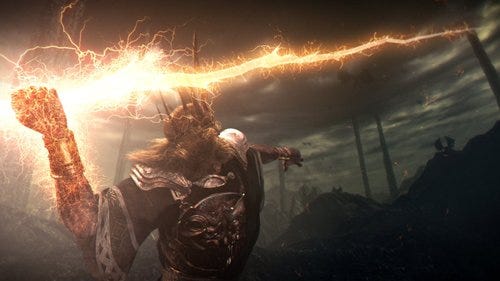
In Dark Souls, Gwyn is our Yaldabaoth. With lightning bolts echoing the Greek version of the Demiurge — Zeus — he takes down the Dragons much as Zeus casts out Uranus.
Left: Yaldabaoth, depicted as a worm with a lion’s head, encased by a sun. Right: Calliope, Homestuck’s Sophia analogue, who creates LE by accident.
“Realistic” depictions of the Sun are used as symbols for Homestuck’s Demiurge-Lord English.
And just like Yaldabaoth, Gwyn is marked by the the Sun. In both Dark Souls and Homestuck, the Sun is used as both an identifier for the Demiurge and as a mark of said God’s dominion and oppression over the mortals in the cast.
The sun is the symbol of the Dark Sign, the means by which Gwyn freezes time and subjects humanity to the Undead Curse. All of the suffering and brutality humanity is put through across the trilogy is ultimately an effort to keep his dominion over the physical world intact, and the abstract threat of a realm he can’t perceive or understand at bay.
In this understanding, we can see Sophia as equivalent to the Furtive Pygmy — the figure that grants humanity the Dark Soul, which ultimately manifests as the power of Imagination: The power to perceive the world of Ideas and paint what lies within, the power to imagine what Gwyn and the other Gods cannot perceive.
Hence the innate threat of the Painted Worlds.
She could also be analogous to Velka, the Goddess of Sin. Sophia, as the counterpart to Christ, was also understood as the Holy Spirit: The spiritual instict that guides humanity upwards towards Enlightenment, commonly depicted by the Dove.
Velka, strongly associated with Crows, is repeatedly implied to lead humans to forbidden knowledge that threatens the Gods — it’s her crow that begins the journey of the Chosen Undead, deeming humans worthy of entering the Realm of the Gods all the way back in Dark Souls 1.
But either way, her analogues are both envoys of Gwyn’s opposing force: The Abyss. And so, Yaldabaoth’s counterpart, Abraxas.
Pt. 3 — The Light found in the Darkness is named Abraxas.
If it has a counterpart in Dark Souls, it could only be the Dark Soul itself — the idea that both empowers your character and shackles humanity’s fate to Gwyn’s power throughout the series, the core concept that defines every moment of the game through the fantasy it justifies to make the world feel “believable”.
If Gwyn is the “Power” that the Player must strive against, then the Dark Soul — Abraxas — is the “Power” that allows us to Play.
Yet Abraxas can be seen as the Abyss threatening to swallow the world, as well. Endless Blackness expanding forever. Black like the world of ideas the Greeks imagined as the source of all things Good and True: The infinite blackness your brain perceives whenever you close your eyes.
We’ll come back to that in a second, but first, a slight detour.
So an interesting quirk of the “Gnostic” worldview is that in their interpretation of the Book of Genesis, the Snake is actually a heroic figure — borderline Christ-like, actually.
It kinda makes sense, once you consider that “Gnostics” imagined Yaldabaoth — the God in the Book of Genesis, commanding we not eat the apple — as an evil God suppressing humanity, and saw the pursuit of knowledge and wisdom as a spiritual end.
Knowledge is good. Ergo the snake, who leads humans to knowledge, is also good. Eating the apple might have sucked in the short term, but it was also the only way for Humans to claim “the power of God”: The power to perceive ideas, and create/reshape reality according to what we imagine.
Utena bows out of this question mostly out of propriety. It’s interested in, uh, a different kind of snake.
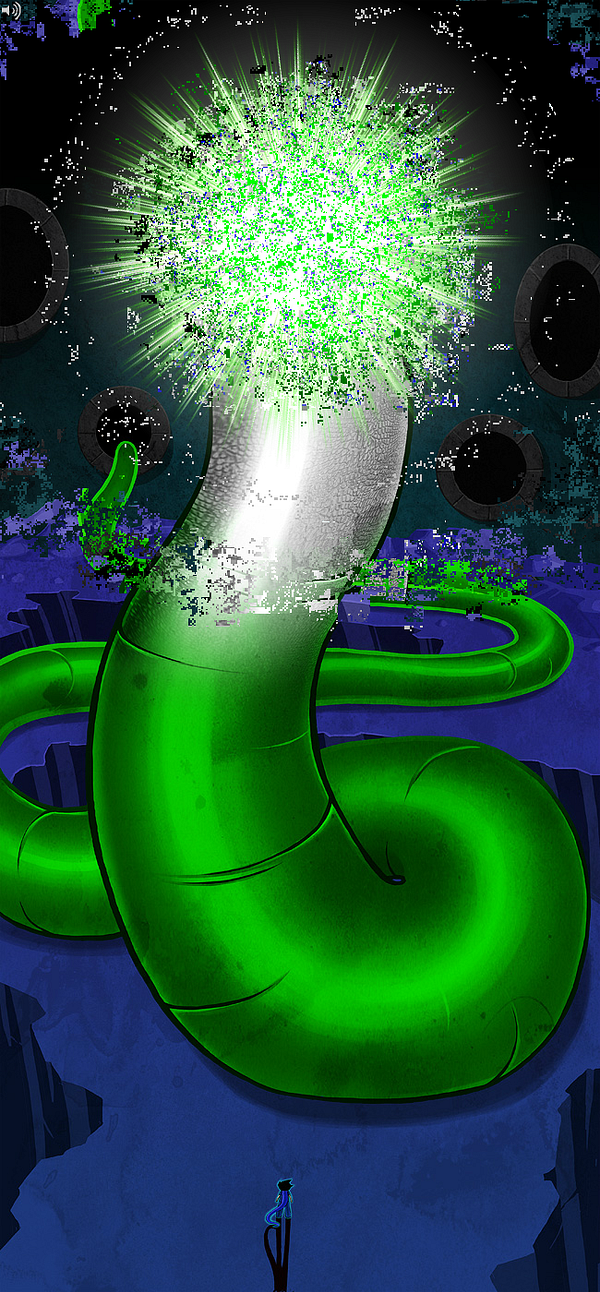
Because of this, Snakes are often used as a symbol of obscure, enlightening knowledge — as holders of secrets and old truths. Homestuck’s Denizens are impossibly long snake-worms the players can either battle to the death or consult for existential insight.
If approached for the latter function, the Denizens become sources of Knowledge and Ideas: Light. Hence their shining heads. And if we can see the abyss itself as Abraxas, and Snakes are seen as providers of True Ideas — the realm of thought that Abraxas presides over — then that puts an interesting spin on the twin snakes that make up Abraxas’ legs.
We can see them as reflections of the key power players in Dark Souls’ cosmology, who seem to emerge endlessly out from the Abyss: The Primordial Serpents. They present us with both the “Gnostic” and traditionally “Judeo-Christian” views of the Biblical Snake simultaneously, represented by two different snake characters.
You have Frampt, who encourages obedience to Gwyn, the figure standing for the Biblical God, and teaches the necessity of human suffering and sacrifice to the first flame as noble.
And then Kaathe, who inspires dissent and rebellion against the Gods’ world order, and the pursuit of humankind’s rise to their own dark, creative potential. In both cases, Snakes invite the understanding of a fundamental worldview:
Are humans bad and in need of penance and control? Or are they noble victims who have been cheated by the gods? The spectrum of answers to these questions the inhabitants of each Kingdom come up with define the world of Dark Souls.
But all Primordial Serpents ultimately seem to bow down to the Dark Lord once they surface and claim humanity’s freedom over the Gods. So even Frampt seems to act in service to the expansion of the Abyss — of Abraxas.
Interestingly, in Dark Souls 3’s final areas, the most devout adherents of either serpent’s following start transforming, sprouting wings that echo traditional warrior angels in the worlds ruled by Light. Birds being symbolic of ascension and liberation from the former world’s shell, a motif that’s also carried by…
The dark pilgrims, who when awakened to their true forms are reborn as winged serpents, specifically — snakes being symbolic of knowledge and enlightenment, remember. This design is particularly evocative of those that Jake English, a Warrior strongly linked to Abraxas, summons in Homestuck
Carl Jung describes Abraxas as a “coil of winged serpents” in his post-humously 7 Sermons. All this said, Dark Souls doesn’t necessarily choose a side. This is pretty charged imagery, but I’m not arguing Dark Souls is telling an inherently Gnostic story — just that it plays with Gnostic symbols.
For one thing, mankind’s dark ascent is portrayed as pretty fucking terrifying, whether or not it was fair of Gwyn to try and suppress it. It has some fairly ugly consequences, and it’s not exactly clear that the world to come is a better one.
While Bloodborne’s universe might not directly follow from Dark Souls’, its kind of a natural thematic successor to the trilogy in this sense — with it’s grim exploration of humanity’s own innate capacity for cruelty, brutality, and damnation — as focused on the destructive power of science as Dark Souls is on he influence of religion.
Humanity’s dark ascenscion isn’t the exactly the inspiring triumph of humanity over oppression we see in Utena and Homestuck, is what I’m saying — although it certainly can be interpreted that way.
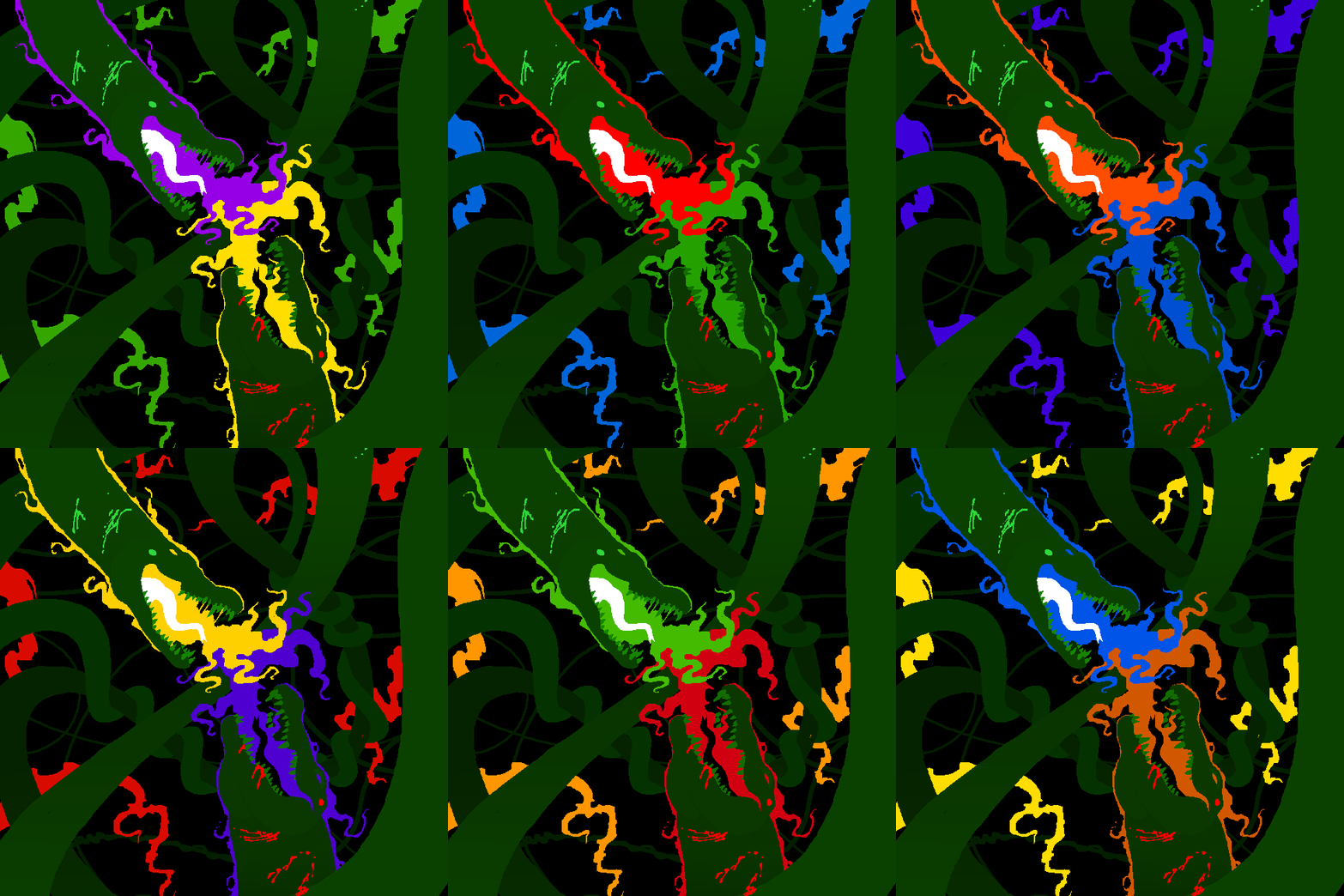
Homestuck’s Primordial Serpents: Cherubs.
Homestuck, draws its moral and philosophical lines in the sand more clearly. It has a twin set of serpents, too. Cherubs are a biological component of any part of the Paradox Space multiverse: They come with two alignments of “good” or “evil”. “Good” cherubs act as protectors of the universe, challenging and subverting the destructive and controlling urges of “Evil” ones.
The story of Homestuck concerns two very special Cherubs who are allowed to play a game that allows mortals to become Gods, and the conflict of wills that plays out between them spans the entire narrative.
Caliborn, the Lord of Time.
The way that conflict plays out between them turns out to be eerily similar to the conflict between the Abyss and Gwyn in Dark Souls. Gwyn is repeatedly identified as a Lord, a Class Caliborn is assigned by Sburb’s vague forces of omniscience.
The primordial serpent that represents him would be Frampt: while Frampt puts a nicer spin on it, the story he peddles is ultimately that humans exist to suffer Gwyn’s cycle and sacrifice themselves to keep the age of Fire alive — just as Caliborn believes his subjects deserve only death and suffering.
In both cases, Lord seems to be a mythological reference — Gwyn and Caliborn are Lords not just as in Royalty, but as in Lord Gods, the title of the Biblical Deity. Both Gwyn and Caliborn are obeyed, by both reality and their subjects — their power over their realms is absolute, while it lasts.
Both Gwyn and Caliborn commit first sins that create their flawed worlds — Gwyn the world of Dark Souls, Caliborn the world of Homestuck.
And in both cases, this sin involves the subjugation of Humanity and a diminishing of Humankind, though how that subjugation is carried out depends on the Lord. Gwyn — named a Lord of Light, deals directly with Fire and Light in his fight against humanity.
Caliborn, as a Lord of Time, oppresses the heroes through the Alpha Timeline, a massive timeloop every character must play out perfectly to ensure his own rise to power as Lord English, and so the creation of every character.
And Light and Time are positioned directly next to one another in Homestuck’s official Aspect wheel — the Aspects the twelve primordial particles of Thought in Homestuck’s cosmology. The “elements of disparity”, as Dark Souls calls them — Life and Death, Light and Dark, and so on.
Calliope, the Muse of Space
What unites Gwyn and Caliborn is their shared pursuit of the destruction of their opposite. Lord English is motivated by fear of his only weakness — his sister Calliope, the Muse of Space. Space is presented as the opposite to Time, and it’s directly next to Light’s opposing Aspect, Void.
Void is the aspect of nothingness and the unknowable, the hidden, secret, and abstract. In Homestuck, it’s depicted as the Furthest Ring, an endless realm of pure black chaos where natural laws break down, sometimes depicted as an ocean.
Calliope spends most of the narrative hiding deep in this Darkness, as Lord English endlessly tears at the Furthest Ring in a desperate bid to wipe her out. Sounds pretty similar to the way Gwyn’s fear makes him endlessly war against the darkness, huh?
Which is quite fitting, as it’s Calliope who echoes the Dark Serpent, Kaathe. Like Kaathe, Calliope leads her friends to a view that empowers them to claim their own innate creative power and divine potential in resistance of the Lord’s will.
Where a Lord commands through authority and respect, a Muse commands through inspiration, and though the Lord seems to overpower her initiatilly, it is the Muse who proves the true Master in the end.
Space rules over creativity, inspiration, the environment, and the story’s setting.
Just as the underlying truth of the setting of Dark Souls is that the Abyss, and the true birth of humanity, is inevitable. There was nothing Gwyn could ever really do to stop it — it’s simply the course the world naturally takes, the nature of the world’s Setting.
And so Calliope’s final act over the story, and the final move of the Abyss in Dark Souls, turns out to be the same:
Birthing a final black Hole, that swallows the Sun that marks the power of the Demiurge. Both stories end with the final destruction of Yaldabaoth’s reign, and so, with the death and rebirth of the world he created. Here’s where both stories differ from what many perceive as one of the core “tenets” of Gnosticism, which is the idea that the world itself is inherently bad.
Instead of a straightfowardly “Gnostic” ending, all three of these stories turn to metatextual endings that position freedom and enlightenment as a noble pursuit — even if the enlightened power of Humanity proves risky or dangerous. Because, quite simply, it is Humanity’s birthright.
Utena can only end when Anthy overcomes her guilt and belief in her own evil, and rejects her Brother’s rule, and embraces Utena’s friendship completely by escaping Ohtori Academy — thus effectively ending the reign he established through her power.
Thus, it, too, ends with an escape from the realm of the Demiurge, an exit from the world of the narrative, and a rebirth into a lawless and apocalyptic new world, with the only comfort being true companionship.
In Homestuck, the Lord’s subjects emancipate themselves, and rule the Earth as Gods. But more important than their power is the simple comfort of being able to live peacefully in their new home. Together.
And in that respect, Dark Souls isn’t terribly different, either. The world Painted with the Dark Soul is cold and dark, but it’s also a very gentle place. And even in the ending where we let the fire die completely, we’re left with a different kind of warmth:
That of another.
And that’s satisfying to me — that all of these stories seem to end with the idea that all we really need, more than Light and Time and Gods and Power…is each other. Because at the end of the day, isn’t it true? Isn’t that all that really matters?
I’ll be eager to hear what you all think, so please let me know. In the meantime…
Let’s be clear here: I barely know anything about Gnosticism. It’s a spiritual tradition that as far as I can tell has been mostly dead for ages, and it’s roots are tangled with Christianity, so the history we’re dealing here is massive, complex, and often contradictory.
I learned about Gnosticism simply by taking note of thoroughly Modern works that play with its symbols and ideas, and not always in a completely sincere way, or at least not an overtly religious/spiritual one. It’s compelling imagery for worldcrafting! Useful for fiction writing.
And Japan in particular seems to like making God the bad guy in some video games–a suitable threat level for a long campaign, I guess–so a lot of my understanding comes from comparing these modern works and seeing how they use the same symbols the same way, or very very very VERY similarly.
Some of those works are:
-Homestuck
-Mother 3, the sequel to Homestuck’s namesake, Earthbound (and to a lesser extent, Earthbound itself)
-Revolutionary Girl Utena
-The Dark Souls series
-Angel’s Egg (anime movie; it good)
-Persona 5, and generally the Persona series through its Jungian themes.
But when I say Homestuck is a Gnostic work, I don’t mean it’s literally to be understood solely through that particular spiritual doctrine. I just mean it draws from Gnosticism in crafting itself, and deliberately plays off Gnostic themes. Homestuck draws just as much from Greek, Egyptian, and potentially even Judaic myth.
And with most of these works, there’s a lot more going on than just those themes. My other big source here is Carl Jung, a psychoanalyst who was quite influential in the field and in pop culture, too.
RGU, Homestuck, and Persona all explicitly work his ideas into their worldbuilding, and though Jung himself was known to be a Gnostic, he had more to offer than just regurgitating Gnostic ideas per se. He’s probably the biggest source of Gnostic inspiration for modern writing, though. You can find a free compilation of some of his Gnostic writing here.
You might also want to check out Herman Hesse’s Demian, a novel I’ve read (its good) explicitly dealing with Gnosticism set just before the beginning of WWI. It’s a well-known influence on Utena in particular, and reading it illuminated some of the prominent symbolism across all of the works I just mentioned, too.
Hope you have fun with this! I’d probably reccomend engaging with any or all of the more modern works and seeing what comparisons you can draw to Homestuck, rather than trying to force yourself to read relatively dry ancient literature without context. This is all for fun!
Homestuck is terrible, and not every work that uses Mamichaean dualism is necessarily Gnostic in origin. Not trying to take away from the response, just adding to it.
1) I don’t particularly care about your bad homestuck opinion, and it’s hard for me to imagine how that extremely stale take adds to anything. Please don’t add boring drivel to my posts if you’re trying to be interesting or constructive; it makes it really hard to care.
2) I am genuinely interested in your mention of Manichaean dualism because, as I’ve said, I’m no expert. I may well be misidentifying things here, and I don’t want to be inaccurate.
I’ll risk assuming you’re talking about Dark Souls judging by your avatar, so If you’re willing, I’d be interested to know if Manichaean dualism has meaningful things to add to our understanding of:
1. The egg the Ashen One breaks/damages at the end of DKS3
2. The Dark Soul, and the Abyss
3. Gwyn (I don’t think Gnosticism is too directly linked to him, but I do think he takes quite a bit from Zeus, who’s probably the original deity the concept of a Demiurge itself is drawing from, since the idea was Greek before it was Gnostic. And ofc, the mark of Gwyn’s dominion is the Sun, which Yaldabaoth is strongly associated with.)
4. The Primordial Serpents, and the duality they present
Lastly, if you’re willing, I’d like to understand why you’d make the case that Dark Souls is specifically drawing on Manichaean dualism in distinction from Gnosticism. As in, how is it different?
And if you’re aware of the symbolism here, I’m kinda curious–do you have any clue why I haven’t seen it in the wider analysis sphere? This seems like the sorta thing Vaatividya would be all over, but I’ve never seen a wink of it outside of like, the Angels’ Egg video, which is only the tip of the iceberg as far as this stuff goes.
Thanks for your time and thoughts, should you be willing to offer them.
Let’s be clear here: I barely know anything about Gnosticism. It’s a spiritual tradition that as far as I can tell has been mostly dead for ages, and it’s roots are tangled with Christianity, so the history we’re dealing here is massive, complex, and often contradictory.
I learned about Gnosticism simply by taking note of thoroughly Modern works that play with its symbols and ideas, and not always in a completely sincere way, or at least not an overtly religious/spiritual one. It’s compelling imagery for worldcrafting! Useful for fiction writing.
And Japan in particular seems to like making God the bad guy in some video games–a suitable threat level for a long campaign, I guess–so a lot of my understanding comes from comparing these modern works and seeing how they use the same symbols the same way, or very very very VERY similarly.
Some of those works are:
-Homestuck
-Mother 3, the sequel to Homestuck’s namesake, Earthbound (and to a lesser extent, Earthbound itself)
-Revolutionary Girl Utena
-The Dark Souls series
-Angel’s Egg (anime movie; it good)
-Persona 5, and generally the Persona series through its Jungian themes.
But when I say Homestuck is a Gnostic work, I don’t mean it’s literally to be understood solely through that particular spiritual doctrine. I just mean it draws from Gnosticism in crafting itself, and deliberately plays off Gnostic themes. Homestuck draws just as much from Greek, Egyptian, and potentially even Judaic myth.
And with most of these works, there’s a lot more going on than just those themes. My other big source here is Carl Jung, a psychoanalyst who was quite influential in the field and in pop culture, too.
RGU, Homestuck, and Persona all explicitly work his ideas into their worldbuilding, and though Jung himself was known to be a Gnostic, he had more to offer than just regurgitating Gnostic ideas per se. He’s probably the biggest source of Gnostic inspiration for modern writing, though. You can find a free compilation of some of his Gnostic writing here.
You might also want to check out Herman Hesse’s Demian, a novel I’ve read (its good) explicitly dealing with Gnosticism set just before the beginning of WWI. It’s a well-known influence on Utena in particular, and reading it illuminated some of the prominent symbolism across all of the works I just mentioned, too.
Hope you have fun with this! I’d probably reccomend engaging with any or all of the more modern works and seeing what comparisons you can draw to Homestuck, rather than trying to force yourself to read relatively dry ancient literature without context. This is all for fun!
Back in the old fandom days, I was one of the many who was pretty pissed about that joke and internalized it as some sort of “take that” at Homestuck fans who had criticisms of the comic’s relationship to race.
My feelings have since shifted, and I certainly don’t think that was the narrative intent. I think the Caucasian joke is better understood in context with the rest of the comic’s gnostic themes. I’ve written an article on Trickster Mode:
Suffice it to say, I’m not an expert on race issues, and I don’t want my personal feelings to imply that all people who are critical of Homestuck along those lines are being unreasonable or anything.
But my reading of the text is such that if anything, the joke here is on Whiteness as a source of political power.
Or, even more likely, on making a tongue in cheek reference to one of AURYN’s side-effects in The Neverending Story. When Bastian (a white kid) gains the amulet (same one depicted on Jane’s Lollipop), he’s also transformed into an “oriental prince.” Racebending is sort of part of the thing’s powerset.
Not on debunking the idea that the kids could be white, or mocking fans who wanted to consider the possibility.
In this episode, we cover the mechanics behind each Sburb player’s individualized planet, the Lands. We explore the nature of their Consorts, and dive deep into the story-spanning importance of the Denizens as both game mechanics and mythological symbols.
Don’t worry if this one’s a little overwhelming! I’m still learning how to talk about this stuff, and I’ll definitely be covering the same material in different ways over time. Next episode will have us looking over Xefros’ complex and interesting Classpect. Thanks for watching, and please feel free to leave your thoughts!
Probably can’t go with anything but a Muse of Light.
It’s essentially the Gnostic world of ideas or the Collective Unconcious made manifest physically, if you think about it. Jokes, stories, images, lies–we experience all of reality, vicariously, through this slim sheen of glass and light. The screens inform us, educate us, give us knowledge and power–the power to reach out, the power to be heard, the power to be seen.
That’s kind of what the internet is. It’s light–electricity, energy, power harnessed into a form that is able to showcase any thought any of us care to share, and give all of our eyes windows into that holds those forms.
It’s a terrifically powerful tool, one that determines and controls basically everything about the world we live in. It commands us, one could say–holds our attention even as it constantly directs us towards each other.
I’m not sure how well I’m getting across what I feel, but I think a lot about the internet, and the way it entangles us and connects us and drives us apart. Basically, I think the internet can be understood as an entity that commands us all, for all of our collective and individual benefit. So I’d say Muse of Light.
Hey, chums! This time, we take a look at the Hero Titles, also known as Classpects. Let me know what your Class and Aspect is in the comments, and say whether Classpect videos on different characters sounds interesting to you!
Also, an announcement. After December 1st, I’ll be changing the Patreon to charge per video post, rather than monthly.
Here’s a couple of resources that may be of interest to Classpect fans who haven’t heard about Jungian Archetypes or Carol S. Pearson’s system, in case you find it interesting:



















 Flying through Storytelling