
OK this is gonna be shorter than Marvus obvs but Fozzer DID give me a good amount to think about, so here goes

Fozzer outright identifying as a dialectical materialist is exciting for a couple reasons. There’s a lot one could say about dialectics and Paradox Space in general (I’ve been trying to write that script for about a year) but here I want to focus on the Materialist half of that, because it immediately reminded me a lot of @arrghus’ idea of the notional/material divide between aspects.
Ever since the Extended Zodiac, we’ve been wondering if the way the Aspect wheel is laid out might suggest some relationships between Aspects, either original to Homestuck, mirroring the relationships the Signs share in the traditional Zodiac wheel, or some combination of both.
Arrghus’ essay series proposes a model for how those relationships might work, at least in part. I’d suggest checking it out for the full picture, but here I want to focus on the divide I find clearest and most compelling: That between the Ideal/Notional Aspects and the Material/Physical ones.

The gist is this: The top five Aspects (Mind, Hope, Breath, Life, and Light) are more closely aligned with the World of Ideas, and so those bound to them tend to be more concerned with the ideal, abstract, and imaginary. The bottom five (Void, Doom, Blood, Rage, and Heart) are more closely tied to the material, physical, and real.
If you’ve seen my prior writing on Homestuck, you might note that this dovetails easily with Gnosticism’s old cosmology of reality as divided between an imaginary world of Light and a physical world of Darkness. That said, this isn’t a hard binary–Blood obviously refers to some concepts as well as physical experience, and Breath obviously links to some things that happen in physicality, even if those elements are by definition elusive and insubstantial.
Space and Time are an even split, as much conceptual law to be deciphered as they are physical element of reality to be experienced. It could well be that this reflects most strongly in the perspectives those Bound to each Aspect are given to, as opposed to an underlying reality of the Aspects themselves, and in any case all twelve Aspects are necessary to describe a full picture of reality.

One of the most exciting possibilities this model raises for me is the idea of Aspect “Mirroring”, which is essentially a different kind of relationship Aspects can have. Aspects that are Mirror each other vertically, for example, might express the same ideas through the filter of the Ideal vs. the Material–reflecting the hermetic/magical principle of “As above, so below”.
Heart and Light are a pretty good way to express the relationship between vertically mirrored Aspects, as it turns out. Consider:
In Gnosticism, “Light” refers to directly to Information/Ideas, as the world of Light is the world of the imaginary. This is where “Platonic Ideals” live–the perfect imaginary version of any object, from which all physical manifestations of that object are derived.
Humanity gains the ability to access this world, the self-aware conciousness necessary to think, when the Goddess of Wisdom Sophia descends from that realm and imbues us with her Light–the light of curiosity, of wisdom, of the power to know. The light of the soul.
In this way, we can think of the Soul–the Heart–of living beings as their inner Light, expressed throughout their lives in the realm of physicality. And we can think of Light/Ideas as abstract concepts, that can only enter reality proper through the doorways created by the self-expression of individuals, as enabled by their soul.

There are a lot of ideas and concepts that Dirk’s soul seems consistently inclined to express onto reality. The shades, the concept of “being a Bro”, the idea of the Hard Anime Dude, Stoicism, the pervasive homoeroticism innate to the Greek ideals he’s generally shaped by, etc.
The clearest example of this might be his sword, which is itself a physical object seemingly ripped directly out of the “fake” (read: imaginary) world of anime. An idea, made physical, through the sheer expression of will manifested by Dirk’s soul.
This is what makes his katana so powerful:
It’s quite near to being a physical expression of our collective idea of the “Perfect Sword”, much like Bro sets an impossible ideal of “Perfect Manhood” that Dave wrestles with living up to. This might give you an idea of some of the more direct ways Heart’s conceptual toolbox could be exploited or weaponized.
The point here is that just expressing the idea of a “Bro” is
extremely important to Dirk, and expressing the idea of “Cats” is
similarly important to Nepeta and Meulin.
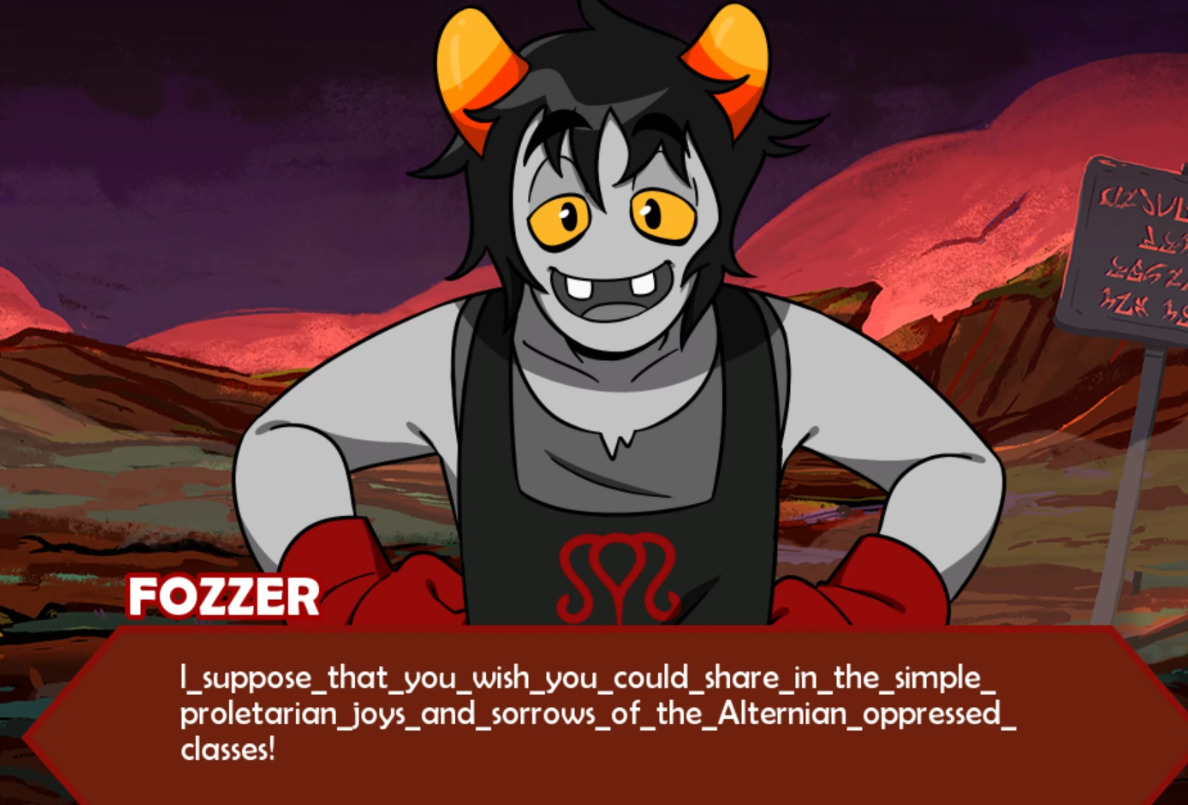
In the same way, Fozzer seems like an acutely intense expression of a political Persona. A philosophical idea, expressed in the physical world as an intense commitment to an associated identity. His shovel is an expression of that identity, much the same way Dirk’s katana or Nepeta’s claws are expressions of theirs.
But then again, Fozzer’s identity ain’t exactly stable, is it?

Before we talk about The Thing That Happens, we should note that as much as Fozzer seems to genuinely believe in his communist philosophy, he mostly seems interested in it as a means for self-expression, rather than an actual political movement with direct goals and results he’s looking to achieve.
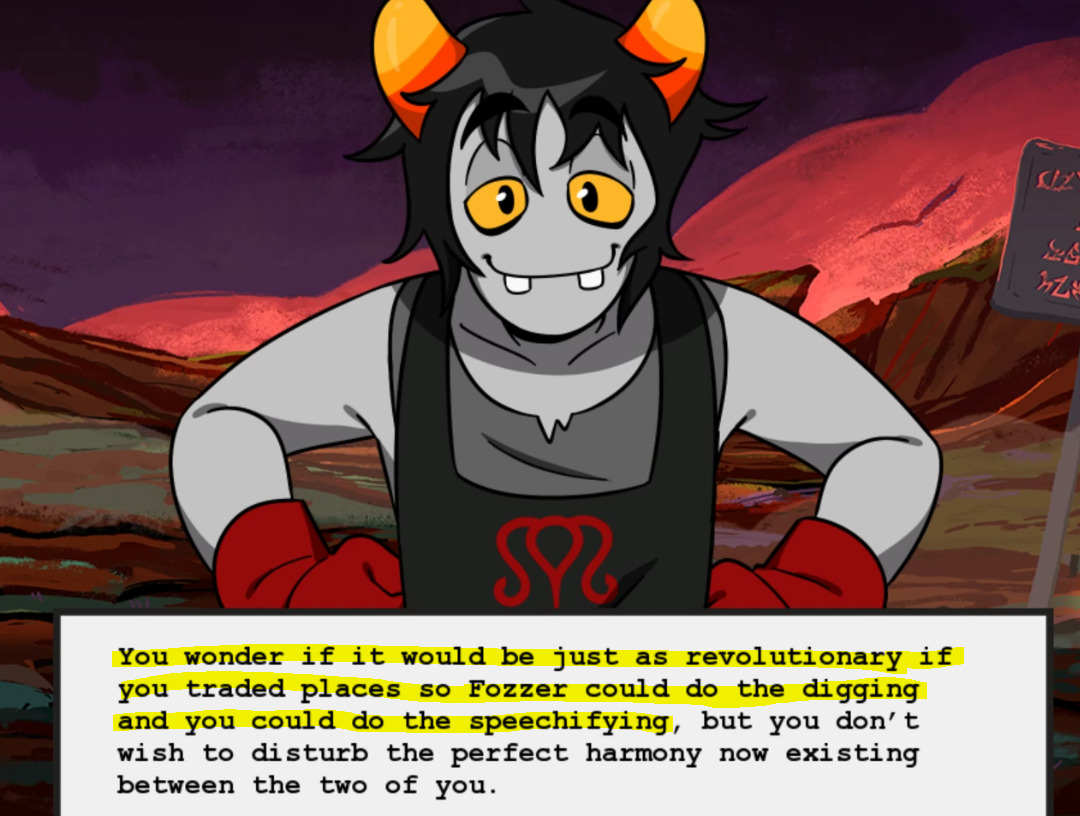
And even though he’s very intense and earnest about it, Fozzer seems inclined
to exploit his own identity in somewhat self-serving ways.
Unintentionally or no, he more or less uses his ideological speechifying
to conscript the Reader into doing work for him, therefore inviting the reader to Serve him through Heart, for Fozzer’s own benefit.

This, coupled with his strongly noted cowardice, leads me to consider him a Page. But my real point here is that even if a lot of us here on Tumblr find Fozzer’s ideology appealing, Fozzer seems less invested in ideology proper than with the identity it comes with–and even here, Fozzer isn’t exactly being portrayed as unambiguously Good and Correct.
Even if he’s preferable to the alternative. Sigh.
Let’s talk about the thing.

[WORLDBUILDING INTERMISSION]
So the biggest surprise of this friendsim was that we stumbled onto what’s basically a swell of Scratch energy just…hanging out under Absence Park, apparently?
Which is. A lot. This energy resets our conversation with Fozzer and changes his personality, which we’ll get into in a minute, but first I want to speculate:
How the hell does this thing exist at all, and what does it even mean? There’s a couple of possibilities.
Since this is essentially Time-coded Scratch energy we’re dealing with, @blindrapture pointed out that it could have something to do with the Handmaid, which I’d expand to include Lord English–and though I doubt it’s directly linked to Scratch himself, since he’s not too associated with Time the way the former two are, he may be aware of or able to use this…”glitch” in reality.
It’s also possible this is a natural consequence of a Scratch, and pockets of leftover Scratch energy like these are present in some locations of Post-Scratch worlds. For that matter, it could be a consequence of John’s retcon powers, which act like the scratch in some ways and might have had consequences we don’t yet fully understand.

Finally, given the language, I suspect that the hole in Absence Park is actually just a hole into the Void, leading to the Furthest Ring, much like Roxy’s windows. This Scratch energy seems to have entered the Furthest Ring, and is presumably writhing there until circumstances allow it to vent out through this particular entrance to reality.
What are the implications? Who knows. If this is a hole into the Void, then this is another avenue through which Hiveswap’s cast might be able to exit Alternia and find a new world.
If the Scratch outbursts are recurring enough, then we have at least one way for our heroes to “Time Travel” and basically save scum to try and achieve optimal desires results, like saving a troll friend who gets killed by going back in time for example.
That’s probably the biggest takeaway to me, because having a way to time travel built into Hiveswap’s text already makes me that much more sure that no matter what kind of carnage and brutality our beloved troll friends get subjected to, we’re ultimately headed towards a happy ending where probably nobody dies–
I can reasonably see the possibility that even antagonistic figures like Ardata and even Trizza could be saved, under these circumstances.
Ok back to Fozzer.

So the thing about “Post-Scratch” Fozzer is that I feel he’s being dismissed somewhat due to his admittedly unsavory politics. This still strikes me as a very genuine and direct expression of Fozzer’s Classpect inclinations.
Fozzer is still taking a very materialist view of reality here, for example–he’s interested in the actual physical history of how this system evolved, and considers understanding that history necessary to understanding society.
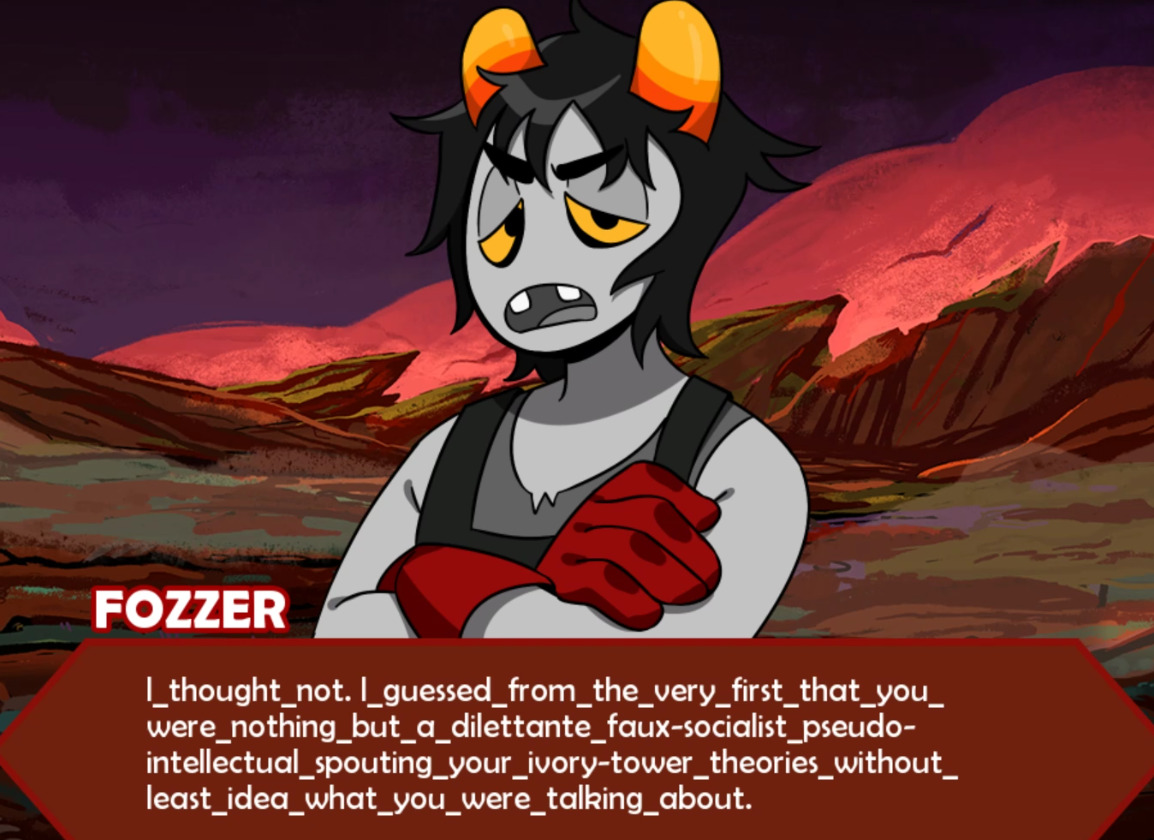

And however he disagrees with you, his instinctual response is the same. He storms off after verbally thrashing the Reader, but its interesting that he does it the same way both times: By imposing identities onto the Reader. Hilariously, Fozzer is unwittingly owning alternate versions of himself, too, and unwittingly inviting self-owns is basically the core of the Knight/Page aesthetic.
So really, Fozzer’s core personality is much the same–what’s taken place is a binary flip in the persona he relates to the world with. In one reality, he conveys the ideas of the hopeful revolutionary underclass.
In the other, he projects the identity of a happy and willing member for the Empire’s war-machine–the joyful slave, the pain of his own exploitation cushioned by a strong sense of societal purpose and identity. Note how the shovel easily parses as a strong symbol of this identity, too–a triumphant tool with which to serve the empire, rather than an ironic symbol of oppression.
I don’t think we should be hasty in assuming one Fozzer is more real than the other, even if we’re inclined to like one of them more. Especially since Fozzer works in Absence Park and seems familiar with these lights, meaning these scratch shifts might have been happening to him for a while.
The two Fozzers give us a fascinating window into the nuances of Heart, and indeed we’ve been told this sort of splintering of self can be common to the Heartbound by Calliope. Their opposing ideologies present us with a self-contained dialectic, in fact.
In Hegel’s understanding of the term, we can only truly understand an individual idea (say: Fozzer) by examining the tensions and similarities between these two opposed perspectives.
And these tensions are usually resolved not by one winning out over the other, but by achieving a Synthesis that combines he best traits of both.

Maybe because of that, I find the fact that we can only “win” by embracing the “Happy Slave” Fozzer unnerving. It’s hard to say how Fozzer’s path will evolve going forward, but given how central the idea of conflicting opposites is to his expression of his Classpect, I highly doubt we’ve seen the last of “Comrade” Fozzer.
So, I guess we’ll just have to see how it goes?
[Closing disclaimer: I’m not entirely sure how different Marxism’s Dialectic Materialist approach is from Hegel’s Dialectics. For instance, I’m unsure if it also uses the “Thesis”, “Anti-Thesis”, “Synthesis” model Hegel describes, or if I’m accidentally mixing the two.
@gamblignant8 on the Perfectly Generic Podcast described Dialectic Materialism as being Hegel’s Dialectic applied with a focus on physical reality, mixed with an analysis of humanity’s historical evolution on the physical plain.
Cursory Wikipedia research seems to bear this out, with Marx even describing Dialectic Materialism as simply the opposite of Hegel’s more philosophical and idealistic take on the idea, which Marx regarded as full of “Mysticism”. As a Hopebound more comfortable with the ideal than the material myself, I suppose its no surprise I find Hegel’s dialectics more immediately approachable and comfortable, for now.
What I’m saying here is, take everything I’ve written about dialectic materialism here with a grain of salt: I’m trying to do my homework and make sure I have the facts straight, but it turns out philosophy can get hard to sum up, especially when you’re trying to reconcile it with a fantasy metaphysics system. Feel free to clarify if I’ve messed details up. ]


 Flying through Storytelling