was Marvus “massacres his own fans every show” Xoloto taking one look at a random alien hanging out with Zebruh and being like
man, that’s rough i should help them nobody deserves a fate that bad
going to add that this is doubly hilarious because its actually a solid example of Zebruh inviting service through Doom (suffering/restriction/death),
for the benefit of others (MSPA Reader)
which is exactly what I’d expect from a Knight.
Unwittingly helpful through awfulness. What a guy.
they already implied there’d be other “rounds” of friendsims later, and linked it to seadwellers with a pun. its just narrative and thematic pacing at work; the seadwellers are the ruling class that controls alternia, so it makes sense to get to know the world they victimize before we try to engage with them directly. especially since seadwellers are some of the castes we know least about and judging by the friendsim so far they’ll come with hella lore
OK this is gonna be shorter than Marvus obvs but Fozzer DID give me a good amount to think about, so here goes
Fozzer outright identifying as a dialectical materialist is exciting for a couple reasons. There’s a lot one could say about dialectics and Paradox Space in general (I’ve been trying to write that script for about a year) but here I want to focus on the Materialist half of that, because it immediately reminded me a lot of @arrghus’ idea of the notional/material divide between aspects.
Ever since the Extended Zodiac, we’ve been wondering if the way the Aspect wheel is laid out might suggest some relationships between Aspects, either original to Homestuck, mirroring the relationships the Signs share in the traditional Zodiac wheel, or some combination of both.
Arrghus’ essay series proposes a model for how those relationships might work, at least in part. I’d suggest checking it out for the full picture, but here I want to focus on the divide I find clearest and most compelling: That between the Ideal/Notional Aspects and the Material/Physical ones.
The gist is this: The top five Aspects (Mind, Hope, Breath, Life, and Light) are more closely aligned with the World of Ideas, and so those bound to them tend to be more concerned with the ideal, abstract, and imaginary. The bottom five (Void, Doom, Blood, Rage, and Heart) are more closely tied to the material, physical, and real.
If you’ve seen my prior writing on Homestuck, you might note that this dovetails easily with Gnosticism’s old cosmology of reality as divided between an imaginary world of Light and a physical world of Darkness. That said, this isn’t a hard binary–Blood obviously refers to some concepts as well as physical experience, and Breath obviously links to some things that happen in physicality, even if those elements are by definition elusive and insubstantial.
Space and Time are an even split, as much conceptual law to be deciphered as they are physical element of reality to be experienced. It could well be that this reflects most strongly in the perspectives those Bound to each Aspect are given to, as opposed to an underlying reality of the Aspects themselves, and in any case all twelve Aspects are necessary to describe a full picture of reality.
One of the most exciting possibilities this model raises for me is the idea of Aspect “Mirroring”, which is essentially a different kind of relationship Aspects can have. Aspects that are Mirror each other vertically, for example, might express the same ideas through the filter of the Ideal vs. the Material–reflecting the hermetic/magical principle of “As above, so below”.
Heart and Light are a pretty good way to express the relationship between vertically mirrored Aspects, as it turns out. Consider:
Humanity gains the ability to access this world, the self-aware conciousness necessary to think, when the Goddess of Wisdom Sophia descends from that realm and imbues us with her Light–the light of curiosity, of wisdom, of the power to know. The light of the soul.
There are a lot of ideas and concepts that Dirk’s soul seems consistently inclined to express onto reality. The shades, the concept of “being a Bro”, the idea of the Hard Anime Dude, Stoicism, the pervasive homoeroticism innate to the Greek ideals he’s generally shaped by, etc.
The clearest example of this might be his sword, which is itself a physical object seemingly ripped directly out of the “fake” (read: imaginary) world of anime. An idea, made physical, through the sheer expression of will manifested by Dirk’s soul.
This is what makes his katana so powerful:
It’s quite near to being a physical expression of our collective idea of the “Perfect Sword”, much like Bro sets an impossible ideal of “Perfect Manhood” that Dave wrestles with living up to. This might give you an idea of some of the more direct ways Heart’s conceptual toolbox could be exploited or weaponized.
The point here is that just expressing the idea of a “Bro” is
extremely important to Dirk, and expressing the idea of “Cats” is
similarly important to Nepeta and Meulin.
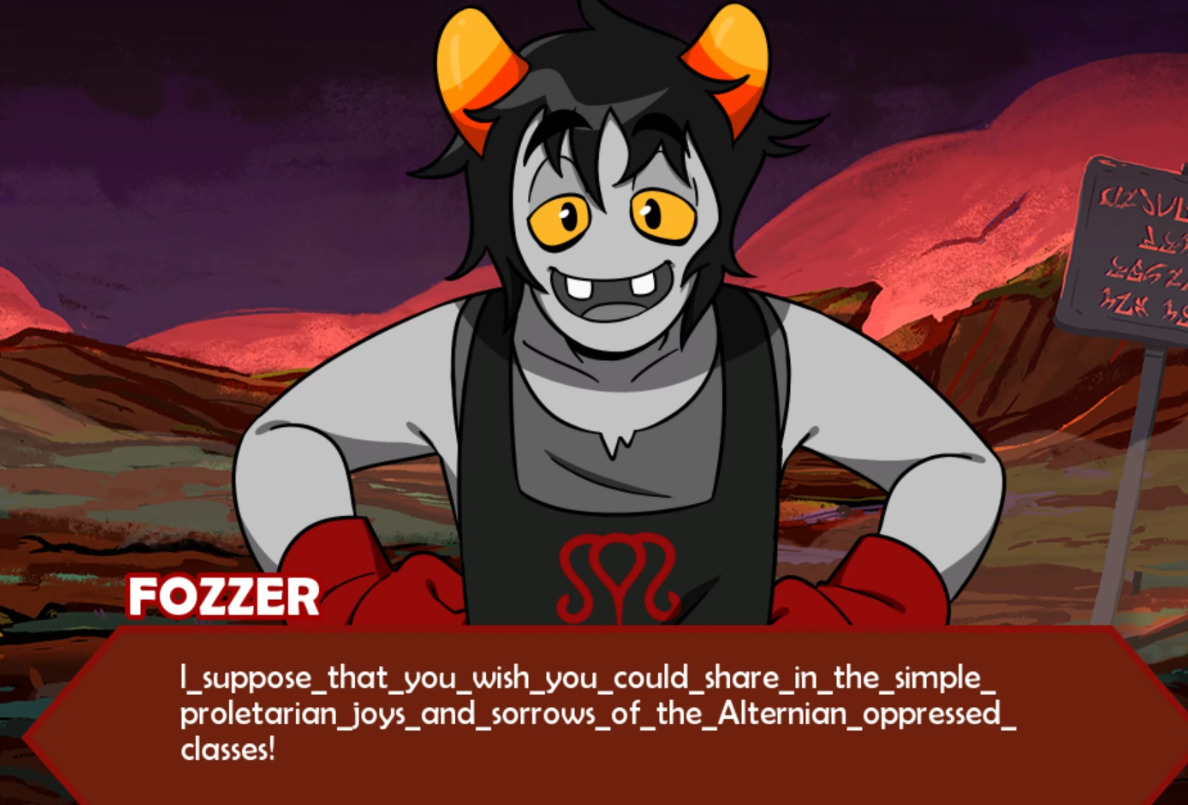
In the same way, Fozzer seems like an acutely intense expression of a political Persona. A philosophical idea, expressed in the physical world as an intense commitment to an associated identity. His shovel is an expression of that identity, much the same way Dirk’s katana or Nepeta’s claws are expressions of theirs.
But then again, Fozzer’s identity ain’t exactly stable, is it?
Before we talk about The Thing That Happens, we should note that as much as Fozzer seems to genuinely believe in his communist philosophy, he mostly seems interested in it as a means for self-expression, rather than an actual political movement with direct goals and results he’s looking to achieve.
And even though he’s very intense and earnest about it, Fozzer seems inclined
to exploit his own identity in somewhat self-serving ways.
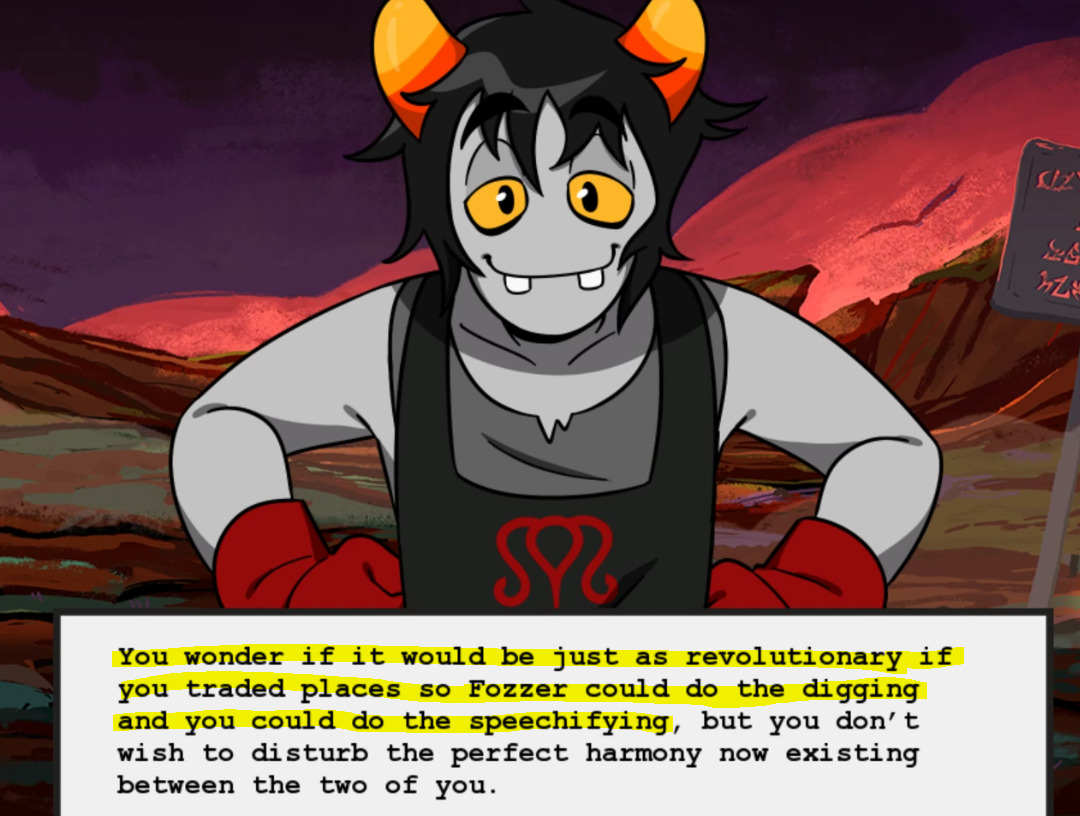
Unintentionally or no, he more or less uses his ideological speechifying
to conscript the Reader into doing work for him, therefore inviting the reader to Serve him through Heart, for Fozzer’s own benefit.
This, coupled with his strongly noted cowardice, leads me to consider him a Page. But my real point here is that even if a lot of us here on Tumblr find Fozzer’s ideology appealing, Fozzer seems less invested in ideology proper than with the identity it comes with–and even here, Fozzer isn’t exactly being portrayed as unambiguously Good and Correct.
Even if he’s preferable to the alternative. Sigh.
Let’s talk about the thing.
[WORLDBUILDING INTERMISSION]
So the biggest surprise of this friendsim was that we stumbled onto what’s basically a swell of Scratch energy just…hanging out under Absence Park, apparently?
Which is. A lot. This energy resets our conversation with Fozzer and changes his personality, which we’ll get into in a minute, but first I want to speculate: How the hell does this thing exist at all, and what does it even mean? There’s a couple of possibilities.
Since this is essentially Time-coded Scratch energy we’re dealing with, @blindrapture pointed out that it could have something to do with the Handmaid, which I’d expand to include Lord English–and though I doubt it’s directly linked to Scratch himself, since he’s not too associated with Time the way the former two are, he may be aware of or able to use this…”glitch” in reality.
It’s also possible this is a natural consequence of a Scratch, and pockets of leftover Scratch energy like these are present in some locations of Post-Scratch worlds. For that matter, it could be a consequence of John’s retcon powers, which act like the scratch in some ways and might have had consequences we don’t yet fully understand.
Finally, given the language, I suspect that the hole in Absence Park is actually just a hole into the Void, leading to the Furthest Ring, much like Roxy’s windows. This Scratch energy seems to have entered the Furthest Ring, and is presumably writhing there until circumstances allow it to vent out through this particular entrance to reality.
What are the implications? Who knows. If this is a hole into the Void, then this is another avenue through which Hiveswap’s cast might be able to exit Alternia and find a new world.
If the Scratch outbursts are recurring enough, then we have at least one way for our heroes to “Time Travel” and basically save scum to try and achieve optimal desires results, like saving a troll friend who gets killed by going back in time for example.
That’s probably the biggest takeaway to me, because having a way to time travel built into Hiveswap’s text already makes me that much more sure that no matter what kind of carnage and brutality our beloved troll friends get subjected to, we’re ultimately headed towards a happy ending where probably nobody dies– I can reasonably see the possibility that even antagonistic figures like Ardata and even Trizza could be saved, under these circumstances.
Ok back to Fozzer.
So the thing about “Post-Scratch” Fozzer is that I feel he’s being dismissed somewhat due to his admittedly unsavory politics. This still strikes me as a very genuine and direct expression of Fozzer’s Classpect inclinations.
Fozzer is still taking a very materialist view of reality here, for example–he’s interested in the actual physical history of how this system evolved, and considers understanding that history necessary to understanding society.
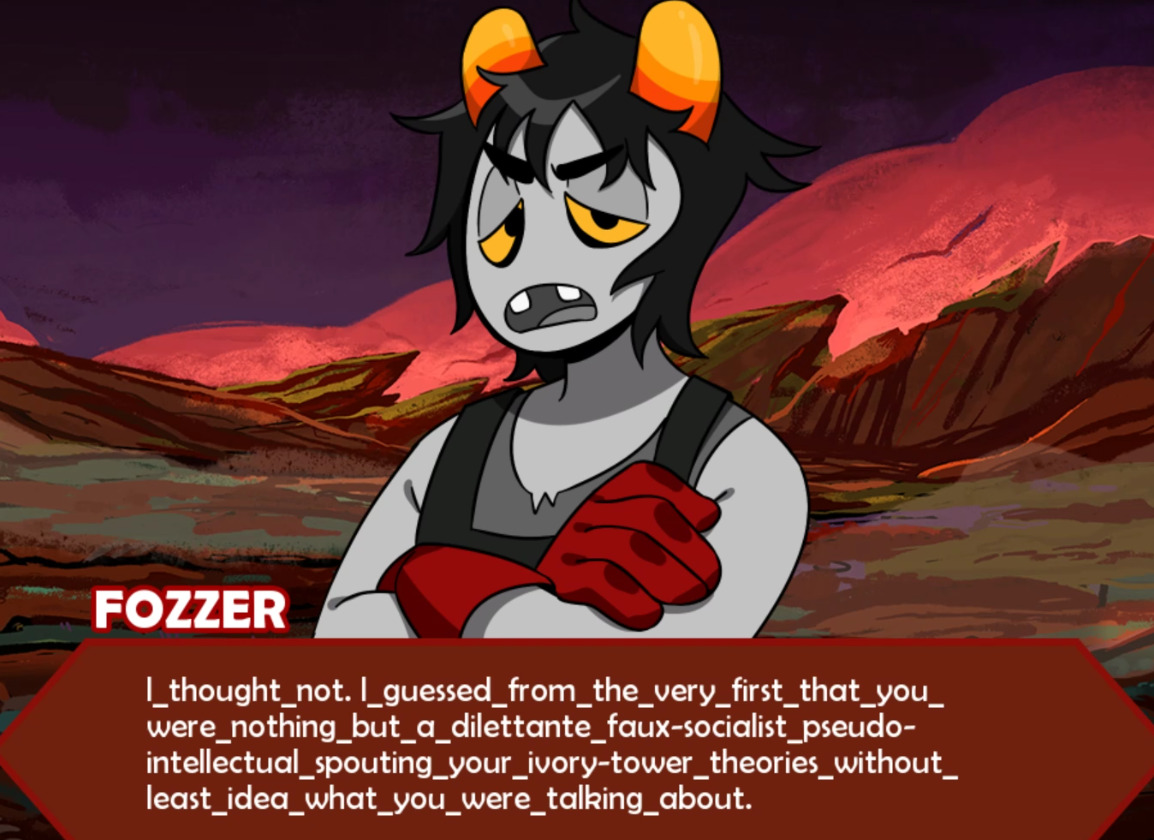
And however he disagrees with you, his instinctual response is the same. He storms off after verbally thrashing the Reader, but its interesting that he does it the same way both times: By imposing identities onto the Reader. Hilariously, Fozzer is unwittingly owning alternate versions of himself, too, and unwittingly inviting self-owns is basically the core of the Knight/Page aesthetic.
So really, Fozzer’s core personality is much the same–what’s taken place is a binary flip in the persona he relates to the world with. In one reality, he conveys the ideas of the hopeful revolutionary underclass.
In the other, he projects the identity of a happy and willing member for the Empire’s war-machine–the joyful slave, the pain of his own exploitation cushioned by a strong sense of societal purpose and identity. Note how the shovel easily parses as a strong symbol of this identity, too–a triumphant tool with which to serve the empire, rather than an ironic symbol of oppression.
I don’t think we should be hasty in assuming one Fozzer is more real than the other, even if we’re inclined to like one of them more. Especially since Fozzer works in Absence Park and seems familiar with these lights, meaning these scratch shifts might have been happening to him for a while.
The two Fozzers give us a fascinating window into the nuances of Heart, and indeed we’ve been told this sort of splintering of self can be common to the Heartbound by Calliope. Their opposing ideologies present us with a self-contained dialectic, in fact.
In Hegel’s understanding of the term, we can only truly understand an individual idea (say: Fozzer) by examining the tensions and similarities between these two opposed perspectives.
And these tensions are usually resolved not by one winning out over the other, but by achieving a Synthesis that combines he best traits of both.
Maybe because of that, I find the fact that we can only “win” by embracing the “Happy Slave” Fozzer unnerving. It’s hard to say how Fozzer’s path will evolve going forward, but given how central the idea of conflicting opposites is to his expression of his Classpect, I highly doubt we’ve seen the last of “Comrade” Fozzer.
So, I guess we’ll just have to see how it goes?
[Closing disclaimer: I’m not entirely sure how different Marxism’s Dialectic Materialist approach is from Hegel’s Dialectics. For instance, I’m unsure if it also uses the “Thesis”, “Anti-Thesis”, “Synthesis” model Hegel describes, or if I’m accidentally mixing the two.
Cursory Wikipedia research seems to bear this out, with Marx even describing Dialectic Materialism as simply the opposite of Hegel’s more philosophical and idealistic take on the idea, which Marx regarded as full of “Mysticism”. As a Hopebound more comfortable with the ideal than the material myself, I suppose its no surprise I find Hegel’s dialectics more immediately approachable and comfortable, for now.
What I’m saying here is, take everything I’ve written about dialectic materialism here with a grain of salt: I’m trying to do my homework and make sure I have the facts straight, but it turns out philosophy can get hard to sum up, especially when you’re trying to reconcile it with a fantasy metaphysics system. Feel free to clarify if I’ve messed details up. ]
Honestly the best part of this friendsim
was Marvus “massacres his own fans every show” Xoloto taking one look at a random alien hanging out with Zebruh and being like
man, that’s rough i should help them nobody deserves a fate that bad
Pretty fuckin much but as a like metaphysical consequence everyone around him loses their decency more extremely and shamelessly than akio’s victims ever did
also he talks like fucking this
homestuck is a curse. god help me, i love him
MARVUS XOLOTO MOODBOARD
How the hell can this feel so true and yet Marvus is still a good guy somehow. This is the most cursed post ive ever made.
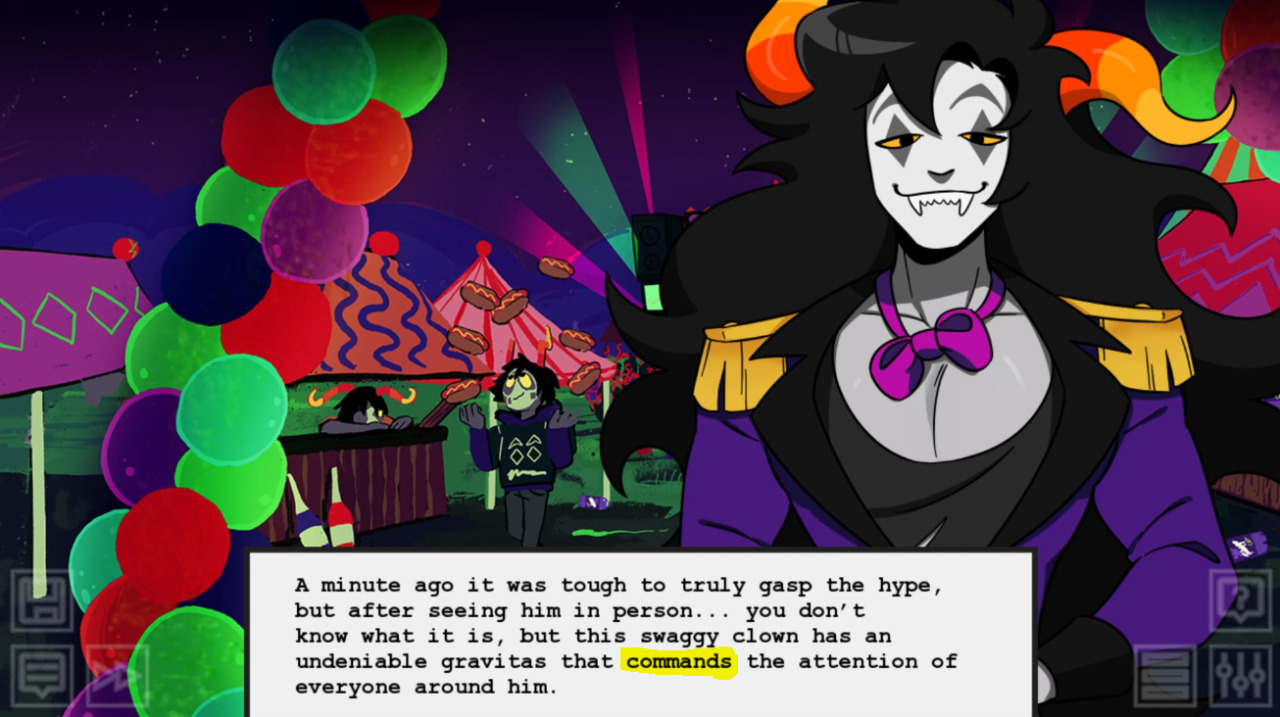
Command comes up with Caliborn like, a lot. Its also the name of the little arrows that connect every page of Homestuck. Every Command is a sort of direct attempt at mind control to the characters, as Hussie frames it–whether delivered by Exiles, the audience, or “The Author” himself.
The Muse seems inclined to wield that power through inspiration–once given a compelling enough idea, an actor can do nothing but work in relation to it, an artist can do nothing but work on it, as though they were possessed or enslaved.
The Lord seems to wield it through sheer dominance, or charisma–like a King who’s will cannot be denied.
I’m sure I don’t need to explain how that relates to Marvus. Y’all know.
So let’s cover why I think he’s a Lord of Blood specifically.
Imagine my surprise when I took another look at the Church. Now, to be fair, this spiral was always there, so its not exactly unique to Marvus. Chahut brought us here first, after all.
But it’s notable that Marvus brought us here because he was somehow aware it provided metaphysical safety. It’s “Hallowed ground, bizznatch.” That could be simple religious belief, but Marvus is a little too aware of the nature of reality for me to buy that. He’s aware of the rules of PSpace in a way Chahut isn’t, and the spiral is one of the rules. So it feels somewhat significant.
Now I can add this nugget: This is also one of a few purple signs that feature a crucifix or cross in the design. Given that a crucifix figures prominently in his path, that also feels notable.
Even so, this is all pretty circumstantial and quite likely bullshit. Like I said before, Marvus seems to showcase a mastery of many Aspects, and so its difficult to really be sure I’ve got him pinned down, especially based on some hazy symbolism stuff we aren’t sure is relevant.
Even so, lets get to his Blood imagery, which I feel is pretty strongly emphasized in this route–more than any other Aspect, barring Rage. And into why I think its through Blood that he carries his most definitive command over other people.
There’s a couple outright references to Blood early on, describing his effect on everyone around him. His very nature creates conflict, as the overzealous loving passion of his fans meets the violent restriction of his bodyguards.
These are classic Blood themes, all coming to the fore simultaneously.
Passion and commitment meet societal restriction, and the violence through which restriction is enforced. Blood flows in the wake of that conflict.
We see the conflict distilled during the concert. References to physical agony and mortal suffering are made, both of which are significant Blood ideas–the most recent example being Tyzias’ famous quote: “there’s so mmmmuch suffering.”
Though to be fair, that might have at least something to do with Zebruh. Blood may be associated with physical bondage and suffering, but Doom is quite literally the suffering Aspect, so its something of an area of overlap–Likely born at least partly from their close association on the Aspect wheel.
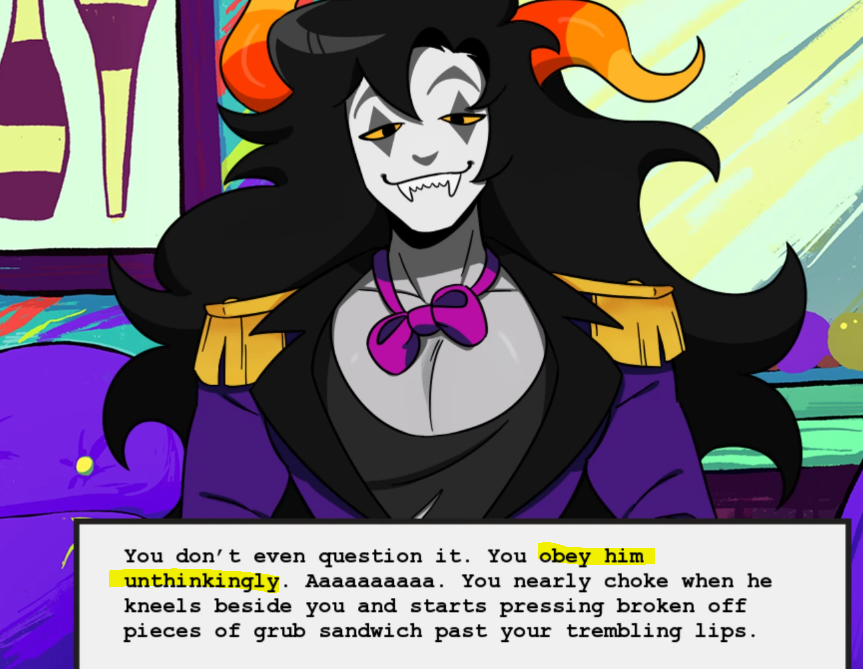
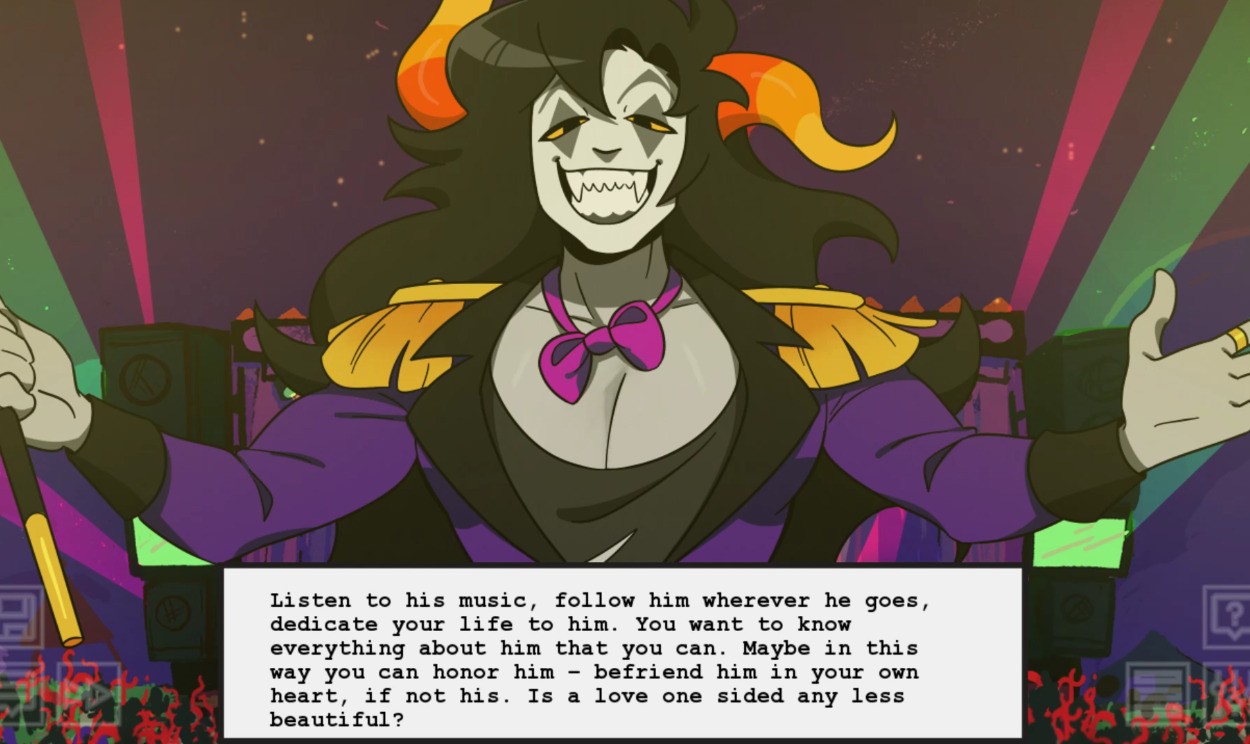
And the MSPA Reader of course falls into the romantic, committed, relationship-focused side of Blood–willing to do anything at all to share a connection with him.
The two ideas fuse at the height of his performance, as it makes the MSPA Reader keenly aware of their physical suffering and subjects them to enormous violence and agony, whilst paradoxically keeping them spellbound to the mortal plane where they’re experiencing it. Violence, suffering, commitment, relationship.
Later, the MSPA Reader directly takes on Blood’s violent enforcer position, punching out teens desperate to establish a relationship with Marvus.
And Marvus doesn’t just absently invite these dynamics. He’s keenly aware of both the commitment to a relationship with him his fans experience, and the social obligation he would be subjected to as a result of it, unless the performance is violent enough.
He’s also deeply cognizant of the social restrictions imposed on Purplebloods as a caste, and the various forms of literal and institutional violence through which they’re enforced.
As well as the revolutionary implications of subverting or questioning those restrictions. In other words, Marvus has a deep understanding of the social glue that holds Alternia, a vertical structure held together by repression imposed from top to bottom, with blood spilled through brutality the whole way down.
But of course, understanding doesn’t make a Lord. Command does.
I’ve long said that Paradox Space is a place born of the wills of the individual, and it could be said that what the classes describe, more than anything, is the means by which a Hero most effectively applies their will to reality to achieve any given desired result.
This is what makes Lords and Muses so powerful–they shine at understanding the capabilities and inclinations of everyone around them, and more than anything, controlling and directing the other to achieve their own desired result. A Page might inspire others to serve them and rise to Kingship through their devoted teamwork, but to a Lord this innocence is unnecessary:
Be it freely given, manipulated or coerced, a Lord is supremely talented at dominating, and getting others to give them exactly what they want. When Marvus’ presence suggests silence, the silence is absolute among all blood castes. When Marvus wants his audience ready to turn up, they are so fucking ready. His every request is undeniable, and his will is others’ command.
What makes him scary is that he knows how to use that power. What he does with the Player’s execution is actually pretty clever–he pulls off a small magic trick, simply pretending to stab them. The illusion would fall apart under the most cursory scrutiny, but Marvus knows that doesn’t matter, because he’s working his real magic on the audience.
Marvus knows exactly how his stage will be segmented, and all he needs to do is kickstart a cascade of violent euphoria amongst the lowbloods, who by their structural disadvantage are too far away to tell the difference. (Interesting that the tealbloods are singled out as the rough origin point, considering their Mind association and how vulnerable Terezi was to Gamzee’s Rage-y predation.)
Even any highbloods who figured out what he’s up to are screwed, trapped by their own lucky blood closest to the stage and under his net, where they must fight if they want to get out alive. But nobody does. Once the climactic bloodbath is finished, nobody survives.
Which Marvus expected would happen. He told us so earlier. If Marvus isn’t literally massacring his fans with every performance he gives, he’s doing it during enough of them that it doesn’t feel much like hyperbole. And he does it effortlessly, through a simple understanding of how to move the crowd the way he wants to, like the ringmaster of a circus or the conductor of an orchestra.
This is one hells of powerful clown–frightfully intelligent and ruthless when he deems it necessary, even under the niceguy suave wokeness. Joey’s going to have a powerful ally on her side if they team up. Though I can’t help but worry that the old Purpleblood capriciousness might have him turn on us if the circumstances are right. Or, his ruthless pragmatism could make him end up feeling like a bit of a Vriska.
Probably both are gonna happen. Oh well. Anyway that’s why I see him as a Lord, and one of Blood specifically. Don’t hold me to it because frankly, if I’m really honest, there’s only one train of thought with Marvus that I’m really committed to:
He’s really hot and I’ve been the naughtiest, so frankly he can–
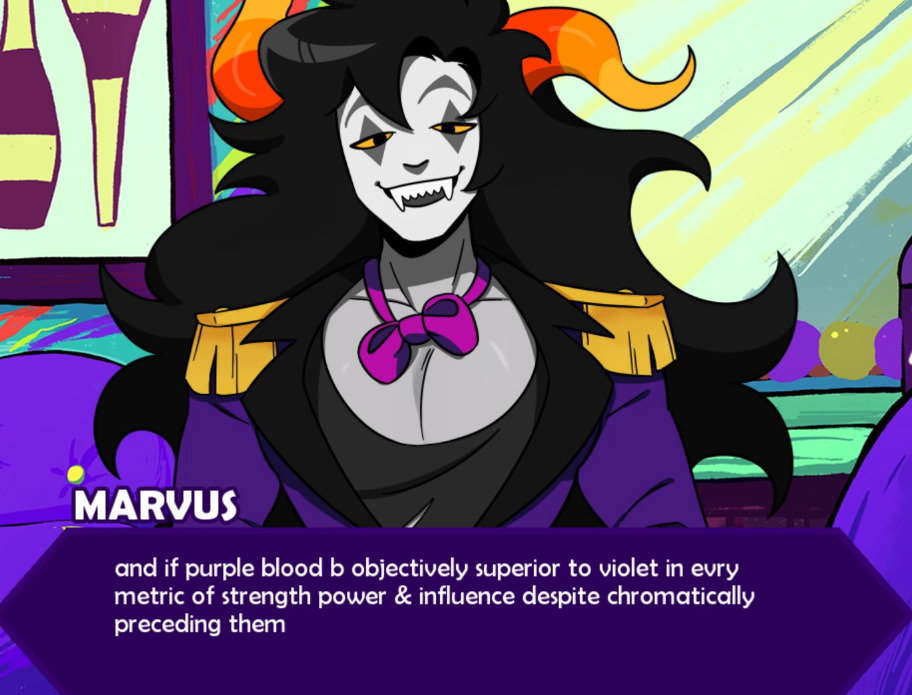
No, not really. Clowns are close knit and insular and all purple bloods, and Marvus is super enmeshed in the Rage coding that purplebloods are connected to.
OP: I love the idea that hes a lord of blood but from his true sign id have to say he’s either a rouge or mage of time, giving the mc time while also being able to see the other timelines.
Someone from WP debunked the idea that that was his actual sign, tho. Unless that was a double lie, its something different.
I think Toby actually named this one. The idea here is that you start with a normal song and slowly work your way to the weird clown shit. this is meant to reflect the real life struggle of finding someone hot and slowly but surely acclimating to the fact that they are a clown. we all been there. extremely relatable.
i got that weird laugh from toby as an mp3 and i THINK its from a spiderman game. it could just be toby’s own impish laughter but probably not. toby has a hearty joy-filled laugh with exactly 0% in the vein of clownery department. i love toby so much.
so here we are. friendsim friday and i have to act like clownfuckery is just another aspect of my life akin to say a sweet tooth or psoriasis. like “yeah man we all done fugged a clown once am i right fellas” over here grasping at straws, desperation in my voice “r-right??? fellas???”
his name was daniel and he really loved ICP and i think now he works as a manager at a taco bell. yeah thats right daniel. i’m callin you out you nasty juggalo. my inherited army of teens are comin into your taco bell and taking all your fuego sauce. dont call me. that felt good. i feel better. what were we talkin about?















 Flying through Storytelling