I don’t know that anyone’s arguing that troll society itself conciously considers those signs special, so I’m not sure why you’re addressing me as such.
But insofar as canon goes, those signs are already explicitly special, by virtue of the fact that their holders are the ones who all of Alternia exists to faciliate, so that they in turn can facilitate the existence of LE. Literally all of Alternian history already revolves around the 24 trolls who play Sburb–the beginning of the race, it’s evolution towards exploitative fascism, it’s eventual apocalypse–ALL of it traces back to the 24 trolls who play Sburb. Trying to tell me the signs associated with those trolls aren’t special is…kind of ridiculous?
Whether or not troll society is aware of that, or treats them with any special distinction, is beside the point. I’d guess they probably don’t! Why treat a Rustblood sign with any particular distinction if they’re all rubbish in the end, in Alternia’s eyes? Etc.
But the only thing Wak seems to be arguing for is an association between the Castes and the True Sign’s ASPECT, not the True Sign itself. And I feel that’s already demonstrably true, to some extent.
All rustbloods have to think about their short lifespans and imminent deaths, and going by Xefros’ example, the sheer amount of time they’re expected to devote to intense service, too. All of that lends itself to a focus on thinking in terms of Time. All goldbloods have to think about the possibility of being conscripted to exploitative, sacrificial service if their psiionics are good enough. That lends itself to a cultural pattern of thinking about Doom. Olivebloods seem to be living in the wild, which would distance them from society and make them more aware of their Selves–and so, Heart.
So on and so forth. That dynamic is what I’m interested in, moreso than anything about the True Signs themselves. I currently regard them as indicators, not much else–the groundwork for this idea is all over troll lore, and that’s why it interests me. It’s possible we’re way off base here, but if so, I expect Act 2 will make that clear. Does that clear up my position for you, anon?
I don’t have much to say about Folykl right now, other than cool design.
But Maxlol’s eye colors are pretty interesting. The two-color duality motif typically associated with Goldbloods is present with him, but to a much lesser extent than it is for Sollux or Mituna–he’s got the eye colors, but isn’t color coordinating his outfits or anything.
And the colors of Maxlol’s eyes are themselves pretty interesting. His left eye reads as Hope yellow pretty easily, but more fascinatingly, his Right eye is the purple color associated with Rage–Hope’s complementary Aspect.
This means that while his psiionics reflect the duality motif usually associated with Doom, they also seem linked to his true Aspect, and the opposing force that balances it. Fascinating stuff! I’m excited to learn more about you, Maxlol :33
A thank you to all of you following so far, as well as an update on this channel. From now on, videos will go up on the 2nd and 4th Saturdays of every month, at 8 PM EST.
This begins this Saturday, with a reupload of our video on Classpects, this time as a two part series. Part 3–an expansion focused on six Class Archetypes (excluding that of Lord and Muse, the Conductor)–will be released on December 30th.
Those born
with the Role of the Knight are devoted and reliable. Or at
least, they want to appear reliable to those they care about. Insecurities,
fears, doubts, they don’t tend to share them, even with their most trusted and
loved partners, unless they’re being pressed or in dire need to vent. Rather,
Knights have a tendency to mask their true feelings in order to showcase
themselves in a specific manner. They want to feel necessary, to know others
trust them to give advice and offer help, and will rush to the aid of those who
need it in a heartbeat, no matter the risk or how monumental the task, if they
are needed, they will answer the call. Knights dislike inaction and will seek
something to do, even in situations where it’s inadvisable to do so. As long
as, in the end, they feel as though they have contributed and been useful in
some way, as long as they managed to help others in some way, they will be
happy. At their best, they are nurturing and great friends, always there when
you need them the most. At their worst, they can be obsessive, reckless and
needy.
Knights may try to take charge of a situation, to try and live to the
expectations of responsibility and reliability they themselves created, which
doesn’t tend to end well for them. While not completely incapable of doing so,
they’re most effective supporting their team rather than leading it, following
the will of their Aspect, or aiding others through it. They cannot
be Lone Heroes, and can only shine with the support of others, and specially,
by supporting others. This tends to make Knights likeable and good to have
around, even those who aren’t specially fit for fighting are capable of
bringing ease with them. However, this need to aid others can be a heavy crux.
Regardless of the situation, Knights are quick to blame themselves for
mistakes, even if they themselves weren’t necessarily responsible. Furthermore,
this instinct to aid anyone in need of help can easily lead them to rush ahead
without thinking in the consequences, putting them in jeopardy.
Being one of the Giver Classes, Knights are the Passive counterpart to Pages,
and similar to them, their strengths lie in Serving. Providing,
Weaponizing, Using or Distributing their Aspect in some way, or coming to other
people’s Aid through the use of their Aspect. Knights are a versatile Class,
just as well suited to keep those they care about from harm, as they are to
Serve a crushing defeat to those who tried to harm them in the first place.
Resourceful, quick to act, God help whoever dares lay a single finger on those
a Knight is in service of, they will know no rest until they have ensured their
loved ones are safe.
Maybe to some extent. I do think Dammek is in an unhealthy state of mind, for sure. We won’t be able to say for sure where he’s involved until Hauntswitch lets us get into his head, though, I think.
I love how a new upd8 culture is slowly emerging. Each time something happens, more ex homestucks and new hiveswaps and being pulled in. Soon, the black hole will expand to absorb this entire website yet again.
Those born
with the Role of the Page are a well of potential. Pages tend
to liken themselves to others or create an ideal persona in their minds, which
they then proceed to emulate and hide behind. Wishful, disconnected between
their inner world and how they present themselves, their nature radiates
innocence and kindness. They don’t take well to change, and would rather live
in a static lie than accept a truth that’d shift what they’re used to. A Page
may, however, be more aware and perceptive than they appear to be,
intentionally shutting themselves away beneath their fabricated persona, in an
attempt to lose accountability and tip-toe around unpleasant topics. Due to
this, they may come off as daydreamers, childish, and sometimes even outright
mean. And while they can definitely be rude, a well meaning Page is as charming
as can be. Striving for their ideals, working towards their own goals, they can
easily inspire others to want to spend time together, to help them out, to
achieve what they want. At their best, they are inspiring, easygoing, likeable
dreamers. At their worst, they can be manipulative, selfish and infuriating.
Pages have a long way to go if they desire to obtain mastery over their Aspect.
They are presented with one of the toughest challenges when it comes to
discovering their self worth and true potential. Their development is slow,
slower than that of the rest, and for this reason they need the help of others
to fully mature. With their inspiring personalities, rather than directly
making use of their Aspect, they tend to draw others to take control or aid
them through it, although they may also call upon their Aspect to shield
themselves from unpleasantness and hardship. Their strengths initially lie in
the bonds they build with people and how persuasive they can be, or at worst,
in how desperately and obviously they need help. But once matured, their drive,
power and range of possibilities are second next to none.
Being one of the Giver Classes, Pages are the Active counterpart to Knights,
and similar to them, their strengths lie in Serving. In the case of
the Pages specifically, it’s them who tend to be Served. Offered help by
others, and Stockpiling their Aspect’s power for themselves, to begin with they
may find it difficult to make direct use of their Aspect, forcing them to rely
on others to steadily improve. This only makes the road towards maturation and
self-improvement harder for Pages. However, if they manage to overcome the slow
rise to their full potential, they may tap into the immense stockpile of power
that is their Aspect. Making full use of their powers, a fully realized Page is
an unstoppable powerhouse, a beacon of their Aspect capable of facing even the
strongest of foes. Patience is key for the Page, and those that wronged them
while they were still growing, will eventually face the consequences of their
actions.
I’m happy to hear you like Jake more now! He’s p much my favorite character more often than not.
Mage of Hope has been the classpect I identified with for a longass time. I might be flirting with Maid now, though.
A Mage is the active version of a Prophet. So it’d be one who Knows hope or Knows through Hope. That could mean getting future visions, or just being a knowitall expert on matters where fantasy and beliefs are concerned (that’s what I aim for).
It’s basically a kind of fortuneteller or magician who can attain immense knowledge of and perform literal miracles through their Aspect.
It’d be easier to list things a Mage of Hope couldn’t do, to be honest!
There’s basically no parts of Homestuck I’m not interested in doing analysis of to some extent. There’s stuff to say about the Helmsman, i just haven’t the time just yet.
If one knows the details of my reading on Heirs and takes note of the way I describe Psionics in the Aspects video, though, I think they’d be able to hazard a good guess as to my general thoughts.
To start with, let me be clear that I have a ton of admiration and respect for people like BKEW and Dahni. Writing like theirs nourished teen me’s love for Homestuck for years, and I quite literally wouldn’t be here if I hadn’t spent years devouring all of it. I understood Homestuck through inversion theory terms for a long ass time, and had a lot of fun with it! So this isn’t me trying to dunk on anyone or “”debunk”” anyone’s approach to fanon-building, or whatever.
I’m only interested in attaining a better understanding of the text of Homestuck itself, and I think “Inversion Theory” ultimately holds us back from doing so right now. That said, Inversion Theory is an overly broad term that leads to a lot of confusion. So let’s break it down into Aspect and Class inversion.
Aspect Inversion:
This has canonical backing, in that Calliope says that in players resistant to their true calling or corrupted by outside forces, player abilities might manifest in defiance of one’s Aspect. So I’ve always loosely agreed with this part.
That said, I’ve never been sure that Aspect “switches” always happen across complementary Aspects. I’ve been harboring the suspicion that any player sufficiently stressed could manifest their powers as any other Aspect, depending on the circumstances and influences at play.
Which means Xefros–who is a Rage player–is experiencing some of the detrimental effects usually associated with Inversion, along with a LOT of references to thinking in terms of Time,, as opposed to Hope.
I’ve picked up on a few cues suggesting something similar is going on with Dammek and Breath–the Aspect associated with bronzebloods. So for the most part, I just feel that Aspect “inversion” as a concept might be limiting our understanding. But that’s just a guess for now, and it seems to me most of the transitions in Homestuck DO qualify as Inversion, in that they involve the opposite Aspect heavily.
Class Inversion:
My problems with Class inversion are more intense. For one thing, inversion models p much always cast Pages as Passive and Knights as Active, which I think I’ve made clear I don’t buy at all. So my ability to engage with the system is mostly broken from the outset.
For another, where I’m uncertain and curious about Aspects, I’m absolutely sure the idea of Class inversion limits our reading of the text.
It’s biggest problem is that it narrows characters down into game mechanic templates that restrict what they can do and how they can act in ways that don’t seem super logical to me. A Maid who has “inverted” must always be a Bard, for example.
This discounts a lot of instances of quite similar, also unhealthy behavior that manifests outside the expected model, and misses a lot of the mechanical weight that Homestuck gives to any given characters’ stated interests, ambitions, and self-images.
Homestuck is a deeply Jungian work–his ideas are paralleled in Circumstantial Simultaneity, A bunch of Gnostic motifs, and in the case of the Classes, Archetypes. Jung believed Archetypes were patterns of behavior that arose from the collective unconcious–such as, perhaps, the act of theft, or of destruction.
Those patterns of behavior would then be contextualized by culture into more specific symbols. A thief might look like a burlap sack in one culture, and like a guy in a suit in another. But both would engage in the same behavior pattern–one associated with taking from others to benefit oneself. (Jung didn’t literally write about a Thief archetype, though. At least, not that I’ve found so far. This is just an example!)
The Classes are heroic Roles–their parts in the narrative as characters in a story. But Homestuck is a narrative where fantasy falls in love with itself, where characters have deeply impactful interests that move and shape them, just like ours do to us.
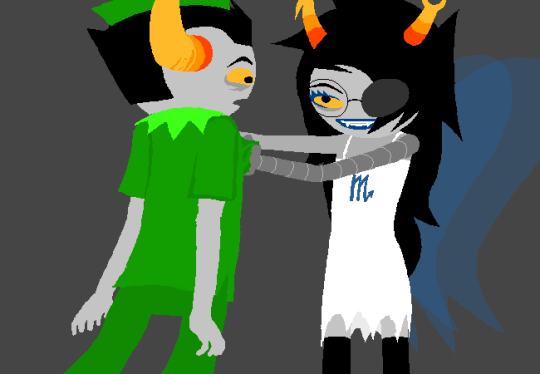
So when Vriska tries to live out her Mindfang fantasy, and rope Tavros along as her Summoner…
It’s not a coincidence that she dresses up as a fairy, and thinks in terms of a Sylph’s key verb–or close enough to it if you go with Create, same difference. And hey, doesn’t Vriska spend this arc insisting she only wants to make Tavros stronger? Get him to take charge and be powerful? Why, that almost sounds like…
What Aranea does effortlessly, by virtue of being a Sylph.
This is legitimate, compelling nuance that is lost under Inversion theory. And I can pull it out for close to every character. Dirk, AR, and Terezi’s fixations on being Knights, Roxy’s early flirtations with prophecy, Jake’s occasional references to wizardry, etc.
There’s a LOT of depth here, is what I’m saying, and in my view, the system is way more flexible and well-executed than what we’ve understood up until now. Even if inversion theory were literally canon (and its not, wp people debunked it YEARS ago.) I don’t think I’d want to trade it for what I see in the system now, personally.




 Flying through Storytelling