I’m still trying to figure out how the exploit/allow behavior works and how the scale is structured, exactly. I’m beginning to suspect some archetypes lean Active, ie: Both the Active and Passive Class tend towards behaving more Actively (Fairies, Outlaws, Magicians), while others tend towards behaving more Passively (Royalty, Servants, Prophets).
All on the individual though, of course, and it’s only a vague sense I currently have and haven’t really figured out in a way concrete enough that I’d be happy explaining/espousing the view. Just goes to show how much I’m still trying to figure it out, myself.
I think an Active class will tend towards exploiting, and a Passive class will tend towards allowing/inviting. If you’re looking for a hard rule, it seems to me like Active classes will almost always act to benefit themselves, while Passive classes act to benefit others. As such, they tend to be coded as Selfish/Selfless respectively.
yall ever get physically mad at yourself for how much you love homestuck like you’ll just be sitting somewhere minding your business and your brain busts in like “have you considered that every time anyone visits roxy they have to probably wade through 4,000 cats and jake teases her constantly about getting a dog and dirk stands there statue still while kittens climb his pant legs pretending their claws don’t hurt and dave just walks in and lays on the floor and is immediately sat upon by 6 individual cat breads while karkat scoffs nearby about how earth meowbeasts don’t actually care about anyone and appealing to soft human emotion is just an evolutionary mechanism they’ve developed to great effect while simultaneously sneaking a kitten into his pocket”
and you just have to be like I have work to do you piece of shit shut the fuck up let me live can I not think about homestuck for like one second please but it’s too late because you’re already smiling as you imagine rose lalonde sneaking food from her plate to a multitude of cats under the table with a perfectly straight face while dave dials up terezi to ask how to formally prosecute her for blatant cat bribery and wanton feline corruption
I don’t do analysis of classpects like, one by one, because honestly it’d be way too time consuming. I do write about Classpects as part of my analysis of Homestuck’s characters, however, since I regard both the true Classes and the characters’ various attempts at Roleplay as important sign posts for how to read their character arcs.
I should also mention the video on Xefros covered about half of the article I actually wrote about him. Had to be a ruthless editor to keep the video at a watchable size. So here’s that, along with my Hiveswap writing on:
Not in my view, but my view of the Classpects doesn’t generally have much to do with the popular view of them–I argue Pages are Active, after all. I pair the classes the way I do because they’re consistently linked to the same verb in the comic–Make/Create for Maid/Sylph, Change for Witch/Heir.
But on top of that, it’s my view that the classes are also tied by common Archetypes or symbolic motifs. Sylphs and Maids share the Fairy motif, while Witches and Heirs share the motif of the Magician.
John is coded as a “Secret Wizard” from pretty early into his session, and the references never really stop. Jane’s got a couple of references to being a Gnome and producing sparkle dust, so on.
At this point, contesting viewpoints would have to A) Present a common verb that is linked to both classes in the text of the comic, and B) Present a uniting symbol tying the two classes together thematically (or debunk the concept of Archetypes altogether) for me to be seriously swayed.
Which isn’t impossible–Homestuck contains so much content I will never be surprised to be told I’ve missed something. But it does set the bar pretty high.
not the original asker, but I’ve got some of both A and B to share, I suppose.
first and foremost, I would say ‘inherit’ is heavily tied to both Maids and Heirs, as an action verb. Jane uses it the most of anyone to describe her own future. for Maids, they begin in a position of hardship and a lack of their aspect (which is tied to a social role/expectations they have ‘inherited’), while for Heirs, they begin in a position of relative ease and abundance of their aspect (also tied to a role they have ‘inherited’). Maids seek to overcome the difficult expectations and hardships they have inherited by breaking away from the will of others and taking agency for themselves. Heirs, ideally, should overcome their own lack of awareness about their inherited position and take agency on behalf of others. I know you don’t subscribe to inversion theory, but I think this also ties into the Prince (as inversion of Heir) and Bard (as inversion of Maid) classes. the Princes we see both ‘inherit’ a lot of cool and dangerous shit from their progenitors that they use in sometimes questionable ways to enforce their will on reality, but their reality is a relatively difficult/uncomfortable position for them. the Bard that we actually get glimpses of ‘inherits’ a privileged social position and a lot of dangerous expectations but a dearth of actual benefit or resources, and would have to overcome that to stop being a pawn of those expectations and of the people who hold power over him.
we also see the term ‘create’ used more for John, an Heir, than anyone else, even the Maids. the concept of ‘supply’ is connected as well–Heirs are supplied with their aspect, while Maids tend to supply themselves. as said by Rose: “I presume an Heir would be supplied with what’s needed for his maturation, assuming he’s looking for it.“
in terms of Witches and Sylphs, I think the concept of order is a good fit for them. for an action verb, maybe ‘change’? this ties into both the chaotic tendency of Witches to break down order and cause changes in a “destructive” or unexpected way, and the opposing tendency of Sylphs to repair order and cause changes in a “healing” way. we already have canon support for Sylphs and Witches being linked–Kanaya spells it out explicitly. A Sylph is "sort of like a Witch, but more magical”. another word that’s arguable is ‘manipulate’, though I’m somewhat hesitant simply because it’s used so frequently. A lot of people want to peg Sylphs as the counterpart of Maids, but Sylphs do not create, they do not supply–they fix and repair and heal what is already present, which is not the same thing at all.
furthermore, we know from word of Hussie that the most active class is ‘female’,
while the two most passive classes are ‘male’ (discounting Muse and
Lord), which means either Maid and Heir are at the top, or Witch and Heir are. but Witch was explicitly said by Hussie to be “one of the most active”, but not THE most active, which would be a simpler distinction to make, if it were the case. third-most active out of twelve is still heavily active-leaning.
in addition, I think it enables the simplification of the classes into a neat and ordered arrangement from most to least active/passive and combines all 12 in 3 groups of 4 with similar concepts.
first, the most and second-most active and passive (respectively).
all four of these are linked to courts, and both rulers and servants within them.
Maid —— Heir Prince —- Bard
next, the middle ground grouping.
all four of these are linked to the concept of magic, and both direct and indirect usage of it:
Witch —– Sylph Mage —– Seer
finally, the least two active/passive classes.
all four of these are sort of the ‘ordinary person’ roles, but roles
found outside the protected bubble of the castle and deep into the grit
of real life:
Thief —— Rogue Knight —- Page
admittedly a few of my arguments for Knight being the active counterpart of the passive Page nod at the example of inversion in action that we see when Vriska practically cosplays a Page of Void, and the flighty, apathetic, unsatisfied Karkat we see presenting as a Rogue of Breath, but there’s also the matter of the word ‘exploit’ being explicitly linked to active classes by Calliope (”active classes exploit their aspect to benefit themselves“) and exploit being linked in-text to Dave the Knight (repeatedly), Doc Scratch (who has no ‘official’ class or aspect), and HIC the Thief (again repeatedly). the passive counterpart, ‘allow’ (passive classes “allow their aspect to benefit others”, also by Calliope) is linked to Seer Terezi, Muse Calliope herself, the Black Queen, Aradia (a Maid, but when she is both dead and acting very much in an inverse or ‘ghosting’ if you prefer, Bard-like way), and Thief Vriska surprisingly (but when Doc Scratch is narrating Seer Terezi’s perception of her).
I accept that the official word says inversion isn’t a thing, but I also counter that if it looks like a duck and it quacks like a duck and calling it a duck enables people to make informed guesses about how it’s going to behave next, it’s simpler to call it a duck than to create an entire layer of rationalization about how it’s actually a rabbit playing dress-up in flippers.
I also suspect that due to how close they are to the center-point, all of that last group of four classes tend to be somewhat flexible and/or confused about how active or passive they are the most satisfied and successful being. with both Knights Karkat and Dave and Thieves Vriska and Meenah, they start their stories convinced that they are acting in everyone else’s best interests, always, but they’re both actually not very good at it, at all. they all seem much happier and healthier if and when they are given the right environment to focus on actually understanding themselves, their own needs, and their relationship to their aspects–in ways that don’t require destroying the agency of everyone around them. some are more successful at this than others. conversely, both Pages Tavros and Jake and Rogues Roxy and Rufioh spend a lot of time pretending very hard to be self-focused, confident, in-control, and aggressive in ways that maybe are just as much a false front, and when that pressure frees up, they’re far more able to use their innate and instinctive wellspring of their aspect or ability to redirect it to benefit everyone around them, freely (in Rufioh’s case, as his Alternian self who reached that point, rather than his stagnating dream-bubble self).
You mention a lot of inversion examples, too. I can understand your mindset, but…all I can really say is they don’t look like ducks to me. Any example of inversion theory I’ve ever seen has been better explained by roleplay (Aradia’s actually referred to as a witch *in the text*, and reads far more like one than like a Bard imo.), or as nothing at all (I’ve yet to read an interpretation of (Vriska) as a Page that isn’t a million times weaker than reading her as a Thief.)
I also disagree with the reading of Knights presented. I don’t think Dave and Karkat ever really stop serving/focusing on others. Pre-Retcon, Dave’s neurotic and stressed about Dirk for the entire meteor ride, ditto Karkat about Terezi.
Post-Retcon, they’re as focused on each other as they are on themselves, to the point that Karkat’s literal last words, delivered at what Karkat views as the climax of his personal story, are about how Dave is what he’s thinking about.
Seems to me their improvement has a lot more to do with being honest about their desires for validation and closeness from others–and having healthy outlets for those desires in each other– than about disattaching from others entirely. Their growths mirror Rose a lot more than Vriska–starting off with self-images that are much more Active than their true natures, and chilling out a lot more as they get older.
Now, as for the verb/Class stuff. I have three big issues here:
1) You mention Jane is associated with the verb “inherit”, which I don’t dispute. But my view is that most of Jane’s arc is about her pretty intense roleplaying as an Heir, through her status as Crockercorp’s Heiress. So I don’t see much reason to connect the “inherit” verb to Maids at all.
2) It doesn’t make a ton of sense to me to connect Witches and Sylphs solely in terms of a shared focus on Magic, because Heirs and Maids are also explicitly connected to magic.
My only particular point there is that I deeply disagree that Sylphs don’t Make/Create. Kanaya making Eridan his wand or making/increasing Space between all parties when fighting Eridan, Vriska trying to Make Tavros stronger or Create Bec Noir, Aranea literally Making Jake brighter. Sylphs do plenty of creating, in my view.
you know what? i fuckin love every kind of dirkjake content. Pre-sburb content where they meet and slowly get to know each other and dirk is pining and they’re so alone so they try to make up for each other’s presence with voice, video calls and gifts from the future. In-game content where it’s definitely not going well and their personalities clash but they’re still trying to make it work, they both want it to work so they stupidly try to ignore their problems and push them away. Post-canon content where its like starting over, they try to bond again, to understand each other’s boundaries and are so so scared at first of overstepping them. And then, where they finally get rid of the awkwardness and a bit of the fear and they are kings and live together and where with every day their trust and bond is deeper, better, where everything seems finally fine and not everything is perfect but at least its warm and safe and home.
Well, not literally the same person. That’d be stupid. But Dave Strider, from Homestuck, and Tidus, from Final Fantasy X, share a surprisingly high number of similarities. Their weapon progression, their abilities, a few of their in-story actions, and most importantly, some of the themes their characters tie heavily into, are far more closely related than one might think at first glance. One might ask “Just how high did you even have to be to think this shit up? After all, Homestuck and Final Fantasy are worlds apart in terms of story, dialogue, characters, and basically everything!”
My answer to that little query is that I must’ve been pretty god damn high. But this little exercise gave me a fairly interesting outlook on both Tidus and Dave as characters, and hopefully you’ll enjoy it in a similar fashion. Obviously there will be casual spoilers for Final Fantasy X in this post, so I’ll hide the rest of this under the break.
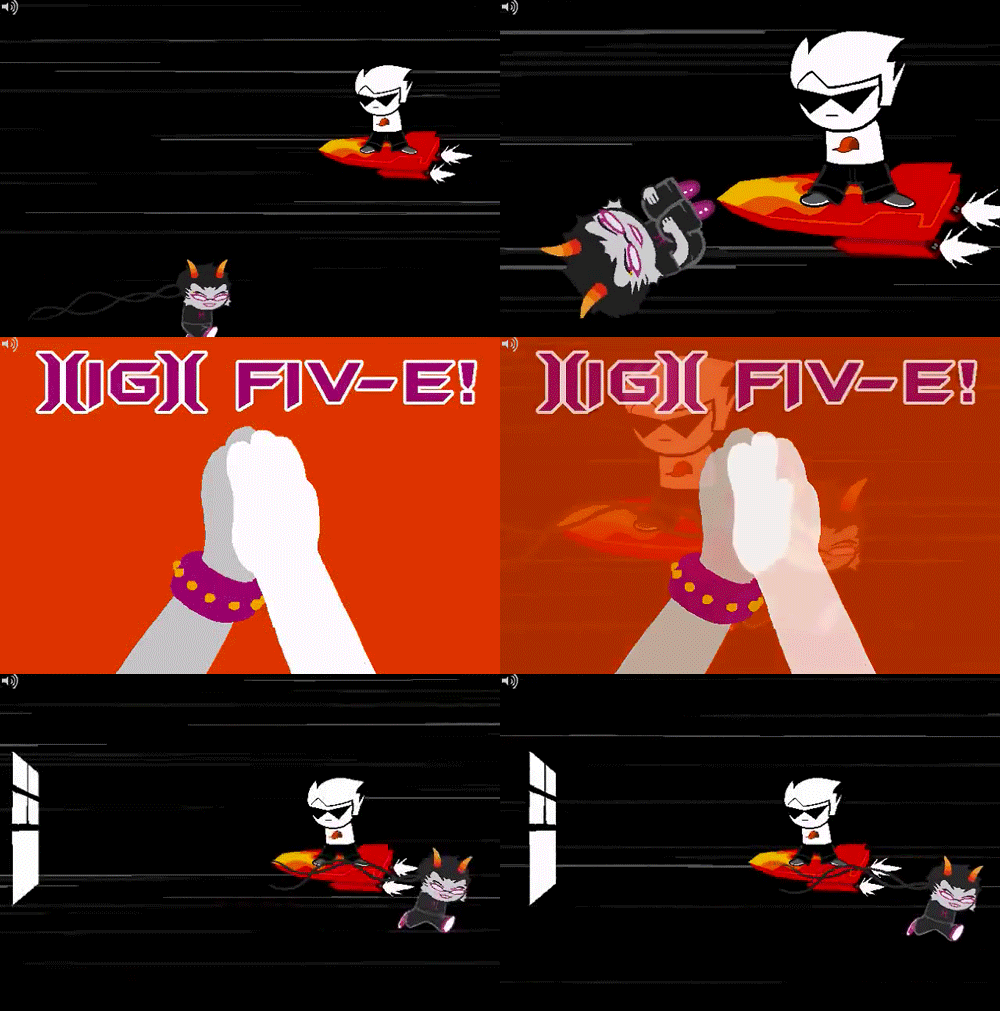
An important thing to know about this gif is that Dirk doesn’t know who the fuck that is. The only Dirk that had met Neenah was Dream Ghost Dirk, and Alpha Dirk does not have the memories of that Dirk
Dirk just… Did this. He’s that cool
You have to realize that the Condesce exists in his world so he just randomly high fived someone who looks like the tyrannical ruler he wants to take down as a teenager
Which just makes this extra wild
I think just as important is why he did this, bcuz the context to this scene makes it one of the most understatedly beautiful parts of the comic.
We see the lamps light up like this again, sort of, in that the lamps eventually explode and take out the building holding them…but that happens when the kids God Tier. So Dirk’s feelings are being portrayed as roughly equivalent to that.
The High-Five itself drives this link in further. The High-Five as a gesture comes from a closely intertwined overlap between mainstream American culture and LGBT history, as it was started by Glenn Burke, and I quote “the first and only MLB player to come out as gay to teammates and team owners during his professional career and the first to publicly acknowledge it”–Wikipedia.
And as for the High Five itself:
After retiring from baseball, Burke used the high five with other homosexual residents of the Castro district of San Francisco, where it became a symbol of gay pride and identification.[9]
So yeah, high fives are literally gay dude culture. Considering the conversation that serves as the lynchpin of Dirk and Jake’s relationship is all about Dirk telling Jake about the fall of American civilization and that Dirk’s biggest role-model is Texan, I think it’s fair to say this is probably intentional.
Puts a neat spin on Dirk’s other gay high-five jokes about Jake, too. And we don’t even really need to bring all this High-Five history in to read Dirk’s feelings for Jake into this sequence.
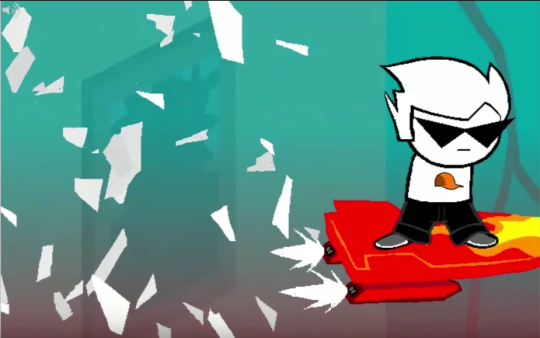
Dirk spends a shitload of this flash Breaking glass windows. If we can understand Dirk’s suicide as Dirk Destroying his “Self”, it pretty clearly parses through his Prince of Heart title as Destroying Heart.
The window breaking, then, would be Dirk destroyingthrough Heart–using both his feelings for Jake and his cool-guy Persona to smash through the obstacles in his way and save himself and his friends from certain death.
And the final shot of window breaking, the one immediately following his high-five with Meenah?
Positions Jake’s green directly at Dirk’s back, as though pushing him onwards. Jake is, in a sense, the wings on Dirk’s back. In essence, Unite Synchronize is half desperate, heroic effort on the part of a gay teen to save himself and his loved ones.
That kind of attention to detail and symbolic impact is why I keep coming back to Homestuck. I want more stories about gay teens who love their friends to be celebrated as heroes, in all their painful messiness. And that’s why I deeply hope characters like Dirk and his ridiculous rocketboard high-fives stay with us for years to come.
Windows are made of glass, which is reflective, so Dirk is literally smashing through himself, and shattering that himself into a bunch of smaller reflective surfaces. Which connects rather well to his whole “splinters” thing. Just some more Prince of Heart imagery.
ffffffffffffffffffffff it never stops from keep going deeper
An important thing to know about this gif is that Dirk doesn’t know who the fuck that is. The only Dirk that had met Neenah was Dream Ghost Dirk, and Alpha Dirk does not have the memories of that Dirk
Dirk just… Did this. He’s that cool
You have to realize that the Condesce exists in his world so he just randomly high fived someone who looks like the tyrannical ruler he wants to take down as a teenager
Which just makes this extra wild
I think just as important is why he did this, bcuz the context to this scene makes it one of the most understatedly beautiful parts of the comic.
We see the lamps light up like this again, sort of, in that the lamps eventually explode and take out the building holding them…but that happens when the kids God Tier. So Dirk’s feelings are being portrayed as roughly equivalent to that.
The High-Five itself drives this link in further. The High-Five as a gesture comes from a closely intertwined overlap between mainstream American culture and LGBT history, as it was started by Glenn Burke, and I quote “the first and only MLB player to come out as gay to teammates and team owners during his professional career and the first to publicly acknowledge it”–Wikipedia.
And as for the High Five itself:
After retiring from baseball, Burke used the high five with other homosexual residents of the Castro district of San Francisco, where it became a symbol of gay pride and identification.[9]
So yeah, high fives are literally gay dude culture. Considering the conversation that serves as the lynchpin of Dirk and Jake’s relationship is all about Dirk telling Jake about the fall of American civilization and that Dirk’s biggest role-model is Texan, I think it’s fair to say this is probably intentional.
Puts a neat spin on Dirk’s other gay high-five jokes about Jake, too. And we don’t even really need to bring all this High-Five history in to read Dirk’s feelings for Jake into this sequence.
Dirk spends a shitload of this flash Breaking glass windows. If we can understand Dirk’s suicide as Dirk Destroying his “Self”, it pretty clearly parses through his Prince of Heart title as Destroying Heart.
The window breaking, then, would be Dirk destroyingthrough Heart–using both his feelings for Jake and his cool-guy Persona to smash through the obstacles in his way and save himself and his friends from certain death.
And the final shot of window breaking, the one immediately following his high-five with Meenah?
Positions Jake’s green directly at Dirk’s back, as though pushing him onwards. Jake is, in a sense, the wings on Dirk’s back. In essence, Unite Synchronize is half desperate, heroic effort on the part of a gay teen to save himself and his loved ones.
That kind of attention to detail and symbolic impact is why I keep coming back to Homestuck. I want more stories about gay teens who love their friends to be celebrated as heroes, in all their painful messiness. And that’s why I deeply hope characters like Dirk and his ridiculous rocketboard high-fives stay with us for years to come.






 Flying through Storytelling