i say this a lot but these are two of my absolute favorites
Tagora seems like the exact kind of planned-for-everything shitheel I love in like, death note and stuff so I’m resigning myself to loving his shitty little grin preemptively
Back in 2010, I was a young college student. I was massively depressed and confused about my identity. My mental illness had isolated from me from my friends and family, and my life felt hopeless. So, as many young people do, I channeled all of my heart and soul into creating fanart, fanmixes, cosplay, fan fiction, and meta posts about my favorite webcomic: /Homestuck/, by Andrew Hussie. I was SO prolific in the fandom that in 2012, Andrew asked me to do the canon art for a fangirl parody character, “Calliope”. Of course, I accepted right away! It was so much fun getting to put a lot of myself into this character through her art.
Calliope is an alien character that shares a body with her “brother”, Caliborn. Together they live in complete isolation, chained up and only allowed to talk to people on their computers. Caliborn is a raging misogynist who is determined to break down Calliope’s will to live and ultimately kill her. Calliope’s goal was to reform her brother, to make him more like her, so that their personalities could integrate into one powerful being, with her as the dominate force.
Throughout 2012 and 2013, my popularity and following in the fandom grew due to my insanely prolific nature. (Seriously, my mental health was so bad that Homestuck was the ONLY thing I let myself think about. I lived my entire life in a dissociative haze.) I became, as they are called, a “big name fan”, and as such, I started to receive a hell of a lot of harassment. A lot of it was misogynist in nature, and a lot of it came from my own blunders and mistakes as I tried to figure out my identity and sexuality while in the public eye. (I made a lot of mistakes in my early 20s, as pretty much everyone does!)
Online fame has a way of making you lose yourself in the hatred. I related more and more to Calliope, and grew increasingly attached to her character and fictional plight as a coping mechanism to deal with all the abuse and isolation. The more I isolated myself, the less people online treated me like a real person. It was a vicious cycle!
At some point though, the constant harassment became too much to bear. I stopped allowing myself to enjoy my hobbies, and I focused hard on building my life again. I started writing original fiction! I killed the part of myself that enjoyed fanwork, because at a certain point, she was bringing me nothing but misery. I became afraid and ashamed of how deep I was into my coping mechanisms, and several toxic people around me just reinforced this view over and over again. I retreated into obscurity, leaving my fandom days behind me and trying desperately not to think about the kind of person I was in those days.
I never left Homestuck behind, though! I continued to do freelance work for the comic, and became increasingly involved in What Pumpkin Games, where I now work full time on the Hiveswap series. But I told myself over and over again that this was just a job, that I had left behind my embarrassing fandom days that in my mind, had brought me nothing but misery.
But… here’s the thing: I was lying to myself.
Through the Homestuck fandom, I met my amazing wife! I had so many opportunities to share myself with an audience, I found inspiration and meaning in my life, and it launched me into a promising artistic career! A LOT of good things have blossomed from that strange coping mechanism. to think that it brought me nothing but pain was nothing but my distorted, PTSD-addled brain telling me that I was garbage.
So, why did I let myself stop enjoying something I loved SO MUCH? I don’t have any one good answer, but I do know one thing now: I’m done living like that! I am a queer person, I’m an abuse survivor, and I am a writer and an artist and a cosplayer and god dammit, I fucking love Calliope and Caliborn. So, this mix is for them, but it’s also for everyone out there in this awful culture that makes women feel like shit for daring to speak, for daring to like things and have opinions, and for being weird fangirls.
I have news for everyone, though. Weird fangirls are amazing, and we are going to win!
I tried to express this point back in the Force & Flow essays, but I’m not sure I succeded, so I’m glad for the chance to revisit it! I think I can answer your first question with the second. The range of a “miracle” is essentially the same as the range of “magic”, a concept that canonically applies to Heirs, Witches, Maids and Sylphs.
Jesus’ story is imported into Homestuck in the story of the Signless–a Seer. When Jesus comes up, John describes him as magic–just as he later describes himself, Jade, and Rose in the midst of her Witch roleplay. (And yes, this does mean the Jegus meme had a payoff in the form of classpect exposition.)
Later on, Rose seems to more or less figure out how to roleplay a wizard. But when Dave thinks to ask, she makes it clear what she’s doing isn’t exactly casting spells in the typical sense.
Which makes sense, because Prophets aren’t typically thought of as being magic per se. If you think about it, the miracles Jesus performs aren’t really that different from what we might imagine wizards could do.
What makes them different is a matter of emphasis. Wizards are regularly linked to knowledge, just like prophets are. Hence the concept of the “wizard’s spellbook”. But for magicians, knowledge is typically a means to an end, it’s an answer to “how” the magic is performed.
Prophets also do magic, but for them the emphasis is on the knowledge itself as opposed to the spellbook. A Prophet like Jesus or Moses would typically claim their magic wouldn’t happen at all, but for their faith in and knowledge of their divine Source–God.
Just trade in the figure of “God” for the Seer/Mage’s Aspect (the Aspects are inherently divine-coded anyway, given that they’re basically Aeons), and there you go. Any kind of magic you can think of a Prophet doing through their Aspect is something I believe reasonably falls under their purview.
I’d simply put just as much of an emphasis on what the Prophet might end up saying as a result of their Aspect’s influence, which is probably even more interesting. Do their prophecies concern/affect/benefit primarily themselves or others? How does their Aspect influence what message they have to give, and how they deliver it?
A particular nuance to the pair might be a penchant for resurrections/raising others from the dead, particularly in ways that might otherwise seem impossible. Sollux pulls this off for himself by half-ghosting, while Terezi pulls it off for Vriska by guiding John’s choices.
Does this answer your question, anon? It’s a pretty dang good one, btw.
One entire week to indulge in our favourite pumpkin patch boyfriends!
Date: 4 March 2018 – 10 March2018
Day 1: Flower Crowns Day 2: Caught In The Rain Day 3: Animals Day 4: Fluff Day 5: First Dance Day 6: Favourite AU Day 7: End Of Spring, Beginning Of Summer
Submissions can be in the form of art, fanfics, gifsets, cosplays, videos, fanmixes, anything! NSFW works are also allowed, but be sure to tag it as #nsfw !
Tag your DirkJake week content as #dirkjakeweek2018 !
dirk’s the kind of person who you tell him you’re interested in something and by the time you next talk to him he’ll have a complete knowledge about the statistics and history of it
play the system by telling him you’re interested in him and watch as his 37 personalities all fight for dominance.
(This is technically a video script, not an article! Prepare for discrepancies.)
Obligatory Disclaimer: This is an evolving subject, and information in future Hiveswap or Homestuck content may render it inaccurate. If that happens, I’ll be the first to let you know.
Welcome to Hiveswap Lore, a video series designed for Hiveswap fans who want to learn more about the game’s expansive background story. Here we’ll cover the history of Alternia and Earth, get to know the people and forces that shaped them, and as we’ll do in this installment, learn about our Player Characters.
Let’s get started by looking at the Hero Titles, one of the intricate methods Hiveswap uses to characterize one of it’s main characters: Xefros Tritoh.
Xefros Tritoh is an all-around Very Good Boy living in the Very Bad interstellar empire of Alternia. Alternia is a dystopian wasteland kept afloat by a mysterious, all-powerful Guardian, the ruthless conquering of other civilizations, and the just-as-ruthless subjugation of it’s own people: A species of alien known as Trolls.
This subjugation is structured through the Hemospectrum, a strictly-enforced Caste system that assigns its people different societal standings — and corresponding occupations, or Roles — according to Blood Color.
As a Dark-Red Rustblood, Xefros sits at the bottom of this system, while the Fuschia-Pink Heiress that destroys his suburb during Hiveswap is at the top. Because of this, Xefros — and all others born with his blood hue — can look forward to nothing but a lifetime of exploitation, abuse, and suffering.
Oh, and Butlering. As a gutter-blood, Xefros has been forcefully assigned the slave-labor role of Butlering for highblood trolls, providing grunt work for those leading the neverending warfare against all other life in their universe. And it’s with this imposed Service that our look at the Hero Titles begins.
In his episode on Mario’s Jump (and other versatile verbs), Mark Brown from Game Maker’s Toolkit explores how designing highly-flexible and nuanced Verbs is often a great way to provide a Player with interesting choices.
Giving characters powerful tools can enhance a Player’s sense of connection to both the character *and* the game space, as the interplay between the world and the ways the Player Character can manipulate it’s systems makes both feel more dynamic and fully realized.
By using the Hero Title system introduced in Homestuck, Hiveswap aims to achieve something similar. This story-driven RPG Class System is made up of 14 Classes. The classes come in 7 Pairs, each linked to a Verb — like “Know”, “Steal”, or “Destroy” — that describes their core function, and one or more Archetypes that link the pairs together.
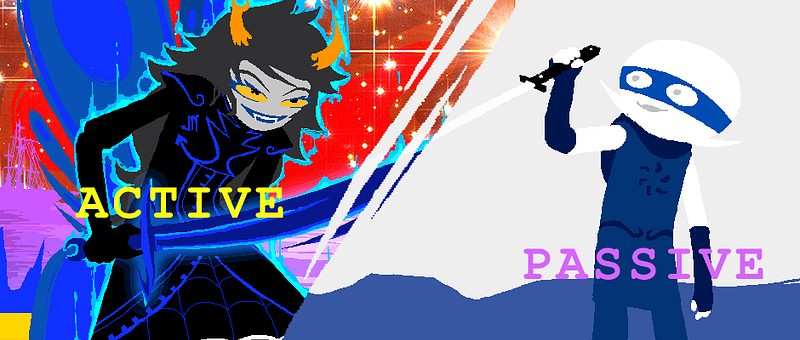
Each Class in a pair is distinguished as either Active (Self-Oriented and Direct;Yang) or Passive (Support-Oriented and Indirect;Yin) versions of an Archetype.
The Thief of Light (Left) | The Rogue of Void (Right)
So while Thieves and Rogues are both versions of an Outlaw, and both will have a predisposition towards Stealing, the Active Thief will tend to act for their own benefit, while the Passive Rogue will more often move to support or empower others.
Click through here to learn more about Aspects. | Click here to take the True Sign Test & discover your Aspect.
The system is complicated further by the Hero’s Aspect, which describes what existential idea the Hero interacts with. Two Witches will differ greatly, for example, depending on whether they change “Life”, or change “Space”, as they draw from different sources of magic.
What are “Life” and “Space”, you ask? Well, I was being literal when I mentioned existential Ideas. Hiveswap draws heavily from sources that dealt heavily with the implications of a reality where thought creates reality. Plato’s Theory of Forms, Jung’s Collective Unconcious? All here.
The consequence is that in Paradox Space, reality is made of 12 fundamental particles of thought. Thought creates reality in Hiveswap, and so every character in it’s cast inevitably gets their wishes granted in some way.
And twelve basic, fundamental ideas can be combined in infinite different ways to create literally everything in all of reality. So the Aspect of Space contains anything an individual can imagine as being linked to the idea of “Space”, and everything in that conceptual domain is something Jade — The Witch of Space — has a natural talent for Changing.
Think Avatar: The Last Airbender, but through psychic powers instead of martial arts, and with each “Element” associated with different philosophical and metaphysical roots that describe it’s relationship to reality.
However, Hiveswap is a Point-and-Click puzzle-adventure game with an emphasis on storytelling, not an action-brawler, or even an actual RPG (yet). So instead of being used to determine how the Player interacts with the game world, Hiveswap’s verbs provide a basis for world-building, instead.
In this, Hiveswap’s writing is comparable to something like Dark Souls, where clues to the nature of the world and powerful figures within it are scattered across text descriptions, dialogue boxes, and environmental detail.
The Hero Titles let us expand this approach to character analysis, helping us understand the complicated interpersonal contexts of the cast, as well as giving us insight into the nature of their deep inner worlds and unique personal strengths.
Dave serves his friend by assisting with a mission-critical Frog-Hunting expedition.
Which brings us to the cultural image of the Butler. Butlers are by definition, “Ones who Serve”, meaning their existential relationship to reality is roughly synonymous with that of the Hero Classes Knight and Page.
Dave, as The Knight of Time, is associated with acting like a Butler for his friends, and spends most of his adventure either: 1) engaging in acts of service by helping others with their goals Or 2) giving others goods and resources, as if on a silver platter.
Which brings us back to this kid. Xefros is a Butler-In-Training for the Alternian Empire, meaning he’s forced to learn to provide food and assistance to Highblooded trolls, with death as the price of any failure — all for the benefit of the Empire, not himself.
He’s also a Butler-in-Practice to his best friend Dammek, a Bronzeblood only a single rung above him on the Hemospectrum, but a few years older and considerably more driven. Dammek is an ambitious outlaw, and the leader of an extensive Rebel Network that aims to take out the Empire once and for all.
He has a habit of starting massive ventures and expecting Xefros to come along for the ride. Andso Xefros, like Dave, develops a habit of acting in service to the goals of others, rather than following through on goals he sets for himself.
Between preparing to Serve the Empire and keeping up with Serving his friend, Xefros notes repeatedly that his own interests and dreams are left by the wayside, since he simply doesn’t have the Time to keep up with them.
In other words, societal forces and toxic friendships have combined to force Xefros to Serve Time for the benefit of Others, and so he is playing out the role of a Knight. As a result of his upbringing and life circumstances, he also thinks quite a lot about Time. Thus, we can understand Xefros, at least partly, as a different interpretation of the title Knight of Time.
But that’s not all there is to the story. Because where acting to serve his friends came fairly naturally to Dave, for Xefros the entire effort is harmful to his personal growth, and deeply unfulfilling.
Our first clue to this fact comes when, perhaps because he’s associated with all of this Passive behavior, Xefros notes that he prefers to passively engage with narratives, as opposed to doing something action-oriented like playing a game.
Because what Xefros really wishes he could do, above all else, is make a run at fame and fortune by playing the Sport of Lords — a combination of Billiards and Football known on Alternia as Arena Stickball.
In his sport of choice, Xefros plays the role of Pusher — the most dangerous game position, but also the only one allowed to score, and one that usually finds itself protected by their teammates because of this. Xefros references feeling particularly at home when he feels protected by his Brawler.
This echoes a set of other characters from Homestuck who enjoyed being protected or assisted by friends, such as Tavros Nitram and Jake English.
What these characters have in common is an association with the Page Class, which we’ll find many connections to as we draw hints of what Xefros is really like under all that pressure and responsibility from his idle thoughts and childhood memories.
Unfortunately for Jake and Xefros, Pages often find themselves “Served” by friends in the “humiliating defeat” sense.
If a Knight embodies the mantra “One for All”, then the Page embodies that of “All for One”.
Where Knights tend to step into the role of the Butler to aid their friends, Pages’ innocent and giving naturetends to win them allies invested in helping them grow stronger, or giving them what they want. Where Knights simply are Butlers, Pages can more often be found surrounded by them.
Both classes are also linked to the image of the Warrior, hinting at the third definition of Serve: To deliver a swift and decisive defeat, or humiliate someone so much they can only say “I got Served.” Pages are often the recipients of this kind of Serving, too.
So Xefros eats bitter leaves provided by his Sloth Dad, believing he’s being generous — but ultimately, the action serves to make him stronger, and builds up his capacity to take further action in the future, rather than empowering the people around him.
This tendency to benefit from the aid of others is at its strongest with a Pages’ Imaginary Friend, who the Page imagines as far more competent and impressive than themselves, and who serves as a role-model and mentor figure.
For Xefros, that slot is filled by Xultan Matzos, a legendary Arena Stickball player that Xefros likens to “a figure from History” — again thinking in terms of his relationship to Time.
Joey also points us to Xefros’ Page nature when she calls him Xerox. In the 90′s, Xerox (Logo pictured above) was the colloquial term for both a product and the company that produced it. Particularly, Xerox was a popular brand of photocopier, meaning a machine designed to copy text and images onto a blank Page.
This hints at another Page skill — imitation and copycatting. Tavros finds narrative success by imitating Peter Pan, and Jake English copies female action heroes like Lara Croft — Boobs & Butt Pose and all. And Xefros credits his imitation of Xultan’s stance with at least occasional Sports success.
Take a moment to imagine the implications a whole community of people being inspired to empower and aid a single individual, who happens to be excellent at identifying effective role-models and talented at learning through mentorship and hands-on coaching from others.
Now you have a sense of why the Page class is described as one of the most powerful classes, with late-game Pages carrying a reputation for limitless potential.
As a Burgundy-Blood, Xefros has a (so-far untested) ability to commune with the dead along with his Telekinesis, meaning he could even come to meet his Hero despite Xultan’s death, as Pages’ progressions often involve having their imaginary friend become real.
However, that’s an open question. We don’t really know how Xefros’ psychic powers will develop as Hiveswap continues, because both raising the dead and Telekinesis are powers linked to his Blood Color, not Xefros himself.
Now, while every character has a true Aspect, we’re also told that a character might manifest their abilities as another Aspect entirely if corrupted by an outside influence.
And Alternia’s Caste system itself is one such corrupting influence — it’s a system meant to systematically confuse and subjugate its citizens, and so it will naturally have an impact on the ways they think about themselves.
For Rustbloods, this True Sign is Aries, and it’s associated Aspect is Time. This means all Rust-Blooded trolls are coerced by Alternia into thinking in and attempting to interact with Time, regardless of where their true strengths actually lie.
Let’s take a look at how Xefros’ relationship to Time itself is unhealthy for him.
Pages, like Knights, are a version of the Warrior archetype, and both classes share a penchant for fighting — along with a thirst for glory and recognition for their heroism in society’s eyes. This desire for personal stardom and success is one of many parts of himself Xefros gives up as he’s forced to give hisTime to other’s agendas.
Making things worse, he knows full well that in a few more years, he’ll face exile from the Empire’s Homeworld as he comes of age. No adults are allowed on Alternia on decree of it’s brutal Empress, and all trolls who grow up are funneled off-planet to fuel the Empire’s variety of war efforts.
And to top it all off, since Trolls’ standing on the Blood Caste is linked to their lifespan, Xefros can only expect to live for, at most, two dozen sweeps — around 51 years old, in Earth years. The end result is that Xefros experiences life through a lens of resignation and exhaustion.
But beneath those burdens, Xefros is actually a Rage player. And even while thinking in terms of Time, it’s through Rage that he best leverages his Page potential and wins over his most powerful ally yet: Joey Claire.
Rage is a more nebulous and abstract concept than Time, so let’s describe a few of its nuances. Rage describes negative emotions, doubt, and the search for hard, objective Truth.
As a Page, Xefros “Serves” Joey Rage — giving her reason to doubt, distrust, and take umbrage with his otherwise innocent statements. At the beginning of their relationship, Joey finds Xefros immensely frustating. Xefros acts as a “bringer of confusion”, remaining fixated on talking to Dammek even when Joey repeatedly makes it clear she isn’t him.
When Xefros makes a request of Joey, she’s inspired to Serve him Rage in one of three ways. She can give him the banal truth (Earth), fear through physical threats (tap-dancing), or provide him with the mental image from a Nightmare (squid-god). Whatever her answer, Xefros will doubt her claim.
Dammek was also at times moved to Serve Xefros Rage. Trolls sleep while enmeshed in a somewhat dangerous Soporific slime that dilutes the impact of constant, unending nightmares of horrific violence and brutality that plague the species as a whole.
These nightmares are inflicted by the psychic Chucklevoodoo powers of the Grand High Bloods, one of the Castes highest on the Hemospectrum. These powers are equated to the Rage Aspect in Homestuck, and with the Rage-bound Capricorn as its true Sign, the entire Caste of the Purple-Bloods is linked to the Rage aspect.
Which means that by being exposed to the Chucklevooodos, Xefros was actually being Given Rage, and as he now has somewhat of an immunity to these debilitating nightmares, it’s fair to say it was to his benefit. Uh. Arguably, anyway. Still a pretty dick move, Dammek.
And soon, Joey’s confusion and frustration give way to a sense of concern for Xefros, making her wonder if he needs help.
While Rage is one of the most seemingly negative Aspects, this is misleading. It’s a necessary part of reality, particularly where rebellion is concerned. The ability to observe the raw reality of injustice being experienced, and the focus and fury necessary to smash the mechanisms that inflict it, are both concepts closely intertwined with Rage.
Or in the mouth of someone sticking up for a friend. At the climax of Act 1, Joey serves Xefros some intense Rage, calling out Dammek’s belittling behavior and the ways it caused Xefros’ lack of self-esteem.
When Xefros tries to hold onto his relationship with Dammek with empty justifications, Joey tears righteously tears them down. When Xefros acts like Alternia’s view of his blood color means his life is nothing, Joey rips the entire concept of the Hemospectrum wide open.
Joey praises Xefros for his strengths, validates his sense of self, and promises to raise him up and help him develop healthy standards for how his friends treat him.
At the end of Act 1, Joey has committed to Serving Xefros, and it’s her Rage at his confused sense of self and the society that produced it that leads her to do it. Now, what will we learn about who Xefros is and what he’s really capable of, as he works on discovering his true self and seeking out the other members of the rebellion with Joey’s assistance?
Between Joey’s passion for the spotlight and Xefros’ ability to stoke the furious flames of rebellion in those who get to know him, maybe the Rebel Network has found its secret weapon after all?
Interesting questions to consider as we wait for Act 2.
I hope this video has been helpful to you in understanding Hiveswap. If you like what I’m up to here, please feel free to spread the word! I really want this stuff to reach the eyes of the growing Hiveswap fanbase, because there’s a lot of fascinating stuff to uncover and I want everyone to join in on the fun!
ok, see… I support a lot your roleplay theory, but this is where I disagree.
Or rather, I think that both your roleplay theory and bladekindeyewear’s inversion theory are both valid interpretations of the same concept of the charactes acting in resistance/defiance of their role and should be applied on a case to case basis and can even sometimes interlope, like in Rose’s case. For example, I think “Aranea is roleplaying as a Thief” is more accurate than “Aranea is overbearing her Sylph role”, but I think Inversion is more accurate in this case. Yeah, Jade is acting more passively due to Skaia’s influence, but why is she so submited to said influence? Vriska, who is putting her to sleep every chance she gets for 13 years of her life to further her own agenda, so Jade’s attitude on life up until she can’t dream with Skaia is to just do what the clouds say, and once she’s forcefully taken out of that position she starts acting more actively, as represented by her actually confronting karkat’s bullshit instead of just blocking him The difference between Jade and Kanaya is that the latter has a normal sleeping schedule and a passive alignment in her class, so she can enact her role with more balance.
Also, I don’t get why you say there’s no imagery associated with Jade as a seer when everyone up to act 4 is calling her a Psychic, has 2 pages were she shows off both her 8-ball and cue ball and later makes a pair of goggles that let her see everything. Not to mention the entire segment of her letter to PM and the cable she left for The Mayor.
I agree completely with shizukateal–I think the imagery is too prevalent and too frequent to be brushed off as “oh it’s Prospit’s influence”, when the imagery is very specifically linked to Seers. Crystal balls? Spectagoggles? Her early fixation on seeing events disconnected in time, and trying in vain to remind herself of when all these things are supposed to happen, while she frantically attempts to give instructions to others to allow them to bring about the events she has witnessed? It’s textbook Seer of Time behavior, but it’s not healthy for Jade, she isn’t really happy or satisfied behaving that way, because her true nature is far more active and hands-on.
When Rose is (whether through inversion or roleplay) behaving like a Witch of Void, she is wielding wands (a Witch symbol if I ever saw one), trying to solve everything herself (an Active sign), and highly focused on rebellion (also a Witch trait) against her Light aspect and the concept of anything being meaningful (the tearing apart of more Light, to get Void, its opposite).
When Jade is (through inversion, because roleplay frankly doesn’t justify it) behaving like a Seer of Time, she is wielding assorted crystal balls (a Seer symbol), trying to pass every bit of information she has glimpsed in the clouds of Skaia (moments scattered throughout Time) on to the people who can actively Do Something about them while remaining quite inert herself. She’s even likely doing it all because her extremely isolated spatial position has left her feeling powerless and frustrated in her natural aspect and class. She can’t change things happening across Space now, herself, so she naturally flips to telling other people what to expect across Time.
I think it’s also causing additional confusion when people treat the Derse vs Prospit categorization as meaning the same sort of active/passive as the Active classes vs Passive classes.
If we want to take WP’s official word on the subject, Prospit sway means: inherently optimistic, adaptable, intuitive, instinctive, emotional, unstable, changeable, flexible, outward-looking, and focused on the present day to day.
Derse sway means: inherently skeptical, pessimistic, dissatisfied, rebellious, self-aware, controlling, inflexible, cerebral, introverted, and fixated on analyzing the past and looking forward into the future.
‘Passive’ classes, however, are (according to Calliope) those which “allow their aspect to benefit others”, and a player with a Passive class is “one who allows (aspect) to be (verbed), or invites (noun) throUgh (aspect), as if by the will of the aspect”.
‘Active’ classes, by the same token, are those which “exploit their aspect to benefit themselves”. And an Active player is “one who (verbs) (aspect), or caUses (noun) throUgh (aspect)”.
These are not describing the same feature at all. If they were, classes would naturally be linked to either Derse or Prospit. They’re not. In fact, as near as I can tell from searching mspa, Derse is never called ‘active’ in canon OR on the extended zodiac, and Prospit is never called ‘passive’. How did that get started, anyway?
I’m drawing partly on the description of Derse/Prospit from the Zodiac, but just as much, if not more, from a particular post Hussie made on Tumblr (archived here). where he describes the moons this way:
I don’t really think Jade is acting like a Seer at all. At least, I haven’t seen that referenced in the story so far. Roleplay is a way that players deviate from their native active/passive states, but it doesn’t seem to be the only way. Dreaming moons influence players to be more Active (in Derse’s case) or more Passive (in Prospit’s) on their own.
Jade *is* acting more Passive during that section of the story, but that’s explicitly due to her waking up early on Prospit, and Prospit’s Passive influence. I don’t really know that we need more of an explanation for her behavior there.
Similarly, I don’t really think Jade’s ability to see the future is dropped as an element of her character–it just stops being relevant as the timeline catches up to Jade and other characters start waking up.
Everything Jade does is, by Kanaya’s own admission, something Kanaya also does. So unless Seer roleplay is a thing all Space players default to early on (which I suppose is fairly possible–Skaia certainly qualifies as a divine influence), I don’t think that’s what’s up.
It’s important to note *why* I think Rose is roleplaying a Witch. It’s a byproduct of her interest in wizardry and an inability to really understand Mom’s true nature as a Rogue. She isn’t assigned the Witch roleplay from abstract, Skaian forces–she’s driven into it by her own confused admiration of her mom and desperate desire for power.
If Jade is roleplaying a Seer, I’d expect some similar impetus or drive or associated imagery from her. Along those lines, I think there’s *sort of* an argument Jade might be roleplaying a Page, though I kind of feel like Grandpa and Nanna’s relative absences mean there’s not a ton of ancestral influence from them. It’s hard to say.
But if we’re saying active/passive literally translates to offensive/defensive for the sake of this topic, then Derse would be very active and Prospit would be very passive. Derse’s job is to attack. Prospit’s is to defend. This seems to carry over to the roles of the dreamers too. Dave and Rose turned out to be very active players. Dave time traveling all over the place, making a fortune on stocks and such. […]
Being from Derse means you are from a culture of offense and aggression.
Being from Prospit means the opposite. You could argue that these are
qualities that either rub off on the dreamers, or they are designated as
those dreamers in the first place because of those qualities. You could
take the view that these are innate tendencies to overcome, as seemed
to be the case for Jade and Rose.
Or maybe sometimes they are tendencies
that are resisted, and need to be understood and embraced. As a Prospit
dreamer, did Karkat struggle because he was actually passive in nature,
but had a very active self image as a leader and conqueror? Was Vriska
an even more extreme case of misplaced active behavior from a Prospit
dreamer? These are yet more things to consider when looking at
everything contributing to the hero story of an individual in this game.
As for the item imagery you note–I mean, I tend not to assume roleplay unless there’s some kind of hard evidence to imply it in the text, through description in the narrative prompt or pesterlog dialogue.
The examples you note seem pretty general to me, to that effect. Jade has crystal 8-balls and a Scratch cueball, but then so does Vriska. Vriska even also had special goggles that let her peer into the cueball, where Jade couldn’t–does that mean she was also roleplaying a prophet?
I feel that the focus with roleplay is less on individual actions and more on the impact of role models and interests on the characters’ ways of interacting with the world. Hence why I’m so careful about it.
Trust me, I’d be delighted if I was convinced Jade was roleplaying a Seer, not the least because it avoids me having to consider any implications that Jade roleplaying a Page makes her more Passive, which I *am* considering but am not in love with.
But if I’m going to be convinced, it’s going to have to be with more evidence. Inversion theory is not canon, and I am left unsatisfied by arguments that posit a character has changed in so fundamental away simply on its merits. If Jade *is* roleplaying a Seer, then I’m sure it’s somewhere in the text and I’ve missed it. But where would she be drawing that influence from?
If I may, I would like to put forth a term I’ve been using to express that a character is acting in a way that would make more sense with either an opposite class or aspect, but not both: Ghosting. I don’t get super involved with these discussions and and kind of new to the fandom (I started reading when Act 7 was uploaded), so I’m not sure if anyone else uses this term.
I originally used the term “ghosting” to describe the way Princes and Bards have personalities and modus operendi that seem to represent their counterpart aspects; Gamzee and Kurloz are religious zealots (Hope), Eridan is pessimistic and wants to tear down society so only the royal bloods are left (Rage). Beforus didn’t really give Cronus an outlet for his Rage-related tendencies the way Alternia did with purplebloods and Eridan, but his pessimism showed up in other ways: his totally-not-a-harry-potter-reference-what-are-you-talking-about deal with Kurloz and Lord English. He really, really believed that he could and would defeat Lord English, but Kurloz convinced him otherwise and forever after he was pessimistic. And then we have Dirk, who, being cynical and the kind of person who overthinks everything, acts more like I would imagine a Mind-bound person that isn’t as insane as Terezi would be.
They all are still aligned with their true aspects, of course. Dirk has his splinters and is extremely focused on himself and his actions. Gamzee has his murderspree and his kismissitude with Terezi that causes the meteor crew to fall apart, and so on and so on. It just isn’t very obvious. I believe that Jade is ghosting pre-entry, but with both her class instead of her aspect.
This is where my evidence comes in, @revolutionaryduelist. Two of the major symbols associated with Seer-hood and Prophecy in Homestuck are the 8-ball and the cueball, both of which were possessed in conjunction by 2 people: Vriska and Jade, and the way they used them was fundamentally different. Vriska Stole the Relevance of her 8-balls on the regular; she kept breaking them and was noted to be almost addicted to the action. She also Stole Knowledge from the cueball via her vision eightfold. She didn’t use it to see or See anything; she Stole the Knowledge it had by asking questions and then Stealing a glance through its surface. She never saw or Saw anything through it.
On the other hand, Jade never used her cueball to See the future. She didn’t use it at all until she Alchemized (Created) her Spectagoggles. Vriska kept putting her to sleep, so she kept using the Oracle Clouds during the eclipse with Skaia. I would posit that the use of the word “Oracle” is enough to link the clouds, and Jade who Saw what happened in them with her eyeballs, to Prophecy and Seerhood. She also alchemized herself a pair of Spectagoggles, which she then immediately used to Look at her friends around her session and Know what they were doing. And when she saw Rose doing something she didn’t understand, she asked. She wanted to understand, which is perfectly in line with a Seer’s tendencies.
It is here where we see that Jade was Ghosting, not Inverting or Roleplaying. Jade had no guardian to be influenced by. There wasn’t really anyone she looked up to so much growing up that she wanted to imitate them. She only had Bec. So Roleplaying is out. And an inversion would merit a full flip from Witch of Space to Seer of Time, and I don’t think Jade flipped over to the Time Aspect.
We don’t know everything Jade Saw in the Oracle Clouds, but what we do know Skaia showed her had to do with Creation, which is part of Space. We saw the “birth” of Bec on Earth. I don’t remember everything else she saw (it is almost midnight here and I’m only still up because I really, really want to write this), but we know for sure that she saw John’s dreamself Wake Up, which is essentially the creation of another perspective for him. We know that she Saw several things regarding the way all the kids entered their session, essentially Knowing the Creation of their Incipisphere (literally their Space in the Furthest Ring) ahead of time. Then when she was using her Specagoggles, she was Looking at all of her friends and where they were in Space.
Never was she Served in the same way as a Page. John acted as her Server Player because literally everyone that played Sburb had one. Dave became her Server Player after that because that’s what he did as a Knight. Furthermore, we never really see anyone try to “improve” any part of herself as we did with Jake and Tavros. No one was trying to make her stronger or more able to take on the world.
And then she made Jadesprite, a Saw something she wanted to Change about herself, realized she was frustrated with her passivity so far, and flipped over to her Ideal Nature as a Witch.
Thoughts?
Hm. Fair enough, I actually think I’m fairly swayed. I think it makes enough sense from a Jungian perspective, in that Jung posited that the archetypes were immutable potentials *all of us* held. I think it makes sense to say a particular role has been forced on a character by simple circumstance.
You know, it occurs to me. If waking up early on one’s moon is a Space player thing, maybe this whole oracle cloud experience explains why, on the Zodiac, Space sounds like it almost tends towards Passive behavior. Maybe all Space players are, indeed, encouraged into Seer roleplay at the start? Or the ones on Prospit, at least.
Thanks for swaying me. I’m genuinely curious–are there other examples of “Ghosting” behavior like the one you’re describing? Besides the Bards and Princes, I mean. I’m not sure if I agree with those, but for now I’m just curious to see where else you see it.






 Flying through Storytelling