Why do you not support the inversion theory?

To start with, let me be clear that I have a ton of admiration and respect for people like BKEW and Dahni. Writing like theirs nourished teen me’s love for Homestuck for years, and I quite literally wouldn’t be here if I hadn’t spent years devouring all of it. I understood Homestuck through inversion theory terms for a long ass time, and had a lot of fun with it! So this isn’t me trying to dunk on anyone or “”debunk”” anyone’s approach to fanon-building, or whatever.

I’m only interested in attaining a better understanding of the text of Homestuck itself, and I think “Inversion Theory” ultimately holds us back from doing so right now. That said, Inversion Theory is an overly broad term that leads to a lot of confusion. So let’s break it down into Aspect and Class inversion.


Aspect Inversion: 

This has canonical backing, in that Calliope says that in players resistant to their true calling or corrupted by outside forces, player abilities might manifest in defiance of one’s Aspect. So I’ve always loosely agreed with this part.

 That said, I’ve never been sure that Aspect “switches” always happen across complementary Aspects. I’ve been harboring the suspicion that any player sufficiently stressed could manifest their powers as any other Aspect, depending on the circumstances and influences at play.

I now have reason to think this is true, given Xefros’ weird focus on Time and Time-Travel while being linked to the traditionally Time-linked Rustblood Caste. I’m not sure if this is canonical yet (excited to find out in Act 2), but indications so far point to the idea that each Caste strongly encourages/outright pushes characters into particular patterns of thought. 

Which means Xefros–who is a Rage player–is experiencing some of the detrimental effects usually associated with Inversion, along with a LOT of references to thinking in terms of Time,, as opposed to Hope. 

I’ve picked up on a few cues suggesting something similar is going on with Dammek and Breath–the Aspect associated with bronzebloods. So for the most part, I just feel that Aspect “inversion” as a concept might be limiting our understanding. But that’s just a guess for now, and it seems to me most of the transitions in Homestuck DO qualify as Inversion, in that they involve the opposite Aspect heavily.


Class Inversion: 

My problems with Class inversion are more intense. For one thing, inversion models p much always cast Pages as Passive and Knights as Active, which I think I’ve made clear I don’t buy at all. So my ability to engage with the system is mostly broken from the outset.

For another, where I’m uncertain and curious about Aspects, I’m absolutely sure the idea of Class inversion limits our reading of the text. 

It’s biggest problem is that it narrows characters down into game mechanic templates that restrict what they can do and how they can act in ways that don’t seem super logical to me. A Maid who has “inverted” must always be a Bard,
for example. 

This discounts a lot of instances of quite similar, also unhealthy behavior that manifests outside the expected model, and misses a lot of the mechanical weight that Homestuck gives to any given characters’ stated interests, ambitions, and self-images.

Homestuck is a deeply Jungian work–his ideas are paralleled in Circumstantial Simultaneity, A bunch of Gnostic motifs, and in the case of the Classes, Archetypes. Jung believed Archetypes were patterns of behavior that arose from the collective unconcious–such as, perhaps, the act of theft, or of destruction.

Those patterns of behavior would then be contextualized by culture into more specific symbols. A thief might look like a burlap sack in one culture, and like a guy in a suit in another. But both would engage in the same behavior pattern–one associated with taking from others to benefit oneself.
(Jung didn’t literally write about a Thief archetype, though. At least, not that I’ve found so far. This is just an example!)

The Classes are heroic Roles–their parts in the narrative as characters in a story. But Homestuck is a narrative where fantasy falls in love with itself, where characters have deeply impactful interests that move and shape them, just like ours do to us.

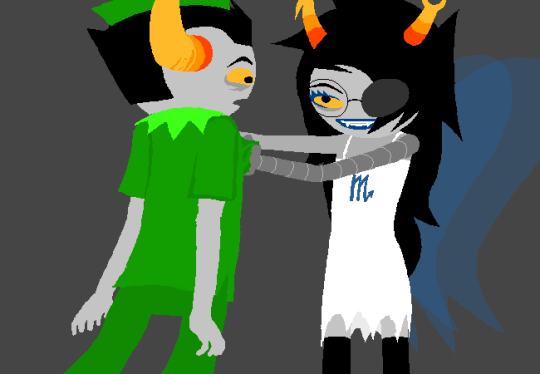
So when Vriska tries to live out her Mindfang fantasy, and rope Tavros along as her Summoner…
image
image

It’s not a coincidence that she dresses up as a fairy, and thinks in terms of a Sylph’s key verb–or close enough to it if you go with Create, same difference. And hey, doesn’t Vriska spend this arc insisting she only wants to make Tavros stronger? Get him to take charge and be powerful? Why, that almost sounds like…

image

What Aranea does effortlessly, by virtue of being a Sylph.

This is legitimate, compelling nuance that is lost under Inversion theory. 
And I can pull it out for close to every character. Dirk, AR, and Terezi’s fixations on being Knights, Roxy’s early flirtations with prophecy, Jake’s occasional references to wizardry, etc. 

There’s a LOT of depth here, is what I’m saying, and in my view, the system is way more flexible and well-executed than what we’ve understood up until now. Even if inversion theory were literally canon (and its not, wp people debunked it YEARS ago.) I don’t think I’d want to trade it for what I see in the system now, personally. 

What do you think about fan aspects or classes? I personally don’t like them, because the 14 classes and 12 aspects we have are broad enough to fit any personality or power set

I mostly haven’t engaged with fan classes and aspects, so I’m not sure I can say. But there are circumstances under which I can imagine them being crafted in some pretty interesting ways, provided enough depth and foresight. This is particularly true for the Classes, I think–I can see a different story describing the same rough existential behaviors through different Archetypes, and I think that approach has a lot of room for character depth.

For example, it seems to me Maids and Sylphs are linked to Fairies in Homestuck. This is because they “Make” their Aspect, and Homestuck describes them as “Made of” their Aspect in turn. That roughly translates to both classes coming off as sorts of Elementals, embodying their Aspects very intensely. But you could parse the concept of an elemental any number of other ways–you just portray any “imaginary” being strongly related to a concept. Creator Goddesses, Angels, Demons, w.e–seems to me like all of that parses pretty easily.

So I could see a class that has the same fundamental verb and active/passive alignment, but slightly different cultural connotations and presentation that comes along with a different name. That’s an approach I think I’d likely find interesting. And that’s just one example–I can think of other ways one could tease and complicate the system. 

The potential is there, I think. I have a friend who’s thinking about writing on this subject in more depth, so I’m hoping I see that happen :B

i’m not sure if the aspect binding thing really applies? theyre looking at it in terms of already knowing the 12 trolls and what they’re doing and using them as the default- but this stuff exists before they did. like as an example, ‘taurpio’ isn’t a combination of taurus and scorpio- it’s a combination of ‘taur’, the prefix for brown bloods, and ‘pio’, the suffix for prospit/light. there being a concept of a ‘true taurus’ only applies in terms of the human zodiac and using the 12 as an example.

 I’m…not sure I follow? The concept of a true Taurus applies because the Extended Zodiac refers to the sign as…True Taurus. Same for every other zodiac sign. And that sign is a Breath sign, in the zodiac itself. The coding is already in the extended zodiac system.

The prefix for brown bloods is Taur BECAUSE it’s derived from Taurus. Sure, that might not be literally true in the lore of the world, but it’s transparently true from our perspective. 
And Alternia–including it’s Caste system–were still predominantly set up by Lord English and Doc Scratch, who were/are predominantly exposed to trolls…through their memories of/being literally some of the trolls from Homestuck. The 24 trolls that play Sburb have always been an influence on how Alternia developed, to some extent, through the vector of LE.
So I don’t really see when they literally showed up to exist there as relevant to how this sociological structure is set up. 

wakraya:

Castes, Aspect-Binding and Deviations

So with the reveal of the Expanded Zodiac and the explanations of the Aspect Players, people have been wondering how come Xefros is a Rage Player apparently. There’s things fitting his Character Arc and his possible Growth that indicate he could definitely lean towards Rage, however, the references to Time are still there.

Then it dawned on me.

These two symbols? The first is Ariborn, the second, Libries. Now why is this important? Because the names are, obviously, combinations of the names of the True Symbols.

Within every Caste, individuals may be Prospit or Derse and any Aspect as needed, however, there are True symbols. The Human Zodiac Symbols, the Symbols of the Beta Trolls and their Ancestors, of the Dancestors. These specifically match their Prospit Moon and Aspect as expected. And they are ‘True’ symbols, that is to say, there’s some significance to them.

This is because everything that shares any part of the Symbols’ Root is Bound to its Aspect as well. With Libries, it’s evident- -RIES at the end comes from Aries, making it a combination of ‘Libra’ and ‘Aries’. And… That’s exactly the thing. Libra is within the symbol’s root as well. In Xefros’ case? -IBORN at the end states Derse and Rage, but AR- at the beginning denotes its connection to Aries.

The castes are not limited to the Aspect of their True Symbol, however, they still seem to be partially Bound to this Aspect. That is to say, while each specific individual will have their own leanings and convictions and Aspect, their Caste will also determine either a facet of them or what Society expects from them. Not all Rustbloods are Time Players- But by being Rustbloods, they’re tied to Aries inseparably, and thus, tied to Time in some way.

This is why Xefros seemed like a Time Player but is actually a Rage Player- At the beginning of Hiveswap he’s being contained, oppressed by Dammek’s attitude and the Society around him, not letting him grow. And thus the only thing that showed through was the natural Time leaning all Rustbloods have. Now though, Joey is giving him more confidence and making him believe in himself, and you better believe this Rust boy isn’t going to be Time-Bound anymore, and it’s going to start Serving some Rage.

I could have sworn I reblogged this ages ago when it was posted but it seems…not???

Anyway, consider this the basis for all my Classpect speculation going into Hiveswap: Act 2. I’m currently of the opinion Wak hit it out of the park, and the reading seems to hold well with both Xefros and Dammek in Hiveswap Act 1.

Not sure at all that it’s true, but I am very sure it’s interesting. I expect we’ll know for sure once we get a chance to meet all these dang new troll kids :B

homestuckexamination:

Role of the Visionary – The Seer


Those born
with the Role of the Seer are seekers of knowledge. They have
an innate awareness of their surroundings and a knack for learning, recalling
and analysing their interests, no matter how difficult or dense they may be. As
such, a Seer’s inner world may be as confusing and complicated as their
interests, making it sometimes hard to get to know them properly. On top of
that, they tend to struggle with grey areas, dividing in their mind what’s
right and wrong. This black and white point of view can be biased, muddling in
turn the insight a Seer may be able to offer otherwise. They can become easily
frustrated when presented with choices or situations that don’t fit their
divide of the world, and need to eventually learn not everything in the world
is as clear as it seems to them. When they think something is right, they will
try hard to share it with others, and won’t easily back down on their word. At
their best they are capable, intelligent and always eager to offer advice to
others. At their worst, they can be pedantic and zealous about their opinions
and thoughts.

Seers don’t need to be specially comfortable with their Aspect,
rather, their Aspect determines what kind of insight and information comes more
naturally to them, or what they have an easier time understanding. As such,
intrusive thoughts are their enemy, and paranoia can easily take hold of them
if they’re not careful, making them obsess playing scenarios in their minds
over and over. If something manages to muddle their vision and presents what
they thought to be true as wrong, a Seer’s sense of self can easily be
shattered, doubts about themselves and regrets about the outcomes they should
have been able to predict will plague their mind, and the healing process won’t
be an easy journey. Seers tend to be well meaning, however, and even when
things aren’t going too well for them, they’re open to talk and listen to those
they care about, to offer whatever little bit of help they may be able to.

Being one of the Visionary Classes, Seers are the Passive counterpart to Mages,
and similar to them, their strengths lie in Knowing things.
Understanding, Learning, and Guiding others through their knack for the subject
in general, they can be powerful aids when it comes to planning and strategy.
This doesn’t mean they’re completely meant for utility, however, as with their
insight and awareness, a Seer can use that which they have seen to bend causality
to their whims. Once they know the outcome, they can focus on reaching it or
preventing it. Precision, Subtlety, Cunning, a Seer adept in the arts of combat
may become completely untouchable, and perform feats others would have deemed
completely impossible. For those they care about, they will bend the future if
they need to.

How did you go about the extended zodiac wrt your blood sign? Did you just choose the one that corresponds with your real life sign, or the one that has a description that you jive with? I went my my real birth sign, for teal blood, but I am super torn? ‘Cause I also identify heavily with jade bloods? Also, Taz is a totally rad name dude!!

I’m a Leo, so I went with that. But only because the description happened to speak to me, too, and it happens to be close to my favorite shade of green. The only description that really spoke to me otherwise was fuschia.

homestuckexamination:

Role of the Visionary – The Mage


Those born
with the Role of the Mage are naturally insightful.
Introspection and learning more about themselves is as important to them as
learning the ins and outs of what has become important to them. They have an
idealized view of how the world around them should work, and will strive to
make their Reality pleasant and bearable for themselves, even when it may not
be the best path for others. Mistakes can weigh heavy on a Mage’s shoulders,
but their biggest enemy is the immutability of a world they don’t deem fair and
that has wronged them in the past. Due to this, while eager to share their
knowledge and interests with those they trust, they may become reclusive if
they fall to the clutches of self-deprecation and lack of agency. At their
best, they are deep, optimistic and great teachers to those willing to learn.
At their worst, they can be fatalistic and isolate themselves from their peers.

Mages find their Aspect coming quite naturally to them, they
barely need to try to understand their strengths and weaknesses. As such, they
will use the insight they know is there to lead others and change fate in ways
that suit them. However, this insight isn’t always appreciated, and as such, a
Mage may begin overthinking what should be simple and straightforward, sending
them down a swirling spiral they need to escape as soon as possible. Their
struggle is that of their desires and wants versus the inevitability of reality
around them. Confident and stubborn Mages will push forward with all their
might and not let anything stand in their way of what they want, but if they
become disillusioned with the way things are, they may fall prey of complacency
and acceptance against their better desires. And yet trying to change the
unchangeable may come with a heavy price for them. Striking a balance between
what they can do and what they want to do is vital for them, lest they push
themselves too hard.

Being one of the Visionary Classes, Mages are the Active counterpart to Seers,
and similar to them, their strengths lie in Knowing things.
Their Insight about their Aspect and Themselves is unmatched, and will Teach
and Guide others through that which they find important and relevant to their
interests. Foresight, Planning, Mages will not be taken by surprise easily, and
will fight back with all they have in order to change that which they don’t
agree with. They’re miracle workers that will take hold of their Aspect to both
ensure things go smoothly, and to directly engage those who dare oppose them. A
Mage’s conviction is nothing to shrug at, and if you stand in their path, they
will show you the hard way.