jane: hates tic tacs. shitty little dots of sugar without flavor. melt on your tongue before you get a chance to enjoy them. if she sees tic tacs in a trick-or-treater’s bag when they come to her door she takes them away and gives the kid twice their weight in real candy instead
roxy: actually ambivalent to tic tacs, but pretends to love them to piss off jane. will sit down to dinner with nothing but a box and pour them down her throat. she keeps stashes of them all over the house and jane uproots the building trying to get them out while roxy cries laughing in the background
dirk: mildly enjoys tic tacs, but pretends to hate them because they’re “inferior quality candy” and he’s a pretentious fuck. he does love their potential for fucking with people, though; he carries around a pill bottle full of the mint ones and will down like 6 or 7 at a time whenever an elderly white woman starts eyeballing his anime t-shirts
jake: doesnt know what they are. roxy convinces him that they’re an advanced form of future-medicine and he believes they cured his pneumonia
I’ve used Create for the longest time, but am finding myself leaning towards Make lately simply because it’s referenced much more in the comic and I think has some interesting wordplay with Maids specifically.
My tldr response is I don’t think Heal/repair accurately describes enough of what fairies do. I think both are ways their abilities might be described, but using make or create accounts for much more of all of the fairies’ behavior.
My immediate counterpoint is Aranea, who doesn’t really heal Jake at all. That seems very much like her flattering herself. She just makes him more important and relevant, and doing so enables Jake’s will more than her own in ways she didn’t expect.
I also don’t agree Sylphs are selfish and Maids are selfless. I laid out my argument for most of this with my Destroy/Create essay, so I’d be curious to how you’d respond to my points there.
Preface/Disclaimer: This series is not meant to belittle or otherwise shit upon the obvious tremendous amount of artistic effort that went into Homestuck’s final updates. I think everyone can agree the conclusion was visually & aurally stunning, and I would even say that what writing that was present was also top notch. This series is purely meant to explore something many people have found fault with: the failure to deliver on arc conclusions for just about every single one of Homestuck’s main characters despite a significant amount of build up and narrative foreshadowing that such conclusions were planned. I won’t be chiming in about the main plot/plot holes/etc, either, this is purely character discussion.
What Is A Character Arc? Also known as an “inner journey,” a character arc is generally what separates a main protagonist from a secondary, minor or background character. The successful completion of a character arc is often what allows a character to be considered “round” vs “flat” – meaning that by the end of the story they have changed in some fundamental way.
Homestuck is a coming of age story, featuring young characters thrown into impossible situations expressly meant to challenge them and grow them as people. This is actually stated in the narrative several times, but more importantly, shown to us via what actually exists of each major characters’ arc. My argument then is that these arcs were truncated with a narratively lazy conclusion, not that they didn’t exist at all – and this is a large part of why so many people are finding the conclusion unsatisfying.
Pt. 1: Jane Crocker
Few people would deny that Jane Crocker caught the short end of Homestuck’s narrative stick; she is used to introduce us to the B2 Universe, her primary conflicts and motivations are laid out for us early on, and then… nothing ever happens with them, ever. She is waylaid partway through her story via a subplot wherein she is mind controlled by the Condesce, and – more importantly – never recovers any significant agency after being released from HIC’s influence.
So, what were Jane’s primary conflicts? Let’s talk about it.
Here’s the first of the Class essays, where we go over the most intense Active/Passive dichotomy, putting these Classes on the furthest ends of the spectrum.
The Key Verbs for these classes are Destroy and Create, covering Princes and Bards & Maids and Sylphs, respectively.
Quick disclaimer so I don’t get anyone’s hope’s up: This essay doesn’t include much discussion of Jane Crocker! Not because she isn’t relevant, but because I actually ended up writing this entire series because I needed to lay out my thoughts on Maids so I could get around to writing my essay about her.
I’ll be linking to my Jane post at the end of this essay once it’s up, and this essay is pretty much required reading for it! So I think it’s worth checking out if you’re interested in her anyway.
As for the rest, I just hope you enjoy. The other two essays are already written, and I’ll be posting them over the next two weeks!
They are available in their entireties for my Patrons, so if you can spare me a buck a month you can get these early if you decide you like them enough. Higher reward tiers will let you invite friends to the Discord so they can read them too!
Feel free to @ me, reblog or send me an ask with your thoughts on these first two essays. There may be some things I can’t answer as they will be answered in later posts, but I might use those as inspiration for what teasers to release from sections of the next two essays over the course of the week.
You can also feel free to talk to me in the Hiveswap Discord where I moderate and cry about Homestuck. I’m very interested in seeing how my thoughts stand up to scrutiny, so don’t be shy!
Just wanted to reblog this to mention that I made some heavy revisions and added a bunch more stuff, particularly making the Unifying Myth of Fairies far more compelling!
There’s also some talk about Vriska, and I made some edits and added some graphics that should make it much easier to understand how I think the Class Active/Passive spectrum works as a whole. Finally, I also included Jane’s one reference to being a Fairy (that I’ve found so far).
Special thanks to @ymawgat for sending me the questions that made me reevaluate a couple things in the canon and dig all this extra stuff up! This argument is both way more compelling and far easier to read now, I think, and I appreciate it.
I also wanted to note that thanks to my financial situation improving, I’ve been able to lower my Patreon goals substantially! At this point, I’ve got something like 630 followers, so if less than half of them considered sending me three bucks a month, I’d be able to bring out new insights about Homestuck as a full-time job.
You’d also join a Homestuck analysis community that has already proven exceptionally awesome 😉
Of course, I appreciate anyone’s attention and thoughts in response to my writing most of all! I just wanted to keep everyone updated on what the state of this project is.
Ok, this is a pretty good reasoning of the motif, however there are still a couple of things I think you’ve missed:
1: Vriska’s motivation for dressing up as fairy is to fulfill the whole pupa pan story, and this is then connected to her GT outfit. She doesn’t do it in conscious reference to her ancestor at all, and I don’t think her admiration for Mindfang is ever verbally or image-ly linked to her fairy motifs? Also Vriska’s tinkerbell reference is also sort of present in WV’s dream, something that isn’t really connected to Tavros?
2: The references to people being fairies are connected to the troll god tier outfit, as is the fairy imagery (butterfly wings, fairy dust – which is connected to tinkerbell in [S]wake but continues to be present in the comic afterwards). The reason I think this is important is that the Maids and Sylphs who aren’t troll god tiers (Jane, Kanaya, Porrim?) are never called fairies, which sort of implies that the motif has more to do with the god tier accesories than it has to do Maids and Sylphs?
Ok, so:
1. You’re right! A lot of Vriska’s playing up the Fairy thing has to do with Tavros…but Vriska wants to win over Tavros because of Mindfang in the first place. And as far as I can tell, these dynamics are just as often presented through…for lack of a better term, narrative game mechanics, as they are through explicit text.
As far as Mindfang is relevant to the narrative, she exists as a being Made of Light in Vriska’s eyes–her importance, agency and storytelling define her, and this a Light Vriska steals for herself, to make herself feel more important and capable.
For as long as Vriska is trying to live out Mindfang’s image specifically, and trying to recreate her relationship with the Summoner through herself and Tavros, she spends her time trying to act like a Sylph.
Think about what she’s doing with Tavros: She’s trying to get him to get stronger and more assertive, trying to increase his willpower, trying to get him to become more important.
If that sounds familiar, it’s because it’s what Aranea successfully does effortlessly with Jake. Vriska tries (and is equally harmful in the process) but she isn’t playing to her strengths like Aranea is. This isn’t her forte or where she excels–it’s a role she’s playing out because it’s Important to her.
And that’s reflected in the mechanics of how she tries to handle the people around her, just as it does with Dirk and Hal.
This is also why I don’t think WV’s dream presents a conflict–being a Fairy is something important to Vriska because of Mindfang as much as because of Tavros, though the two are deeply interrelated.
There’s lots of other examples of this in the story, too–I’m fairly certain I’ve missed many even now, since Vriska as a fairy wasn’t on my radar until you sent this. Again, I’ll go over some in more detail as this series goes up.
2. The troll god tier thing is complicated somewhat by the fact that the only two trolls who god tier are…Aradia, a fairy class, and Vriska, who’s trying to fit into the fairy figure. I agree there’s some muddling of themes, but not as much as it seems like. This is because no God Tier trolls are described as fairies besides Aradia or Vriska, and Vriska drops the aesthetic completely after dying/getting punched by John.
It’s also worth noting that the forms of exposition for the classes aren’t always symmetrical–like I pointed out in my Jade essay, Witches’ powerful guardians aren’t literally called Familiars, but by all definitions that’s exactly what they are. The implication is built into the nature of the title Witch, while their complement classes have parallels built up through other means.
This, again, will hopefully become clearer soon.
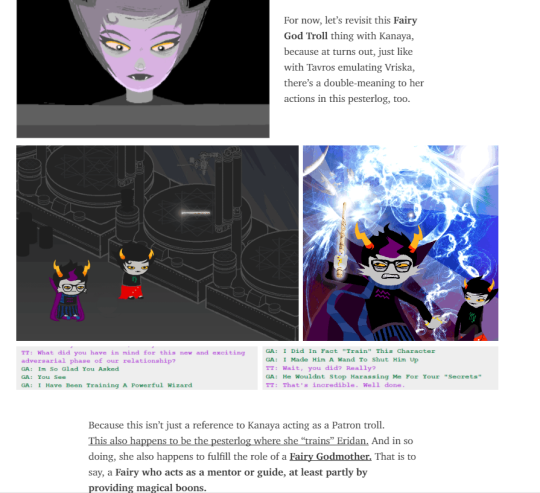
So too it is with a Sylph. Maybe they aren’t literally called fairies as often, but I’d argue they don’t need to be, because a Sylph by definition is a species of Fairy. It’s also untrue that Kanaya is never referred to as a Fairy! She receives the title “Fairy God Troll” in reference to her being Rose’s Patron troll, although Doc Scratch later says this about it:
As she prepares to alchemize new items, she is contacted by her “fairy god troll”, a distinction which does not necessarily have anything to do with being a kid’s patron troll.
She’s the only troll to be described this way, with one exception: Tavros in this pesterlog with Jade, where he’s described as a Fairy God Troll…and where he attempts to do the same thing Vriska is doing by inserting himself into Jade’s story, and even considers following Vriska’s ideology briefly and controlling Bec over Jade’s protests.
Tavros ultimately doesn’t end up being Jade’s patron troll–Karkat fills that role, and is not described as a Fairy. Kanaya is described as a Fairy God Troll and successfully lives out the role that implies, setting her apart in this regard.
Finally, Jane is complicated. Like Kanaya and Karkat, Jane’s entire arc is about struggling to find herself, and she spends a lot of time slotting herself into the role of an Heiress instead–something I think I’m likely to talk about in my essay about her now that I noticed it, ALSO thanks to you so thanks.
Hey! So, this is a really good point (and is leading me to thinking about Vriska in some interesting new Lights…)
What I will point out is this: I looked it over, and pretty much every time Vriska is referenced as a fairy, it either directly concerns or surrounds a pivotal moment in her arc with Tavros specifically. After [S] Wake, Vriska is never referenced as a Fairy again.
Vriska also at least somewhat admired two Fairy figures–she thought Kanaya’s lusus was the coolest of all of them, and she literally crafted herself in the image of Mindfang–a Sylph of Light herself. This is not the only instance of a character from one mythological role actively trying to fit into the context of another. I’ll be going into at least some others–but not all–in the next two posts. One thing I’m noticing more and more now that I have the understanding I do is that the way these mythological motifs affect different classes is complicated, and that this system has kind of essentially infinite depth. There’s a lot in this story for us to reconsider and rediscover, and I’m very excited about sharing it with you guys.
Stay tuned 😉
PS: As I release these essays, I’ll begin tagging posts concerning these mythological figures with their tags instead of going for the more awkward Active/Passive setup. I just think it’ll be more elegant that way, though I might have to think up terms for Prince/Bard and Thief/Rogue, who don’t seem to get them (as far as I can tell right now) because they’re freebies from Calliope.
Ok, you’ll try it out with one of your less prized possessions just to prove how dumb it is. You never liked this hat much. It makes you look like a gnome and basically isn’t funny at all.
[Author’s Note: This is a repost of Love, Faith and Fantasy–my piece on Jake and Dirk’s character arcs and the relevance of Knights and Pages in understanding them. I thought breaking it up into chunks would make the content more accessible, and give me room to flesh out each argument. Thus there will be some updates to the content. Hopefully this will mean more people can easily approach it!] [Pt. 1 – Knights/Pages – Service and Ownage] [Pt. 2 – Faith and Fear] [Pt. 3 – Fearful Heart] [Pt. 5 – As You Wish]
So now that we know that Knights are defined by service to others, and now that we have a clear reading of how badly Dirk wanted to be of service to Jake, it’s time to veer off a bit.
In this section, we’ll take a look at how hard Dirk tries to live up to Dave’s mythological role (while still very much carrying out his own), and see how that affects our reading of his character. We’ll also take a look at how Dirk is treated by–and feels about–the rest of his friends.
Dave is the only character who ends up acting as a server player for more than one person, and Dirk on some level tries to emulate Dave’s effect on the game the first chance he gets.
He fails at this, Miserably. But Hal, who is also a Dirk trying to emulate Dave, succeeds. By the end, Hal take’s over as EVERYONE’S server player, even Dirk’s. He even takes Dave’s text color during the process AND takes charge of–his words–metatemporal mechanics.
Dirk’s failure–and Hal’s success–in this regard established, let’s refocus a bit and note the nature of Dirk’s relationship with all of his friends by the time they start playing.
To make matters worse, we learn Jake essentially toyed with Dirk’s heart with jokes he–fitting into Jake’s general pattern of behavior–never confronted Dirk to correct, although he correctly deduces it left lasting damage on Dirk’s feelings.
Partly as a result, he views Jane as a competitor with an unfair advantage. Her complete ignorance about his sexuality doesn’t help matters, so he can’t talk to her.
All the while, Roxy is actively and willingly pressuring him into romantic interest in her and directly comparing him unfavorably to Hal for his lack of romantic reciprocation. And Hal not only harasses Jake and positions himself as a better friend to Jane (this particular act I do not view as malicious), but uses Dirk’s very insecurity about failing Roxy against him.
And while Hal claims to be on Dirk’s side in the Jakestakes, Dirk is pretty much right to be suspicious of his intentions:
So essentially, Dirk has no one to talk to about his sexuality and gets ignorance or cruelty on all sides with regards to it.
Is it really reasonable to demand of a teenager to come forward to his best friend–who he last heard voice rejection of the very CONCEPT of gayness–not only to admit his sexuality and explain how it factors into his alternate self’s abusive behavior, but also to confess or try to talk around his soul-searing, cosmic romantic love for the guy?
And that is what it is, make no mistake about Hal is either getting carried away with feelings he says are distant and diluted for him, or confessing the full form of those feelings on Dirk’s behalf. But the feelings are there, and they are cosmic in scale.
Heart is the aspect not just of love, but of any intense attraction between two or more people, and thus shipping. At first, these elements may seem disparate, but they’re more connected than they seem.
After all, what do you do if you ship two characters? If you think they’re in love? Typically. they’re shown as close together as possible, trading attention and feelings. Placing their souls in proximity to one another’s and implying a give and take between them.
Dirk’s Prince of Heart role does reflect how he destroys his relationships, but not the way most people think. It’s not that Dirk is willing to erode the selves of his friends to fit into his molds, but rather that Hal positioning his Self between Dirk and his friends undercuts Dirk’s ability to reach out and trust their perceptions of him, and even stops him from being able to tell where he begins and Hal ends.
At the same time, Dirk’s intense fear of rejection keeps him away from broaching his problems with Jake the same way Jake’s fear of disappointing others stops him from broaching his–Dirk’s Love getting in the way of honesty as much as his constructed Persona.
And yet, despite the unhelpfulness or outright cruelty Dirk’s friends put him through, largely because of his sexuality…
Save for the trickster log–which he recants–Dirk never once even thinks to consider his friends as aggressors towards him. His instinct is to assume he’s somehow failing them instead. Just like with Jake, Dirk sees into the core of all of his friends, and what he really sees at the end of the day is this:
Dirk thinks Roxy is noble. He sees her as she really is–as one of the Nobles of the session, as they ALL are, seeing right past their flaws and mistakes and straight to the shining hearts of their intentions.
Again, Roxy’s not even the one he wants to be with romantically, and we saw the intensity of how he feels about Jake. He wrote Jane entire books and sent her personal bodyguards crafted out of heirlooms taken from the Bro Dirk essentially shapes himself in the image of. What would he have to say about the two of them, if asked?
Dirk’s problem is his perception of his friends’ nobility leads him to erasing all their hurtful behavior, and the hurtful behavior he sees Hal commit on his behalf–which Dirk views as being his own actions, despite the fact that he never does anything about it for the exact same reason he stops himself from killing Hal–stops him from seeing any nobility within himself.
Dirk’s response to all of the complicated ways he’s been hurt in trying to manage the Hal and Jake situation as ethically as possible by all of his friends is to internalize responsibility for absolutely all of it. It never even crosses his mind to hold Jane or Jake or even Roxy accountable. Only his own self, and Hal as an extension of it.
It’s some pretty sad shit! Dirk conflates himself with Hal and views all of Hal’s actions as literally his own, despite the fact that they were carried out without Dirk’s agency of desire. And much of the fandom has taken the worst that Dirk has to say about himself at face value, in a way that simply hasn’t happened for…say…what Jake says about himself after the retcon.
So it’s a good thing, then, that Jake ultimately reciprocates Dirk’s feelings…and has a completely different view of Dirk than the one Dirk thinks he has.
How does Jake’s view of Dirk intersect with Dirk’s desire to live up to Dave’s image? And might it help resolve Dirk’s existential crisis of self-loathing?
If you like my writing and have a buck to spare, you could also really help me out by enabling me to focus on putting more of this content out there through pledging on Patreon. Doing so will also give you access to my private community of enthusiasts trying to advance new and interesting readings of this wonderful property.
[Author’s Note: This is a repost of Love, Faith and Fantasy–my piece on Jake and Dirk’s character arcs and the relevance of Knights and Pages in understanding them. I thought breaking it up into chunks would make the content more accessible, and give me room to flesh out each argument. Thus there will be some updates to the content. Hopefully this will mean more people can easily approach it!]
Now that we’ve established that Knights are a Passive class and Pages an active one, and further established that the Passive/Active divide at least partly refers to a sort of inherent Selflessness vs. Selfishness, let’s take a look at what being a Page means for Jake.
To recap, the key verb for Knights and Pages is ‘Serve’–and the two classes are tied together by the symbol of Butlers, who show up linked to Dave and Jake with particular frequency.
This means we can roughly parse Jake’s title as:
One who Serves themselves Hope, or Serves themselves through Hope.
With the corollary attribute of One who is Served By Hope
So, how does Jake’s classpect inform us about his behavior?
Let’s take a look.
I was never exactly trying to argue Jake was some kind of secret supergenius manipulator. What I tried to say, rather, is that he’s pretty much about as aware and capable as his friends are.
Whatever mental hiccups he has that can be attributed to mental shortcomings on our part are a red herring, and it’s a red herring Jake kind of deliberately sets up. Jake’s problem is actually similar to Jane’s: Ignorance.
But where Jane’s ignorance is mostly genuine–if stubborn and self-serving–Jake displays an intensely willful ignorance coupled with an intense aversion to confrontation. These traits typically end with him putting the burden of action on his friends, especially Jane and Dirk, and primarily so that Jake doesn’t have to let Jane down by letting her know he’d rather date Dirk instead.
Note here that Jake slips up and describes Jane’s pinings as “unrequited”. Jake broaches the subject, and then rambles a bit about how he wonders if people really do feel that way. Then Roxy is interrupted by something and has to go, which results in…
I’m not really vouching for the idea that this “Hmm.” is definitely Jake being given a line of quiet contemplation before he decides to do what he does next–talk to Jane–but I will advance it as a possibility. At the very least, the line is ambiguous. This kind of understated response is a little bit odd in the context of Jake being worried about Roxy’s danger, and he seemed lost in his own thoughts right before she left.
The question is: Why go about things this way? And how’d Jake even manage this bizarre feat of ignoring reality in the first place? If Jake knew how Jane felt, why not just answer her? And why does he seem to forget Jane ever liked him in the first place once she says No–to the point that even with Brain Ghost Dirk, his literal own brain, telling him better, he still claims ignorance?
And the answer is that Jake conflates believing in someone with believing the things they say, and Jake very much wants to be a good friend to his loved ones. What Jake fears more than anything is that he may have to confront or disappoint anyone. That he be forced to find out he accidentally hurt his friends’ feelings–or be forced to choose to do something that would do so himself.
This is why his big solution when he becomes a Trickster is to become a doormat and date everybody, explicitly so that he can make everyone happy–not because he wants to date everyone himself. (though he makes it a point to include Dirk when the girls exclude him) And he admits his reasoning himself once the session falls apart:
So it’s more convenient for him if it turns out he really was wrong about Jane liking him–despite literal evidence to the contrary–and once he has it, he serves himself through Hope and believes it wholeheartedly:
Note that he admits to having put Jane on the spot while doing this, btw.
And implicitly uses the head trauma he received during session entry as a plausible excuse for his lack of foresight, just as he uses his Hotheaded Adventurer persona to ignore possibilities he finds inconvenient. He does all this because on some level he’s genuinely convinced it’s all true, so this isn’t exactly active manipulation. But he convinced himself it was true in the first place because it was conducive to his preferred fantasies.
This reluctance to confront his friends when he thinks there’s a chance he messed up also answers a question barely anyone seems to have asked: If Jake was having so much trouble with Dirk, why did he always go to Jane or Erisol? Why never Roxy, over the course of six months?
The answer is because Roxy knows a secret (hidden information-Void stuff), a fact that Jake cannot square with his constructed identity: That he knew Jane liked him all along. Because she told him about it. (Roxy has her own reasons for not advancing this information, which we’ll get to someday.)
But because of all this behavior, Jake’s friends find it extremely difficult to approach him about subjects he doesn’t want to be approached with, which coupled with their own issues ends with everyone bottling up their feelings until they burst, always ending in Jake getting breathtakingly….
Devastatingly…
Served.
But I don’t want to harsh on Jake here. It’s not that he doesn’t love his friends–it’s just that he’s kind of selfish about it. But that isn’t always a bad thing. Do you know what Jake is more comfortable doing for Jane than letting her down gently over her unrequited feelings?
Literally dying for her. After she threatened him with sexual slavery. And she’s not the one he chose to be with–but we’ll get to Dirk later. The point is this is not a boy who cares only about himself–it’s a boy who is so scared of disappointing the people he cares about he would rather lie to them and himself forever rather than face the possibility.
Jake is selfish, sure–but you can love deeply and perform great acts based on selfish love. Another way to parse it is that he’s self-directed. Jake is demonstrably not motivated by thinking primarily about how his friends might benefit from(or be hurt by) his actions–that’s Dave’s instinct.
Jake’s instinct is to get what he wants. But when they’re in danger, Jake wants to protect his friends more than he wants to stay alive himself.
But that doesn’t mean it doesn’t hurt them when he’s thoughtless and selfish by choosing to believe whatever’s easiest for him, obviously. In the words of so many people who have told me about their perceptions of Dirk: “Intent does not invalidate harm.”
And there’s no one this habit of Jake’s hurts worse than it hurts Dirk Strider. We’ll talk about their relationship next.
If you like my writing and have a buck to spare, you could also really help me out by enabling me to focus on putting more of this content out there through pledging on Patreon. Doing so will also give you access to my private community of enthusiasts trying to advance new and interesting readings of this wonderful property.
You didnt ask for this but you put Dirk and love in the same sentence and this is what i’ve been thinking about so lets go
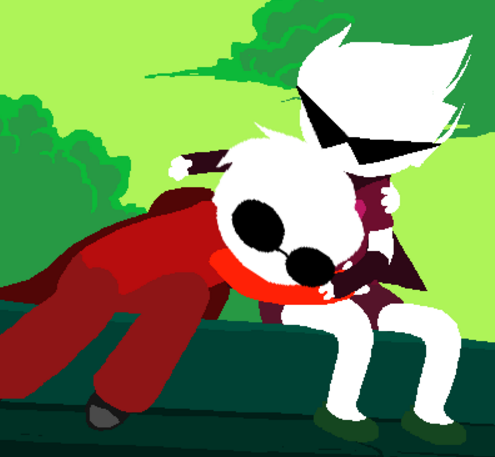
Im gonna ramble about how much Dirk would love John Egbert and Jade Harley like, instantly, he did conceptually before he even met them but the instant they meet Dirk is permanently owned and has that many more people he’d happily die for because: Dirk loves Jane and Jake more than life itself, and John and Jade are…their kids basically. And early on Dirk cannot unsee that.
The biggest treason this fandom has ever committed to my person is ignoring the fact that Dirk Strider would fucking melt himself to death even looking at John Egbert or Jade Harley and deconstructing all the little ways they’re like Jake and Jane and thinking about his typical self-loathing shit like “god those two would’ve been so happy together I’m such an ass for getting in the way look at them their kids are perfect they’re so good–”
before Jake like puts his arm around Dirk’s shoulders and all thoughts immediately stop if they’re dating again, it’s probably a source of great angst for Dirk before they are and one of the bigger reasons he stays away. Maybe Jake and Jane will get the idea and be happy together. Someone write this for me thanks.
Anyway that got too sad so back to Dirk’s relationship with the ectokids.
Early on in Earth C John gets the impression Dirk hates him early on and pranks him pretty hard and often but while it kind of annoys Dirk when all his meticulously set up horsecam figurines get their heads swapped (and john breaks some of them in the process) he’s mostly just reminded that things with him and Jane are still awkward enough that he hasn’t gotten this from HER and he’s a torn up bag of “Fuck I miss her” and “Fuck I can’t believe how much I care about her goober ecto-son already” and NONE of this gets across his stoic demeanor so all john gets is that poker face. It takes them fucking forever to be actual friends and I’m not sure what does it but its probably the formidable teamwork of Jake and Dave who get sick of the awkwardness eventually.
Meanwhile Dirk is 100% in awe of and terrified of disappointing Jade Harley who he A) cannot stop thinking about as JAKE’S GRANDMA and “OH GOD WHAT IF SHE DISSAPROVES WHAT IF I’M NOT GOOD ENOUGH WHAT IF-”- and B) Cannot stop thinking about as SO MUCH like Jane it kills him. She’s so no-nonsense and down to business and whenever he starts rambling too much about philosophy or some bullshit she just looks at him like … and he’s like “Ok I’ll shut up.” The way Jade moves in a science lab is EXACTLY like Jane moves in a kitchen (or later, a business meeting) and Dirk knows because he learned the ins and outs of that movement by heart across so many video cam sessions growing up. Everything about Jade Harley destroys Dirk and he thinks she’s the fucking coolest and there’s basically no part of him that didn’t love her from the word go
Dirk manages to work up the will to keep everyone else (but Jake) out of his private garage but not Jade, Dirk’s got all this futuretech practice and as SOON as Jade catches wind of this she’s like “Hey dirk! Alt!Callie handed me the secrets of the universe and basically i need a bigger workshop and better science can you help me out” and that’s basically his main project for the next two years is catching Jade up on 400 years of scientific progress (Jake tags along) and having to work on his weirdo animatronic shit that he was GOING to use his garage for originally in like, one of the cramped floors of Jake’s jungle globe instead
But it’s fine cause it makes Jade happy and getting to be helpful to Jade is like a dream come fucking true and Jake is so happy whenever he and Jade get to talking about some interesting intersection of philosophy and science or furries or whatever. The first time Jade gives him a friendly smack on the back Dirk jumps so hard he hits the roof.






 Flying through Storytelling