the tl;dr is that I’m perfectly aware of the interpretation of Knight/Page as the Active/Passive “Exploit” pair. I held the view for years, since I was introduced to classpect theory by BKEW. You’re not dealing with someone who’s oblivious– you’re dealing with a different interpretation of these Classes.
I don’t even use the verb “Exploit” but the verb “Serve”, which I think has considerably more support in canon. I don’t agree with that characterization of Pages at all, either. I’ve written a tooon on Knights and Pages you can find on my Medium page or by looking through my blog if you want, so I’m not gonna rehash the debate here.
Canon or Hussie’s eventual Class test will presumably provide us incontrovertible evidence for which view (if either) is correct eventually. Until then it’s just fun stuff to talk about and consider.
Okay, a bit late, but like I said, there was a reason I got back onto the topic of the extermination of the Gamblignants, and it’s to do with the Alternian enforcement of classes.
A lot of the classes that would be assigned to blood castes make easy sense. Rustblood maids because they’re a serving class. Purplebloods are bards for their performative wildcard nature. Princes are royalty, so that’s what violets are. Seers’ analysis is important for a class who act as assistants to the government (and seers as assistants to more combat-oriented classes is a concept that has been evoked within the comic itself).
Some of them are more symbolic. Heirs generally serve as the “Beta Male” class, so their being assigned to the caste that serve as lackeys to the top dogs of the land dweller race makes sense. Sylphs are a fitting role for jades for their nurturing and also mythical nature. Rogues might even make sense, given the heroic spin Homestuck applies to them, as the ones at the top of the lowblood group.
What really sticks out like a sore horn is the thief class. What reasonable society would implement a social class of criminals?
And in doing so we’re left with Vriska as what we can probably safely assume is the last member of the thief class.
That’s interesting, because it puts thief in a unique position shared with only Feferi’s witch class in that only one troll has the class. Which makes you wonder why!
A good place to start is probably that Meenah’s class was also thief, and we know at least a little bit about how she took over her session. The thief by nature is forceful and hard-headed, and really not a hero you want to have lying around in hoards.
The problem with the thief class being thinned down to just one member, of course, is that the chance that a thief will be involved in the SGRUB session are reduced significantly from what they would be if there were a whole social caste of thieves. Which would explain exactly why, of course, Doc Scratch chose Vriska in particular to be his protoge (and perhaps the same reason that Kanaya was chosen too, considering the extreme rarity of her own caste/class).
I like this a lot overall, and I’m pretty curious if the Class enforcement really is this consistent.
One thing I’d like to mention is that it is my view that Rustbloods are forced into the role of a Knight as much as the role of the Maid. For that matter, the Knight role seems to be forced on Bronzebloods, too.
There’s a pretty strong association between Butlers/Serving and Knights and Pages, with Knights typically serving others and Pages being the recipients of service. Mindfang describes Redglare as a “civil servant”. John refers to Dave as “serving all the ladies”, and asks why he can’t have a Dave butler, too.
Dirk and AR idolize Dave and strive to live up to the role of the Knight, and both are associated with Knights as a result. Grandpa remembers his Alpha friends, and Dirk specifically he recalls as a Knight, collecting suits of armor that evoke his memory.
AR’s final sacrifice in the Masterpiece, he takes on as an act of service for the other Alphas–giving Dirk time to destroy Caliborn for good. After that, he spends eternity inside Lord English’s soul, living out his Knight fantasy, monkey’s paw style–he’s Lord English’s personal Butler.
Associations between pairs of Classes and corresponding symbolic Archetypes are all over Homestuck, and I think they help a lot in figuring out what’s going on. Xefros, for example, makes reference to Serving Dammek in Act 1, as associated with his Butler uniform.
yep! I pretty much agree. I’ve been trying to figure out exactly how to parse the motifs of the classes in a comprehensible way, and the Protect and Serve motto reads really well with Knights and Pages. I’ve never seen canon reference it–the closest would be Dave’s repeated references to Obama, I’d say. But it’s definitely been taking up my thoughts as I consider how the classes all fit together thematically. Sweet catch!
I’ll start off with saying that your ideas on the Page and Knight classes are a pretty fresh take, clearly original ideas that draw from a solid foundation in the canon.
From your explanations however, I think that the Knight is the active class, and Page the passive, given that the only direct canon explanation for what the passive/active distinction amounts to is that active classes directly do something with their aspect, and passive classes invite others to do that same thing. The knight herself is still Serving, whereas the page is still inviting others to Serve, regardless of whether they are serving him. Just because Serving seems to imply acting for another person doesn’t mean it’s any different than the Prince who can destroy others (aspect). Both are acting impressing their will on another, the distinction being that one is trying to help, the other is most likely hurting.
However, I can’t say I’m convinced on Serve being the primary verb for the pair. This debate is a old as the classes themselves, yet we still find ourselves here. Serve is good, and you’ve found evidence for it, but I say it’s not Enough.
From my own theory crafting experience, I’ve cycled through most of the different words thought of as being the Key Verb. Be it Exploit (which really works for Dave’s time looping powers, and to a lesser extent Karkats victory over Clover) Wield or Use (which I then extrapolated to mean the knight was some sort of item using class, that they had a favored weapon that they could summon, an aspect themed mount, or perhaps a batman like toolbelt that contained a variety of aspect aligned tools that only they are proficient in using, eventually boiling it down to the idea that the Knight can use aspect associated items without any difficulty) as well as Protect (the knights armor is such a sound power concept). The most clear non HS example I could think of was Guts from Berserk, who is the Knight of Rage (though anyone with the Brand becomes an Heir of Doom). Guts’ dragonslayer sword is described as being more a slab of iron than a blade, basically the thing is way to big for a human, he was Wielding a Contrivance. That, and he eventually obtains the berserker armor, which protects him with his rage (protect being a strong word here, but it let’s him keep going). The Page I’ve described as the sidekick, the one who puts Armor on other people, who brings them their weapon, or car keys, given the knights penchant for having a mount. Anthy himemiyas ability to pull a sword out of her or others chest seems on surface level to be a obvious page move (Another time I’d like to discuss with you whether or not Anthy was a Page, or if the swords were complete powers in of themselves, metaphorically far more than swords, making her a Muse. But I digress)
I’m Making/playing a Sburb tabletop game with some of my friends, and the Knight of Doom has never been satisfied with his powers, and I have changed them over and over again to no avail, which Is why I have looked at the knight through so many lenses.
The most recent idea I’ve had for the Knight is something I’ve not seen touched on. When I asked my Rogue of Mind to describe what a knight traditionally is, he gave me a simplistic, shounen answer of how knights go around challenging others for the honor of their lord, and to test their mettle. I thought it was silly, until I realized the Knights in canon all did that in some form. Knights seem to challenge others to a competition related to their aspect. Dave regularly got into Rap Battles with the trolls, as well as Ironic oneupsmanship games. Karkat incessantly Argued with people, especially over Relationships and Team related things. And latula played video games I guess. The same thing is also present in the pages, to a lesser extent. Tavros was an avid fiduspawn player. Jake physically fought the dirkbots, while also playing romantic games with the alphas (while relationships are Blood, and your preferences are Heart, I give Eridan and Jake as examples that Unrequited Feelings are Hopes domain). I’ve got nothing for Horuss, which maybe is part of it? I’ve struggled with whether to call this Fight or Compete. It’s pretty obvious once you look back at it, but it still leaves questions; how do we find a word that includes the concept of Protect, Wield, Exploit, Use, Serve and Fight? They all have grounds in the canon, and all of the classes have to have one Key Verb to them. So what is it?
Also, should you find this all interesting, Check out the game I am developing, SKRUB: a Tabletop Creation Myth, a pen and paper role-playing game made to give players a complete Sburb experience.
so shit kinda hit the fan for me and i am mostly cleanin up and getting ready for some announcements, so im gonna keep this pretty short, i just wanna knock a bunch of asks out of the way:
1) once i like, can, i’d love to talk about Anthy. I’ve been reading her as a Witch or a Muse depending on my mood–I don’t really think she’s a Page at all, though I can see how you’d think so if you read them as Passive. On which point,
given that the only direct canon explanation for what the passive/active distinction amounts to is that active classes directly do something with their aspect, and passive classes invite others to do that same thing.
That’s not true? That isn’t the description of Passive classes, for starters. Passive classes invite the Aspect Itself to act through them, or invite Y action onto the Aspect. That can include influencing others, but it also includes simply acting as a channel for the “will of the Aspect” itself.
Calliope gives us the “For themselves” vs. “For others” definition seperately, but I don’t really see a reason to single that one out as Class-specific while not doing so for the description she gives for Prince/Bard. And all classes employ both “exploit” and “allow” behaviors at various times.
Hence why I think understanding the classes is easier when you parse whether they tend to benefit themselves or others.
Protect, Wield, Exploit, Use, Serve and Fight
They all have grounds in the canon, and all of the classes have to have one Key Verb to them. So what is it?
It’s Serve. Hiveswap makes me even more certain, since it’s way less subtle. For starters, I don’t really think Wield, Exploit and Use make sense as Knight/Page verbs.
Eridan, Vriska, Roxy, Rose, and countless others can be said to “Wield” their aspect like a weapon through items–the dice, roxy’s cubes, eridan and rose’s wands, etc. Rose can easily be said to be “using” Light when she uses the cueball Scratch gives her. And “Exploit” is basically synonymous with the idea of “using” one’s aspect directly, as Active classes are said to do.
There’s way more examples than I can even count, but basically I think all of those verbs are too general. As for Protect, it falls under the Serve verb under the idea of “Service”, which can mean to help someone or to literally be in their service. Redglare is referenced as a civil servant in allegiance to the Subjugglators, for example.
Help is a concept strongly associated with Knights and Pages, and often in terms of providing protection. Jake “invites” Dirk to give him Heart through the form of a bodyguard doppleganger that is referenced as a butler, and the Brobot later literally Serves Jake his heart like a butler offering it up on a platter–giving it to him, which falls under the second definition of Serve.
The “Fight” verb also falls into Serve as it’s third interpretation, because to Serve someone can also mean to own them completely or kick their ass–Caliborn directly references this definition. “You got Served”, etc.
This, by the way, is a big reason I think Knights are Passive and Pages Active. Knights are invested in working hard to protect and Serve others, while Pages are more inclined to get others to Serve them–and that can be contentious on both ends given the “fight” association, but at their respective bests Knights are still predominantly working for the benefit of other people, while Pages are rallying others to work for their own benefit.
RE: The tabletop game, i’ve been interested in tabletop sburb potential for years, so I’d def love to check it out! could you drop me a link?
(@revolutionaryduelist I’m starting a new post cause the last one was getting a bit long)
For now I’d just be curious to know: In what way would you say Karkat “exploits” Blood? He’s not really cognizant of where his strengths lie even by the end, and yet he routinely solves conflicts by establishing bonds almost magically.
And what about Jake in the Masterpiece? There might be ambiguity to Karkat and Tavros (I’d argue Tavros’ behavior is much more in line with exploitation, but I already did so I won’t here), but Jake’s final act in the story is wielding his gay hope bubble against Caliborn as a weapon, which he does specifically because he, himself, decides he wants to save Dirk.
That seems much more in line with exploitation than with allowance to me–it’s willful, conscious and pre-determined.
1) Karkat is also difficult to comment on, since we can’t know what’s going through his head at the points where he ends the fights with Slick, Gamzee and Clover.
I will say however, that whether or not he cognizant of what he’s doing isn’t the only element of whether or not he “exploits” Blood? As in, he might not be directly aware of what he’s doing, but could still be using Blood in a way that it “shouldn’t” be used?
Hmm. I’m not sure what definition of Exploit and Allow you’re using–I don’t remember Exploit ever being clearly delineated as the Aspect being used in a way that it “shouldn’t” be used or doesn’t want to be used.
I’m using the dictionary definitions of the terms Exploit and Allow:
ex·ploit
make full use of and derive benefit from (a resource).
al·low
give (someone) permission to do something.
Retooled slightly to reflect Aspects, of course. Basically, if a character is knowingly using their Aspect and thinking about their connection to the Aspect as a means to achieve a goal, I consider it exploitation. The aspect is “being used”, and the Player’s will is the Yang force on that use.
If a character is unaware of what they’re causing but their actions lead to a manifestation of the Aspect, then I count it as allowance. The player is “being used”, and the Aspect’s will is the Yang force on the player.
Ergo, Karkat dropping Sollux down the stairs is allowance–he isn’t aware of what he’s doing, didn’t want to drop Sollux down the stairs, and it ultimately benefits Sollux.
That seems pretty in line with “The will of the Aspect” to me–Karkat achieved Blood-y ends, but it wasn’t Karkat’s will that solved a problem Sollux never told him about or even realized he wanted solved. Blood just happened to do that through Karkat.
Dave being presented with time loops he has to comply with is also allowance, because he finds himself dancing to the predetermined loops Time presents him with in the first place.
As such, I think we can say that Karkat establishing relationships as a method of winning fights is more often than not Allowance.
Slick and Gamzee might be questionable, but Clover really isn’t–even if Karkat were aware of what he’s doing, he doesn’t seem to have a clue Clover wants a relationship with him, and the Felt’s romantic practices are unrecognizable to him anyway.
Karkat’s never met the Felt, and doesn’t know about Clover’s massive luck attribute. As far as he knows, he beat the leprechaun by tying him up. Karkat knowing more than that would require exposition that isn’t given, so for now counting it as allowance seems like by far the most elegant solution.
As for Jake’s hope bubble in the masterpiece, this is why I feel it isn’t a Passive activity. It’s not Hope’s will at play here–It’s Jake’s. The narrative makes a big deal of *Jake* wanting to save Dirk here, *Jake* getting mad, *Jake* having a goal in mind that he achieves through Hope.
If he can’t control all of the specifics of it, well, sure–but Dirk can’t control how AR behaves all the time, either, and he doesn’t seem able to control BGD at all. Roxy, meanwhile, literally trains into being able to control Void to a staggering degree.
I still think that Jake making brain-ghost Dirk real was an example of him allowing/inviting others to fight through hope, and that Tavros’ army is an example of the same thing (Brain-ghost-Dirk especially I think is due to Dirk’s own will rather than anyone else’s) but you’ve explained it explicitly enough that I think our disagreements are pretty subjective now.
Jake is definitely Allowing Hope to benefit him in the case of Brain Ghost Dirk, but that’s the point–Jake wants to benefit himself, and Brain Ghost Dirk is an extension of his will in that regard.
I’m not sure how Dirk’s will comes into BGD, since Dirk scarcely seems aware of the Brain Ghost, doesn’t react at all when BGD is summoned, and is completely unaware of Aranea or the position Jake is in or anything.
Especially given that by this point, Dirk thinks of himself as a toxic element in Jake’s life and they’re technically broken up. Whilst the Brain Ghost is proudly declaring himself Jake’s boyfriend.
There’s a cognitive dissonance between them that can only be solved in two ways, as far as I can tell:
You either assume bad/unclear writing, or you assume this is Jake’s will manifesting through Brain Ghost Dirk, which lines up with all of the themes built up between Jake and Dirk up to this point.
It also means Dirk and Jake’s relationship got an actual conclusion, because we know Dirk still has feelings for Jake, and BGD gives us Jake’s actual answer and a clear view into what Jake actually wanted.
I’d be curious to hear your interpretation, of course. This is just how it looks to me right now.
She does! But Calliope also says that her definitions are just starting points, and that the system is much more complicated than what she describes. And there are clear examples of “Passive” classes exploiting (Roxy’s matriorb is as exploitative as it gets), and “Active” classes allowing.
My argument isn’t that Knights don’t exploit their Aspect at all, but rather that both Knights and Pages can make use of the “Exploit” and “Allow” uses–the determining factor is whether classes use their influence primarily for the benefit of “others” or for “themselves”.
3) One thing I would still like to challenge you on though, is that I still can’t see Thieves and Rogues being the opposites to Knights and Pages? Like Vriska literally says she weaponizes her aspect?
Like with the Aspects, I’m taking to viewing the Classes as complements, not opposites. And I don’t remember Vriska saying she weaponizes her Aspect. I don’t necessarily doubt it, but I feel it only backs up my point?
It would mean that Thieves/Rogues and Knights/Pages have a common underlying motif, tying them all together. Seers/Mages and Heirs/Witches have a similar underlying motif as I see it, so I wouldn’t be shocked to hear it honestly.
In my opinion, Weaponizing isn’t the most important thing Pages do–the Serve verb includes that connotation, but the most obvious way it’s dichotomous with Steal is the simple contrast of Give/Take.
Also I’m definitely interested in hearing your take on the contrast between Seer/Mages and Knights/Pages! I should be clear that I think the Classes, like the Aspects, can resonate in all kinds of different ways.
I really don’t think the nuance ends at what classes are Active/Passive pairs, or what the key verbs are. So i’m always interested in hearing people’s takes on how they’re connected, regardless of disagreement over the pairings I think they’re still relevant and interesting.
Well, that would be Spoilers™ so for the most part I’m gonna abstain from answering and say that you’ll know why I placed them where I did within the next couple weeks–looking like next week if the current votes are anything to go by.
But I will say I don’t think you’re too far off! The nature of the Active/Passive spectrum factors in here, and hopefully once you see the post you’ll know what I mean 😉
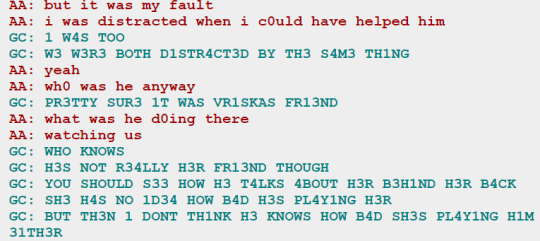
Idk if you’ve already mentioned this but wrt Jake being smarter than he presents himself as, there’s also this dialogue about Tavros (and Vriska) early in Act 5:
GC: H3S NOT R34LLY H3R FR13ND THOUGH GC: YOU SHOULD S33 HOW H3 T4LKS 4BOUT H3R B3H1ND H3R B4CK GC: SH3 H4S NO 1D34 HOW B4D H3S PL4Y1NG H3R GC: BUT TH3N 1 DONT TH1NK H3 KNOWS HOW B4D SH3S PL4Y1NG H1M 31TH3R GC: S33 1TS COMPL1C4T3D
But I haven’t been able to find anything in the rest of the comic that builds on this quote. What do you think?
The thing is, this quote doesn’t refer to Vriska and Tavros. It refers to Doc Scratch. Here’s the full quote:
Terezi and Aradia are talking about how Scratch distracted them, giving Vriska the opening she needed to hurt Tavros in the first place.
I haven’t deleted it because I think it’s a lot better than people thinking Jake is a clueless moron, and deleting it wouldn’t stop the reblogs anyway. But I think I overstated my point pretty hard.
Jake is really perceptive and aware–much more than people give him credit for–but he’s not like, moreso than any other one of the kids. He’s just about on par with them. What people mistake for cluelessness is actually willful ignorance that Jake uses to avoid confrontation because it scares him, basically.
I think reading Pages as a class that is out to serve themselves and inspires others to serve them is a much more comprehensive and accurate description of how Pages act in general.
I don’t think that behavior is always particularly intentional and highly ceberal/manipulative though, and I certainly wouldn’t say what happened with Tavros and Vriska was at all equal.
Tavros found himself outmaneuvered, manipulated and coerced at almost every point with Vriska– that she did it all out of a desire he inspired in her to help him become stronger doesn’t really change that.
You can abuse someone while wanting to help them every step of the way, and Vriska’s intentions weren’t even quite that clear-cut and noble. Things with Dirk and Jake are substantially more complicated, and I don’t consider Dirk’s behavior abusive or coercive at all (Hal is another story).
But that I’m trying to reframe how Pages are perceived to act in general shouldn’t be an indication that I’m trying to establish a new parallel between Dirk and Jake’s relationship and Tavros and Vriska’s.
They are two completely different arcs with totally different contexts, and how I read Jake and Tavros as characters doesn’t mean that either was less abused–Jake by Hal, Crockertier!Jane and Aranea, Tavros by Vriska.
But uh yeah basically check out that other post, I wrote better in that one and I had new info to add there anyway. Thanks a ton for sending me an ask I could use as a loose excuse to get this off my chest.
[Author’s Note: This is a repost of Love, Faith and Fantasy–my piece on Jake and Dirk’s character arcs and the relevance of Knights and Pages in understanding them. I thought breaking it up into chunks would make the content more accessible, and give me room to flesh out each argument. Thus there will be some updates to the content. Hopefully this will mean more people can easily approach it!]
Now that we’ve established that Knights are a Passive class and Pages an active one, and further established that the Passive/Active divide at least partly refers to a sort of inherent Selflessness vs. Selfishness, let’s take a look at what being a Page means for Jake.
To recap, the key verb for Knights and Pages is ‘Serve’–and the two classes are tied together by the symbol of Butlers, who show up linked to Dave and Jake with particular frequency.
This means we can roughly parse Jake’s title as:
One who Serves themselves Hope, or Serves themselves through Hope.
With the corollary attribute of One who is Served By Hope
So, how does Jake’s classpect inform us about his behavior?
Let’s take a look.
I was never exactly trying to argue Jake was some kind of secret supergenius manipulator. What I tried to say, rather, is that he’s pretty much about as aware and capable as his friends are.
Whatever mental hiccups he has that can be attributed to mental shortcomings on our part are a red herring, and it’s a red herring Jake kind of deliberately sets up. Jake’s problem is actually similar to Jane’s: Ignorance.
But where Jane’s ignorance is mostly genuine–if stubborn and self-serving–Jake displays an intensely willful ignorance coupled with an intense aversion to confrontation. These traits typically end with him putting the burden of action on his friends, especially Jane and Dirk, and primarily so that Jake doesn’t have to let Jane down by letting her know he’d rather date Dirk instead.
Note here that Jake slips up and describes Jane’s pinings as “unrequited”. Jake broaches the subject, and then rambles a bit about how he wonders if people really do feel that way. Then Roxy is interrupted by something and has to go, which results in…
I’m not really vouching for the idea that this “Hmm.” is definitely Jake being given a line of quiet contemplation before he decides to do what he does next–talk to Jane–but I will advance it as a possibility. At the very least, the line is ambiguous. This kind of understated response is a little bit odd in the context of Jake being worried about Roxy’s danger, and he seemed lost in his own thoughts right before she left.
The question is: Why go about things this way? And how’d Jake even manage this bizarre feat of ignoring reality in the first place? If Jake knew how Jane felt, why not just answer her? And why does he seem to forget Jane ever liked him in the first place once she says No–to the point that even with Brain Ghost Dirk, his literal own brain, telling him better, he still claims ignorance?
And the answer is that Jake conflates believing in someone with believing the things they say, and Jake very much wants to be a good friend to his loved ones. What Jake fears more than anything is that he may have to confront or disappoint anyone. That he be forced to find out he accidentally hurt his friends’ feelings–or be forced to choose to do something that would do so himself.
This is why his big solution when he becomes a Trickster is to become a doormat and date everybody, explicitly so that he can make everyone happy–not because he wants to date everyone himself. (though he makes it a point to include Dirk when the girls exclude him) And he admits his reasoning himself once the session falls apart:
So it’s more convenient for him if it turns out he really was wrong about Jane liking him–despite literal evidence to the contrary–and once he has it, he serves himself through Hope and believes it wholeheartedly:
Note that he admits to having put Jane on the spot while doing this, btw.
And implicitly uses the head trauma he received during session entry as a plausible excuse for his lack of foresight, just as he uses his Hotheaded Adventurer persona to ignore possibilities he finds inconvenient. He does all this because on some level he’s genuinely convinced it’s all true, so this isn’t exactly active manipulation. But he convinced himself it was true in the first place because it was conducive to his preferred fantasies.
This reluctance to confront his friends when he thinks there’s a chance he messed up also answers a question barely anyone seems to have asked: If Jake was having so much trouble with Dirk, why did he always go to Jane or Erisol? Why never Roxy, over the course of six months?
The answer is because Roxy knows a secret (hidden information-Void stuff), a fact that Jake cannot square with his constructed identity: That he knew Jane liked him all along. Because she told him about it. (Roxy has her own reasons for not advancing this information, which we’ll get to someday.)
But because of all this behavior, Jake’s friends find it extremely difficult to approach him about subjects he doesn’t want to be approached with, which coupled with their own issues ends with everyone bottling up their feelings until they burst, always ending in Jake getting breathtakingly….
Devastatingly…
Served.
But I don’t want to harsh on Jake here. It’s not that he doesn’t love his friends–it’s just that he’s kind of selfish about it. But that isn’t always a bad thing. Do you know what Jake is more comfortable doing for Jane than letting her down gently over her unrequited feelings?
Literally dying for her. After she threatened him with sexual slavery. And she’s not the one he chose to be with–but we’ll get to Dirk later. The point is this is not a boy who cares only about himself–it’s a boy who is so scared of disappointing the people he cares about he would rather lie to them and himself forever rather than face the possibility.
Jake is selfish, sure–but you can love deeply and perform great acts based on selfish love. Another way to parse it is that he’s self-directed. Jake is demonstrably not motivated by thinking primarily about how his friends might benefit from(or be hurt by) his actions–that’s Dave’s instinct.
Jake’s instinct is to get what he wants. But when they’re in danger, Jake wants to protect his friends more than he wants to stay alive himself.
But that doesn’t mean it doesn’t hurt them when he’s thoughtless and selfish by choosing to believe whatever’s easiest for him, obviously. In the words of so many people who have told me about their perceptions of Dirk: “Intent does not invalidate harm.”
And there’s no one this habit of Jake’s hurts worse than it hurts Dirk Strider. We’ll talk about their relationship next.
If you like my writing and have a buck to spare, you could also really help me out by enabling me to focus on putting more of this content out there through pledging on Patreon. Doing so will also give you access to my private community of enthusiasts trying to advance new and interesting readings of this wonderful property.
[Author’s Note: This is a repost of Love, Faith and Fantasy–my piece on Jake and Dirk’s character arcs and the relevance of Knights and Pages in understanding them. I thought breaking it up into chunks would make the content more accessible, and give me room to flesh out each argument. Thus there will be some updates to the content. Hopefully this will mean more people can easily approach it!] [Pt. 2 – Faith and Fear] [Pt. 3 – Fearful Heart] [Pt. 4 – Noble] [Pt. 5 – As You Wish]
This is super interesting! I really like the serve/own verb, but I’m still kinda trying to square away the active/passive reversal with what we’re told in canon. Obviously Homestuck is full of unreliable narrators, so we might be able to just throw out some of that, but I wonder if it might be possible to slightly adjust our understanding of active and passive classes to make this all work? Kind of what I’m thinking about here is a grammatical approach, with active classes more frequently taking on the subject of the sentence. For example: A thief steals, a prince destroys, a knight serves. A rogue allows things to be stolen, a bard invites destruction, a page inspires service. I do agree with you that players generally both act and are acted upon by their aspects though, so this is more about general inclination than saying that a rogue can’t directly steal or a prince can’t be destroyed by their own aspect.
Hmm. So here’s the thing: I think this understanding of Knights and Pages is much more in line with canon, actually.
As far as I can tell, the understanding that Pages are passive and Knights active seems much more in line with cultural connotations of those phrases than with how the classes’ actual execution lines up with what we’re told.
Calliope gives us two different potential signposts for the Active/Passive divide:
There’s what she says about Rogues/Thieves:
Active Benefits Themselves, Passive Benefits Others
And what she says about Princes/Bards:
Prince destroys the Aspect, or through the Aspect.
Bard invites the destruction of the Aspect, or invites destruction through the Aspect.
I think both of these definitions of Active are much more clearly filled by Pages than by Knights. Knights are thrown off by Dave seeming so in control of his Aspect, but Dave is in fact forced to comply with loops Time has already presented him with.
Pages seem passive perhaps because they inspire their Aspect in others–but then, they only do it so those others will then serve them. And what do we make of Dave giving John a hammer made of Time and Karkat seeming to invite Blood without even knowing it?
I do think it’s intentional that Knights come off active and Pages come off passive, though. Calliope also tells us this:
The Dichotomy is complex. Understanding the Active/Passive dichotomy as being “for oneself” or “for others” is, apparently, only a handy starting point. And this is demonstrably true–after all, Roxy is a “passive” player, but she develops pretty willful and deliberate control over her Aspect.
It’s hard to say she’s acting “as if through the will of Void” when she revives Calliope or makes the Matriorb–that really seems like the will of Roxy to me.
So while we’re considering potential complications for the pairs, I think the question is worth asking: Is it possible for a pair to exist operating one way while cultivating an affect that suggests the opposite? I think so. It’d be in line with Hussie’s MO to mislead our perceptions that way, I think.
That said, I am genuinely curious to hear people contest this, if they ever do. It’s entirely likely I’m wrong here and I’ve missed something obvious that makes Pages passive after all, but no real definition I’ve seen for them in the comic seems to fit that.
What we seem to be going off, as a culture, is that regularly lacking agency or not necessarily contributing much to events makes the class Passive…but we never get that as a definition for Passive in the comic, and several Passive players fly in the face of it. It seems like something we’re bringing to Homestuck from the broader cultural understandings of those words to me right now.
[Author’s Note: This is a repost of Love, Faith and Fantasy–my piece on Jake and Dirk’s character arcs and the relevance of Knights and Pages in understanding them. I thought breaking it up into chunks would make the content more accessible, and give me room to flesh out each argument. Thus there will be some updates to the content. Hopefully this will mean more people can easily approach it!] [Pt. 2 – Faith and Fear] [Pt. 3 – Fearful Heart] [Pt. 4 – Noble] [Pt. 5 – As You Wish]
What I didn’t do is discuss the potential key verbs Knights and Pages might operate under–because I honestly didn’t have one I felt confident in. In the wake of discussing the piece with @theworstpersonintheworld (misleadingly named), he made a suggestion that struck me deeply, and once I started thinking about the story in those terms everything truly fell into place.
I think it will be useful in explaining the dynamic between Jake and Dirk as I see it, so I’d like to make the case for it here before we move forward.
The key verb for both Knights and Pages is ‘Serve’. This puts them in direct thematic opposition to Rogues and Thieves, who ‘Steal’, which lines up with those dual systems Sburb loves so much–after all, if Princes and Bards are ‘Destroy’ classes, it’s reasonable to assume there is also a ‘Create’ set, right?
Knights Serve their Aspect to others. Pages use their Aspect to Serve themselves. To establish this and contrast against Jake’s actions later, let’s see how this model applies to Dave, Karkat and Tavros. First, the Knights, and an outline of the different executions the Serve verb can take.
Serve can mean:
1. To provide, or give (a counterpoint to Take)
2. To provide service for
3. To own or defeat, in literal or rhetorical battle (in the colloquial ‘You Got Served’ sense).
Karkat does the same thing–often offering Pacts and Bonds to friends that he likes while simultaneously offering his services in helping them figure out relationship problems.
Davesprite comes back from the future and literally empowers not just Dave, but John by providing him Time in the form of a Hammer with Time powers.
Dave’s primary contribution to the Beta session is to run loops around the session, constantly gathering all relevant resources possible so that his friends don’t need to worry at all about limitations like money or access to weapons and can do whatever they feel like.
Essentially, Dave takes care of the minutiae. He provides a service to his friends–putting them in the best position possible to act out their own wills.
Karkat’s ultimate contribution to his session is similar–ultimately, Karkat’s main role was to maintain the bonds between all his friends. LIke Dave’s, Karkat’s nature affects every single other player, keeping them bound towards a common goal and thus bettering their odds of winning the game. (it’s worth noting I think Vriska’s view of Sburb is wrong here.)
This predisposition to giving service to others is also likely why Knights seem to end up helping out with Frog Breeding duties so often. This is essentially the most important game objective, and so helping the Space player in completing it is also helping every other player in step.
And then there’s this. There’s a colloquial definition of Serve that derives it’s use from the term “Get Served”, which Urban Dictionary defines as: To be completely owned or shown up by someone. Kinda like Dave does to us here–which Karkat also does, by the way, before going on a rant outlined by his ambitions and silhouetted with Blood colors.
To serve someone in this sense essentially means to defeat them in rhetorical or literal battle, explaining why Aradia describes Knights as a powerful Warrior class–one of the definitions this wordplay allows for is a class that uses its Aspect to deal devastating, embarrassing defeats.
Every time Karkat wins a confrontation in Homestuck, he does so by establishing a connection. You can argue Karkat’s aware he does this with Gamzee, but he doesn’t really parse it as doing a Knight of Blood thing. But with Clover he doesn’t realize what he’s doing at all! He thinks he just beat this green elf dude, but what actually happens is Clover wanted to enter a relationship with him.
What goes ignored is how unlikely a win this is–because Clover is so lucky, he straight up could not be defeated normally. Clover loses this fight not because he’s overpowered, but because he benefits even more than Karkat does. Clover is a horndog, and in his view there’s no better outcome to this fight than Getting Lucky. Karkat wins unawares, as if through the Will of Blood.
Contrast this with Jake’s win. Jake beats the felt, shocking Crowbar–but Crowbar doesn’t benefit from this at all. Jake does. Jake is the one who wants to be seen as an impressive adventuring hero, and by exposing Crowbar to an unforeseen possibility, he achieves that.
I’d like to posit a corollary attribute that I believe holds true for all Classes, as well. This one is not explicitly advanced textually, but I believe I can back it up. It takes place along a different axis. I posit that just as the classes affect their Aspect, so too they are affected BY their Aspect.
So in addition to the Active/Passive distinction, we could read both Knights and Pages as ones who are Served by their Aspect.
This is true of Dave, as he gets owned by his Bro in an explicitly time-consuming fight. And the trend continues as he then gets saved by his future selves over and over again throughout the session–being served in both senses:
In this sense, Dave also operates “As if through the Will of the Aspect”, even as he’s in control of his actual powers. He’s presented with stable time loops that he has to obey, and it’s kind of a loaded question whether any given Present Dave would have taken the same path had he not already been given the path to follow from his future selves.
Now, to contrast before we move on to the rest of this series, a few notes on Tavros:
Tavros’ main psychic abilities correspond to his Classpect–he’s able to move animals to serve his will, providing them direction. The reading that Pages inspire their Aspect in others isn’t totally off, in my view. What it misses is that Pages seem to inspire in others a desire to serve or help them. To benefit themselves somehow.
This doesn’t extend to just Vriska, though. Tavros inspires Kanaya and even Equius–who ordinarily wouldn’t help on account of the Hemospectrum–to provide him with robot legs, extending his freedom of motion, again a concept linked to Breath. This again benefits no one except Tavros.
And of course, this reading puts a whole new spin on Tavros’ final act in the story. If we’re reading Pages as intrinsically kind of selfish and self-motivated, then Tavros’ motivation here isn’t to provide a useful service to Vriska. It’s to do something so useful she can’t possibly deny it, so he can have the pleasure of owning her.
This is Vriska getting Served. This is an immutable fact that is being stated for the record. That it is genuinely helpful does not mean that Vriska getting fucking wrecked isn’t what is taking place here. Notably, Tavros immediately gives power over the army to Meenah, because he doesn’t give a shit about responsibility. Tavros had a goal, and the ghosts helped him achieve it.
A final note:
If this reading of Knights and Pages happens to bother you because it means that the Beta session has an uneven distribution of Active/Passive classes, consider the dynamics of both sessions:
In the beta session, Rose essentially takes and follows orders from the Horrorterrors and Doc Scratch, whilst also distributing orders to Dave and John (who each take further orders from troll girls and Jade).
All of this is ultimately in support of the plan Jade commits to herself, plans herself, and executes herself–taking Active control of the entire session in one fell swoop at the last instant.
In the Alpha session, all three Active players flounder and stifle themselves and each other with nothing meaningful to do and no way to receive substantial benefit.
Ultimately, it is the Passive player–Roxy–who rises above the constraints of her session and achieves more or less competence at understanding her role and powerset by the end of the session.
In the session that requires constant action and change, there’s Three passives to one Active. In the session that requires patience, introspection, and connecting with each other, the inverse is true. The incentives and natural skills of the players are set at odds in both cases, stacking the cards against them.
In fact, @arrghus makes an insightful point about these unbalanced sessions:
Namely, that this puts the kids in the exact same position as the Trolls’ Red and Blue teams–which ALSO have an uneven distribution of Passive/Active classes under this reading, only reaching equilibrium when added together.
This segment covered, we can move on to Jake, and how this reading of Pages reflects on him.
If you like my writing and have a buck to spare, you could also really help me out by enabling me to focus on putting more of this content out there through pledging on Patreon. Doing so will also give you access to my private community of enthusiasts trying to advance new and interesting readings of this wonderful property.





 Flying through Storytelling