Openbound is a Descent To The Underworld in the mythological sense, not for its characters (who have degrees of familiarity with or belonging in there) —but for an underappreciated little character named MSPA Reader. Openbound is your descent to the underworld, and it is Homestuck’s most interactive iteration of one central question.
Behold, new content from Caliborns Wake. I wrote this for you. Yes, for you. The one who is reading this right now.
“Was that the plan, DJay? To give me a reason to look at A6I3 again?”
Yeah. And you… got one.
I love this!!! Here’s some extra thoughts I’ll float out in response
There’s some world details that I think prop up this reading of the bubbles pretty nicely, which I just want to repeat here for people who might not be familiar with them.
and the Dark Carnival afterlife of the ICP, both of which feature Judge figures who obliterate/consume the souls of the unworthy- Ammit in Egyptian myth, and at least Bang! Pow! Boom! in the Juggalo cosmology. ( https://en.wikipedia.org/wiki/Bang!_Pow!_Boom!#Music_and_lyrics )
Second, there’s the fact that the horrorterrors are explicitly feeding off the negative energy the trolls generate in the furthest ring through this eternal, performative social media dance. Meaning they have a vested interest in reducing these kids to hollowed out, cartoonish versions of themselves that can be predictably farmed for energy.
In general the gods are framed like social media website administrators, casting the whole thing as a grim parody of algorthims and corporations fostering negativity and hostility for the sake of “engagement”. Reminds me a lot of hussie’s recent interview where he outright suggests the possibility that we vitriol we see online is some kind of hellish illusion.
It all kinda reminds me of how Hussie frames the distinction between engaging with people offline vs. online:
“All in-person interactions with fans are overwhelmingly positive. Easily
over 99% of everyone I meet with in person seems great, and have
nothing but good things to say. It doesn’t seem sufficient to just say
they’re nice people. They all genuinely seem to be overflowing with
emotion and enthusiasm for this thing I did. It’s very odd how all the
argumentative chaos, invective and incrimination of the internet seems
to completely vanish when you directly confront great numbers of people
in their physical forms.
The two realms are so different, it’s hard to
reconcile, but it does lend a sense of optimism that the complete hell
we perceive on the internet every day is just some sort of horrific
illusion conspiring to agitate and demoralize us, without much truth or
substance behind it.
“
So it seems to me he does fundamentally think of social media a way compatible with that which the framing of the dream bubbles as a social media hell here suggests.
Finally: Gamzee’s manipulation of Terezi during Horrorstuck and Rage’s theatrical motifs, combined with Kurloz’s exploitation of Meulin, vaguely suggests that part of what he might’ve been doing in the bubbles all this time is excacerbating these negative character traits and flat, extravagantly theatrical outlets for the alphas personalities, essentially helping to erode their identities even more than the bubbles naturally do.
So Kurloz may be very directly implicated in this degradation of character.
1) Whether It’s a purpleblood power or a bard of rage power is beside the point to me. I consider the purple blood caste itself biologically and socially engineered to force in its members a connection to Rage, regardless of their true alignment. The same is true of every other blood caste in my framework: Rusts are linked to Time, Jades to Space, and so on.
Pretty much every troll introduced in Hiveswap and the Friendsim so far includes references not only to their True Sign aspect, but also the aspect of their caste. That’s one of the reasons I misidentified Xefros as a Time player before the Zodiac dropped! I didn’t recognize this mechanic until @wakraya pointed it out.
2) There’s a second half to the classes’ descriptions, remember? There’s also “inviting destruction THROUGH Rage”, as if by the will of the Aspect–which does evoke to me why Gamzee seems almost possessed by his fury when it comes.
3) Another thing to consider is that, at least in my framework, Gamzee’s Horrorstuck shtick coincided with Gamzee embracing the legacy of the Grand Highblood–who was Kurloz, a Prince.
I consider this indicative of Gamzee beginning to roleplay a Prince, and so his verbiage during his more directly violent segments would coincide with the Prince description of simply Destroying Through X, which seems like a better fit to me.
The fact that Gamzee is one of the most Passive classes forcing himself to roleplay one of the most Active is a contributing factor to the extreme stress he seems to be under when doing that Ragey thing, in my opinion.
Most of the Homestuck fandom will tell you that Gamzee Makara is a broken character, and with good reason. It’s not just that his actions are morally repugnant, but that he seems like a hollowed out caricature of a character, almost deliberately crafted by the author to be as flat and nonsensical as possible.
The author of the story literally tells us that his actions probably don’t make any sense, and a lot of the fandom has decided to take that literally, believing that Andrew Hussie didn’t know what he was doing when writing this character — or, more likely, was just “trolling” us.
The end result is a character that is, for most, deeply unpleasant to think about for all sorts of reasons — he commits all kinds of acts of depraved and distasteful immorality, but we’re also barely told anything about who he is, how he does what he does, or why he even does it.
But I think there’s a coherent strain of thought behind Gamzee’s character, and while I consider Gamzee responsible for everything he did, I think there’s a case to be made that his worldview made him uniquely malleable and exploitable by Lord English.
You probably won’t believe me about this, but then, that’ll be kind of the point. Introductions complete, let’s begin our Descent.
The Rage-bound care about truth more than anything. They aren’t so much religious or spiritual as they are deeply dogmatic and intense about their worldviews — in essence, they’re conspiracy theorists.
Understanding this is vital, because at the core of Gamzee’s narrative is a schism between two major versions of his character, separated by an intense crisis of faith.
Gamzee is a Bard: The Passive Destroyer Class. This means we can understand him as one who allows Rage to be Destroyed, or invites destruction through Rage. Rage rules over concepts like anger, fear, hate, doubt, and confusion, and Gamzee will often be found exerting his influence over the story through both definitions of his title, sometimes at the same time.
Early Gamzee is little more than a 420 joke — he’s depicted as a harmless stoner juggalo who simply wants to make his friends happy.
He worships his personal vision of the Mirthful Messiahs, an obscure religious cult largely made up of Purple-Blooded trolls like Gamzee, the Highest blood color of Alternia’s Hemospectrum that belongs to Land-dwelling trolls.
Highblood privilege allows him a sheltered upbringing and the freedom to indulge his soporific drug habit, and as a result he seems completely out of touch with the true nature of his religious order.
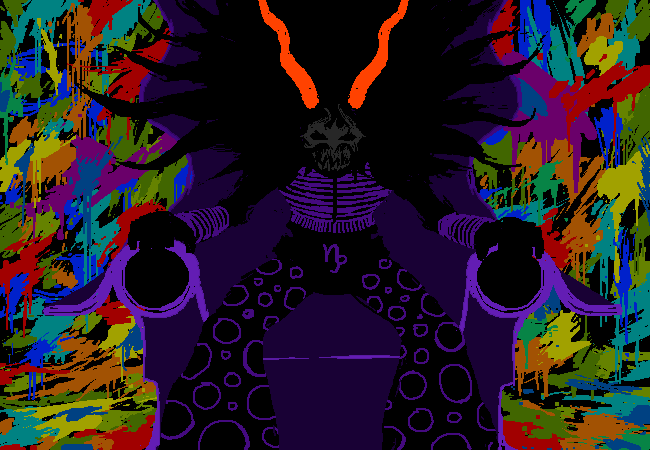
In reality, Alternia’s Grand High Bloods are an obscure but powerful cult devoted to the worship of Lord English, a physical God who exists on Alternia and tortures trollkind throughout its history through a number of Agents.
The Highbloods are one of these agents: religious enforcers who control the population through a combination of brutal executions and psychic Chucklevoodos that poison lowblood’s minds with nightmares of gore and violence, fear, anger, and paranoia.
Gamzee’s crisis of faith comes about when Dave Strider exposes Gamzee to the real-world inspiration for his religion: The Juggalo subculture formed around the Insane Clown Posse. When Gamzee learns about this, he regards it as heretical, and a desecration of everything he believes in.
He soon comes into contact with two messengers of his God, Lord English. First is Lil Cal — a doll containing the Lord English’s composite, twisted soul. Gamzee looks into Lil Cal’s eyes, and in the depth of those peepers he discovers a horrifying, unavoidable truth:
Inviting destruction through the HIghblood’s Truth|Rage
Just as Caliborn does later, Gamzee recognizes one of the souls that makes up Lord English as his own — meaning Gamzee’s soul is, in effect, partly responsible for starting his own religion.
Gamzee is initially distraught and confused by this knowledge, but he soon begins to trust Lil Cal and the souls within, and decides to reframe his worldview according to what it tells him.
Lil Cal can be highly influential to those who hold it, as Gamzee and Bro both begin to pick up phrases and habits originally native to Caliborn while in contact with the doll. Because Bro is a highly Active class and Gamzee a highly Passive one, we also have grounds to believe Gamzee more susceptible to suggestion.
But the relationship doesn’t seem to be mind control, since this form of psychic influence is distinct from the full mind control Lil Cal proves capable of later. Rather, Gamzee implies he welcomes Lil Cal like a best friend.
Specifically a replacement for Tavros, who Gamzee had romantic feelings for. The Purple Sign Caste description tells us Gamzee is a strictly monogamous and devoted lover, and he goes on to prove it.
We can see Tavros’ death as the moment Gamzee’s relationship to the rest of his friends is severed, and he devotes himself fully to the new object of his affections: Caliborn — the Cherub boy who will eventually become Lord English.
And why?
Because Lil Cal gives him the truth.
[ACT 2 — THE VAST JOKE]
At this moment, Gamzee simultaneously receives three divine revelations: He discovers that his cult’s God exists in physical form, the cruel and brutal nature of this God, and that he himself is this God.
The important thing is that Gamzee does not choose to believe these things — he’s confronted with unavoidable proof for all of them. He’s confronted with a raw, physical, tangible truth.
Now forced to accept this truth, Gamzee embraces the violent and vicious roots of the cult, becoming a Dark Messiah ruthlessly devoted to bringing about the advent of his God.
He taps into his ancestral memory of the Grand High Blood, a notable head of the cult and Gamzee’s Ancestral Figure. He begins imitating the Highbloods and murdering his lower-blooded friends.
Starting with Equius, one of the other characters whos soul becomes part of LE’s. Equius must become Arquis for Lord English to be born, which Gamzee would also have found out from Lil Cal. He kills Equius and hoards his corpse.
After securing the other component of Lord English in his session, he targets female characters that Caliborn later goes on to single out for death in his retelling of Homestuck. He kills dear, sweet, precious, DEAR Nepeta before our eyes, while Caliborn describes her as useless and irrelevant. The monster.
Vriska is targeted for her ambition and attempts at relevance. Rather than confront her directly, Gamzee drags Terezi Pyrope into the conflict.
He does so by manipulating Terezi to play up her anger and frustration with Vriska. He also encourages her to take on the Neophyte Redglare persona she used to roleplay during FLARP campaigns she and Vriska waged together, partnered as the Scourge Sisters.
Caliborn singles Terezi out for getting between his One True Pairing of Dave and Karkat, and though she doesn’t die, Gamzee makes sure she suffers for this.
After Terezi kills Vriska, Gamzee and Terezi enter a Kissmesitude, and he starts harassing and emotionally abusing her, wearing down her self-respect and ability to focus and help her friends for the rest of the adventure.
Inviting destruction through fear/Rage.
He also uses his Caste-given Chucklevoodos to mess with the Beta Kid’s minds, rendering them all somewhat mentally unstable. He pays special attention to John, seeding in his mind the clown doll that acts as the source of John’s self-loathing messages and clown scrawlings.
Inviting destruction through anger/Rage.
Which indirectly contributes to Jack Noir’s Rage fueled rise to power, and destruction of the Beta’s session.
However, perhaps because Bard is one of the most Passive classes, pushing himself into behaving so actively is exhausting and stressful for him. While Gamzee’s behavior during Horrorstuck is impactful, it’s also unsustainable, and he soons settles down with some help from Karkat.
He’s then contacted by Doc Scratch, Lord English’s second emissary. Scratch is LE’s best bureaucrat, smooth salesperson, and master manipulator. He’s also a part of Lord English himself, a puppet that LE uses to carry out tasks he doesn’t want to perform himself.
It’s Doc Scratch who manipulates Trolls into being as violent and cruel as they are, across their entire planet’s history. And since Scratch’s soul includes Dirk’s cyber-omniscient AI Auto-Responder, Equius, and Gamzee himself, Scratch is also aware of all the events to come in the second half of Homestuck.
In [S] Cascade, Gamzee talks to Scratch, and by reporting the completion of Horrostuck’s events, implies he was doing everything he did on the orders of Scratch, Lil Cal, or both. Then he asks what’s next.
So Scratch is in a position to offer Gamzee something unique: A script. Through Scratch, Gamzee could have learned everything he needed to do over the course of the Alpha Kid’s session in order to bring about the birth of LE.
This is why Gamzee complains about Vriska in the Post-Retcon timeline. There’s a plan in place that the Cult of the Mirthful Messiahs is following, and Vriska cheating her way into being alive throws that plan off the rails.
But in learning his role, Gamzee would also learn something else. A deep truth of Homestuck’s universe, that would reshape the way he sees the world, and the way we see Rage. He would learn that Homestuck…isn’t real.
Homestuck is a story. A story told online, by an author: Andrew Hussie, who wrote Gamzee’s life into existence as a silly parody of the Insane Clown Posse. An author who created Gamzee’s life to be a joke.
But Homestuck is also the story of how Lord English murdered its author, and took over the story for his own, ensuring that his dominance is forever absolute. LE cannot be defeated. LE cannot be stopped.
And Gamzee cannot die, because he has to become part of LE for the story of Homestuck to exist. Knowing this means Gamzee sees the story for what it is — as a jokey webcomic structured like a theatre play, with himself as the comic relief.
Where the rest of the characters see The World, Gamzee sees a Stage.
[ACT 3— THEATRE OF DIONYSUS]
Perhaps Gamzee’s biggest recurring symbol is the masks of comedy and tragedy-the archetypal symbol for Theatre and Tragicomedy. The harlequin mask keys he and Caliborn use to power on the MSPA terminal grant Caliborn the ability to view and influence every event in the entire story — letting him take ownership of the play of Homestuck itself.
Maenad, Top Right | Satyr, Bottom Right
We can more about theatre through the Troll Call purpleblood Chahut’s last name: Maenad.
In Greek Myth, the Maenads were the female companions to Dionysus— the Greek God associated with wine, epiphanies, religious ecstasy, and ritual madness. Also associated with Dionysus are half-goat men called Satyrs, who are described as “ archetypal musicians and dancers”, associated with the breaking down of traditional values.
Like Gamzee, Dionysus is also intimately connected to his Godly All-Father, the Demiurge: Zeus for Dionysus, Lord English for Gamzee. Zeus saved his son by sewing him up in his thigh and keeping him there until he reached maturity, so that he was twice born. Similarly, Gamzee is Born Again when he discovers his ultimate fate is to become part of Lord English.
Early theatre often employed the use of masks, allowing actors to easily switch between portraying different characters. This colors almost every action Gamzee takes as performative in nature — recognizing Homestuck for the story it is, he plays whatever character is convenient to achieve his objectives.
Gamzee also uses theatre’s history of audience participation to punish the viewer directly. We can view pretty much every nonsensical impact on the plot he has this way — like how his immortality is literally derived from “Plot Armor”, practically begging the audience to call the story on its bull.
But in particular, every sprite he creates in the Alpha session seems deliberately designed to cause as much frustration and anger as possible, not just for the characters, but for Us — the fans.
Seriously. Hear me out.
Eridan and Sollux’s mutual hatred made them two of the most popular characters over the course of act 5, with plenty of detractors and supporters on both sides passionately clashing to defend their favorite characters — and just as many shipping the two in hate-fueled Kismessitude relationships.
Gamzee revives the character conflict between these two — but without any of the fandom-fuel romantic tension. Just misery and self-loathing with no catharsis, a disappointing outcome for any fan invested in seeing their conflict reach any kind of resolution.
Gamzee making Fefeta, Erisol and Arquis leads to Fefeta’s explosion when the other two start fighting over her — Inviting destruction through Confusion/Rage.
Nepeta and Feferi — — two characters the fandom often criticizes the comic for abandoning — are brought back, but their union leaves them a running gag where the fandom gets to hear all about the cool and helpful stuff they’re up to, but without ever actually seeing either girl talk again. Fueling the fandom’s bitterness over their irrelevance.
And Tavrisprite’s creation eventually causes Vriska and Tavros to get into a relationship together, extending the fandom’s furious debate about their unhealthy, abusive dynamic long past the deaths of both characters, when we thought we’d seen the end of both arcs.
And the creation of Arquisprite, of course, is a necessary part of the script that eventually leads to Caliborn, Arquis, and half of Gamzee’s corpse being destroyed and merged inside the Lil Cal doll, bringing about the birth of Lord English.
Don’t believe me? Does this sound too thought out for Hussie, just a bit too far-fetched? That’s fine, I feel you. I understand. Just keep in mind that Doubt itself is also linked to the Rage Aspect. Our skepticism is already written into the story.
To me, it now seems that Gamzee’s story is not that he was lying or pretending during his kind phase, or that he’s a helpless victim of mind control, but rather that he’s coerced through his own intense convictions into accepting a deep sense of tragicomic fatalism.
This distances him from his friends, as he can no longer see them as anything more than falsehoods to be obliterated and punished by the self-evident power of his One True God. We don’t know exactly how Gamzee feels about this, beyond the fact that he’s accepted it.
But it brings up an interesting question that puts a new light on the half of a Gamzee corpse that remains after the end of the Masterpiece, and the creation of Lord English.
It’s true that LE is the overbearing truth of Homestuck, the comic. But there are deeper truths than those that are immediately apparent from observing physical reality — such as the inevitability that all tyrants eventually fall, just as Lord English has at the end of Act 7.
And the paradise planet that Gamzee so passionately believed in early in life, the one he wanted to share with his friends and at least one boy he had romantic feelings for — it actually exists. Earth C is just that sort of paradise planet.
Only half of Gamzee went into Lord English, so he still technically has a corpse available. Jane could, hypothetically, use her life-restoring powers to bring Gamzee back from death’s doorstep — only he would now be custody of our Heroes, with his God either dead or sealed in a black hole for eternity.
If that were to happen, and if there’s any truth to this reading of Gamzee, then what would the Bard of Rage make of this truth beyond truth, this promised land he would find himself in on the other side of an endlessly dark reality?
It’s enough to make me curious, personally. Although my personal suspicion is that if he gets the opportunity, whatever he does, it’s going to manage to piss us off. It’s inevitable, because seriously…Fuck that guy.
I’m more than a little upset I’m going to have to work these into my Force and Flow essays soon, but I figured I’d write these posts on the Unifying Myths for the Steal and Destroy classes because they’ll help me get my thoughts in order for the Classpect video I’m writing the script for.
(PS: That’ll exist soon! Ideally an easy way to introduce all sorts of newbies to the Classpect system. I’m excited!!)
So let’s talk about the unifying myth for Princes and Bards: That of Royalty. Related terms include aristocracy, nobility, and high blood by association.
I…don’t know why it took me so long to notice this? I guess I got tripped up by the royalty focus on the Fuschias, but I mean, class roleplay is an established thing and the Ancestors, as complex and multifaceted people living in the real world, muddy the water with the multiplicity of symbols they portray all the time.
Also, both Meenah and Feferi explicitly reject their royalty status and abdicate the crown. So. I really don’t know what was stopping me here. Anyhow, let’s get into it.
I think this mostly speaks for itself, honestly? Equius attributes Dave’s habit of destroying things to the training Bro–a Prince–gives him. He suggests it makes him nobler than others, and Dave himself likens himself to a King while carrying out the behavior.
This contextualizes Dave’s habit of destruction during Act 5 as him roleplaying as a Prince, in imitation of Bro. Fittingly given his confused state with regards to his abusive parentage, Dave doesn’t realize that’s what he’s doing or why, but his habit of breaking random stuff is one he mostly drops as he grows out of wanting to imitate Bro on any level (with one notable exception).
If the Royalty classes have a coherent theme, it’s a focus on historical legacy, lines of descent, and inherited destiny. Where other classes draw their interests from fiction, abstract concepts, or their own creative interests, the Royals typically find their biggest interests in the past–that of themselves and of their people. So Dirk and AR both view themselves as scions of Dave’s legacy.
The Makaras are beholden to their Subjugglator bloodline, and the allegiance to Lord English it represents. They don’t seem to believe in the cause of the Mirthful Messiahs so much as simply know the inevitable reality of their success well in advance. And why wouldn’t they, with evidence all around them like Doc Scratch, Lil Cal, and Lord English already wandering the Void?
And while we’re talking about Gamzee, I may as well cover Bard’s link to Royalty. I should note that this is part of a recurring trend with the Classes–one will generally relate to the unifying myth very directly, while the second will come with a host of references and plot beats linking it to the myth indirectly.
So a Witch is a magician by name, while an Heir is revealed as one through the myriad references John gets to wizardry. A Sylph is a kind of fairy by name, but it’s Maids who get described as being “Made of” their Aspect, and so their brand of magic. So on.
In this same respect, while Princes are Royalty manifest by their very name, Bards–though Gamzee–are lifted into the noble circle by implication and continuous reference.
Gamzee’s allegiance to LE results in the cultural dominance of Subjugglators, both on Alternia and on the Alpha Earth. The Mirthful Executives give us the clearest link to Gamzee, since their rise to horrible, aristocratic power is prophecized well in advance, George Washington describing them as “Salty Bards”.
The Amporas seem to have two distinct lines of inherited destiny–one related to their Blood, and one related to their Aspect. Their status as scions of the legacy of the Angels sees them as champions of fantasy, belief, and Hope. It also sets them up as natural rivals to the Makaras, and threats to Lord English.
It’s also likely deliberate to some extent, since it’s suggested that someone close to Lord English talked Cronus out of his relationship with Magic, and Alternia was all but designed to bring out the worst in Eridan’s entitlement complex and arrogance.
Since Caliborn had prior experience with the danger of a Hero of Hope, it makes sense he’d want to neutralize the others by prompting them to believe in something darker to believe in.
Which brings us to the arrogance and entitlement the Royalty classes often struggle with–the part of their natures that seems to constitute their greatest challenge before achieving fulfillment and balance.
The concept of High Birth seems to manifest in a sense of inherent superiority for Princes and Bards, and it’s this belief that tends to destroy their ability to make relationships. Both Makaras and both Amporas harbor these intense, megalomaniacal worldviews.
This, however, is where the best Prince begins to set himself apart. A successful, happy, healthy version of a prince who reaches balance is one who humbles himself, and gets over their sense of arrogant supremacy.
So we can see Dirk as a loose, loose glimpse into what it might look like for Eridan, for example, to chill out after a couple of years–had he gotten the chance. Of course, Dirk was never half as domineering or controlling as Eridan, so this is an unequal comparison, but I think it’s worth noting how their three age difference is meant to influence or readings of the two.
AR/Lil Hal is the version of Dirk that commits most of the abusive/manipulative behavior people usually pin on Alpha Dirk, and fittingly, he’s the one who actually distinguishes himself as Above his friends for most of his narrative.
In AR’s case, he does so on the basis that he is cybernetic and cyber-omniscient, a state he views as superior to being flesh-and-blood, even likening it to an aristocratic position once he’s mixed with Equius.
To swing things back around to Dave’s roleplay, there actually is one final act of destruction in his arc. After talking things out with Dirk and coming to see a version of his Bro as someone with the potential to do good, Dave and Dirk engage in what I can only describe as a 2x roleplay combo, with Dirk serving Dave through his Self and Dave killing Dirk to finish off the Jacks.
I like the sense of inverted symmetry here, and it puts into context why Dave’s attack is a positive thing for him–this moment is about Dave accepting that there can be some good in Dirk’s nature, and being willing to incorporate some of Dirk’s influence into his person at an appropriate time.
By embracing Dirk’s affinity for destruction and giving Dirk the chance to put his fate in someone else’s hands, Dirk can find absolution and Dave can find a coherent understanding of his identity, and Bro’s influence on it.
Anyway that’s about it. I’m glad to finally have coherent myths for Princes/Bard and Thief/Rogue, but we know how these classes work mechanically, so it’s not like they revolutionize my whole understanding of the canon. Feel free to send me asks with your thoughts, but for now…








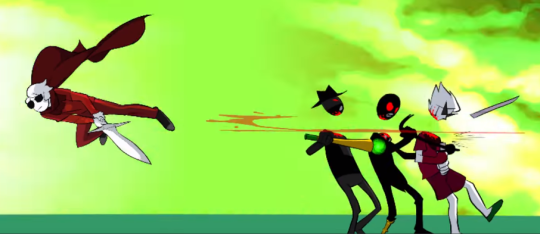
 Flying through Storytelling