Basically the Active Knight reading ignores the fact that, like Rose, Dave and Karkat START OFF trying to be intensely Active but gradually mellow out and grow happier as they adopt more passive/reactive roles and become more honest about their desire for attention and validation from others (for Rose, mainly Kanaya and Roxy. For Dave and Karkat, mainly each other, tho Dave also struggles with a desire for reconciliation/catharsis with Bro/Dirk on the side).
More importantly, it misses all the ways they allow/invite their Aspect (Karkat dropping Sollux down the stairs drawing Sollux’s Blood and leading to Sollux being happier is a clear example.) and pigeonholes our understanding of their behavior as being exclusively Exploitation focused because of that one quote of Aradia’s, despite the fact that every single Class both exploits and allows their Aspect–Calliope’s definition describes a tendency, not a limitation of their powersets.
It also ignores how Knights’ greatest impacts tends to be how their efforts benefit and empower others. Karkat allows the troll session to function at all by keeping everyone bound to a common cause and leading them to victory instead of self-destruction through petty rivalries. Dave empowers Rose, Jade and John to do literally any of what they do in their session at all by making Grist cost a complete non-issue, allowing them to make whatever kinds of powerful weapons they want. Davesprite literally buffs John by giving him a hammer with Time powers!!! The Active reading of Knights misses all of that stuff.
As for Passive Pages, I wouldn’t know where to start. Every shitty reading of Jake as a kind, patient soul cruelly Put Upon by his predatory gay friend. Every dumbass take that Tavros is boring because he’s just a lame pushover, instead of an abused kid who resists and fights his abuser’s pressuring influence every step of the way, and who usually knows pretty well who to ask for help to stop her!
All of them are grounded in this idea of the Page as a Passive wallflower nobody with zero impact on Homestucks’ plot to speak of, except of course for how they are mistreated by others.
The powerset of a Page in development, if you listen to the Passive reading, seems to veer between ??? and “Nothing much”, since they’re regarded as p much a burden who must be carried through the game by everyone else until the day they finally reach their True Power, which is presumably buffing everyone else until the whole team is super saiyans.
This is a day that never comes in canon, for any Page. Instead, we get Jake feeling sexually threatened and objectified and summoning a mental version of his boyfriend spouting quotes from a romantic comedy-adventure movie (which is way more Jake’s bag than Dirk’s).
Not to mention BGD talks about Jake as his boyfriend while Dirk himself broke up with Jake and is simultaneously flying around in literal nowhere with no idea what’s going on.
The Brain Ghost Dirk episode is about Jake benefiting HIMSELF with his Hope. Think about his level of power and the context surrounding it.
Aranea wanted to use Jake’s Hope power to benefit herself, and he immediately summoned a warrior for the sole purpose of turning said power against her. His power is definitely not for her benefit.
It’s not for the benefit of anyone else in the session, either, because Jake doesn’t do jack shit about the Condesce as a threat despite having more than enough power to. Jake isn’t thinking about the good of the session or fixing everything so everyone is safe and conflict is resolved, all of which is stuff he could accomplish with a power level exceeding Jade’s.
Jake is only thinking about himself and wanting to feel safe, and Dirk is how he gets there. The fact that the fandom has missed that rests on the assumption of the Passive Page.
Ditto Tavros’ big moment–rallying the Ghost Army–being cast as a shitty moment where he character develops by getting to help his abuser instead of being a cathartic beat where he gets to own her as revenge because that’s all he wants–to prove her wrong definitively and get on with his life. Or ghost-life, or whatever. Homestuck is dumb, I love it.
I could make similar complaints about Karkat and how everyone thinks he got shafted because he never Got Tough and started fucking shit up with Blood-lasers or whatever. Karkat uses Blood constantly, all the time, and he’s extremely successful and effective at leveraging it. He just does most of it indirectly.
I have a lot of thoughts about this, as you can tell. All this said, it’s possible I’m just straight up wrong about what it means to be Active/Passive and canon will clarify once the Class test happens. Until then though, I’m gonna work with what I have, and it seems to me Homestuck as a work reads much better with one interpretation over the other.
I hadn’t really gotten to Jude yet at all–he still seems like a Doom player, but now I’m more uncertain about all of them.
I have been reconsidering Joey as a Life player pretty heartily, actually, BUT…I think in the end, at least so far, it’s only left me more sure she’s a Light player.
But the reason why, I think, suggests some new infomation relevant to how the Classpect system works. I’m curious to know what you’ll think about it! And since I’m about to record this in video form and it’s pretty overwhelming and difficult to talk about, I think it’ll help to get my thoughts in order somewhat, so I think I’ll do some prep here.
Ok so a couple things! It seems like we agree on Xefros, so him aside:
A) My only real point with Aspect roleplay is that if this Caste=Aspect link is real, we now know it’s POSSIBLE for a character to be one Aspect but ghost/manifest another, even if the aspect isn’t the other side of their coin.
I agree we’ve only seen that with this Caste system, but if it’s possible here, I’m not sure there’s much reason to assume it’s impossible for the system in general.
Most Aspect “switching” in Homestuck does seem to be along the opposed pairs, though, so I’d say that’s still the default trend absent powerful cultural or personal forces like this one.
If this is true, we’ll probably find out in Act 2. Not sure I believe it yet, but I’m hoping because it sounds cool.
B) Fair point re: A. Claire painting the sun! I think I’ve officially hit a point where I’m shrugging and going “GUESS WE’LL SEE” with Joey. I’m not sure what’s going on with her Light and Life synchronicity.
I will say I think her conflict with Pa vibes more with Light than Life for me. Joey isn’t particularly putting her needs aside for Pa, she just feels ignored and uncared for. Joey craves attention/the spotlight, not the ability to indulge self-care.
C) Jude we’re reading considerably differently, and writing about him means talking about Joey as Light a bit more, so let’s see how this sounds:
First, I don’t view him as being particularly interested in knowledge for its own sake–it seems to me he collects knowledge specifically on what he perceives as threats. The cultists, siege tactics, etc. The abduction shirt is the same way–Jude is aware of and afraid of what he sees as consequences or things that will befall him and Joey.
Jude certainly knows a lot, but he knows it for a reason, and I have been-until now-attributing it to him being a Mage or, more likely given that he manages to save Joey through his knowledge but suffers greatly to do so himself, a Seer.
Knowledge for it’s own sake is actually something I’d describe Joey seeking! The book on Alternian animals, wanting to know more about Lusii, etc. She’s essentially teaching herself about an entire ecosystem on the fly, which def sounds like being “the universe’s student”.
“They aren’t overly concerned with laws or norms, either. They often take rules as simple suggestions, instead searching for loopholes or work-arounds.”
I can see how this describes Jude, but I’d kind of say it describes Joey better. Like you said, Jude is unaware of how he comes off. Joey, on the other hand, is aware that liking video games and stuff makes kids at school think she’s weird and call her a poser. She’s been exposed to the sexist “rules” of 90′s Americana.
She just doesn’t care about those rules, and mostly finds herself frustrated that kids at school are dull and mean. She doesn’t perceive herself as doing anything wrong at all!
This kind of “above the rules” mindset linked to Light was always how I handwaved Rose having like, no conflict about her sexuality, so I guess maybe I’ve just been inclined to find something like that in Joey when thinking of her as a Light player. But we’ll see.
Finally, re: the Hyperion Child thing, I’d…actually say Byers is way more likely to represent Joey, not Jude himself. Comes down to Jude’s relationship with the other birds–Frohike dies, Langley runs away. Just like A. Claire and Pa, respectively.
Jude isn’t linked to the birds directly; instead, they seem to represent his relationship to his family members. I think that connection is redoubled since Byers leaves with Joey, and the scruff of Byer’s neck matches the color of Joey’s Sun shirt. If anyone is the Hyperion child, I’d say it’s her.
That’s where I’m at currently, anyway. This stuff is all a work in progress, and I’m currently not sure about any of it, don’t get me wrong. Those are just the associations I’d built up until now.
If Act 2 further establishes Goldblood as a Caste as connected to Duality, I think that would sway me closer to Jude as a Doom player, given his Lord English associations. If it debunks that, I think I’ll move closer to your view.
I will say you make some good points, particularly with the Light puzzle (though I’d argue if the duality motif holds it has just as much Doom relevance, given the Deer and Lion’s associations with Calliope and LE). And with the lantern. I don’t really have anything to say about those one way or another, except that they’re interesting and I think it’s possible you’re correct.
So. We left off affirming Hope’s connection to rationalizations, and how Hope players are able to use this to give themselves great power. My working theory right now is that Hope players find “evidence” to use as fuel for attacks and skills that I’ll call “claims” and “theories”– but they can also be confronted with “evidence” against their “claims”. This “debunks” their “claims”, perhaps permanently, and is also kind of demoralizing.
Like Kanaya being alive even after getting blasted through the stomach. That’s the kind of thing that makes you doubt your ability to Hope people to death, y’know?
I’m using this analogy of evidence and theories because there’s something about Eridan that a lot of people tend to gloss over when discussing Hope.
That thing is his obsession with SCIENCE.
At some point during his time in SGRUB, he decided that to really get ahead in life he needed to employ the most stringent magics of wwizardly science.
The fact that all of his scientific principles were objectively more shaky than a half-paralysed mountain goat about to get simultaneously devoured by a puma and crushed by an avalanche doesn’t matter. He decided that testable science was vastly preferable to arcane magic, and this has an interesting relationship to what I’ve already noticed– rationalizations and the quest for explanations.
Now we’ll take a brief interlude in order to discuss what I consider to be Hope’s antithesis.
I’m talking about Rage.
Zenosanalytic recently made an eloquent and highly sexy post that detailed his(her?) observations on Rage. In the interest of economy, I’ve decided that their points and views line up well enough with mine that you can read his post and come away with 70-75% of my understanding of Rage*.
One of the core points that zenosanalytic raised is that Rage deals with emotions and the animal part of people. I think it’s called the hindbrain or something, but my knowledge of neural anatomy might be a little dated/wildly incorrect. Point is, Rage is the opposite of logic and science. It is run by emotions and precious little else.
It also deals with fear and suffocation, so we can further say that it might act as anathema to the SPIRIT OF ADVENTURE!
You would love to travel around the world, toppling any SACRED URNS you encountered. You’d be tickled by the opportunity to defile HALLOWED TOMBS everywhere, raiding them of their treasures. And how you’d give your RIGHT LEG for a shot at desecrating THE SHIT out of some real life MYSTIC RUINS for their byzantine wares. Luckily for your limb, there is a dandy set of such ruins nearby, and you desecrate them quite frequently!
Anyway, that’s largely tangential. Hope as adventure is only ever really explored by Jake, although Eridan (as a Prince) did have adventures in destruction, and Cronus had his stupid “fantasy” about the evil wizard.
Back to Rage vs. Hope as Emotional Thinking vs. Rational Thinking: when you look at it, a lot of things that humans have done must look really dumb to animals. It’s like, “Let’s poke this mystery substance to see what happens!” Or, “Guys let’s go fight a vicious dragon so that we can have FUN ADVENTURES!”
Would an animal do that? Hell fucking no. Not for those reasons, anyway. I guess they could just be that stupid. But that’s a whole other aspect.
So we could further colour Rage vs. Hope as Animal vs. Human. Interestingly, here we can see their issues of belief reflected in real life, with animals believing in what happens on the surface but not trying to find explanations– much like Gamzee does!– while humans have managed to explain reality to the point that they can be very skeptical about things that do happen in front of their faces.
Rage sees objects as self-explanatory, but Hope sees explanations as the object. It’s not a cat, it’s a bunch of carbon, hydrogen, oxygen, nitrogen and a few other elements mixed in such a way that it meows and is adorable! It’s not a bright glowy thing in the sky, it’s a ball of hydrogen and helium that causes nuclear fusion to keep itself burning!
(Also: Cronus sees himself as “humankin”. This is pretty interesting against this interpretation of Hope, especially when we see that the Alternian trolls were largely ruled by Rage.)
But there’s something that divorces Hope from Science, or at least the Science that is practiced today. Put simply, Hope players are complacent. They make something up, and since it matches every single data point they believe it. They’re accommodating when the evidence shifts, disregarding previous theories and adopting new ones– much like scientists– but when evidence doesn’t seem to change, they stick to their guns. They might be driven to seek explanations, but they aren’t driven to seek evidence.
One could make a connection between this outlook and many religions, despite how triggering it could be. I think that, while the connection exists, it’s more because religion is a kind of science– in terms of “I seek a reason”. There are probably a couple of religions that don’t seek reasons for humanity’s existence, but the vast majority of them give explicit reasons for why humanity exists. To worship gods, to seek enlightenment, to protect Earth… the list goes on. But, unlike Science, most religions don’t actively look for ways to debunk their own theories– just like Hope players. I don’t mean to offend or insult, but religions are a very human thing. It makes sense that Hope deals with it, and that Rage finds it stupid.
“But wait!” I hear you cry. “Gamzee is one of the only explicitly religious characters in the story! And the other Heroes of Rage are both religious as well!”
Well. Yeah.
But have you actually looked at their religion?
You can sum up their views in two two-word phrases: “MoThErFuCkInG mIrAcLeS” and “mirthful MESSIAHS”.
They don’t try to explain anything beyond saying “miracles” and “jujus”, they worship the two most terrible gods ever, they are goddamn juggalos and the entire thing is just a parody of a stupid Internet cult that revolves around drinking Faygo and watching ICP videos.
When you look at it, this religion is actually viciously pragmatic in its own right. Its worshippers recognize that you don’t necessarily need any explanation beyond “it’s fucking magic”, and so they’ve based it on absolutely concrete tenets like “thou shalt not piss off Caliborn to the point that he obliterates you from the timeline”.
So while the veracity of calling Gamzee’s beliefs a “religion” may be a matter of contention between philososcholars, it’s sufficiently divorced from Hope’s concept of a religion that we can consider it another opposite between them.
(In fact, it could be said that the bullshit about miracles is basically how cats and dogs see our technology, with all our water taps and refrigerators and computers and buses and planes. They don’t exactly think to themselves “Oh I get it there must be some piping system that gets water from a remote reservoir”. They don’t even think to themselves “Humans must put their tears into bottles which they then hide inside the sink”. They just think “Miracles”. Compare that to a scientist or the Pope getting abducted by aliens for a while. The scientist would be all like “so this must be some kind of relativistic anti-speed drive with the ability to blah blah blah blah science words”, and the bishop would be like “ah this must be a challenge from God blah blah blah blah Biblical verses”. They could be exactly correct, or seven thousand miles from the truth, but the point is that people come up with explanations, while animals literally cannot give two shits.)
Anyway. Hope as logic and humanity’s quest for meaning, versus Rage as emotions and the animalistic urges to survive. Does that look absolutely awesome? Mildly cool? Structurally sound?
…
And thus concludes my musing. Heed these words well. Heed… them… well.
Or I guess you can just forget about my overthinking and laugh at the fact that I might have jumped to what might be an absurd conclusion in an ironically Hope-like manner. OH WELL.
* The other 25-30% of my understanding of Rage comes from this dude. He’s an outstanding candidate for Rage’s philosopher right now, so take from that what you will.
1) why have i never seen this in, what, four goddamn years?
2) thank u @arrghus for making me see this, you’re a hero
I’ve almost made like 6 different posts about this going in depth about how Brain Ghost Dirk quoting this line is proof of how powerful and badass Jake sees Dirk as, more than anything to do with thinking of Dirk as toxic or controlling, but mostly it’s just come to my awareness of how many people don’t fucking know “My name is [x], you [verb]ed my [person], prepare to die” is a reference (some because they are young and some because well it’s a damn 80s fantasy film) and basically educateyourself.gif
This quote being the one BGD fires off is also deep proof of just how much of him comes from Jake’s psyche, not Dirk himself. Like. You wanna look at this and tell me Dirk wouldn’t be rolling his eyes the entire time. Meanwhile Jake watches this with the biggest stars in his eyes and gasps when Inigo gets back up
blah blah also the six-fingered man is to inigo’s father as aranea is to jake: both are being used and exploited by the more powerful individuals specifically for the sake of weapons, but that’s a deeper reading than andrew hussie likely intended with his witty quote dispensing at the ideal time
and, in summary,
I think that the line playing into movies is very important for the scene and that this is crucial to how Jake views thing, but I think what makes BGDirk so powerful here is that it represents Jake truly understanding Dirk and who he is. I would say this line is particularly representative of Dirk and how Dirk tries to express sincere emotions.
Consider Umberto Eco’s description of saying “I love you” in a postmodern world:
“The postmodern reply to the modern consists of recognizing that the past, since it cannot really be destroyed, because its destruction leads to silence, must be revisited: but with irony, not innocently. I think of the postmodern attitude as that of a man who loves a very cultivated woman and knows that he cannot say to her ‘I love you madly’, because he knows that she knows (and that she knows he knows) that these words have already been written by Barbara Cartland. Still, there is a solution. He can say ‘As Barbara Cartland would put it, I love you madly’. At this point, having avoided false innocence, having said clearly that it is no longer possible to speak innocently, he will nevertheless have said what he wanted to say to the woman: that he loves her in an age of lost innocence. If the woman goes along with this, she will have received a declaration of love all the same. Neither of the two speakers will feel innocent, both will have accepted the challenge of the past, of the already said, which cannot be eliminated; both will consciously and with pleasure play the game of irony… But both will have succeeded, once again, in speaking of love.”
You can see a clear parallel with Dirk’s description of irony to Jane:
TT: The upper echelons of irony should always include measures of sincerity. And if the satirical practice is executed faithfully it will achieve something bona fide in its own right regardless. TT: Through an intense commitment bordering on religious devotion to the absolutely inane, absurd, or plain fucking stupid, a very different kind of sincerity begins to materialize. One of reverence to the ridiculous. You begin to “mean it,” but what exactly it is you mean is never quite what appears on the surface, and is utterly inaccessible to obtuse and literal minds. That you “mean it” then becomes inseparable from the joke, and additional rich strata of humor may be stripped aggressively from this irreconcilable truth.
Dirk is extremely pop culture savvy and likes to quote things (he does it left and right, from SBAHJ references to stupid memes), and this is one more quotation that fits into it. BGDirk, as a splinter of Dirk based on Jake’s understanding, becomes fully actualized here. Rather than reflecting Jake’s self-hatred as he does in the jail cell scenes, BGDirk in this scene is fully realized through Jake’s awakened hope powers and is able to become ACTUALLY like Dirk. And he represents that through a quotation: a quotation of a silly movie, but also a very sincere one, a quotation that allows him to be ironic while also expressing his extreme love and devotion for Jake.
In my opinion, that’s what makes this such an incredibly powerful moment for their relationship. In this moment, Jake fully understands Dirk, and so he fully understands how Dirk loves him, sincerely loves him, even through his ironies and references. That understanding of his love is what allows BGDirk to be completely real for as long as Jake has faith in him.
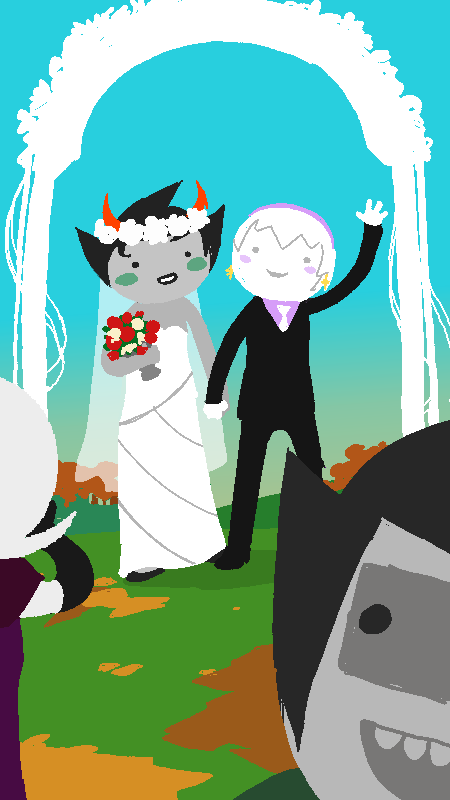
Well, it’s @rosemarymonth and I’ve wanted to talk about Rosemary and why I think the canon gets WAY too little credit with regards to their execution for ages so I may as well do it now.
Keep in mind, of course, that I am a dude and in no way want any wlw to feel I’m shutting down critiques of Homestuck’s flaws in this regard. I think that’s perfectly valid, this is just my reading. I’ll be interested in seeing what people have to say.
I don’t get to talk about Rosemary enough anyway, so I’ll also take you up on it and go over why I love Rosemary and why I think readings that they were “meant to be moirails” and “go ooc” is straight up just misreading the text, because the comic is actually pretty clear in broadcasting its intent.
The thing to keep in mind is that Homestuck’s entire plot follows one consistent rule: The message of AURYN from The Neverending Story, “Do what you will.”
The events in Homestuck that actually happen are by design the sum product of the wills of the entire cast, and how well characters express their wills on reality directly correlates to how “powerful” they are.
Caliborn is the villain because Lord English violates EVERYONE’s agency by confining them all to the plot of Homestuck/his Alpha Timeline. Within the confines of those prescribed paths, however, reality always defaults to fulfilling the wishes of all characters involved, or resolving the tension between them.
What this means PRACTICALLY is that almost every event that happens in the story, no matter how ridiculous….
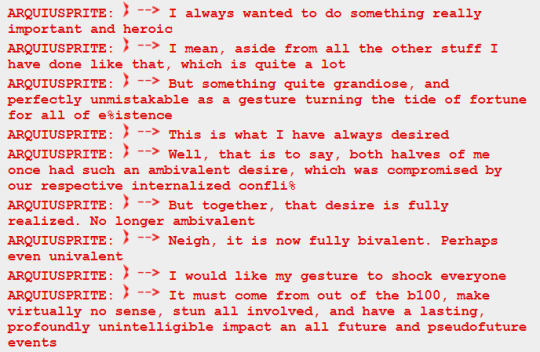
is, on some level, foreshadowed by the desires of the characters, just as Arquius’ heroic sacrifice and absorption into LE is foreshadowed by the desires of both him and Caliborn:
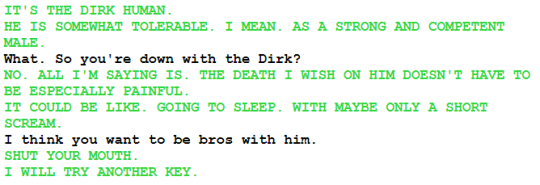
Oh, and speaking about Caliborn wanting to be bros with Dirk and allowing him to die as if going to sleep:
All this in mind, let’s focus on Rose and Kanaya. No, I don’t get the impression they were ever going to be moirails. I’m not sure when Hussie decided on Rosemary, but I get the impression it was early, at least by the time Kanaya was introduced.
Why? Let’s take stock of both girls’ desires and conflicts throughout Act 5.
Kanaya’s early characterization revolved around A) A tendency to gravitate and pacify take-charge, forward individuals,
and B) A profound dissatisfaction with that role.
That’s what burned her out so hard when she was interested in Vriska. So I’m not sure why one would assume that actually, Kanaya’s True Destiny was to fall into… the exact same arrangement with Rose once again, despite expressly avoiding it. That doesn’t seem like good storytelling to me.
Especially since Rose is, from the very beginning, posited as an idealistic escape from that solitude for Kanaya. Kanaya is the receiver of Rose’s prophetic text—one of her earliest big contributions as a Seer of Light– and it makes a tremendous impact on her.
That impact is partly manifested as an out and out romantic fantasy about Rose, who Kanaya idealizes as the legendary leader of her session.
Kanaya’s fantasies about Rose in this regard play heavily into her attempted courtship through the Flighty Broads and their Snarky Horseshitometer sequence—and it is romantic courtship.
Kanaya makes that clear in the mission-critical text document where she positions herself as an antagonistic suitor to John, and that document is first referenced in… oh, mid-Act 4.
So Kanaya’s romantic interest suffuses the narrative from pretty early on. What about Rose?
Let’s talk about romance aesthetics. Pretty much every endgame ship in Homestuck is couched in a distinctive brand of romantic connotation. For example, Dave and Karkat are linked to anime romance cliches, with Dave as shonen hero and Karkat as heroine.
Jade and Davepeta are linked by a mutual indulgence in furry identity. Vriska and Terezi get the “Home Sweet Home” connotation of The Wizard of Oz, and Dirk and Jake have the undying devotion and mutual passion implied by their link to The Princess Bride.
Rose is once described as a reserved girl “enamored by what dwelt in shadow”. This is a facet of her characterization that’s present from moment 1, what with her interest in the Horrorterrors. Another obvious place to go is Mom, and by association Roxy–both of whom certainly “dwell in shadow” as Void players.
And then, of course, we have Kanaya:
Vampires are traditionally associated with hiding in darkness, away from the Light. And Kanaya describes her rainbow drinker fantasy in exactly those terms. So this aesthetic link between them is established pretty damn early, too.
Of course, Kanaya is not a traditional vampire. I’m far from the first to point out that Rainbow Drinkers most strongly resemble the hyper-romanticized, shine-in-the-light vampires of Twilight, one of the most popular romance series for teen girls of the 2000′s.
Taking that incredibly popular aesthetic and using it as a wrapper for the love story of two girls is instantly compelling. What’s genius is that this is a cocktail of imagery that has natural appeal for Roseas a person, because while it’s true that she’s interested in the darkness that surrounds her, it’s clear that Rose spends her narrative seeking the truth and the meaningful.
In other words, even when she’s enmeshed in darkness, what Rose wants is…
The Light. She may not have taken an interest in Meyer’s prose or Edward’s surly patriarchal authority, but all else being equal? Rose was all but made for a story with imagery like Twilight’s. That in and of itself would be evocative and romantic enough, but it goes deeper.
Because Rose’s relationship with Kanaya is deeply interwoven with her relationship to the reality of Homestuck, a conflict that Kanaya directly helps her solve. Perhaps fittingly, given that Kanaya is a Sylph implied to be “Made of Space”, and so innately linked to the Setting of the story through her Aspect.
This conflict between Rose and the Setting of Homestuck is, in my view, nothing less than the main thrust of Rose’s character arc, so it’ll take a little bit to unpack. Let’s dig in.
But even before she learns about him in name, she spends pretty much her entire arc resisting and fighting against his machinations, subtly perceiving something deeply wrong in the story from its very beginning.
In this, Rose strikes a compelling counterpoint to her partner TT, Dirk Strider. Because If Dirk’s character arc revolves around his belief that he himself is inherently evil, then it’s fair to say Rose’s main conflict is a belief that the world itself is inherently evil.
Or at the very least, incomprehensible and meaningless. Random and empty of logic or reason. And borderline antagonistic to her and her friends, as though reality itself is an unfortunate occurence.
In other words, Rose’s experience of reality is deeply colored byVoid, the aspect of the unimportant, meaningless, irrelevant, and most importantly: incomprehensible.
Just as Dave’s sense of self is broken by his abusive upbringing from a Prince of Heart, so too Rose’s sense of reality is shaped by her codependent relationship with her Mom, a guardian whose actions she can neither understand nor predict.
As a Seer of Light, Rose is drawn towards trying to understand the truth, and in particular the inner truths and meanings behind the minds of others. At the core of her being, Rose is a person who desperately desires to know and understand.
Consider how frustrating this must make Mom’s erratic and dysfunctional behavior to her–there’s no rhyme or reason behind her mother’s actions, influenced as they are by her depression, loneliness, and alcoholism. There’s just apparent randomness from the person who defines her entire life– in essence, the God of her household.
Add in Roxy’s tendency toward passive-aggressive behavior–which Rose definitely perceives from her Mom, whether it was intentionally directed at her or not–and it’s unsurprising that Rose quickly begins to view reality as not just nonsensical and arbitrary, but outright antagonistic.
Rose’s inherently defiant worldview is only intensified by Sburb. Not only does Mom continue being aloof and indecipherable, but Rose discovers that fate has apparently already decreed that she and her friends are doomed to failure and death. To Rose this is more than unacceptable: It’s infuriating.
Throughout Act 5, characters often comment on how Rose’s obsession with subverting Sburb leads her to becoming withdrawn, self-serious, and distant from her relationships. She also attempts to assume responsibility for herself and everyone around her, culminating in the suicide mission she tries to take on alone.
All of this is accompanied by her tearing her Land apart, as she foregoes its “childish” path in favor of something she perceives as more mature and adult. Most blatantly of all, Rose flirts with emulating her Mom in her most obviously adult activity: indulging alcohol. Rose is, in essence, trying to be an adult. Forcing herself to grow up too fast.
By the way? Withdrawing emotions, carefully managing the feelings of others, attempting to assume outsize responsibility for their households and attempting to take care of their guardians are all behavioral hallmarks of kids who grow up in codependent households.
Fast-forward to the aftermath of Cascade, when Rose achieves God Tier and comes face to face with Kanaya for the first time. It’s notable that achieving God Tier is the first moment that Rose is given any indication whatsoever that the plight she shared with her friends was not just random, pointless doom.
It is instead a lucky break. Or a suggestion of greater meaning. In essence, it’s the first time Rose is given really any reason to see reality as anything but the chaotic, nonsensical burden she’s experienced it as so far.
The revelation is accompanied by Kanaya’s sudden phosphorescence, which Rose describes as “inexplicable”–a word usually associated with frustration for her. Here, however, it comes as a happy surprise. Here, Rose is seeing through the incomprehensible Void of her reality to perceive Light for the first time.
Especially since the trend continues. As Rose grows more confident reality not necessarily ALWAYS being a hellish, meaningless landscape of random and pointless suffering, she also grows more playful and willing to be sincere. She grows to trust the Light she was once so suspicious of, asks Kanaya out on dates, and comments on things she enjoys about her without insincerity.
But she remains traumatized and conflicted about her relationship to both her Mom and the world, and takes up Mom’s alcoholism as a way to try to understand the former and ignore the latter.
This comes between her and Kanaya, since Kanaya relies on Rose to help her figure out HER role in the world, and to figure out how to achieve the revival of her species.
It’s worth mentioning that alcohol abuse, for both Rose and Roxy, is extremely Void-coded. It leads Rose to prioritize the pointless, ridiculous, unimportant and non-existent.
Here, Kanaya ends up valuing the desires of her physical form as a Rainbow Drinker over the more idealistic goal of the revival of her species, or even her relationship with Rose. As such, the two girls’ problems are marked as the same problem, even as they drive them further apart from one another.
And we see where their disunity and lack of direction takes them Pre-Retcon: It renders both of them less effective, and thus less important to the plot. It also leads them to misfortune. Rose’s inability to connect with and help, or even be helped by Kanaya, leads directly to tragedy in her relationship to the world.
Good thing there’s a flip side.
In the retcon timeline, Rose and Kanaya work stuff out. Rose gets past her alcohol addiction and directly credits Kanaya’s aid for it. Kanaya resists the pull of literal blood as she takes Karkat to Echidna and engages in an intellectual discussion about his relationship to his Aspect and the future of Troll-kind.
Rose reconciles with her Mom completely through Roxy, finding meaning where she could only speculate before. And with her increased ability to sort truth from lie, important from unimportant, and meaningful from irrelevant…
She resolves the tension between herself and the “demands” of Sburb, openly voicing her ambivalence to the very concept of her Personal Quest. In so doing, she illuminates an important truth to both the cast and the audience: that Sburb’s prescribed path to self-actualization is not particularly important, and certainly not strictly necessary.
Inner truth, understanding, good fortune, foresight, and happiness–Rose never needed to comply with some videogame’s 12-step program for self-satisfaction to get any of that, and neither do we. Light can arise anywhere, as long as you have the patience to look for it and people who love you at your side.
Hope this helps you see what I see, anon. Rose and Kanaya’s story is one worth cherishing, and I haven’t even come close to saying all I think there is to say about it, if you can believe that! But its a start.
Happy rosemary month, happy Halloween, and as always
[2]Then wouldnt it follow that princes/bards and sylphs/maids would switch places with the heirs/witches and mages/seers
Hrmmm, I see what you’re saying. I was going off this quote from Calliope:
Along with the distinction of Lords as “Most Active” and Muse as “Most Passive”.
My logic was that the more intensely Active/Passive classes had more dramatic impacts on their sessions, while the less Active/Passive classes were more versatile and able to switch back and forth from Active to Passive easier, making them more flexible.
The Master Classes, then, have the best of both worlds–they can have incredibly high impacts like the far-end classes, but they can also reap the benefits of both Exploiting and Allowing their aspect as necessary like the closer ones.
But that may be inaccurate. I think we’re getting closer, but I’m not sure we’ve “figured out” all the nuances of the Active/Passive scale. There’s a couple things that are still puzzling me, and questions like this one shaking or playing with the model are definitely helpful for helping us figure things out.
I don’t necessarily have any thoughts on this right now except that I’d like to hear how you account for Princes being positioned close to Lords in the scale. I don’t think you’re necessarily wrong, I feel like I’m missing stuff in my model. I’m just not 100% sure how to square this with the evidence we’ve got in canon.
Any thoughts?
If Lord being a very active class places them on the far side of the scale, then Witch (which Hussie says is “said to be a highly active class”) should also be towards the active end of the scale instead of the middle?
hrrrrm, yeah. My logic I wish I could find something in the text that helped us at least figure out how the structure works :[ I think we’re starting to understand what the spectrum means, but I’m not even sure that class pairs would be placed on it symmetrically.
All I can figure is that Witches are said to be highly active in context with all of the classes, including Passive ones? My mindset being that If they’re as active as, say, Princes, then I have to wonder why they don’t seem to struggle QUITE so dramatically when they’re in a Passive state, and why they seem to have an easier time switching back and forth.
It’s quite possible my train of thought wrt how to understand the classes in this regard is completely off, but I’d like to see alternate interpretations for how to understand the classes more holistically to counter the view, if that makes sense.
Hmm ok. Unfortunately holistic doesn’t come very naturally to me, as I’m more of a bottom-up (vs top-down) kinda thinker and I prefer to throw details at each other in the hopes that some conclusion will fall out eventually, maybe after a few years or so. Unifying myths or some other overarching key idea that Hussie included to clue us into the system is not an assumption I’m willing to throw into that mix so readily.
So here I am again, back to niggling at those details. Specifically, you mentioned classes at either ends of the active/passive scale have the worst and the most unhealthy difficulty if/when they attempt to swap to the other side, and you’ve defined the destroy/create classes as the very ends of the scale. But Dirk’s swap to a passive Knight doesn’t seem to be a bad thing for him, by your analysis? It demonstrates Dirk’s deep love for Jake and his friends, or something like that, and he even gets immortalized in Grandpa’s memories as a knight.
Additionally, I’d like to suggest that destroy/create are the classes who actually swap with each other as a matter of course, since destroying an aspect creates its opposite and vice versa. (This is again by your theory, according to that post a while ago where I argued that destroying Hope doesn’t automatically create Rage or vice versa? Although I don’t know if that’s a theory you still hold.)
Obviously there’s a lot of fine tuning required, but if you’re looking to shake up your class scale then this might be somewhere to start?
All kinds of thinking are useful to understanding Homestuck, imo! I hope I didn’t come off as talking down or anything, i was just trying to explain how I typically think about this stuff.
Yeah, I regard Dirk as a unique exception to the general trend of Roleplay Being Bad For You. The main thing that enables this is that Pages naturally invite Knight-like behavior in other classes, and Jake is a Hope player, which enables some good old powergamer cheating, of the sort that successful Sburb players often use.
AR would actually be a pretty good example of unhealthy roleplay. Like Dirk, he ends up roleplaying permanently, but his Knight imagery is decidedly darker: after his heroic sacrifice to save the alphas and stop Caliborn, he spends like, an eternity as LE’s personal Butler, serving for LE’s benefit for like, forever.
Which sucks and I hope AR is revived or something but, you know. It fits the mold.
As for that theory, I think you kind of swayed me back then? In that lately I think it’s more flexible. Like for example AR destroys Heart by getting Dirk to kill himself, but that doesn’t really result in the creation of Mind?
But I will admit I’m pretty tired and might be misunderstanding you. To be clear, you’re suggesting that a Prince of Heart will typically tend to act like a Sylph of Mind, and vice versa, simply due to the inverse meanings of their verbs?
[2]Then wouldnt it follow that princes/bards and sylphs/maids would switch places with the heirs/witches and mages/seers
Hrmmm, I see what you’re saying. I was going off this quote from Calliope:
Along with the distinction of Lords as “Most Active” and Muse as “Most Passive”.
My logic was that the more intensely Active/Passive classes had more dramatic impacts on their sessions, while the less Active/Passive classes were more versatile and able to switch back and forth from Active to Passive easier, making them more flexible.
The Master Classes, then, have the best of both worlds–they can have incredibly high impacts like the far-end classes, but they can also reap the benefits of both Exploiting and Allowing their aspect as necessary like the closer ones.
But that may be inaccurate. I think we’re getting closer, but I’m not sure we’ve “figured out” all the nuances of the Active/Passive scale. There’s a couple things that are still puzzling me, and questions like this one shaking or playing with the model are definitely helpful for helping us figure things out.
I don’t necessarily have any thoughts on this right now except that I’d like to hear how you account for Princes being positioned close to Lords in the scale. I don’t think you’re necessarily wrong, I feel like I’m missing stuff in my model. I’m just not 100% sure how to square this with the evidence we’ve got in canon.
Any thoughts?
So,this is my current version of the active passive scale.
My theory is that the further a class is positioned horizontally,the more direct control over their aspect they have,and the less likely they are to act in a more passive or active manner,and if they do it usually doesn’t go very well.The further vertically positioned a class is,the less direct control over their aspect they have,and the more likely they are to act in more active or passive manners successfully.So Princes and Bards are very active,just not the same way that lords are,and vice versa for Sylphs and Bards.
hmmm. I like this setup in theory, I think? I guess my main issue is that I don’t see how it’s provable or referenceable in Homestuck’s canon, and if we can’t pin down what Homestuck thinks it means for a class to be (-1) as opposed to (-2), then the whole setup becomes too abstract and theoretical to easily explain to a layperson.
Do you have any thoughts on how Homestuck would transmit these distinctions through its storytelling?
I mainly based this off of princes/bards and maids/sylphs having such extreme relations with their aspects as create and destroy,whereas muses and lords seem to have very little direct control over their aspects.For example,John an heir has basically no clue what to do with his wind powers until Vriska(i think?) tells him to get creative,and even then John’s use of his powers seem very basic,he can make wind,and that’s all he ever really does with it until he starts using his powers as makeshift teleportation,and even that’s after spending three years messing around on the ship. Eridan,a prince,on the other hand uses his hope powers to devastating effect without even going god tier,all he needed was a white stick and some convincing and he just went to town immediately.
I just had a realization that that this ties into the unifying myth theory pretty well actually.Princes/Bards (royalty) and Sylphs/Maids(fairies) are obviousy going to be in tune with their aspect much more readily,being made of it,and being raised by it.Whereas Witches/Heirs(wizards) and Seers/Mages (prophets),are very obviously going to have a bit of trial and error when it comes down to figuring out how to use their aspect,because theyre whole shtick is that they learn how to use it instead of being granted its power.I feel like the dichotomy between sorcerers and wizards applies well here,sorcerers just know magic intrinsically,while wizards have to learn about their magic through study.Im not sure what to say about Thiefs/Rogues(outlaws) and Knights/Pages(warriors/butlers) at the moment other than that they occupy a very nice and comfortable middle ground.
hmmmm, interesting! I will keep this in mind for now, for sure. I think there’s something to be said for Thief/Rogues and Knights/Pages common descriptions of “Weaponizing” their Aspects, but I’m not really sure how to tie these things together right now.
The hemospectrum as a biological thing is just part of how trolls are born, but Beforus doesn’t commit genocide and enforce slavery based on it. It has its problems as a society, but Alternia is a whole other ballpark of evil. And that has a lot to do with the hemospectrum as a violent, oppressive ideology, which is not really in Beforus to the same degree. That system is what I attribute to LE.
Also my view at this point is that Lord English is basically the God of all four worlds, with differing amounts of influence in each one of them–the least amount of influence in Beforus, the most amount of influence on Alternia. We don’t have a skull monster, but we do have systems of oppression, misinformation, and exploitative power, and Lord English is a villain that operates primarily through those abstract forces. That’s why I think Homestuck is such an important narrative–it presents the casting off of those toxic ideologies as inherently heroic, and necessary for both happiness and peace.
The hemospectrum as a biological thing is just part of how trolls are born, but Beforus doesn’t commit genocide and enforce slavery based on it. It has its problems as a society, but Alternia is a whole other ballpark of evil.
Yes, I addressed that. There’s a big difference between a mostly peaceful society working with a rigid social structure that can be shitty at enabling free expression, and an interstellar fascist empire that routinely commits genocide on its own species.
I don’t think it makes sense to regard Beforus’ problems as equivalent to Alternia’s, and Alternia being so much worse has Lord English and Doc Scratch’s influence as an established, canonical explanation. I’m just fleshing out the nuances here.
Ok but Beforus still had a system where people were privileged or oppressed based on the color of their blood, and I’m not sure if we can really be certain they never had slavery, either.
If the caste system were paradoxically originated from English’s components then it wouldn’t exist on Beforus, unless Lord English had a major influence there, and we know he didn’t because if he did then it would be just as bad as alternia
Ok, two things:
1) To the extent that Beforus HAD oppression, it was pinned on the purple cast that is strongly associated with LE. So I think it’s likely it had a degree of influence from him, just not a full-scale dominion like on Alternia–something more on par with the Condesce and Lil Cal’s influences on Beta Earth, more likely.
But 2) My point is that Beforus and Alternia, insofar as they exist in the modern states they are currently in, have different relationships to the hemospectrum.
Beforians had to deal with differing responsibilities and maybe some coddling and enforced roles based on their blood. Alternians had to deal with genocide, slavery, all manner of systemic and personal brutality, distrust, judgment, and cruelty. It’s like…a fundamentally different dynamic, and Alternia is demonstrably and explicitly far worse.
Lord English is the canonical cause of that difference. He’s why Alternia is explicitly worse. I don’t see how it’s a stretch to say that he’s responsible for the harsher penalties and views on the Hemospectrum when he’s already canonically responsible for…everything else wrong with Alternia?
At no point have I argued that the actual physical differences in trolls are a result of LE. Whether they are or not is besides the point–the decisions Beforus and Alternia make as societies regarding what to do about those differences is what matters, and one society makes demonstrably better choices than the other.
Higher castes live longer and tend to be more vicious. While lower castes have shorter lifespans (even without the drones hunting them) and are naturally attuend to become psychics.
Just because you want to force political correctness unto a race of violent space dominators and establish that racism is bad in our world doesn’t mean it’s a lie among the trolls.
1) Charming. Do you get invited to parties often when you open rebuttals to people’s points with “you fuckin dumb”?
2) All this, and yet, Beforus managed to handle the exact same physical differences with a system that didn’t necessitate genocide and slavery! Hm, how about that! It’s almost like the eerie bargain the Alpha trolls made that allowed Scratch onto Alternia had some sort of impact on their society. Interesting. Almost like…the racism and exploitation was a bad thing? Huh.
3) Before you even go there, no, Beforus is not as bad as Alternia in “a different way”. Alternia is explicitly presented as a fall from grace for Trollkind, and it’s brutal, and it’s awful, and it’s Lord English’s fault. Don’t make me dig up the screencaps just please go actually read Homestuck. Systems of exploitation are bad and unnecessary across the board–no physical differences justify exploitation and brutality. Period.
And another thing about the source of STRENGTH thing. I don’t think that’s right either. Equius is plenty strong in his own. The reason why him and every other Zahhak followed it (in relation to how the hemocaste was in each alternate universe) was because they are incredibly dependent on SYSTEMS. Everything has to be in their right place, everyone doing what they’re meant to do. If someone doesn’t fit in the system it confuses and flusters them.
Equius is physically strong because that’s a mutation endemic to his blood color, of which he seems to be a particularly exceptional example. He values the blood that marks him as someone physically strong quite similarly to how Caliborn values physical strength itself.
And he values the system that takes that physical trait of his and tells him he’s special for it, tells him he’s Above Others due to something he was born with, which is objectively. Not. True. There is nothing about Equius that makes him intrinsically better than anyone else–he just treats others that way because the system he so values conditions him into believing there is. Yes, of course he’s reliant on the system on which he predicates his entire self-worth.
“Confuses and flusters” him? Sure. And on Alternia, he would’ve acted on that confusion and fluster by exploiting, hurting, or reporting others to the authorities. He’s a Good Troll by alternian standards. This is how systems of oppression work. None of this does much to counteract my point, or…make Equius’ ideology more palatable? Is that what you’re trying to do here? It sounds unbelievable, but I’m not sure what else you could be going for.
It took him being killed, get his moirail killed, be revived as a sprite, getting combined with a horse AI, and finally reuniting with his moirail but he did change at the very, very end when it would even matter. Either way, the changed Equius is what was finally put into LE.
Yes, at which point the “changed Equius” was promptly devoured by Caliborn’s soul and integrated into LE like so many spare puppet parts. Caliborn predominated–that’s what he does. The other souls incorporated into LE are little more than amalgamations of interests and puppets for him. Equius has no blame or agency in this–it’s simply a way he fulfills his Class role by “becoming” Void. Not reallyyy sure what this is supposed to tell me.
so i’ve been replaying p2: innocent sin and decided to try doing one of the psp-version exclusive side quests for the first time and out of nowhere it’s just…THROWN out at you, plain as day, that tatsuya is bisexual? he’s already implied to be bisexual throughout both p2 games but this is so utterly blatant and abrupt, i feel like i’ve just been hit with some kind of surprise gay left hook
even in the original version of innocent sin his romance options were still a guy and two girls though so that also counts but this is cool
i’m well aware– as much as i love lisa, i have to pick jun every time:
the main reason i made this post was because of people who aren’t knowledgable about p2 and don’t realize that tatsuya is his own character with a fleshed out backstory, family, personality, and sexuality.
he and maya are outliers amongst SMT protags, which are usually silent and have their personality/interests left up to your interpretation. some people assume tatsuya and/or maya are the same kind of silent protagonist. while you do make plenty of minor in-game decisions for them in their respective games, their characterizations are otherwise set in stone.
(using tatsuya examples below since less people on tumblr have played ep):
i’ve seen people who think that tatsuya’s personality and sexuality are up for interpretation, and i’ve seen people choose to “interpret” him as straight or gay, based upon the romance option they prefer.
but tatsuya is canonically bisexual, regardless of who he dates. whether people are doing this to tatsuya because of biphobia or because they don’t know much about p2 is besides the point.
even in eternal punishment, where maya is now the main character, tatsuya is still implied to be bisexual because it’s an important part of who he is. it’s shown through various minor details, such as tatsuya’s only real friends being anna yoshizaka and noriko katayama, who are both lesbians (solidarity, anyone?) or katsuya being very vocally supportive and protective of lgb youths and their feelings, almost as if someone he knew fit in with people like that…
TLDR; some people get confused and think tatsuya’s sexuality is up for interpretation based upon the romance option you pick, but it’s not, and i don’t like seeing people erase his sexuality. it made me happy to see such an obvious in-game reference to him being bisexual added into the PSP port and since it was featured in an obscure side quest that people may have missed i thought i’d share it.
THIS IS HOW IT COULD BE, PERSONAS 3-5….WE COULD BE LIKE THIS BUT INSTEAD YOU PLAY GAMES W/ MY HEART….
Anyway nelfes linked me to this very good post so I am obligated to reblog it and let us all in on what we’re missing in P2. Goddamn this franchise is weird and cool.
@sam-keeper i feel like you would love this franchise, by the way. this is the same game as the one where hitler wields the lance of longinus and works for nyarlathotep or w.e

















 Flying through Storytelling