The childlike Empress (The neverending story), likely the direct prototype Callie is based on just as Bastian is the prototype for Caliborn’s Lord, forgot to mention him last time.
Also forgot to mention Pokey Minch (from earthbound/mother 3), who I see as a Lord of Life and also a direct influence on caliborn
Anthy Himemiya from Utena, Muse of Hope (or maybe Heart? I go back and forth) roleplaying a Witch of Rage (or maybe Mind)
The shadow girls from Utena collectively play the part of muse of void, too.
Madoka Kaname (Madoka magica), Muse of hope
Junko enoshima (dangan ronpa), Muse of rage and/or Doom
Momoka Oginome (mawaru penguindrum), muse of heart roleplaying Witch of Heart (she’s Very good at what she does, ok)
The holy ghost and the muses from Greek myth seem like the clearest mythological links, too.
Lil Cal and Doc Scratch arguably evoke LE’s roleplay of the Muse role in some ways, just as Callie’s direct destruction of the green sun evokes her roleplaying Lord
Karako’s most emphasized attribute is his youth, Caliborn is identified by his eternal immaturity, and Porky Minch and Bastian (the two characters who most seem to infliuence Caliborn’s Lord status) are also either defined by an inability to grow up, or deal with a possible failure to do so, respectively.
And Karako does seem to operate pretty much off instinct, much like Caliborn.
That the Reader is left to carry on his will to punish the
Horror-Terrors is particularly compelling–the Reader has to make the CHOICE(Mind) to follow Karako into death, and getting onto the carousel is their reward for doing so.
As an ask pointed out back when we were talking about Boldir, we might expect circles to pop up in relation to Lords as well as spirals, and indeed circles pop up with Karako in several ways. His symbol contains a circle, and the dog tag his symbol is printed on is a gold circle itself. @wakraya also pointed out the cans can be seen as Tallcircles which seems like a stretch but still, worth noting.
But the most interesting circle in the Sim is definitely the Carousel. What we’ve got here is a circle, a wheel, that spins endlessly, always
pulling the horses that exist within it around and around. They’re bound
to the wheel, stuck in it.
Much like everyone who exists in the circle of LE’s causality.
I think this has its roots in LE’s nature as a Demiurge, and so a direct
offspring of “Abraxas”, the abstract God that we could see as Paradox
Space itself.
Abraxas is always depicted with twin snakes pulling in different directions, and in this notable depiction, the snakes themselves are pulling/guiding horses along.
To me, this evokes Caliborn and Calliope exerting their twin influences on the narrative, with the horses representing individuals living under their influence.
Whether it’s a psychic projection of Karako’s or some kind of afterlife (and we’ll come back to that question soon), the Carousel seems like a pretty succint presentation of the Mirthful Messiah’s entire Lord English-centric religion.
We’ve got the conflicting tragic/comic masks, Gamzee raising Caliborn
(red sun, green background) and Callie (green sun, red background), and
of course a wheel/circle that many horses are bound to.
Its interesting to note that this makes it pretty clear that the Mirthful Messiah was a seperate and distinct figure from Callie and Caliborn in the cult’s doctrine–it is specifically Gamzee, not the cherubs or LE’s later incarnations.
Of course, Callie isn’t really being worshipped here–the carousel is an altar to LE, not Abraxas.
Yaldabaoth was real big
on being known as the “one true god”, and being himself unaware of the
higher orders of God who created him. It’s unsurprising that his cult
would be lacking that higher-order imagery, and would place its highest
emphasis on the symbol of LE’s looping dominion.
The Dream version of the Dark Carnival that Meenah and (Vriska) visit in the dreambubbles is empty and lacks the historical frills describing Gamzee and Callie, but the religion’s most important symbol, the Circle/Carousel, remains. That’s the most prominent recurring memory.
(Aside: This might answer why horses are so ironic–horses bound/stuck to a wheel are a prominent symbol of LE’s dominance, and free horses running as they please are a suitable undermining of his symbolism.)
(Aside x2 combob: Akio Ohtori from Revolutionary Girl Utena is a Yaldabaoth figure quite similar to Caliborn, and his power/dominion too ends up being depicted through carousels. Chalk it up to shared gnostic symbolism I guess, but still, odd coincidence.)
Back to Karako.
Its worth noting that coming into conflict with highbloods/high
class members of troll society was one of the few things we were
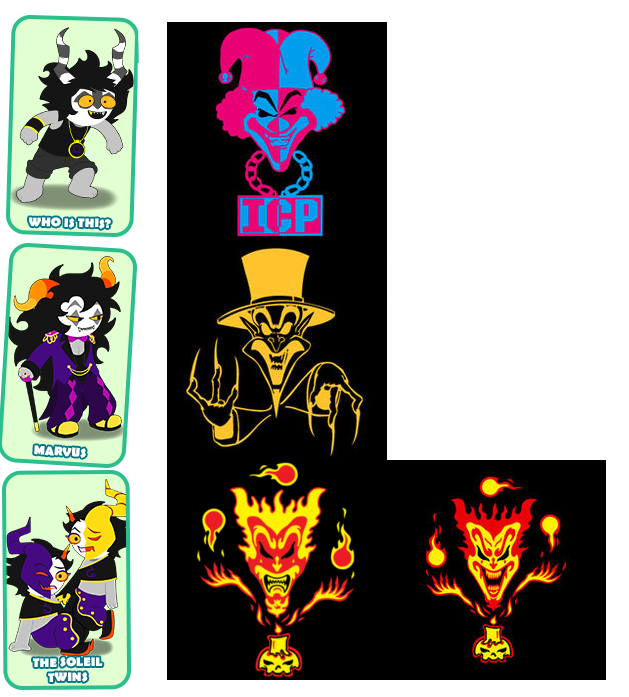
expecting from Karako-it fits the motif of his Joker Card–oh yeah, a
bunch of the purplebloods in Hiveswap seem to match Joker Cards from the
ICP’s albums in their designs:
“
The first Joker’s Card, Carnival of Carnage (1992), is a representation of the ghetto and the violence that occurs within.
It takes the form of a traveling carnival which doles out the same
brutality on those who have ignored the inner cities’ cries for help. The Card issues a warning against the upper-class and government’s negligence toward the lower classes.”
So yeah. That line of inquiry seems to be checking out so far. Really there’s a bunch of parallels between Juggalore and the Mirthful Messiah cult/LE in general, but I happen to know someone else is working on that, so I’ll leave it there for now.
Now to what is to me, the most interesting part: the vision of the carousel itself.
There are two possibilities here, I think:
1) This is a psychic projection Karako’s putting out in his dying moments. Its a quick vision meant to provide some small moments of comfort before they die.
2) I think more likely, we’re getting a glimpse into how death works in Paradox Space, absent dreambubbles. It seems likely to me that this is a dark carnival afterlife createdby the collective unconscious of Alternia and, specifically, it’s fervent cult of Mirthful Messiahs.
Karako was led to it because he’s part of the group that collective consciousness recognizes–ie: it’s likely a burgundy would be rejected as one who doesn’t belong, or led somewhere different in Alternia’s collective consciousness. The MSPA Reader was recognized because Karako recognized them, specifically, and was able to extend his afterlife’s promise to his friend.
Either way, we have no way to know and there’s more interesting questions. I’m struck by the fact that considering this is a promised afterlife of spiritual fulfillment, the vision we see is distinctly non-spiritual--in fact, it’s deliberately artificial.
There are angels, but they’re mannequin props strung up by string. There are happy inhabitants, but they are also mannequins made of wood. It’s like a theatrical parody of an afterlife, depicting the physical presence of holy attendants and subjects, but not the spiritual/magical influence that makes them true.
Basically, it’s a very Rage-y afterlife–it’s theatrical, it’s artificial, and above all it’s physical, not spiritual or magical. It all reminds me very much of the concept of “Maya” from various Indian philosophies–including Hinduism, from which we got the name “Makara” for Gamzee.
How Maya is treated by different cultures varies, but the basic gist is of
a magical power of illusions, of creating real, physical/material things that don’t actually reflect spiritual reality. To quote wikipeds:
The thing is that according to this framework, basically all of physical existence, or at least quite a lot of it, is ultimately Maya and thus illusionary. Physical existence is might or might not be “real”, but it is constantly changing, and so does not reflect spiritual, eternal truth.
I’ve suspected for a long time that at its core, the nature of Chucklevoodoo/Rage powers stem from an ability to manipulate the experience of Maya.
Chucklevoodos employ illusions that are physically real (the Jack Noir doll in John’s room, or Dave’s dream copy of Lil Cal), and inspire people to be afraid/paranoid/angry–binding them to their physical experiences of the world.
Enlightenment in these Maya-centric frameworks generally means becoming one with these eternal principles of spiritual truth, and thus moving away from Maya/physical reality and the fear/confusion it produces.
So here’s the thing: That’s pretty much exactly what the MSPA Reader begins to experience after Karako is killed.
They come into awareness of the fact that everything they’ve been experiencing on Alternia, everything about Paradox Space, is kind of profoundly unreal.
Which it is! Because its just a story being told to us, the players. They seem to become very aware of this unreal/illusionary nature to their own existence and that of the world of the Friendsim.
And instead of continuing to treat it as real/something to be afraid of, the Reader chooses to stand up for moral virtues, generate them into the world themselves.
And as they move on from the illusionary world of Alternia, they’re rewarded by becoming aware of an eternal, universal, spiritual truth:
Friendship.
Of course, the MSPA Reader is still on their path. If they’re going to keep up this metatextual evolution and eventually reach enlightenment, coming to understand the true nature of their own existence, then there’s a lot more to learn. (Here’s hoping Lanque will teach them (and us) something about Astrology, Alchemy, and Aspects.)
What I’m wondering is, how much longer before they start becoming aware of the part of their reality that is well and truly outside of the visible realm? How much longer before the MSPA Reader becomes aware of us?
That’s a very good point. While Caliborn is associated with a spiral, Lord English is strongly linked to the Perfect Circle, itself pretty much the symbol of the Paradox–”A SHAPE WITHOUT ANGLES. WHAT.”
Circles might be another thing we want to look out for with Marvus, Whodis, and whatever other characters show up that give us Lordly vibes.
The Master classes are weird, so Lord is also a solid possibility. I went for Muse because Junko leads less by direct control than she does by inspiring and motivating others into adopting her ideology–a Lord commands through Orders, a Muse commands through Ideas or Inspiration. Neither one is to be underestimated, imo.
[3. Earthbound – The two Yaldabaoths, Dramatic Tension & The Diegetic Reader (That’s You!)]
[Spoilers for Earthbound:Beginnings, Earthbound, & Mother 3]
Most know by now that Earthbound is referenced every time we say the word “Homestuck”. It’s built into the name: To be Stuck at Home. To be Bound to Earth.
And fittingly for a reference which such pervasive impact on our understanding of the comic, Homestuck styles itself as a spiritual successor to Earthbound in a number of ways.
Both Earthbound and Homestuck begin with a set of four kids who go on an adventure together. Both feature kids with psychic powers, friendship, and the meaning of growing up.
But there are three particular similarities to Homestuck that I want to present you with here. In these three areas, Homestuck and Earthbound/Mother are notably alike:
The Characters:
1) Both feature a unique execution of dramatic tension and narrative stakes for the characters.
The Player:
2) Engage in heavily metatextual, diegetic relationships between the World/Story and The Player/Reader.
The Antagonists:
3) Are God-Like, Authoritarian powers that cannot engage with ideas. In other words, they operate as Yaldabaoths.
These antagonists are who I want to talk about first. We will proceed from number 3 up to number 1, talking about the context of the games and tying it into the comic further as we go.
I’ll ask you to be patient with me if you don’t see much about Homestuck at first–there’s a lot of setup work to do.
Here’s the next essay in this series on Homestuck’s use of thematic reference. This time, we go over the latter two MOTHER games, Earthbound and Mother 3, to see what they can tell us about the themes Homestuck builds up.
These games are near and dear to my heart, so I hope you enjoy this essay!
2. The Neverending Story – Muse/Lord & The rules of Paradox Space
[Spoilers for The Neverending Story]
I’m not the first to note Homestuck’s references to AURYN, the magical amulet from The Neverending Story. The symbol of the intertwined black and white snakes is directly referenced only twice in Homestuck’s story, and both times it tells us a mind-boggling amount about the nature and function of Homestuck’s universe.
And even that only scratches the surface. So instead of starting off with Homestuck itself, let me tell you a little bit about The Neverending Story itself.
Here’s the post on Homestuck’s links to The Neverending Story, particularly as they concern Calliope, Caliborn, and their relationships to the story. Some additional details on Jane’s Lollipop and the nature of Paradox Space. Hope you enjoy, and let me know what you think!
2. The Neverending Story – Muse/Lord & The rules of Paradox Space
[Spoilers for The Neverending Story]
I’m not the first to note Homestuck’s references to AURYN, the magical amulet from The Neverending Story. The symbol of the intertwined black and white snakes is directly referenced only twice in Homestuck’s story, and both times it tells us a mind-boggling amount about the nature and function of Homestuck’s universe.
And even that only scratches the surface. So instead of starting off with Homestuck itself, let me tell you a little bit about The Neverending Story itself.
The Neverending Story is a book split in two. In the most commonly printed version, it comes in Red and Green text halves. The real world, the realm of humans where you and I live–those sections are printed in Red. Fantastica, the world of fiction and stories and all things imaginary, is printed in green.
And as with two sections, The Neverending Story is split into two central figures:
The Childlike Empress, and Bastian Balthazar Bux.
Muse & Lord
In the green-lettered plains of Fantastica, The Childlike Empress rules over all. Although her authority is accepted by even the most evil and mostrous in Fantastica, she never gives orders. Even so, she is both eternal and eternally childlike. Good and evil are equal in her eyes.
Sometimes called the Golden-Eyed Commander of Wishes, The Childlike Empress’ authority only manifests when she grants her gem of wish-fulfilling powers–AURYN–to another. This other is treated as though the Empress herself were present, and acts as an emmisary for her.
She is the embodiment of Fantasy itself, inspiring others to act out her will. She is a question, a mystery, a wonder. She is, in short…A Muse.
And she has a direct parallel in Calliope, who similarly draws no distinction between good and evil (people forget that she read what was likely the worst of Vriska without being exposed to her growth, and seemingly wanted to be friends with her anyway)…
Everyone is entangled in and created by Lord English’s Alpha Timeline, but that web is Calliope’s as well, and she’s causally entangled in the creation of all four of the universes we follow.
And again like the Childlike Empress, Calliope who bestows her Symbol on others, granting AURYN to humans–an emblem which endows in the wearer the ability to make any wish come true.
Hell, Calliope even seems not to grow up normally in Act 7 and [S] Credits. A Childlike Empress indeed. And as for her counterpart? Bastian may not be as much of a jerk as Caliborn, but the parallels between them are even more explicit:
Where The Childlike Empress is a Muse only by implication, Bastian is textually and demonstrably a Lord.
But let’s back up a bit.
Bastian Balthazar Bux is a little boy who steals a book named “The Neverending Story” from a bookshop and hides in his school to read it in one sitting. His sections, those taking place in the Human world, typically feature text colored Red.
However, around the halfway point of The Neverending Story, he realizes that the story is not only aware of him, but calling out to him. And he eventually finds himself pulled into the realm of Fantastica.
Bastian is a human, you see, and only humans can create stories–the inhabitants of Fantastica themselves cannot. And once the Childlike Empress is reborn with a new name, Fantastica must be reborn as well. So The Childlike Empress meets Bastian in the void between the two realms of Fantastica, and gives him the amulet AURYN, the symbol of her power.
And so, she entrusts him with a quest: To fulfill his wishes in Fantastica, and re-create the realm of Fantasy as he goes.
Incidentally, receiving AURYN also changes Bastian’s race. Bastian is explicitly white, but upon arriving in Fantastica transforms into “a young prince from the Orient”. I’m not sure why that even happens, to be honest? Let’s note that this book is from, like, 1979 and definitely not perfect.
To be honest, I should’ve noted that was explicit earlier, since Homestuck all but explicitly states that Tricksterfied Cherubs would look like Lil Cal, which definitely entails a primary skin color swap. And there, as with Humans, the transformation always renders the subject Caucasian-looking.
Now, where were we?
Ah, right. So, the first thing you might notice is that Bastian’s ascent to Lordship also coincides with him leaving the World of Men and entering the World of Fantasy/Ideas.
Which strikes his first echo with Caliborn. Both characters’ entries into power are marked by changing their text color to Green–the color of their respective Muse figures. And like Calliope dies for Caliborn to Enter, The Childlike Empress disappears from Fantastica as soon as Bastian becomes it’s Lord.
Bastian spends most of his adventure in the realm seeking to meet her once more, on some level–just as Lord English spends an eternity in the Void, trying to find and destroy the Calliopes.
And during his search, Bastian also accrues subjects and followers who carry out his will. Bastian is adored for his ability to create stories–which instantly become Real– across Fantastica. With The Childlike Empress’ AURYN around his neck, nothing can resist his will. Bastian becomes, for all intents and purposes, a God.
Although he loses his humanity little by little with every wish he makes. The memory of being weak, the memory of being ugly, the memory of being scared– as Bastian travels, he grows more self-satisfied and arrogant, desiring the adoration of others without true regard for their feelings and hearts.
Until in the end, he’s exploiting those he calls friends through sheer force of will. At this point, Bastian seeks to replace The Childlike Empress entirely, attempting to become the Childlike Emperor–just as Lord English seeks to emulate Calliope through a multitude of stylistic choices in his personal aesthetic.
“Doc Scratch was born to serve as Lord English’s other half, replacing the role Calliope served when the two shared one body. From Caliborn’s warped perspective, the two share many similarities. They’re both wordy, intelligent, and (as Caliborn saw her) quite smug. He scrapbooks with a ~ATH book like she did, and carries her weapon.
In addition to being a pastiche of his sister, Scratch is also a symbol of his other weakness, the cue ball. Both are heralded to be the key to his defeat, after all. He does double duty then by killing Scratch, hatching out of his body and growing more powerful (by assimilating Scratch’s first guardian powers), “predominating” over him and asserting his dominance over both his vulnerabilities once again.”
And Bastian, well…
Sound familiar at all?
By the end, Bastian is at risk of becoming what is essentially a Yaldabaoth–an arrogant God with full dominion over his material reality, but blind to the world of ideas outside of him.
Luckily, Bastian escapes this fate, and goes on to live a happy life, becoming a world-renowed storyteller. His path is not the path of the Lord forever. But that is another story, and shall be told another time.
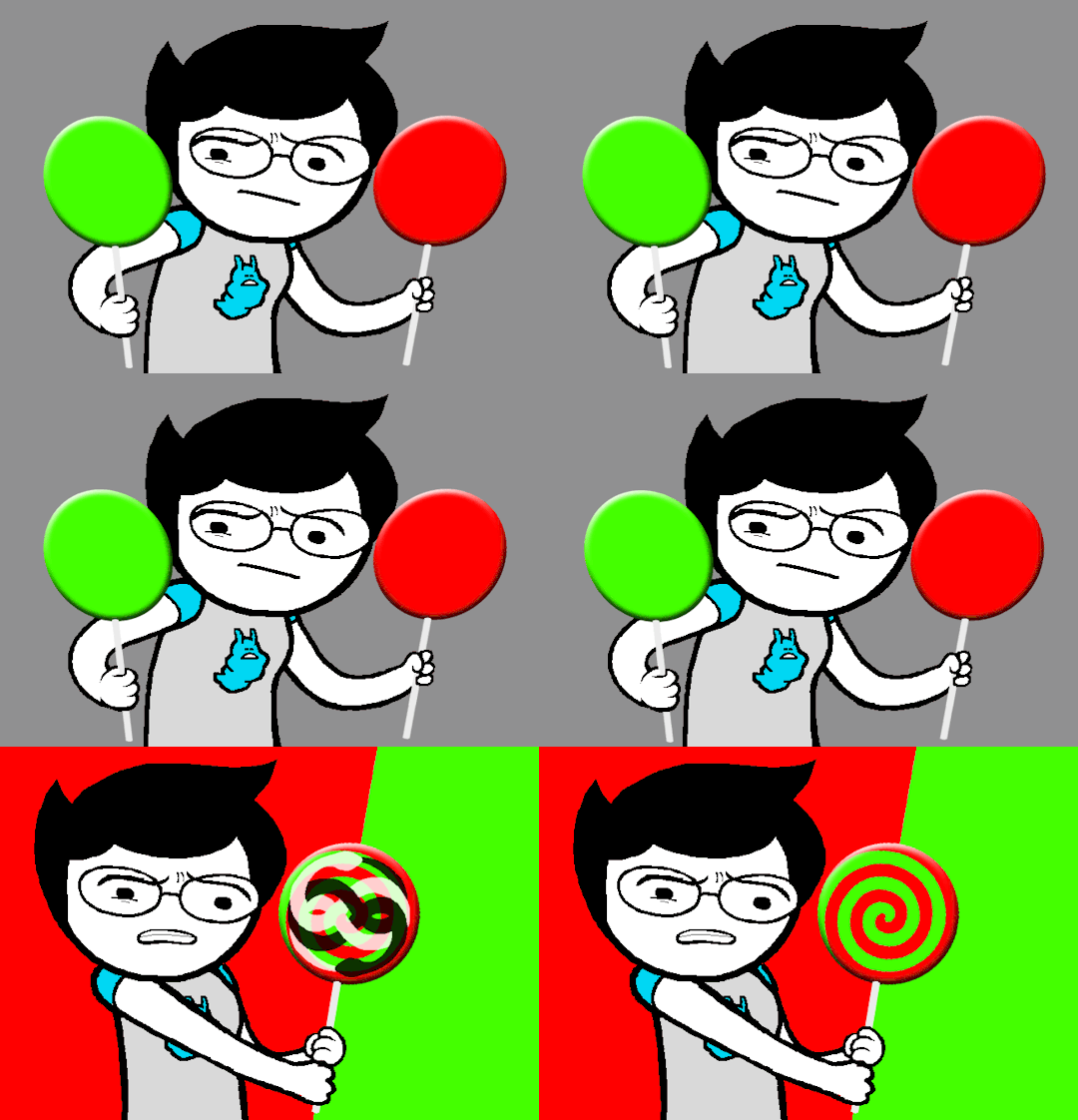
There’s one last thing to note about AURYN, because it appears in two places in Homestuck. There’s the Lollipop, yes–and by linking AURYN to the Cherubs, we learn a great deal about both Muse and Lord, Calliope and Caliborn.
But AURYN’s impact is a bit more far-reaching than just them.
The emblem is also depicted during the mating ritual of Cherubs, remember? And it’s important to view this image in context, because as Aranea tells us…
Mating Cherubs tap into the forces of power presiding over all that is eternal. Cherubs are linked to the primordial forces of reality by their nature. The source of Cherub’s powers is their intrinsic connection to the flow and nature of reality.
Which suggests that the principle that AURYN is inscribed with, the principle that guides the power of its magic, is also the fundamental principle of Homestuck’s universe. Cherubs are simply beings with a unique ability to tap directly into it. And that principle is…
“Do As You Will.”
Nothing in Homestuck’s reality happens except by the Will of someone living inside it. Individual will is the backbone of all events and objects, all circumstances and beings, all people and universes in Homestuck. In Homestuck, everybody always gets what they want–one way or another.
That is what AURYN– placed here, at the center of the forces of creation and destruction– suggests. A good example of this is Lord English’s creation, where Caliborn and Gamzee’s wills to become Lord English meet Arquis’ desire to have a heroic moment of unfathomable impact onto reality:
Thus resulting in a scenario that fulfills all of their desires, and results in the creation of Lord English and Doc Scratch:
I’m not going to list a bunch of other examples because this kind of stuff is literally always what happens in Homestuck. The only thing that trumps a person’s desires in Homestuck is the desires of another willing to undermine or exploit the former.
And that kind of authoritarian behavior is the closest thing to “Sin” Homestuck’s setting has. It always comes with consequences. This is also why Karma exists in Homestuck’s causality, as noted by Latula. This is what the cycle of revenge was about.
Not even killing someone can truly erase the impact of their will on reality in Homestuck’s universe, and usurping or denying others their wills always comes with a whiplash effect back on yourself. So what does that mean for Lord English, who has so thoroughly usurped and denied the wills of every other member of the cast?
Well that… is another story, and shall be told another time.
Next time, we’ll talk about the Mother franchise’s two later installments: Mother 3, and Earthbound. There’s much to discuss. Perhaps we’ll even find an echo of Lord English’s karmic punishment there?








 Flying through Storytelling