
That seems to be true on Alternia, though bear in mind that was a guess and I could be wrong.
But with the Sburb players things seem to be different. We know there are plenty of Kurloz ghosts in the dream bubbles after all.

That seems to be true on Alternia, though bear in mind that was a guess and I could be wrong.
But with the Sburb players things seem to be different. We know there are plenty of Kurloz ghosts in the dream bubbles after all.
oh no i love this tiny little clown boy ;_; hes so good. OK theres a lot to talk about so lets start. big time spoilers below
Classpect:
The bottom line is I tentatively agree with the take that Karako’s a Lord of Mind, though Page seems like a plausible runner-up guess. Lord makes a fair bit of sense to me. There’s some obvious connections–Karako somehow ended up with a gold tooth, mirroring Caliborn’s.
Karako’s most emphasized attribute is his youth, Caliborn is identified by his eternal immaturity, and Porky Minch and Bastian (the two characters who most seem to infliuence Caliborn’s Lord status) are also either defined by an inability to grow up, or deal with a possible failure to do so, respectively.
And Karako does seem to operate pretty much off instinct, much like Caliborn.
That the Reader is left to carry on his will to punish the
Horror-Terrors is particularly compelling–the Reader has to make the CHOICE (Mind) to follow Karako into death, and getting onto the carousel is their reward for doing so.

As an ask pointed out back when we were talking about Boldir, we might expect circles to pop up in relation to Lords as well as spirals, and indeed circles pop up with Karako in several ways. His symbol contains a circle, and the dog tag his symbol is printed on is a gold circle itself. @wakraya also pointed out the cans can be seen as Tallcircles which seems like a stretch but still, worth noting.

But the most interesting circle in the Sim is definitely the Carousel.
What we’ve got here is a circle, a wheel, that spins endlessly, always
pulling the horses that exist within it around and around. They’re bound
to the wheel, stuck in it.

Much like everyone who exists in the circle of LE’s causality.
I think this has its roots in LE’s nature as a Demiurge, and so a direct
offspring of “Abraxas”, the abstract God that we could see as Paradox
Space itself.

Abraxas is always depicted with twin snakes pulling in different directions, and in this notable depiction, the snakes themselves are pulling/guiding horses along.
To me, this evokes Caliborn and Calliope exerting their twin influences on the narrative, with the horses representing individuals living under their influence.
Whether it’s a psychic projection of Karako’s or some kind of afterlife (and we’ll come back to that question soon), the Carousel seems like a pretty succint presentation of the Mirthful Messiah’s entire Lord English-centric religion.
We’ve got the conflicting tragic/comic masks, Gamzee raising Caliborn
(red sun, green background) and Callie (green sun, red background), and
of course a wheel/circle that many horses are bound to.
Its interesting to note that this makes it pretty clear that the Mirthful Messiah was a seperate and distinct figure from Callie and Caliborn in the cult’s doctrine–it is specifically Gamzee, not the cherubs or LE’s later incarnations.

Of course, Callie isn’t really being worshipped here–the carousel is an altar to LE, not Abraxas.
Yaldabaoth was real big
on being known as the “one true god”, and being himself unaware of the
higher orders of God who created him. It’s unsurprising that his cult
would be lacking that higher-order imagery, and would place its highest
emphasis on the symbol of LE’s looping dominion.
The Dream version of the Dark Carnival that Meenah and (Vriska) visit in the dreambubbles is empty and lacks the historical frills describing Gamzee and Callie, but the religion’s most important symbol, the Circle/Carousel, remains. That’s the most prominent recurring memory.

(Aside: This might answer why horses are so ironic–horses bound/stuck to a wheel are a prominent symbol of LE’s dominance, and free horses running as they please are a suitable undermining of his symbolism.)

(Aside x2 combob: Akio Ohtori from Revolutionary Girl Utena is a Yaldabaoth figure quite similar to Caliborn, and his power/dominion too ends up being depicted through carousels. Chalk it up to shared gnostic symbolism I guess, but still, odd coincidence.)
Back to Karako.
Its worth noting that coming into conflict with highbloods/high
class members of troll society was one of the few things we were
expecting from Karako-it fits the motif of his Joker Card–oh yeah, a
bunch of the purplebloods in Hiveswap seem to match Joker Cards from the
ICP’s albums in their designs:
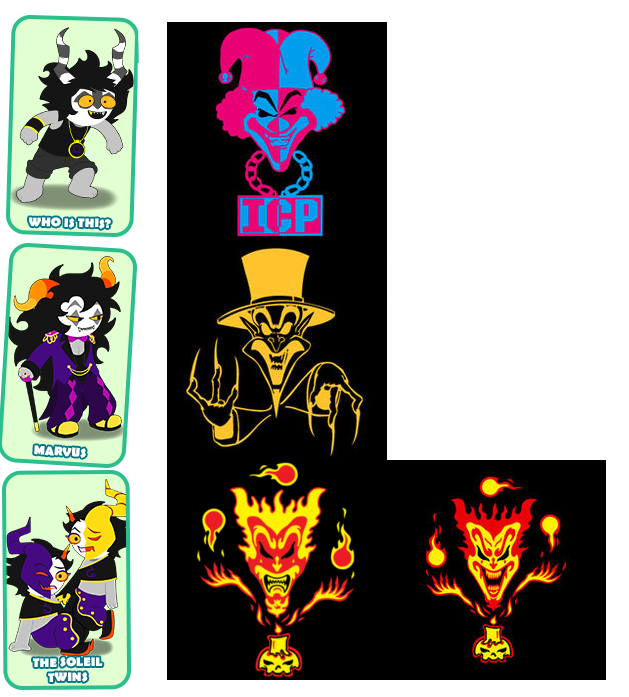

“
The first Joker’s Card, Carnival of Carnage (1992), is a representation of the ghetto and the violence that occurs within.
It takes the form of a traveling carnival which doles out the same
brutality on those who have ignored the inner cities’ cries for help. The Card issues a warning against the upper-class and government’s negligence toward the lower classes.”
So yeah. That line of inquiry seems to be checking out so far. Really there’s a bunch of parallels between Juggalore and the Mirthful Messiah cult/LE in general, but I happen to know someone else is working on that, so I’ll leave it there for now.

Now to what is to me, the most interesting part: the vision of the carousel itself.
There are two possibilities here, I think:
1) This is a psychic projection Karako’s putting out in his dying moments. Its a quick vision meant to provide some small moments of comfort before they die.
2) I think more likely, we’re getting a glimpse into how death works in Paradox Space, absent dreambubbles. It seems likely to me that this is a dark carnival afterlife created by the collective unconscious of Alternia and, specifically, it’s fervent cult of Mirthful Messiahs.
Karako was led to it because he’s part of the group that collective consciousness recognizes–ie: it’s likely a burgundy would be rejected as one who doesn’t belong, or led somewhere different in Alternia’s collective consciousness. The MSPA Reader was recognized because Karako recognized them, specifically, and was able to extend his afterlife’s promise to his friend.

Either way, we have no way to know and there’s more interesting questions.
I’m struck by the fact that considering this is a promised afterlife of spiritual fulfillment, the vision we see is distinctly non-spiritual--in fact, it’s deliberately artificial.
There are angels, but they’re mannequin props strung up by string. There are happy inhabitants, but they are also mannequins made of wood. It’s like a theatrical parody of an afterlife, depicting the physical presence of holy attendants and subjects, but not the spiritual/magical influence that makes them true.
Basically, it’s a very Rage-y afterlife–it’s theatrical, it’s artificial, and above all it’s physical, not spiritual or magical. It all reminds me very much of the concept of “Maya” from various Indian philosophies–including Hinduism, from which we got the name “Makara” for Gamzee.
How Maya is treated by different cultures varies, but the basic gist is of
a magical power of illusions, of creating real, physical/material things that don’t actually reflect spiritual reality. To quote wikipeds:
The thing is that according to this framework, basically all of physical existence, or at least quite a lot of it, is ultimately Maya and thus illusionary. Physical existence is might or might not be “real”, but it is constantly changing, and so does not reflect spiritual, eternal truth.
Māyā is the empirical reality that entangles consciousness. Māyā has the
power to create a bondage to the empirical world, preventing the
unveiling of the true, unitary Self—the Cosmic Spirit also known as Brahman.
I’ve suspected for a long time that at its core, the nature of Chucklevoodoo/Rage powers stem from an ability to manipulate the experience of Maya.
Chucklevoodos employ illusions that are physically real (the Jack Noir doll in John’s room, or Dave’s dream copy of Lil Cal), and inspire people to be afraid/paranoid/angry–binding them to their physical experiences of the world.
Enlightenment in these Maya-centric frameworks generally means becoming one with these eternal principles of spiritual truth, and thus moving away from Maya/physical reality and the fear/confusion it produces.
So here’s the thing: That’s pretty much exactly what the MSPA Reader begins to experience after Karako is killed.

They come into awareness of the fact that everything they’ve been experiencing on Alternia, everything about Paradox Space, is kind of profoundly unreal.

Which it is! Because its just a story being told to us, the players. They seem to become very aware of this unreal/illusionary nature to their own existence and that of the world of the Friendsim.
And instead of continuing to treat it as real/something to be afraid of, the Reader chooses to stand up for moral virtues, generate them into the world themselves.

And as they move on from the illusionary world of Alternia, they’re rewarded by becoming aware of an eternal, universal, spiritual truth:

Friendship.
Of course, the MSPA Reader is still on their path. If they’re going to keep up this metatextual evolution and eventually reach enlightenment, coming to understand the true nature of their own existence, then there’s a lot more to learn. (Here’s hoping Lanque will teach them (and us) something about Astrology, Alchemy, and Aspects.)
What I’m wondering is, how much longer before they start becoming aware of the part of their reality that is well and truly outside of the visible realm? How much longer before the MSPA Reader becomes aware of us?
https://www.patreon.com/optimisticDuelist
[The script for this 3-Part Video Series is available to Patrons now.]
I didn’t plan for this, you gotta believe me. The Homestuck thoughts converged on me late in the night, beat me up and MADE me make you start watching what’s now at least a trilogy of videos on Gamzee Makara–often described as the worst character in Homestuck. I’m sorry.
…But is he? A combination of new insights from the fandom and lore details revealed through Hiveswap have left me wondering if, perhaps, this lousy purple clown may have hidden depths after all. I found the questions so exciting, I literally couldn’t resist the impulse to drop everything else I’m working on to share them with you. You’re welcome.
I wanna do something a little different, so I’m going to include a question of the day for each video from now on. Answer it, and you might have higher odds of eventually being featured in a comments response, whenever and however I bring those out for you guys.
This week’s question is simple:
What do you think the relationship between Lil Cal and Gamzee is like?
If you’d like some other perspectives on Gamzee to work off, here’s some of the works that inspired this one:
Tex Talks’ case for Gamzee, Rage, and Plot Contrivance: https://www.youtube.com/watch?v=4H7m2…
Oscar @problematwink‘s (200 Page!) Essay on Gamzee’s character arc: https://problematwink.tumblr.com/post…
My prior biggest post on Gamzee (now somewhat outdated): https://revolutionaryduelist.tumblr.c…
I don’t necessarily agree with the exact points raised in any work I link (including my own), but you might find such work useful in responding.
Hope they help! Feel free to respond here, on Patreon, or at:
https://twitter.com/RoseOfNobility
https://revolutionaryduelist.tumblr.com/
Find the music on Bandcamp!:
“Soft Happy Pal”, https://spellmynamewithabang.bandcamp…
“Purple Tyrant”, https://homestuck.bandcamp.com/track/…
“Midnight Calliope”, https://homestuck.bandcamp.com/track/…
“Blackest Heart (With Honks)”, https://homestuck.bandcamp.com/track/…
“Scratch”, https://homestuck.bandcamp.com/track/…
When you say you’re going on hiatus, that means you ramp up your posting massively, right? I was going to leave this by the wayside but I am, lucky for you guys, I’m still too sick to record.
Plus the Xefros and A.Claire posts are doing really well and frankly winning over the fandom is my best shot at long-term stability and things changed for the better for me in a big way recently, so I have the time to get out a couple more of the things I’ve really wanted to say before I start focusing on video–these will all be useful scripts for me soon anyway.

Let’s talk Jude Harley, who has already given us a likely Class and a definite Aspect. And who knows–maybe he’ll lead us to a bit of prophecy on the threats our heroes will face in Hauntswitch? Maybe, maybe not, but either way it’s clear I was doomed to make this post from the start.
So let’s dive right in, and let’s start with the side of Jude’s title I’m surest about: His affinity for the Aspect of Doom.

If Jude’s psyche is concerned with anything, then it’s concerned with death, risks, threats, and the rules you follow to avoid them. While not exactly cynical, Jude is certainly cautious and wary. Even his interest in aliens and cryptids frames them as mysterious threats to watch out for–his shirt isn’t depicting a simple alien, but an alien abduction.

He keeps a flare gun because the chance of a life-threatening emergency is a basically constant presence in his mind, and his interest in POGS is linked to his belief in their eventual post-apocalyptic value. Jude sees the worst in the world, and he prepares for it.


Apparently pretty well, too! I’m not AS sure that Jude is a Seer as I am that he’s a Doom player, but if this is a case of Class Roleplay, then it’s an oddly successful one. The big twist of the first half of Hiveswap is, of course, that Jude was right about basically everything–even if he muddled the execution a bit.
The Seer/Mage key verb–Know–is repeatedly linked to Jude’s biggest contributions, and it’s his foresight that keeps not just Joey but her beloved dog Tesseract safe.
All of this squares quite nicely with the verbiage we can extrapolate for a Seer:
One who knows Doom (or through Doom) for the benefit of others.
And we should stress that “for others” part, because where his plans stumble, Jude himself is the one to pay the price. For Joey’s benefit, but also for ours–the audience’s– as his tragedy give us the deepest glimpse into his psyche and character we get during Act 1.

As @curlicuecal ‘s excellent post on Jude tells us, Jude’s pigeons actually each reflect his relationship to one of his family members, and how he experiences the loss of each of them in turn. Of course we start off with Frohike, apparently Jude’s favorite. Jude is devastated by Frohike’s tragic death, but nothing about it necessarily links the bird to A.Claire except context.


Langly makes things far clearer. When Jude finds himself abandoned, his fury is outright vicious. He makes it clear that he regards this as both betrayal and abandonment, an act of cowardice. He also alludes to being unable to communicate his anger properly and needing to suppress the emotion in order to focus on the task at hand.
Given that we’re talking about Jude, who basically ALWAYS has a task at hand, this all reads as a clear analog for his feelings about Pa. Emotional repression is something of a hallmark of the Harley line–John, Jake, Jade and Jane are all known to dabble in it. If he’s this upset when a bird abandons him, how does he feel about his own father doing so?

All this loss had already gotten to him before the attack on the Harley manor–Joey refers to all of this stress on Jude growing bad enough that Roxy took him to a doctor.

And the losses of his birds leave Jude isolated and desperate–he begs Joey to protect Byers and refers to him as “all he has left”. Not long after, he begs Joey not to go near the portal, saying he can’t lose her, too.
Byers, of course, is the bird that represents Joey in Jude’s heart, and he leaves with her when she’s abducted. However things work out between him and Dammek, for the time being, Jude is now alone.
And maybe worst of all is that this always seems to have been the plan, because Jude is the victim of Act 1′s titular Kansas City Shuffle.
In order for a confidence game to be a “Kansas City Shuffle”, the mark must be aware that he is involved in a con, but also be wrong about how the con artist is planning to deceive him. The con artist will attempt to misdirect the mark in a way that leaves him with the impression that he has figured out the game and has the knowledge necessary to outsmart the con artist, but by attempting to retaliate, the mark unwittingly performs an action that helps the con artist to further the scheme.

Given that we know that Scratch was expecting Joey, and that he is involved in the events that have put her here, we know for a fact that the swap between her and Dammek was always the plan.
Jude assumed the cult wanted the Cherub Portal for themselves, and that may well be true, but it’s his very defense of the thing that leads Joey right to it–and so, right into Scratch’s plans.
In this regard, Jude’s fears have come fully to fruition, as his knowledge of Doom helped the aliens who abducted his sister in the first place. Jude’s shirt is not just a mark of interest, but a prophecy of the fate Jude himself was doomed to witness, and Joey to experience.
And here is where it gets interesting (and somewhat speculative), because Jude’s Classpect is only half as relevant to his family as it is to his relationship with the source of all their troubles, the true antagonistic force behind both Hiveswap and Hauntswitch.

Homestuck’s Doom players were always marked by a duality motif, largely centered on Red and Blue. This was fitting for the trolls, as everything that Beforus and Alternia were doomed to was ultimately linked to the Red/Blue bomb that would eventually lead to the creation of the Green Sun.
Notice how once the sun is created, Sollux’s red/blue motif expires, and reaching the sun is basically the end of his relevance to the plot.

But even then he maintains a focus on Black/White duality. As is fitting of a Doom player, because Duality seems to be one of the biggest fundamental principles of Paradox Space. Everything in Homestuck comes in pairs:
Aspects, Classes, Class Verbs, Players–all of it.


Duality is the rule, the boundary–just as death is a rule we all must follow, just as some fates are unavoidable. And so Jude, like the Captors, is similarly marked by a motif of duality. Only instead of the Red/Blue that the Captors are bound by, Jude is marked by the Red/Green color contrast linked to all Cherubs and, specifically, the cherub responsible for these games’ events:
Lord English.

Jude’s Red/Green motif directly references Lord English at least once, when the red and green marbles are used as the Lion’s eyes. Yaldabaoth–the evil, flawed creator God that Lord English is partly based on–is commonly depicted as a serpent with a lion’s head. And this lion has its gaze planted firmly on a globe of Alternia, reflecting Lord English’s indomitable control over the planet.
It goes further.

Whether or not the Cherub portal is a literal doomsday device, as has been hypothesized, it’s undeniable that every member of the cast is doomed.
Both Alternia and Earth are doomed by Sburb in a matter of decades,
so Jude, Joey, Xefros and Dammek are all on borrowed time.
Hell, this even extends to Trizza, who must inevitably be ousted or killed as Heiress in order to make way for Feferi’s short-lived reign. And on both sides of the Portal, the fates the characters are being led to are tied to agents of the
Lord of Time himself.
Because while Joey and Xefros seem to be dealing with the nefarious influence of Doc Scratch, Jude still has his Cultists to deal with–and they’re likely more linked to Lord English than it initially seems.

After all, The Condesce spent time on Earth before her dissapearance–perhaps enough to craft the perfect Heiress, but almost definitely enough to continue her habit of empowering clown-themed cults to carry out her agendas for her, just as she did on Alternia through Subjugglators and as she will on Alpha Earth through the juggalo presidents.

And while we never learned about the cult of the Mirthful Messiahs in too much detail in the comic, they are described as being spread across the cosmos.
It makes sense to think they may be a smaller operation on the Beta Earth, where the Condesce spent relatively little time. But it is still altogether likely that they are already here.
And if so, Jude and his friends seem to be the only ones watching.
I’m really overwhelmed and grateful by the support so many have shown me, and excited to take posts like the one I did on Joey and this one to Youtube, where more of the fandom can engage with classpects in an accessible way!
You can also feel free to drop by and chat about this and other interesting Hiveswap and Homestuck topics in the r/Hiveswap discord!
Hope to see you soon, and until then–
Keep Rising!
Oh! Hm. Well I definitely think Lord English is involved by proxy–Hiveswap seems to be largely centered around Doc Scratch as an antagonistic influence, while Hauntswitch seems focused on the cult of the Mirthful Messiahs. Jude seems like he’s almost definitely a Doom player, probably a Seer, and his corresponding Two-color duality motif is Lord English’s main colors: Red and Green.
As for why Pa has been visiting Alternia or how he came to possess the portal: No idea! All I really have on Pa is a strong suspicion that he’s been setting up the plot of these games at least partly to save Jude and Joey, just as he set up Sburb to save as much of humanity as he could. Pa’s a shitty dad and I hope Joey gets to set him on fire, but I don’t think he’s evil and I do think he cares.
He just sucks really hard at it.
As for the portal, well. I am pretty certain it’s not JUST a portal, and it’s not just a doomsday device, either. But you’ll be able to see my thoughts on it towards the end of Joey’s Classpect post (which I just finished!), so I’ll keep my thoughts there to myself for right now, if you don’t mind 🙂
We’ve already got Lord English references all over the place, and LE has always had three main prongs of underlings so to speak:
Doc Scratch & Whoever he commands at any given moment–usually the Felt.
His Witch figure, IE: Handmaid/Condesce.
And the cult that worships him–the Subjugglators, Kurloz, Meulin & other acolytes in the bubbles, and Gamzee.
We’ve always known the Condesce was on B1 for years before disappearing for the Alpha universe, but nothing much came of her involvement in B1 in the comic. And we never learned too much about the cult’s specifics, either. Given that Scratch is already involved in Hiveswap, and that Joey already wondered if some of the kids at the school were evil (and referred to them as clowns), it makes sense to think Jude is right about the cult and they’ll be the primary opposition in Hauntswitch.
Hence, we’ll learn about the Guardians and the Cult in one fell swoop.

