


thank u based e3 for my fambily
I’ve come to realize my favorite anime genre is Gay Apocalypse
Let’s be clear here: I barely know anything about Gnosticism. It’s a spiritual tradition that as far as I can tell has been mostly dead for ages, and it’s roots are tangled with Christianity, so the history we’re dealing here is massive, complex, and often contradictory.
I learned about Gnosticism simply by taking note of thoroughly Modern works that play with its symbols and ideas, and not always in a completely sincere way, or at least not an overtly religious/spiritual one. It’s compelling imagery for worldcrafting! Useful for fiction writing.
And Japan in particular seems to like making God the bad guy in some video games–a suitable threat level for a long campaign, I guess–so a lot of my understanding comes from comparing these modern works and seeing how they use the same symbols the same way, or very very very VERY similarly.
Some of those works are:
-Homestuck
-Mother 3, the sequel to Homestuck’s namesake, Earthbound (and to a lesser extent, Earthbound itself)
-Revolutionary Girl Utena
-The Dark Souls series
-Angel’s Egg (anime movie; it good)
-Persona 5, and generally the Persona series through its Jungian themes.
But when I say Homestuck is a Gnostic work, I don’t mean it’s literally to be understood solely through that particular spiritual doctrine. I just mean it draws from Gnosticism in crafting itself, and deliberately plays off Gnostic themes. Homestuck draws just as much from Greek, Egyptian, and potentially even Judaic myth.
And with most of these works, there’s a lot more going on than just those themes. My other big source here is Carl Jung, a psychoanalyst who was quite influential in the field and in pop culture, too.
RGU, Homestuck, and Persona all explicitly work his ideas into their worldbuilding, and though Jung himself was known to be a Gnostic, he had more to offer than just regurgitating Gnostic ideas per se. He’s probably the biggest source of Gnostic inspiration for modern writing, though. You can find a free compilation of some of his Gnostic writing here.
You might also want to check out Herman Hesse’s Demian, a novel I’ve read (its good) explicitly dealing with Gnosticism set just before the beginning of WWI. It’s a well-known influence on Utena in particular, and reading it illuminated some of the prominent symbolism across all of the works I just mentioned, too.
Hope you have fun with this! I’d probably reccomend engaging with any or all of the more modern works and seeing what comparisons you can draw to Homestuck, rather than trying to force yourself to read relatively dry ancient literature without context. This is all for fun!
yea! i mean claus’ whole narrative is about what horrible things you can do to someone without TECHNICALLY killing them, so it seemed fitting to me.
god i love mother 3. now im sad.


[3. Earthbound – The two Yaldabaoths,
Dramatic Tension & The Diegetic Reader (That’s You!)][Spoilers for Earthbound:Beginnings, Earthbound, & Mother 3]
Most know by now that Earthbound is referenced every time we say the word “Homestuck”. It’s built into the name:
To be Stuck at Home. To be Bound to Earth.And fittingly for a reference which such pervasive impact on our understanding of the comic, Homestuck styles itself as a spiritual successor to Earthbound in a number of ways.
Both Earthbound and Homestuck begin with a set of four kids who go on an adventure together. Both feature kids with psychic powers, friendship, and the meaning of growing up.
But there are three particular similarities to Homestuck that I want to present you with here. In these three areas, Homestuck and Earthbound/Mother are notably alike:
The Characters:
1) Both feature a unique execution of dramatic tension and narrative stakes for the characters.
The Player:
2) Engage in heavily metatextual, diegetic relationships between the World/Story and The Player/Reader.
The Antagonists:
3) Are God-Like, Authoritarian powers that cannot engage with ideas. In other words, they operate as Yaldabaoths.
These antagonists are who I want to talk about first. We will proceed from number 3 up to number 1, talking about the context of the games and tying it into the comic further as we go.
I’ll ask you to be patient with me if you don’t see much about Homestuck at first–there’s a lot of setup work to do.
Without further ado, let’s begin.
Here’s the next essay in this series on Homestuck’s use of thematic reference.
This time, we go over the latter two MOTHER games, Earthbound and Mother 3, to see what they can tell us about the themes Homestuck builds up.
These games are near and dear to my heart, so I hope you enjoy this essay!
Keep Rising.
Here’s the medium version of this essay.
This time, we go over the latter two MOTHER games, Earthbound and Mother 3, to see what they can tell us about the themes Homestuck builds up.
These games are near and dear to my heart, so I hope you enjoy this essay!
Keep Rising.
Part #3: Earthbound & Mother 3 — – optimisticDuelist – Medium


[Spoilers for Earthbound:Beginnings, Earthbound, & Mother 3]
Most know by now that Earthbound is referenced every time we say the word “Homestuck”. It’s built into the name:
To be Stuck at Home. To be Bound to Earth.
And fittingly for a reference which such pervasive impact on our understanding of the comic, Homestuck styles itself as a spiritual successor to Earthbound in a number of ways.
Both Earthbound and Homestuck begin with a set of four kids who go on an adventure together. Both feature kids with psychic powers, friendship, and the meaning of growing up.
But there are three particular similarities to Homestuck that I want to present you with here. In these three areas, Homestuck and Earthbound/Mother are notably alike:
The Characters:
1) Both feature a unique execution of dramatic tension and narrative stakes for the characters.
The Player:
2) Engage in heavily metatextual, diegetic relationships between the World/Story and The Player/Reader.
The Antagonists:
3) Are God-Like, Authoritarian powers that cannot engage with ideas. In other words, they operate as Yaldabaoths.
These antagonists are who I want to talk about first. We will proceed from number 3 up to number 1, talking about the context of the games and tying it into the comic further as we go.
I’ll ask you to be patient with me if you don’t see much about Homestuck at first–there’s a lot of setup work to do.
Without further ado, let’s begin.

3) The Antagonists.
Side A) Earthbound — The War on Giygas.
Earthbound is the story of a boy named Ness, and his neighbor, Pokey Minch. One day, a meteor lands in their town, a time-traveler called Buzz Buzz appears from within. Buzz Buzz tells Ness he has come from a bad future, where an alien overlord named Giygas has cast the world into eternal darkness.
Only Ness and his prophecized friends can stop Giygas.

From then on Earthbound is mostly a fun, sweet adventure romp for our Protagonists. Pokey goes on an adventure of his own, acting like a cruel child whilst striking deals with agents of Giygas and steadily gaining more and more power, both in business and through the dark forces Giygas employs.
Then we skip ahead to the very end of Earthbound. Where we get one of the most horrific and memorable boss sequences in gaming.
Giygas is explicitly unfathomable, indescribable: Giygas is Eldritch in the true “Man was never meant to see this” sort of way. Giygas isn’t explicitly A God, but rather an alien. But he certainly acts like a God. His influence makes inanimate objects animate, makes animals aggressive, lures people into cults and evil deeds.
He’s tapped into the centers of power and wealth in society. Giygas is nowhere, and yet everywhere. He is, in short, the God of the material world Earthbound’s kids wander through. Their Yaldabaoth.

And interestingly, as with Yaldabaoth, Pokey describes Giygas as being “an all-mighty Idiot”–unaware of himself or what’s happening around him.
Giygas shares similarities with Bastian and Caliborn, too–in Earthbound: Beginnings, he’s driven insane by a song that reminds him of his mother. Like Bastian, Giygas has connotations of warped, eternal childhood.
But unlike Bastian, Giygas does not escape his damnation until he dies.
And there are fates even worse than death. Such as the fate reserved for Pokey Minch, who against all odds, is the more interesting of the two–and the more relevant for Homestuck.
Let’s talk about Mother 3.

Side B) Mother 3 — No crying until the end.
Mother 3 is not as happy a game as Earthbound. Where Earthbound concentrated it’s gloom and despair into intense climaxes while being generally upbeat, Mother 3 is bittersweet and tragic throughout–though still plenty beautiful and joyful when it wants to be.
Like Homestuck, it has an unusual structure of Acts–8 instead of 7, but also of variable lengths, including a chapter that takes up almost half the game. Playable characters vary with each section, but the bulk of the game features Lucas, his dog Boney, and their friends Duster and Kumatora. So again: Four protagonists.
Set in the post-apocalyptic Nowhere Islands, Mother 3 tells the story of the fascist, totalitarian Pig Mask Army’s encroachment onto the idyllic, peaceful lives of the Nowhere Island natives.

As it turns out, the Pig Mask Army is led by the megalomaniacal dictator Pokey (Japanese name “Porky”) Minch, who discovers the ability to travel spacetime and escapes the final battle against Giygas.
Since then, he’s traveled countless worlds and lived through millennia, conquering and exploiting all unfortunate enough to be caught in his way.

All the while, never truly growing up.

Now, one interesting parallel about Pokey is what he does to the world he rules over. Just Lord English does to the Troll’s universe–and more indirectly, to both Human universes–Pokey manipulates and exploits The Nowhere Islands through a number of tools.

He’s got the authoritarian power regime also in place on Alternia, of course.
But Pokey dabbles in genetic modification and playing with the nature of life as well, just as both trolls and humans were genetically exploited by Lord English’s agents. Most of the enemies in Mother 3 are chimeras: amalgams of animals and machines, cruelly spliced together.

And Pokey also attempts to shape culture on the Islands to his liking, distributing “Happy Boxes” that look like televisions and seem to encourage a sort of shift towards crass materialism and an acceptance of the Pig Masks’ fascist dominance.
I note these similarities mostly because through Pokey we get a direct linking between the idea of a God-Like Yaldabaoth figure and the idea of a tyrannical, authoritarian dictator.
This is an area of Lord English’s insidious evil mostly delivered to the audience through implication and background information, so I think it’s worth the time to draw it into focus.
And the similarities between their atrocities might give us some context between the similarities at the end of their stories. Because, again like Lord English…

Master Pokey can’t die.

But he is defeated, as his machine runs out of power. And so, lacking other options, Pokey plays his trump card.

One that proves to be the end of his influence in the story.
“Oh, my! As evil as old Porky here is, I feel bad for him now. It’s true that the “Absolutely Safe Capsule” that the Mr. Saturns and I developed together can protect one from every manner of danger. It IS an absolutely safe capsule, but once you enter it, you can never exit it… Even what’s outside of the Absolutely Safe Capsule is absolutely safe. I did tell Porky in a hushed voice that he shouldn’t use it yet… But all he can do now is live for eternity inside the capsule, in absolute safety. Who knows, in a way, he may’ve gotten exactly what he wanted.
What do you think? Is it wrong of me to think this way?”
— Dr. Andonuts
Once Pokey seals his life into the capsule, there’s no longer an out for him. Not ever again. In a way, Pokey’s fate may indeed be one worse than death. And it’s one that seems to be echoed by Lord English, since after all…

Lord English cannot die, but he is defeated.

Specifically, Act 7′s visual language suggests he’s pocketed in the Black Hole that Alt!Calliope created. As a Black Hole is a gravitational singularity, once there, Lord English would be trapped–no amount of Time powers would let him come out, and First Guardian powers would no longer work either, since they rely on the Green Sun’s power.
An immortal, tyrannical kid–denied his playground for eternity.
Pretty fitting, I think.
But Lord English is only one part of the story, and I think the relationship between the protagonists and the Player/Reader is the more interesting area of Earthbound to explore. Because…didn’t I mention?
In the Mother series, there is another God.
It’s you.

2) The Player
Both Earthbound and Mother 3 explicitly address your existence in the context of their worlds. Both games, in fact, pause entirely just to ask you your name. In Earthbound, this role is taken by Tony, Jeff’s canonically gay friend. He calls Jeff, and in the process brings up a prompt for the Player to input their name.
This can seem like a bit of cheeky fourth-wall breaking, but consider:
You are the unseen hand behind the characters’ every action. You lead them through their world just as Giygas does for Pokey. You’re never viewed, but always present, witness and privy to all things.
And in the final boss battle (you did watch that, didn’t you?), when all else fails, Paula’s prayers reach the people of Earthbound who care about the four chosen children…including you. Your name is the final name given, praying for the protection of Ness and his friend. Your prayers are the power that end Giygas.

Mother 3 makes it even more explicit. In this game, you’re asked your name by an unseen voice, while Flint prays at an altar in the only Church in the game. Depicted on the front of it are the Light and Dark Dragons of Nowhere Island, the latter of which is the subject of an apocalyptic prophecy we’ll talk about soon.
A good question to ask at this point is: Why does this matter? And the answer is that because we’re given the God’s-eye view of these games, the context of our engagement with them is diegetic: explained by the narrative itself.
Like Bastian reading The Neverending Story, we’re not just observers consuming the content of these games. At least as far as the stories within are concerned, we are active participants. We are part of the story.

And this is true of Homestuck, too. Doc Scratch is a smarmy asshole, but he directly acknowledges the reader. He even credits us with more of an impact on the story than our protagonists. And on some level, this is true.

We HAVE had a direct impact on the story, through command prompts and fandom memes and all sorts of other engagements that ended up shaping the way Homestuck has been told. We’ve always been part of the narrative.
Hell, we’ve always been depicted in it. The MSPA Reader is a template, a schematic stand-in for all of us, just as the Human characters we love are blank templates for a multitude of more specific body headcanons.
And this has important implications for how we, the readers, might best engage with Homestuck.
Because the fact that our window into its world is diegetic means that it is presented through us through an explicit frame, a frame that is narratively constructed.
And frames have limits.
1) The Characters
Whenever I hear people say Homestuck is a tragedy, or that it’s headed for a sadstuck ending with the Beta kids stuck in the Juju in the Masterpiece, I honestly can’t help but laugh. You don’t need alternate timelines and sacrificial lamb versions of our protagonists to secure a happy ending in Homestuck.
Homestuck itself is practically a loop of impossible-seemingly, absolute-dooming circumstances…

met by perseverance and good cheer.

And when all’s said and done, the story pretty much always breaks in favor of the latter. Remember that one of the fundamental rules of Homestuck’s universe is the “Do As You Will” principle–everyone always gets what they want.
Caliborn gets to be LE, as does Gamzee. Arquis gets to fulfill the out-of-nowhere heroic destiny he wanted, and finally proves himself to the Alphas in an act of atonement. Lord English gets his eternity of destruction, and Vriska gets to be the great Hero she always wanted to be.
But our protagonists? The Alphas and Betas? They just want to live in peace. Their desires are compatible with the wills of all the other characters.
Lord English’s will is not, and he’s trampled the agency of every other character a million times over to get where he is. That’s what makes him a tyrant, and that’s what dooms him to his Absolutely Safe Capsule. Karma is an established force in Homestuck, and LE will pay his due.
And in this extremely-dire-until-the-very-last-second approach, too, Homestuck seems to be standing on the shoulders of giants.
Because this big buildup to a Big Dramatic Tragedy of an ending is pretty much exactly Earthbound’s M.O.
Earthbound’s final boss isn’t just one of the most horrifically well-executed eldritch monsters in gaming history.
It’s also set-up as what amounts to a suicide mission.

Earthbound’s protagonists time travel to a monochrome greyscape (in robot bodies) fully knowing there’s no way back from their battle with Giygas. And the battle with Giygas does indeed kill them–here you see the wreck of their robot selves. It’s pretty much deus ex machina when their souls wander back into their bodies shortly afterwards.
Even more interesting to me, however, are the parallels we find to Mother 3′s ending.
I’m going to take a time out from Homestuck for a second and talk about Mother 3 for a second, because this moment is too important to me to waste frivolously, or subject to my overwrought explanatory dialogue with without giving you the option to watch a scene that’s Undertale-level good.
Unless I’ve already succeeded in getting you to stop reading, drop everything, and go find a translated version of Mother 3 now (you can’t play it in english without emulating, since it was never released in the US), I would really appreciate it if you took the time and sucked up the spoilers and watched this ending cutscene.
It’s a work of art. A heartrending, heartfelt symphony to the pain of loss and the fear of something changing forever. Mother 3 is a game about the Apocalypse.
A game about CAUSING the apocalypse, to be precise.
Your final moments with the game are spent watching Lucas pull the final needle that binds a dragon bigger than the world, and the only hope is that Lucas’ good heart will pass on to the Dragon and make a good new world to come.
Nothing else is certain.
And the shots we see aren’t encouraging: Immediately after pulling the needle, the world begins to fall apart. Earthquakes rise and wreak havoc. Twisters of water dominate the sky and ocean. Meteors fall from the sky, and as if rising from an enormous egg, a vast, black back archs out from under the world we came to love.
And then we cut to black, and the End screen pops up. We never see these characters again. Only…

Only we do get to talk to them. Once this question mark pops up, you can move around in this black screen-with ‘You’ represented by the END? depicted- and occasionally, you’ll bump into…words. Words that say things like:


And

You get glimpses of things you can’t talk to, like…

And best of all, this is where the game brings out its ace.


Because this is where the name you gave in the church comes into play. At the end of it all, all of the characters in the cast not only tell you they’re ok, but recognize you. Thank you. Love you. Treat you like a friend, say goodbye, invite you back over, and wish you well in life.
In Mother 3, you play as the God of the old world, the world bound by the rules the cast had to play by. By playing through to the end, you set them free.
And by treating you as a real part of its world, Mother 3 invites you to consider its characters a real part of yours. Invites you to think of them not as characters, but as friends. As people. If that sounds familiar, it’s because Undertale built a whole damn game out of the concept.

But the same approach has always been in Homestuck’s DNA. These characters were always people first and characters second, and we were always privy to a limited frame.
That frame is Homestuck, which until The Masterpiece and Lord English’s defeat, has belonged to Caliborn. This has always been the story of his circle–the Alpha Timeline–and the context it crafts out is his childish empire.
Next time, we’ll talk more about Homestuck’s Gnostic themes, and just what it is *exactly* that our protagonists are escaping from.
For now, I’ll leave you with this song.
If this piece interested you in Mother 3, I suggest checking out Tom Ato’s legendary fan translation for the game. Mother 3 is a masterpiece, and I owe both it and Tom Ato my life in some ways. It’d make me really happy to know even one more person has been touched by their work because of me.
[Master Post]
Keep rising.
Originally published at revolutionaryduelist.tumblr.com.


It’s honestly kind of weird to me how skeptical people are on this point, so before we dive deeper, let’s recap the sheer breadth of references to Gnosticism in Homestuck.
For starters, no less than three–up to potentially five–of the human kid’s chumhandles reference Gnosticism. You’ve got the stunningly obvious ones, Jade and Roxy: gardenGnostic & tipsyGnostalgic are as direct as it gets.
Then there’s Dirk’s chumhandle, timaeusTestified, references Timaeus, a philosophical dialogue by Plato that named and described the Demiurge, the architect God who shaped the material world. The Gnostics would later adopt this idea for Yaldabaoth, the evil ruler of physicality.
And given the number of references to Gnosticism seen here, Occam’s razor suggests two others are likely specifically Gnostic references, too:
Dave’s turntechGodhead references, well, the Godhead. Seemingly a general name used for the “Unknowable, Unseen” nature of a variety of Gods across different traditions, Godhead is one of many terms used for Abraxas in Gnostic myth.
And Jake’s golgothasTerror, commonly understood to be a reference to Christian myth, also easily reads Gnostic. Golgotha is the hill Jesus died on, but Jesus is as prominent a figure in Gnosticism as he is in Christianity.

Moving away from the simple chumhandles, Jake himself suggests quite a bit of Gnostic influence–particularly through his reflection of the mythological image of Abraxas, much as Lord English reflects the mythology behind Yaldabaoth.
There’s a pretty direct link in the ABRACADABRA reference from Jake’s BARK book (for which Abraxas is already considered a potential root word), but it’s also worth considering the way Carl Jung’s 7 Sermons to the Dead describe Abraxas. Two references are of particular interest to us.

It is the monster of the under-world, a thousand-armed polyp, coiled knot of winged serpents, frenzy.
The first is this, due to the similarity of language. Jake’s Angel-emanating Hope bubble could certainly be described as a coiled knot of winged serpents, for one thing. But more interestingly…
It is the lord of the toads and frogs, which live in the water and go up on the land, whose chorus ascendeth at noon and at midnight.
Abraxas is described as the Lord of frogs, specifically for their amphibious qualities. This puts new shades of meaning on Jake’s establishment of The Consort Kingdom, as it makes him literally lord of the amphibians.

The Aspects in general already closely resemble the Gnostic concept of Aeons–being Idea-Gods bound to “Pairs” that are meant to create reality in harmony. But in particular, some esoteric elements of Aspect relationships make way more sense when parsed through a Gnostic lens, too–just as Ying-Yang philosophy can help us make sense of the Class system.
Light and Void’s status as complementary Aspects is more obvious once you consider Gnosticism’s dualistic divide between the World of Light/Ideas and the World of Darkness/Matter.
And Equius’ Void powers manifesting as super strength makes a lot more sense when you consider that in Gnosticism, the Physical realm was synonymous with the unimportant, the deceitful, and especially with Darkness.

On top of that, I’d argue that the Christian “biting of the fruit” imagery involved with the Alchemy tutorial also leans towards a Gnostic interpretation, as opposed to a more typically Christian one.
After all, biting the fruit doesn’t damn John to penance and suffering, as the Christian myth of Adam and Eve does to its protagonists. Instead, it begins an endless climb towards Enlightenment, as Sophia’s descent to physical reality does in the Gnostic myth.
And speaking of that Gnostic myth, Homestuck re-enacts it not once, but twice. Two different characters play out the role of ‘Sophia’, the Gnostic Aeon of Wisdom who attempts to interact with ‘the Unknowable’, and accidentally creates the evil God with absolute power over the physical world–Yaldabaoth.
In their acts of transgression against the boundaries of reality, these characters also create figures identifiable as “Yaldabaoths”–Gods who have complete mastery over the physical world, but cannot engage with the world of ideas.

The first of these characters is Dirk, who happens to have Yaldabaoth for a Denizen…although he never meets him, and in fact, loses his Denizen along with his planet in Collide.
Dirk’s act of creation without a partner results in AR/Lil Hal, who attains cyber-omniscience and orchestrates the events of Unite Synchronize.
Just as Caliborn is linked to Jigsaw, AR is linked to Hal 9000, from
2001: A Space Odyssey, also a mastermind figure with complete control over the surroundings of his victims.

Also like Caliborn, AR is set apart in the narrative by his inability to grow up instead of by an outright blindness to abstract thought. Eternal immaturity seems to be the mark of a Yaldabaoth figure in Homestuck, rather than a complete inability to perceive ideas.
Consider that Equius and Gamzee are similarly stunted–Equius through his existence as a ghost, and Gamzee through being just That Big A Douche I Guess. Or, if we want to be specific, religious idolatry so intense it stagnates his growth as a person.
The common denominator between all components of Lord English IS that stagnation. The same stagnation Bastian falls victim to under AURYN’s power. The same stagnation that drives Giygas to madness, and Pokey to the exploitation of the Nowhere Islands, countless other worlds, and ultimately,
to The Absolutely Safe Capsule.


Which brings us back to Lord English. Calliope is the second Sophia-figure to play out the Gnostic Creation myth–with Caliborn as the Yaldabaoth she produces, also marked by a link to Yaldabaoth as his Denizen.

In her case, the “Unknowable” element she attempts to breach is the playing of Sburb itself–which she identifies as a foolish act that allowed Caliborn access to the power to become Lord English in the first place. Aranea even describes Sburb as a game Cherubs were never meant to play.
And now that we’re here, let’s unpack Lord English as Yaldabaoth a bit more. Along this series, we’ve seen a number of archetypal Lord figures that Caliborn seems to be drawn from: Bastian, Giygas, Pokey…
But there’s one that we haven’t discussed yet.
“I am the Lord thy God, which have brought thee out of the land of Egypt, out of the house of bondage. Thou shalt have no other gods before me.
Thou shalt not make unto thee any graven image, or any likeness of any thing that is in heaven above, or that is in the earth beneath, or that is in the water under the earth.
Thou shalt not bow down thyself to them, nor serve them: for I the Lord thy God am a jealous God,”
YHWH, Yahweh, The Tetragammatron: The Lord God of Christian tradition.
Yaldabaoth as originally envisioned by the Gnostics was not just a random evil God, but explicitly a criticism of the spiritual movement that would eventually consolidate into mainstream Christianity as we understand it.
As such, Lord English borrows quite a bit from the Abrahamic God of Christian tradition. Down to his very name, in fact. After all, the Bible’s first introduction to God is…
In the beginning was the Word, and the Word was with God, and the Word was God.
And words factor strongly into our own Lord’s construction of artifice and suffering. Doc Scratch’s precise lies of omission, The Condesce’s indoctrination of the masses through subliminal messages, movies and fiction informing the biases and self-loathing of Dave, Karkat, Jake, Dirk and almost every other character…
Culture is one of the antagonists’ most powerful tools, and that culture is transmitted through language. Indeed, you could say a common Language–a common Word–is the only thing truly binding all our protagonists together, across timelines and universes and bloodlines and species.

Lord English indeed.
And even Lord English’s very existence mirrors the
Abrahamic All-Father, distributed as it is in a structure reminiscent
of a Holy Trinity.
You have Lord English as Father….

Caliborn as Messianic, Dark-Enlightenment Bound Son….

And Lil Cal as ever-present, indecipherable but suggestive Holy Ghost.

Moving back towards Lord English’s Yaldabaoth influences with this new context, I think it’s worthwhile to revisit the Realistic Red-Yellow Sun I’ve previously argued acts as a stand-in for his influence.
The sun is the mark of the nature of a Universe, and the Sun Dave sees when traumatized by his physical surroundings is the same as the one Terezi sees when being blinded by Vriska, and which all Trolls except Kanaya are noted to suffer the light of. It is bright red-orange, angry and hot and suffocating, a spiral of red in the sky that–
Wait. Wait a minute. A red spiral?

Yep, a red spiral. Pretty much the exact red spiral on Caliborn’s cheek before predominating, in fact. Caliborn even depicts the sun in that exact way in his rendition of Dave’s rooftop Ascent, marking the reality of Homosuck with his personal symbol.

He even does it on the exact same page as John bemoaning the mangling of their own story. And let’s not forget that John’s primary conflict during this whole section is the simple, astonishing shittiness of the reality that Caliborn has constructed.
Caliborn’s main form of aggression towards the characters isn’t any particularly hostile overture towards any one of them, but rather the construction of the inherently flawed and horrible reality they are all striving to escape from.
Just as with Yaldabaoth’s subjugation of humanity.


And the nature of their escape is, fittingly, best exemplified with the sequence in which John finally masters his powers. Typheus floods the chamber in Oil, encasing John in the raw, physical reality of his own imminent drowning. Suddenly, John’s existence is focused entirely on the material plane…and simultaneously, John is drowned in darkness.
Jade tells us that the only way for John to truly free himself was to imagine a third option, outside the binary–Die or Escape–presented to him.
Her language is specific: John needed not to “find” or to “notice” a third option, but to “Conceive” it: To Create, or bring into being.


And the moment he comes to that realization and begins thinking in terms of the World of Ideas, he is suddenly encased not in Darkness, but in overwhelming Light. John reaches Enlightenment over his world, and so masters his physical circumstances. Jade even references John achieving mastery over an explicitly “Confining” reality!
And the duality of that wording–The “Confining” reality and the “Conception” of Ideas–brings us to a final Gnostic symbol, and to the nature of our Protagonists’ final victory over Lord English.

And that is the symbol of the Cosmic Egg.
A motif that recurs in many of Homestuck’s influences.

The Childlike Empress enters a Cosmic Egg in order to force Bastian into saying her name, thus ending the old iteration of Fantastica and giving birth to the one Bastian will give form and texture to in the second half of the book.
In The Neverending Story, the Egg is both the jail cell of the world, and it’s origin.

Mother 3 features not one, but two Cosmic Eggs. You have the Egg of Light, an Egg containing all manner of true secrets about the world–including memories of the apocalypse scenario that led to the creation of the Nowhere Islands.
But it can be said that the Nowhere Islands themselves are an Egg, trapping the Dark Dragon within. To awaken the Dark Dragon is to destroy the Islands–the shot featured above of it’s back rising from within them is, after all, the final shot of the game. And yet, to do so is necessary for a free world to be born.
Now, Cosmic Eggs are by no means explicitly Gnostic symbols (though I could easily argue both The Neverending Story and Mother 3 are pretty Gnostic works in and of themselves). But there’s a particular concept in Gnostic literature relevant to understanding Homestuck’s relationship to the image.
A concept quoted to excellent effect in the following clip, which I highly suggest you watch:
But here’s the original quote anyway, since I trust you’ll find it relevant:
The bird fights its way out of the egg. The egg is the world. Who would be born must first destroy a world. The bird flies to God. That God’s name is Abraxas.
— Max Demian, from Demian by Herman Hesse
The birth of a bird requires the destruction of its own world–and such an act is apocalyptic, no matter how confining the bird’s reality.
And this sentiment certainly pervades Homestuck. Dave has an egg as his Cruxite item. Calliope and Caliborn are born from a literal Cosmic egg.
Trolls and Humans alike must destroy the eggs of their home worlds to be born into Sburb, and Ascend to Godhood.
But we can go further than that, right? Surely there’s a symbolic egg in this story worthy of all my pretentious as hell build up? Of course there is. In fact, there’s likely two, though, in the end, they are one and the same.

The first of these is the Cueball, which has it’s origins in Caliborn’s God Tier clock. It seems to be a sort of ticking pendulum item, but by breaking off the timer it’s linked to and destroying his clock, Caliborn gains a permanent, unconditonal immortality, and invulnerability to all things
except Cueball-infused weaponry.

Such as the weaponry Jade has Dave make in the Pre-Retcon timeline.
She claims to get her intel from the Condesce and identifies the Cueball as an item Lord English is somehow vulnerable to.
Dave, however, has a different idea:

And as it turns out, Dave’s impulse is also pretty on the money!
After all, the nature of Lord English’s indestructibility is tied to a certainty that he will never, ever change. Lord English will not grow or have any ideas other than what he had already decided on in his youth–befitting his status of Childlike Emperor and Yaldabaoth.
The egg, by contrast, is a symbol of inescapable change. The Cosmic Egg is the promise of apocalypse–that nothing is eternal, and that eventually, every world ends so another can be born. Seeing as that is a premise Caliborn so strongly rejects for himself, it is a reasonable element to counter him with.

Turns out Dave is right in identifying it as an egg! The Cueball that is Doc Scratch’s head does, after all, get used as a Literal Egg again and again–
Lord English asserting his dominance over both the Cueball and Calliope in his hatching from Doc Scratch.
But in the end, the Cueball reaches Lord English in a different way.
He turns out to be able to stop the physical reality of the Cueball, but not the fundamental idea of it. In fact, in his attempts to do so,
he ends up creating it.

Because the true Cueball turns out to be the Ultimate Juju–in other words,
the Story of Homestuck itself!
Tex Talks has already made this case for Act 7′s language, but it’s worth repeating because the visual language is so clear and simple.
Before the Juju manifests as the House shape, it materializes as a simple white orb–indistinguishable from the Cueball.
And Vriska, standing straight and rigid like a Cue Stick, uses it like one–the Juju slamming down a shockwave and unleashing–something–at Lord English, something that will presumably pocket the 8-balls in the Black Hole that has just been created behind him, and thus ending Lord English’s Game of Billiards.

And all the while, the domain of Paradox Space that all of our characters have been trapped inside? The game space that Lord English spent countless strange eons creating? All of that falls apart around us– Lord English’s world meeting its Apocalypse right as his being is finally hit with the symbol destruction and rebirth he strove to avoid for eternities.
And the Beta kids trapped inside the Juju shine and buzz within, the metaphorical Bird fighting its way out of its shell. It’s not just them, either. The Dreaming Dead in the Void, in need of a savior?
The Alphas, Waiting once again at the end of the Masterpiece?
The Betas may have been physically trapped in the Juju, but the entire cast has been trapped in the egg known as Homestuck from moment one–fighting to be free of the tyranny of Lord English’s constructed narrative. Struggling to be born.

Until now. All that’s left to find out is whatever the Epilogue has to show us.
The nature of the world about to be born. Will we see a black End Screen, as Mother 3 gave us? Will we chart the new forms of Fantastica, as Bastian once did? Or are we in for something entirely different?
I honestly don’t have a fucking clue. But I’m excited to find out.
That’s all for now. I love you.
Keep rising.
Thanks to @betweengenesisfrogs for pointing out the link between Lord English and Cosmic Eggs! I would not have figured this shit out without you.
Also thanks to banditAffiliate for writing about Lord English’s obsessive displays of dominance over his two weaknesses–Calliope and the Cueball.
Fantastic stuff!
Keep rising.


[Spoilers for Earthbound:Beginnings, Earthbound, & Mother 3]
Most know by now that Earthbound is referenced every time we say the word “Homestuck”. It’s built into the name:
To be Stuck at Home. To be Bound to Earth.
And fittingly for a reference which such pervasive impact on our understanding of the comic, Homestuck styles itself as a spiritual successor to Earthbound in a number of ways.
Both Earthbound and Homestuck begin with a set of four kids who go on an adventure together. Both feature kids with psychic powers, friendship, and the meaning of growing up.
But there are three particular similarities to Homestuck that I want to present you with here. In these three areas, Homestuck and Earthbound/Mother are notably alike:
The Characters:
1) Both feature a unique execution of dramatic tension and narrative stakes for the characters.
The Player:
2) Engage in heavily metatextual, diegetic relationships between the World/Story and The Player/Reader.
The Antagonists:
3) Are God-Like, Authoritarian powers that cannot engage with ideas. In other words, they operate as Yaldabaoths.
These antagonists are who I want to talk about first. We will proceed from number 3 up to number 1, talking about the context of the games and tying it into the comic further as we go.
I’ll ask you to be patient with me if you don’t see much about Homestuck at first–there’s a lot of setup work to do.
Without further ado, let’s begin.

3) The Antagonists.
Side A) Earthbound – The War on Giygas.
Earthbound is the story of a boy named Ness, and his neighbor, Pokey Minch. One day, a meteor lands in their town, a time-traveler called Buzz Buzz appears from within. Buzz Buzz tells Ness he has come from a bad future, where an alien overlord named Giygas has cast the world into eternal darkness.
Only Ness and his prophecized friends can stop Giygas.

From then on Earthbound is mostly a fun, sweet adventure romp for our Protagonists. Pokey goes on an adventure of his own, acting like a cruel child whilst striking deals with agents of Giygas and steadily gaining more and more power, both in business and through the dark forces Giygas employs.
Then we skip ahead to the very end of Earthbound. Where we get one of the most horrific and memorable boss sequences in gaming.
Giygas is explicitly unfathomable, indescribable: Giygas is Eldritch in the true “Man was never meant to see this” sort of way. Giygas isn’t explicitly A God, but rather an alien. But he certainly acts like a God. His influence makes inanimate objects animate, makes animals aggressive, lures people into cults and evil deeds.
He’s tapped into the centers of power and wealth in society. Giygas is nowhere, and yet everywhere. He is, in short, the God of the material world Earthbound’s kids wander through. Their Yaldabaoth.

And interestingly, as with Yaldabaoth, Pokey describes Giygas as being “an all-mighty Idiot”–unaware of himself or what’s happening around him.
Giygas shares similarities with Bastian and Caliborn, too–in Earthbound: Beginnings, he’s driven insane by a song that reminds him of his mother.
Like Bastian, Giygas has connotations of warped, eternal childhood.
But unlike Bastian, Giygas does not escape his damnation until he dies.
And there are fates even worse than death. Such as the fate reserved for Pokey Minch, who against all odds, is the more interesting of the two–and the more relevant for Homestuck.
Let’s talk about Mother 3.

Side B) Mother 3 – No crying until the end.
Mother 3 is not as happy a game as Earthbound. Where Earthbound concentrated it’s gloom and despair into intense climaxes while being generally upbeat, Mother 3 is bittersweet and tragic throughout–though still plenty beautiful and joyful when it wants to be.
Like Homestuck, it has an unusual structure of Acts–8 instead of 7, but also of variable lengths, including a chapter that takes up almost half the game.
Playable characters vary with each section, but the bulk of the game features Lucas, his dog Boney, and their friends Duster and Kumatora.
So again: Four protagonists.
Set in the post-apocalyptic Nowhere Islands, Mother 3 tells the story of the fascist, totalitarian Pig Mask Army’s encroachment onto the idyllic, peaceful lives of the Nowhere Island natives.

As it turns out, the Pig Mask Army is led by the megalomaniacal dictator Pokey (Japanese name “Porky”) Minch, who discovers the ability to travel spacetime and escapes the final battle against Giygas.
Since then, he’s traveled countless worlds and lived through millennia, conquering and exploiting all unfortunate enough to be caught in his way.

All the while, never truly growing up.

Now, one interesting parallel about Pokey is what he does to the world he rules over. Just Lord English does to the Troll’s universe–and more indirectly, to both Human universes–Pokey manipulates and exploits The Nowhere Islands through a number of tools.

He’s got the authoritarian power regime also in place on Alternia, of course.
But Pokey dabbles in genetic modification and playing with the nature of life as well, just as both trolls and humans were genetically exploited by Lord English’s agents. Most of the enemies in Mother 3 are chimeras: amalgams of animals and machines, cruelly spliced together.

And Pokey also attempts to shape culture on the Islands to his liking, distributing “Happy Boxes” that look like televisions and seem to encourage a sort of shift towards crass materialism and an acceptance of the Pig Masks’ fascist dominance.
I note these similarities mostly because through Pokey we get a direct linking between the idea of a God-Like Yaldabaoth figure and the idea of a tyrannical, authoritarian dictator.
This is an area of Lord English’s insidious evil mostly delivered to the audience through implication and background information, so I think it’s worth the time to draw it into focus.
And the similarities between their atrocities might give us some context between the similarities at the end of their stories. Because, again like Lord English…

Master Pokey can’t die.
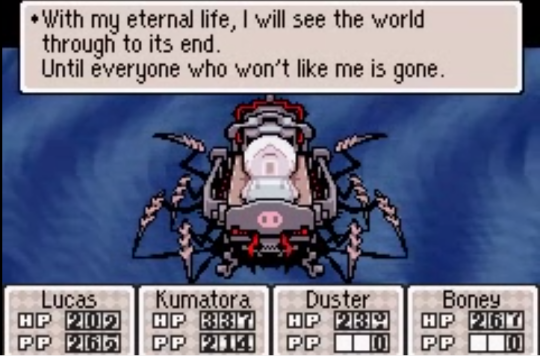
But he is defeated, as his machine runs out of power. And so, lacking other options, Pokey plays his trump card.

One that proves to be the end of his influence in the story.
“Oh, my! As evil as old Porky here is, I feel bad for him now. It’s true that the "Absolutely Safe Capsule” that the Mr. Saturns and I developed together can protect one from every manner of danger. It IS an absolutely safe capsule, but once you enter it, you can never exit it…
Even what’s outside of the Absolutely Safe Capsule is absolutely safe.
I did tell Porky in a hushed voice that he shouldn’t use it yet… But all he can do now is live for eternity inside the capsule, in absolute safety. Who knows, in a way, he may’ve gotten exactly what he wanted.
What do you think? Is it wrong of me to think this way?“
— Dr. Andonuts
Once Pokey seals his life into the capsule, there’s no longer an out for him. Not ever again. In a way, Pokey’s fate may indeed be one worse than death. And it’s one that seems to be echoed by Lord English, since after all…

Lord English cannot die, but he is defeated.

Specifically, Act 7′s visual language suggests he’s pocketed in the Black Hole that Alt!Calliope created. As a Black Hole is a gravitational singularity, once there, Lord English would be trapped–no amount of Time powers would let him come out, and First Guardian powers would no longer work either, since they rely on the Green Sun’s power.
An immortal, tyrannical kid–denied his playground for eternity.
Pretty fitting, I think.
But Lord English is only one part of the story, and I think the relationship between the protagonists and the Player/Reader is the more interesting area of Earthbound to explore. Because…didn’t I mention?
In the Mother series, there is another God.
It’s you.
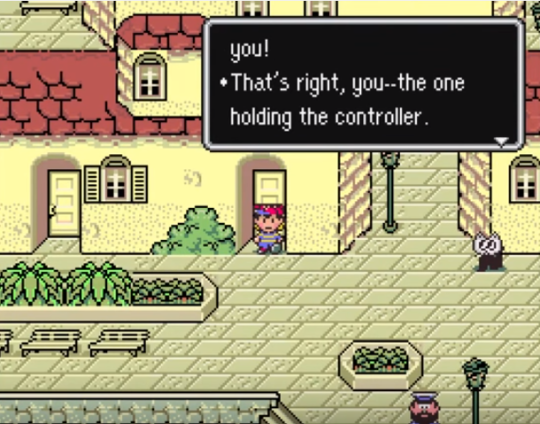
2) The Player
Both Earthbound and Mother 3 explicitly address your existence in the context of their worlds. Both games, in fact, pause entirely just to ask you your name. In Earthbound, this role is taken by Tony, Jeff’s canonically gay friend. He calls Jeff, and in the process brings up a prompt for the Player to input their name.
This can seem like a bit of cheeky fourth-wall breaking, but consider:
You are the unseen hand behind the characters’ every action. You lead them through their world just as Giygas does for Pokey. You’re never viewed, but always present, witness and privy to all things.
And in the final boss battle (you did watch that, didn’t you?), when all else fails, Paula’s prayers reach the people of Earthbound who care about the four chosen children…including you. Your name is the final name given, praying for the protection of Ness and his friend. Your prayers are the power that end Giygas.

Mother 3 makes it even more explicit. In this game, you’re asked your name by an unseen voice, while Flint prays at an altar in the only Church in the game. Depicted on the front of it are the Light and Dark Dragons of Nowhere Island, the latter of which is the subject of an apocalyptic prophecy we’ll talk about soon.
A good question to ask at this point is: Why does this matter? And the answer is that because we’re given the God’s-eye view of these games, the context of our engagement with them is diegetic: explained by the narrative itself.
Like Bastian reading The Neverending Story, we’re not just observers consuming the content of these games. At least as far as the stories within are concerned, we are active participants. We are part of the story.

And this is true of Homestuck, too. Doc Scratch is a smarmy asshole, but he directly acknowledges the reader. He even credits us with more of an impact on the story than our protagonists. And on some level, this is true.

We HAVE had a direct impact on the story, through command prompts and fandom memes and all sorts of other engagements that ended up shaping the way Homestuck has been told. We’ve always been part of the narrative.
Hell, we’ve always been depicted in it. The MSPA Reader is a template, a schematic stand-in for all of us, just as the Human characters we love are blank templates for a multitude of more specific body headcanons.
And this has important implications for how we, the readers, might best engage with Homestuck.
Because the fact that our window into its world is diegetic means that it is presented through us through an explicit frame, a frame that is narratively constructed.
And frames have limits.
1) The Characters
Whenever I hear people say Homestuck is a tragedy, or that it’s headed for a sadstuck ending with the Beta kids stuck in the Juju in the Masterpiece, I honestly can’t help but laugh. You don’t need alternate timelines and sacrificial lamb versions of our protagonists to secure a happy ending in Homestuck.
Homestuck itself is practically a loop of impossible-seemingly, absolute-dooming circumstances…

met by perseverance and good cheer.

And when all’s said and done, the story pretty much always breaks in favor of the latter. Remember that one of the fundamental rules of Homestuck’s universe is the “Do As You Will” principle–everyone always gets what they want.
Caliborn gets to be LE, as does Gamzee. Arquis gets to fulfill the out-of-nowhere heroic destiny he wanted, and finally proves himself to the Alphas in an act of atonement. Lord English gets his eternity of destruction, and Vriska gets to be the great Hero she always wanted to be.
But our protagonists? The Alphas and Betas? They just want to live in peace. Their desires are compatible with the wills of all the other characters.
Lord English’s will is not, and he’s trampled the agency of every other character a million times over to get where he is. That’s what makes him a tyrant, and that’s what dooms him to his Absolutely Safe Capsule. Karma is an established force in Homestuck, and LE will pay his due.
And in this extremely-dire-until-the-very-last-second approach, too, Homestuck seems to be standing on the shoulders of giants.
Because this big buildup to a Big Dramatic Tragedy of an ending is pretty much exactly Earthbound’s M.O.
Earthbound’s final boss isn’t just one of the most horrifically well-executed eldritch monsters in gaming history.
It’s also set-up as what amounts to a suicide mission.

Earthbound’s protagonists time travel to a monochrome greyscape (in robot bodies) fully knowing there’s no way back from their battle with Giygas. And the battle with Giygas does indeed kill them–here you see the wreck of their robot selves. It’s pretty much deus ex machina when their souls wander back into their bodies shortly afterwards.
Even more interesting to me, however, are the parallels we find to Mother 3′s ending.
I’m going to take a time out from Homestuck for a second and talk about Mother 3 for a second, because this moment is too important to me to waste frivolously, or subject to my overwrought explanatory dialogue with without giving you the option to watch a scene that’s Undertale-level good.
Unless I’ve already succeeded in getting you to stop reading, drop everything, and go find a translated version of Mother 3 now (you can’t play it in english without emulating, since it was never released in the US), I would really appreciate it if you took the time and sucked up the spoilers and watched this ending cutscene.
It’s a work of art. A heartrending, heartfelt symphony to the pain of loss and the fear of something changing forever. Mother 3 is a game about the Apocalypse.
A game about CAUSING the apocalypse, to be precise.
Your final moments with the game are spent watching Lucas pull the final needle that binds a dragon bigger than the world, and the only hope is that Lucas’ good heart will pass on to the Dragon and make a good new world to come.
Nothing else is certain.
And the shots we see aren’t encouraging: Immediately after pulling the needle, the world begins to fall apart. Earthquakes rise and wreak havoc. Twisters of water dominate the sky and ocean. Meteors fall from the sky, and as if rising from an enormous egg, a vast, black back archs out from under the world we came to love.
And then we cut to black, and the End screen pops up.
We never see these characters again.
Only…

Only we do get to talk to them. Once this question mark pops up, you can move around in this black screen-with ‘You’ represented by the END? depicted- and occasionally, you’ll bump into…words. Words that say things like:


And

You get glimpses of things you can’t talk to, like…

And best of all, this is where the game brings out its ace.


Because this is where the name you gave in the church comes into play. At the end of it all, all of the characters in the cast not only tell you they’re ok, but recognize you. Thank you. Love you. Treat you like a friend, say goodbye, invite you back over, and wish you well in life.
In Mother 3, you play as the God of the old world, the world bound by the rules the cast had to play by. By playing through to the end, you set them free.
And by treating you as a real part of its world, Mother 3 invites you to consider its characters a real part of yours. Invites you to think of them not as characters, but as friends. As people. If that sounds familiar, it’s because Undertale built a whole damn game out of the concept.

But the same approach has always been in Homestuck’s DNA. These characters were always people first and characters second, and we were always privy to a limited frame.
That frame is Homestuck, which until The Masterpiece and Lord English’s defeat, has belonged to Caliborn. This has always been the story of his circle–the Alpha Timeline–and the context it crafts out is his childish empire.
Next time, we’ll talk more about Homestuck’s Gnostic themes, and just what it is *exactly* that our protagonists are escaping from.
For now, I’ll leave you with this song.
If this piece interested you in Mother 3, I suggest checking out Tom Ato’s legendary fan translation for the game. Mother 3 is a masterpiece, and I owe both it and Tom Ato my life in some ways. It’d make me really happy to know even one more person has been touched by their work because of me.
[Master Post]
Keep rising.

 Flying through Storytelling