She wants to improve you as dramatically as Kanaya and Aranea improved Eridan/Jake’s power levels. MAKE is right there. Nuff said, I think.
In the bad end she may echo Page or Heir, deploying these faculties to buff herself rather than you and manifesting either the Page’s limitless potential or the Heir’s powers of transformation and power over reality (through Void either way, since technology has some Void associations with Bluebloods particularly and factors so much into how she empowers herself)
Either way, both Page and Heir are less passive than sylph and so would explain her benefiting herself instead of others.
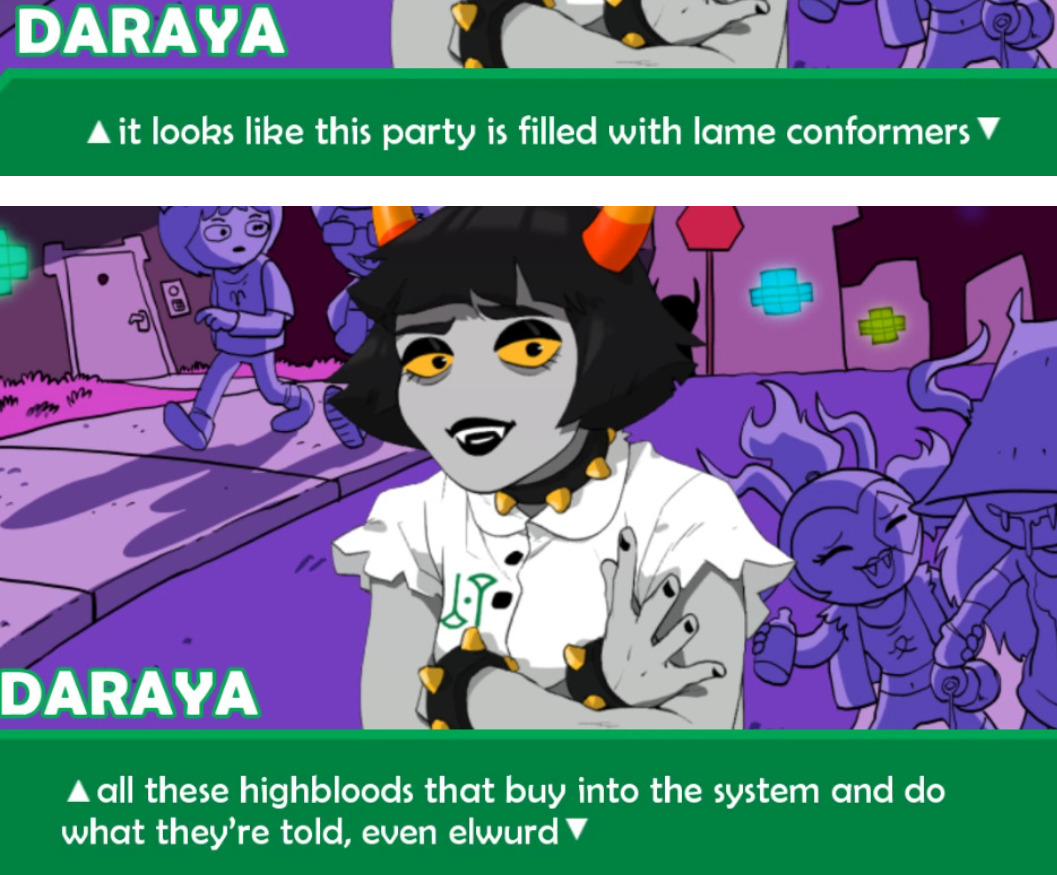
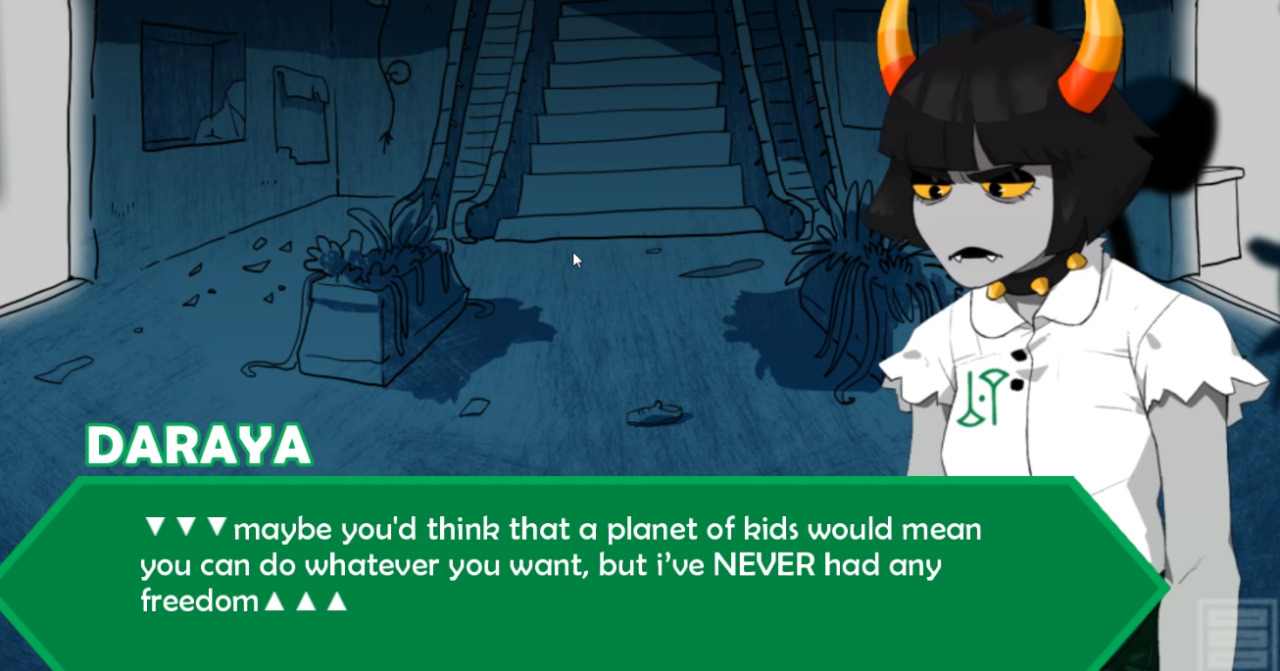
Daraya: Rogue of Hope
She’s heavily invested in rebelling/standing OUTSIDE alternia’s legal/social norms. She’s heavily drawn to other people who feel similarly, reflecting thieves/rogues general affinities for other outlaws(1)
–note that she’s specifically drawn to Elwurd and how she presents herself, and Elwurd is either a thief or a thief roleplayer herself.
as a Jade, Daraya would have the role of Sylph or maybe Maid forced on her, not Thief or Rogue. Hence, I think it’s likely her presentation of the Outlaw motif comes from a genuine place in her heart, rather than roleplay.
Things go very, very badly if you let her take direct charge and have her will take you to her favorite place. If you encourage her to just go out into the world and Let Stuff Happen (ie: take a more passive role in relation to reality), things go much better for both of you, and she finds an outlet that makes her feel better by making a friend and finding a cause she can help. by basically offering to steal books from the library, no less. so thats my Rogue logic.
(1)think the “Honor among thieves”
thing or Robin Hood’s band of merry men–Mindfang, a successful thief roleplayer, was drawn to Rufioh, an
innate Rogue. Vriska, an innate thief, was attracted to the IDEA of
tavros acting like a Rogue/the summoner rather than to tavros himself,
and later was drawn to Meenah.)
Vriska declares everyone on her ghost crew is ALSO a pirate, ie: an outlaw. Which is also a good example. Outlaws by definiton can only form communities/serious bonds with other people willing to shirk or redefine the norms of society, and outlaw communities run on their own self-defined rules and conventions of behavior. Contrast against Knights and Pages who generally feel quite beholden to societal convention.
I have longer posts on both of them sort of in the works but I’m doin a lot of stuff atm and the Classpects per se were not the most interesting thing about this volume imo, Daraya’s in particular. Not to say they were bad, I loved them both. Just that theres other stuff in these arcs I’m more inspired by.
I was getting bogged down writing ways all day today so I figured I’d try putting my thoughts out here in a shorter/snappier way, hope the format works. Lemme know if it does and maybe i’ll convince myself to write in shorter/snappier ways like this more in the future, could cover more trolls that way.
I’ll get to classpect meta later but honestly this is so important
Daraya’s path put Jadebloods into much sharper focus as a caste subject to incredibly strict control and norms of behavior. Specifically, norms concerning romantic and intimate interest in other trolls, where young, fleeting relationships might be allowed but consummated, long-lasting adult relationships are explicitly illegal.
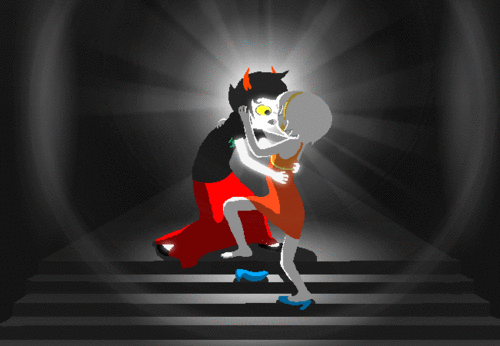
This puts Kanaya’s early struggles with romance into some really compelling context. Of course she’s more interested in those “More Daring” than her. Of course she’s compelled by people willing to break rules and flaunt convention and risk everything for what they want, like Vriska.
Who else could she dare to hope would be with her? As romantic and extremely into girls as she is, under ordinary circumstances, romance and love were an impossible dream for Kanaya. But by god…
Kanaya said “fuck that” and fucking got it anyway.
She ollied out of her entire universe and hooked up with the girl who wrote her favorite Gamefaqs entry. And then that girl led her through space and time and places where spacetime doesn’t EXIST to a blank slate planet. And then that girls’ Mom handed her the key to ensuring Kanaya’s entire SPECIES could live and love there freely, forever and ever and FUCKING ever after that, A MEN.
Kanaya loves girls so hard that it obliterated the cruel karmic punishment shoved onto her ENTIRE caste, and she’s FREE NOW, AND KISSING ROSE RIGHT THIS VERY MOMENT.
Idk, also Junko? Doom covers extreme binary shifts that can happen across active/passive lines after all
I don’t particularly think there need to be both classes in any given story, I just see them as playing the role of Dungeon Master/god and king.
Both are likely to show up in stories about gods manipulating mortals in a contest against each other, which ikuhara likes to do a lot so we tend to get pairs there. Not mandatory tho!
Hey guys, new HSE! In this part 1 we look at the timeline of the mythical bunny, and consider the most beautiful human emotion…Friendship. But like, as a source of narrative power.
Does this look feel compelling? If not, what do you think the bunny represents? Let me know what you think! Hope you enjoy this video, and til next time,
OK this is gonna be shorter than Marvus obvs but Fozzer DID give me a good amount to think about, so here goes
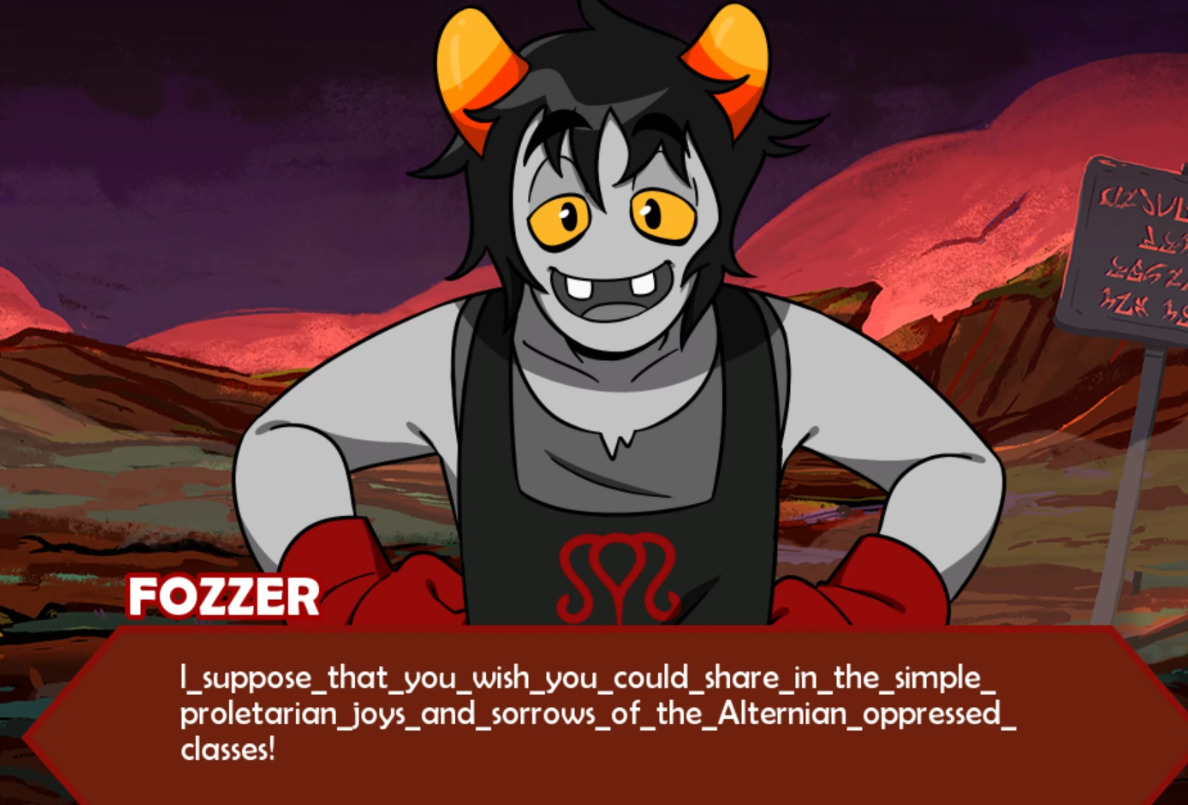
Fozzer outright identifying as a dialectical materialist is exciting for a couple reasons. There’s a lot one could say about dialectics and Paradox Space in general (I’ve been trying to write that script for about a year) but here I want to focus on the Materialist half of that, because it immediately reminded me a lot of @arrghus’ idea of the notional/material divide between aspects.
Ever since the Extended Zodiac, we’ve been wondering if the way the Aspect wheel is laid out might suggest some relationships between Aspects, either original to Homestuck, mirroring the relationships the Signs share in the traditional Zodiac wheel, or some combination of both.
Arrghus’ essay series proposes a model for how those relationships might work, at least in part. I’d suggest checking it out for the full picture, but here I want to focus on the divide I find clearest and most compelling: That between the Ideal/Notional Aspects and the Material/Physical ones.
The gist is this: The top five Aspects (Mind, Hope, Breath, Life, and Light) are more closely aligned with the World of Ideas, and so those bound to them tend to be more concerned with the ideal, abstract, and imaginary. The bottom five (Void, Doom, Blood, Rage, and Heart) are more closely tied to the material, physical, and real.
If you’ve seen my prior writing on Homestuck, you might note that this dovetails easily with Gnosticism’s old cosmology of reality as divided between an imaginary world of Light and a physical world of Darkness. That said, this isn’t a hard binary–Blood obviously refers to some concepts as well as physical experience, and Breath obviously links to some things that happen in physicality, even if those elements are by definition elusive and insubstantial.
Space and Time are an even split, as much conceptual law to be deciphered as they are physical element of reality to be experienced. It could well be that this reflects most strongly in the perspectives those Bound to each Aspect are given to, as opposed to an underlying reality of the Aspects themselves, and in any case all twelve Aspects are necessary to describe a full picture of reality.
One of the most exciting possibilities this model raises for me is the idea of Aspect “Mirroring”, which is essentially a different kind of relationship Aspects can have. Aspects that are Mirror each other vertically, for example, might express the same ideas through the filter of the Ideal vs. the Material–reflecting the hermetic/magical principle of “As above, so below”.
Heart and Light are a pretty good way to express the relationship between vertically mirrored Aspects, as it turns out. Consider:
Humanity gains the ability to access this world, the self-aware conciousness necessary to think, when the Goddess of Wisdom Sophia descends from that realm and imbues us with her Light–the light of curiosity, of wisdom, of the power to know. The light of the soul.
There are a lot of ideas and concepts that Dirk’s soul seems consistently inclined to express onto reality. The shades, the concept of “being a Bro”, the idea of the Hard Anime Dude, Stoicism, the pervasive homoeroticism innate to the Greek ideals he’s generally shaped by, etc.
The clearest example of this might be his sword, which is itself a physical object seemingly ripped directly out of the “fake” (read: imaginary) world of anime. An idea, made physical, through the sheer expression of will manifested by Dirk’s soul.
This is what makes his katana so powerful:
It’s quite near to being a physical expression of our collective idea of the “Perfect Sword”, much like Bro sets an impossible ideal of “Perfect Manhood” that Dave wrestles with living up to. This might give you an idea of some of the more direct ways Heart’s conceptual toolbox could be exploited or weaponized.
The point here is that just expressing the idea of a “Bro” is
extremely important to Dirk, and expressing the idea of “Cats” is
similarly important to Nepeta and Meulin.
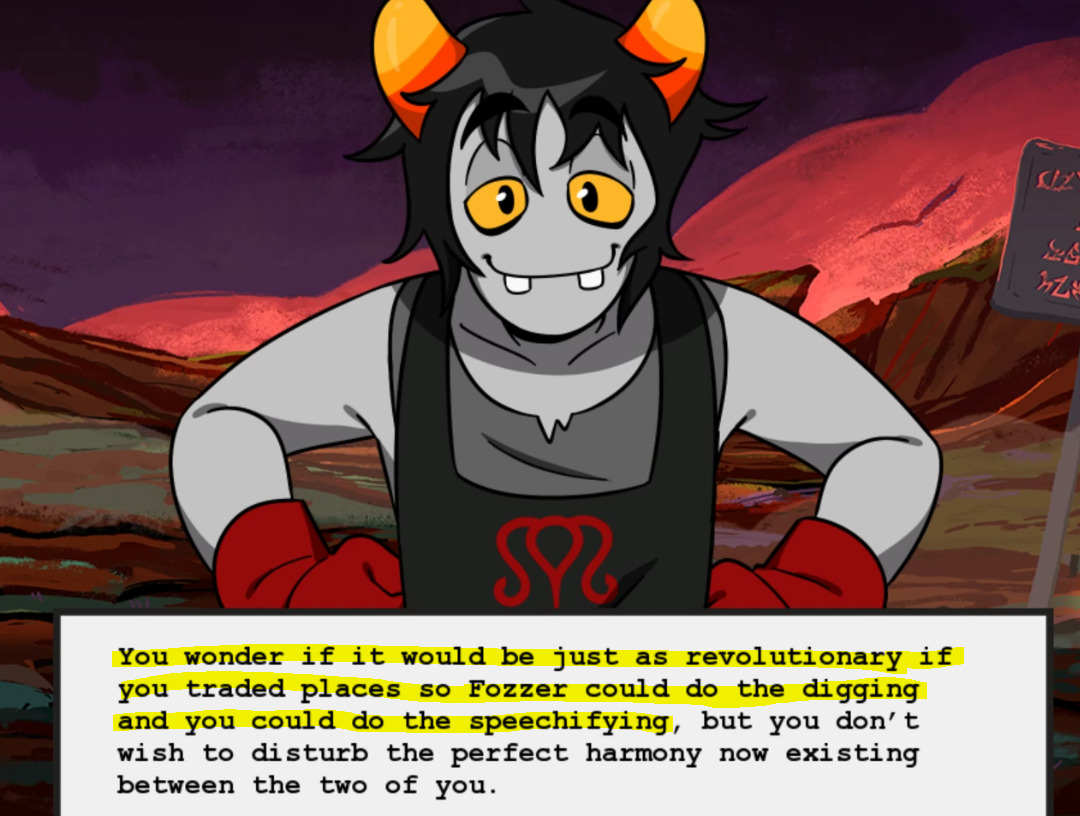
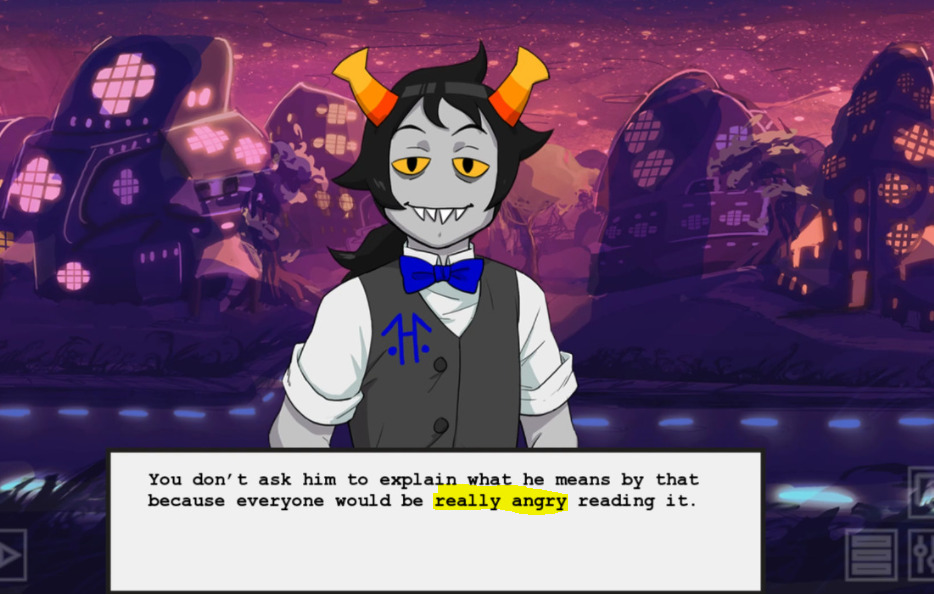
In the same way, Fozzer seems like an acutely intense expression of a political Persona. A philosophical idea, expressed in the physical world as an intense commitment to an associated identity. His shovel is an expression of that identity, much the same way Dirk’s katana or Nepeta’s claws are expressions of theirs.
But then again, Fozzer’s identity ain’t exactly stable, is it?
Before we talk about The Thing That Happens, we should note that as much as Fozzer seems to genuinely believe in his communist philosophy, he mostly seems interested in it as a means for self-expression, rather than an actual political movement with direct goals and results he’s looking to achieve.
And even though he’s very intense and earnest about it, Fozzer seems inclined
to exploit his own identity in somewhat self-serving ways.
Unintentionally or no, he more or less uses his ideological speechifying
to conscript the Reader into doing work for him, therefore inviting the reader to Serve him through Heart, for Fozzer’s own benefit.
This, coupled with his strongly noted cowardice, leads me to consider him a Page. But my real point here is that even if a lot of us here on Tumblr find Fozzer’s ideology appealing, Fozzer seems less invested in ideology proper than with the identity it comes with–and even here, Fozzer isn’t exactly being portrayed as unambiguously Good and Correct.
Even if he’s preferable to the alternative. Sigh.
Let’s talk about the thing.
[WORLDBUILDING INTERMISSION]
So the biggest surprise of this friendsim was that we stumbled onto what’s basically a swell of Scratch energy just…hanging out under Absence Park, apparently?
Which is. A lot. This energy resets our conversation with Fozzer and changes his personality, which we’ll get into in a minute, but first I want to speculate: How the hell does this thing exist at all, and what does it even mean? There’s a couple of possibilities.
Since this is essentially Time-coded Scratch energy we’re dealing with, @blindrapture pointed out that it could have something to do with the Handmaid, which I’d expand to include Lord English–and though I doubt it’s directly linked to Scratch himself, since he’s not too associated with Time the way the former two are, he may be aware of or able to use this…”glitch” in reality.
It’s also possible this is a natural consequence of a Scratch, and pockets of leftover Scratch energy like these are present in some locations of Post-Scratch worlds. For that matter, it could be a consequence of John’s retcon powers, which act like the scratch in some ways and might have had consequences we don’t yet fully understand.
Finally, given the language, I suspect that the hole in Absence Park is actually just a hole into the Void, leading to the Furthest Ring, much like Roxy’s windows. This Scratch energy seems to have entered the Furthest Ring, and is presumably writhing there until circumstances allow it to vent out through this particular entrance to reality.
What are the implications? Who knows. If this is a hole into the Void, then this is another avenue through which Hiveswap’s cast might be able to exit Alternia and find a new world.
If the Scratch outbursts are recurring enough, then we have at least one way for our heroes to “Time Travel” and basically save scum to try and achieve optimal desires results, like saving a troll friend who gets killed by going back in time for example.
That’s probably the biggest takeaway to me, because having a way to time travel built into Hiveswap’s text already makes me that much more sure that no matter what kind of carnage and brutality our beloved troll friends get subjected to, we’re ultimately headed towards a happy ending where probably nobody dies– I can reasonably see the possibility that even antagonistic figures like Ardata and even Trizza could be saved, under these circumstances.
Ok back to Fozzer.
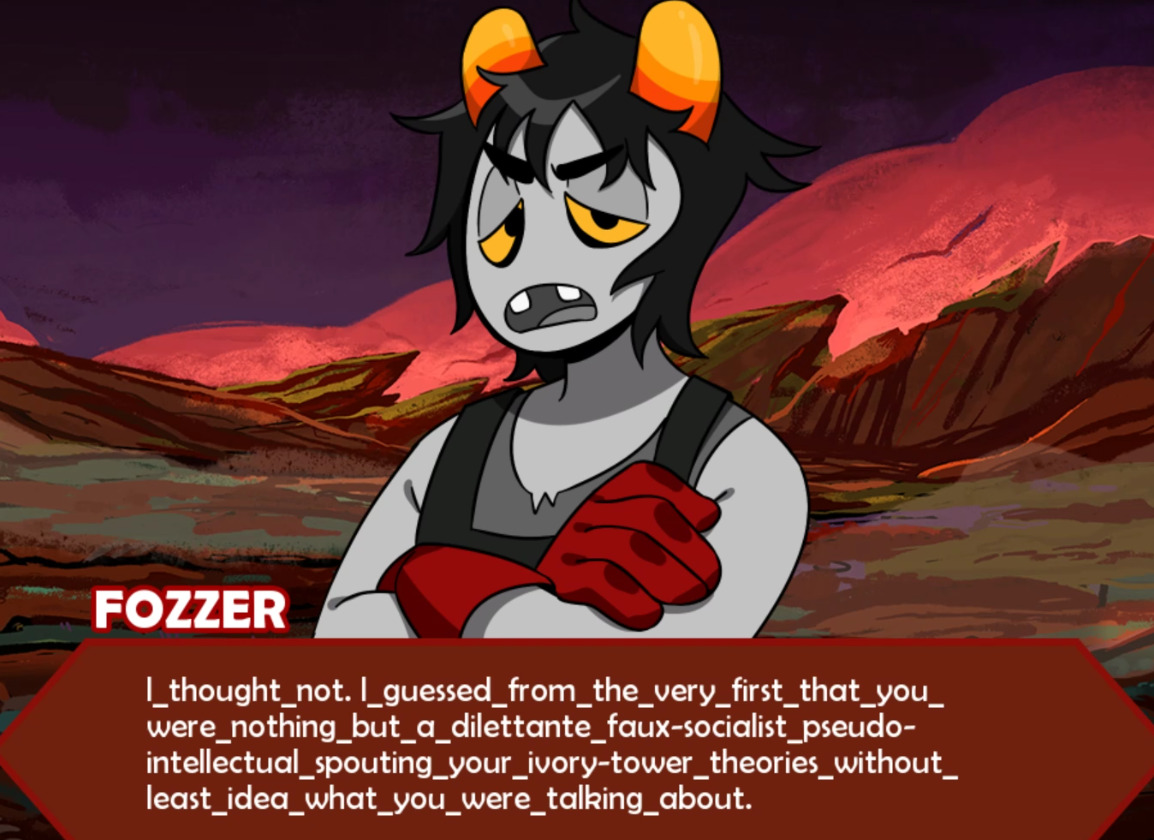
So the thing about “Post-Scratch” Fozzer is that I feel he’s being dismissed somewhat due to his admittedly unsavory politics. This still strikes me as a very genuine and direct expression of Fozzer’s Classpect inclinations.
Fozzer is still taking a very materialist view of reality here, for example–he’s interested in the actual physical history of how this system evolved, and considers understanding that history necessary to understanding society.
And however he disagrees with you, his instinctual response is the same. He storms off after verbally thrashing the Reader, but its interesting that he does it the same way both times: By imposing identities onto the Reader. Hilariously, Fozzer is unwittingly owning alternate versions of himself, too, and unwittingly inviting self-owns is basically the core of the Knight/Page aesthetic.
So really, Fozzer’s core personality is much the same–what’s taken place is a binary flip in the persona he relates to the world with. In one reality, he conveys the ideas of the hopeful revolutionary underclass.
In the other, he projects the identity of a happy and willing member for the Empire’s war-machine–the joyful slave, the pain of his own exploitation cushioned by a strong sense of societal purpose and identity. Note how the shovel easily parses as a strong symbol of this identity, too–a triumphant tool with which to serve the empire, rather than an ironic symbol of oppression.
I don’t think we should be hasty in assuming one Fozzer is more real than the other, even if we’re inclined to like one of them more. Especially since Fozzer works in Absence Park and seems familiar with these lights, meaning these scratch shifts might have been happening to him for a while.
The two Fozzers give us a fascinating window into the nuances of Heart, and indeed we’ve been told this sort of splintering of self can be common to the Heartbound by Calliope. Their opposing ideologies present us with a self-contained dialectic, in fact.
In Hegel’s understanding of the term, we can only truly understand an individual idea (say: Fozzer) by examining the tensions and similarities between these two opposed perspectives.
And these tensions are usually resolved not by one winning out over the other, but by achieving a Synthesis that combines he best traits of both.
Maybe because of that, I find the fact that we can only “win” by embracing the “Happy Slave” Fozzer unnerving. It’s hard to say how Fozzer’s path will evolve going forward, but given how central the idea of conflicting opposites is to his expression of his Classpect, I highly doubt we’ve seen the last of “Comrade” Fozzer.
So, I guess we’ll just have to see how it goes?
[Closing disclaimer: I’m not entirely sure how different Marxism’s Dialectic Materialist approach is from Hegel’s Dialectics. For instance, I’m unsure if it also uses the “Thesis”, “Anti-Thesis”, “Synthesis” model Hegel describes, or if I’m accidentally mixing the two.
Cursory Wikipedia research seems to bear this out, with Marx even describing Dialectic Materialism as simply the opposite of Hegel’s more philosophical and idealistic take on the idea, which Marx regarded as full of “Mysticism”. As a Hopebound more comfortable with the ideal than the material myself, I suppose its no surprise I find Hegel’s dialectics more immediately approachable and comfortable, for now.
What I’m saying here is, take everything I’ve written about dialectic materialism here with a grain of salt: I’m trying to do my homework and make sure I have the facts straight, but it turns out philosophy can get hard to sum up, especially when you’re trying to reconcile it with a fantasy metaphysics system. Feel free to clarify if I’ve messed details up. ]
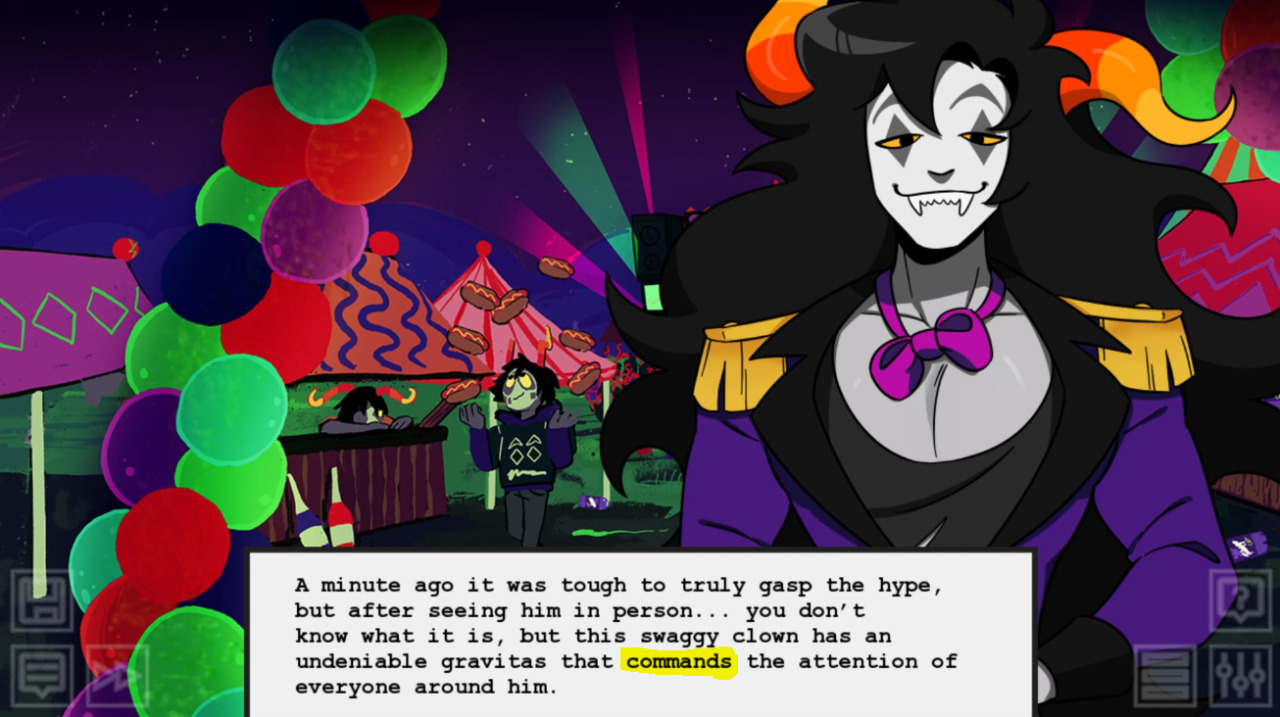
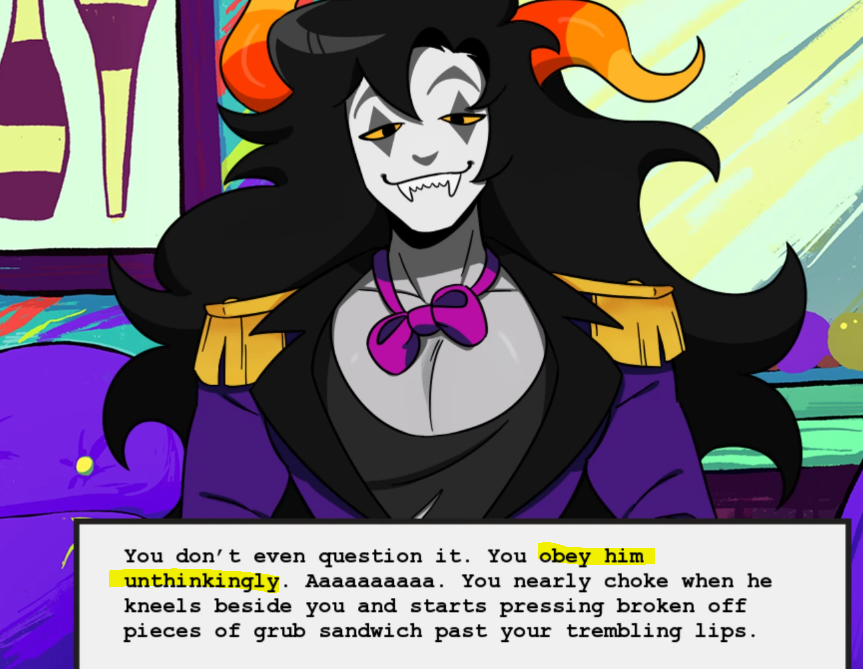
Command comes up with Caliborn like, a lot. Its also the name of the little arrows that connect every page of Homestuck. Every Command is a sort of direct attempt at mind control to the characters, as Hussie frames it–whether delivered by Exiles, the audience, or “The Author” himself.
The Muse seems inclined to wield that power through inspiration–once given a compelling enough idea, an actor can do nothing but work in relation to it, an artist can do nothing but work on it, as though they were possessed or enslaved.
The Lord seems to wield it through sheer dominance, or charisma–like a King who’s will cannot be denied.
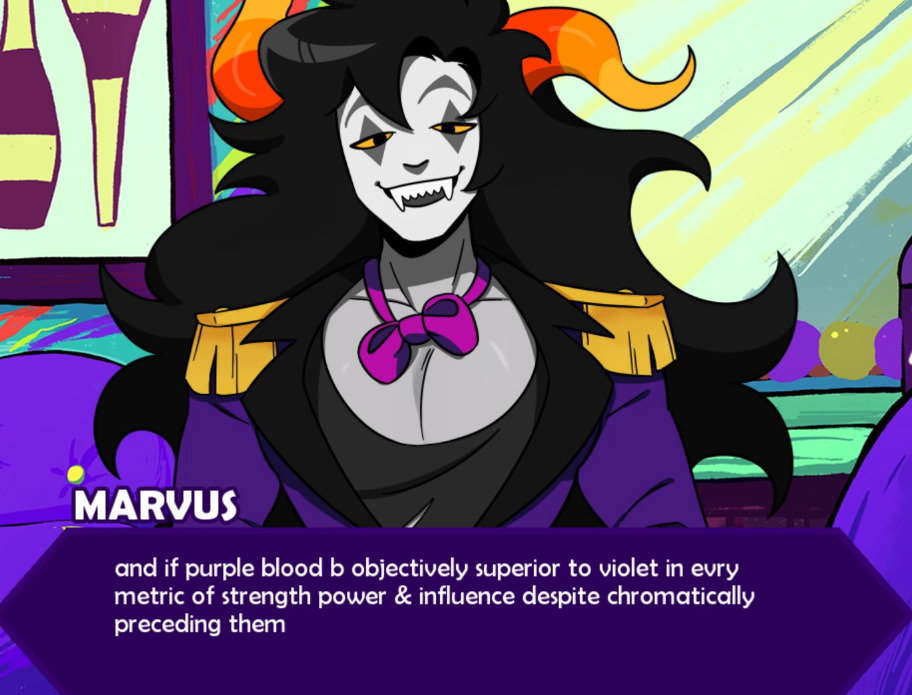
I’m sure I don’t need to explain how that relates to Marvus. Y’all know.
So let’s cover why I think he’s a Lord of Blood specifically.
Imagine my surprise when I took another look at the Church. Now, to be fair, this spiral was always there, so its not exactly unique to Marvus. Chahut brought us here first, after all.
But it’s notable that Marvus brought us here because he was somehow aware it provided metaphysical safety. It’s “Hallowed ground, bizznatch.” That could be simple religious belief, but Marvus is a little too aware of the nature of reality for me to buy that. He’s aware of the rules of PSpace in a way Chahut isn’t, and the spiral is one of the rules. So it feels somewhat significant.
Now I can add this nugget: This is also one of a few purple signs that feature a crucifix or cross in the design. Given that a crucifix figures prominently in his path, that also feels notable.
Even so, this is all pretty circumstantial and quite likely bullshit. Like I said before, Marvus seems to showcase a mastery of many Aspects, and so its difficult to really be sure I’ve got him pinned down, especially based on some hazy symbolism stuff we aren’t sure is relevant.
Even so, lets get to his Blood imagery, which I feel is pretty strongly emphasized in this route–more than any other Aspect, barring Rage. And into why I think its through Blood that he carries his most definitive command over other people.
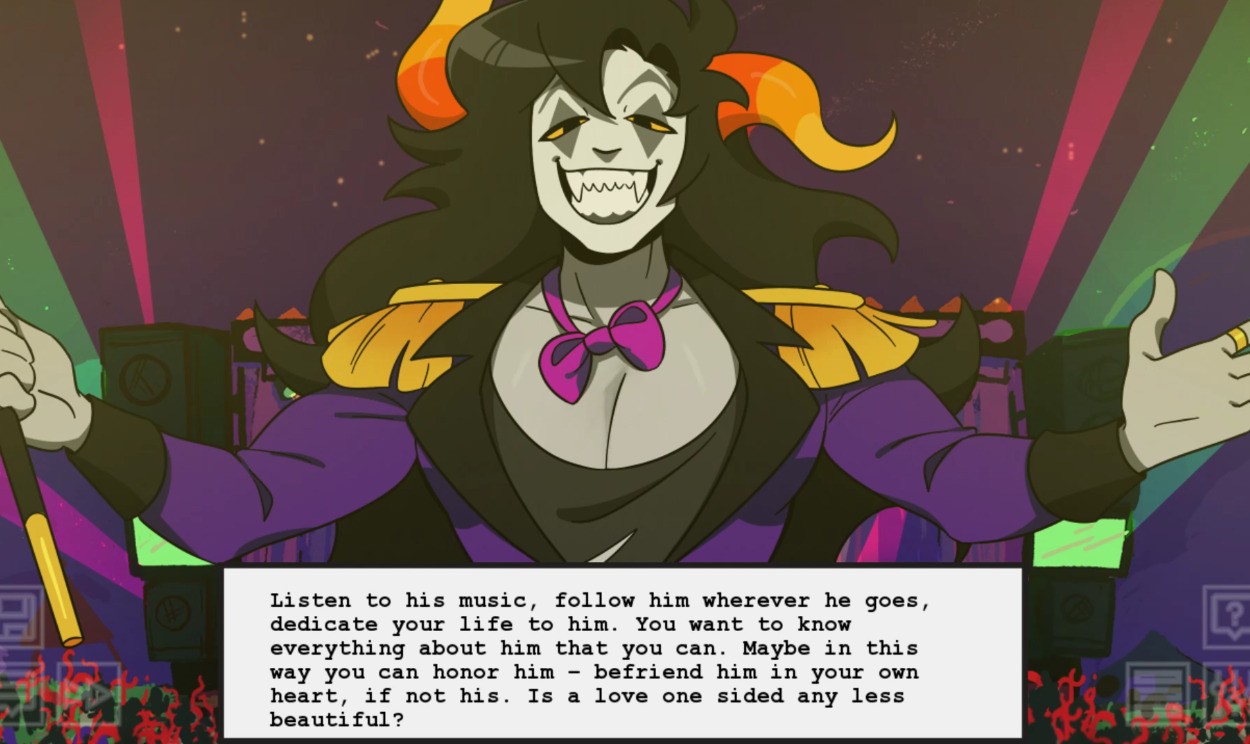
There’s a couple outright references to Blood early on, describing his effect on everyone around him. His very nature creates conflict, as the overzealous loving passion of his fans meets the violent restriction of his bodyguards.
These are classic Blood themes, all coming to the fore simultaneously.
Passion and commitment meet societal restriction, and the violence through which restriction is enforced. Blood flows in the wake of that conflict.
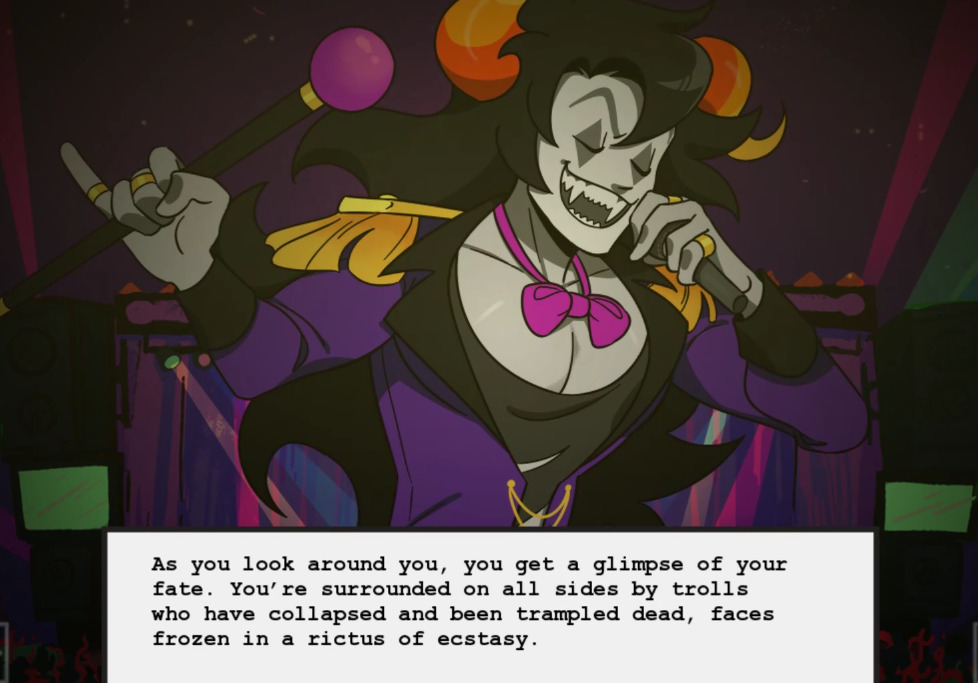
We see the conflict distilled during the concert. References to physical agony and mortal suffering are made, both of which are significant Blood ideas–the most recent example being Tyzias’ famous quote: “there’s so mmmmuch suffering.”
Though to be fair, that might have at least something to do with Zebruh. Blood may be associated with physical bondage and suffering, but Doom is quite literally the suffering Aspect, so its something of an area of overlap–Likely born at least partly from their close association on the Aspect wheel.
And the MSPA Reader of course falls into the romantic, committed, relationship-focused side of Blood–willing to do anything at all to share a connection with him.
The two ideas fuse at the height of his performance, as it makes the MSPA Reader keenly aware of their physical suffering and subjects them to enormous violence and agony, whilst paradoxically keeping them spellbound to the mortal plane where they’re experiencing it. Violence, suffering, commitment, relationship.
Later, the MSPA Reader directly takes on Blood’s violent enforcer position, punching out teens desperate to establish a relationship with Marvus.
And Marvus doesn’t just absently invite these dynamics. He’s keenly aware of both the commitment to a relationship with him his fans experience, and the social obligation he would be subjected to as a result of it, unless the performance is violent enough.
He’s also deeply cognizant of the social restrictions imposed on Purplebloods as a caste, and the various forms of literal and institutional violence through which they’re enforced.
As well as the revolutionary implications of subverting or questioning those restrictions. In other words, Marvus has a deep understanding of the social glue that holds Alternia, a vertical structure held together by repression imposed from top to bottom, with blood spilled through brutality the whole way down.
But of course, understanding doesn’t make a Lord. Command does.
I’ve long said that Paradox Space is a place born of the wills of the individual, and it could be said that what the classes describe, more than anything, is the means by which a Hero most effectively applies their will to reality to achieve any given desired result.
This is what makes Lords and Muses so powerful–they shine at understanding the capabilities and inclinations of everyone around them, and more than anything, controlling and directing the other to achieve their own desired result. A Page might inspire others to serve them and rise to Kingship through their devoted teamwork, but to a Lord this innocence is unnecessary:
Be it freely given, manipulated or coerced, a Lord is supremely talented at dominating, and getting others to give them exactly what they want. When Marvus’ presence suggests silence, the silence is absolute among all blood castes. When Marvus wants his audience ready to turn up, they are so fucking ready. His every request is undeniable, and his will is others’ command.
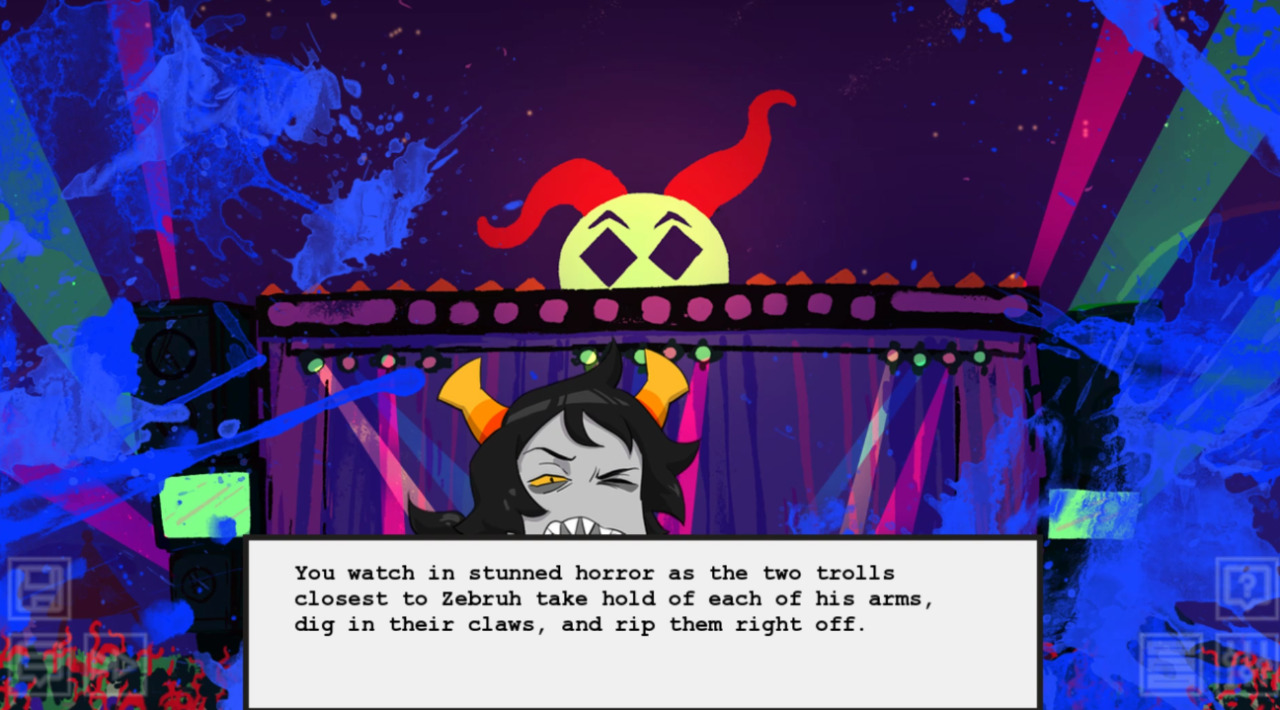
What makes him scary is that he knows how to use that power. What he does with the Player’s execution is actually pretty clever–he pulls off a small magic trick, simply pretending to stab them. The illusion would fall apart under the most cursory scrutiny, but Marvus knows that doesn’t matter, because he’s working his real magic on the audience.
Marvus knows exactly how his stage will be segmented, and all he needs to do is kickstart a cascade of violent euphoria amongst the lowbloods, who by their structural disadvantage are too far away to tell the difference. (Interesting that the tealbloods are singled out as the rough origin point, considering their Mind association and how vulnerable Terezi was to Gamzee’s Rage-y predation.)
Even any highbloods who figured out what he’s up to are screwed, trapped by their own lucky blood closest to the stage and under his net, where they must fight if they want to get out alive. But nobody does. Once the climactic bloodbath is finished, nobody survives.
Which Marvus expected would happen. He told us so earlier. If Marvus isn’t literally massacring his fans with every performance he gives, he’s doing it during enough of them that it doesn’t feel much like hyperbole. And he does it effortlessly, through a simple understanding of how to move the crowd the way he wants to, like the ringmaster of a circus or the conductor of an orchestra.
This is one hells of powerful clown–frightfully intelligent and ruthless when he deems it necessary, even under the niceguy suave wokeness. Joey’s going to have a powerful ally on her side if they team up. Though I can’t help but worry that the old Purpleblood capriciousness might have him turn on us if the circumstances are right. Or, his ruthless pragmatism could make him end up feeling like a bit of a Vriska.
Probably both are gonna happen. Oh well. Anyway that’s why I see him as a Lord, and one of Blood specifically. Don’t hold me to it because frankly, if I’m really honest, there’s only one train of thought with Marvus that I’m really committed to:
He’s really hot and I’ve been the naughtiest, so frankly he can–
It’s an understatement to say that Marvus is a lot. He’s so much, in fact, that I had to split my thoughts about him into two posts from the get go. This got predictably long as hell so catch it under the read more.
This first part has to do with how he evokes various themes of Rage. I don’t think Marvus is Ragebound, but he seems to be the first direct evidence we’ve gotten that the Aspect influence of each Blood caste doesn’t necessarily have to manifest negatively.
Marvus seems to be so self-actualized and self-aware that he’s successfully reconciled and incorporated Rage into his identity, regardless of his true Aspect. Indeed, I’ve seen compelling arguments for Marvus as a Light, Hope, Mind, Heart and Life player so far–besides the personal impression I came away with of Blood.
He reminds me a lot of Doc Scratch, in terms of being someone who is so competent that they successfully blend and blur mastery of several different Aspects. Scratch wields virtually infinite influence through at least Space, Light, Rage, and even Time and Heart depending on how you look at it simultaneously, for example, which makes it hard to really assign him a true Aspect.
Marvus is obviously not that extreme, but given that he’s presumably a mere mortal in the end, he might be substantially more impressive. Anyway, lets get to noting the Rage references.
Obviously Its interesting that they start well before Marvus himself shows up. This has to do with the Reader becoming more aware of the nature of their reality as artificial/unreal/contrived, though, and that’s important to note for what comes next. For now lets keep it in mind and move on.
Zebruh, of course, inspires Rage through his “clowns are woke” comment, this time through simple anger. Of course, we’re inclined to think of Zebruh in terms of Doom and maybe Void, right? So maybe its a coincidence…
…but, huh, there it is again. Mentioned by name this time, no less.
This gets at an interpretation of Rage I’ve been meaning to talk about: Rage as a passionate spurt of fashion. The definition for this idiom, “all the rage”, says:
“The current or latest fashion, with the implication that it will be short-lived, The use of rage reflects the transfer of an angry passion to an enthusiastic one”
When something is highly fashionable, it generally involves a lot of passionate reproduction in the realm of physicality-whether its an object, like Zebruh’s scooter, or a particular kind of performance.
Things like sports seasons, for example, are a kind of performance that comes about every so often, generating intense passion and fervor when they do. This is why I see Xefros’ interest in Arena Stickball indicative of his Rage inclinations.
In the same way, both the traveling circus and the music festival are fundamentally events of the moment, and when they’re in town, they draw our eyes to artifice, meaningless (if fun!) spectacle, and when they’re good, hearty guffaws or empassioned bellows–all things associated with the Comitragic heart of Rage.
Zebruh’s designs on Marvus also evoke Rage. He asks us to engage in a theatrical performance (one centered on Black feelings, no less–Kissmesitude itself is inherently linked to Rage via Kurloz and Gamzee).
It’s pretty odd that Zebruh is so taken with Rage, but I think that’s simply the nature of Marvus’ performance–and perhaps tells us a bit about how Aspects shift and spread through individuals. Zebruh is thinking entirely about clowns, purplebloods, and Marvus specifically, and that seems to influence his actions–and so is really everyone in attendance at this dark carnival.
As a refresher, cults to Dionysus generally involved people–usually his female attendants, the Maenads, (who you might remember from Chahut’s last name) entering states of ritual madness and tearing animals or sometimes even humans apart with their bare hands.
Which uh, you know. Might have some parallels here. Just maybe.
I’m thinking its a possibility that Zebruh is inheriting Equius’ Orphic legacy here, just as Marvus is inheriting Gamzee’s Dionysian one.
Ok everyone should be about gone by now which means we can finally stop talking about Zebruh, just you and me. Finally.
Let’s cover some other things Dionysian worship tended to cover. Dionysus was also the god of religious ecstasy, which I think we see in the intense, deific love Marvus inspires. He’s also an entity of sexual transgression–much of his worship included orgies, and included in his male attendants were the Satyrs, goat men with perpetually erect penises described as “archetypal musicians and dancers”, associated with the breaking down of traditional values.
I think this is part (but not all) of the intense horniness that surrounds Marvus. Moreover, most of that horniness takes a pretty specific bent. It’s not just that people are horny for Marvus, but that he inspires some intense and very physical reactions, usually involving things we culturally see as debasement, degradation, and filth.
In other words, the specific kinks invoked through Marvus generally fall in the camp of things that are likely to outrage or disgust the audience, and so I’m ascribing that to his Rage influence as well.
I am well on record as describing Hope as the “horny” Aspect, but it’s worth noting that as its complement, we have precedent to see Rage as pretty horny, too, and in precisely this way: It brings to mind Gamzee’s bouts of necrophilia or profoundly upsetting approach to expressing his sexuality with women.
And of course, he’s putting on a performance of artifice and illusion for his fans–his show’s as much Theater as music. He even tricks them into thinking he killed you, sending them into a frenzy (ritual madness) that has them all tear each other to death. But more on that later.
The most important way Rage manifests in Marvus is through his deep awareness of the theatrical, metatextual artifice that is The Friendsim itself. Like Gamzee before him, Marvus is aware of the nature of the story he’s in. He rivals Boldir or even Davepeta in his understanding of the implications of this, even.
But where the Heartbound tend toward an existential/spiritual focus on
the fates of the characters locked in the narrative, Marvus devotes his
awareness to dissecting the meaning and mechanisms that underpin this
entire narrative framework.
He transgresses against the rules of Paradox Space itself, and insists
that there is meaning even in the paths that seem most meaningless.
Interestingly, even the way he thinks about PSpace feels Ragey:
He says it doesn’t matter if a path is completely contrived and illegitimate–acknowledging a state of being as unreal can still inform how you interpret reality, and so choose to act upon it. The awareness of unreality can be a source of power in itself, as well as a source of confidence and motivation.
So for example, acknowledging Homestuck as unreal/artificial could have allowed Gamzee to interpret himself as immortal, or at least informed his choice to reject Homestuck and follow Lord English.
Or one could be Marvus, who is empowered by this awareness–I’m sure it’s easier to perform for crowds of adoring fans when you’re aware you’re in a video game in which you’re a pretty major character–and still choose to be the exact opposite of Gamzee. In the face of unreality, he chooses to be a friend and a comforting hero. Which is why hes bae.
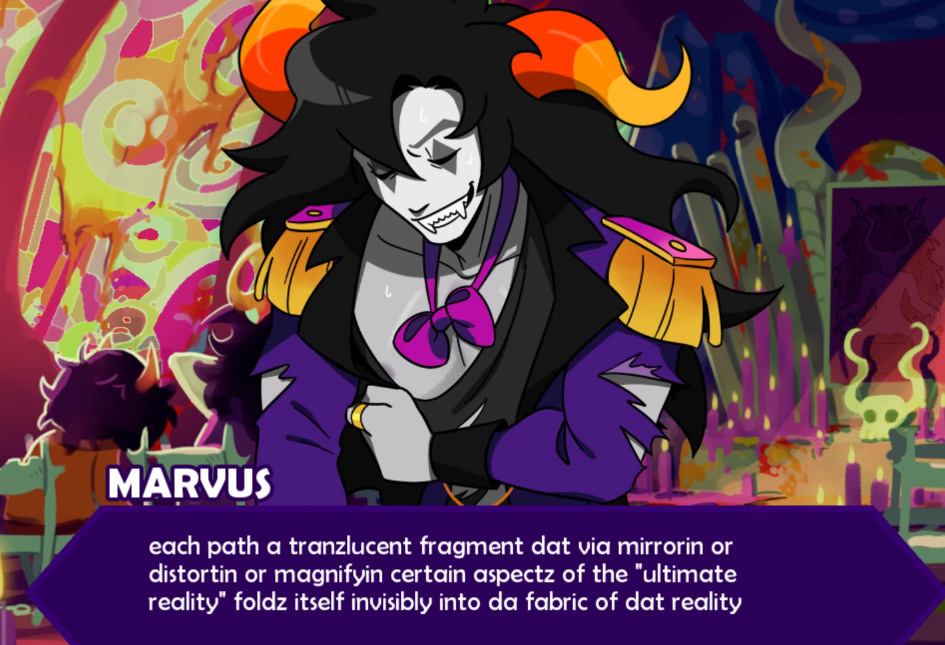
Mirroring, Distorting, Magnifying–these are all tools of theater, of jokes, of circus acts and the deliberate construction of art and narrative.
Marvus is suggesting that any individual timeline expands the meaning of Paradox Space as a whole by exaggerating, paralleling, or subverting different elements of how we see it, and putting new elements of each character and the setting into focus as a result.
And he argues that wearing down or violating continuity can itself bring that continuity into sharper focus. By “defiling” the story, its the shape of its integrity is further defined.
This is terribly exciting, because its basically Marvus straight up saying that plot holes and contrivances are another element of Homestuck’s story, and that is absolutely crucial to understanding how Lord English attacks the characters, the audience, and Homestuck itself.
Every little thing Gamzee does or manipulates others into doing that pisses us off and makes us further question whether Homestuck is worthwhile or a pile of dreck is being directly acknowledged here as explicit and intentional.
Hell, his actions have the exact payoff he claimed they would–we’ve fundamentally learned something new about the nature of Paradox Space because of what he’s done. It actually CAN come undone around the characters, provided they’re resistant enough to dying or dissapearing as a doomed timeline demands.
I previously believed that was impossible, and that timelines in Homestuck simply faded out naturally when players went to sleep instead–meaning there couldn’t be any Gamzees who didn’t go to sleep and merge with the Alpha iteration of the guy. That presumption is now in question.
At the same time, we can now be pretty sure that those hypothesized Schrodingers Gamzees out there never turned into horrorterrors, since we know what happens when someone resists the pull of a doomed timeline and it’s…not that. So that old bit of fanon is that much more questionable.
Now we have new questions, like: Why did this doomed timeline collapse so quickly, as opposed to say, Dave and Rose’s, which lasted four months? And so, through this singular violation of the rules of Doomed timelines, the grander design that informs them has come into sharper focus.
By far the most interesting thing he says though, is this. This is. A lot. let’s try to unpack it. Basically, he’s saying even an incident outside of canon contributes to a wider fandom metaconciousness.
So for example the Game Over timeline isn’t canon, but we still know that when Jake reaches full Hope power he can summon Brain Ghost Dirk, and that even after Dirk breaks up with him, Jake thinks of Dirk as his boyfriend. So that is meta knowledge that we all hold, even though it didn’t happen in the “canon” timeline. Alright. Simple enough.
But then he suggests that that metaconciousness is built by, and might even be defined primarily by, the various interpretations held by those who observe the event, and the discussion where they exchange those ideas afterwards.
In other words, what defines the metaconcious reality of Paradox Space is…us. The audience. And the various interpretations of meaning we derive from what we’re witnessing, whether canonical or non-canonical. We’re the ones who tie it all together, in our heads and through our conversations and relationships with each other.
The album’s lyrics describe the leader of the Carnival, who serves as
one of the judges of one’s soul in the afterlife, as being created from
the listener’s own evils.
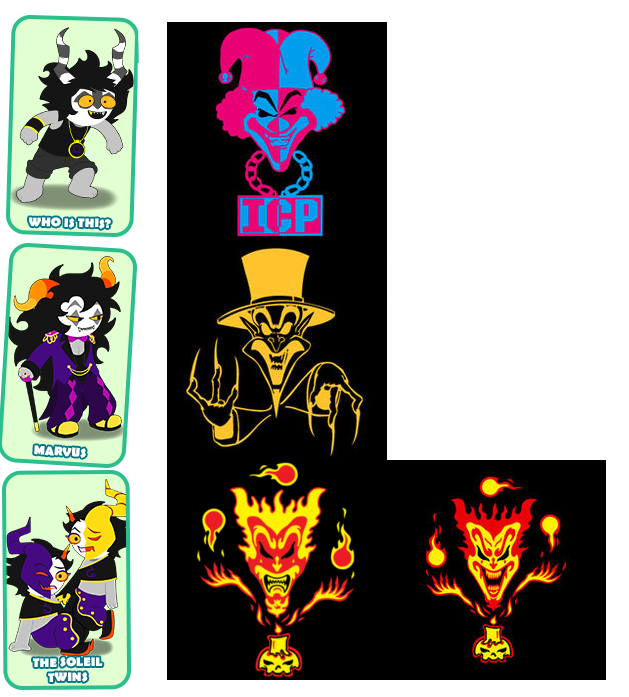
When I read that, it reminded me of “The Ringmaster”, the juggalo Joker Card we’ve been associating with Marvus in my patron server. The juggalo card suggests that the leader of the carnival is created by “The listener’s own evils”, and in this context I think we can trade “listener” for “audience” and “evils” for general thoughts. Paradox Space as it exists in Homestuck/hiveswap is created by our thoughts.
But of course there is a bigger ringmaster than Marvus out there. Is it worthwhile to consider that the true judge of souls in Homestuck’s afterlife–Lord English–is born from our evils himself, in some way?
Dunno. It’s all a lot to think about. For now, this wraps up my discussion of Marvus’ extensive links to Rage, so join me next for a discussion on what I’m certain is his Class–Lord–and my personal guess at his Aspect–Blood.
Hey guys, this time around we’re looking at the impact of Guardians and Ancestors, two distinct kinds of parentage in Homestuck. In the process, I outline how I think the Roleplay mechanic works as per Homestuck’s Classpect system.
Let me know what you think!
Here’s some links to other writing I’ve done on the subject of Roleplay:
Karako’s most emphasized attribute is his youth, Caliborn is identified by his eternal immaturity, and Porky Minch and Bastian (the two characters who most seem to infliuence Caliborn’s Lord status) are also either defined by an inability to grow up, or deal with a possible failure to do so, respectively.
And Karako does seem to operate pretty much off instinct, much like Caliborn.
That the Reader is left to carry on his will to punish the
Horror-Terrors is particularly compelling–the Reader has to make the CHOICE(Mind) to follow Karako into death, and getting onto the carousel is their reward for doing so.
As an ask pointed out back when we were talking about Boldir, we might expect circles to pop up in relation to Lords as well as spirals, and indeed circles pop up with Karako in several ways. His symbol contains a circle, and the dog tag his symbol is printed on is a gold circle itself. @wakraya also pointed out the cans can be seen as Tallcircles which seems like a stretch but still, worth noting.
But the most interesting circle in the Sim is definitely the Carousel. What we’ve got here is a circle, a wheel, that spins endlessly, always
pulling the horses that exist within it around and around. They’re bound
to the wheel, stuck in it.
Much like everyone who exists in the circle of LE’s causality.
I think this has its roots in LE’s nature as a Demiurge, and so a direct
offspring of “Abraxas”, the abstract God that we could see as Paradox
Space itself.
Abraxas is always depicted with twin snakes pulling in different directions, and in this notable depiction, the snakes themselves are pulling/guiding horses along.
To me, this evokes Caliborn and Calliope exerting their twin influences on the narrative, with the horses representing individuals living under their influence.
Whether it’s a psychic projection of Karako’s or some kind of afterlife (and we’ll come back to that question soon), the Carousel seems like a pretty succint presentation of the Mirthful Messiah’s entire Lord English-centric religion.
We’ve got the conflicting tragic/comic masks, Gamzee raising Caliborn
(red sun, green background) and Callie (green sun, red background), and
of course a wheel/circle that many horses are bound to.
Its interesting to note that this makes it pretty clear that the Mirthful Messiah was a seperate and distinct figure from Callie and Caliborn in the cult’s doctrine–it is specifically Gamzee, not the cherubs or LE’s later incarnations.
Of course, Callie isn’t really being worshipped here–the carousel is an altar to LE, not Abraxas.
Yaldabaoth was real big
on being known as the “one true god”, and being himself unaware of the
higher orders of God who created him. It’s unsurprising that his cult
would be lacking that higher-order imagery, and would place its highest
emphasis on the symbol of LE’s looping dominion.
The Dream version of the Dark Carnival that Meenah and (Vriska) visit in the dreambubbles is empty and lacks the historical frills describing Gamzee and Callie, but the religion’s most important symbol, the Circle/Carousel, remains. That’s the most prominent recurring memory.
(Aside: This might answer why horses are so ironic–horses bound/stuck to a wheel are a prominent symbol of LE’s dominance, and free horses running as they please are a suitable undermining of his symbolism.)
(Aside x2 combob: Akio Ohtori from Revolutionary Girl Utena is a Yaldabaoth figure quite similar to Caliborn, and his power/dominion too ends up being depicted through carousels. Chalk it up to shared gnostic symbolism I guess, but still, odd coincidence.)
Back to Karako.
Its worth noting that coming into conflict with highbloods/high
class members of troll society was one of the few things we were
expecting from Karako-it fits the motif of his Joker Card–oh yeah, a
bunch of the purplebloods in Hiveswap seem to match Joker Cards from the
ICP’s albums in their designs:
“
The first Joker’s Card, Carnival of Carnage (1992), is a representation of the ghetto and the violence that occurs within.
It takes the form of a traveling carnival which doles out the same
brutality on those who have ignored the inner cities’ cries for help. The Card issues a warning against the upper-class and government’s negligence toward the lower classes.”
So yeah. That line of inquiry seems to be checking out so far. Really there’s a bunch of parallels between Juggalore and the Mirthful Messiah cult/LE in general, but I happen to know someone else is working on that, so I’ll leave it there for now.
Now to what is to me, the most interesting part: the vision of the carousel itself.
There are two possibilities here, I think:
1) This is a psychic projection Karako’s putting out in his dying moments. Its a quick vision meant to provide some small moments of comfort before they die.
2) I think more likely, we’re getting a glimpse into how death works in Paradox Space, absent dreambubbles. It seems likely to me that this is a dark carnival afterlife createdby the collective unconscious of Alternia and, specifically, it’s fervent cult of Mirthful Messiahs.
Karako was led to it because he’s part of the group that collective consciousness recognizes–ie: it’s likely a burgundy would be rejected as one who doesn’t belong, or led somewhere different in Alternia’s collective consciousness. The MSPA Reader was recognized because Karako recognized them, specifically, and was able to extend his afterlife’s promise to his friend.
Either way, we have no way to know and there’s more interesting questions. I’m struck by the fact that considering this is a promised afterlife of spiritual fulfillment, the vision we see is distinctly non-spiritual--in fact, it’s deliberately artificial.
There are angels, but they’re mannequin props strung up by string. There are happy inhabitants, but they are also mannequins made of wood. It’s like a theatrical parody of an afterlife, depicting the physical presence of holy attendants and subjects, but not the spiritual/magical influence that makes them true.
Basically, it’s a very Rage-y afterlife–it’s theatrical, it’s artificial, and above all it’s physical, not spiritual or magical. It all reminds me very much of the concept of “Maya” from various Indian philosophies–including Hinduism, from which we got the name “Makara” for Gamzee.
How Maya is treated by different cultures varies, but the basic gist is of
a magical power of illusions, of creating real, physical/material things that don’t actually reflect spiritual reality. To quote wikipeds:
The thing is that according to this framework, basically all of physical existence, or at least quite a lot of it, is ultimately Maya and thus illusionary. Physical existence is might or might not be “real”, but it is constantly changing, and so does not reflect spiritual, eternal truth.
I’ve suspected for a long time that at its core, the nature of Chucklevoodoo/Rage powers stem from an ability to manipulate the experience of Maya.
Chucklevoodos employ illusions that are physically real (the Jack Noir doll in John’s room, or Dave’s dream copy of Lil Cal), and inspire people to be afraid/paranoid/angry–binding them to their physical experiences of the world.
Enlightenment in these Maya-centric frameworks generally means becoming one with these eternal principles of spiritual truth, and thus moving away from Maya/physical reality and the fear/confusion it produces.
So here’s the thing: That’s pretty much exactly what the MSPA Reader begins to experience after Karako is killed.
They come into awareness of the fact that everything they’ve been experiencing on Alternia, everything about Paradox Space, is kind of profoundly unreal.
Which it is! Because its just a story being told to us, the players. They seem to become very aware of this unreal/illusionary nature to their own existence and that of the world of the Friendsim.
And instead of continuing to treat it as real/something to be afraid of, the Reader chooses to stand up for moral virtues, generate them into the world themselves.
And as they move on from the illusionary world of Alternia, they’re rewarded by becoming aware of an eternal, universal, spiritual truth:
Friendship.
Of course, the MSPA Reader is still on their path. If they’re going to keep up this metatextual evolution and eventually reach enlightenment, coming to understand the true nature of their own existence, then there’s a lot more to learn. (Here’s hoping Lanque will teach them (and us) something about Astrology, Alchemy, and Aspects.)
What I’m wondering is, how much longer before they start becoming aware of the part of their reality that is well and truly outside of the visible realm? How much longer before the MSPA Reader becomes aware of us?
So, wow. Looks like shit got real all of a sudden, huh? We suddenly understand jack shit.
This is what keeps me in Homestuck, god I love this stuff. Let’s talk bout Boldir a little bit–needless to say, spoilers for her path under the cut.
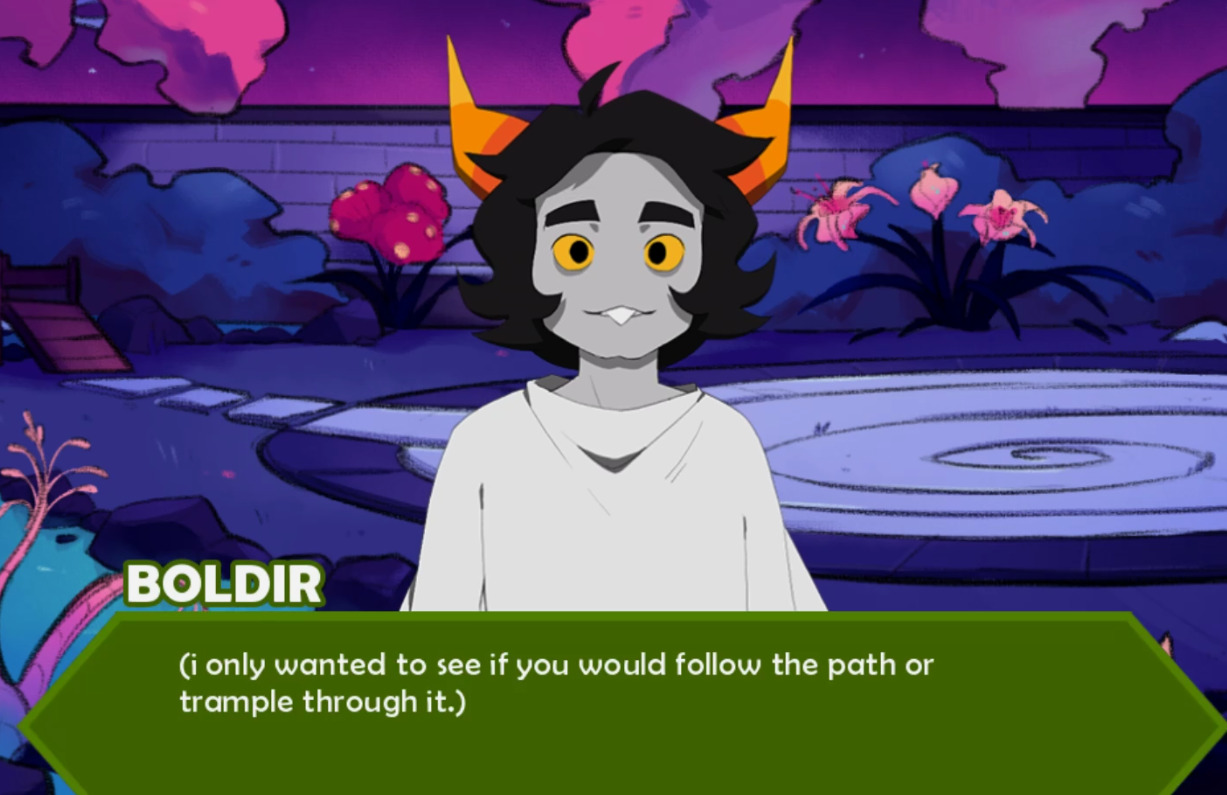
First things first: Yeah, I have no idea who this is, either. I suspect it might be Boldir herself, given that she suggests she has some knowledge of what happens when someone dies. “You’ll sleep when you’re dead”, “If only”.
The only other party who seems likely to have this kind of metatextual awareness is Doc Scratch, but this doesn’t really feel like him to me. It could also be the MSPA Player themselves, I suppose? We’ll see.
Onto Boldir! I agree with @banavalope‘s opinion that she’s a Muse, and seeing someone else came to that conclusion independent of me and the crowd talking on my Discord made me feel that much more certain. But since I feel I have some stuff to add here, let me run through the evidence I’ve compiled for this view.
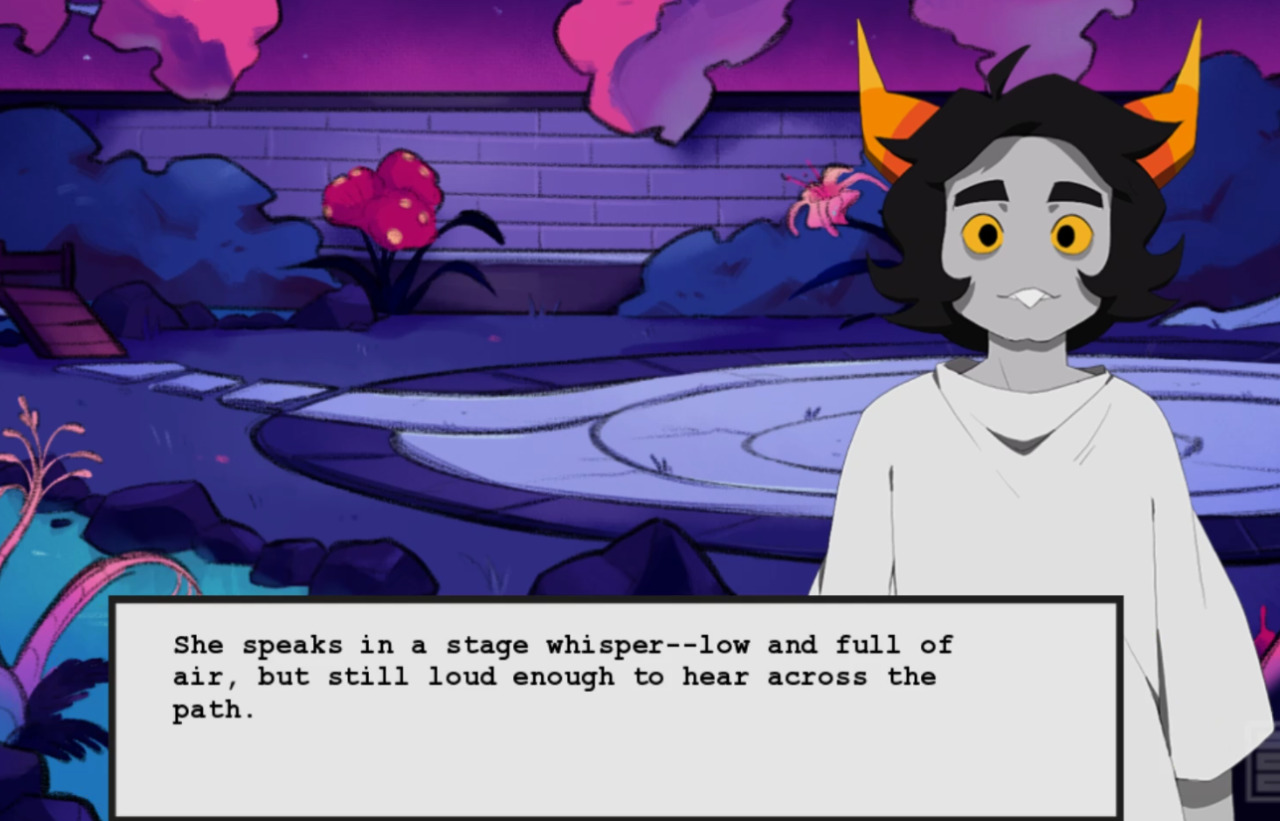
There are a couple of lines in her text that seem to echo Calliope; she speaks in a “stage whisper”, for starters, and whenever Stages and Theater references come up, they seem to feel associated with Caliborn, Calliope, or the Rage aspect via Gamzee.
Paradox Space itself is a Stage, and both Calliope and Caliborn find microcosms of that stage on their journeys, using it to tell and define parts of Homestuck.
From her Stage, Calliope invites Jane and Jade to tell us the story of John claiming ownership of his absolute power over Homestuck’s reality. From his Stage, Caliborn tells us the story of how John used that power to unintentionally make Caliborn’s wish to become Lord English come true.
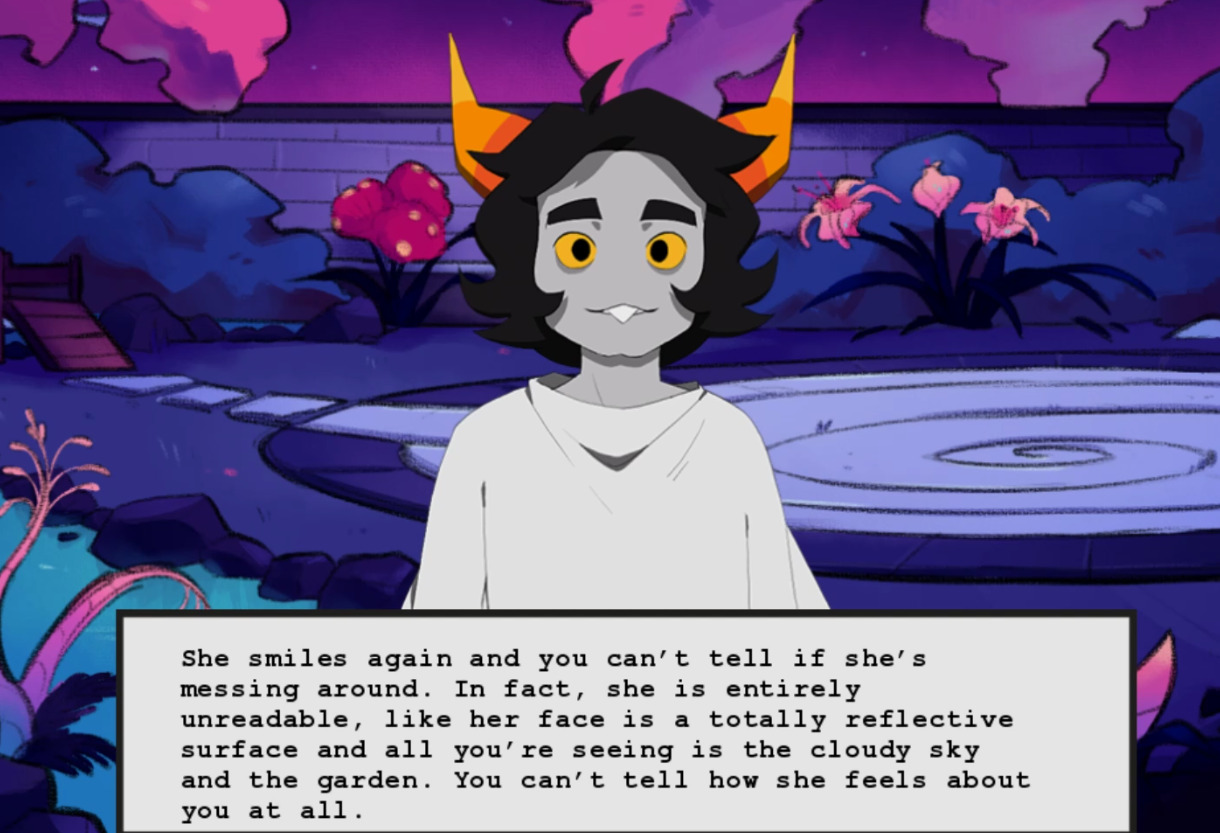
This section of text also reminded me heavily of the Childlike Empress from The Neverending Story, the uber-Passive ruler of the realm of Fantastica, who was described as reflective and somewhat unreadable/incomprehensible in the book.
To be fair, this has as much to do with Boldir’s nature as a Heart player as anything else–it’s very evocative of Dirk’s unreadable stoicism. But still, Boldir’s unreadable “essence” paints her as something like a mirror of the world around her–the garden, the sky, all of it. And that reminds me very much of Calliope, who was herself a mirror of her environment.
Alt!Calliope grows stoic and straightforward when surrounded by nothing but absence and purpose, and Alpha Calliope’s personality and nature is defined by her experience with Homestuck.
Both Callies, however, had a deep intrinsic understanding of the macrocosmic, metaphysical principles on which Paradox Space operates-and Boldir has that in spades.
She seems to have a sense of what happens after death, she’s aware that “Fate” is a force being created by particular forces in Homestuck/Hiveswap, and that the MSPA Player has more leeway in the river of those powers than most. This makes her a unique sort of threat to Lord English and Doc Scratch, who rule over fate on Alternia.
Like Calliope did for the Alpha kids, Boldir uses this awareness to at least partly clue the MSPA Player into their own role, pulling them towards some important part they must play.
What that’ll mean, we’ll find out later, but she’s told us some very interesting things.
1. The Friendsims are taking place within the context of a Paradox. This
is important, because it means there’s at least one stable time loop
defining the narrative, just like there was in Homestuck.
That means the entire story exists diegetically, under temporal constrainment–we see
the events that we see because they’re the events that fulfill this time
loop. Much like in Homestuck, events that conflict with this loop probably cause doomed timelines due to the paradox failing to fulfill itself.
And if that’s true of the Friendsims, its also true of
Hiveswap. I already had reason to suspect this was true, but it’s nice
to see someone in the actual story talk about it.
This suggests that the MSPA Player, and by association Joey and our other heroes, are parts of an event of cosmic importance that must come to pass in order for them to ever have existed.
The importance of the plots of Hiveswap and apparently even the Hiveswap:Friendsim are similar in nature to that of Homestuck, which was necessary in order to create the world that these stories take place in.
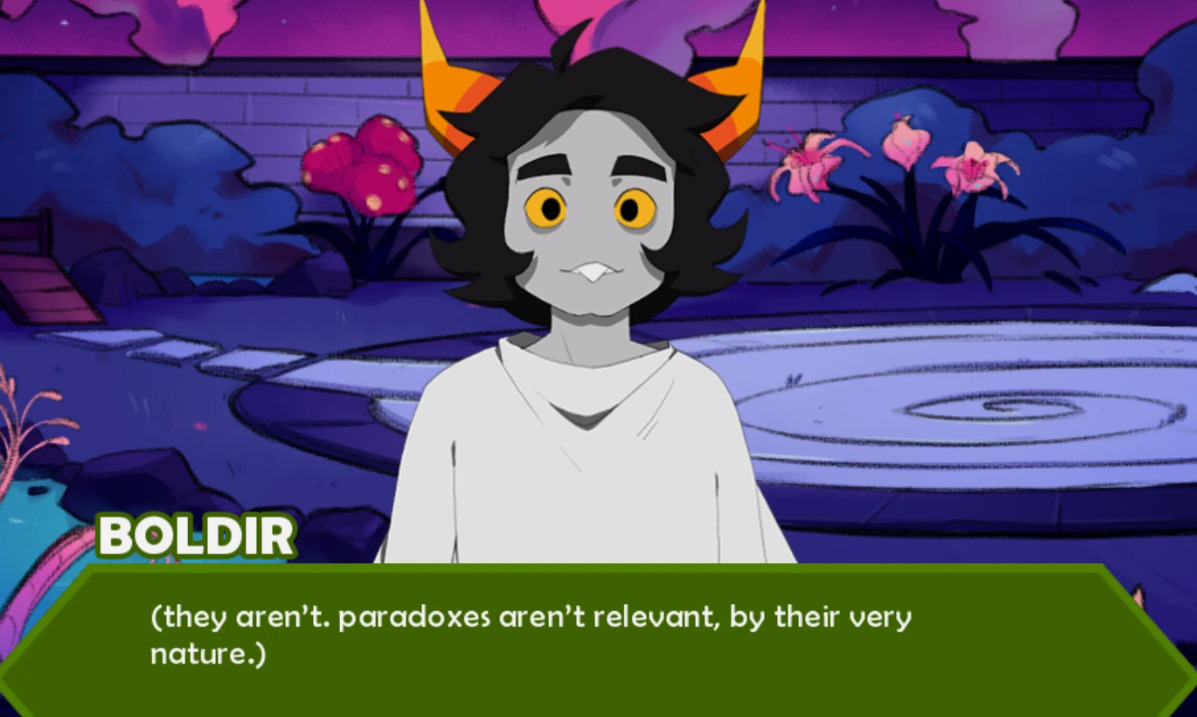
2. Paradoxes are inherently irrelevant. This is honestly Boldir’s most interesting line to me, because Paradoxes define everything about Homestuck–but particularly, everything about Lord English and time travel. To say they’re irrelevant is to link them to Void by nature, isn’t it?
I’m honestly not entirely sure what the implications of that are, and if I were to ramble about it this would turn into a totally different essay, so I’ll talk about it later, but this is a very profound statement to make about the nature of reality in Paradox Space. I’m about to vibrate so hard my molecules come apart you guys.
For now, just ponder the question: Paradoxes defined literally the entire plot of Homestuck. If they aren’t relevant, then what is?
That said, also like Calliope, despite her immense and intimate wisdom with regards to the nature of reality, her understanding of its scope is such that she seems inclined to see herself as unimportant and irrelevant in the face of it.
I’m not sure I agree with Bana that she dabbles in every Class (though it does strike me as possible), but she certainly seems quite adept at playing a Rogue.
There’s a lot of Outlaw motifs surrounding Boldir; she lives outside, under a tree, she’s competent at Stealing and committing crime, and she’s pretty much as outside of the social order as you can get on Alternia without being a seadweller.
I’d expect Rogue roleplay from an Oliveblood, since I suspect that as a
Caste they’re mostly ignored by society, rendering them inclined to act
like Outlaws–and indeed, I’d say Polypa and Konyll both have shades of
it.
But in Boldir’s case that role is neatly compartmentalized–its clearly something she can psychologically put on and take off, not the core of her identity. A hat she wears, so to speak.
But The MSPA Player cites Boldir exuding a “sneaky aura”, so I see this as the very Muse-like passive nature of Boldir’s identity/heart/soul influencing the world around Boldir, in like with her current intent to stay outside of society’s sight, as the role of the Outlaw implies. Again, it reminds me of the Childlike Empress, and how nobody in Fantastica would think to hurt her.
Of course, somebody does hurt Boldir, and when she dies it seems to change or shift the world in some way. Again, Childlike Empress vibes–Fantastica literally relies on the Empress’ existence. If she dies, the world of Fantastica goes with her.
Now this whole time I’ve been sidestepping the most direct connection to Calliope, which is Boldir’s relationship to the Spiral. It’s fascinating, to be sure, but most of what there is to say about the connection has been said already, I think.
1. If there’s a Muse character among our ranks, there may well be a Lord to match. Caliborn was linked to his own spiral, so we may assume such a link between Spirals and our hypothetical Lordling as well.
2. The spiral is represented in Boldir’s sign itself.
Meaning if there is a Lord, we might be able to find such a spiral in their sign, as well.
3. There’s a Purple Sign that seems to match this criteria–Capricen has a spiral in it’s design, which curls opposite to Lelo even. One sign is Prospit–matching Calliope. One sign is Derse–matching Caliborn.
So if there’s any merit to this stuff, Capricen just rocketed to the top of the charts as far as my guesses for the True Sign of the mysterious Marvus Xoloto.
I’d already kind of suspected Marvus might at least roleplay a Lord, by virtue of his role as circusmaster. Caliborn is described as a ringleader to his own dark carnival, and if Marvus “runs the shitshow”, its only in Lord English’s shadow, since he’s the one who truly runs the show, after all.
We’ve also got a theater reference in his Troll Call, to Shakespeare’s “A Midsummer Night’s Dream”. To be fair, Marvus is a Purpleblood, and so has a certain connection to Rage and thus Theater, so this might not be indicative of Lordship. And Blood might be represented by the line “texting your sister”, since it’s the Aspect of relationships and social connections.
There’s not much else to connect Marvus to Blood, but it’s worth noting it would make a lot of sense for a hypothetical Lord character in Hiveswap to command the story to his whims through Blood.
Trizza and Dammek are both Bloodbound, and if one wanted to pull all the strings in this story, having power over both of them would be a good way to get there. Alternia’s a pretty damn Blood-heavy society in general, what with all the Suffering and social constrictions and interest in romantic entanglements.
All of which is to say, if this is true, Marvus would be quite fearsome indeed.
That’s all I’ve got for now, but damn, am I excited. Lemme know what you all think!
Til next time,
Keep rising.
[Final Notes that didn’t fit in anywhere else: Boldir’s the only troll we’ve ever seen wear
white and without her identifying symbol at all–other than maybe Doc
Scratch.
Ardata and Marvus hide their signs, but they’re also higher on the social ladder, so its an interesting bit of her design. Wonder how important that’ll turn out to be.]


































 Flying through Storytelling