Here’s the script version of the last two videos on Gamzee, btw, for anyone who prefers reading to watching stuff. Part 3 has its own script that Patrons have access to, I’ll post that later.
Needed to post this now since I’m writing something related I’ll be dropping soon, probably tonight. Stay tuned :o)
Oh yes, I’m glad you brought this up. Me and the pals in the patreon discord talked about Orpheus a bit after this Dionysus stuff came out, and I think there are two solid ideas to consider.
The first is we should probably keep an eye out for an Orpheus themed troll in Hiveswap, since the story you mentioned is one of the more notable stories Maenads are involved in, so uh…we might be able to expect such a character might have trouble with Chahut. RIP @ that hypothetical guy, probably.
But it’s also possible Orpheus’ analogue is Already Here, in this guy:
We won’t get to this in video for a while, so lets just get into it here.
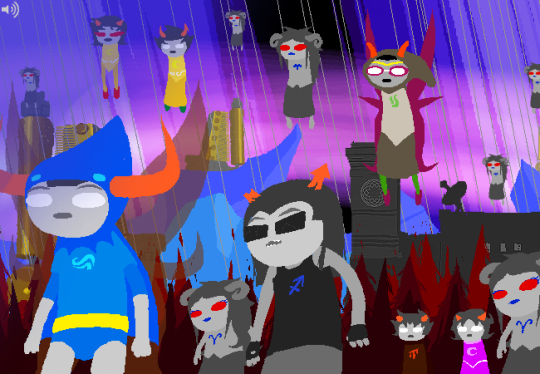
Gamzee kills Equius right when Equius turns his back on the Highblood’s ideology, and tries to stop Gamzee from murdering the lowbloods. So there are some legit parallels. An obvious issue here is that Orpheus is killed by the Maenads on Dionysus’ behalf, but there’s a couple things to consider.
Gamzee also enters the scene of Equius’ murder wearing Terezi’s shades. Dionysian imagery plays into Gamzee’s treatment of Terezi already–Satyrs were known for “breaking down traditional values”, a good example of which is…Law.
So uh. That puts a new spin on all of Gamzee’s mockery of courts of law whilst pitting Terezi against Vriska. And his literal breaking down of Terezi–emotionally across the meteor, and physically before Game Over.
+ given how Gamzee basically dragged Terezi into his juggalo cult, I think we can–to an extent–read her as an unwilling Maenad, and so Gamzee identifying himself with her symbol here seems relevant.
Back to Orpheus, though. You’re right to point out the similarities between Orphic and Dionysian traditions–both were apparently mystery cults, fitting both the secretive nature of the Mirthful Messiahs and the unknowable nature of Void.
Orpheus in general comes off pretty Voidy–his mythology seems to feature a lot of water imagery, fitting Equius’ sweat motif, for example. But apparently, some held that Orpheus was a mortal version of Dionysus himself:
“Here his death is analogous with that of Pentheus,
who was also torn to pieces by Maenads; and it has been speculated that
the Orphic mystery cult regarded Orpheus as a parallel figure to or
even an incarnation of Dionysus.”
Which is certainly interesting because part of Dionysus’ myth is being ingrained in Zeus’ thigh until he grows to reach maturity. This “becoming part of the Patriarch God” narrative evokes, to me, Gamzee and Equius both becoming one with AR/Caliborn, who are both stand ins for Yaldabaoth, the sun-branded Demiurge described in Gnostic mythology.
Void is the counterpart to Light, the aspect of the imaginary, the Humanities–the realms of thought. So ‘Thoughtless’ feels particularly Voidy here, especially since it causes a return to depths. Memory and Forgetting pretty clearly tie into Light/Void respectively, too.
I might be reading too much into the wording here, but the basic parallel stands–Equius doesn’t die to find Aradia, but his stint in the underworld coincides with dating a bunch of Aradiabots, and when he returns to the world of the living it’s without her, as…
A version of Yaldabaoth/Zeus, with a side of Orpheus/Dionysus attached. I’m not totally sure I buy this reading–if we were talking about any Aspect besides Void, which is literally linked to vague and unknowableness, I’d want to feel a lot more certain. Its possible there are other deities that might reflect the Zahhaks better.
But this seems pretty fitting to me, so I thought I’d raise the curiosity.
What do you all think?
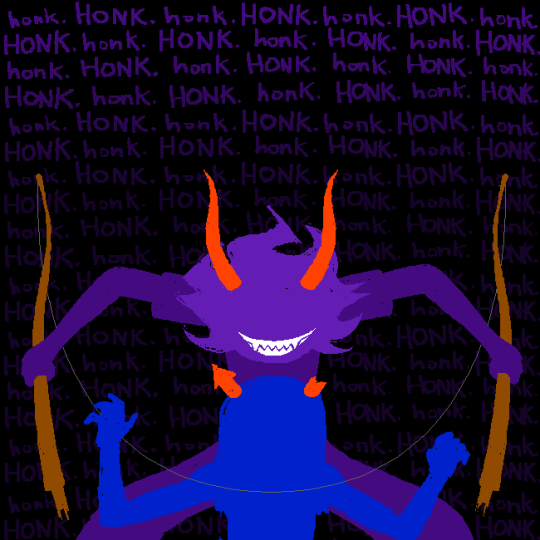
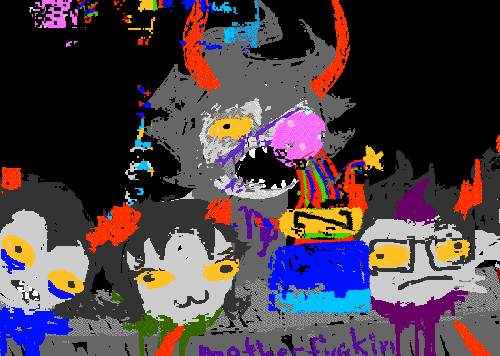
This time we dig into Gamzee’s recurring links to the masks of Comedy and Tragedy, historical worship of the Greek god of Theatre, Dionysus, and what all of this tells us about Gamzee’s arc and, potentially, even the Rage aspect.
Today’s question is: Can you think of other trolls with strong ties to figures in Greecoroman/Egyptian/Judeo-Christian mythologies?
In this episode, we take a closer look at the God Tier power-up system, and its various perks. I also make a case for understanding God Tier powers as being an innate inner power of the players, manifested through their wills and thoughts, rather than a power-up granted to them by the game.
This means I argue that every character uses their Classpect powers throughout their lifetimes, whether or not they actually make God Tier. It also means a player can develop God Tier-level powers without actually being God Tier.
God Tier tends to grant players power because experiencing the messianic death and rebirth of the heroes’ journey tends to make people feel more like heroes, and so more able to self-actualize–NOT because doing so arbitrarily unlocks their superpowers. In other words, I argue God Tier is a shortcut to Heroes’ inner potential–not a requirement for it.
This warrants a closer look at examples of characters in Homestuck typically considered not to be good “examples” of their Hero Titles. I provide some examples of how I understand such characters, as well–including Karkat, Nepeta, and Gamzee.
Lastly, this understanding ties Homestuck’s take on psychic powers to that of it’s namesake, Earthbound–and suggests the possibility that Hiveswap’s characters could well develop God Tier-like powers, too.
Please feel free to discuss and question these ideas in the comments. I’m sure we’ll be revisiting your responses sooner or later, and I’m very curious as to how this video will be received. Thanks for reading, and keep rising!
Hey, chums! In this episode of Hiveswap lore, we take in the lives and times of Joey Claire’s absentee father, Jake Harley! Doing so gives us some insight on why this man abandoned his kids, and what the future looks like for both of them.
Soon, we’ll ask deeper questions as we learn about Pa’s evil stepmother, the alien girl Pa remembers as a deer, the mysterious prophecy Joey and Jude may or may not be subject to, and how all of these might relate to the cult Jude sees across the yard–and the clowns Joey sees at school. Stay tuned.
“Cumulating Dreams”, by Jeremy “Solatrus” Iamurri (feat. Clark Powell on cello) https://homestuck.bandcamp.com/track/… art by Kat (Nyanface) at nyanface.tumblr.com
In this episode, we cover The Alpha Timeline–the anchor of Homestuck’s plot. The understated rules that guide Homestuck’s time flow tell us a lot about the way Homestuck’s story functions, and the stakes it involves. Let me know what you think in the comments! 😀
Hey, guys! In this video, we dive into Classpects in a little more depth, focusing on the recurring symbol of the Witch’s Familiar. We also take a look at every case of Witch roleplay we’re currently aware of, and note how characters who roleplay as Witches always seem to end up with Familiars themselves.
We’ve gotta start with the fact that as the third Hope player, Jake is subject to a magical prophecy passed down from Cronus. All three Hope players roleplay Magicians at some point.
Eridan and Jake both use Hope to force an enormous amount of emotional labor out of a Life player. And both Eridan and Jake piss their respective Life players off so much they revoke a symbol of mutual friendship. Eridan does this by using willful ignorance to keep his belief in a legacy of destruction, and then selfishly choosing to destroy Hope to save his own skin.
Jake is more complicated. He actually foreshadows his own behavior when he tells John about his Grandma in his letter, back in Act 4. It’s telling that tells John he likes to be honest, because he’s anything but for the first half of Act 6.
Jake uses willful ignorance to get what he wants without having to be honest about it. In so doing, he ends up keeping secrets–not just from all his friends, but even from himself. Only the part of his brain that takes the form of Brain Ghost Dirk is fully honest about Jake’s true awareness of his surroundings.
Secrecy comes fairly naturally to a Witch. Jade’s plan in its entirety is shared with no one until the end, Damara is secretive and cryptic about her actions, the Batterwitch is noted for her secrets, Feferi doesn’t fill anyone in on the nature of her bargain with the Horrorterrors until after she’s already Dead…so on.
This seems to be an element of his Grandmother’s Jake emulates, but it doesn’t come naturally to him. He mentions that secrecy wears on him and leaves him feeling jaded, which is exactly how he ends up feeling about his relationship with Dirk.
Jade: Becquerel (Space) Damara: Lord English (Time) Feferi, The Batterwitch: Gl’bolyb (Life) Rose: The Horrorterrors (Void), Doc Scratch (Light)
The interesting thing is, the relationship between a Witch and her Familiar always seems to be described in terms of Service. Serve is the verb inherent to Knight/Page, with Knights often Serving for the benefit of others, and Pages often benefiting from the service of others.
It’s from Dirk that we get the best description of Witches’ Familiars, as he describes the relationship between Gl’bolyb and the Batterwitch.
And as it happens, it’s also an excellent description of the sum total of Jake’s experience of Dirk, himself. Which is fitting, because Dirk is also an intense roleplayer–one who roleplays a Knight.
Brain Ghost Dirk is the manifestation of Jake’s faith in Dirk as both his personal bodyguard and his secret weapon–a window into how Jake sees Dirk at his best. Here he parallels Bec saving Jade from the meteor or from imps. While Bec is powered by Space and Dirk by Hope, the image is of a devoted, hypercompetent protector.
Jake’s faith also has a hand in creating AR, however, and Hal becomes the interpretation of Familiars as foreboding and controlling figures. This Dirk most reflects Gl’bolyb imposing its will onto the Condesce’s desires, or Lord English imposing his onto Damara’s.
ok so i totally failed at making that quick or short but that’s the loose gist of it. I could write a lot more but i really need to learn how to make these points concisely so i am hoping this is short and concise enough to get the point across.
Hey guys! This time we take a look at the Dreaming World. We take a look at the way the Dreamselves of the players serve as useful tools to both the Players and the Game itself. We also learn about the warring kingdoms of Prospit and Derse, how their distinct cultures rub off on and affect the players, and how they relate to the different Gods that influence any given session of Sburb.
I don’t do analysis of classpects like, one by one, because honestly it’d be way too time consuming. I do write about Classpects as part of my analysis of Homestuck’s characters, however, since I regard both the true Classes and the characters’ various attempts at Roleplay as important sign posts for how to read their character arcs.
I should also mention the video on Xefros covered about half of the article I actually wrote about him. Had to be a ruthless editor to keep the video at a watchable size. So here’s that, along with my Hiveswap writing on:






 Flying through Storytelling