Seeking truth through conversations on Love and Fandom
Tag: My MSPA Analysis
Hey, chums! Here’s the next episode of Homestuck: Explained!
This time we take our first step into The Incipisphere, Homestuck’s main stage.
I’ll be honest and say this video probably won’t have much new information for you old hat Homestucks–but it should be a great introduction to the Inicipisphere for the new fans I am excited to welcome, as we get ready for the ancient seal on Hiveswap to be broken and a new age of the fandom, unleashed.
I’ve got a couple more videos down the pipeline, and we’ll be opening Patron voting on the next series of Homestuck: Explained videos within the next week, so stay tuned. That’s all for right now.
Not enough of the fandom is interested in how Classpects may play into Hiveswap, I think. We’ve gotten lots of hints at the player’s potential Classpects, but there’s a lot of skepticism as to whether Classpects will even show up at all, given that the game doesn’t center around Sburb.
I’m here to argue that they’ll definitely feature in some way. And luckily for all of us, whether or not I’m right here will be incredibly easy to prove!
Our case study will be Xefros Tritoh. But before I explain how we’ll scrutinize Xefros to determine whether or not I’m full of shit, I’ll need to talk about three things:
In Homestuck, when characters are particularly inspired by or moved to imitate rolemodels, that tends to show up in their mechanical behavior as Heroes. What’s more, such acts of imitation tend to come with references to the specific Mythological Archetypes that inform the Class of the Role-Model figure.
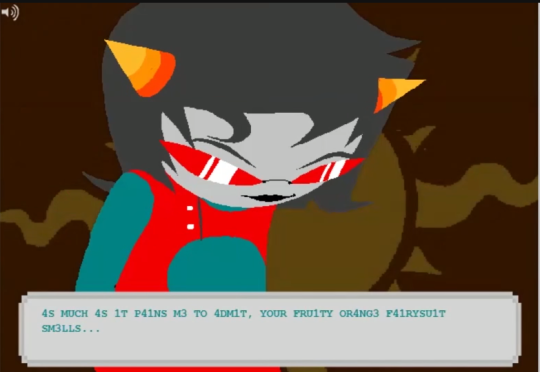
The Troll Ancestors are essentially our introduction to this concept, and there is no clearer example than Vriska. For all of Act 5, Vriska strives to emulate Mindfang in all things–and at the same time, Vriska is consistently depicted and referenced as a Fairy. You can see one such reference above.
So Maids and Sylphs are fairies, according to the Class system. But Vriska is a Thief, and attempting to live out the role of one. One important factor in the Roleplay system is that Roleplaying this way is often misguided and unhealthy, and that players are typically at their happiest and most powerful when playing to their innate strengths.
Compare Vriska’s attempts to make Tavros stronger to Aranea’s effort to do the same for Jake. Both end disastrously, but it’s hard to deny that Aranea had an easier time getting the job done.
We’ll talk about Knights (and Pages, by association) in a bit, but for those of you curious, here are the Archetypes for the other classes that have them:
The first thing Serve classes are prone to doing is Serving their enemies in brutal defeats.
The second–and nicely bringing us into a description of Neophyte Redglare, Terezi’s mythological idol–is the providing of Service.
Knights are prone towards helping others and serving others’ needs through the use of their Aspects. In Redglare’s case, that means that everything she does is at the behest of the Highbloods–even if she doesn’t agree with their ideology.
All the Knights we see in Homestuck adopt a code of honor of some sort, in that they hold themselves up to very high standards of behavior based on a persona they construct in their heads.
For Dave, this is the image of the cool dude. For Karkat, it’s the ruthless leader. For Latula, it’s the R4D G1RL act.
In all three of these cases, the Knights primarily use their personas to distance themselves from their emotions and force themselves into positions of responsibility, even if they’re uncomfortable with their own competence or don’t really want to carry out a particular duty.
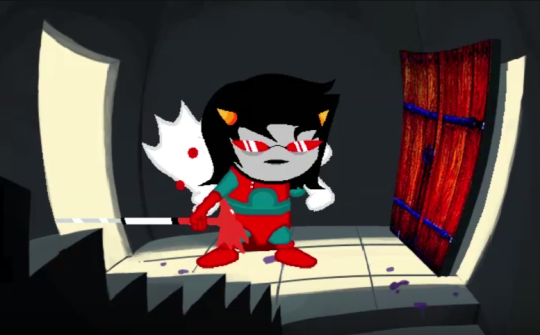
Which is exactly what Terezi does when confronted with the need to kill Vriska! Terezi buries her feelings about Vriska and decides that eliminating her is simply the professional way to resolve the problem–choosing to focus on performing her role as Redglare instead of thinking about her own feelings.
Terezi’s Redglare roleplay, however, might even go farther than the three true Knights–since it even includes a literal code for how to act as a Warrior, that she uses to determine when killing was acceptable. This code of honor is, of course, Terezi’s idea of JUST1C3.
And once Gamzee manipulates Terezi into fully embracing her Redglare persona, Terezi is visually cast as an echo of another Knight– [S] Seer: Ascend acting as an extended visual callback to Dave’s [S] Dave: Ascend to the Highest Point of the Building. Seer: Ascend even starts off with Dave’s symbol!
And the end result of this roleplaying is, of course, as disastrous for Terezi’s being as Vriska’s Mindfang roleplay is for her.
Passing judgment on Vriska leaves Terezi doubt-riddled and self-loathing for years because her true inclinations as a Seer were not to try and go to war for the sake of Justice, but rather to pry, inquire, and discover the truth about Vriska’s nature and feelings. That roleplay misled Terezi from her desires and needs in this respect shows how much of an impact it has in the narrative.
Hopefully this overview gave you an idea of the logic behind it, and if not hopefully looking at other examples I’ve written in the links above–such as Rose as a Witch, Jane as an Heiress, or Dirk as a Knight– will illustrate further.
Now. Let’s get to Xefros.
Xefros is interesting here primarily because of his interest in Butlering. The Butler is the second Archetype that informs Knights and Pages, and it covers the Service connotation as well, but it also includes last definition of the Serve verb:
To give. As a counterpoint to Thieves and Rogues–who Take–Knights have a tendency to give others their Aspect, or give others things through their Aspect. Much as a Butler offering a plate of food. Davesprite giving John a hammer with Time powers is a prime example.
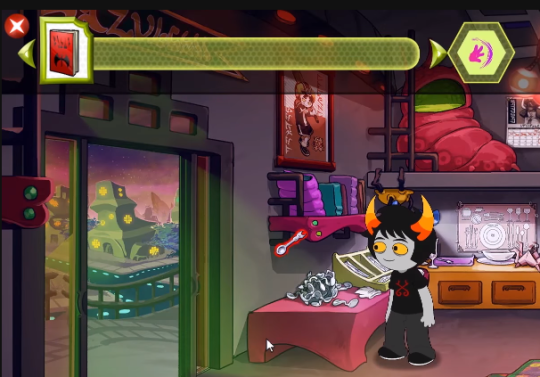
And on top of being interested in one of the biggest symbols of a given Class in the comic, Xefros also comes with one free FLARP manual, it seems. Flarp being the same book that marked the impact of Roleplay and Mythological Archetypes on Vriska and Terezi, this is relevant to me.
So my premise is simple. If the Classpect system has any weight in Hiveswap, odds are very good we’ll see Xefros display similarities with Knights in some way.
(I say Knights and not Pages because Pages seem to have a knack for inspiring those around them to do the serving, whereas Knights seem much more inclined to be serving others–and Xefros is definitely interested in doing the serving.)
But there is a catch here.
Apparently, becoming a Butler is Xefros’ ambition. But that seems a bit odd, considering he’s also a rebel fighter.
So the question is: Is Xefros a Knight, or is this interest in serving (presumably the elite of Alternia?) going to prove to be unhealthy for him? In other words: Is this an indication of Xefros’ true Classpect? Or is it a case of Roleplay?
I think it could go either way at this point. Of course, it’s also possible I’m reading into stuff too much and there’s nothing here but coincidences–in which case, Xefros will exhibit nothing particularly related to Knights or Pages or possibly any Classpect stuff at all.
But to be honest, I doubt that. I am, however, very interested in testing this guess, and I hope you’ll all at least be interested in holding me up to scrutiny, too.
That’s all for now. Feel free to drop by on r/Hiveswap’s reddit and Discord if you’d like to ask questions about this, or just jam about Classpects or other cool stuff in general.
[4. Gnostic Myth – Literally fucking everything. A Non-Exhaustive review.]
It’s honestly kind of weird to me how skeptical people are on this point, so before we dive deeper, let’s recap the sheer breadth of references to Gnosticism in Homestuck.
Here’s our last essay in this series, covering quite a bit more of Homestuck’s gnostic influences and taking a look at what they mean for the execution of Act 7. This undercurrent has been pretty fascinating to uncover, particular for contextualizing Lord English, so if nothing else I hope you enjoy reading and letting me know what you think!
“allegory – a story, poem, or picture that can be interpreted to reveal a hidden meaning.”
Like all good games, Homestuck tries very hard to teach the reader how to engage with it. Homestuck cues the reader into how to read some of its narrative vagueness through the use of literary allusion. This includes allusions to anime, games, books, movies and entire cultural and philosophical movements.
In this series, we’ll go over some of the biggest examples of Homestuck using references to clue the reader into what it’s doing. Hopefully, you’ll come away from these essays with a new insight into Homestuck’s logic–especially later on, where Homestuck outright finishes character arcs and thematic climaxes through this approach.
I’m numbering these posts from simplest to most complex, and roughly from least to most plot impact, too.
[All of these essays are finished, and accessible to Patrons. They will be released once a week, every Monday from now on!]
This post exists for introduction purposes and as an easy link once all of them are uploaded, but please reblog the individual essays instead, as old reblogs of this post will be outdated and lack the correct hyperlinks!]
The binary system of Aspects is wrong! Just completely unable to be true.
Why? Because Aspects aren’t one single thing that matches up neatly with one other singular Aspect. Parts of the Aspects will of course make neat little parallels, or opposites. But the WHOLE Aspect? No, not a chance.
Example: Void! (I love Void, you can’t help but love your own Aspect, I feel) Void is described as primarily the essence of Lack, but also of Obfuscation. It’s often paired with Light, and on some notes I agree! Part of Void is “Lack of Clarity/Knowledge” and part of Light is “Knowledge/Understanding”**. Nice and clear opposites!
But, and here’s where a lot of Classpect*** theories start to fall apart: Void is not described and cannot reasonably assumed to be “Lack of Fortune”. You can’t really just put “lack” in front of a word and make it – Tah Dah! – Void-y. Likewise, Light isn’t described as “the essence of being”. On these facets, the comparison makes no sense! So saying that “Light is just Not!Void” as an end all be all of the conversation is just…not true.
But you know what is the opposite of Void’s “nothing”? Space! and that’s something you never see mentioned: Space is sometimes an opposite, sometimes intermingled with Void!
This kind of component-based analysis of Aspects make so so so much more comprehensive, it’s such a better tool to describe Aspects (or just in general).
And it makes for so many really interesting comparisons! Light and Rage have a few stark similarities! Hope and Void do too, in some ways! Time and Doom. Blood and Time. Space and Life. Breath and Heart. Heart and Time. There’s lots of similar or “opposite” facets of these Aspects, and they are usually lost if you’re only concerned about “yeah, but whats the nega-Breath? What’s the anti-Mind? What’s the bizarro-Hope?”
* There’s two theories, this one and the one I’m railing against lol ** I see Light as more of “Interpretation” as a core, and “Fortune” as a semi-related concept. *** Probably could have changed this to “classpect theorists” meh
It’s not only the opposites between aspects but the similarities that are missed with the Aspect Duality system. Space is related to Life via frog breeding. Space is opposed by Hope via their female/male and successful/failed sexuality, respectively. Void is opposed by both Light and Space, as described by OP – and also that the symbol of Void consists of the “voids” within the Space symbol (I’m p sure this was confirmed by Hussie, but I can’t find a source) – yet Light and Space don’t seem to have much of anything in common of either opposites or similarities. Life and Breath are also the same symbol, turned sideways, and Doom and Time both have the gear motif in their symbols in addition to their general themes of death and inevitability.
Unfortunately, it’s also difficult to isolate the influence of the Aspects from the individual characters. Space is female sexuality through frog breeding, Rosemary, and Porrim’s red flings – basically the only successful flush relationships in the entire comic – but then again the Maryams are both Virgo, and Jade hasn’t had a successful relationship yet. Life and Breath seem related through their perseverance and ability to keep moving forward, but then again so are Jane and John. Same with Heart and Time, due to Dirk and Dave. And hell, same with Void and Light as opposites, due to Roxy and Rose.
There are some Aspects that work well in opposing pairs. Space and Time, obviously, and even more so since that’s one of the pairs Hussie started with (the other being Light and Breath). (<– Rachel also says inversion isn’t a thing at that link.) I also think that Heart and Mind are solid opposites, despite seriously disagreeing with the way that most of the fandom jumped to the emotion vs logic, duh!!! conclusion and rarely looks further.
But a few pairs doesn’t prove the existence of the entire system.
If you guys don’t mind me chiming in, I have a bit of a counterpoint. I basically agree that there are all sorts of resonances between the Aspects, and that the focus on the established binaries tends to make people miss them. I think this is unfortunate because we definitely lose a lot of depth that way.
However, the pairs themselves are still real. I would not describe them as opposites, but rather as specifically dichotomous or, better yet, complementary, as Tex Talks describes them.
This is because I don’t think that, for example, Void lacking a connotation of misfortune (an idea I’d argue against anyway) means that Void does not present an existential counterpoint to Light. The symmetries don’t have to be perfectly exact to paint a compelling picture in the broad strokes.
i DO say u can arrange aspects in contrasting or dichotomous pairs. however, i DON’T think that has an impact into how acting against one’s class manifests.
And in the quote you linked to from her, there’s an interesting little tidbit of information.
Andrew said that he started with Light and Breath, and then Time and Space, as the things you need for creation. Light and Breath being the more metaphysical concepts (especially influenced by Western canon/Christian thought, given that that’s deeply fused to our culture), Time and Space being the more quantifiable ones.
Which actually suggests more strongly than anything that there are indeed Aspect pairs, given the source Hussie was drawing on. I’ll be posting an essay on this on Monday so I’m not gonna go into much depth here, but I’m talking about the Gnostic concept of Aeons.
Gnosticism is pretty much a conglomerate of obscure Christian mystic and alternative spiritual practices, and it is definitely part of the canon softowl references, since it’s where Abraxas and Yaldabaoth get their names and theres all sorts of other references to it in the story.
The Gnostic gist is that, n the “Nothing” before Creation, the One True God/Source of Light and Knowledge emanates a series of Idea-Gods known as “Aeons”. These Aeons were created in pairs, and were meant to create reality by working together “in harmony”.
So what you’ve got is beings of God-like power, bonded in pairs, who together create all of reality, yet exist entirely as Ideas rather than existing as concrete, physical entities. And Ideas are essentially what the Aspects are–conveyed as they are entirely through symbols, color and thought rather than specific language or concrete physicality.
As with Yin-Yang’s applicability to the Active/Passive spectrum and Classes, the Gnostic concept of Aeons seems to be the closest analogue to Homestuck I’ve seen yet, so I think it’s worth bringing up here. Understanding the Aspects as akin to Gods also sort of helps me imagine how they might be understood to have “Wills” of any sort, as Calliope implies.
As with the last one, hope this helps or that you found it interesting!
Just wanted to chime in for a second about this question:
Can a player appear entirely active even if they are in a passive class? How closely does active/passive relate to the player’s actions? How much did Rose’s status as a Derse dreamer affect the activity/passivity of her class? How good is Hussie’s storytelling, actually? What else might the readers be wrong about?
Because as it happens, Hussie’s actually talked about it. I usually don’t do word of god stuff, but this particular quote is handy in exemplifying how Hussie might think about the Active/Passive dichotomy.
First of all, not really. BKEW’s system is the most popular by a wide margin. Although that might be partially due to the fact that he serves as a very well-known figurehead. Theorists who think similarly to him will stumble onto his pages very easily and probably end up adopting the whole system, or something similar to it. Alternate systems, on the other hand, usually share some common theories with each other but can differ widely in the specifics based on the reader’s personal interpretations.
Also, just the fact that BKEW is so popular means that any novice reader trying to get into classpect will probably see his theories first and form their own theories based on BKEW’s system. Most of the theories I see use class/aspect concepts very similar to BKEW’s own, even if they end up at different conclusions.
Deviation from BKEW’s system is most apparent in Aspect Pairs or Aspect Duality. (I really need to fix those tags eventually.) Everyone knows BKEW’s aspect system:
LIGHT – VOID
SPACE – TIME
HEART – MIND
LIFE – DOOM
HOPE – RAGE
BREATH – BLOOD
and the next most common system is probably what I call the What Pumpkin system, named after the graphic that they had on their site and due to the fact that this aspect presentation tends to appear mostly in official Homestuck media:
BREATH – LIGHT
TIME – SPACE
MIND – HEART
LIFE – VOID
HOPE – DOOM
BLOOD – RAGE
And then there are aspect systems that differ entirely from these two. I can’t describe them all here, but I do recommend going through my Aspect Pairs/Duality tags linked above to see the ones I’ve collected so far. Those posts almost always describe each aspect, so you can compare aspect definitions from there too.
As for classes,
(This is off the top of my head so I’m sure I’ve missed a few, but I think I got the most popular ones and haven’t been too badly biased by my own theories)
Then the classes PRINCE, BARD, ROGUE, and THIEF are usually accepted as given by Calliope in-comic.
*
in my experience the theorists who suggest the Seer is active are going entirely based on in-comic evidence and have not seen the word-of-Huss that confirms the Seer is passive. (Which is really interesting to me. Can a player appear entirely active even if they are in a passive class? How closely does active/passive relate to the player’s actions? How much did Rose’s status as a Derse dreamer affect the activity/passivity of her class? How good is Hussie’s storytelling, actually? What else might the readers be wrong about?
You could also look to the passive/active nature of the classes in making some retroactive sense of the Derse/Prospit dreamer duality. Passive/active classes are also a pretty vague thing, and don’t resolve so easily into simple dualities like defensive/offensive and such. Those are the guidelines for understanding them, but there is clearly a lot of flexibility within that system. They seem to suggest tendencies rather than absolute capabilities. Like there isn’t a rule that says a passive class could never use an offensive technique. The system is meant to be very flexible, and in the story, classes suggest a little more about a hero’s path and role in the greater quest than what their battle capabilities are.
But if we’re saying active/passive literally translates to offensive/defensive for the sake of this topic, then Derse would be very active and Prospit would be very passive. Derse’s job is to attack. Prospit’s is to defend. This seems to carry over to the roles of the dreamers too. Dave and Rose turned out to be very active players. Dave time traveling all over the place, making a fortune on stocks and such. Rose went on her crazy solo mission to break the game and fight Jack. Jade and John had more passive roles through most of that, players who were “acted upon” by other players and circumstances. John was always being led around by trolls this way and that, drifting around wherever the wind took him. Jade was especially passive for a lot of the story, spending a lot of time falling asleep (or being put to sleep) at key moments. It wasn’t until she reached god tier as a Witch (said to be a highly active class) that she became extremely active, making lots of stuff happen, rounding up planets and all that. Rose may have been a similar case, being excessively active as a Derse dreamer, but then flipping over to a passive role upon reaching god tier as a passive class.
Being from Derse means you are from a culture of offense and aggression. Being from Prospit means the opposite. You could argue that these are qualities that either rub off on the dreamers, or they are designated as those dreamers in the first place because of those qualities. You could take the view that these are innate tendencies to overcome, as seemed to be the case for Jade and Rose. Or maybe sometimes they are tendencies that are resisted, and need to be understood and embraced. As a Prospit dreamer, did Karkat struggle because he was actually passive in nature, but had a very active self image as a leader and conqueror? Was Vriska an even more extreme case of misplaced active behavior from a Prospit dreamer? These are yet more things to consider when looking at everything contributing to the hero story of an individual in this game.
So yes, a Passive player can behave Actively, and vice versa. It’s also worth noting that Calliope’s description of Active/Passive references another existential dichotomy concerned with behavior sometimes called “active” and “passive”–the Yin-Yang.
Full disclosure: I’ve written about the implications of Yin-Yang for understanding the Active/Passive spectrum previously. While confident, I’m not married to the idea that I’m right about each pair or verb. But I do think the Yin-Yang connection itself is pretty much inarguable, and popularizing it would go a long way to improving fandom understanding of Active/Passive as a system.
hope this helps, or that you at least find it interesting!
PS: While I’m here, I feel It’s worth noting how Hussie casts doubt on the nature of Knights, leaving it pretty ambiguous as to whether the class itself is active or passive.
“allegory – a story, poem, or picture that can be interpreted to reveal a hidden meaning.”
Like all good games, Homestuck tries very hard to teach the reader how to engage with it. Homestuck cues the reader into how to read some of its narrative vagueness through the use of literary allusion. This includes allusions to anime, games, books, movies and entire cultural and philosophical movements.
In this series, we’ll go over some of the biggest examples of Homestuck using references to clue the reader into what it’s doing. Hopefully, you’ll come away from these essays with a new insight into Homestuck’s logic–especially later on, where Homestuck outright finishes character arcs and thematic climaxes through this approach.
I’m numbering these posts from simplest to most complex, and roughly from least to most plot impact, too.
[4. The Gnostic Creation Myth – Literally fucking everything. A Non-Exhaustive review.]
[All of these essays are finished, and accessible to Patrons. They will be released once a week, every Monday from now on!]
This post exists for introduction purposes and as an easy link once all of them are uploaded, but please reblog the individual essays instead, as old reblogs of this post will be outdated and lack the correct hyperlinks!]
Here’s the post on Homestuck’s links to The Neverending Story, particularly as they concern Calliope, Caliborn, and their relationships to the story. Some additional details on Jane’s Lollipop and the nature of Paradox Space.
2. The Neverending Story – Muse/Lord & The rules of Paradox Space
[Spoilers for The Neverending Story]
I’m not the first to note Homestuck’s references to AURYN, the magical amulet from The Neverending Story. The symbol of the intertwined black and white snakes is directly referenced only twice in Homestuck’s story, and both times it tells us a mind-boggling amount about the nature and function of Homestuck’s universe.
And even that only scratches the surface. So instead of starting off with Homestuck itself, let me tell you a little bit about The Neverending Story itself.
Here’s the post on Homestuck’s links to The Neverending Story, particularly as they concern Calliope, Caliborn, and their relationships to the story. Some additional details on Jane’s Lollipop and the nature of Paradox Space. Hope you enjoy, and let me know what you think!
This section is pretty much setup for the next three essays. There’s a couple sections here that I have a fair bit to say about, but probably just as many where I’ll close out with some minor observations, or reference to someone else’s Good Post™.
What I think is important is noting the consistency and similarity with which Homestuck engages in meaningful reference. I just want you to have this list in mind as I flesh out the three truly impactful references I want to talk about in this series.
So here’s a short list of cases where Homestuck outright leans on other stories to structure itself, with accompanying references:







 Flying through Storytelling