“allegory – a story, poem, or picture that can be interpreted to reveal a hidden meaning.”
Like all good games, Homestuck tries very hard to teach the reader how to engage with it. Homestuck cues the reader into how to read some of its narrative vagueness through the use of literary allusion. This includes allusions to anime, games, books, movies and entire cultural and philosophical movements.
In this series, we’ll go over some of the biggest examples of Homestuck using references to clue the reader into what it’s doing. Hopefully, you’ll come away from these essays with a new insight into Homestuck’s logic–especially later on, where Homestuck outright finishes character arcs and thematic climaxes through this approach.
I’m numbering these posts from simplest to most complex, and roughly from least to most plot impact, too.
[All of these essays are finished, and accessible to Patrons. They will be released once a week, every Monday from now on!]
This post exists for introduction purposes and as an easy link once all of them are uploaded, but please reblog the individual essays instead, as old reblogs of this post will be outdated and lack the correct hyperlinks!]
[4. Gnostic Myth – Literally fucking everything. A Non-Exhaustive review.]
It’s honestly kind of weird to me how skeptical people are on this point, so before we dive deeper, let’s recap the sheer breadth of references to Gnosticism in Homestuck.
For starters, no less than three–up to potentially five–of the human kid’s chumhandles reference Gnosticism. You’ve got the stunningly obvious ones, Jade and Roxy: gardenGnostic & tipsyGnostalgic are as direct as it gets.
And given the number of references to Gnosticism seen here, Occam’s razor suggests two others are likely specifically Gnostic references, too:
Dave’s turntechGodhead references, well, the Godhead. Seemingly a general name used for the “Unknowable, Unseen” nature of a variety of Gods across different traditions, Godhead is one of many terms used for Abraxas in Gnostic myth.
And Jake’s golgothasTerror,commonly understood to be a reference to Christian myth, also easily reads Gnostic. Golgotha is the hill Jesus died on, but Jesus is as prominent a figure in Gnosticism as he is in Christianity.
Moving away from the simple chumhandles, Jake himself suggests quite a bit of Gnostic influence–particularly through his reflection of the mythological image of Abraxas, much as Lord English reflects the mythology behind Yaldabaoth.
There’s a pretty direct link in the ABRACADABRA reference from Jake’s BARK book (for which Abraxas is already considered a potential root word), but it’s also worth considering the way Carl Jung’s 7 Sermons to the Dead describe Abraxas. Two references are of particular interest to us.
It is the monster of the under-world, a thousand-armed polyp, coiled knot of winged serpents, frenzy.
The first is this, due to the similarity of language. Jake’s Angel-emanating Hope bubble could certainly be described as a coiled knot of winged serpents, for one thing. But more interestingly…
It is the lord of the toads and frogs, which live in the water and go up on the land, whose chorus ascendeth at noon and at midnight.
Abraxas is described as the Lord of frogs, specifically for their amphibious qualities. This puts new shades of meaning on Jake’s establishment of The Consort Kingdom, as it makes him literally lord of the amphibians.
Light and Void’s status as complementary Aspects is more obvious once you consider Gnosticism’s dualistic divide between the World of Light/Ideas and the World of Darkness/Matter.
And Equius’ Void powers manifesting as super strength makes a lot more sense when you consider that in Gnosticism, the Physical realm was synonymous with the unimportant, the deceitful, and especially with Darkness.
On top of that, I’d argue that the Christian “biting of the fruit” imagery involved with the Alchemy tutorial also leans towards a Gnostic interpretation, as opposed to a more typically Christian one.
After all, biting the fruit doesn’t damn John to penance and suffering, as the Christian myth of Adam and Eve does to its protagonists. Instead, it begins an endless climb towards Enlightenment, as Sophia’s descent to physical reality does in the Gnostic myth.
And speaking of that Gnostic myth, Homestuck re-enacts it not once, but twice. Two different characters play out the role of ‘Sophia’, the Gnostic Aeon of Wisdom who attempts to interact with ‘the Unknowable’, and accidentally creates the evil God with absolute power over the physical world–Yaldabaoth.
In their acts of transgression against the boundaries of reality, these characters also create figures identifiable as “Yaldabaoths”–Gods who have complete mastery over the physical world, but cannot engage with the world of ideas.
The first of these characters is Dirk, who happens to have Yaldabaoth for a Denizen…although he never meets him, and in fact, loses his Denizen along with his planet in Collide.
Dirk’s act of creation without a partner results in AR/Lil Hal, who attains cyber-omniscience and orchestrates the events of Unite Synchronize. Just as Caliborn is linked to Jigsaw, AR is linked to Hal 9000, from 2001: A Space Odyssey, also a mastermind figure with complete control over the surroundings of his victims.
Also like Caliborn, AR is set apart in the narrative by his inability to grow up instead of by an outright blindness to abstract thought. Eternal immaturity seems to be the mark of a Yaldabaoth figure in Homestuck, rather than a complete inability to perceive ideas.
The common denominator between all components ofLord English IS that stagnation. The same stagnation Bastian falls victim to under AURYN’s power. The same stagnation that drives Giygas to madness, and Pokey to the exploitation of the Nowhere Islands, countless other worlds, and ultimately, to The Absolutely Safe Capsule.
Which brings us back to Lord English. Calliope is the second Sophia-figure to play out the Gnostic Creation myth–with Caliborn as the Yaldabaoth she produces, also marked by a link to Yaldabaoth as his Denizen.
In her case, the “Unknowable” element she attempts to breach is the playing of Sburb itself–which she identifies as a foolish act that allowed Caliborn access to the power to become Lord English in the first place. Aranea even describes Sburb as a gameCherubs were never meant to play.
And now that we’re here, let’s unpack Lord English as Yaldabaoth a bit more. Along this series, we’ve seen a number of archetypal Lord figures that Caliborn seems to be drawn from: Bastian, Giygas, Pokey…
But there’s one that we haven’t discussed yet.
“I am the Lord thy God, which have brought thee out of the land of Egypt, out of the house of bondage. Thou shalt have no other gods before me. Thou shalt not make unto thee any graven image, or any likeness of any thing that is in heaven above, or that is in the earth beneath, or that is in the water under the earth. Thou shalt not bow down thyself to them, nor serve them: for I the Lord thy God am a jealous God,”
YHWH, Yahweh, The Tetragammatron: The Lord God of Christian tradition. Yaldabaoth as originally envisioned by the Gnostics was not just a random evil God, but explicitly a criticismof thespiritual movement that would eventually consolidate into mainstream Christianity as we understand it.
As such, Lord English borrows quite a bit from the Abrahamic God of Christian tradition. Down to his very name, in fact. After all, the Bible’s first introduction to God is…
In the beginning was the Word, and the Word was with God, and the Word was God.
And words factor strongly into our own Lord’s construction of artifice and suffering. Doc Scratch’s precise lies of omission, The Condesce’s indoctrination of the masses through subliminal messages, movies and fiction informing the biases and self-loathing of Dave, Karkat, Jake, Dirk and almost every other character…
Culture is one of the antagonists’ most powerful tools, and that culture is transmitted through language. Indeed, you could say a common Language–a common Word–is the only thing truly binding all our protagonists together, across timelines and universes and bloodlines and species.
Lord English indeed.
And even Lord English’s very existence mirrors the Abrahamic All-Father, distributed as it is in a structure reminiscent of a Holy Trinity.
You have Lord English as Father….
Caliborn as Messianic, Dark-Enlightenment Bound Son….
And Lil Cal as ever-present, indecipherable but suggestive Holy Ghost.
The sun is the mark of the nature of a Universe, and the Sun Dave sees when traumatized by his physical surroundings is the same as the one Terezi sees when being blinded by Vriska, and which all Trolls except Kanaya are noted to suffer the light of. It is bright red-orange, angry and hot and suffocating, a spiral of red in the sky that–
He even does it on the exact same page as John bemoaning the mangling of their own story. And let’s not forget that John’s primary conflict during this whole section is the simple, astonishing shittiness of the reality that Caliborn has constructed.
Caliborn’s main form of aggression towards the characters isn’t any particularly hostile overture towards any one of them, but rather the construction of the inherently flawed and horrible reality they are all striving to escape from. Just as with Yaldabaoth’s subjugation of humanity.
And the nature of their escape is, fittingly, best exemplified with the sequence in which John finally masters his powers. Typheus floods the chamber in Oil, encasing John in the raw, physical reality of his own imminent drowning. Suddenly, John’s existence is focused entirely on the material plane…and simultaneously, John is drowned in darkness.
Jade tells us that the only way for John to truly free himself was to imagine a third option, outside the binary–Die or Escape–presented to him. Her language is specific: John needed not to “find” or to “notice” a third option, but to “Conceive” it: To Create, or bring into being.
And the moment he comes to that realization and begins thinking in terms of the World of Ideas, he is suddenly encased not in Darkness, but in overwhelming Light. John reaches Enlightenment over his world, and so masters his physical circumstances. Jade even references John achieving mastery over an explicitly “Confining” reality!
And the duality of that wording–The “Confining” reality and the “Conception” of Ideas–brings us to a final Gnostic symbol, and to the nature of our Protagonists’ final victory over Lord English.
And that is the symbol of the Cosmic Egg.
A motif that recurs in many of Homestuck’s influences.
The Childlike Empress enters a Cosmic Egg in order to force Bastian into saying her name, thus ending the old iteration of Fantastica and giving birth to the one Bastian will give form and texture to in the second half of the book. In The Neverending Story, the Egg is both the jail cell of the world, and it’s origin.
But it can be said that the Nowhere Islands themselves are an Egg, trapping the Dark Dragon within. To awaken the Dark Dragon is to destroy the Islands–the shot featured above of it’s back rising from within them is, after all, the final shot of the game. And yet, to do so is necessary for a free world to be born.
Now, Cosmic Eggs are by no means explicitly Gnostic symbols (though I could easily argue both The Neverending Story and Mother 3 are pretty Gnostic works in and of themselves). But there’s a particular concept in Gnostic literature relevant to understanding Homestuck’s relationship to the image.
A concept quoted to excellent effect in the following clip, which I highly suggest you watch:
But here’s the original quote anyway, since I trust you’ll find it relevant:
The bird fights its way out of the egg. The egg is the world. Who would be born must first destroy a world. The bird flies to God. That God’s name is Abraxas.
The birth of a bird requires the destruction of its own world–and such an act is apocalyptic, no matter how confining the bird’s reality.
And this sentiment certainly pervades Homestuck. Dave has an egg as his Cruxite item. Calliope and Caliborn are born from a literal Cosmic egg. Trolls and Humans alike must destroy the eggs of their home worlds to be born into Sburb, and Ascend to Godhood.
But we can go further than that, right? Surely there’s a symbolic egg in this story worthy of all my pretentious as hell build up? Of course there is. In fact, there’s likely two, though, in the end, they are one and the same.
The first of these is the Cueball, which has it’s origins in Caliborn’s God Tier clock. It seems to be a sort of ticking pendulum item, but by breaking off the timer it’s linked to and destroying his clock, Caliborn gains a permanent, unconditonal immortality, and invulnerability to all things except Cueball-infused weaponry.
Such as the weaponry Jade has Dave make in the Pre-Retcon timeline. She claims to get her intel from the Condesce and identifies the Cueball as an item Lord English is somehow vulnerable to. Dave, however, has a different idea:
And as it turns out, Dave’s impulse is also pretty on the money!
After all, the nature of Lord English’s indestructibility is tied to a certainty that he will never, ever change. Lord English will not grow or have any ideas other than what he had already decided on in his youth–befitting his status of Childlike Emperor and Yaldabaoth.
The egg, by contrast, is a symbol of inescapable change. The Cosmic Egg is the promise of apocalypse–that nothing is eternal, and that eventually, every world ends so another can be born. Seeing as that is a premise Caliborn so strongly rejects for himself, it is a reasonable element to counter him with.
Turns out Dave is right in identifying it as an egg! The Cueball that is Doc Scratch’s head does, after all, get used as a Literal Egg again and again– Lord English asserting his dominance over both the Cueball and Calliope in his hatching from Doc Scratch.
But in the end, the Cueball reaches Lord English in a different way. He turns out to be able to stop the physical reality of the Cueball, but not the fundamental idea of it. In fact, in his attempts to do so, he ends up creating it.
Because the true Cueball turns out to be the Ultimate Juju–in other words, the Story of Homestuck itself!
Tex Talks has already made this case for Act 7′s language, but it’s worth repeating because the visual language is so clear and simple. Before the Juju manifests as the House shape, it materializes as a simple white orb–indistinguishable from the Cueball.
And Vriska, standing straight and rigid like a Cue Stick, uses it like one–the Juju slamming down a shockwave and unleashing–something–at Lord English, something that will presumably pocket the 8-balls in the Black Hole that has just been created behind him, and thus endingLord English’s Game of Billiards.
And all the while, the domain of Paradox Space that all of our characters have been trapped inside? The game space that Lord English spent countless strange eons creating? All of that falls apart around us– Lord English’s world meeting its Apocalypse right as his being is finally hit with the symbol destruction and rebirth he strove to avoid for eternities.
The Betas may have been physically trapped in the Juju, but the entire cast has been trapped in the egg known as Homestuck from moment one–fighting to be free of the tyranny of Lord English’s constructed narrative. Struggling to be born.
Until now. All that’s left to find out is whatever the Epilogue has to show us. The nature of the world about to be born. Will we see a black End Screen, as Mother 3 gave us? Will we chart the new forms of Fantastica, as Bastian once did? Or are we in for something entirely different?
I honestly don’t have a fucking clue. But I’m excited to find out.
That’s all for now. I love you.
Keep rising.
Thanks to @betweengenesisfrogs for pointing out the link between Lord English and Cosmic Eggs! I would not have figured this shit out without you.
[3. Earthbound – The two Yaldabaoths, Dramatic Tension & The Diegetic Reader (That’s You!)]
[Spoilers for Earthbound:Beginnings, Earthbound, & Mother 3]
Most know by now that Earthbound is referenced every time we say the word “Homestuck”. It’s built into the name: To be Stuck at Home. To be Bound to Earth.
And fittingly for a reference which such pervasive impact on our understanding of the comic, Homestuck styles itself as a spiritual successor to Earthbound in a number of ways.
Both Earthbound and Homestuck begin with a set of four kids who go on an adventure together. Both feature kids with psychic powers, friendship, and the meaning of growing up.
But there are three particular similarities to Homestuck that I want to present you with here. In these three areas, Homestuck and Earthbound/Mother are notably alike:
The Characters:
1) Both feature a unique execution of dramatic tension and narrative stakes for the characters.
The Player:
2) Engage in heavily metatextual, diegetic relationships between the World/Story and The Player/Reader.
The Antagonists:
3) Are God-Like, Authoritarian powers that cannot engage with ideas. In other words, they operate as Yaldabaoths.
These antagonists are who I want to talk about first. We will proceed from number 3 up to number 1, talking about the context of the games and tying it into the comic further as we go.
I’ll ask you to be patient with me if you don’t see much about Homestuck at first–there’s a lot of setup work to do.
Without further ado, let’s begin.
3) The Antagonists.
Side A) Earthbound – The War on Giygas.
Earthbound is the story of a boy named Ness, and his neighbor, Pokey Minch. One day, a meteor lands in their town, a time-traveler called Buzz Buzz appears from within. Buzz Buzz tells Ness he has come from a bad future, where an alien overlord named Giygas has cast the world into eternal darkness. Only Ness and his prophecized friends can stop Giygas.
From then on Earthbound is mostly a fun, sweet adventure romp for our Protagonists. Pokey goes on an adventure of his own, acting like a cruel child whilst striking deals with agents of Giygas and steadily gaining more and more power, both in business and through the dark forces Giygas employs.
Then we skip ahead to the very end of Earthbound. Where we get one of the most horrific and memorable boss sequences in gaming.
Giygas is explicitly unfathomable, indescribable: Giygas is Eldritch in the true “Man was never meant to see this” sort of way. Giygas isn’t explicitly A God, but rather an alien. But he certainly acts like a God. His influence makes inanimate objects animate, makes animals aggressive, lures people into cults and evil deeds.
He’s tapped into the centers of power and wealth in society. Giygas is nowhere, and yet everywhere. He is, in short, the God of the material world Earthbound’s kids wander through. Their Yaldabaoth.
And interestingly, as with Yaldabaoth, Pokey describes Giygas as being “an all-mighty Idiot”–unaware of himself or what’s happening around him.
Giygas shares similarities with Bastian and Caliborn, too–in Earthbound: Beginnings, he’s driven insane by a song that reminds him of his mother. Like Bastian, Giygas has connotations of warped, eternal childhood. But unlike Bastian, Giygas does not escape his damnation until he dies.
And there are fates even worse than death. Such as the fate reserved for Pokey Minch, who against all odds, is the more interesting of the two–and the more relevant for Homestuck.
Let’s talk about Mother 3.
Side B) Mother 3 – No crying until the end.
Mother 3 is not as happy a game as Earthbound. Where Earthbound concentrated it’s gloom and despair into intense climaxes while being generally upbeat, Mother 3 is bittersweet and tragic throughout–though still plenty beautiful and joyful when it wants to be.
Like Homestuck, it has an unusual structure of Acts–8 instead of 7, but also of variable lengths, including a chapter that takes up almost half the game. Playable characters vary with each section, but the bulk of the game features Lucas, his dog Boney, and their friends Duster and Kumatora. So again: Four protagonists.
Set in the post-apocalyptic Nowhere Islands, Mother 3 tells the story of the fascist, totalitarian Pig Mask Army’s encroachment onto the idyllic, peaceful lives of the Nowhere Island natives.
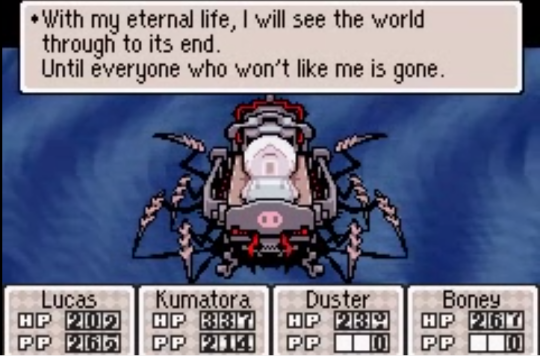
As it turns out, the Pig Mask Army is led by the megalomaniacal dictator Pokey (Japanese name “Porky”) Minch, who discovers the ability to travel spacetime and escapes the final battle against Giygas.
Since then, he’s traveled countless worlds and lived through millennia, conquering and exploiting all unfortunate enough to be caught in his way.
Now, one interesting parallel about Pokey is what he does to the world he rules over. Just Lord English does to the Troll’s universe–and more indirectly, to both Human universes–Pokey manipulates and exploits The Nowhere Islands through a number of tools.
I note these similarities mostly because through Pokey we get a direct linking between the idea of a God-Like Yaldabaoth figure and the idea of a tyrannical, authoritarian dictator.
This is an area of Lord English’s insidious evil mostly delivered to the audience through implication and background information, so I think it’s worth the time to draw it into focus.
And the similarities between their atrocities might give us some context between the similarities at the end of their stories. Because, again like Lord English…
Master Pokey can’t die.
But he is defeated, as his machine runs out of power. And so, lacking other options, Pokey plays his trump card.
One that proves to be the end of his influence in the story.
“Oh, my! As evil as old Porky here is, I feel bad for him now. It’s true that the "Absolutely Safe Capsule” that the Mr. Saturns and I developed together can protect one from every manner of danger. It IS an absolutely safe capsule, but once you enter it, you can never exit it… Even what’s outside of the Absolutely Safe Capsule is absolutely safe. I did tell Porky in a hushed voice that he shouldn’t use it yet… But all he can do now is live for eternity inside the capsule, in absolute safety. Who knows, in a way, he may’ve gotten exactly what he wanted. What do you think? Is it wrong of me to think this way?“ — Dr. Andonuts
Once Pokey seals his life into the capsule, there’s no longer an out for him. Not ever again. In a way, Pokey’s fate may indeed be one worse than death. And it’s one that seems to be echoed by Lord English, since after all…
Lord English cannot die, but he is defeated.
Specifically, Act 7′s visual language suggests he’s pocketed in the Black Hole that Alt!Calliope created. As a Black Hole is a gravitational singularity, once there, Lord English would be trapped–no amount of Time powers would let him come out, and First Guardian powers would no longer work either, since they rely on the Green Sun’s power.
An immortal, tyrannical kid–denied his playground for eternity. Pretty fitting, I think.
But Lord English is only one part of the story, and I think the relationship between the protagonists and the Player/Reader is the more interesting area of Earthbound to explore. Because…didn’t I mention?
In the Mother series, there is another God.
It’s you.
2) The Player
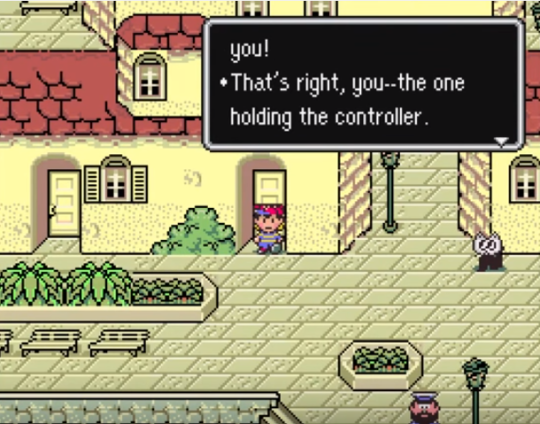
Both Earthbound and Mother 3 explicitly address your existence in the context of their worlds. Both games, in fact, pause entirely just to ask you your name. In Earthbound, this role is taken by Tony, Jeff’s canonically gay friend. He calls Jeff, and in the process brings up a prompt for the Player to input their name. This can seem like a bit of cheeky fourth-wall breaking, but consider:
You are the unseen hand behind the characters’ every action. You lead them through their world just as Giygas does for Pokey. You’re never viewed, but always present, witness and privy to all things.
And in the final boss battle (you did watch that, didn’t you?), when all else fails, Paula’s prayers reach the people of Earthbound who care about the four chosen children…including you. Your name is the final name given, praying for the protection of Ness and his friend. Your prayers are the power that end Giygas.
Mother 3 makes it even more explicit. In this game, you’re asked your name by an unseen voice, while Flint prays at an altar in the only Church in the game. Depicted on the front of it are the Light and Dark Dragons of Nowhere Island, the latter of which is the subject of an apocalyptic prophecy we’ll talk about soon.
A good question to ask at this point is: Why does this matter? And the answer is that because we’re given the God’s-eye view of these games, the context of our engagement with them is diegetic: explained by the narrative itself.
Like Bastian reading The Neverending Story, we’re not just observers consuming the content of these games. At least as far as the stories within are concerned, we are active participants. We are part of the story.
And this is true of Homestuck, too. Doc Scratch is a smarmy asshole, but he directly acknowledges the reader. He even credits us with more of an impact on the story than our protagonists. And on some level, this is true.
We HAVE had a direct impact on the story, through command prompts and fandom memes and all sorts of other engagements that ended up shaping the way Homestuck has been told. We’ve always been part of the narrative.
And this has important implications for how we, the readers, might best engage with Homestuck.
Because the fact that our window into its world is diegetic means that it is presented through us through an explicit frame, a frame that is narratively constructed.
And frames have limits.
1) The Characters
Whenever I hear people say Homestuck is a tragedy, or that it’s headed for a sadstuck ending with the Beta kids stuck in the Juju in the Masterpiece, I honestly can’t help but laugh. You don’t need alternate timelines and sacrificial lamb versions of our protagonists to secure a happy ending in Homestuck.
Homestuck itself is practically a loop of impossible-seemingly, absolute-dooming circumstances…
met by perseverance and good cheer.
And when all’s said and done, the story pretty much always breaks in favor of the latter. Remember that one of the fundamental rules of Homestuck’s universe is the “Do As You Will” principle–everyone always gets what they want.
Caliborn gets to be LE, as does Gamzee. Arquis gets to fulfill the out-of-nowhere heroic destiny he wanted, and finally proves himself to the Alphas in an act of atonement. Lord English gets his eternity of destruction, and Vriska gets to be the great Hero she always wanted to be.
But our protagonists? The Alphas and Betas? They just want to live in peace. Their desires are compatible with the wills of all the other characters.
Lord English’s will is not, and he’s trampled the agency of every other character a million times over to get where he is. That’s what makes him a tyrant, and that’s what dooms him to his Absolutely Safe Capsule. Karma is an established force in Homestuck, and LE will pay his due.
And in this extremely-dire-until-the-very-last-second approach, too, Homestuck seems to be standing on the shoulders of giants.
Because this big buildup to a Big Dramatic Tragedy of an ending is pretty much exactly Earthbound’s M.O.
Earthbound’s final boss isn’t just one of the most horrifically well-executed eldritch monsters in gaming history. It’s also set-up as what amounts to a suicide mission.
Even more interesting to me, however, are the parallels we find to Mother 3′s ending.
I’m going to take a time out from Homestuck for a second and talk about Mother 3 for a second, because this moment is too important to me to waste frivolously, or subject to my overwrought explanatory dialogue with without giving you the option to watch a scene that’s Undertale-level good.
Unless I’ve already succeeded in getting you to stop reading, drop everything, and go find a translated version of Mother 3 now (you can’t play it in english without emulating, since it was never released in the US), I would really appreciate it if you took the time and sucked up the spoilers and watched this ending cutscene.
It’s a work of art. A heartrending, heartfelt symphony to the pain of loss and the fear of something changing forever. Mother 3 is a game about the Apocalypse. A game about CAUSING the apocalypse, to be precise.
Your final moments with the game are spent watching Lucas pull the final needle that binds a dragon bigger than the world, and the only hope is that Lucas’ good heart will pass on to the Dragon and make a good new world to come. Nothing else is certain.
And the shots we see aren’t encouraging: Immediately after pulling the needle, the world begins to fall apart. Earthquakes rise and wreak havoc. Twisters of water dominate the sky and ocean. Meteors fall from the sky, and as if rising from an enormous egg, a vast, black back archs out from under the world we came to love.
And then we cut to black, and the End screen pops up. We never see these characters again. Only…
Only we do get to talk to them. Once this question mark pops up, you can move around in this black screen-with ‘You’ represented by the END? depicted- and occasionally, you’ll bump into…words. Words that say things like:
And
You get glimpses of things you can’t talk to, like…
And best of all, this is where the game brings out its ace.
Because this is where the name you gave in the church comes into play. At the end of it all, all of the characters in the cast not only tell you they’re ok, but recognize you. Thank you. Love you. Treat you like a friend, say goodbye, invite you back over, and wish you well in life.
In Mother 3, you play as the God of the old world, the world bound by the rules the cast had to play by. By playing through to the end, you set them free.
And by treating you as a real part of its world, Mother 3 invites you to consider its characters a real part of yours. Invites you to think of them not as characters, but as friends. As people. If that sounds familiar, it’s because Undertale built a whole damn game out of the concept.
But the same approach has always been in Homestuck’s DNA. These characters were always people first and characters second, and we were always privy to a limited frame.
That frame is Homestuck, which until The Masterpiece and Lord English’s defeat, has belonged to Caliborn. This has always been the story of his circle–the Alpha Timeline–and the context it crafts out is his childish empire.
Next time, we’ll talk more about Homestuck’s Gnostic themes, and just what it is *exactly* that our protagonists are escaping from.
For now, I’ll leave you with this song.
If this piece interested you in Mother 3, I suggest checking out Tom Ato’s legendary fan translation for the game. Mother 3 is a masterpiece, and I owe both it and Tom Ato my life in some ways. It’d make me really happy to know even one more person has been touched by their work because of me.
2. The Neverending Story – Muse/Lord & The rules of Paradox Space
[Spoilers for The Neverending Story]
I’m not the first to note Homestuck’s references to AURYN, the magical amulet from The Neverending Story. The symbol of the intertwined black and white snakes is directly referenced only twice in Homestuck’s story, and both times it tells us a mind-boggling amount about the nature and function of Homestuck’s universe.
And even that only scratches the surface. So instead of starting off with Homestuck itself, let me tell you a little bit about The Neverending Story itself.
The Neverending Story is a book split in two. In the most commonly printed version, it comes in Red and Green text halves. The real world, the realm of humans where you and I live–those sections are printed in Red. Fantastica, the world of fiction and stories and all things imaginary, is printed in green.
And as with two sections, The Neverending Story is split into two central figures:
The Childlike Empress, and Bastian Balthazar Bux.
Muse & Lord
In the green-lettered plains of Fantastica, The Childlike Empress rules over all. Although her authority is accepted by even the most evil and mostrous in Fantastica, she never gives orders. Even so, she is both eternal and eternally childlike. Good and evil are equal in her eyes.
Sometimes called the Golden-Eyed Commander of Wishes, The Childlike Empress’ authority only manifests when she grants her gem of wish-fulfilling powers–AURYN–to another. This other is treated as though the Empress herself were present, and acts as an emmisary for her.
She is the embodiment of Fantasy itself, inspiring others to act out her will. She is a question, a mystery, a wonder. She is, in short…A Muse.
And she has a direct parallel in Calliope, who similarly draws no distinction between good and evil (people forget that she read what was likely the worst of Vriska without being exposed to her growth, and seemingly wanted to be friends with her anyway)…
Everyone is entangled in and created by Lord English’s Alpha Timeline, but that web is Calliope’s as well, and she’s causally entangled in the creation of all four of the universes we follow.
And again like the Childlike Empress, Calliope who bestows her Symbol on others, granting AURYN to humans–an emblem which endows in the wearer the ability to make any wish come true.
Hell, Calliope even seems not to grow up normally in Act 7 and [S] Credits. A Childlike Empress indeed. And as for her counterpart? Bastian may not be as much of a jerk as Caliborn, but the parallels between them are even more explicit:
Where The Childlike Empress is a Muse only by implication, Bastian is textually and demonstrably a Lord.
But let’s back up a bit.
Bastian Balthazar Bux is a little boy who steals a book named “The Neverending Story” from a bookshop and hides in his school to read it in one sitting. His sections, those taking place in the Human world, typically feature text colored Red.
However, around the halfway point of The Neverending Story, he realizes that the story is not only aware of him, but calling out to him. And he eventually finds himself pulled into the realm of Fantastica.
Bastian is a human, you see, and only humans can create stories–the inhabitants of Fantastica themselves cannot. And once the Childlike Empress is reborn with a new name, Fantastica must be reborn as well. So The Childlike Empress meets Bastian in the void between the two realms of Fantastica, and gives him the amulet AURYN, the symbol of her power.
And so, she entrusts him with a quest: To fulfill his wishes in Fantastica, and re-create the realm of Fantasy as he goes.
Incidentally, receiving AURYN also changes Bastian’s race. Bastian is explicitly white, but upon arriving in Fantastica transforms into “a young prince from the Orient”. I’m not sure why that even happens, to be honest? Let’s note that this book is from, like, 1979 and definitely not perfect.
To be honest, I should’ve noted that was explicit earlier, since Homestuck all but explicitly states that Tricksterfied Cherubs would look like Lil Cal, which definitely entails a primary skin color swap. And there, as with Humans, the transformation always renders the subject Caucasian-looking.
Now, where were we?
Ah, right. So, the first thing you might notice is that Bastian’s ascent to Lordship also coincides with him leaving the World of Men and entering the World of Fantasy/Ideas.
Which strikes his first echo with Caliborn. Both characters’ entries into power are marked by changing their text color to Green–the color of their respective Muse figures. And like Calliope dies for Caliborn to Enter, The Childlike Empress disappears from Fantastica as soon as Bastian becomes it’s Lord.
Bastian spends most of his adventure in the realm seeking to meet her once more, on some level–just as Lord English spends an eternity in the Void, trying to find and destroy the Calliopes.
And during his search, Bastian also accrues subjects and followers who carry out his will. Bastian is adored for his ability to create stories–which instantly become Real– across Fantastica. With The Childlike Empress’ AURYN around his neck, nothing can resist his will. Bastian becomes, for all intents and purposes, a God.
Although he loses his humanity little by little with every wish he makes. The memory of being weak, the memory of being ugly, the memory of being scared– as Bastian travels, he grows more self-satisfied and arrogant, desiring the adoration of others without true regard for their feelings and hearts.
Until in the end, he’s exploiting those he calls friends through sheer force of will. At this point, Bastian seeks to replace The Childlike Empress entirely, attempting to become the Childlike Emperor–just as Lord English seeks to emulate Calliope through a multitude of stylistic choices in his personal aesthetic.
“Doc Scratch was born to serve as Lord English’s other half, replacing the role Calliope served when the two shared one body. From Caliborn’s warped perspective, the two share many similarities. They’re both wordy, intelligent, and (as Caliborn saw her) quite smug. He scrapbooks with a ~ATH book like she did, and carries her weapon.
In addition to being a pastiche of his sister, Scratch is also a symbol of his other weakness, the cue ball. Both are heralded to be the key to his defeat, after all. He does double duty then by killing Scratch, hatching out of his body and growing more powerful (by assimilating Scratch’s first guardian powers), “predominating” over him and asserting his dominance over both his vulnerabilities once again.”
And Bastian, well…
Sound familiar at all?
By the end, Bastian is at risk of becoming what is essentially a Yaldabaoth–an arrogant God with full dominion over his material reality, but blind to the world of ideas outside of him.
Luckily, Bastian escapes this fate, and goes on to live a happy life, becoming a world-renowed storyteller. His path is not the path of the Lord forever. But that is another story, and shall be told another time.
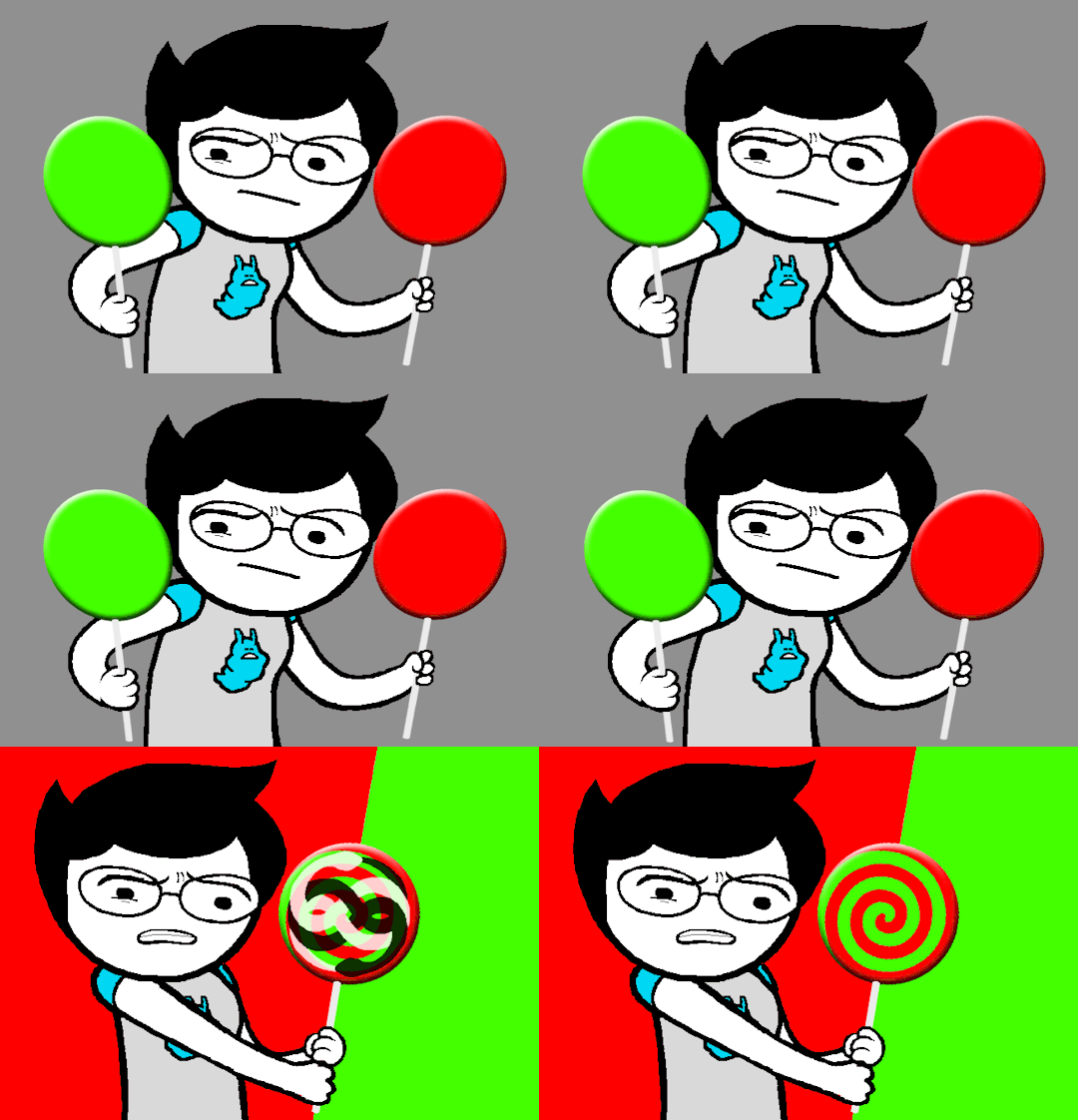
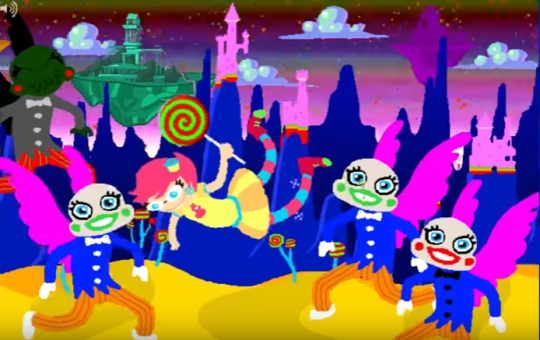
There’s one last thing to note about AURYN, because it appears in two places in Homestuck. There’s the Lollipop, yes–and by linking AURYN to the Cherubs, we learn a great deal about both Muse and Lord, Calliope and Caliborn.
But AURYN’s impact is a bit more far-reaching than just them.
The emblem is also depicted during the mating ritual of Cherubs, remember? And it’s important to view this image in context, because as Aranea tells us…
Mating Cherubs tap into the forces of power presiding over all that is eternal. Cherubs are linked to the primordial forces of reality by their nature. The source of Cherub’s powers is their intrinsic connection to the flow and nature of reality.
Which suggests that the principle that AURYN is inscribed with, the principle that guides the power of its magic, is also the fundamental principle of Homestuck’s universe. Cherubs are simply beings with a unique ability to tap directly into it. And that principle is…
“Do As You Will.”
Nothing in Homestuck’s reality happens except by the Will of someone living inside it. Individual will is the backbone of all events and objects, all circumstances and beings, all people and universes in Homestuck. In Homestuck, everybody always gets what they want–one way or another.
That is what AURYN– placed here, at the center of the forces of creation and destruction– suggests. A good example of this is Lord English’s creation, where Caliborn and Gamzee’s wills to become Lord English meet Arquis’ desire to have a heroic moment of unfathomable impact onto reality:
Thus resulting in a scenario that fulfills all of their desires, and results in the creation of Lord English and Doc Scratch:
I’m not going to list a bunch of other examples because this kind of stuff is literally always what happens in Homestuck. The only thing that trumps a person’s desires in Homestuck is the desires of another willing to undermine or exploit the former.
And that kind of authoritarian behavior is the closest thing to “Sin” Homestuck’s setting has. It always comes with consequences. This is also why Karma exists in Homestuck’s causality, as noted by Latula. This is what the cycle of revenge was about.
Not even killing someone can truly erase the impact of their will on reality in Homestuck’s universe, and usurping or denying others their wills always comes with a whiplash effect back on yourself. So what does that mean for Lord English, who has so thoroughly usurped and denied the wills of every other member of the cast?
Well that… is another story, and shall be told another time.
Next time, we’ll talk about the Mother franchise’s two later installments: Mother 3, and Earthbound. There’s much to discuss. Perhaps we’ll even find an echo of Lord English’s karmic punishment there?
This section is pretty much setup for the next three essays. There’s a couple sections here that I have a fair bit to say about, but probably just as many where I’ll close out with some minor observations, or reference to someone else’s Good Post™.
What I think is important is noting the consistency and similarity with which Homestuck engages in meaningful reference. I just want you to have this list in mind as I flesh out the three truly impactful references I want to talk about in this series.
So here’s a short list of cases where Homestuck outright leans on other stories to structure itself, with accompanying references:
1) The Game Over Arc – Plot Structure & Dragon Ball Z
We’re starting with Dragon Ball Z because the references here are relatively simple and straightforward, and they largely set up either pretty clear structural parallels, rather than thematic ones.
The clearest of these examples is the section of the story that begins with the joke Arquius makes above. In case you don’t know, the “over 9000″ meme has its roots in this iconic, hilarious sequence from DBZ:
What’s notable is what follows. From the moment this joke happens, the very structure of Homestuck changes to following the loose structure of some of the most memorable DBZ arcs.
I’m no buff on the series, but the memories it calls up for me most strongly resemble the Namek/Freeza or Buu arcs, and expert DBZ consultant @alotofmomos (who hates me for writing this) confirms these are the arcs that most perform the particular structure Homestuck will now be mimicking.
And what does that structure consist of? A particular mix of “pacing” choices, cinematography, and sheer scale of spectacle that I find hard to source to anything but DBZ. I can’t even think of other Shonen series that mix all these elements in quite the same way, though again, I’m no expert.
Some of these elements are:
A) Drawn out, massive power-up sequences:
B) Conflicts that carry out on planetary scales, and indeed often destroy the planets hosting them.
This pretty much speaks for itself, doesn’t it? Do I really have to say some stuff to make it look like I’m doing anything other than pointing out some obvious goddamn parallels that blew my mind because they took me years to notice?
Alright, fine. I’ll say this much: I think it’s quite fitting that Homestuck would borrow from the DBZ playbook for the section of the story that illustrates the sheer mind-boggling scale of power our protagonists have reached.
There’s very few stories out there that demonstrate this sense of mortals achieving such bonkers dominion over reality through sheer force of will, and the homage certainly hammers home the idea that these kids are Gods with levels of power we’ve barely scratched the surface of.
But I don’t think there’s a big Narrative Payoff to this particular reference. Instead, I think what Homestuck takes from this is functional in terms of narrative. Because the most interesting things this narrative model adopts are structural.
C) Convenient plot-structure.
Namely, what we end up with is a bunch of characters grouped into disparate conflicts across the same larger “playing field”, separated by considerable amounts of distance–and thus, isolating them into distinct narratives.
As a natural consequence of this, the pacing slows down to an excruciatingly slowness, as we cut from conflict to conflict, each one progressing in small snippets of minutes or even seconds at a time. All of this is par for the course for Dragon Ball Z, particularly in the Namek saga.
So what this provides us with isn’t a profound, revelatory moment of thematic meaning–but instead, an effective backdrop on which to flesh out that meaning elsewhere. In fact, this very arc does that like twice with two other stories!
So let’s move on from this and take a look at a couple of character arcs whose resolutions are telegraphed by way of reference.
The bottom line is: Terezi janks Jade’s shoes, and adopts the role of Dorothy in Homestuck’s symbol logic. This leads her home–to Vriska and their memories of growing up together, and ultimately to embracing her red feelings for her.
Terezi’s resolution is one of two relationships resolved in the wake of [S] Game Over. Let’s take a look at the other.
3) Jake as Buttercup
Don’t have much to say about this one either, cause I already wrote most of it. I will say I don’t think it’s an accident that the arcs to coincide here are Dirkjake’s and Vrisrezi’s, since the two relationships are in many ways direct parallels. But that’s another essay for another time.
I have received some rightful criticism on my writing on Jake in particular, and this is a good place to clarify my position, however. I do not think it’s particularly “Good” or “Healthy” for Jake to indulge his own desires at the expense of Dirk’s (or Jane’s) feelings.
My point has never been that Jake’s selfish behavior is inherently good–merely that Jake’s reasons for being in love with Dirk are his own, and not imposed to him from Dirk himself, or anyone around him.
As with all things in Homestuck, the key is for Jake to grapple with the negatives in himself and come to balance with the tension between his own wants and his relationships with others. This is true of literally everyone in Homestuck.
And there’s an easier way of saying what I am getting at. Because Homestuck literally gives us a guidebook to understanding Jake and Dirk’s relationships to each other, as parsed in Jake’s head–a guidebook that provides context to their entire relationship.
Just as you can read Terezi as Dorothy, so too can you read Jake as Buttercup. This is the crucial distinction I seek to make. In common readings of Dirk and Jake’s relationship, Jake acquiesces to Dirk’s pushy forcing of the relationship despite Dirk’s control issues.
In this one, Dirk is a flawed but committed provider and protector, and Jake picks up on and begins internalize a belief that Dirk will always be there for him, prompting him to fall for him. This reflects the fundamental core of their attraction to each other. It does not present a solution to their communication issues. They both have to work through that and be more aware of each other’s needs.
Now, The Princess Bride is a comedy action-adventure movie, but it’s also a philosophical fairy tale. Buttercup and Westley aren’t just in love, they’re in True Love, and the driving force of the movie is how Westley’s love empowers him to do anything it takes for his beloved.
A big part of her journey is learning to truly commit to not just Westley’s love for her, but her belief in that love as something both true and powerful. Something that can transcend all odds and obstacles.
Which is. You know. Exactly what Jake does when he’s fully immersed in the power of his own faith.
Now let’s move on, and note two more movie references that the comic makes outside of the context of this DBZ-mini arc.
4) Tavros as Peter Pan
There’s not a terrible amount of depth to be drawn here, either. I think most people accept that Tavros is deliberately invoking Peter Pan in his narrative victory here, with the ghosts as his Lost Boys. I will add, however, that if Peter Pan is the role Tavros is emulating in reaching his full potential, well…
Peter Pan isn’t exactly known for being Selfless, is he? He’s a hero, for sure, but self-centeredness is pretty much his calling card as a hero. To the point that Wikipedia claims that
“In the play and book, Peter symbolizes the selfishness of childhood, and is portrayed as being forgetful and self-centered.”
Understanding Caliborn as a Yaldabaoth is one way to contextualize his power over the reality all the characters preside over, and we’ll definitely touch on that further in the next three sections I’ll be covering.
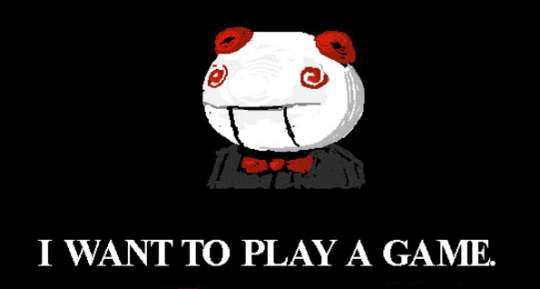
But one easy way to contextualize Lord English’s power is as…well…Jigsaw.
Like Jigsaw, Lord English builds a massive, highly controlled gauntlet that he exploits and terrorizes his victims through. The only difference is that Lord English’s dungeon is bigger than some creepy gray cellar.
It is in fact, Literally Everything that occurs within the context of the Alpha Timeline. Every homeworld that every character originates from–except for, arguably, Beforus, which is still under his sway enough to be doomed, but also presented as borderline Eden-like by comparison to Alternia.
While Yaldabaoth’s control seems very distant and abstract, Jigsaw’s is crystal clear and vicious. Everything the characters of SAW suffer is, ultimately, in the hands of the orchestrator of their misery. Their puppetmaster, so to speak.
In the same sense, pretty much every single way the characters in Homestuck suffer has Lord English at the root of it–even the thing they do to themselves and each other as a result of cultural memes.
Troll Violence, heteronormativity, quadrant normativity, and hypermasculinity–all are memetic structures that exist because Lord English himself disseminated them, in the context of Homestuck. They’re thought-traps rather than literal physical torture devices, but they’re torture tools all the same.
And you can even see Jigsaw as a symbol for Lord English’s influence, since it is, after all, one of the primary differences setting apart Bro and Dirk. Dirk has no interest in the SAW franchise at all, whereas Bro makes a point of mocking Dave with it. (thanks to @jadedresearcher for pointing this out, by the way!)
So yeah. Not only does SAW tell us a lot about the nature of Caliborn’s effect on our characters through the Alpha Timeline, it also acts as a mark for his influence. That’s…pretty much all there is to say on the matter.
For now.
That wraps up this little introductory round-up. Now I can get to talking about three of the biggest influences on Homestuck as a story: The Neverending Story (the book), Earthbound & Mother 3, and Gnostic Myth. Hope you’ll follow along with us over the next couple of weeks to find out more.
Hey, guys! My good friend Rune asked me to provide a good post they could reblog boosting the work I’ve been doing here for a while, and upon attempting to do so I realized:
Holy crap! It’s already been six months! Half a year has flown by as I have striven to delve deeper into Homestuck’s symbol language and referential philosophy, attempting to help bring new readings and positive sentiments to the fandom.
For those of you who don’t know me, I’m optimisticDuelist. My goals are simple: I love Homestuck. I think there’s a lot that Homestuck tries to say that is not immediately apparent or easily accessible, and it is my goal to make as much of that information as I can uncover accessible to old and new fans alike.
Emphasis on the new, in fact! This is why my main project is…
This youtube series is an in-depth and allegedly entertaining look at Homestuck, designed to make the comic not just understandable but interesting to anyone who watches them!Currently numbering at six videos and counting, each has been a labor of love. I hope you find them as enjoyable to watch as they’ve been enjoyable to put together!
Since the next video on my roster finally has us enter the Medium, you’re just in time to catch up and have the series Welcome you to a new extreme ;).
Besides videos, I’ve also put out plenty of readily accessible writing on Homestuck, on all manner of different subjects–mostly focused on poorly understood or often underlooked parts of the comic. Here’s a short list of what I consider my best work:
There’s also essays on Jane Crocker, Davekat, and how Homestuck deliberately references other works to clue the reader in on what it’s trying to say in the works! Among yet other things. Is there any end to my hopes for this project? It is difficult to say.
Needless to say, I’m pretty busy. I’ve only been able to do as much as I have due to the incredible support of my Patrons–thanks to all of you for signing on to this journey so far. I also owe a lot to all my friends across both the Homestuck community and my online and offline life.
Besides my Patreon projects, I also help run the r/Hiveswap reddit and Discord, where you can find me regardless of what you think of all this stuff. Thanks for taking the time to read this! If you enjoy any of the stuff I’ve put out, let me know, because it always makes my day to hear it :).
That’s all for now! Thanks again, to all of you, so, so much.
Hey, everyone. In this episode, we finally close out the tutorial section and unpack some of the deeper philosophical implications Homestuck works off.
That means going into the Biblical references built into the Alchemy system. We contrast the book of Genesis against the Gnostic creation myth, go over what Gnosticism entails in some detail, and what the main difference is between Gnosticism and traditional Christianity.
What do both stories tell us about Homestuck’s priorities? What does it mean for Homestuck to so strongly embrace the latter? And what does that approach say about the idea of original sin?
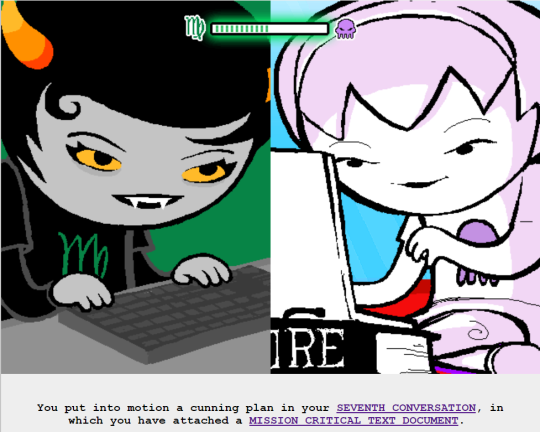
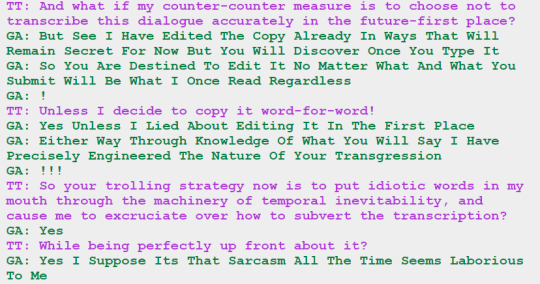
So I finally read that MISSION CRITICAL TEXT DOCUMENT–where Kanaya tactically edits her first conversation with Rose (which, unbeknownst to her, is actually with John) and presents it to Rose as a ploy of passive aggressive friend-courtship
(emphasis on courtship, this shit’s gonna get good) and
holy shit,
this is definitely one of the most underrated parts of this damn comic
heres a loose, non-exhaustive breakdown for those who might have missed it like i did. seriously read it it’s so good
First off, Kanaya begins by doctoring out her own dialogue through the extensive use of [Tactical Ommission]s.
I’m not sure why but I find the wording here hysterical. I want to imagine she types it out every time instead of copy/pasting it. It helps her commit to the roleplaying scenario.
She tries to play coy as hell about whether or not she actually edited the document but she just rewrites parts of John’s lines and doesn’t change her typing quirk and just blatantly mocks Rose as if Rose were John fuck
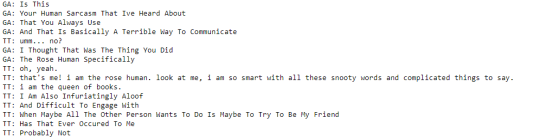
Ooh my god, and this. Like, INSTANTLY Kanaya’s roleplaying-as-Rose devolves into a frustrated tirade on how distant and unapproachable Rose makes herself with her sarcasm stuff, and like
As i think @roxilalonde wrote about already, Rose’s emotional distance keeps being a factor in their relationship past the meteor. Rose admits to having never told Kanaya she loved her.
And honestly this beat, though early in their relationship, is a fascinating little window into what Kanaya might sound like when frustrated about this stuff while they’re dating.
more tactical ommissions. they make my day. since we know Rose is a slob i hope someday like someone comes over to visit them and kanaya just wanders around the house covering up rose’s embarassing shit or putting it away and whispering “tactical ommission” under her breath
John is right to be smug here so it’s just hysterical that Kanaya is takes umbrage and pettily mocks rose for it, like, god Kanaya is such unabashed scorn and frustration and jealousy in this log in a way that rails against her fandom ascribed Mom Friend persona and–
oh, did i mention jealousy???
Because oh my god let’s talk about the fucking jealousy. Kanaya and Rose aren’t even DATING here yet, this is Kanaya getting to know Rose and it literally escalates into full-blown explicit romantic courtship like
This is Kanaya editing words into Rose-as-John’s mouth implying that Rose is only saying she likes John only to bother Kanaya herself, and suggesting that Rose says this in the unedited log Kanaya presents specifically to improve the odds they’ll develop a “more favorable relationship”.
Here Kanaya betrays that her romantic attraction was instantaneous and suggests that it was for Rose as well through the medium of passive aggressive mistaken identity temporal trolling roleplay, as she attempts to flirt by way of implying Rose already flirted with her
This is so high-level i can’t even follow it, these gay girls are beyond my mere mortal ken. Thank god for Rosemary
I’ll close out with this last tactical ommission because i fucking love the line she blots out, because:
yeah. Yeah. Embarassing much, Kanaya? I’d be embarassed too. Tactical Ommission indeed if you’re invested in keeping the intellectual highground. What the hell kind of line is that anyway. you nerd. i love you
In this episode, we break down the rules of the Alchemy system, and take a glimpse at how the ability to create anything is exploited by the kids playing Sburb. We also begin our exploration of how this mechanic is used to advance Homestuck’s philosophy.
In the next, we will see that philosophy come to fruition.
[This is the reuploaded link with the audio issues fixed! Please reblog this version. Thanks! :D]
Here’s the last one of this Classpect essay series! This is on the Know and Change pair, the quartet of classes closest to the Spectrum:
Mage and Seer & Heir and Witch
Coming soon will be:
More Homestuck Explained videos, covering Homestuck’s core themes from beginning to end
Writing about Jane Crocker, Davekat, the Alpha Timeline… .
Hiveswap lore and analysis, linking the game to Hiveswap once it comes out and probably handing streams and such if all goes well!
And more stuff as I think of it, too. Really, figuring out the Classpect system made me realize we’ve only scratched the surface of Homestuck (it keeps happening), and this is only the beginning of a new extreme.
If you can spare me a buck a month you can help me make all this content and, like, not die and stuff– and get your hands on it earlier, too! Higher reward tiers will let you invite friends to the Discord so they can access this stuff and talk about it, too!
Feel free to @ me, reblog or send me an ask with your thoughts on these first two essays. There may be some things I can’t answer as they will be answered in later posts, but I might use those as inspiration for what teasers to release from sections of the next two essays over the course of the week.
You can also feel free to talk to me in the Hiveswap Discord where I moderate and cry about Homestuck. I’m very interested in seeing how my thoughts stand up to scrutiny, so don’t be shy!
















 Flying through Storytelling