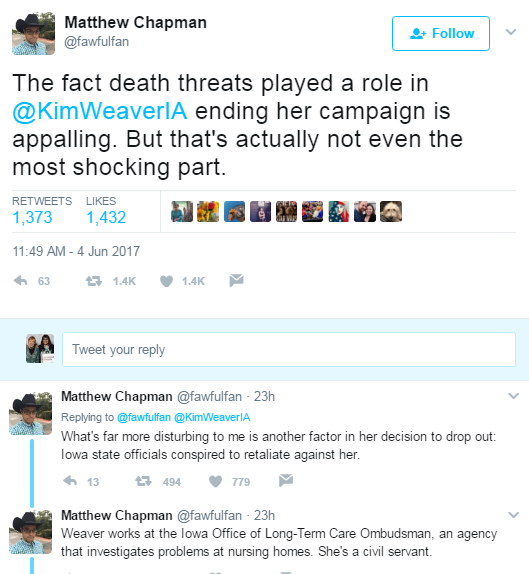
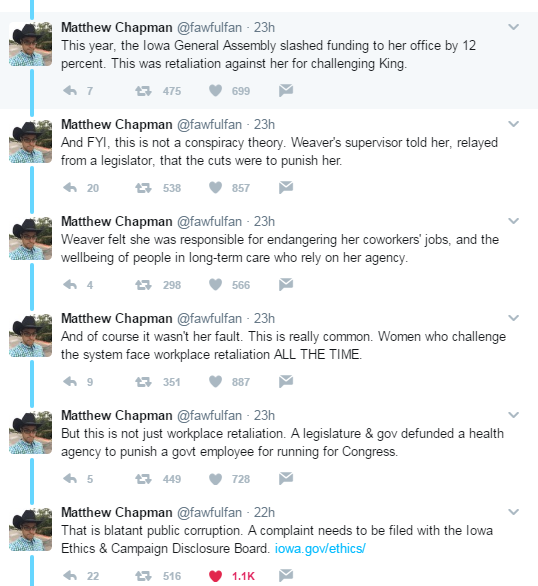
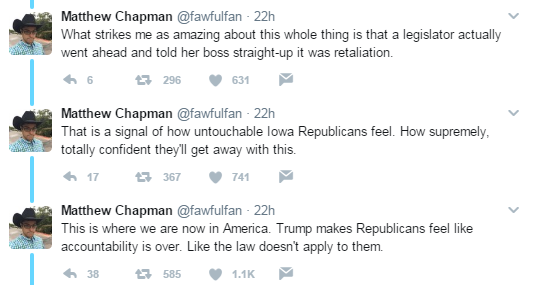
Fearing for her life, Iowa Democrat abandons race to unseat GOP Rep. Steve King

runwithskizzers:

fattyatomicmutant:

saywhat-politics:

The Democratic candidate running against anti-immigrant Republican Congressman Steve King (IA) announced Saturday that she is dropping out of the race for her own safety.

Hey so

Part of Fascisms early roots was using violence to scare away potential candidates against their power.

yo also this apparently too: 

[x]

Fearing for her life, Iowa Democrat abandons race to unseat GOP Rep. Steve King

Fearing for her life, Iowa Democrat abandons race to unseat GOP Rep. Steve King

fattyatomicmutant:

saywhat-politics:

The Democratic candidate running against anti-immigrant Republican Congressman Steve King (IA) announced Saturday that she is dropping out of the race for her own safety.

Hey so

Part of Fascisms early roots was using violence to scare away potential candidates against their power.

Fearing for her life, Iowa Democrat abandons race to unseat GOP Rep. Steve King

noobgroomer:

marxism-sjwism:

autistic-nano-shinonome:

scotsdragon:

autistictalk:

Aspergers/autism is seeing a needle, and then a minute later possibly noticing the haystack.

This is so accurate it almost hurts.

I don’t understand this

it means you pick up on weird extremely esoteric little details about things while completely overlooking what seems most obvious to everybody else 

like. someone asks a silly question and you think and give it a really serious comprehensive answer, while everyone else realizes it was a joke. or you have to do this really repetitive mind-numbing task, and you’re halfway done before someone walks by and tells you you’re doing it “wrong” and theres actually a much simpler/more common way to do it, which didnt even occur to you but seems self-explanatory to allistic ppl. that type of thing 

Autistic brains analyse bottom-up, while other people their brains analyse top-down.

In one of the books about autism that I have, their is a picture that illustrates this perfectly. It’s an illustration of a forest with the trees vaguely drawn but all the little details like a mouse and mushrooms are drawn in great detail. The explanation next to the illustration was the following; When a person with ASD walks into a forest, his/her brain starts to collect information to create a context just like all the other kinds of brains do, but the autistic brain starts at the bottom. First it sees the mushrooms, then some leafs, a bird flying by, the bushes, … Meanwhile the not-autistic brain in the same situation will notice the large group of trees first. The non-autistic brain will think “Ah a big group of trees, this is probably a forest”, and then goes on searching for details that confirms this and adds more information. At the same time, the autistic brain still doesn’t know it is in a forest, however, it does know it is somewhere where there are mushrooms and wild animals. The brain will continue to look for details until it finally reaches the point it notices the trees and other obvious signs that one is in a forest. 

TL;DR/ An autistic brain uses details to create a big picture of a situation. A non-autistic brain will use the general context to create the big picture.

This difference in processing information has some consequences, like @marxism-sjwism already mentioned.

Other occurring ‘problems’ are f.e.: doing tasks slower, getting tired easily*, becoming overstimulated when there is too much information, headaches, intolerant of bright colors/loud sounds/touch/smells/taste**, having difficulties doing a certain task because the details weren’t explained to you, getting stressed out because a detail changed in a situation***,…

*Because an autistic brain processes a lot more information than any other brain, it also demands a lot of energy from its body. Sadly, the human body can’t provide the energy this kind of brain needs. As a result, most, if not every, person with ASD gets tired quickly and needs hours, or even days, of relaxation to reload its batteries. Especially after big events like going to a party f.e. (I myself need a lot of sleep).

**Because the autistic brain gets its information from details, it has hardly any filters. When a non-autistic person is at a party and talking to someone, his/her brain wil cancel out other inputs so it can focus on the conversation. An autistic-brain doesn’t do this, or if it does, it isn’t doing a good job.  When a person with ASD is at the same party, talking to the same person as the the person without ASD, he/she will have difficulties understanding the conversation and keeping focused, because the brain isn’t canceling out all the other information. The conversation a nearby group of people is having will be equally as loud as the conversation he/she is participating in. This also means that a person with ASD can get easily distracted. F.e.: I was talking with someone, when suddenly I could hear two people talking in the room next door. It was a muffled noise and I could not understand what they were saying, but it was enough to distract me and render me unable to keep focused on my own conversation, resulting in me forgetting what I was saying mid sentence over and over again. Anyway, worst case scenario, if there is to much information for the autistic-brain to handle, it will become overstimulated, and this overstimulation often results in a fight-or-flight reaction. This behavior is often illustrated in mainstream media by an autistic child who suddenly becomes unmanageable, crying, kicking, screaming, … often at public places like a supermarket. Not every person with ASD will throw a tantrum when becoming overstimulated, some shut down, some start crying (like I do), some get angry, … It’s important to understand that this person is not being an asshole because he/she wants too, or that the child is not badly raised. These people their brains have triggered a natural instinct and their is nothing they can do about that except obey it. Best thing to do is to remove them from the situation to another less stimulating environment where they can calm down.

***Last but not least, there is another important consequence of having a brain that gets its information from details: it doesn’t recognize a same situation when a detail is changed. This causes difficulties in many different kinds of situations and it can occur in many different ways. A person with ASD will find it difficult to drive a different (brand of) car than he/she is used too, because, even though it’s a car and all cars operate the same, small details like a different dashboard layout can be confusing and stressful. A more extreme example is when the barman in a pub you frequent always wears a red shirt, but one day he wears a blue one. The change in color is enough for the autistic brain to think this is a completely different and new situation and thus it operate as if this is a new situation. This is why people with ASD can be insecure in situations that should be no big deal. Or why people with ASD seem to forget how to do a certain task, or lose their shit while any other person quickly adapts, all because something is different. Or also why they keep asking for explanation on how to do a certain task even though they have been doing it for months.

All these things are mostly downsides of having an autistic brain but it also has its benefits. People with ASD notice details much easier and faster which can come in handy when doing certain jobs. They also make different connections and come to new ideas that others never would’ve thought of. 

The work they do is often more correctly because they pay attention to details, include details, or want to make sure it is 100% the way it should be because their brain only takes peace with that. Consequently, a lot of people on the spectrum also have a high sense of justice and are good detectives, insurance agents, police(wo)men, lawyers, mystery shoppers, …

A brain like this makes these people also excellent at IT, gaming, art, music, programming, math, bookkeeping, science, sorting, systematization,… 

Sadly, people on the spectrum are often still seen as a problem instead as and added value. Like Temple Grandin often says; The world needs to realize it needs different kinds of brains to work together to reach greater heights. 

I’m sorry, but I don’t quite understand the context of your my/your kink argument, esp. the examples you are using. While I do obviously agree that writing about something is not the same as condoning it, is that where the statement ends? I mean, if someone were to write exclusively about rape/pedophilia/sexual abuse and portray it in a positive light, I wouldn’t merely regard it as a kink (afaik kink implies practice, implies consent) and morally I would condemn it. Could you elaborate?

madamehardy:

I have (at least) five answers.

1.  The vast majority of the moral meaning lies in both the consumer’s and creator’s contexts.  Martha writes a fic in which two sixteen-year-olds explore one another’s bodies.  Pedophilia?  Which country are you living in? What about the characters? What’s the time period and context?  José writes a fic in which one character sexually abuses another but they both come to a better place.  Endorsement of abuse?  Darkfic?  Hurt/comfort?  Akane writes a senpai/kohai fic that mirrors material in the original manga.  Is writing drawn from  a culpable (see point 3) source automatically culpable itself? In specific, there’s an ancient tradition of rape-as-seduction fiction, and an enormous body of documentation showing that it’s a common female fantasy. Rape-as-seduction is rape culture, sure, but we’re embedded in it: see my point in the original post about ids. You cannot responsibly make a moral judgment unless you consider all of these, as well as the context of your own reaction.

2. Consider the creator’s point of view.  You don’t know what the creator was thinking, and you don’t have the right to ask.  The creator may be working through a painful experience and getting catharsis through fiction.  The creator may be trying to convey as subtext that a particular situation is wrong and bad.  (With or without success.) The creator may be fantasizing a situation without any intention of putting it into practice – see the very relevant quotations in my post.  And, of course, the creator may be deliberately getting off on something that the vast majority of people in the creator’s culture consider morally wrong. (To whom is the creator accountable? Transformative media is created and consumed worldwide now.)  You can’t know which of these is going on.  Intent is not 100% of an immoral act, but when it comes to writing fiction, it’s a very, very high percentage.

3.  Consider the consumer’s point of view.   All of the possibilities in 2 apply, plus “I’m reading/viewing this to avoid doing it in real life.”

4.  Consider the likely consequences of consuming the transformative work.   There is no evidence that a person not already disposed to commit rape/incest/pedophilia/abuse is likely to be moved by fiction to commit those acts.  There just isn’t.   The evidence that people who are so disposed are more likely to commit those acts after viewing supportive media is, at best, mixed; there’s a lot of “post hoc versus propter hoc” going on there.  

5. Finally we come to “What are you going to do with your moral condemnation”?  You have carefully considered 1, 2, 3, and 4, and have determined that “applying contemporary community standards, the dominant theme of the material taken as a whole appeals to the prurient interest.”  ( Roth v. United States, and you bet your booty I’m being ironic.)   Are you going to draw a conclusion and move on?  Are you going to speak privately to your friends about why the fic offended you?  Or are you going to drop the wrath of Tumblr on the head of the offending creator?   

If your answer is “unleash the hounds of Hell”, I think you’re the one who’s morally wrong.  Period.   Your moral act also has a context, and part of the context is  the expected result.  You are not going to change what the writer thinks about morality.   You are going to create a mob of haters, most of whom are not going to present a reasoned argument based on evidence, but instead are going to tell the creator, and the world, that the creator is a terrible person. Not that the creator makes terrible works, but that they are a terrible person, and there is an ENORMOUS difference.  The experience of the last (at least) fifteen years demonstrates that hate mobs are emotionally satisfying to the haters, are not a force for any moral good, and routinely drive their victims out of fandom and even off the internet.

tl;dr:  It all depends.   I lived through the fallout of 1970s feminist consciousness-raising groups, and I don’t need to watch the hi-def remake.  I am sick beyond words of callout culture.

whatis2plus2:

Since joining Tumblr, I’ve met a lot of young queer people. Look, I’m a bisexual man in a gay relationship, and I’m approaching 30. I was still a kid when Matthew Shepard’s story was being covered on the news. I remember thinking, “I better keep my mouth shut about these feelings I’m having.”

And then I met Dominic when I was 12, and people could see how in love we were. And we got the shit beat out of us. The year I met him, some kids in the grade above me held me down against the bleachers in our gym and stomped on my hand until my fingers broke. Instead of sending me to the nurse, the teacher sent me to the assistant principal to explain the situation. She asked why the kids had beat me up. I said, “They were calling me gay.”

Her response was, “Well, are you?”

My, “I don’t know,” earned a call to my parents, and I was outed. Efforts were made to keep me from seeing Dom. Throughout high school, Dom’s stepmother intensified these efforts. He slept in the basement of the house. Although he was an incredibly talented student, he was prohibited from participating in any extracurriculars. He suffered a lot of physical abuse during those years.

The day he turned 18, he packed up everything he had and walked to my house, and we’ve lived together ever since. Things are better, but they’re not perfect. I’ve had trucks pull up next to me at stoplights and, seeing the pride sticker on my car, through old drinks and garbage into my window. I no longer speak to my dad’s side of the family. I haven’t been to see them for Christmas or Thanksgiving in years. One of my uncles had cornered me at Thanksgiving when I was 17 and said, “I’m not going to judge you, but I’d be happy to break your neck so God can do the judging a little sooner.”

I joined a support group for trans and intersex people. When I joined, 40 people attended regularly. Within the year, the group was half the size it had been. Some couldn’t make it anymore, because they were staying at the shelter, where their stay hinged on them agreeing to instead to attend homophobic sermons. Some were put in correctional therapy. Five of them died. Three of those, I didn’t know, but I knew Alex, the 19 year old who was fag-dragged in Kentucky and died a day later in the hospital, and I knew Stephanie, who went home to Alabama to care for her mom in hospice and was beaten to death with a baseball bat by her mom’s boyfriend.

Tumblr is not reality. The dynamic here does not reflect the dynamic out there. Here’s the part where I finally make a point, and it might be extremely unpopular – but guys, value your allies. Value each other. We are met with enough hate in our daily lives to enter an online safe-space and meet more hate from our own, over petty things. Don’t go after one another over every little thing you find problematic.

Learn to see nuance. Maybe the word “queer” bothers you, and you see a gay man using it as an umbrella term. Maybe someone called a trans man a trans woman because they’re confused about terminology, but the post where they did it was voicing support for the trans community. Maybe someone is just asking a question, wanting to learn more. Stop. Attacking. These. People.

Allies are being driven away. Members of our own community are being ostracized. Others are feeling nervous and estranged, and it’s largely because of places like Tumblr, where the social justice movement is quickly becoming violent and radical. I am begging you, stop nitpicking “problematic” things and start directing your efforts to create real change. When it comes to comes to your allies, forget the “social justice warrior” mentality and put down your torch. Educate calmly. Be respectful. Be understanding. Be forgiving. And I’m certainly not saying that your anger doesn’t have a good place – when you are met with bigots on the street, congress members who want to pass hateful laws, violent protesters, abusive parents, prejudiced teachers, that is when you need to be a warrior. That’s when it counts. In the real world. When you have the opportunity to protect people from real harm. Attacking your would-be allies via anonymous asks is just going to lose us ground in the long run. And we don’t have time for that, not when trans women of color are being murdered every day, not when states are still fighting against marriage equality, not when there are politicians in office who believe that trans people are possessed by demons, not when we’ve just lost 50 brothers and sisters to one gunman, not when the media won’t even admit that the attack was homophobic.

Please step back. Look at the big picture. Look at where we are, globally. Don’t just log on to your safe space and attack your allies over small missteps. That’s like washing the dishes in a house that’s on fire, kids. Let’s fight on the battlefield, and when we come home to each other, let’s just focus on bandaging up our wounds so we can go out and win the war.

friendly-neighborhood-patriarch:

signedtheghost:

purplekecleon:

I’m really tired of seeing people broken up into labels of absolutes.

People are not just “good” or “bad”.

People are not a list of labels. 

People are complex, situations are complex.

I know, that makes it a lot harder when you want to just write off everything someone’s ever done as bad – but that’s not how people actually are, and it would do everyone good to stop pretending they are.

I am tired of hearing about the fear people have in putting themselves out there. And it is a scary thing! Putting yourself out there means subjecting yourself to people who want a really good reason to tear you down, who will jump at the first chance to feel “good” by labeling someone else as “bad”.

I reject this. I reject the idea that there should be fear in speaking up and talking about experiences and trying to reach an understanding of a situation.

I’m unhappy to see people spitefully urging others to cut off ties with their friends under the guise of “well, that person’s just inherently bad, so if you talk to them you’re bad too.” That is fucked up. You definitely have the right to let the friend know you don’t want to hear about whoever troubles you, but you do not at all have the right to decide who their friends should be. This includes guilt trips.

Anyway, just try to be more aware of others. Everyone else is a person like you. They might not have the same experiences as you. They might not understand how their words are harmful, or how what they’re doing is wrong. They certainly won’t if you never tell them.

Most people are trying to be good, but they’re going to mess it up sometimes. Try to keep that in mind. Even when people do really fucked up shit, sometimes they are trying to do good. “The road to hell is paved with good intentions” and all that.

Nothing gets solved, no growth happens when you put people into a box from which you’ll never let them escape.

Yes, you absolutely must be careful about people who have tendencies and patterns that are harmful to you. Sometimes people try to overcome those patterns and they fail, and you have to distance yourself from them: that is the sad reality of life. Sometimes though, they can overcome it. But they certainly won’t if the first thing you do is write them off after a fuck up. 

Be sincere. Use your best judgment.

This is interesting timing for something to show up on my dash, because I just found out about this article earlier. It weighs the pros and cons of the two main options of what to do about a friend with views and beliefs even you find distasteful.

I like this