
This is a script draft that was used for the following video, and is missing picture assets as well as general polish:
This train of thought is a bit more speculatory, so I decided to keep it seperate from focusing on Gamzee’s character. But linking Rage to Homestuck’s Theatrical elements might also tell us about the abilities and powersets Rage players might exhibit, and that seems worth discussing on its own, so…here we are.
Obviously, reading Rage as the Aspect that rules over Homestuck’s reality as a play lends itself to Tex Talk’s theory of Rage as the Aspect that describes Plot Contrivance, and I could argue there’s even a link between the two in the text itself.
The MSPA Command Terminal that Caliborn and Gamzee unlock using the tragicomic mask keys allow Caliborn to talk directly with the author, Andrew Hussie — Specifically, the ghost of Andrew Hussie, who somehow communicates through the machine after being murdered by Lord English.
As the original author, he’s now the God in the machine operating the story of Homestuck, and his awareness of Homestuck’s larger context lets him give Caliborn the scoop, enabling his rise to power as Lord English in the first place.
This could be seen as an echo of Homestuck’s roots in Theatre as well:
The term “Deus Ex Machina”, or God in the Machine, originally refers to the practice whereby actors playing Gods would be entered into the play by an elaborate mechanism built into the theatre stage, usually by crane or a trapdoor.
The God character was often used at the end of a Tragedy, using their divine powers to wrap up remaining plot threads and bring the story to a close.
Now, of course, the term is used as shorthand for whenever a story resolves problems in highly unlikely and often surprising ways — and is often considered a hallmark of bad, contrived writing as a result.
Actually, this might solve a mystery nobody knew needed solving. A lot of fans assume the story’s logic breaks down with the dream bubbles, based on the perceived nonsensical absence of dream ghosts — mainly concerning four characters:
Meenah and Aranea, Vriska, and Gamzee. But Meenah and Aranea actually do have ghosts in the bubbles — both are present in the final army that faces Lord English.
Vriska only has (Vriska), which is kinda weird, but John’s retcon is bizarre enough that I can kinda believe it would collapse all potential versions of Vriska into the weird…schrodinger’s vriska setup the comic gives us.
Which leaves only Gamzee. If he’s aware of the mechanisms that run the theatre of Homestuck, then he may know about an obscure game mechanic. If a player goes to sleep at the end of a doomed timeline, like Rose does in the timeline that Davesprite came from, they don’t actually produce a ghost.
Instead, the player’s dreamself simply merges with the Alpha dreamself, and the player inherits all the memories of the doomed version. This might require that the player in question be the last one standing, which might be why Gamzee kills all the other trolls in at least one doomed timeline.
Whether he kills the others for this reason or not, if Gamzee outlives all the other trolls in every timeline in this manner, then we have canonical basis for Hussie’s statement that Gamzee hasn’t died in any timeline he’s aware of.
This would also mean Gamzee houses the conciousness of all his doomed selves, and that every single version of Gamzee would get to live out the truth that he is his own mirthful messiahs. No clown left behind…I guess?

But there’s something else I want to talk about.
If Gamzee views Homestuck as a play, then another facet of his power may be the ability to understand the various Masks that characters wear during their adventure — and the corresponding Roles they take on, as they perform their identities in relationship with the world.
Only in Homestuck, roles that define how characters Act are a codified game mechanic: Classes.
And I’ve recently found myself arguing that characters perform the behaviors of the Classes they’re assigned, but also often emulate — or try and fail to emulate — other Classes’ behaviors, through a mechanic I’ve taken to calling Roleplay.
Most characters only Roleplay classes they absorb through culture, whether it’s their interests or — more commonly — role model adult figures called Ancestors.
Having power over roleplay would make Gamzee uniquely dangerous, because it would give him the power to warp how other players see themselves and each other — confusing them by alienating them from their own true roles.


By inviting Terezi to adopt the persona of Redglare, he encourages her to take on the role of a Knight. As a result, Terezi gives a Knight’s performance in one of Homestuck’s theatrical Flashes — [S] Seer: Ascend. She’s even cast in another Knight’s shadow— imitating Dave’s own ascension flash.


It would also make him uniquely flexible. Understanding all the roles played in the story, Gamzee would be able to wear any of those masks to complete whatever objective is at hand. This is likely why Gamzee’s Jokerkind Specibus allows him to use every weapon.
He introduces himself to Jane with music boxes originally owned by Aradia Megido — A Maid, a class linked to the Fae archetype.
Maids and Sylphs are often referenced as imaginary beings, and this tends to include players committed enough to roleplaying one of the two — vampires, ghosts, gnomes, fairies, and in Gamzee’s case, he’s referenced as an elf during this stint.


The Fairy classes are associated with healing and creating new things. And Gamzee happens to perform this role— healing his troll friends by reviving them as Sprites, merging their personalities together in the process.


Later, Caliborn learns he’s immortal for arbitrary reasons that make no sense. Of course, it’s because he’s still relevant to later events in the story, and knowing this, Gamzee is aware he cannot die.
Wearing Fairy wings labeled with the masks of comedy and tragedy,
Gamzee evokes Maids as ones who are “Made of” their Aspect — in his case, Made of Rage: In this case, in the form of theatrical contrivance.
In the comic, Maids are repeatedly shown to have some passive self-ressurection or survivability perks, and Gamzee seems able to make use of that benefit by acting out the Maid’s role.


But all of Gamzee’s creations are abominations, and his form of “immortality” is brutal and painful for him, especially since his natural inclinations invite destruction — no matter what part he consciously tries to act out.
This is a common result of roleplay. Homestuck seems to lean on a “Know yourself first” approach to identity, as characters often confuse their own personalities with what they wish they were, commonly while trying to emulate an ideal or person they view with admiration.
This commonly leans to failure and confusion for Roleplayers, as their own instinctive tendencies come out even when they’re going for something entirely different.
Gamzee is subject to these negative effects, but to him, it doesn’t seem to matter. He’s just barely good enough at acting like these classes to accomplish the goals he sets out to achieve, and the rest of us just have to deal with it.

Of course, many would argue that Theater has nothing to do with Rage and everything to do with Gamzee belonging to the Purpleblood Caste, since several Purplebloods in Hiveswap share Gamzee’s clown motif and one pair even evokes the Comedy and Tragedy imagery.
Just as Xefros’ Rust-Blood status encourages him to think in terms of Time, I believe it’s possible these cultists are being societally pushed into thinking in terms of Rage, the Aspect of their Caste’s True-Sign — Capricorn.


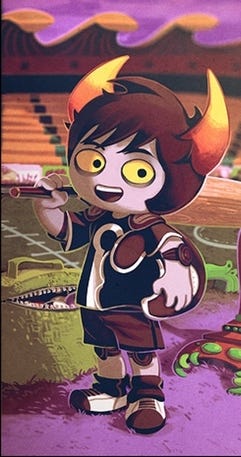

So I’ll be interested in observing just how they relate to their own Aspects, and in seeing to what extent any of them are linked to Rage — not to mention comparing them to characters that we know are Rage-bound, such as our hero, Xefros Tritoh.
Off the top of my head, Sports and Wrestling share some similarities with theatre — the inherent artifice of the experience and the distinct roles for every participant to follow. One of my biggest inspirations, Supereyepatchwolf, has actually done a great video on the theatrical elements of wrestling you can check out here, if you’re interested.
I’m not necessarily claiming this interpretation of Rage is canon or anything — I just thought it’d be an interesting thing for you guys to talk about, and consider, as we get to know the trolls through the Hiveswap: Friendsim and Hiveswap: Act 2.








 Flying through Storytelling