1. I’ve never said that Pages categorically manipulate people. That said, anyone can be manipulative under the right circumstances, so its pretty preposterous to state that they categorically don’t.
2. “Freaking out and having no goddamn idea what to do” isn’t mutually exclusive with being manipulative, anyway.
3. This can only really be about Jake and/or Horrus since I don’t think I’ve ever accused Tavros of being particularly manipulative, in which case:
Lying to yourself and your friends for months~eons(depending on the character) to keep those friends treating you in ways you find particularly agreeable or convenient is manipulative, no matter how freaked out and confused you are. That’s the end of that, as far as I’m concerned.
I’m not sure what you’re referring to RE: collaboration, but I don’t really have other leads on that particular front! I ended up deciding that trying to claim the Carol S. Pearson connection for homestuck’s classes was overly cumbersome, so I’ve mostly dropped the angle until whenever we get canon Class info by way of a quiz or whatnot.
I still think it’s true, don’t get me wrong. But since it’s true, I don’t need to make the hard to justifyclaim that Rogues all have arcs that deal heavily in their issues dealing with romantic problems because they’re in some way based on Pearson’s Archetype of the Lover, because instead I can be like:
Yo. Check it out. Between Nepeta’s unrequited love for Karkat, Rufioh’s inability to assert himself with Horruss, and Roxy’s unrequited love for/sexual harrassment of Dirk and general longing for a romantic partner, every single Rogue has an arc that deals heavily with romantic problems.
And so does every Rogue roleplayer, like with Tavros trying to steal back the ring of life to propose to Vriska and saying this (^) in the same conversation.
Seems almost like being overzealously devoted and/or subservient to others in a romantic context might be something Rogues struggle with, and the Summoner’s/Rufioh’s influence on Tavros might have rubbed that particular trait onto Tavros for a while.
And it’s just generally less of a pain in the ass for everybody to think about this way, you know? More efficient. That said, that’s Pearson’s more hyperspecific contribution. If you want to talk about Homestuck, Jung will keep you busy for days.
The collective unconcious, Classes as archetypes, synchronicity, maybe even Active|Passive by way of Jung’s introversion/extroversion theory, though I’m not sure how much I buy that one. There’s plenty to look into and work off there.
Maybe? I don’t really like jossing headcanons, but I’ve never really read a version of this idea that feels compelling to me, personally.
I think it’s more accurate to say Pages tend to either A) Attract the attention of others who mean well, but can be unpredictable in how they go about “helping” the Page, or B) Serve themselves their Aspects in very selfish ways.
I don’t think Jake in particular reads as “lacking” Hope. Understanding the impact Jake has on Dirk when they’re 13, specifically through the vector of his Hope, is instrumental to understanding both their characters, imo.
I feel like I don’t really want to talk about late-game Jake because so much of how I feel about him is tied up in what the Epilogue seems to be leading towards, so I’ll abstain from the question for now.
That said, hit me up again once the Epilogue happens, and I might have something more thoughtful to say for you. It’s a good question!
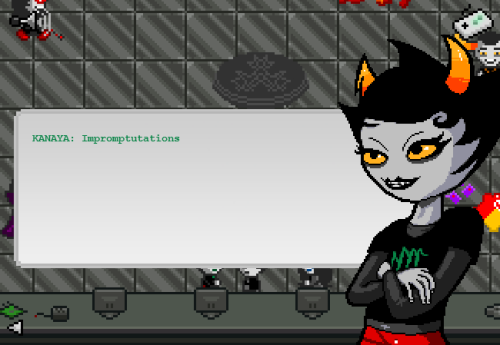
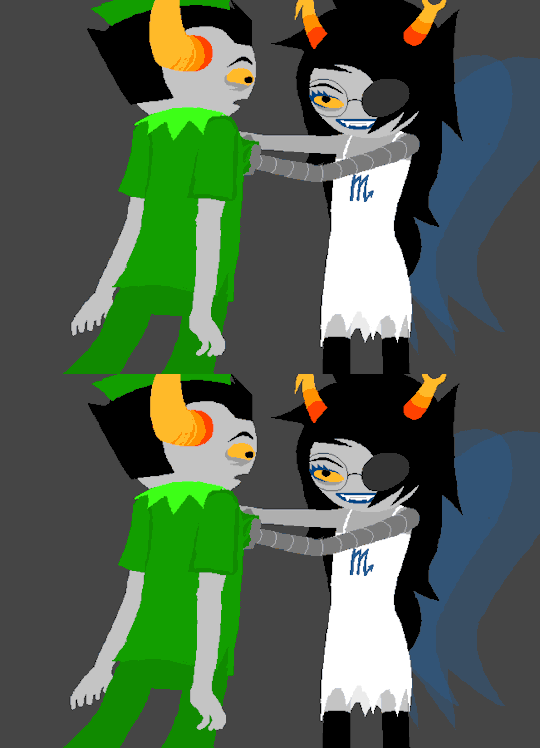
biggest most gay power moment in homestuck. the second at which homestuck threw its first brick at stonewall was when kanaya was head over heels for vriska who was painfully hetcrushing on a sad loser boy so when she got the sudden opportunity to saw off his legs she took it and said this
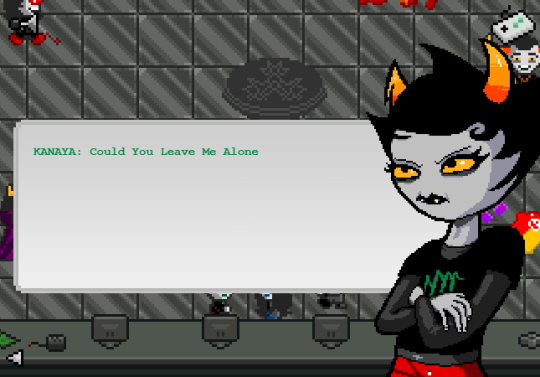
Kanaya was never “head over heels” for Vriska. Her feelings were always complex (she tried to protect others from her, being her moirail), and by this point she had been spurned enough times by her that, if you talk to Kanaya as Vriska in this flash, Kanaya literally doesn’t want to talk to her after a bit because of how uncaring Vriska is:
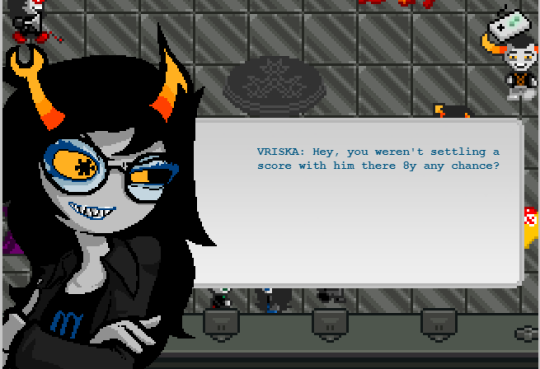
It was pretty self-evident by this point that Vriska was fucking around with Tavros, and didn’t actually care for him, which is something Kanaya and Vriska literally talk about in this flash, too.
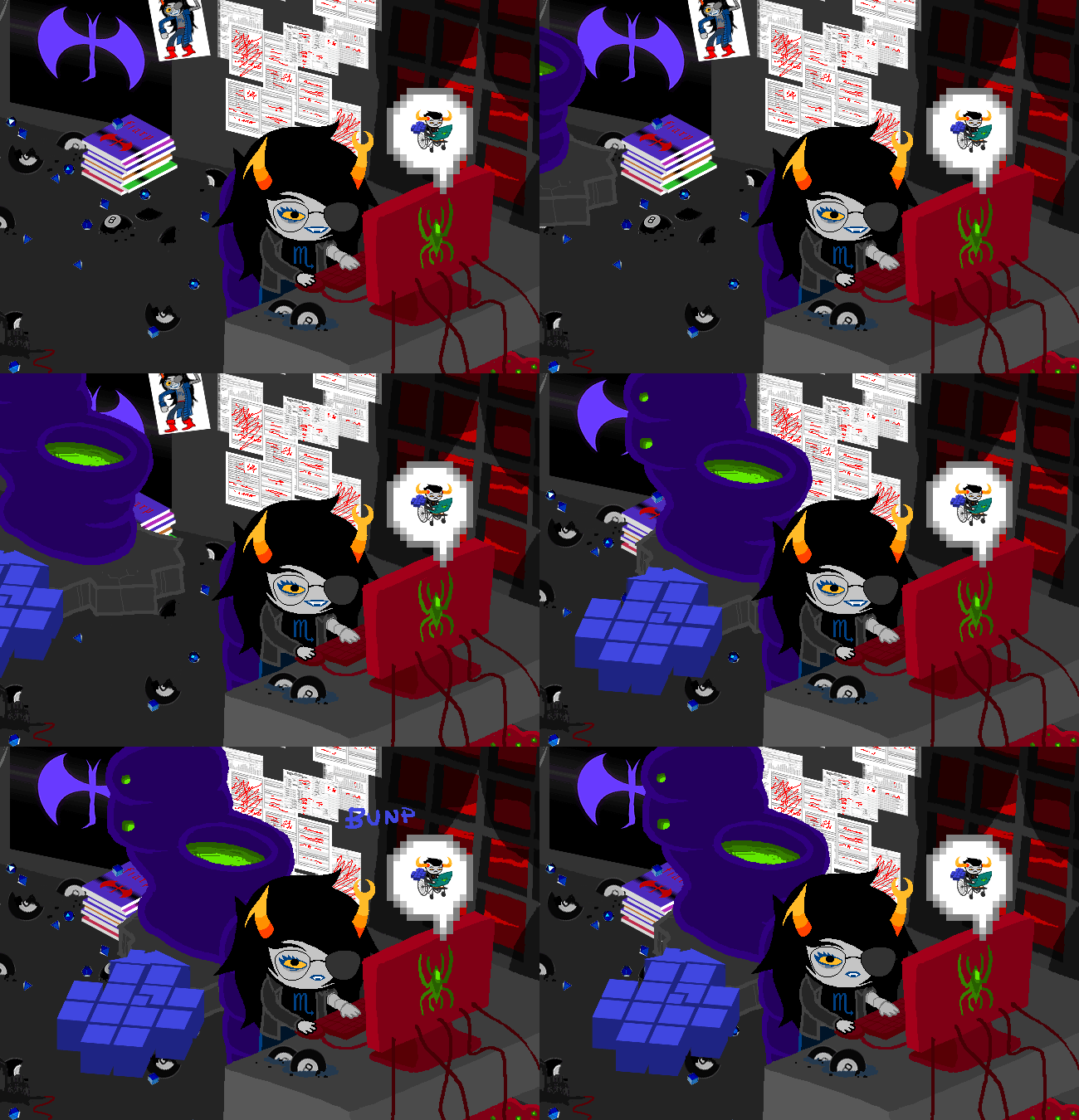
She sawed off Tavros’ legs to give him mechanical ones, which also happened weeks after this incident. Even the “impromputations” joke happens in a conversation with Karkat about not having any more “Impromptu Amputations”, since he fainted from seeing Kanaya amputate Tavros and only woke up hours later. They’re no evidence that she did it out of spite.
Hell, the idea that Kanaya did it to spite Tavros is a jab Vriska uses to get underneath Kanaya’s skin.
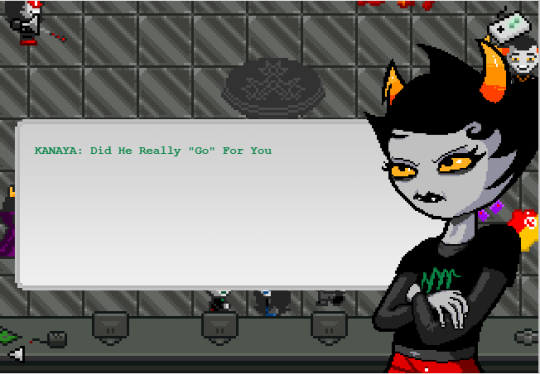
VRISKA: That was some pretty sweet chainsaw work earlier. Pretty 8rutal, really! Didn’t think you had it in you. VRISKA: Hey, you weren’t settling a score with him there 8y any chance? KANAYA: What VRISKA: I’ve got a pretty keen nose for revenge. Could it 8e that you had a thing for him and were upset when he went for me instead? Hmmmmmmmm? KANAYA: Did He Really Go For You KANAYA: Thats Not How I Remember It VRISKA: Yes, I think I must 8e on to something here! Anyway if that’s the case, sorry a8out the 8ad 8r8k! KANAYA: Could You Leave Me Alone
This part is about Vriska spiting Kanaya and Kanaya hating Vriska over hurting her friends and jilting her, not about Kanaya doing anything she can to be with Vriska.
Just to make my position clear, I’d say I disagree that Vriska was intentionally spiting Kanaya, and I think there’s a confused and misguided degree to which she cared about Tavros. I think Vriska’s likely TRYING to genuinely reach out here, she’s just terrible at it because she can’t really escape her own self-absorption.
But otherwise, I totally agree. Kanaya is canonically friendly towards Tavros, and selling that dynamic short lessens the complexity of every character involved. Tavros is an abuse victim, but he’s not really a passive one. He resists Vriska’s pressure and abuse at every turn, early on, and pretty much his most effective skill at doing so is in getting his other friends to want to help him.
Like, remember when Kanaya threatened to dump toilet water on Vriska to get her to stop bullying Tavros, because Tavros asked her to? Fucking with Tavros comes with severe backlash for Vriska pretty often, because most of his friends genuinely care about him.
The basic idea behind Roleplay is this: Whatever a character’s Class, if they strongly admire or want to emulate a figure with a different Class, they’ll adopt said Class’ symbolic imagery and key verb behavior. This will pretty much always go poorly, since the player in question is focused on being someone else instead of being themselves.
Not much to add there, except to note that her Fairy God Troll behavior towards John (behavior that only Kanaya, a Sylph, shares while also succeeding in what she accomplishes) also leads to her Making/Creating Bec Noir.
But let’s talk about someone who isn’t very interested in Roleplay at all: Tavros Nitram.
Vriska tells us that the common bloods are less likely to value historical legends and Alternian traditions, and that actually seems to reflect in the story mechanically.
Eridan, Gamzee, Equius, Vriska, Terezi–all of these characters roleplay very heavily, and sit relatively high on the spectrum while sharing a passion for FLARP and/or historical systems of power, like the Hemospectrum or the Subjugglators.
Aradia, Karkat, Sollux, Tavros–all of these characters don’t really have much of an interest in their Ancestral Legacies. Tavros comes the closest, but it’s important to remember that his Rufioh is not the Summoner! He’s just a guy Tavros made up in his head or got from the Pupa Pan movie, not Rufioh himself.
Vriska’s the one who read Mindfang’s Journal, and so she’s the one who relates Tavros to the Summoner, who is a Rogue of Breath. And when she tries to make Tavros stronger, what she wants is to make him more like him.
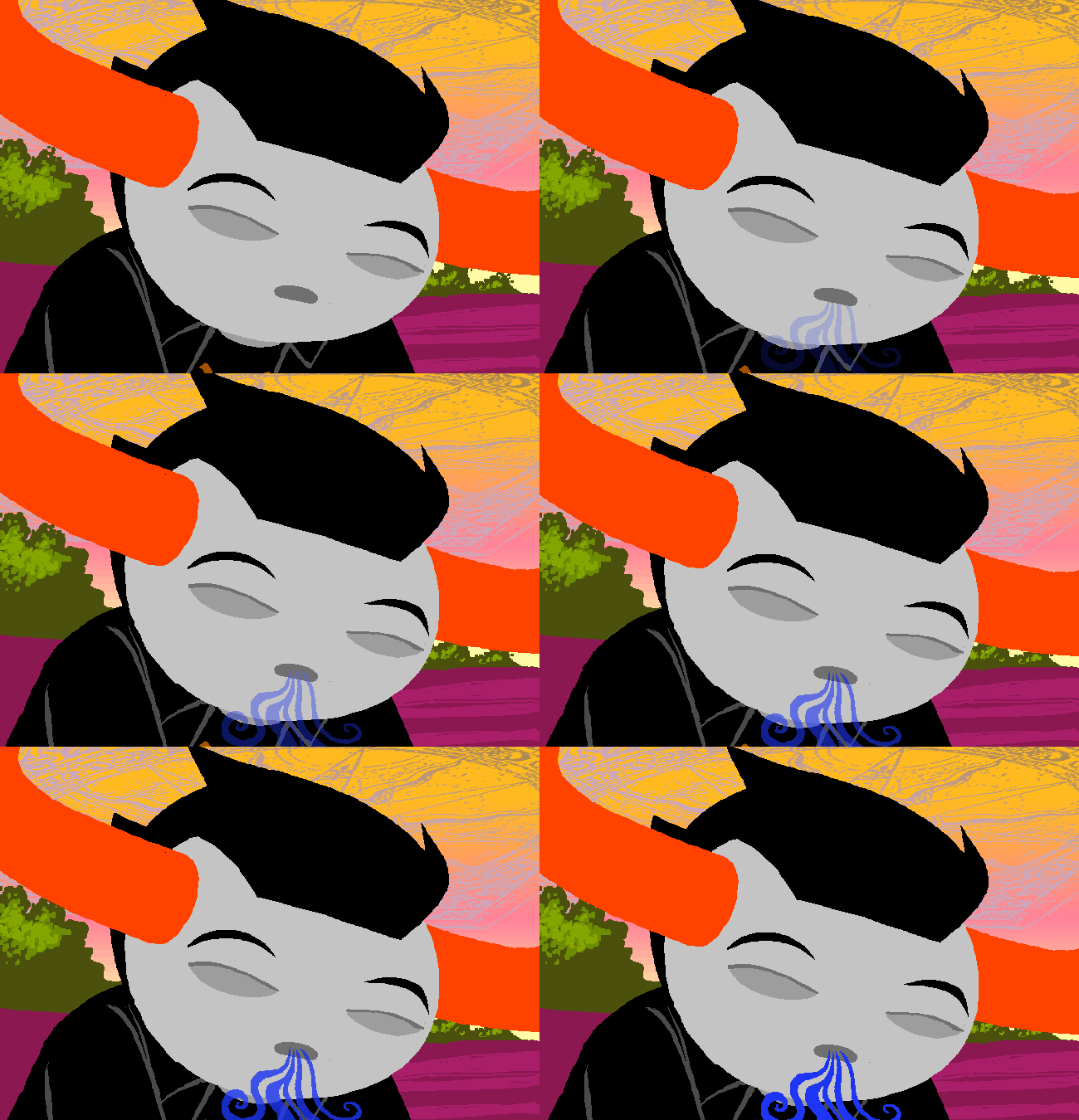
Let’s take this to the critical point of Vriska’s investment in Tavros, and focus on Tavros for once. One thing people don’t tend to notice is that his Aspect powers nearly came to light as he prepared to kiss Vriska–or, in other words, to give her Breath. This was something he made a conscious choice to do, which I view as a critical part of his arc as a Page–the Active Serve/Give class.
If he’d succeeded, he’d presumably have learned how to control his powers better, and become a more effective member of the team by taking direct control of his power.
He does not succeed, as Vriska wants him to do things her way instead.
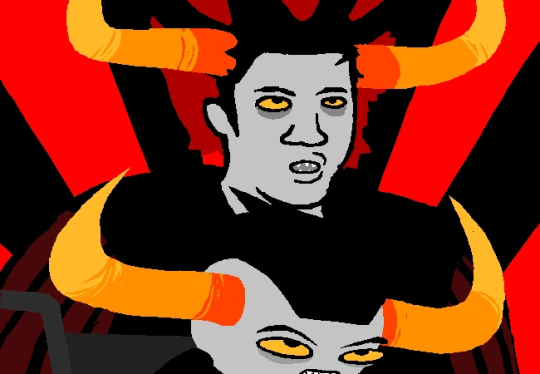
And her way, of course, is to attempt to have Tavros kill her to spare her an agonizing death. Put another way, Vriska wants Tavros to steal her life, for her benefit. This is behavior that would come naturally to a Rogue of Breath, but it does not come naturally to Tavros.
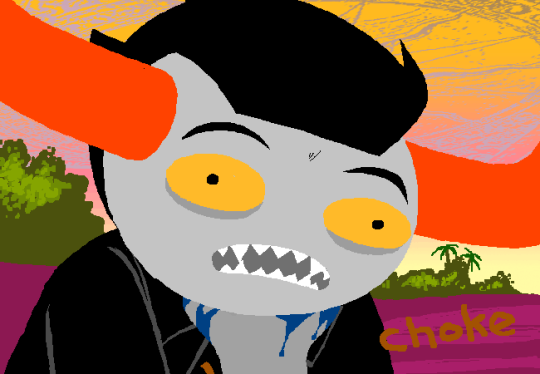
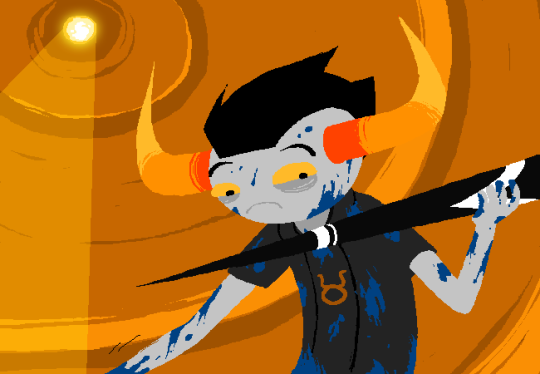
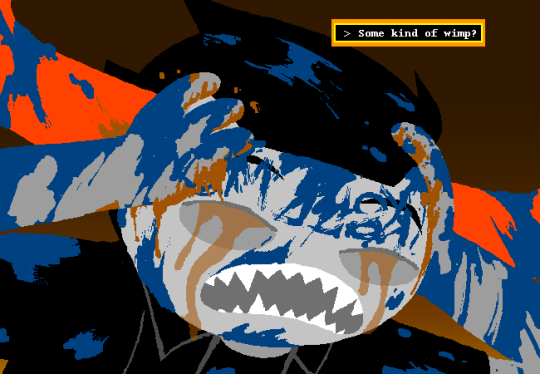
Notice that Tavros grows increasingly covered in Blood during this section, by the way.His freedom and personal momentum are utterly crushed under the weight of his relationship with Vriska, and the responsibility she thrusts on him.
Calliope tells us that if a character is “corrupted by an outside influence”, their abilities may manifest in ways “in defiance of their Aspect”. Funnily enough, through roleplay, we can in fact reach scenarios similar to those of Inversion Theory, since it is true that players who are roleplaying intensely sometimes take on connotations of their dichotomous Aspect.
This is a perfect example, since a Page and a Rogue are in fact entirely opposites in verbs and active/passive affinity. Tavros does not like behaving Passively, and does not find himself comfortable killing for Vriska’s benefit, or for that matter being told what to do.
And both of them suffer heavily for it as a result. Vriska dies a slow and painful death, and Tavros finds the whole event so traumatizing and exhausting that he basically withdraws completely for the rest of the session. That’s the kind of intensely negative effect that forcing roles on others can have in Homestuck.
So what happens when characters willingly take on roles that aren’t natural to them? And how much can this system be said to apply to most characters in the story?
Let’s try to answer both questions next time, when we explore the roleplay behaviors surrounding Eridan, Gamzee, and Kanaya during the height of Horrorstuck, and how Active/Passive alignment is communicated to the audience through visual symbolism.
I’m really… not a fan of this idea for two reasons. One, it’s making some really uncomfortable suggestions that someone who has been coded as a victim in a number of ways is, at heart, responsible for/complicit in the behavior and choices of the person who is mistreating them.
Two, yet again it’s treating Rage players as automatically ‘bad’ or ‘negative’ or ‘destructive’. Neither of these things are, I think, true or helpful assumptions, and they’re assumptions I see bandied about a lot within the fandom, in regards to both victims of assorted horrific mistreatment and Rage players, in ways that tend to try to pivot the axis around until the people making terrible choices and doing terrible things are absolved of all responsibility for their behavior.
I think this tendency is one of the reasons I disagree so strongly with certain reads of the Page role, that imply they unknowingly (or knowingly) encourage all of this mistreatment to “benefit” themselves.
This is an important point, that I agree with. I’m sorry if it’s seemed otherwise. I’m happy Xefros is a Rage player precisely because it’s such a positive depiction of the Aspect in Act 1. Xefros makes Joey feel by turns confused, frustrated, and protectively furious in the span of a couple of hours, causing her to champion on his behalf.
And I don’t think Xefros CAUSES Dammek to be overly aggressive and controlling of him. That’s ultimately Dammek’s choice, and a fuck up on his end. But I’m just not interested in this “Dammek’s mean to Xefros because he’s BAD and CRUEL and A BAD PERSON” narrative. It’s just not very interesting?
You can be interested in characters that are bad people. It’s fine. And taking the time to understand their nuances leads to a better understanding of the text, and of the character’s dynamics.
Here’s the thing about Pages: I regard their tendency to end up in abusive relationships as one of the like…potential dangers of the Class. This isn’t to say it’s their fault, any more than it’s Maids faults that they end up conscripted to their Aspect, or other seemingly Class-related challenges.
See, Pages are simply friendly and likable, and that’s kind of their superpower. They’re incredibly good at getting people to like them in some way, and so want to protect or empower them. But they can’t really control the people that get invested in them, and what someone else thinks is best isn’t always right for you.
Part of a Pages’ arc is about coming to face their reality and, in some cases, the imposed roles and identities others enforced on them. They reach their full potential when they come to be aware and honest about their true feelings and desires, and assert themselves bravely. That’s the basic Page arc, as far as I can tell.
So I consider them active not because they manipulate people into abusing them or w.e, but because their fundamental story is about attracting the protective and sometimes dangerous wills of others to their lives and learning how to stand up for their own.
But this toxic behavior always seems to be rooted in a genuine care for the Page. Vriska was cruel and awful to Tavros, yes. It’s also inarguable that she perceived herself as trying to help Tavros, and that the desire to make him stronger drove her behavior to some extent. She says so herself.
Dirk was outright in LOVE with Jake, and wasn’t a FRACTION as cold feeling towards him as people commonly think. All of the actual conflict and abuse came from AR/Hal, who was in an unimaginably toxic situation himself and was p much also abusing Dirk.
And Jake DID contribute significantly to his actual romantic problems with Dirk. Jake decides to lie to Jane (Roxy had told him explicitly Jane had feelings for him TWICE before that conversation) and decides to believe her when she lies about liking him. All of this because he had already chosen Dirk.
Despite this, and despite KNOWING that his jokes about sexuality and Dirk being a girl probably hurt Dirk’s feelings/made Dirk think he was straight early in life (which turns out to be a major part of why Dirk is so tense and uncomfortable while they’re dating), he doesn’t talk to Dirk about it, because that would require conflict or admitting he did something wrong, and Jake is kind of a coward about that stuff!
He’s non-confrontational to a fault, so Jake deals with problems by denying they exist or, at his worst, indulging escapism and outright running away from them. It’s exactly what Grandpa did to Joey and Jude, and the same potential for toxic behavior shows up in Jake, though he learns to grow out of it through his friends.
This is a HUGE THEME in Homestuck! Pretty much EVERY character has some potential for toxic/abusive behavior, and it’s only by connecting to each other and understanding the world though friendships that they rise above those inherent personal weaknesses.
And it doesn’t mean Jake deserved his abuse but, once again: Dirk didn’t abuse him. So their actual relationship was troubled because of AR’s influence, AND more sensible ways they were both fucking up. This is Jake’s side.
What I’m saying is, there’s room here to both understand Dammek as someone who is toxic to Xefros and understand him as having warm and even positive feelings about Xefros. Dammek might genuinely not realize anything is wrong, because he is a Prospit dreamer and Xefros’ whole problem is being unable to see Dammek’s treatment as a problem, let alone communicate it. (Denial is a recurring motif for Pages, btw.)
None of this is necessarily what’s going on. And even if it is, Dammek could turn out to be considerably judgmental and critical of Xefros. All of this nuance might be true and Dammek would still be an asshole.
Because people are nuanced, and assholery and abuse are behaviors regular people might come to engage in in all sorts of ambiguous ways. And Xefros and Dammek are both shaped by a society literally designed to make them as self-destructive and hateful as possible.
I have noooo idea how Dammek’s character actually works, or how the story is going to handle them. All I’m saying is there’s room for nuance here, and I’m interested in exploring it.
I think I would disagree that the toxic behavior/abuse is necessarily rooted in any desire for the Page’s wellbeing, at all. With Dirk and Jake? Maybe. I don’t have any opinion on them, beyond agreeing that AR was pulling a lot of the strings there. With Dammek and Xefros? We haven’t seen Dammek’s side of the story yet at all, to know what he actually thinks or feels, beyond sounding very very much like Vriska from the outside. But with Vriska and Tavros? She wasn’t looking out for him, regardless of what she said. She had little to no ‘warm’ or ‘positive’ feelings about him–she was a manipulative bully, who saw him as a toy to play with, and to discard when she got bored with him. She was the kind of person who would rather break a toy she wasn’t interested in, anymore, than let someone else handle it. Her excuses were shallower than a coat of paint… she can’t have been completely out of touch with reality enough to believe that forcing him to jump off a cliff and break his back would somehow make him stronger. It was a child’s petty act of aggression against someone who defied her will. She goes on to assault and mistreat him in more ways than one, repeatedly, in ways that demonstrably worsen his health and well-being, and the excuses she tosses out are primarily to keep him compliant/too discouraged to resist and to keep other people off her back. She presents the same kind of excuses any time anyone challenges her on her bad behavior.
I agree completely that reducing characters who do bad things to ‘oh, they did it because they’re Bad and Evil and Terrible’ is reductionist and unhelpful thinking. But I think that painting characters and people who do bad things with the brush of ‘oh, well they meant well all along because they said so, so it must be true’ is also a rather damaging thing to imply, speaking from the standpoint of a survivor. People are nuanced and complex creatures. Relationships are also nuanced and complex–even relationships that turn toxic and absolutely harmful to one or both parties. Being able to say ‘this behavior, this mindset, this habitual treatment was abusive and unhealthy’ is still a helpful statement. A lot of abusers will swear themselves hoarse that everything they’re doing is for the benefit of their victim. They may even have convinced themselves it’s true. ‘This person said they were doing ___ for my own good, but they were lying’ can absolutely be a true statement. It doesn’t matter whether that person was lying to themselves, lying to the victim, or just lying to hear themselves lie. And it doesn’t mean that the character can’t be explored, or discussed, or empathized with, or rehabilitated to grow into someone healthier.
My read on Pages is still that Knights are active and Pages are passive, primarily because I see them both as quite near the center of the active-passive scale, and I think that a lot of their journey is about traveling to the side they ‘belong’ on. Knights start out constantly worried about what other people think of them, always trying to put others first in a very ineffective way while thinking of themselves very poorly, but in the end, I think they function more successfully and happily when they learn to focus more of that energy on themselves. It gives them the boost to actually extend that protection to others as well, as a secondary effect. Pages start out rather self-absorbed and oblivious, in many ways, but have the potential to learn to consider other people, and empower other people. That empowerment can end up spilling back over to give them some secondary protection, as well. I think a very strong trait of both Knights and Pages is endurance/persistence in the face of obstacles, though.
Mostly, I don’t like the idea of associating Pages with that abuse as a key tendency or danger of their class. They’re hardly the only characters we see subjected to blatant on-screen (or implied off-screen) long-term, deliberate, and patterned abuse. At various points in their lives and in different iterations: Dave, a Knight. Damara, a Witch. Mituna, an Heir. Gamzee, a Bard. Terezi, a Seer, and more. All of these characters are subjected to clear and recognizable abuse, in one form or another. It doesn’t make abuse a key risk of their classes… it might just mean that Hussie has a habit of writing about abuse dynamics, frequently in ways that get little to no satisfying resolution.
It seems we’re at fundamentally different readings of the comic in some ways, which is entirely fair. I don’t have much to say about your reading of Vriska, except that I agree wholeheartedly with this statement:
“A lot of abusers will swear themselves hoarse that everything they’re doing is for the benefit of their victim. They may even have convinced themselves it’s true. ‘This person said they were doing ___ for my own good, but they were lying’ can absolutely be a true statement. It doesn’t matter whether that person was lying to themselves, lying to the victim, or just lying to hear themselves lie.”
Vriska is unambiguously an abuser. As is AR, as is Eridan, as is Gamzee, as is Equius–all to different degrees of severity and shaped by contextual nuance. Tavros is fully in his rights to regard her words as lies–because the things she told him about himself were outright untrue, as were the things she said about herself.
Maybe to some extent. I do think Dammek is in an unhealthy state of mind, for sure. We won’t be able to say for sure where he’s involved until Hauntswitch lets us get into his head, though, I think.
Her excuses were shallower than a coat of paint… she can’t have been completely out of touch with reality enough to believe that forcing him to jump off a cliff and break his back would somehow make him stronger.
That said, I don’t think this is true, and I don’t think it logically follows from believing Tavros has a right to regard her as a liar/abuser. More, I think it’s canonical in the text that Vriska is indeed that self-deluded.
She’s a thirteen year old girl that was raised in a fascist society built on racist in-fighting that systematically deludes its children. Vriska is a traumatized kid who dissasociates from her true feelings from birth in order to feed a giant spider? Her entire relationship with Tavros was based on her copying Mindfang, a Sylph, and she constantly tries to mimic a Sylph’s behavior by attempting to make Tavros stronger.
And yes, that level of disassociation and desensitized brutality makes her a monster to Tavros, and pretty much everyone for most of her life. A good half of the Beta trolls are kind of fucking monsters, because they were raised by a fascist society.
That was literally the deal the Alphas made with Echidna, who is literally The Mother Of Monsters. The new Trolls are powerful enough to win, but at the cost of becoming a kind of monster, making their game that much harder to win ideologically/philosophically–they can barely even understand it.
Vriska’s entire problem as a person pretty much boils down to being UNABLE to actually introspect and honestly understand herself! Look what happens when (Vriska) is made to think about how she truly comes off and pulls away from her imagined responsibilities!
Meanwhile, Still Pretty Toxic Retcon Vriska is imagining herself as Responsible and Selfless the entire way to LE. She tears into (Vriska) for being selfish explicitly, in the text! That dissociative tension between Vriska’s true self and her mental self-image is part of the text, as far as my reading goes.
RE: Pages and Knights, I think that’s the most compelling reading for Active Knights and Passive pages i’ve seen yet. I am genuinely unsure if the narrative actually goes that way, and I’m interested in finding out, so it’s cool to feel uncertain about that again.
I think I still disagree, though. I think the nuance is that I perceive Passive/Active behavior as intrinsic to these classes, and as mostly complicated by their self-image.
Dave seems to behave very Actively in that he’s take-charge and exploiting Time during the Beta session, but he’s also roleplaying a Prince and not having a good time. He seems to be a lot happier when he invites/allows it, choosing not to deal in Time Travel himself.
And he’s still focused on others for most of that time–he either falls apart psychologically with no outlet for his tension with Bro pre-retcon or finds better self-understanding by entering a relationship with Karkat.
Also, I don’t like what passive Page implies about Tavros. His last plot beat then becomes “he hands Vriska and army and fulfills his character arc by…becoming aware enough of her and others’ needs and being helpful!” which just doesn’t work for me. The “he ideologically slam dunks her and never thinks about her again” angle just feels more satisfying to me, so long as the canon ambiguity is still extended to us.
also, I do think all the classes have toxic/abusive relationships. It seems to me there’s different recurring patterns and struggles going on for each class, not just Pages, and I think all of them are meaningfully and satisfyingly resolved. So I don’t agree with the “Homestuck doesn’t deliver” angle either.
Someone told me to post this so here it is. Probably my best vocalization yet of the Roleplay mechanic I’ve been talking about, which ties the Ancestors into the Classes and makes the whole system a lot more flexible and comprehensible.
If nothing else I think it’s interesting to consider and discuss, so do let me know if you agree or disagree. Here’s some other examples of Class roleplay I’ve found time to write about:
I agree. I have a few reasons to add “creating Light” as a reason for Joey, and I remember the Maid reference you’re talking about. It’s still SOMEWHAT possible she’s another class–I saw one reference to destruction, but she doesn’t feel like a Prince so I’m still leaning on Maid. But she’s definitely a Light player imo.
I need to get screenshots to make a whole post about it, but my classpect thoughts on the others are:
Xefros is absolutely a Page of Time. There were a fuckload of references to him as a Page already and at least one to Time, which are most of what I’ve got to compile.
Jude is PROBABLY a Seer of Doom. All of his knowledge ends up benefiting or acting through Joey, and she makes explicit reference to being impressed he actually *Knows* his stuff, with respect to all these threats and rogue conspirators he’s predicting. Of course, its still pretty early and there wasnt anything explicit there, so it’s still somewhat up in the air.
Dammek strikes me as a Thief of Breath. Not completely sure on the Thief part–all I have to go on is the fact that he’s so driven and the occasional references to him taking Xefros’ stuff. His passion for communism/non-ownership certainly sounds like “stealing” through “freedom/disattachment” to me for his own benefit, after all. So that’s my rationale there.
But SPECIFICALLY Dammek definitely seems like a Breath player, because he’s strongly referenced as having a talent for leadership and motivating/driving people–providing direction. The fact that Xefros’ classpect matches Aradia’s–Time doesn’t hurt, as Dammek’s analogue would Tavros, the Breath player.
On top of that, it sets up a somewhat interesting inverse dynamic to the relationship we saw between Vriska/Aradia/Tavros. Where Homestuck’s cycle of revenge began with a Maid of Time getting revenge on a Thief of Light for the abuse of a Page of Breath, Hiveswap’s plot seems to begin with a Maid of Light beginning to heal the withered sense of importance of a Page of Time at the hands of a Thief of Breath.
Not entirely sure if this reading will hold up, of course. But The Dancestors demonstrated an affinity for this kind of karmic role switching, and Scratch seems to be managing the events of this story, to an extent–just as he managed the cycle of revenge. So it wouldn’t surprise me if it pans out.
Part #1: Flight of the Movie & Anime References
This section is pretty much setup for the next three essays. There’s a couple sections here that I have a fair bit to say about, but probably just as many where I’ll close out with some minor observations, or reference to someone else’s Good Post™.
What I think is important is noting the consistency and similarity with which Homestuck engages in meaningful reference. I just want you to have this list in mind as I flesh out the three truly impactful references I want to talk about in this series.
So here’s a short list of cases where Homestuck outright leans on other stories to structure itself, with accompanying references:
1) The Game Over Arc – Plot Structure & Dragon Ball Z
We’re starting with Dragon Ball Z because the references here are relatively simple and straightforward, and they largely set up either pretty clear structural parallels, rather than thematic ones.
The clearest of these examples is the section of the story that begins with the joke Arquius makes above. In case you don’t know, the “over 9000″ meme has its roots in this iconic, hilarious sequence from DBZ:
What’s notable is what follows. From the moment this joke happens, the very structure of Homestuck changes to following the loose structure of some of the most memorable DBZ arcs.
I’m no buff on the series, but the memories it calls up for me most strongly resemble the Namek/Freeza or Buu arcs, and expert DBZ consultant @alotofmomos (who hates me for writing this) confirms these are the arcs that most perform the particular structure Homestuck will now be mimicking.
And what does that structure consist of? A particular mix of “pacing” choices, cinematography, and sheer scale of spectacle that I find hard to source to anything but DBZ. I can’t even think of other Shonen series that mix all these elements in quite the same way, though again, I’m no expert.
Some of these elements are:
A) Drawn out, massive power-up sequences:
B) Conflicts that carry out on planetary scales, and indeed often destroy the planets hosting them.
This pretty much speaks for itself, doesn’t it? Do I really have to say some stuff to make it look like I’m doing anything other than pointing out some obvious goddamn parallels that blew my mind because they took me years to notice?
Alright, fine. I’ll say this much: I think it’s quite fitting that Homestuck would borrow from the DBZ playbook for the section of the story that illustrates the sheer mind-boggling scale of power our protagonists have reached.
There’s very few stories out there that demonstrate this sense of mortals achieving such bonkers dominion over reality through sheer force of will, and the homage certainly hammers home the idea that these kids are Gods with levels of power we’ve barely scratched the surface of.
But I don’t think there’s a big Narrative Payoff to this particular reference. Instead, I think what Homestuck takes from this is functional in terms of narrative. Because the most interesting things this narrative model adopts are structural.
C) Convenient plot-structure.
Namely, what we end up with is a bunch of characters grouped into disparate conflicts across the same larger “playing field”, separated by considerable amounts of distance–and thus, isolating them into distinct narratives.
As a natural consequence of this, the pacing slows down to an excruciatingly slowness, as we cut from conflict to conflict, each one progressing in small snippets of minutes or even seconds at a time. All of this is par for the course for Dragon Ball Z, particularly in the Namek saga.
So what this provides us with isn’t a profound, revelatory moment of thematic meaning–but instead, an effective backdrop on which to flesh out that meaning elsewhere. In fact, this very arc does that like twice with two other stories!
So let’s move on from this and take a look at a couple of character arcs whose resolutions are telegraphed by way of reference.
The bottom line is: Terezi janks Jade’s shoes, and adopts the role of Dorothy in Homestuck’s symbol logic. This leads her home–to Vriska and their memories of growing up together, and ultimately to embracing her red feelings for her.
Terezi’s resolution is one of two relationships resolved in the wake of [S] Game Over. Let’s take a look at the other.
3) Jake as Buttercup
Don’t have much to say about this one either, cause I already wrote most of it. I will say I don’t think it’s an accident that the arcs to coincide here are Dirkjake’s and Vrisrezi’s, since the two relationships are in many ways direct parallels. But that’s another essay for another time.
I have received some rightful criticism on my writing on Jake in particular, and this is a good place to clarify my position, however. I do not think it’s particularly “Good” or “Healthy” for Jake to indulge his own desires at the expense of Dirk’s (or Jane’s) feelings.
My point has never been that Jake’s selfish behavior is inherently good–merely that Jake’s reasons for being in love with Dirk are his own, and not imposed to him from Dirk himself, or anyone around him.
As with all things in Homestuck, the key is for Jake to grapple with the negatives in himself and come to balance with the tension between his own wants and his relationships with others. This is true of literally everyone in Homestuck.
And there’s an easier way of saying what I am getting at. Because Homestuck literally gives us a guidebook to understanding Jake and Dirk’s relationships to each other, as parsed in Jake’s head–a guidebook that provides context to their entire relationship.
Just as you can read Terezi as Dorothy, so too can you read Jake as Buttercup. This is the crucial distinction I seek to make. In common readings of Dirk and Jake’s relationship, Jake acquiesces to Dirk’s pushy forcing of the relationship despite Dirk’s control issues.
In this one, Dirk is a flawed but committed provider and protector, and Jake picks up on and begins internalize a belief that Dirk will always be there for him, prompting him to fall for him. This reflects the fundamental core of their attraction to each other. It does not present a solution to their communication issues. They both have to work through that and be more aware of each other’s needs.
Now, The Princess Bride is a comedy action-adventure movie, but it’s also a philosophical fairy tale. Buttercup and Westley aren’t just in love, they’re in True Love, and the driving force of the movie is how Westley’s love empowers him to do anything it takes for his beloved.
A big part of her journey is learning to truly commit to not just Westley’s love for her, but her belief in that love as something both true and powerful. Something that can transcend all odds and obstacles.
Which is. You know. Exactly what Jake does when he’s fully immersed in the power of his own faith.
Now let’s move on, and note two more movie references that the comic makes outside of the context of this DBZ-mini arc.
4) Tavros as Peter Pan
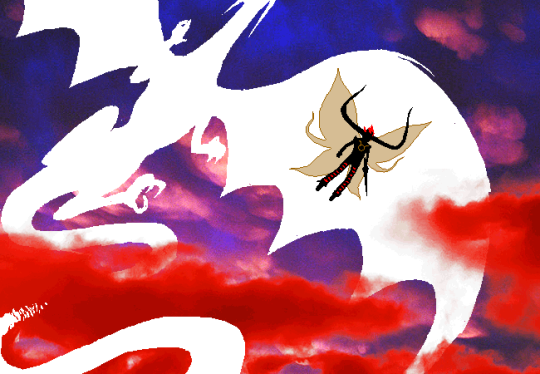
There’s not a terrible amount of depth to be drawn here, either. I think most people accept that Tavros is deliberately invoking Peter Pan in his narrative victory here, with the ghosts as his Lost Boys. I will add, however, that if Peter Pan is the role Tavros is emulating in reaching his full potential, well…
Peter Pan isn’t exactly known for being Selfless, is he? He’s a hero, for sure, but self-centeredness is pretty much his calling card as a hero. To the point that Wikipedia claims that
“In the play and book, Peter symbolizes the selfishness of childhood, and is portrayed as being forgetful and self-centered.”
Understanding Caliborn as a Yaldabaoth is one way to contextualize his power over the reality all the characters preside over, and we’ll definitely touch on that further in the next three sections I’ll be covering.
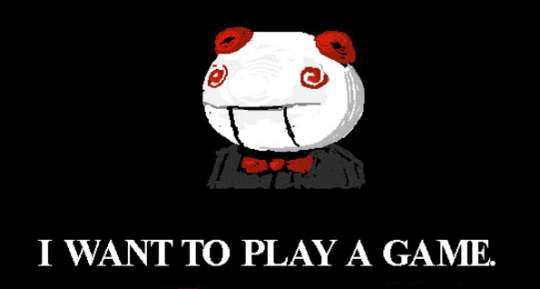
But one easy way to contextualize Lord English’s power is as…well…Jigsaw.
Like Jigsaw, Lord English builds a massive, highly controlled gauntlet that he exploits and terrorizes his victims through. The only difference is that Lord English’s dungeon is bigger than some creepy gray cellar.
It is in fact, Literally Everything that occurs within the context of the Alpha Timeline. Every homeworld that every character originates from–except for, arguably, Beforus, which is still under his sway enough to be doomed, but also presented as borderline Eden-like by comparison to Alternia.
While Yaldabaoth’s control seems very distant and abstract, Jigsaw’s is crystal clear and vicious. Everything the characters of SAW suffer is, ultimately, in the hands of the orchestrator of their misery. Their puppetmaster, so to speak.
In the same sense, pretty much every single way the characters in Homestuck suffer has Lord English at the root of it–even the thing they do to themselves and each other as a result of cultural memes.
Troll Violence, heteronormativity, quadrant normativity, and hypermasculinity–all are memetic structures that exist because Lord English himself disseminated them, in the context of Homestuck. They’re thought-traps rather than literal physical torture devices, but they’re torture tools all the same.
And you can even see Jigsaw as a symbol for Lord English’s influence, since it is, after all, one of the primary differences setting apart Bro and Dirk. Dirk has no interest in the SAW franchise at all, whereas Bro makes a point of mocking Dave with it. (thanks to @jadedresearcher for pointing this out, by the way!)
So yeah. Not only does SAW tell us a lot about the nature of Caliborn’s effect on our characters through the Alpha Timeline, it also acts as a mark for his influence. That’s…pretty much all there is to say on the matter.
For now.
That wraps up this little introductory round-up. Now I can get to talking about three of the biggest influences on Homestuck as a story: The Neverending Story (the book), Earthbound & Mother 3, and Gnostic Myth. Hope you’ll follow along with us over the next couple of weeks to find out more.














 Flying through Storytelling