have i ever responded to a homestuck question by calling it stupid or making fun of someone?
Serious question. If I make someone feel stupid wrt Homestuck, I’m inclined to believe I’ve done something wrong, because that’s not what I’m here to do. This comic is overwrought and complicated and intricately woven, I’m just trying to make it easier for people like you (and I! I’m always learning more about the comic as I talk about it w/ other people) to parse.
it took me like seven years to feel like i even halfway understand this particular relationship and i still feel like i’m missing stuff wrt most of the comic, so I guess all I’m trying to say is…don’t worry bro? you’re good.
The key point here is Dirk never shows any indication of being aware of Brain Ghost Dirk, even though in his last pesterlog before BGD’s appearance he’s trying to understand whats happening in the session and clearly wants to help however he can. It doesn’t make any sense to link Dirk’s agency to Brain Ghost Dirk’s here.
Which is important, since it means Brain Ghost Dirk is a product of Jake’s agency, including this line about Jake being his boyfriend. And this is after Dirk breaks up with him, implying Jake still thinks of Dirk that way, or still hopes they can get together.
It helps that “I am [Name], you [Verbed] my [Loved one], Prepare to die” is a pretty clear reference to The Princess Bride, a movie all about the pure power of love overcoming all obstacles so long as you believe in it. I’ve written about its relevance to reading Dirkjake before, though I wanna do better by the link someday:
No shortage of people have pointed out how Jake seems to see himself as or end up in the positions of sexualized and marginalized female protagonists, but I think there’s a cause to be made Jake’s “arc” draws from this specific one–Buttercup–above all others. Buttercup’s romantic dynamic with Westley is simple: She issues requests to him, and he responds “As you Wish.”
This As you Wish is an explicit I love you, and the power of love is put forth as the source of Westley’s power and endless competence and ability throughout the entire story. It doesn’t matter what needs to happen, Westley finds a way to do it. And he does it because he believes in their love.
Buttercup, however, struggles to hold on to her faith that love can overcome all things possible and wavers in her commitment to living for it, ending up nearly trapped in an unwanted marriage. Buttercups’ arc is resolved when she chooses to believe in love even at risk of dying, promising never again to hide what she truly desires–Westley.
Jake perceives Dirk as his Prince Charming, an idea that could also be described as a Knight in Shining Armor.
I’ve almost made like 6 different posts about this going in depth about how Brain Ghost Dirk quoting this line is proof of how powerful and badass Jake sees Dirk as, more than anything to do with thinking of Dirk as toxic or controlling, but mostly it’s just come to my awareness of how many people don’t fucking know “My name is [x], you [verb]ed my [person], prepare to die” is a reference (some because they are young and some because well it’s a damn 80s fantasy film) and basically educateyourself.gif
This quote being the one BGD fires off is also deep proof of just how much of him comes from Jake’s psyche, not Dirk himself. Like. You wanna look at this and tell me Dirk wouldn’t be rolling his eyes the entire time. Meanwhile Jake watches this with the biggest stars in his eyes and gasps when Inigo gets back up
blah blah also the six-fingered man is to inigo’s father as aranea is to jake: both are being used and exploited by the more powerful individuals specifically for the sake of weapons, but that’s a deeper reading than andrew hussie likely intended with his witty quote dispensing at the ideal time
This section is pretty much setup for the next three essays. There’s a couple sections here that I have a fair bit to say about, but probably just as many where I’ll close out with some minor observations, or reference to someone else’s Good Post™.
What I think is important is noting the consistency and similarity with which Homestuck engages in meaningful reference. I just want you to have this list in mind as I flesh out the three truly impactful references I want to talk about in this series.
So here’s a short list of cases where Homestuck outright leans on other stories to structure itself, with accompanying references:
This section is pretty much setup for the next three essays. There’s a couple sections here that I have a fair bit to say about, but probably just as many where I’ll close out with some minor observations, or reference to someone else’s Good Post™.
What I think is important is noting the consistency and similarity with which Homestuck engages in meaningful reference. I just want you to have this list in mind as I flesh out the three truly impactful references I want to talk about in this series.
So here’s a short list of cases where Homestuck outright leans on other stories to structure itself, with accompanying references:
1) The Game Over Arc – Plot Structure & Dragon Ball Z
We’re starting with Dragon Ball Z because the references here are relatively simple and straightforward, and they largely set up either pretty clear structural parallels, rather than thematic ones.
The clearest of these examples is the section of the story that begins with the joke Arquius makes above. In case you don’t know, the “over 9000″ meme has its roots in this iconic, hilarious sequence from DBZ:
What’s notable is what follows. From the moment this joke happens, the very structure of Homestuck changes to following the loose structure of some of the most memorable DBZ arcs.
I’m no buff on the series, but the memories it calls up for me most strongly resemble the Namek/Freeza or Buu arcs, and expert DBZ consultant @alotofmomos (who hates me for writing this) confirms these are the arcs that most perform the particular structure Homestuck will now be mimicking.
And what does that structure consist of? A particular mix of “pacing” choices, cinematography, and sheer scale of spectacle that I find hard to source to anything but DBZ. I can’t even think of other Shonen series that mix all these elements in quite the same way, though again, I’m no expert.
Some of these elements are:
A) Drawn out, massive power-up sequences:
B) Conflicts that carry out on planetary scales, and indeed often destroy the planets hosting them.
This pretty much speaks for itself, doesn’t it? Do I really have to say some stuff to make it look like I’m doing anything other than pointing out some obvious goddamn parallels that blew my mind because they took me years to notice?
Alright, fine. I’ll say this much: I think it’s quite fitting that Homestuck would borrow from the DBZ playbook for the section of the story that illustrates the sheer mind-boggling scale of power our protagonists have reached.
There’s very few stories out there that demonstrate this sense of mortals achieving such bonkers dominion over reality through sheer force of will, and the homage certainly hammers home the idea that these kids are Gods with levels of power we’ve barely scratched the surface of.
But I don’t think there’s a big Narrative Payoff to this particular reference. Instead, I think what Homestuck takes from this is functional in terms of narrative. Because the most interesting things this narrative model adopts are structural.
C) Convenient plot-structure.
Namely, what we end up with is a bunch of characters grouped into disparate conflicts across the same larger “playing field”, separated by considerable amounts of distance–and thus, isolating them into distinct narratives.
As a natural consequence of this, the pacing slows down to an excruciatingly slowness, as we cut from conflict to conflict, each one progressing in small snippets of minutes or even seconds at a time. All of this is par for the course for Dragon Ball Z, particularly in the Namek saga.
So what this provides us with isn’t a profound, revelatory moment of thematic meaning–but instead, an effective backdrop on which to flesh out that meaning elsewhere. In fact, this very arc does that like twice with two other stories!
So let’s move on from this and take a look at a couple of character arcs whose resolutions are telegraphed by way of reference.
The bottom line is: Terezi janks Jade’s shoes, and adopts the role of Dorothy in Homestuck’s symbol logic. This leads her home–to Vriska and their memories of growing up together, and ultimately to embracing her red feelings for her.
Terezi’s resolution is one of two relationships resolved in the wake of [S] Game Over. Let’s take a look at the other.
3) Jake as Buttercup
Don’t have much to say about this one either, cause I already wrote most of it. I will say I don’t think it’s an accident that the arcs to coincide here are Dirkjake’s and Vrisrezi’s, since the two relationships are in many ways direct parallels. But that’s another essay for another time.
I have received some rightful criticism on my writing on Jake in particular, and this is a good place to clarify my position, however. I do not think it’s particularly “Good” or “Healthy” for Jake to indulge his own desires at the expense of Dirk’s (or Jane’s) feelings.
My point has never been that Jake’s selfish behavior is inherently good–merely that Jake’s reasons for being in love with Dirk are his own, and not imposed to him from Dirk himself, or anyone around him.
As with all things in Homestuck, the key is for Jake to grapple with the negatives in himself and come to balance with the tension between his own wants and his relationships with others. This is true of literally everyone in Homestuck.
And there’s an easier way of saying what I am getting at. Because Homestuck literally gives us a guidebook to understanding Jake and Dirk’s relationships to each other, as parsed in Jake’s head–a guidebook that provides context to their entire relationship.
Just as you can read Terezi as Dorothy, so too can you read Jake as Buttercup. This is the crucial distinction I seek to make. In common readings of Dirk and Jake’s relationship, Jake acquiesces to Dirk’s pushy forcing of the relationship despite Dirk’s control issues.
In this one, Dirk is a flawed but committed provider and protector, and Jake picks up on and begins internalize a belief that Dirk will always be there for him, prompting him to fall for him. This reflects the fundamental core of their attraction to each other. It does not present a solution to their communication issues. They both have to work through that and be more aware of each other’s needs.
Now, The Princess Bride is a comedy action-adventure movie, but it’s also a philosophical fairy tale. Buttercup and Westley aren’t just in love, they’re in True Love, and the driving force of the movie is how Westley’s love empowers him to do anything it takes for his beloved.
A big part of her journey is learning to truly commit to not just Westley’s love for her, but her belief in that love as something both true and powerful. Something that can transcend all odds and obstacles.
Which is. You know. Exactly what Jake does when he’s fully immersed in the power of his own faith.
Now let’s move on, and note two more movie references that the comic makes outside of the context of this DBZ-mini arc.
4) Tavros as Peter Pan
There’s not a terrible amount of depth to be drawn here, either. I think most people accept that Tavros is deliberately invoking Peter Pan in his narrative victory here, with the ghosts as his Lost Boys. I will add, however, that if Peter Pan is the role Tavros is emulating in reaching his full potential, well…
Peter Pan isn’t exactly known for being Selfless, is he? He’s a hero, for sure, but self-centeredness is pretty much his calling card as a hero. To the point that Wikipedia claims that
“In the play and book, Peter symbolizes the selfishness of childhood, and is portrayed as being forgetful and self-centered.”
Understanding Caliborn as a Yaldabaoth is one way to contextualize his power over the reality all the characters preside over, and we’ll definitely touch on that further in the next three sections I’ll be covering.
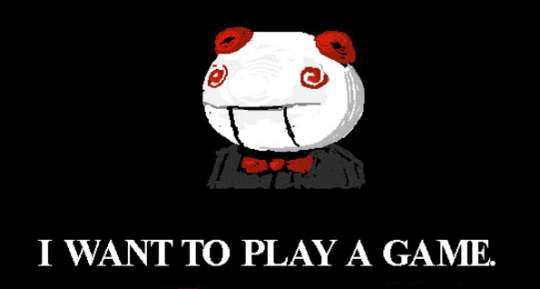
But one easy way to contextualize Lord English’s power is as…well…Jigsaw.
Like Jigsaw, Lord English builds a massive, highly controlled gauntlet that he exploits and terrorizes his victims through. The only difference is that Lord English’s dungeon is bigger than some creepy gray cellar.
It is in fact, Literally Everything that occurs within the context of the Alpha Timeline. Every homeworld that every character originates from–except for, arguably, Beforus, which is still under his sway enough to be doomed, but also presented as borderline Eden-like by comparison to Alternia.
While Yaldabaoth’s control seems very distant and abstract, Jigsaw’s is crystal clear and vicious. Everything the characters of SAW suffer is, ultimately, in the hands of the orchestrator of their misery. Their puppetmaster, so to speak.
In the same sense, pretty much every single way the characters in Homestuck suffer has Lord English at the root of it–even the thing they do to themselves and each other as a result of cultural memes.
Troll Violence, heteronormativity, quadrant normativity, and hypermasculinity–all are memetic structures that exist because Lord English himself disseminated them, in the context of Homestuck. They’re thought-traps rather than literal physical torture devices, but they’re torture tools all the same.
And you can even see Jigsaw as a symbol for Lord English’s influence, since it is, after all, one of the primary differences setting apart Bro and Dirk. Dirk has no interest in the SAW franchise at all, whereas Bro makes a point of mocking Dave with it. (thanks to @jadedresearcher for pointing this out, by the way!)
So yeah. Not only does SAW tell us a lot about the nature of Caliborn’s effect on our characters through the Alpha Timeline, it also acts as a mark for his influence. That’s…pretty much all there is to say on the matter.
For now.
That wraps up this little introductory round-up. Now I can get to talking about three of the biggest influences on Homestuck as a story: The Neverending Story (the book), Earthbound & Mother 3, and Gnostic Myth. Hope you’ll follow along with us over the next couple of weeks to find out more.




 Flying through Storytelling