i am unnerved by how much saionji’s english voice actor reminds me of eridan but honestly they are the exact same guy so w.e
so having uncovered the pervasive gnostic imagery tying homestuck to other fantastic works like The Neverending Story, Mother 3, and Revolutionary Girl Utena, its time to get to the real discourse
the epilogue is real. its going to be act 8 but its just going to be a remake of the episode from Utena where Nanami lays an egg, starring Vriska as Nanami.
Juri can be…oh lets say dead Aradia, why not. or Rose.
I understand that she’s using Lord English to talk about herself there, but I’m not following how this is particularly characteristic of Vriska? I don’t think she’s the only character who gathers self-knowledge from observing others. Though I guess this scene is the most explicit example that comes to mind…
Oh no, people get self-knowledge in Homestuck in all sorts of ways. This is just a pretty clear page of insight for Vriska in particular. Vriska gazes at the lightshow of paradox space and describes it as Lord English “putting on a fireworks display” just for the two of them, right before launching into her little spiel.
So witnessing the Light of Lord English’s destruction leads her to taking a nugget of Truth about reality for herself–I’m reading it as an interpretation of Thieves as “One who takes Light, or takes through Light, for the benefit of oneself” basically.
In this case, the Light she’s taking isn’t Luck or Literal Light, but truth/true information. The kind of information Rose spends her session seeking: information that leads to fortune. Ie: Enlightenment. [S] Remem8er has her gaze upon the lightshow again, even more dazzling this time, right as she reunites with Terezi, too.
I don’t think the experience is unique to her or anything, I just think it’s a pretty notable moment in Vriska’s arc that’s too often passed over, and that parses neatly into Classpect terms. Alpha Vriska is never presented as gazing into Light as an idea in quite the same way, implying that it’s (Vriska) who is closer to the path of fortune.
It’s also important in the sense that it tells the audience that Homestuck as a comic seems, at least, to be calling out Alpha Vriska’s behavior as unhealthy and unfulfilling, which I think is important considering how many feel the comic just kind of said “Actually Vriska wins at everything and is the hero”, in a sense? There’s doubt cast onto that reading, is what I’m saying.
oh yeah, the parallels between vriska’s and aranea’s reaction to finding out their relations to mindfang are definitely solid. i also don’t think the Page’s god tier outfit being visually similar to peter pan’s is a coincidence, either; there’s a deliberate link between pages and youth, immaturity, and a struggle to realize themselves, making theirs the most arduous and lengthy of all the classpects’ journey of maturity.
vriska’s is also a unique journey in terms of thieves; while the thief class sets up the player for a journey of learning to be altruistic instead of selfish, vriska has to go through the additional step of learning that she is a thief in the first place. she frames all of her self-centered choices as selfless ones, done either for the good of another person (tavros, john) or for the general group. she wants to paint herself as a sylph, working for the good of others, even though most of the time, her choices are rooted in altruism only insofar as that altruism can come back to benefit her. i.e., she wants to be a hero, but only so that she can ultimately profit from it.
this comes back in the Dream Bubbles, when she meets another thief and starts dating her. (vriska) is a demonstration of Vriska at her most ‘thief-y,’ totally absorbed in her own world and her own relationships, and willing to give up on altruism entirely. the problem is that although this is technically progress in the right direction, it’s not the thief’s ideal endpoint; ideally, she would come to terms with her own nature and start working towards genuine selflessness. this doesn’t happen, not in the least because she’s dead, and has a dearth of opportunities.
aranea, on the other hand, is a sylph through and through. what she does is for the “good” of others, she’s just very bad at realizing what the good of others is; and she’s too utilitarian (mind-controlling people, killing others, desperately making a power grab) about it. aranea has a vision for the greater good of all people, but the brutal methods she’s willing to use to get to that vision damn both her and the attempt.
Oooooh damn I’ve been arguing for a while now that the Active/Passive distinction inherently includes Selfishness/Selflesnsess respectively but it didn’t occur to me to consider that part of the roleplaying mechanics I’ve been uncovering, that does say a lot about Vriska I think!
Interestingly it suggests Alpha Vriska hasn’t wholly moved on from her Mindfang mentality either since one of the ways she tears into (Vriska) is specifically noting that she thinks (Vriska)’s behavior is selfish.
Man I want the epilogue what the fuck is Terezi going to do about this mess 😦 i believe in her
Haha yeah I was being kind of flippant and facetious in the ask I think you’re referencing. I only want to start conversations, not impose a new understanding, so I’m happy to talk things out and debate views!
Tl;dr Jake wanted Dirk the whole time, he wants Dirk selfishly because he views Dirk has his protector and bodyguard and because Dirk helps him with whatever he wants help with, and he knowingly manipulated Jane into denying her feelings for him despite knowing otherwise for a fact because Roxy told him that she had feelings for him.
All of this is literally textual and in the comic.
Reading Jake as passive is the only reason anyone thinks DirkJake is ambiguous instead of one of the most mutual and passionate gay romances in all fiction, and it’s based on nothing but misinformation.
I’ve written so much about this it’s not funny, but feel free to read any of my various arguments on the subject and debate particular points if you want to follow up on something in particular.
Karkat: the reason there’s any people who think Karkat was turned into a joke and was never effective in the plot at all is because he almost always exerts his impact by “Allowing” his aspect, and thus ends up pretty effective all told despite not being aware of what he’s doing!
Tavros: reading Tavros as passive ignores the fact that Tavros fights and resists Vriska’s will every step of the way throughout his abuse, and is pretty capable about knowing who to get to help him in stopping her.
It ignores that the one time Tavros almost used his powers he was acting under his own agency, and that he quite expressly and dramatically is unwilling to do things the way Vriska wills them on him.
On Vriska’s end, ignoring that Pages inspire others to act for their own benefit paves over the element of her character that genuinely perceived herself as trying to help him, which is a textual element that complicates our view of her.
Obviously none of that is to say Tavros asked for it, or that any of what Vriska did is justified. But the way their wills play off each other is more complex than just “she bullies him and he’s a pushover”.
Tavros is NOT a pushover. He’s overpowered by force, but he tries fucking hard to resist his abuse. And Vriska doesn’t exactly just hate Tavros–there’s an element of her behavior genuinely rooted in a desire to help in the context of the fucked up world she grew up in.
But more than anything reading Pages as passive ignores Tavros’ motivation for raising the ghost army and turns it into “oh he ended up helping Vriska to her benefit in the end and that’s…his character arc?”
Which isn’t what that scene is at all. That scene is Tavros getting what he personally wanted to have closure for himself and move on from Vriska for good. Tavros healed. He moved on. He got a pretty gentle sort of revenge because Tavros is ultimately a kindhearted and gentle boy, but he used the ghosts specifically to aid his desire to own the fuck out of Vriska and then moved the hell on.
Reading Pages this way means that Tavros’ arc wasn’t written for the purpose of making a depthless joke of an abuse victim, which means you can understand Vriska’s character complexly without having to prioritize her over her victim.
I sure as hell wouldn’t call it, like, a perfectly handled narrative, but it does make it substantially better and make Tavros ’ ending a lot more satisfying. Also gives me more hope both Vriska and Tavros will be treated well with whatever on earth happens in the epilogue.
Homestuck was, if not good, at least only kind of shitty instead of dramatically in your face blatant abuse mockery shitty all along. Tavros is definitely treated as jokes, but he’s also given actual closure re:his abuse arc, that actually makes sense given who he is as a person. And understanding that means Vriska’s character was handled with more care, too.
Here’s the second of the class essays, covering the Steal and Serve pair, the four classes that take up the middle of the spectrum:
Thief & Rogue and Page & Knight.
The next essay–on the Change & Know pair–is available in it’s entirety for my Patrons, so if you can spare me a buck a month you can get it and more content early if you decide you like it enough. Higher reward tiers will let you invite friends to the Discord so they can access this stuff and talk about it, too!
Feel free to @ me, reblog or send me an ask with your thoughts on these first two essays. There may be some things I can’t answer as they will be answered in later posts, but I might use those as inspiration for what teasers to release from sections of the next two essays over the course of the week.
You can also feel free to talk to me in the Hiveswap Discord where I moderate and cry about Homestuck. I’m very interested in seeing how my thoughts stand up to scrutiny, so don’t be shy!
Here’s the first of the Class essays, where we go over the most intense Active/Passive dichotomy, putting these Classes on the furthest ends of the spectrum.
The Key Verbs for these classes are Destroy and Create, covering Princes and Bards & Maids and Sylphs, respectively.
Quick disclaimer so I don’t get anyone’s hope’s up: This essay doesn’t include much discussion of Jane Crocker! Not because she isn’t relevant, but because I actually ended up writing this entire series because I needed to lay out my thoughts on Maids so I could get around to writing my essay about her.
I’ll be linking to my Jane post at the end of this essay once it’s up, and this essay is pretty much required reading for it! So I think it’s worth checking out if you’re interested in her anyway.
As for the rest, I just hope you enjoy. The other two essays are already written, and I’ll be posting them over the next two weeks!
They are available in their entireties for my Patrons, so if you can spare me a buck a month you can get these early if you decide you like them enough. Higher reward tiers will let you invite friends to the Discord so they can read them too!
Feel free to @ me, reblog or send me an ask with your thoughts on these first two essays. There may be some things I can’t answer as they will be answered in later posts, but I might use those as inspiration for what teasers to release from sections of the next two essays over the course of the week.
You can also feel free to talk to me in the Hiveswap Discord where I moderate and cry about Homestuck. I’m very interested in seeing how my thoughts stand up to scrutiny, so don’t be shy!
Just wanted to reblog this to mention that I made some heavy revisions and added a bunch more stuff, particularly making the Unifying Myth of Fairies far more compelling!
There’s also some talk about Vriska, and I made some edits and added some graphics that should make it much easier to understand how I think the Class Active/Passive spectrum works as a whole. Finally, I also included Jane’s one reference to being a Fairy (that I’ve found so far).
Special thanks to @ymawgat for sending me the questions that made me reevaluate a couple things in the canon and dig all this extra stuff up! This argument is both way more compelling and far easier to read now, I think, and I appreciate it.
I also wanted to note that thanks to my financial situation improving, I’ve been able to lower my Patreon goals substantially! At this point, I’ve got something like 630 followers, so if less than half of them considered sending me three bucks a month, I’d be able to bring out new insights about Homestuck as a full-time job.
You’d also join a Homestuck analysis community that has already proven exceptionally awesome 😉
Of course, I appreciate anyone’s attention and thoughts in response to my writing most of all! I just wanted to keep everyone updated on what the state of this project is.
Ok, this is a pretty good reasoning of the motif, however there are still a couple of things I think you’ve missed:
1: Vriska’s motivation for dressing up as fairy is to fulfill the whole pupa pan story, and this is then connected to her GT outfit. She doesn’t do it in conscious reference to her ancestor at all, and I don’t think her admiration for Mindfang is ever verbally or image-ly linked to her fairy motifs? Also Vriska’s tinkerbell reference is also sort of present in WV’s dream, something that isn’t really connected to Tavros?
2: The references to people being fairies are connected to the troll god tier outfit, as is the fairy imagery (butterfly wings, fairy dust – which is connected to tinkerbell in [S]wake but continues to be present in the comic afterwards). The reason I think this is important is that the Maids and Sylphs who aren’t troll god tiers (Jane, Kanaya, Porrim?) are never called fairies, which sort of implies that the motif has more to do with the god tier accesories than it has to do Maids and Sylphs?
Ok, so:
1. You’re right! A lot of Vriska’s playing up the Fairy thing has to do with Tavros…but Vriska wants to win over Tavros because of Mindfang in the first place. And as far as I can tell, these dynamics are just as often presented through…for lack of a better term, narrative game mechanics, as they are through explicit text.
As far as Mindfang is relevant to the narrative, she exists as a being Made of Light in Vriska’s eyes–her importance, agency and storytelling define her, and this a Light Vriska steals for herself, to make herself feel more important and capable.
For as long as Vriska is trying to live out Mindfang’s image specifically, and trying to recreate her relationship with the Summoner through herself and Tavros, she spends her time trying to act like a Sylph.
Think about what she’s doing with Tavros: She’s trying to get him to get stronger and more assertive, trying to increase his willpower, trying to get him to become more important.
If that sounds familiar, it’s because it’s what Aranea successfully does effortlessly with Jake. Vriska tries (and is equally harmful in the process) but she isn’t playing to her strengths like Aranea is. This isn’t her forte or where she excels–it’s a role she’s playing out because it’s Important to her.
And that’s reflected in the mechanics of how she tries to handle the people around her, just as it does with Dirk and Hal.
This is also why I don’t think WV’s dream presents a conflict–being a Fairy is something important to Vriska because of Mindfang as much as because of Tavros, though the two are deeply interrelated.
There’s lots of other examples of this in the story, too–I’m fairly certain I’ve missed many even now, since Vriska as a fairy wasn’t on my radar until you sent this. Again, I’ll go over some in more detail as this series goes up.
2. The troll god tier thing is complicated somewhat by the fact that the only two trolls who god tier are…Aradia, a fairy class, and Vriska, who’s trying to fit into the fairy figure. I agree there’s some muddling of themes, but not as much as it seems like. This is because no God Tier trolls are described as fairies besides Aradia or Vriska, and Vriska drops the aesthetic completely after dying/getting punched by John.
It’s also worth noting that the forms of exposition for the classes aren’t always symmetrical–like I pointed out in my Jade essay, Witches’ powerful guardians aren’t literally called Familiars, but by all definitions that’s exactly what they are. The implication is built into the nature of the title Witch, while their complement classes have parallels built up through other means.
This, again, will hopefully become clearer soon.
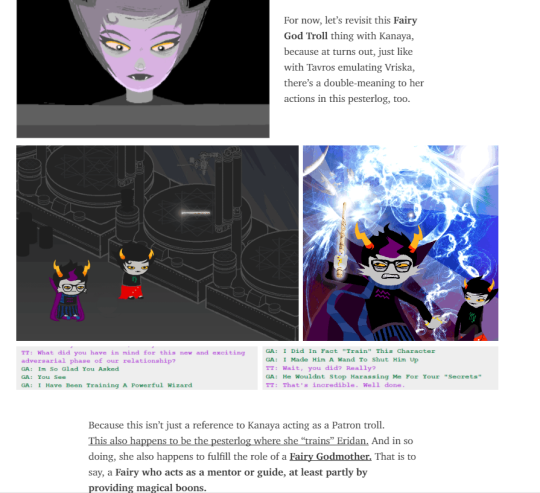
So too it is with a Sylph. Maybe they aren’t literally called fairies as often, but I’d argue they don’t need to be, because a Sylph by definition is a species of Fairy. It’s also untrue that Kanaya is never referred to as a Fairy! She receives the title “Fairy God Troll” in reference to her being Rose’s Patron troll, although Doc Scratch later says this about it:
As she prepares to alchemize new items, she is contacted by her “fairy god troll”, a distinction which does not necessarily have anything to do with being a kid’s patron troll.
She’s the only troll to be described this way, with one exception: Tavros in this pesterlog with Jade, where he’s described as a Fairy God Troll…and where he attempts to do the same thing Vriska is doing by inserting himself into Jade’s story, and even considers following Vriska’s ideology briefly and controlling Bec over Jade’s protests.
Tavros ultimately doesn’t end up being Jade’s patron troll–Karkat fills that role, and is not described as a Fairy. Kanaya is described as a Fairy God Troll and successfully lives out the role that implies, setting her apart in this regard.
Finally, Jane is complicated. Like Kanaya and Karkat, Jane’s entire arc is about struggling to find herself, and she spends a lot of time slotting herself into the role of an Heiress instead–something I think I’m likely to talk about in my essay about her now that I noticed it, ALSO thanks to you so thanks.
Hey! So, this is a really good point (and is leading me to thinking about Vriska in some interesting new Lights…)
What I will point out is this: I looked it over, and pretty much every time Vriska is referenced as a fairy, it either directly concerns or surrounds a pivotal moment in her arc with Tavros specifically. After [S] Wake, Vriska is never referenced as a Fairy again.
Vriska also at least somewhat admired two Fairy figures–she thought Kanaya’s lusus was the coolest of all of them, and she literally crafted herself in the image of Mindfang–a Sylph of Light herself. This is not the only instance of a character from one mythological role actively trying to fit into the context of another. I’ll be going into at least some others–but not all–in the next two posts. One thing I’m noticing more and more now that I have the understanding I do is that the way these mythological motifs affect different classes is complicated, and that this system has kind of essentially infinite depth. There’s a lot in this story for us to reconsider and rediscover, and I’m very excited about sharing it with you guys.
Stay tuned 😉
PS: As I release these essays, I’ll begin tagging posts concerning these mythological figures with their tags instead of going for the more awkward Active/Passive setup. I just think it’ll be more elegant that way, though I might have to think up terms for Prince/Bard and Thief/Rogue, who don’t seem to get them (as far as I can tell right now) because they’re freebies from Calliope.
Ok, you’ll try it out with one of your less prized possessions just to prove how dumb it is. You never liked this hat much. It makes you look like a gnome and basically isn’t funny at all.
Hey! So, this is a really good point (and is leading me to thinking about Vriska in some interesting new Lights…)
What I will point out is this: I looked it over, and pretty much every time Vriska is referenced as a fairy, it either directly concerns or surrounds a pivotal moment in her arc with Tavros specifically. After [S] Wake, Vriska is never referenced as a Fairy again.
Vriska also at least somewhat admired two Fairy figures–she thought Kanaya’s lusus was the coolest of all of them, and she literally crafted herself in the image of Mindfang–a Sylph of Light herself. This is not the only instance of a character from one mythological role actively trying to fit into the context of another. I’ll be going into at least some others–but not all–in the next two posts. One thing I’m noticing more and more now that I have the understanding I do is that the way these mythological motifs affect different classes is complicated, and that this system has kind of essentially infinite depth. There’s a lot in this story for us to reconsider and rediscover, and I’m very excited about sharing it with you guys.
Stay tuned 😉
PS: As I release these essays, I’ll begin tagging posts concerning these mythological figures with their tags instead of going for the more awkward Active/Passive setup. I just think it’ll be more elegant that way, though I might have to think up terms for Prince/Bard and Thief/Rogue, who don’t seem to get them (as far as I can tell right now) because they’re freebies from Calliope.


 Flying through Storytelling