Probably can’t go with anything but a Muse of Light.
It’s essentially the Gnostic world of ideas or the Collective Unconcious made manifest physically, if you think about it. Jokes, stories, images, lies–we experience all of reality, vicariously, through this slim sheen of glass and light. The screens inform us, educate us, give us knowledge and power–the power to reach out, the power to be heard, the power to be seen.
That’s kind of what the internet is. It’s light–electricity, energy, power harnessed into a form that is able to showcase any thought any of us care to share, and give all of our eyes windows into that holds those forms.
It’s a terrifically powerful tool, one that determines and controls basically everything about the world we live in. It commands us, one could say–holds our attention even as it constantly directs us towards each other.
I’m not sure how well I’m getting across what I feel, but I think a lot about the internet, and the way it entangles us and connects us and drives us apart. Basically, I think the internet can be understood as an entity that commands us all, for all of our collective and individual benefit. So I’d say Muse of Light.
Hey, Duelist! It’s Powerhouse, here to hoot at you from another platform.
Here are my two cents: in the WOG quoted, Hussie presents the idea that Vriska’s situation is a more egregious version of Karkat’s.
As a Prospit dreamer, did Karkat struggle because he was actually passive in nature, but had a very active self image as a leader and conqueror? Was Vriska an even more extreme case of misplaced active behavior from a Prospit dreamer?
(Aside: this is a bit of a strange point to make, considering that Vriska generally appears very far from passive… but maybe that’s the point, to help us grasp that there is something passive about Vriska’s nature that most people miss on first read. I wonder what that could be?)
Asides aside, knowing that Thief is active, the description of Vriska as a more extremely misplaced Karkat could suggest that Knight is active too– and it might even give us some extra information about the relative placement of Knight and Thief on the active side of the scale (i.e, that Thief might be more active than Knight).
Hussie does stick to weasel words and hedging techniques in this WOG, for instance phrasing these points as questions, but interpretations that rely on Hussie deliberately trying to mislead the audience of this post (through lies of omission or otherwise) can quickly lead us into a destructive cycle of doubt. If even one idea raised here can’t be taken at face value, there is no way to be sure that the others can: it makes sense to me to stick to the face value and try to glean meaning from that.
It’s also probably worth pulling back a bit and reading the entirety of the quoted paragraph.
Terezi and Karkat, one of which could have been roleplaying a Knight, while the other was a Knight, were linked with the colour white – although in Flip it was only the glasses for Terezi (and wings for Vriska). What are your thoughts on that? (22)
Thanks for the ask! And for the insight. This might well be a solid point in favor of reading Knights as Active.
Being from Derse means you are from a culture of offense and aggression.
Being from Prospit means the opposite. You could argue that these are
qualities that either rub off on the dreamers, or they are designated as
those dreamers in the first place because of those qualities. You could
take the view that these are innate tendencies to overcome, as seemed
to be the case for Jade and Rose. Or maybe sometimes they are tendencies
that are resisted, and need to be understood and embraced.
What Hussie seems to be getting at here is that moons are somehow indicative of innate tendencies in players that can exist outside of their class’s “intended” goals– tendencies towards being active or passive independent of whichever one the player’s class is. So as the Prospit-dreaming Vriska struggles to ignore her innate passivity, the Derse-dreaming Meenah may be convinced to resist her innate activity and only return to it once she’s had some kind of epiphany.
(Feel free to repeat that in your head with Karkat and Dave.)
The question then becomes, in cases where you don’t know what someone’s class is supposed to mean, how are you supposed to tease apart their moon tendencies from their class tendencies… and whether they’re supposed to resist their moon or embrace it?
I think the starting point here is the idea that your moon indicates the culture that you “come from”. If the moon indicates one thing, shouldn’t the class indicate another?
Heya! I hadn’t realized I already followed you, I’m pleasantly surprised. This got a bit long so my response is under the cut.
I do think moon and class indicate different things entirely, and that a player’s Class is the biggest sign of what active/passive state they’re healthiest/happiest/most comfortable in. Essentially, it’s their “true self”–a set of instincts they can’t really change about themselves.
I read the way Hussie describes the moons fairly literally, then. It’s less that they’re indicators of some Secret Tendencies of the players–though they can be that, more on Vriska and Karkat in a minute–and more that they’re environmental influencers. They pull a sort of “gravitational weight” on their Players when those Players dream on them, subtly tugging one way or another.
This also sort of suggests why moons might affect some players more than others. The amount a player spends actually dreaming on the moon might well matter! Rose, Jade and Dave all spent a lot of time awake on their respective moons, and exhibited strong Moon influences as a result.
Hussie describes Karkat as being alienated from his own more Passive nature, and Karkat actually barely dreams on Prospit at all. That said, since the only thing we can tell for sure from this section is that Thief is probably more Active than Knight, I don’t necessarily agree that this suggests Knights are Active. On the contrary, I think it’s likelier it suggests the opposite.
Hussie describes how Rose and Dave start off their sessions very Active here and talks about how Rose’s god tiering leads her to embracing a more Passive role. Similarly, he suggests that Karkat’s self-image is overly Active, implying he’d be better off adopting a relatively more passive role.
Which he does. Since Hussie doesn’t mention it, it kind of gets lost in the weeds that Dave and Karkat’s arc progression pretty much mirrors Roses’, since both of them grow more passive further into the meteor journey.
If future developments suggest that it’s healthier for Dave and Karkat to take up more Active roles in the future, then that’ll change stuff for me, but I think it’s fairly clear that Dave and Karkat get happier and more comfortable the more they focus on their relationship with each other, as opposed to on their own self-images and the responsibilities they bring.
It is possible the Knights are Active and just meant to be Somewhat Less Active, like Vriska. I just don’t think this tract of text tells us either way. While we’re talking about her, though, I do think we learn what it means for Vriska to embrace her Prospitian nature, too.
It looks like (Vriska), basically. She’s happiest focusing on herself–and she needs the focus to figure out that mess–but she spends a lot of her narrative either focusing on empowering others, or considering the existential needs of all of the hypothetical beings in causality above her own.
This ultimately holds Vriska back in terms of personal development, even if it makes her effective at adventuring. (Vriska) becomes more passive behavior-wise, relative to the intense action that mindset brings about, but she is more focused on her own benefit and her own feelings, which is a genuinely healthier place for her to be.
Essentially, she stops trying to be Mindfang and starts trying to be herself. As a result, she’s able to form a genuine connection with Terezi as an equal, and symbolically gain enlightenment.
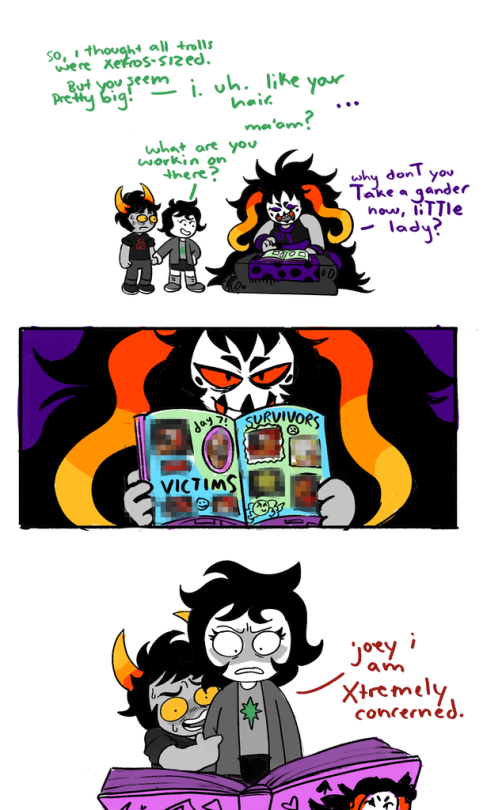
One of the best parts of the weekly TROLL CALL has been the great FAN COMICS. We love them, and we want to reward your enthusiasm. So, here’s the deal. Every week, we’re going to be giving away gift cards to For Fans By Fans, the central hub of Hiveswap and Homestuck merch. Second runner-up gets $25, first runner-up gets $50, and the first place winner gets $75!
Also…ALL first place winners will be entered into our GRAND PRIZE contest, the winner of which will get their fantroll added to Hiveswap as an NPC! What Pumpkin Games’ writers and animators will work with you to develop YOUR fantroll into a CANONICAL CHARACTER, WHO WE PROMISE WILL NOT DIE IMMEDIATELY, UNLESS THAT’S WHAT YOU’RE INTO? YOUR CALL. WE GOT A LOT OF GRAVES TO FILL HERE. YOU CAN STUFF THAT COFFIN IF YOU WANT. IT’S A CORPSE PARTY, EVERYONE’S INVITED.
To be eligible, your comic’s gotta have some Hiveswap. Joey, Xefros, Jude, the pigeons, some Troll Call friends, whatever. You can throw your OCs or some OG Homestuck characters in there too! Here’s a great example by our very own Shelby Cragg and also Cohen.
So, get to it! We’re announcing our first winners on Friday, January 19th. All entries should be posted by, let’s say, 11PM Thursday the 18th, Pacific Time. Anything after that will get rolled over into the next week’s entries. To enter, all you gotta do is write and draw a fancomic featuring some Hiveswap characters and post it on Tumblr or Twitter using the #HIVESWAPCOMICSCONTEST tag. Probably best if it’s the first tag, cause if they’re like the sixth tag, after a bunch of tags that are very long and hilarious sentences, we’re not gonna be able to find it when we’re searching. Make that SEO work for you, sport.
Avoid framing your activism as destruction. There is already plenty of destruction. Someone else will always already be doing more than enough of it.
Try nurturing. Healing. Caring. Listening. Giving. Feeding. Loving. These are not defanged platitudes but ways of transforming the world for the better, if you commit to acting within them. They are far less easy than they seem, and often there is so little you will be able to do, but it is not nothing.
And often you can build yourself up along with the world. Destruction is breaking yourself again and again in hopes that what you’re throwing yourself against will crack, or manipulating others into doing the same (and possibly standing back and letting them take all the damage without doing anything to offset the situation, in which case go to hell). And then who heals the broken? No one, usually, because that is considered feminine and therefore unworthy, because sexism runs deep in the core of our language, below the level at which most of us think. Heal yourself, heal others; heal the world. There are enough people breaking themselves against the walls of the oppressors, there will always be more than enough; and growing tree roots can bring down a wall as easily as a battering ram.
Know this: if the only thought and only respected way is fighting, as soon as you break down a wall, you will believe it is necessary to build it up again. You will build barriers of pain and fear because that is considered more noble than healing or accepting, because building weapons and repairing the infrastructure of war is the only kind of creation and healing that is respected or considered acceptable. It is much more difficult, conceptually, to stop fighting and plant crops and feed refugees, or to try not to escalate situations, but generally a better idea. It is easy to fight. It is easy to want to fight. It is much harder, in a society already full of constant violence, to realize that there should be more, and commit to doing anything to that end. But it needs to be done. You can’t exist just to fight.
If you don’t recognize me, this is some of my most reblogged art.
I accidentally deleted my main blog earlier (which happened to be my art blog) and I’m a pretty upset about that, because since I have a very bad memory I’m having a hard time getting back to all the people I followed… and well because I deleted everything, including sideblogs and likes lol. I really want to get back to everybody and build back my blog and keep posting art, and maybe reposting some of my old stuff? And I really to let everyone know I’m still here in this URL if they were following me n_n; if you’d please spread this it would probably help me find some people back either following me or that I followed! Thanks!
I’m putting this in the HS tag because of the art and for promo reasons, too.
Hey Sollay’s an unfathomably wonderful artist and friend and we are all blessed by their magic every day of our lives, it’d be cool of ya to help them build back up if you like their work! :B
Haha, I mean. To the extent that I’m snappy, it’s not really so much about readings of Pages as a class as it is with the interpretations of Jake that those readings tend to spawn. I mean not just Jake, really–all the Alphas are equally messed up and cruel and painfully noble and mutually loving.
It’s endlessly frustrating that some of the best characters in the story and in all fiction have gotten so passed up, is my opinion.
And it’s a lot harder to spread conversations about Homestuck than it was in the, like, golden age, so to speak. And that’s not anybody’s fault? Buuut I still care about the story, that’s why I’m here. So I’m gonna have feelings about it.
That said, there’s a heavy extent to which I’m playing my contentiousness up. I just default to sarcasm a little as a person, and it’s also kind of true that it’s sometimes easier to get people interested in stuff that sounds highly critical/angry :p
So I try really hard not to come off like I’m looking down on anyone or being too mean-spirited, but well. Like you said, I’m a Hope player, and I think writing as passionately as I do usually makes me more entertaining to read, if also somewhat snappy.
So yeah, I’ve got my reasons. I’m happy to be open about it insofar as people find it compelling and understandable, but I’d also rather not, like. Seem genuinely mad either. If that makes sense.
Anyway thanks for the ask, you’re definitely not wrong 😛
So, this page. This page is one of my favorites, because it shows just how much of a nerd Dirk is, and how wrapped up he and Hal are in their bizarre ironic one-upmanship games even though they don’t really seem to derive any enjoyment for them anymore. One thing to note in this convo is that, in keeping with Dirk’s focus on philosophy and history, they’re not really talking math, even if it might seem like it. More specifically, they’re talking math history.
The theme of the conversation is making bigshot claims of amazingness, while simultaneously introducing deliberate errors in one’s claims.
Hal opens the convo by talking about pi, the “big circle number”. Now, calculating digits of pi is indeed a popular method of testing the computational power and correctness of a computer. However, Hal claims to have “solved” pi, calculating every last digit. This is patent bullshit. As Dirk states, pi doesn’t have an end, it keeps going literally forever, never repeating, and this is one of the reasons why it’s so popular as a test. By claiming to have solved pi, Hal is “inadvertently” admitting to having made an obvious error in his calculations.
What’s interesting, though, is how Dirk claims it to be bullshit, by invoking “an ancient Greek guy” who “settled shit about irrational numbers” “practically when math was invented”, because this, too, is totally wrong, albeit in a more subtle, Dirk-esque way. Considering his interest in Greek philosophy, Dirk would indeed know the story of Hippasus of Metapontum, and how his heretical mathematical discoveries drove his peers to drown him.
Now, Hippasus (who may or may not have actually existed) is indeed credited with the discovery of irrational numbers, which are numbers that cannot be expressed as a fraction of two other numbers (and thus necessarily have no end to their decimal expressions), but the irrational number he’s credited with discovering isn’t pi, it’s the square root of two. Indeed, while pi is irrational, it took until the 18th century to fully prove this, and Lambert, the guy who first did so, was Swiss, not Greek. (Of course, the other, sadder joke here is that the 18th century, too, is ancient history from Dirk and Hal’s post-apocalyptic vantage point, though this is not clear at the point the conversation first happens)
And of course, Hal responds to Dirk’s confusion of history by claiming to have found all the prime numbers, which was proven to be impossible by an ancient Greek guy, specifically Euclid, in his work Elements, a book which mathematicians tend to regard with an awe close to what many people hold for the Bible, and which could by some if far from all definitions of mathematics be considered “practically when math was invented”.
And then Dirk tries to pretend he doesn’t know what prime numbers are for some reason? Yeah, I’m not actually sure if he’s doing something there or just being an ass.





 Flying through Storytelling