I’ve been receiving a lot of asks regarding how to Properly Do The Dab: Japanese Edition, and I figured I’d go ahead and satisfy your thrist.
I know it’s a bit overwhelming but, I figured of all the characters in Homestuck, Dirk would know best. So, hopefully, you guys can appreciate the act as it’s meant to be.
I have completely given up on my tsundere endeavor to claim that i don’t like JakeDirk so here’s a scene from the second chapter of An Ocean Between, go read it
oh my god this is incredible thank you so so much for drawing my fic!!
me, with 100 unfinished works: hey I should draw Jake and Dirk “sleeping together because nightmares are easier to handle like this” stuff inspired by aesthetic stuff i found on tumblr
Commissioned work for @oceanboydirk! Thank you so much for giving me this prompt. I deeply apologize for turning your simple and great request into whatever the actual good christ this convoluted thing is.
(It’s 12,000 words of post-canon dirkjake set early on in their re-established relationship while everyone is still settling in and figuring out the shape of their of their new forever. It’s awkward and full of pesterlogs and yes, nsfw as hell, enjoy.)
You probably weren’t expecting an essay length answer to this question. So like let there be no doubt at all from this point onwards this is exactly the kind of content you can legitimately expect from this blog. This is who I am. I’m sorry.
Also, you’re welcome.
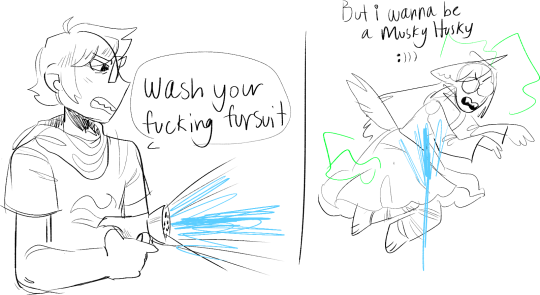
Yes, Dirk is a furry. And his relationship to furries shows us a lot about his parallels and similarities to one Rose Lalonde. Who is also a furry.
Let’s get into this.
Dirk is interested in furries to some extent, and finds the aesthetic appealing on some level. I mean, look at this. I can’t even count how many pictures of muscley horse dudes there are here. The dude isn’t exactly subtle. To quote Jake…
He dodges, and badly at that. To Dirk, swole bunny men represent something to hide–an interest he has that he cannot honestly incorporate into his cool, stoic, Above It All Persona. Not even through the hyper-sincere irony he tells Jane about. It’s something to hide, which means that at his core it’s something that matters to him.
And hey, you know who else is very much not shy about plastering her interests where anyone can see for her own pleasure?
As plenty of people have noted recently, there’s no heterosexual explanation for this. I’d already categorize this as falling into the spectrum of anthropomorphization we talk about as Furry–if you disagree that’s fine, though I do know furries who like this kind of thing. The point is that like Dirk, Rose knows what she likes, and like Dirk, Rose likes some weird shit.
On this side of the argument, though–showing that the characters like this furry stuff through their own characterization–Dirk gets a lot more content than Rose does. But Rose’s relationship with furry is confirmed much more intensely than Dirk’s on the other side of this argument: through their relationships to their Splinters.
In both cases, they’re happy to pretend that furry stuff doesn’t interest them at all, and part of their approach to doing so is either joking about others being interested in it or actively playing up their resentment for it. Either way, the implication they send is that they themselves are Not Interested.
This is a lie, and is to be ruthlessly exploited for comedy, which Homestuck does magnificently well.
Both Dirk and Rose are very invested in seeming Above the kind of self-indulgent identity play that Furry tends to encompass. Intense sincerity of expression bothers to them even as it appeals, because the images they want to project to the people they care about is one of aloof, self-aware, competently critical collectedness. One could say it bothers BECAUSE it appeals.
Which is the exact reason Rose is so annoyed by Jasprose. Jasprose acts as Rose would without the self-awareness she uses to present only the carefully crafted persona she wants other people to see. Jasprose doesn’t think about what others think of her at all. Jasprose thinks in terms of self-indulgence.
A self-indulgence explicitly linked to their status as full-blown, unabashed Furries. Jasprose, by her very being, brings all of Rose’s hidden words and feelings to Light, not being shy at all about sharing them and indulging whatever desire is on her mind.
She mixes cat terminology with flirting, stressing her identity as someone who is a furry and loving every second of it. Davepeta even draws the distinction between her and Rose, noting that Jasprose owns who she is and acts more honestly about it.
But there are genuinely harmless ways that Arquis DOES reflect Dirk’s interest, and those are worth unpackaging. Specifically, there’s the way AR describes himself finally becoming happy.
And yeah someone could nibble with this wording and say well actually Equius likes horses so maybe its him and I actually couldn’t be less interested in trying to explain why Dirk’s character already incorporates an absolutely Furry level of enjoyment of horses so here’s his room again.
So basically Dirk and Rose are interested in furry stuff to some extent but won’t really admit it. They wouldn’t admit it to you if you asked them or anything.
I think this is really fascinating and that they share this particular nuance of characterization so completely is fantastic. Even Dirk’s double face palm and Rose’s pillow hiding feel really similar to me in the sentiment of mortified frustration it gets across.
And all this really stresses their similarities and makes Roxy’s line emphasizing how similar Rose and Dirk are hit home all the harder. I wanted to ramble about that for a while. God I love these kids what was I talking about again?
Oh yeah furries. So Rose and Dirk are both furries but neither of them would CALL themselves furries in public.
Yet. The thing is, this girl exists:
Give Jade like, one birthday party where she decides she wants everyone to have a furry party and draw up fursonas together, and we’re good to go. There’s pretty much no circumstances under which I doubt Jade’s power to get all her friends to stop hiding an interest they ALL KNOW DEEP DOWN they share with her but keep pushing away out of a dumb point of pride.
It’ll be great I promise someone write this fic ok thanks in advance. Anyway yeah give Jade like a year after they get to Earth C and she’ll get them all on the same page. By which I mean all, not just Dirk and Rose.
Jane’s actually the only main character who hasn’t expressed any interest in furries at any point in the story to my memory, and she’s already been willing to play around with trollsonas. Which means at some point in the context of eternity these kids are going to get the hell over themselves and draw some fursonas. And if they don’t, Jade will make sure they will.
So yeah. Every human kid in Homestuck is a furry. Also every living troll, and Callie. Probably all their subjects too frankly.
The two Yaldabaoths, Dramatic Tension & The Diegetic Reader (That’s You!)
[Spoilers for Earthbound:Beginnings, Earthbound, & Mother 3]
Most know by now that Earthbound is referenced every time we say the word “Homestuck”. It’s built into the name: To be Stuck at Home. To be Bound to Earth.
And fittingly for a reference which such pervasive impact on our understanding of the comic, Homestuck styles itself as a spiritual successor to Earthbound in a number of ways.
Both Earthbound and Homestuck begin with a set of four kids who go on an adventure together. Both feature kids with psychic powers, friendship, and the meaning of growing up.
But there are three particular similarities to Homestuck that I want to present you with here. In these three areas, Homestuck and Earthbound/Mother are notably alike:
The Characters:
1) Both feature a unique execution of dramatic tension and narrative stakes for the characters.
The Player:
2) Engage in heavily metatextual, diegetic relationships between the World/Story and The Player/Reader.
The Antagonists:
3) Are God-Like, Authoritarian powers that cannot engage with ideas. In other words, they operate as Yaldabaoths.
These antagonists are who I want to talk about first. We will proceed from number 3 up to number 1, talking about the context of the games and tying it into the comic further as we go.
I’ll ask you to be patient with me if you don’t see much about Homestuck at first–there’s a lot of setup work to do.
Without further ado, let’s begin.
3) The Antagonists.
Side A) Earthbound — The War on Giygas.
Earthbound is the story of a boy named Ness, and his neighbor, Pokey Minch. One day, a meteor lands in their town, a time-traveler called Buzz Buzz appears from within. Buzz Buzz tells Ness he has come from a bad future, where an alien overlord named Giygas has cast the world into eternal darkness. Only Ness and his prophecized friends can stop Giygas.
From then on Earthbound is mostly a fun, sweet adventure romp for our Protagonists. Pokey goes on an adventure of his own, acting like a cruel child whilst striking deals with agents of Giygas and steadily gaining more and more power, both in business and through the dark forces Giygas employs.
Then we skip ahead to the very end of Earthbound. Where we get one of the most horrific and memorable boss sequences in gaming.
Giygas is explicitly unfathomable, indescribable: Giygas is Eldritch in the true “Man was never meant to see this” sort of way. Giygas isn’t explicitly A God, but rather an alien. But he certainly acts like a God. His influence makes inanimate objects animate, makes animals aggressive, lures people into cults and evil deeds.
He’s tapped into the centers of power and wealth in society. Giygas is nowhere, and yet everywhere. He is, in short, the God of the material world Earthbound’s kids wander through. Their Yaldabaoth.
And interestingly, as with Yaldabaoth, Pokey describes Giygas as being “an all-mighty Idiot”–unaware of himself or what’s happening around him.
Giygas shares similarities with Bastian and Caliborn, too–in Earthbound: Beginnings, he’s driven insane by a song that reminds him of his mother. Like Bastian, Giygas has connotations of warped, eternal childhood.
But unlike Bastian, Giygas does not escape his damnation until he dies.
And there are fates even worse than death. Such as the fate reserved for Pokey Minch, who against all odds, is the more interesting of the two–and the more relevant for Homestuck.
Let’s talk about Mother 3.
Side B) Mother 3 — No crying until the end.
Mother 3 is not as happy a game as Earthbound. Where Earthbound concentrated it’s gloom and despair into intense climaxes while being generally upbeat, Mother 3 is bittersweet and tragic throughout–though still plenty beautiful and joyful when it wants to be.
Like Homestuck, it has an unusual structure of Acts–8 instead of 7, but also of variable lengths, including a chapter that takes up almost half the game. Playable characters vary with each section, but the bulk of the game features Lucas, his dog Boney, and their friends Duster and Kumatora. So again: Four protagonists.
Set in the post-apocalyptic Nowhere Islands, Mother 3 tells the story of the fascist, totalitarian Pig Mask Army’s encroachment onto the idyllic, peaceful lives of the Nowhere Island natives.
As it turns out, the Pig Mask Army is led by the megalomaniacal dictator Pokey (Japanese name “Porky”) Minch, who discovers the ability to travel spacetime and escapes the final battle against Giygas.
Since then, he’s traveled countless worlds and lived through millennia, conquering and exploiting all unfortunate enough to be caught in his way.
Now, one interesting parallel about Pokey is what he does to the world he rules over. Just Lord English does to the Troll’s universe–and more indirectly, to both Human universes–Pokey manipulates and exploits The Nowhere Islands through a number of tools.
I note these similarities mostly because through Pokey we get a direct linking between the idea of a God-Like Yaldabaoth figure and the idea of a tyrannical, authoritarian dictator.
This is an area of Lord English’s insidious evil mostly delivered to the audience through implication and background information, so I think it’s worth the time to draw it into focus.
And the similarities between their atrocities might give us some context between the similarities at the end of their stories. Because, again like Lord English…
Master Pokey can’t die.
But he is defeated, as his machine runs out of power. And so, lacking other options, Pokey plays his trump card.
One that proves to be the end of his influence in the story.
“Oh, my! As evil as old Porky here is, I feel bad for him now. It’s true that the “Absolutely Safe Capsule” that the Mr. Saturns and I developed together can protect one from every manner of danger. It IS an absolutely safe capsule, but once you enter it, you can never exit it… Even what’s outside of the Absolutely Safe Capsule is absolutely safe. I did tell Porky in a hushed voice that he shouldn’t use it yet… But all he can do now is live for eternity inside the capsule, in absolute safety. Who knows, in a way, he may’ve gotten exactly what he wanted.
What do you think? Is it wrong of me to think this way?” — Dr. Andonuts
Once Pokey seals his life into the capsule, there’s no longer an out for him. Not ever again. In a way, Pokey’s fate may indeed be one worse than death. And it’s one that seems to be echoed by Lord English, since after all…
Lord English cannot die, but he is defeated.
Specifically, Act 7′s visual language suggests he’s pocketed in the Black Hole that Alt!Calliope created. As a Black Hole is a gravitational singularity, once there, Lord English would be trapped–no amount of Time powers would let him come out, and First Guardian powers would no longer work either, since they rely on the Green Sun’s power.
An immortal, tyrannical kid–denied his playground for eternity. Pretty fitting, I think.
But Lord English is only one part of the story, and I think the relationship between the protagonists and the Player/Reader is the more interesting area of Earthbound to explore. Because…didn’t I mention?
In the Mother series, there is another God.
It’s you.
2) The Player
Both Earthbound and Mother 3 explicitly address your existence in the context of their worlds. Both games, in fact, pause entirely just to ask you your name. In Earthbound, this role is taken by Tony, Jeff’s canonically gay friend. He calls Jeff, and in the process brings up a prompt for the Player to input their name. This can seem like a bit of cheeky fourth-wall breaking, but consider:
You are the unseen hand behind the characters’ every action. You lead them through their world just as Giygas does for Pokey. You’re never viewed, but always present, witness and privy to all things.
And in the final boss battle (you did watch that, didn’t you?), when all else fails, Paula’s prayers reach the people of Earthbound who care about the four chosen children…including you. Your name is the final name given, praying for the protection of Ness and his friend. Your prayers are the power that end Giygas.
Mother 3 makes it even more explicit. In this game, you’re asked your name by an unseen voice, while Flint prays at an altar in the only Church in the game. Depicted on the front of it are the Light and Dark Dragons of Nowhere Island, the latter of which is the subject of an apocalyptic prophecy we’ll talk about soon.
A good question to ask at this point is: Why does this matter? And the answer is that because we’re given the God’s-eye view of these games, the context of our engagement with them is diegetic: explained by the narrative itself.
Like Bastian reading The Neverending Story, we’re not just observers consuming the content of these games. At least as far as the stories within are concerned, we are active participants. We are part of the story.
And this is true of Homestuck, too. Doc Scratch is a smarmy asshole, but he directly acknowledges the reader. He even credits us with more of an impact on the story than our protagonists. And on some level, this is true.
We HAVE had a direct impact on the story, through command prompts and fandom memes and all sorts of other engagements that ended up shaping the way Homestuck has been told. We’ve always been part of the narrative.
And this has important implications for how we, the readers, might best engage with Homestuck.
Because the fact that our window into its world is diegetic means that it is presented through us through an explicit frame, a frame that is narratively constructed.
And frames have limits.
1) The Characters
Whenever I hear people say Homestuck is a tragedy, or that it’s headed for a sadstuck ending with the Beta kids stuck in the Juju in the Masterpiece, I honestly can’t help but laugh. You don’t need alternate timelines and sacrificial lamb versions of our protagonists to secure a happy ending in Homestuck.
Homestuck itself is practically a loop of impossible-seemingly, absolute-dooming circumstances…
met by perseverance and good cheer.
And when all’s said and done, the story pretty much always breaks in favor of the latter. Remember that one of the fundamental rules of Homestuck’s universe is the “Do As You Will” principle–everyone always gets what they want.
Caliborn gets to be LE, as does Gamzee. Arquis gets to fulfill the out-of-nowhere heroic destiny he wanted, and finally proves himself to the Alphas in an act of atonement. Lord English gets his eternity of destruction, and Vriska gets to be the great Hero she always wanted to be.
But our protagonists? The Alphas and Betas? They just want to live in peace. Their desires are compatible with the wills of all the other characters.
Lord English’s will is not, and he’s trampled the agency of every other character a million times over to get where he is. That’s what makes him a tyrant, and that’s what dooms him to his Absolutely Safe Capsule. Karma is an established force in Homestuck, and LE will pay his due.
And in this extremely-dire-until-the-very-last-second approach, too, Homestuck seems to be standing on the shoulders of giants.
Because this big buildup to a Big Dramatic Tragedy of an ending is pretty much exactly Earthbound’s M.O.
Earthbound’s final boss isn’t just one of the most horrifically well-executed eldritch monsters in gaming history. It’s also set-up as what amounts to a suicide mission.
Even more interesting to me, however, are the parallels we find to Mother 3′s ending.
I’m going to take a time out from Homestuck for a second and talk about Mother 3 for a second, because this moment is too important to me to waste frivolously, or subject to my overwrought explanatory dialogue with without giving you the option to watch a scene that’s Undertale-level good.
Unless I’ve already succeeded in getting you to stop reading, drop everything, and go find a translated version of Mother 3 now (you can’t play it in english without emulating, since it was never released in the US), I would really appreciate it if you took the time and sucked up the spoilers and watched this ending cutscene.
It’s a work of art. A heartrending, heartfelt symphony to the pain of loss and the fear of something changing forever. Mother 3 is a game about the Apocalypse. A game about CAUSING the apocalypse, to be precise.
Your final moments with the game are spent watching Lucas pull the final needle that binds a dragon bigger than the world, and the only hope is that Lucas’ good heart will pass on to the Dragon and make a good new world to come. Nothing else is certain.
And the shots we see aren’t encouraging: Immediately after pulling the needle, the world begins to fall apart. Earthquakes rise and wreak havoc. Twisters of water dominate the sky and ocean. Meteors fall from the sky, and as if rising from an enormous egg, a vast, black back archs out from under the world we came to love.
And then we cut to black, and the End screen pops up. We never see these characters again. Only…
Only we do get to talk to them. Once this question mark pops up, you can move around in this black screen-with ‘You’ represented by the END? depicted- and occasionally, you’ll bump into…words. Words that say things like:
And
You get glimpses of things you can’t talk to, like…
And best of all, this is where the game brings out its ace.
Because this is where the name you gave in the church comes into play. At the end of it all, all of the characters in the cast not only tell you they’re ok, but recognize you. Thank you. Love you. Treat you like a friend, say goodbye, invite you back over, and wish you well in life.
In Mother 3, you play as the God of the old world, the world bound by the rules the cast had to play by. By playing through to the end, you set them free.
And by treating you as a real part of its world, Mother 3 invites you to consider its characters a real part of yours. Invites you to think of them not as characters, but as friends. As people. If that sounds familiar, it’s because Undertale built a whole damn game out of the concept.
But the same approach has always been in Homestuck’s DNA. These characters were always people first and characters second, and we were always privy to a limited frame.
That frame is Homestuck, which until The Masterpiece and Lord English’s defeat, has belonged to Caliborn. This has always been the story of his circle–the Alpha Timeline–and the context it crafts out is his childish empire.
Next time, we’ll talk more about Homestuck’s Gnostic themes, and just what it is *exactly* that our protagonists are escaping from.
For now, I’ll leave you with this song.
If this piece interested you in Mother 3, I suggest checking out Tom Ato’s legendary fan translation for the game. Mother 3 is a masterpiece, and I owe both it and Tom Ato my life in some ways. It’d make me really happy to know even one more person has been touched by their work because of me.




 Flying through Storytelling