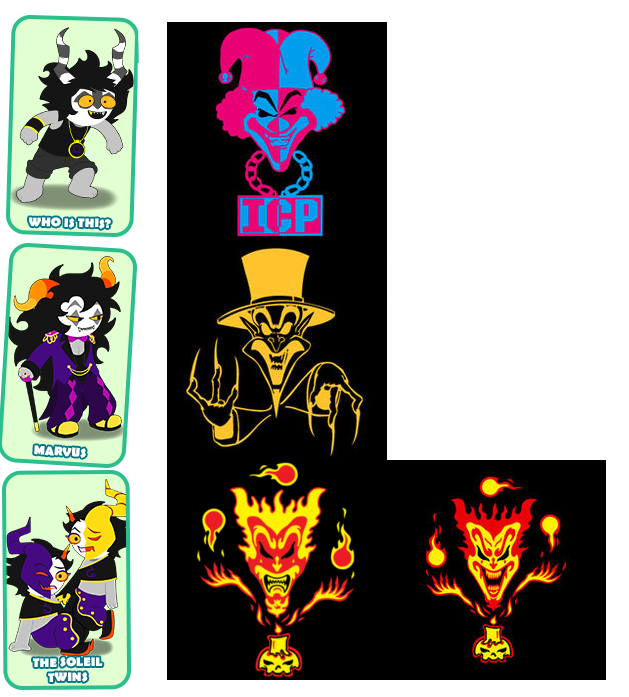
Marvus thoughts pt. 1: Dionysian Frenzy

It’s an understatement to say that Marvus is a lot. He’s so much, in fact, that I had to split my thoughts about him into two posts from the get go. This got predictably long as hell so catch it under the read more.

This first part has to do with how he evokes various themes of Rage. I don’t think Marvus is Ragebound, but he seems to be the first direct evidence we’ve gotten that the Aspect influence of each Blood caste doesn’t necessarily have to manifest negatively.

Marvus seems to be so self-actualized and self-aware that he’s successfully reconciled and incorporated Rage into his identity, regardless of his true Aspect. Indeed, I’ve seen compelling arguments for Marvus as a Light, Hope, Mind, Heart and Life player so far–besides the personal impression I came away with of Blood.

He reminds me a lot of Doc Scratch, in terms of being someone who is so competent that they successfully blend and blur mastery of several different Aspects. Scratch wields virtually infinite influence through at least Space, Light, Rage, and even Time and Heart depending on how you look at it simultaneously, for example, which makes it hard to really assign him a true Aspect.

Marvus is obviously not that extreme, but given that he’s presumably a mere mortal in the end, he might be substantially more impressive. Anyway, lets get to noting the Rage references.

image

Obviously Its interesting that they start well before Marvus himself shows up. This has to do with the Reader becoming more aware of the nature of their reality as artificial/unreal/contrived, though, and that’s important to note for what comes next. For now lets keep it in mind and move on.

image
image

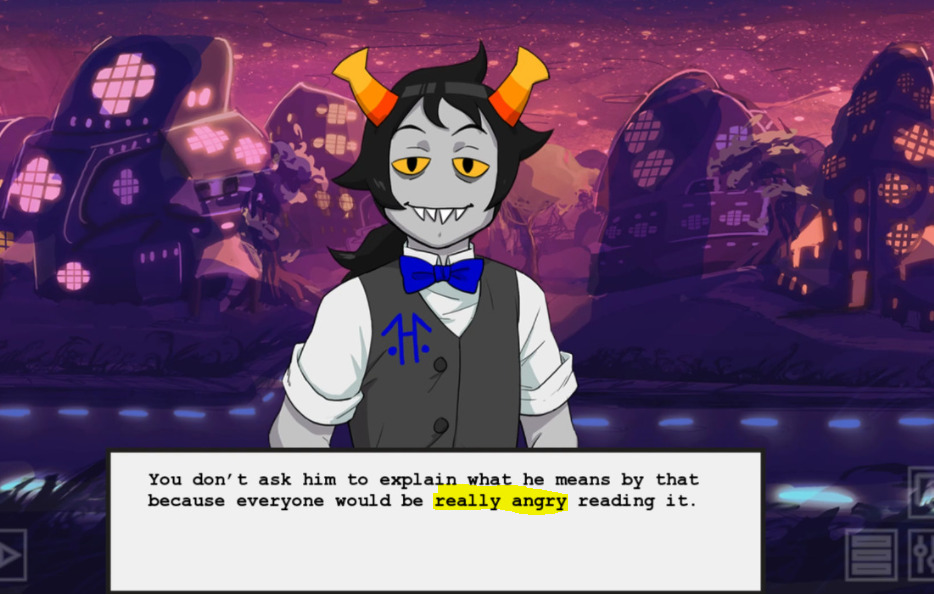
Zebruh, of course, inspires Rage through his “clowns are woke” comment, this time through simple anger. Of course, we’re inclined to think of Zebruh in terms of Doom and maybe Void, right? So maybe its a coincidence…

image

but, huh, there it is again. Mentioned by name this time, no less.

This gets at an interpretation of Rage I’ve been meaning to talk about: Rage as a passionate spurt of fashion. The definition for this idiom, “all the rage”, says:

“The current or latest fashion, with the implication that it will be short-lived, The use of rage reflects  the  transfer of  an angry  passion  to  an enthusiastic one

This understanding of Rage vibes heavily with Rage as indicative of the Hindu concept of “Maya”: The physical world as an inherently illusionary, unreal, ever-changing place.

When something is highly fashionable, it generally involves a lot of passionate reproduction in the realm of physicality-whether its an object, like Zebruh’s scooter, or a particular kind of performance.

Things like sports seasons, for example, are a kind of performance that comes about every so often, generating intense passion and fervor when they do. This is why I see Xefros’ interest in Arena Stickball indicative of his Rage inclinations.

In the same way, both the traveling circus and the music festival are fundamentally events of the moment, and when they’re in town, they draw our eyes to artifice, meaningless (if fun!) spectacle, and when they’re good, hearty guffaws or empassioned bellows–all things associated with the Comitragic heart of Rage.

image

Zebruh’s designs on Marvus also evoke Rage. He asks us to engage in a theatrical performance (one centered on Black feelings, no less–Kissmesitude itself is inherently linked to Rage via Kurloz and Gamzee).

It’s pretty odd that Zebruh is so taken with Rage, but I think that’s simply the nature of Marvus’ performance–and perhaps tells us a bit about how Aspects shift and spread through individuals. Zebruh is thinking entirely about clowns, purplebloods, and Marvus specifically, and that seems to influence his actions–and so is really everyone in attendance at this dark carnival.
image

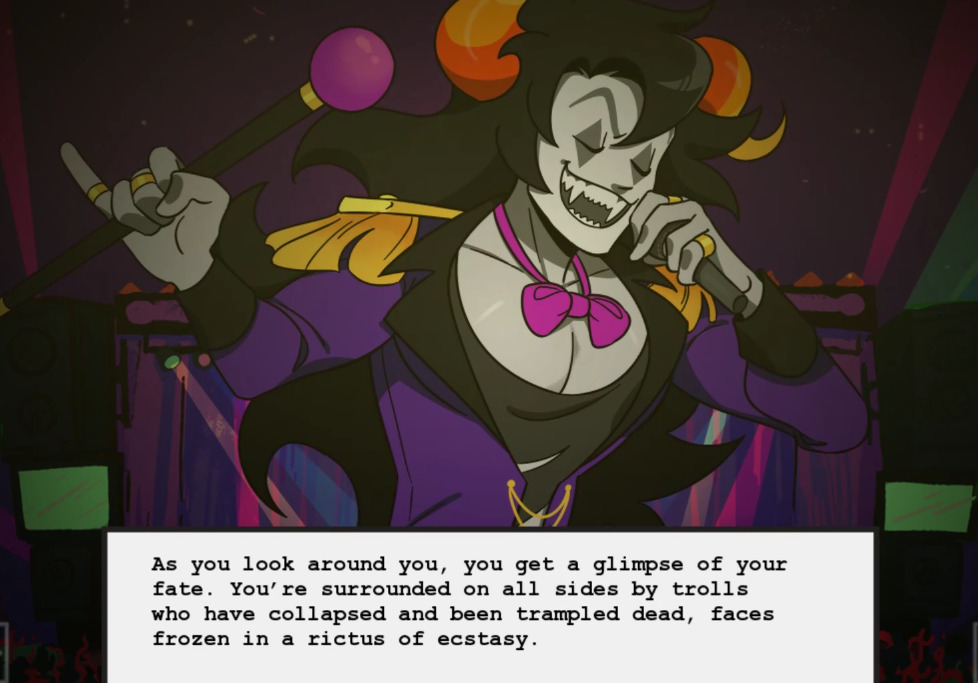
The whole spectacle of Marvus’ performance deeply evokes Dionysian festivals to me. I’ve previously covered how Gamzee Makara is deeply entwined in the myth and symbolism of Dionysus, and its pretty clear by now that this association is inherited by all Purplebloods.

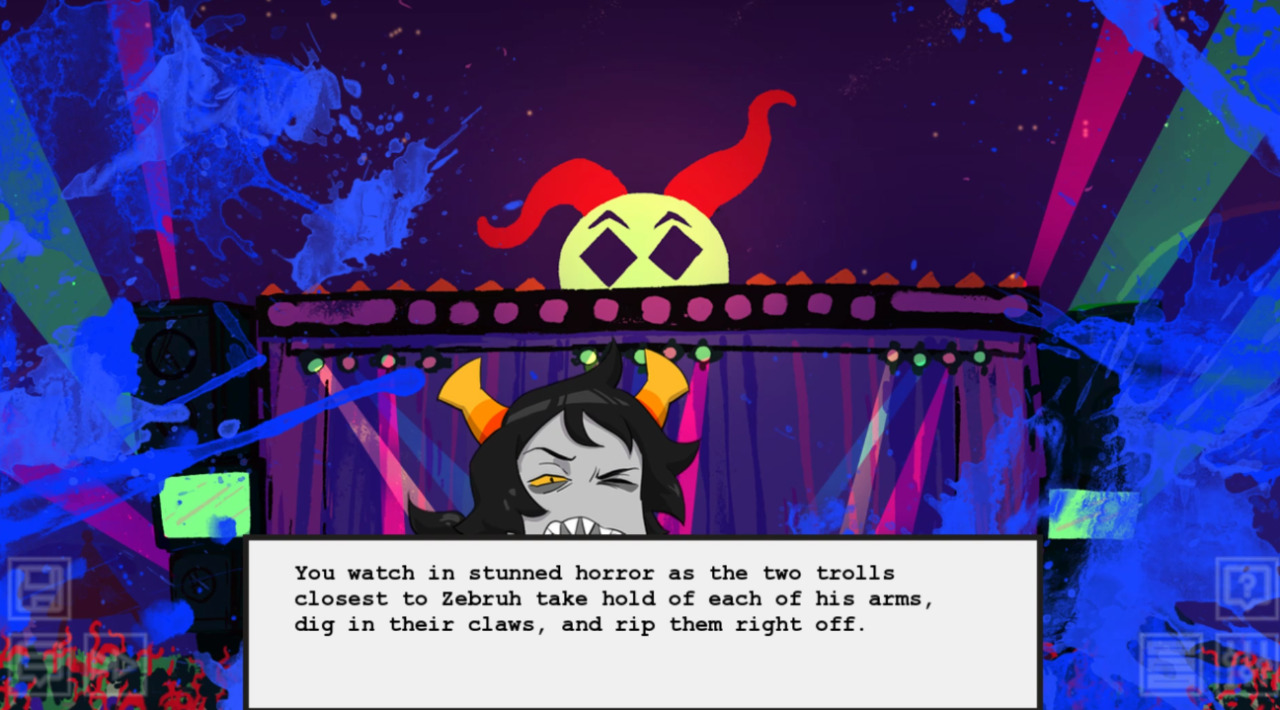
As a refresher, cults to Dionysus generally involved people–usually his female attendants, the Maenads, (who you might remember from Chahut’s last name) entering states of ritual madness and tearing animals or sometimes even humans apart with their bare hands.
image

Which uh, you know. Might have some parallels here. Just maybe.

Actually, Zebruh’s particular dismemberment feels a little more specific. Just as I’ve speculated that Gamzee has links to Dionysus or Terezi to Themis, I’ve suggested that Equius may have links to Orpheus, who was torn apart by Dionysus’ Maenads at the end of his life.

I’m thinking its a possibility that Zebruh is inheriting Equius’ Orphic legacy here, just as Marvus is inheriting Gamzee’s Dionysian one.

Ok everyone should be about gone by now which means we can finally stop talking about Zebruh, just you and me. Finally.

Let’s cover some other things Dionysian worship tended to cover. Dionysus was also the god of religious ecstasy, which I think we see in the intense, deific love Marvus inspires. He’s also an entity of sexual transgression–much of his worship included orgies, and included in his male attendants were the Satyrs, goat men with perpetually erect penises described as “archetypal musicians and dancers”, associated with the breaking down of traditional values.

I think this is part (but not all) of the intense horniness that surrounds Marvus. Moreover, most of that horniness takes a pretty specific bent. It’s not just that people are horny for Marvus, but that he inspires some intense and very physical reactions, usually involving things we culturally see as debasement, degradation, and filth.

In other words, the specific kinks invoked through Marvus generally fall in the camp of things that are likely to outrage or disgust the audience, and so I’m ascribing that to his Rage influence as well.

I am well on record as describing Hope as the “horny” Aspect, but it’s worth noting that as its complement, we have precedent to see Rage as pretty horny, too, and in precisely this way: It brings to mind Gamzee’s bouts of necrophilia or profoundly upsetting approach to expressing his sexuality with women.

And of course, he’s putting on a performance of artifice and illusion for his fans–his show’s as much Theater as music. He even tricks them into thinking he killed you, sending them into a frenzy (ritual madness) that has them all tear each other to death. But more on that later.

image

The most important way Rage manifests in Marvus is through his deep awareness of the theatrical, metatextual artifice that is The Friendsim itself. Like Gamzee before him, Marvus is aware of the nature of the story he’s in. He rivals Boldir or even Davepeta in his understanding of the implications of this, even.

image

But where the Heartbound tend toward an existential/spiritual focus on
the fates of the characters locked in the narrative, Marvus devotes his
awareness to dissecting the meaning and mechanisms that underpin this
entire narrative framework.
He transgresses against the rules of Paradox Space itself, and insists
that there is meaning even in the paths that seem most meaningless.

Interestingly, even the way he thinks about PSpace feels Ragey:

He says it doesn’t matter if a path is completely contrived and illegitimate–acknowledging a state of being as unreal can still inform how you interpret reality, and so choose to act upon it. The awareness of unreality can be a source of power in itself, as well as a source of confidence and motivation.

So for example, acknowledging Homestuck as unreal/artificial could have allowed Gamzee to interpret himself as immortal, or at least informed his choice to reject Homestuck and follow Lord English.

Or one could be Marvus, who is empowered by this awareness–I’m sure it’s easier to perform for crowds of adoring fans when you’re aware you’re in a video game in which you’re a pretty major character–and still choose to be the exact opposite of Gamzee. In the face of unreality, he chooses to be a friend and a comforting hero. Which is why hes bae.
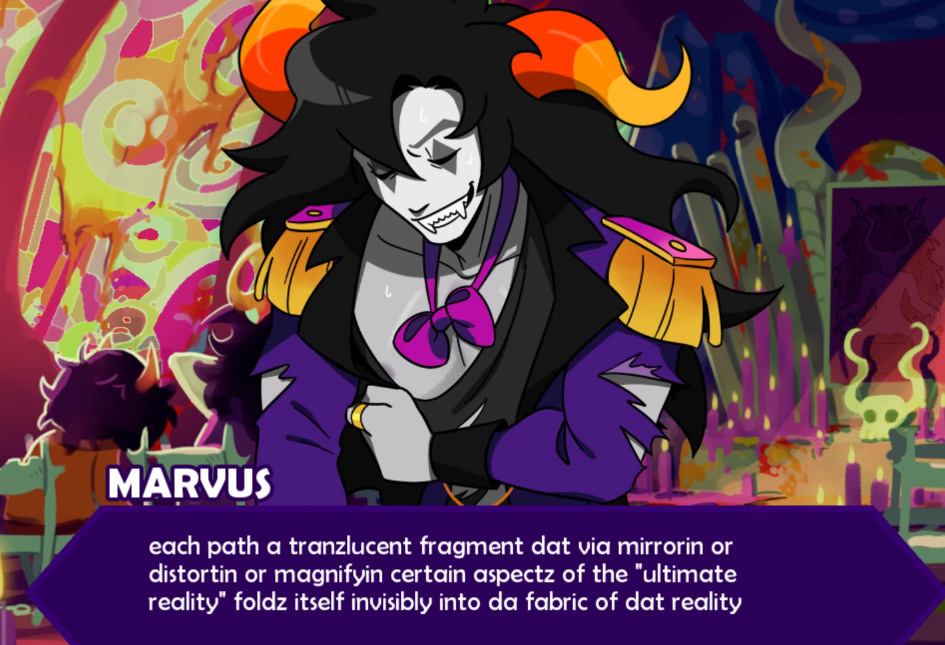
image

Mirroring, Distorting, Magnifying–these are all tools of theater, of jokes, of circus acts and the deliberate construction of art and narrative.

Marvus is suggesting that any individual timeline expands the meaning of Paradox Space as a whole by exaggerating, paralleling, or subverting different elements of how we see it, and putting new elements of each character and the setting into focus as a result.

image

And he argues that wearing down or violating continuity can itself bring that continuity into sharper focus. By “defiling” the story, its the shape of its integrity is further defined.

This is terribly exciting, because its basically Marvus straight up saying that plot holes and contrivances are another element of Homestuck’s story, and that is absolutely crucial to understanding how Lord English attacks the characters, the audience, and Homestuck itself.

Every little thing Gamzee does or manipulates others into doing that pisses us off and makes us further question whether Homestuck is worthwhile or a pile of dreck is being directly acknowledged here as explicit and intentional.

Hell, his actions have the exact payoff he claimed they would–we’ve fundamentally learned something new about the nature of Paradox Space because of what he’s done. It actually CAN come undone around the characters, provided they’re resistant enough to dying or dissapearing as a doomed timeline demands.

I previously believed that was impossible, and that timelines in Homestuck simply faded out naturally when players went to sleep instead–meaning there couldn’t be any Gamzees who didn’t go to sleep and merge with the Alpha iteration of the guy. That presumption is now in question.

At the same time, we can now be pretty sure that those hypothesized Schrodingers Gamzees out there never turned into horrorterrors, since we know what happens when someone resists the pull of a doomed timeline and it’s…not that. So that old bit of fanon is that much more questionable.

Now we have new questions, like: Why did this doomed timeline collapse so quickly, as opposed to say, Dave and Rose’s, which lasted four months? And so, through this singular violation of the rules of Doomed timelines, the grander design that informs them has come into sharper focus.

image

By far the most interesting thing he says though, is this. This is. A lot. let’s try to unpack it. Basically, he’s saying even an incident outside of canon contributes to a wider fandom metaconciousness.

So for example the Game Over timeline isn’t canon, but we still know that when Jake reaches full Hope power he can summon Brain Ghost Dirk, and that even after Dirk breaks up with him, Jake thinks of Dirk as his boyfriend. So that is meta knowledge that we all hold, even though it didn’t happen in the “canon” timeline. Alright. Simple enough.

But then he suggests that that metaconciousness is built by, and might even be defined primarily by, the various interpretations held by those who observe the event, and the discussion where they exchange those ideas afterwards.

In other words, what defines the metaconcious reality of Paradox Space is…us. The audience. And the various interpretations of meaning we derive from what we’re witnessing, whether canonical or non-canonical. We’re the ones who tie it all together, in our heads and through our conversations and relationships with each other.

The album’s lyrics describe the leader of the Carnival, who serves as
one of the judges of one’s soul in the afterlife, as being created from
the listener’s own evils.

When I read that, it reminded me of “The Ringmaster”, the juggalo Joker Card we’ve been associating with Marvus in my patron server. The juggalo card suggests that the leader of the carnival is created by “The listener’s own evils”, and in this context I think we can trade “listener” for “audience” and “evils” for general thoughts. Paradox Space as it exists in Homestuck/hiveswap is created by our thoughts.

But of course there is a bigger ringmaster than Marvus out there. Is it worthwhile to consider that the true judge of souls in Homestuck’s afterlife–Lord English–is born from our evils himself, in some way?

Dunno. It’s all a lot to think about. For now, this wraps up my discussion of Marvus’ extensive links to Rage, so join me next for a discussion on what I’m certain is his Class–Lord–and my personal guess at his Aspect–Blood.

PROTECT KARAKO oh also some lore thoughts i guess

oh no i love this tiny little clown boy ;_; hes so good. OK theres a lot to talk about so lets start. big time spoilers below

Classpect:

The bottom line is I tentatively agree with the take that Karako’s a Lord of Mind, though Page seems like a plausible runner-up guess. Lord makes a fair bit of sense to me. There’s some obvious connections–Karako somehow ended up with a gold tooth, mirroring Caliborn’s.

Karako’s most emphasized attribute is his youth, Caliborn is identified by his eternal immaturity, and Porky Minch and Bastian (the two characters who most seem to infliuence Caliborn’s Lord status) are also either defined by an inability to grow up, or deal with a possible failure to do so, respectively.

And Karako does seem to operate pretty much off instinct, much like Caliborn.
That the Reader is left to carry on his will to punish the
Horror-Terrors is particularly compelling–the Reader has to make the CHOICE (Mind) to follow Karako into death, and getting onto the carousel is their reward for doing so.

image

As an ask pointed out back when we were talking about Boldir, we might expect circles to pop up in relation to Lords as well as spirals, and indeed circles pop up with Karako in several ways. His symbol contains a circle, and the dog tag his symbol is printed on is a gold circle itself. @wakraya also pointed out the cans can be seen as Tallcircles which seems like a stretch but still, worth noting.

image

But the most interesting circle in the Sim is definitely the Carousel.
What we’ve got here is a circle, a wheel, that spins endlessly, always
pulling the horses that exist within it around and around. They’re bound
to the wheel, stuck in it.

Much like everyone who exists in the circle of LE’s causality.
I think this has its roots in LE’s nature as a Demiurge, and so a direct
offspring of “Abraxas”, the abstract God that we could see as Paradox
Space itself.

Abraxas is always depicted with twin snakes  pulling in different directions, and in this notable depiction, the snakes themselves are pulling/guiding horses along.

To me, this evokes Caliborn and Calliope exerting their twin influences on the narrative, with the horses representing individuals living under their influence.

Whether it’s a psychic projection of Karako’s or some kind of afterlife (and we’ll come back to that question soon), the Carousel seems like a pretty succint presentation of the Mirthful Messiah’s entire Lord English-centric religion.

We’ve got the conflicting tragic/comic masks, Gamzee raising Caliborn
(red sun, green background) and Callie (green sun, red background), and
of course a wheel/circle that many horses are bound to.

Its interesting to note that this makes it pretty clear that the Mirthful Messiah was a seperate and distinct figure from Callie and Caliborn in the cult’s doctrine–it is specifically Gamzee, not the cherubs or LE’s later incarnations.

image

Of course, Callie isn’t really being worshipped here–the carousel is an altar to  LE, not Abraxas.

Yaldabaoth was real big

on being known as the “one true god”, and being himself unaware of the
higher orders of God who created him. It’s unsurprising that his cult
would be lacking that higher-order imagery, and would place its highest
emphasis on the symbol of LE’s looping dominion.

The Dream version of the Dark Carnival that Meenah and (Vriska) visit in the dreambubbles is empty and lacks the historical frills describing Gamzee and Callie, but the religion’s most important symbol, the Circle/Carousel, remains. That’s the most prominent recurring memory.

image

(Aside: This might answer why horses are so ironic–horses bound/stuck to a wheel are a prominent symbol of LE’s dominance, and free horses running as they please are a suitable undermining of his symbolism.)

image

(Aside x2 combob: Akio Ohtori from Revolutionary Girl Utena is a Yaldabaoth figure quite similar to Caliborn, and his power/dominion too ends up being depicted through carousels. Chalk it up to shared gnostic symbolism I guess, but still, odd coincidence.)

Back to Karako.

Its worth noting that coming into conflict with highbloods/high
class members of troll society was one of the few things we were
expecting  from Karako-it fits the motif of his Joker Card–oh yeah, a
bunch of the purplebloods in Hiveswap seem to match Joker Cards from the
ICP’s albums in their designs:

image
image


The first Joker’s Card, Carnival of Carnage (1992), is a representation of the ghetto and the violence that occurs within.

It takes the form of a traveling carnival which doles out the same
brutality on those who have ignored the inner cities’ cries for help
. The Card issues a warning against the upper-class and government’s negligence toward the lower classes.”

So yeah. That line of inquiry seems to be checking out so far. Really there’s a bunch of parallels between Juggalore and the Mirthful Messiah cult/LE in general, but I happen to know someone else is working on that, so I’ll leave it there for now.

Now to what is to me, the most interesting part: the vision of the carousel itself.

There are two possibilities here, I think:

1) This is a psychic projection Karako’s putting out in his dying moments. Its a quick vision meant to provide some small moments of comfort before they die.

2) I think more likely, we’re getting a glimpse into how death works in Paradox Space, absent dreambubbles. It seems likely to me that this is a dark carnival afterlife created by the collective unconscious of Alternia and, specifically, it’s fervent cult of Mirthful Messiahs.

Karako was led to it because he’s part of the group that collective consciousness recognizes–ie: it’s likely a burgundy would be rejected as one who doesn’t belong, or led somewhere different in Alternia’s collective consciousness. The MSPA Reader was recognized because Karako recognized them, specifically, and was able to extend his afterlife’s promise to his friend.

Either way, we have no way to know and there’s more interesting questions.
I’m struck by the fact that considering this is a promised afterlife of spiritual fulfillment, the vision we see is distinctly non-spiritual--in fact, it’s deliberately artificial.

There are angels, but they’re mannequin props strung up by string. There are happy inhabitants, but they are also mannequins made of wood. It’s like a theatrical parody of an afterlife, depicting the physical presence of holy attendants and subjects, but not the spiritual/magical influence that makes them true.

Basically, it’s a very Rage-y afterlife–it’s theatrical, it’s artificial, and above all it’s physical, not spiritual or magical. It all reminds me very much of the concept of “Maya” from various Indian philosophies–including Hinduism, from which we got the name “Makara” for Gamzee.

How Maya is treated by different cultures varies, but the basic gist is of

a magical power of illusions, of creating real, physical/material things that don’t actually reflect spiritual reality. To quote wikipeds:

Māyā connotes a “magic show, an illusion where things appear to be present but are not what they seem”.


Māyā is also a spiritual concept connoting “that which exists, but is
constantly changing
and thus is spiritually unreal”, and the “power or
the principle that conceals the true character of spiritual reality”.

The thing is that according to this framework, basically all of physical existence, or at least quite a lot of it, is ultimately Maya and thus illusionary. Physical existence is might or might not be “real”, but it is constantly changing, and so does not reflect spiritual, eternal truth.

Māyā is the empirical reality that entangles consciousness. Māyā has the
power to create a bondage to the empirical world, preventing the
unveiling of the true, unitary Self—the Cosmic Spirit also known as
Brahman.

I’ve suspected for a long time that at its core, the nature of Chucklevoodoo/Rage powers stem from an ability to manipulate the experience of Maya.

Chucklevoodos employ illusions that are physically real (the Jack Noir doll in John’s room, or Dave’s dream copy of Lil Cal), and inspire people to be afraid/paranoid/angry–binding them to their physical experiences of the world.

Enlightenment in these Maya-centric frameworks generally means becoming one with these eternal principles of spiritual truth, and thus moving away from Maya/physical reality and the fear/confusion it produces.

So here’s the thing: That’s pretty much exactly what the MSPA Reader begins to experience after Karako is killed.

image

They come into awareness of the fact that everything they’ve been experiencing on Alternia, everything about Paradox Space, is kind of profoundly unreal.

image

Which it is! Because its just a story being told to us, the players. They seem to become very aware of this unreal/illusionary nature to their own existence and that of the world of the Friendsim.

And instead of continuing to treat it as real/something to be afraid of, the Reader chooses to stand up for moral virtues, generate them into the world themselves.

image

And as they move on from the illusionary world of Alternia, they’re rewarded by becoming aware of an eternal, universal, spiritual truth:

Friendship.

Of course, the MSPA Reader is still on their path. If they’re going to keep up this metatextual evolution and eventually reach enlightenment, coming to understand the true nature of their own existence, then there’s a lot more to learn. (Here’s hoping Lanque will teach them (and us) something about Astrology, Alchemy, and Aspects.)

What I’m wondering is, how much longer before they start becoming aware of the part of their reality that is well and truly outside of the visible realm? How much longer before the MSPA Reader becomes aware of us?

Do you think there are certain aspects ir classes that are more predisposed to roleplay another title?

I suspect Rage, as the aspect of theater and acting/performance, might lend itself to a sort of versatility by way of being able to efficiently, if not effectively, play at many different roles. I touched on this heavily in my writing/videos on Gamzee.

By contrast, I suspect Hope might lend itself to an unusual intensity in roleplaying that makes its players less efficient/versatile, but more potent/effective. Eridan’s power boost when he starts roleplaying a Witch or Jake’s power boost coinciding with summoning Dirk as a Witch’s familiar-esque figure are both examples I’d use here.

This probably sounds silly but I wanted to ask you of what’s the difference between Derse and the Rage aspect? Both are ruled with doubt and skepticism. And if that’s the case, what makes a prospit rage dreamer?

Derse is pretty strongly linked to Rage, but it’s also got strong links to Void, Doom, and Blood. It’s a society, so in general it incorporates all the Aspects, even if it’s cultural conciousness might favor some more than others. 

Gamzee was a Prospit rage dreamer, so we might look to him for clues.  Nihkee Moolah’s also Prospit+Rage, so she might give us more insight, too.

In general I’d expect a Prospit dreamer to tend towards being more passive, positive, and reactive to the world around them. They’ll think less about how they construct and present their personalities and be more inclined to go with the flow–though this depends on Class, too. Derse dreamers tend to be more methodical, intense, and self-directed by contrast.

https://www.patreon.com/optimisticDuelist

Hey guys! This time we look at some neat ways Gamzee might have used his Rage powers along the course of his arc, and some examples of what “Rage powers” might actually mean.

Today’s question is: Can you think of other ways Gamzee might’ve used his Rage powers?

Supereyepatchwolf on Wrestling: https://www.youtube.com/watch?v=BQCPj-bGYro

Find the music on Bandcamp!: 

https://homestuck.bandcamp.com/track/… 

https://homestuck.bandcamp.com/track/… https://spellmynamewithabang.bandcamp… 

https://homestuck.bandcamp.com/track/…

GAMZEE MIGHT MAKE SENSE ACTUALLY — – optimisticDuelist – Medium

Here’s the script version of the last two videos on Gamzee, btw, for anyone who prefers reading to watching stuff. Part 3 has its own script that Patrons have access to, I’ll post that later.

Needed to post this now since I’m writing something related I’ll be dropping soon, probably tonight. Stay tuned :o)

GAMZEE MIGHT MAKE SENSE ACTUALLY — – optimisticDuelist – Medium

spacekeiths:

whats-bronya-the-president-of:

Hm

Hm

Hm

Hm

Hm

Named after two flightless things with wings, but he’s Derse and Mind. What’s this guy’s deal..?

The desire for flight parses to me as a Breath motif, which would be the Aspect all bronzebloods are drawn to by their caste if @wakraya ‘s Troll Sign Caste theory is correct.

Dammek himself exhibits some strong Breath imagery despite being Bloodbound–the hoverpad he steals from Xefros has a breath blue beam, for example.

So this reference feels like it’s along the same lines of Chahut Maenad’s last name, which is a reference to the worship of Dionysus, even though she’s a Hope player.

Their names and aesthetics seem to reflect the Aspect/mythology that Alternian society pressures them into, as much as their own True Sign aspects.

threedogs-toaster replied to your post “im fuckin agog at the fact that Rage might now be my favorite aspect…”

Yo real talk I’m fascinated by my opposin aspect, which is Blood. I tend to find that understandin your opposite aspect helps you understand why you’re so drawn to your own aspect 😀

yeah!! like im bein a bit facetious but honestly im just floored, i literally feel like understanding Rage through this new lens has sorta helped me understand my own relationship to the world better which has been bizarre but really really cool

This time we dig into Gamzee’s recurring links to the masks of Comedy and Tragedy, historical worship of the Greek god of Theatre, Dionysus, and what all of this tells us about Gamzee’s arc and, potentially, even the Rage aspect.

Today’s question is: Can you think of other trolls with strong ties to figures in Greecoroman/Egyptian/Judeo-Christian mythologies?

You can find links to sources & support the project at:
https://www.patreon.com/optimisticDuelist

Find the music on bandcamp!

Purple Bard: https://homestuck.bandcamp.com/track/…
Apocryphal Antithesis: https://homestuck.bandcamp.com/track/…
Entangled with the Void: https://spellmynamewithabang.bandcamp…

Fanart source: Ikimaru http://ikimaru.tumblr.com

More on Theater @ Crash Course: https://www.youtube.com/watch?v=VeTeK…

https://www.patreon.com/optimisticDuelist
[The script for this 3-Part Video Series is available to Patrons now.]

I didn’t plan for this, you gotta believe me. The Homestuck thoughts converged on me late in the night, beat me up and MADE me make you start watching what’s now at least a trilogy of videos on Gamzee Makara–often described as the worst character in Homestuck. I’m sorry.

…But is he? A combination of new insights from the fandom and lore details revealed through Hiveswap have left me wondering if, perhaps, this lousy purple clown may have hidden depths after all. I found the questions so exciting, I literally couldn’t resist the impulse to drop everything else I’m working on to share them with you. You’re welcome.

I wanna do something a little different, so I’m going to include a question of the day for each video from now on. Answer it, and you might have higher odds of eventually being featured in a comments response, whenever and however I bring those out for you guys.

This week’s question is simple:
What do you think the relationship between Lil Cal and Gamzee is like?

If you’d like some other perspectives on Gamzee to work off, here’s some of the works that inspired this one:

Tex Talks’ case for Gamzee, Rage, and Plot Contrivance: https://www.youtube.com/watch?v=4H7m2…

Oscar @problematwink‘s (200 Page!) Essay on Gamzee’s character arc: https://problematwink.tumblr.com/post…

My prior biggest post on Gamzee (now somewhat outdated): https://revolutionaryduelist.tumblr.c…

I don’t necessarily agree with the exact points raised in any work I link (including my own), but you might find such work useful in responding.

Hope they help! Feel free to respond here, on Patreon, or at:
https://twitter.com/RoseOfNobility
https://revolutionaryduelist.tumblr.com/

Find the music on Bandcamp!:
“Soft Happy Pal”, https://spellmynamewithabang.bandcamp…

“Purple Tyrant”, https://homestuck.bandcamp.com/track/…

“Midnight Calliope”, https://homestuck.bandcamp.com/track/…

“Blackest Heart (With Honks)”, https://homestuck.bandcamp.com/track/…

“Scratch”, https://homestuck.bandcamp.com/track/…